




Abstract
Through ethnographic fieldwork as a Teaching Assistant (TA) at the University of California, Berkeley, I advance that pedagogical labor can be conceptualized as two labor games. In the didactic game, I utilize hierarchical lecturing to simplify complex concepts in the pursuit of student comprehension of material, while the experiential game centers nonhierarchical dialogue and students’ personal experiences to promote consciousness-raising. TAs’ ability to create and switch between games underpins my broader theorization of labor games as one of two types: institutional games – shared among workers in similar structural circumstances and persistent across worker entry and exit – and innovation games – created by individual workers with relative autonomy amidst an absence of worker co-presence. Just as institutional games provide a template for obscuring and securing the extraction of surplus value under monopoly capitalism, innovation games do the same for the increasingly flexible, autonomous capitalism of the twenty-first century.
As many educators know, teaching Marx's Capital can feel like wrangling an unruly beast. Such a dense, conceptually-rich piece provides little help for pedagogues trying to tame the tome for their students, something I vividly realized as a Teaching Assistant (TA) throughout the COVID-19 pandemic. On one hand, I wanted my students to understand concepts like surplus-value; on the other I thought it was just as valuable to help them see how these concepts constantly shaped their day-to-day experiences. Professor Smith, 1 the instructor I taught under, had provided little guidance on pedagogical strategies (stemming from their open trust in TAs’ ability to lead classrooms on their own), leaving me with quite a few decisions to make as I took the reins.
At this point in the class, my students had been sharing – as they do every semester – how stretched thin their time was; how burned out they were; how family and work made it nearly impossible to keep up with readings (see Torres Carpio, this issue). It was easy to empathize with them as their stressors were shockingly in line with my own when I was also an undergraduate at U.C. Berkeley. To try and ease these burdens, my first go at teaching Capital heavily used lecturing to make the content as straightforward and accessible as possible. I filled a slide deck with succinct explanations of commodity fetishism and exchange-value and used it to talk with (or, more aptly, at) my students for all 50 minutes of our first class. Thankfully, this seemed to help them grasp many of Marx's more confusing concepts; a few students credited this lecture as why they did well on their subsequent assignment.
As pleased as I was, I still felt an urge to see my students use their fledgling knowledge of Capital to better understand their lived experiences. For our second day, I threw out my lecturing playbook and instead facilitated a long discussion to explore the unpaid labor they do as students. After sharing our experiences and anxieties with common undergraduate experiences like unpaid internships and research positions, Jason – a junior juggling multiple majors – captured the rest of the class's thoughts after we collectively reimagined parts of college as (potentially exploitative) labor: “Woah, I had never thought about school that way”. I was elated to hear how some of my students tweaked their routines after this section, sharing how they refused to pull an all-nighter before a big test to protect their sleep or started spending more time with hobbies they found fulfilling. Hearing this was encouraging and pushed me to strive for similar outcomes in future classes.
Teaching my students about their labor processes sparked me to think about my own, specifically how navigating these varied pedagogical approaches were equivalent to playing labor games. Popularized by Michael Burawoy in his shop floor ethnography of a manufacturing plant (1979), labor games refer to sets of rules, strategies, intended outcomes, and rewards that workers utilize to cope with and extract rewards from their work. Like their more athletic counterparts, labor games’ rules are fixed for a specific labor process, with players (i.e., workers) pursuing winning strategies and the various rewards (monetary or otherwise) accompanying them. Game-playing workers possess enough autonomy to be able to strategize actions within the game. Uncertainty is also built into these positions; if the outcome of an action was guaranteed, there would be no chance to strategize ways to maximize potential rewards. Workers exert great effort to achieve these rewards, thereby “obscuring and securing” the extraction of surplus value for employers while individualizing the successes and failures they experience on the job (Burawoy, 1979, p. 30).
Whether in bustling casinos (Sallaz, 2002) or at concierge desks (Sherman, 2007), prior literature typically describes labor games as pre-existing and collective. When a new employee enters the workplace, they find their veteran coworkers already playing these games and learn the rules from them over time. As the burgeoning literature on the gig economy has shown, even workers physically separated from each other engage in game-playing (Cameron, 2021; Griesbach et al., 2019; Manriquez, 2019; Roy, 1959), although many still seek out those in similar jobs to learn how to improve their odds at winning (Vasudevan & Chan, 2022).
Yet as I began teaching, I noticed how my fellow TAs had little influence over the way I ran my classroom – none of us ever witnessed each other teaching and rarely did we collectively discuss our pedagogical strategies (see Eby, this issue). Since every course is made anew each semester, no pre-existing, collective games were available for me to learn and play when I started teaching. Of course, this did not mean that I could do anything I wanted; the faculty I worked under (Pasquinelli, this issue), the different students I taught (Torres Carpio, this issue), and my research obligations (Gepts, this issue) constrained the strategies I could use while still leaving me with a substantial core of discretion. With autonomy over my classroom, an absence of pre-existing labor games, and a spattering of pedagogical principles I valued, I found myself creating multiple labor games rather than simply inheriting them. On top of my efforts to gradually establish these games’ rules and winning strategies over time, part of my day-to-day work was playing what I call the game of games: selecting which labor game to play at which time, for which purpose.
This raises two relevant questions for labor sociology, which has theorized labor games as relatively undifferentiated and devoted little attention to the mechanism of individual workers creating labor games. First, how do TAs utilize their relative autonomy to construct meaning and extract rewards from their labor? Second, to what extent does this influence their engagement with work amidst the increasingly flexible and autonomous capitalism of the twenty-first century?
I argue that two types of labor games exist, with a worker's degree of individual autonomy and co-presence with other workers mediating their ability to play games of each type. Workers can play institutional games when they possess enough autonomy to strategize their labor process in the pursuit of rewards and do so via significant interaction with fellow workers. Burawoy's machinists (1979), Sharone's software engineers (2006), and Sherman's concierges (2007) all play institutional games, which prior literature has focused most of its analysis upon. Workers share rules and strategies with each other, leading those in similar positions to play similar, if not the same, labor games. Innovation games, on the other hand, are games created by individual workers and tailored to their individual labor process. Workers are better able to create innovation games when they have relatively greater autonomy over their work and limited interaction with fellow workers. Rather than learning about pre-existing rules, strategies, and rewards, workers playing innovation games create their own.
Institutional and innovation games encourage workers to consent to the exploitation embedded within wage labor by providing them the opportunity to inject meaning into and extract rewards from their work (Burawoy, 1979). Yet by enabling workers to continuously and flexibly shape their labor process in ways that feel distinctly rewarding to them, innovation games allow workers to establish a stronger fit between their job position, individual orientation to work, and relations with coworkers and management. Innovation games unlock the opportunity to create, modify, and switch between games (i.e., to play the game of games). The mechanics of game creation and game switching help workers “enchant” their labor (Endrissat et al., 2015) in ways typically unseen within institutional games, making resistance against management, reduction of effort, or the withdrawal of consent less desirable options when rewards are not received.
Playing to Win: The Rules and Rewards of Labor Games
Typically, interacting with fellow workers helps spread the rules, strategies, and potential rewards of the game(s) within a workplace. For instance, when new call center attendants have trouble inputting caller information on a complex technological interface, they learn which keys to use and which information to prioritize (i.e., winning strategies) from their more senior colleagues (Sallaz, 2015). While the immediate presence of coworkers makes it easier to learn games’ rules and strategies, individual workers also play labor games in relative isolation (Roy, 1959). A resurgence of attention to gig work has made this clear as workers flock to Uber and DoorDash, lured by the promise of greater autonomy and flexibility than traditional employment (Hall & Krueger, 2018; Milkman et al., 2021). Without direct supervision and worker co-presence, independent contractors may utilize strategies to increase their take-home pay, connect with other people, and garner insight into their job performance (Cameron, 2021; Rahman, 2021).
Labor games incentivize workers to devote greater effort to their work (Sallaz, 2015). The uncertain potential to gain rewards makes one's labor an engaging game of decision-making and risk. Labor games help workers cope with the dreariness of work by providing additional tips (Sherman, 2007), a sense of achievement or cultural contribution (Roy, 1959; Sharone, 2006), or even a sense of comfort from a non-troublesome conversation (Sallaz, 2015) as the light at the end of the workday's tunnel. Coupled with how a high level of autonomy also pushes workers to work harder, for longer (Occhiuto, 2017; Snyder, 2016), labor games encourage workers to become absorbed into their job (Burawoy, 1979).
By aligning workers’ interests with their manager's – both want the worker to work harder, just for different reasons – “absorption” is a key mechanism ensuring workers continue participating in their own exploitation while disguising the fact that they are being exploited (Burawoy, 1979; Sharone, 2014). As creativity, flexibility, and autonomy become core components of capitalism in the twenty-first century (Boltanski & Chiapello, 2005; Florida, 2012), these same features enable workers to “enchant” the work they do by injecting personalized meaning into it (Endrissat et al., 2015; Frenette & Ocejo, 2018). Enchantment facilitates meaning-making by capturing workers’ attention and funneling it towards the valued aspects of their job. When workers focus more on utilizing their autonomy to make their work more rewarding (in ways that feel tailored to them, rather than others), worker-management conflict tends to become displaced and ignored, either quelling conflict entirely or shifting it horizontally between workers.
If autonomy and uncertainty are core conditions for labor games to emerge, then the TA's labor process is a fitting case study. The uncertainty baked into the TA's labor process stems primarily from their students, similar to the uncertainty customers bring into the service sector (Lopez, 2010; Sherman, 2007). TAs also possess significant autonomy. Course syllabi and grading requirements are generally out of their control, but the ways in which TAs teach, the content they want to cover each day, and their pedagogical goals are often completely up to them.
TAs tend to work on an individual basis, relatively isolated from their coworkers. Aside from the occasional chat about how teaching is going, rarely did other TAs’ teaching strategies affect my own. Many academics often keep quiet about their teaching, turning one's classroom into a black box (Eby, this issue; Gill, 2009). The sizable turnover in the TA position and the fact that TAs do not know which class they will be teaching or who their coworkers will be until a month before the semester exacerbates the absence of sustained co-presence with fellow workers. Unlike working on the shop floor, even as TAs may commiserate over the difficulties of grading or occasionally ask for lesson plan ideas, they are isolated from each other while actively performing their labor. This, in turn, helps preserve TAs’ high degree of autonomy.
These structural circumstances – relative autonomy coupled with an absence of worker co-presence while on the job – hinder the potential for workers to facilitate the spread of, and perpetuate, labor games. As a TA, I found myself utilizing this significant discretion to create my own labor games. With the ability to select the pedagogical methods one follows (i.e., rules and strategies), what those methods are intended to do for students (i.e., outcomes), and how such actions provide benefits to the TA themselves (i.e., rewards), the innovation games I created were tailored to what I wanted to get out of my work. If these desires change or strategies prove to be unreliable, workers playing innovation games possess the autonomy to change or switch between games to continually receive rewards.
What rewards did I look for in my own classroom? Thrust into teaching during the second year of my PhD program, my own experience as a Berkeley undergraduate was key to how I developed my approaches to teaching sociological theory. To my displeasure, a connection between theory and real-world experience was something I rarely encountered during my own undergraduate education in the history department. Growing up in a working-class home, my single mother's three part-time jobs and SNAP benefits had been the only way I could become the first in my family to attend a four-year university. Academic success felt like the only rung on the ladder of social mobility I could reach, although needing to work 25 hours a week throughout college made it difficult to do anything beyond trying to get the highest grades I could to secure a sense of financial security after graduation. What I did not have was an opportunity to explore how what I learned could reframe my worldview, and my own TAs’ sole focus on whatever assignment was coming next only exacerbated this frustration.
When I became a TA myself – finding sparse assistance from the university on how to create a more liberatory form of education – ensuring my students could have chances I did not was at the top of my mind. For this approach, the educational models of Brazilian critical educator Paulo Freire (1970) seemed to be a perfect fit. In an attempt to make education a consciousness-raising tool, Freire advanced a problem-posing model of education where students utilize nonhierarchical dialogue to explore themes relevant to their personal experiences. Freire, along with Freirean educators from Western education systems, highlighted its importance by comparing it to the more traditional “banking” model: the mainstream framework of education consisting of an authoritative teacher lecturing at students, constraining their agency and establishing a vision of the world as static and unchanging (Freire, 1970; hooks, 1994; Wallerstein, 1987).
These models helped inspire two distinct innovation games that shaped my labor process in different ways across my budding pedagogical career. While the organization of the American university makes it difficult to adapt Freire's models with complete fidelity – part of the problem-posing model requires spending weeks living in students’ communities, unfeasible for a TA – the principles behind his problem-posing and banking models informed how I crafted the rules, strategies, intended outcomes, and rewards of the two innovation games shaping my labor: the experiential and didactic games, respectively.
Labor games tend to be composed of four primary dimensions: the rules enabling them to be played in a specific workplace setting, the strategies players use to win given the rules, the outcomes workers strive for, and the rewards they end up receiving (Sallaz, 2015; Sharone, 2006; Sherman, 2007). Each game's rules create different conditions for strategizing. While the experiential game's rules and goals aim to promote conscientização via nonhierarchical dialogue and students’ personal experiences, the didactic game emphasizes lecturing as a method to simplify complex topics and capture student engagement (see Table 1). Laborizing Freire's vision of critical education not only provides insight into how these models fit within the American higher education system, but also into how workers create innovation games and select which ones to play at which time.
Rules, Strategies, Intended Outcomes, and Rewards of Two Innovation Games.
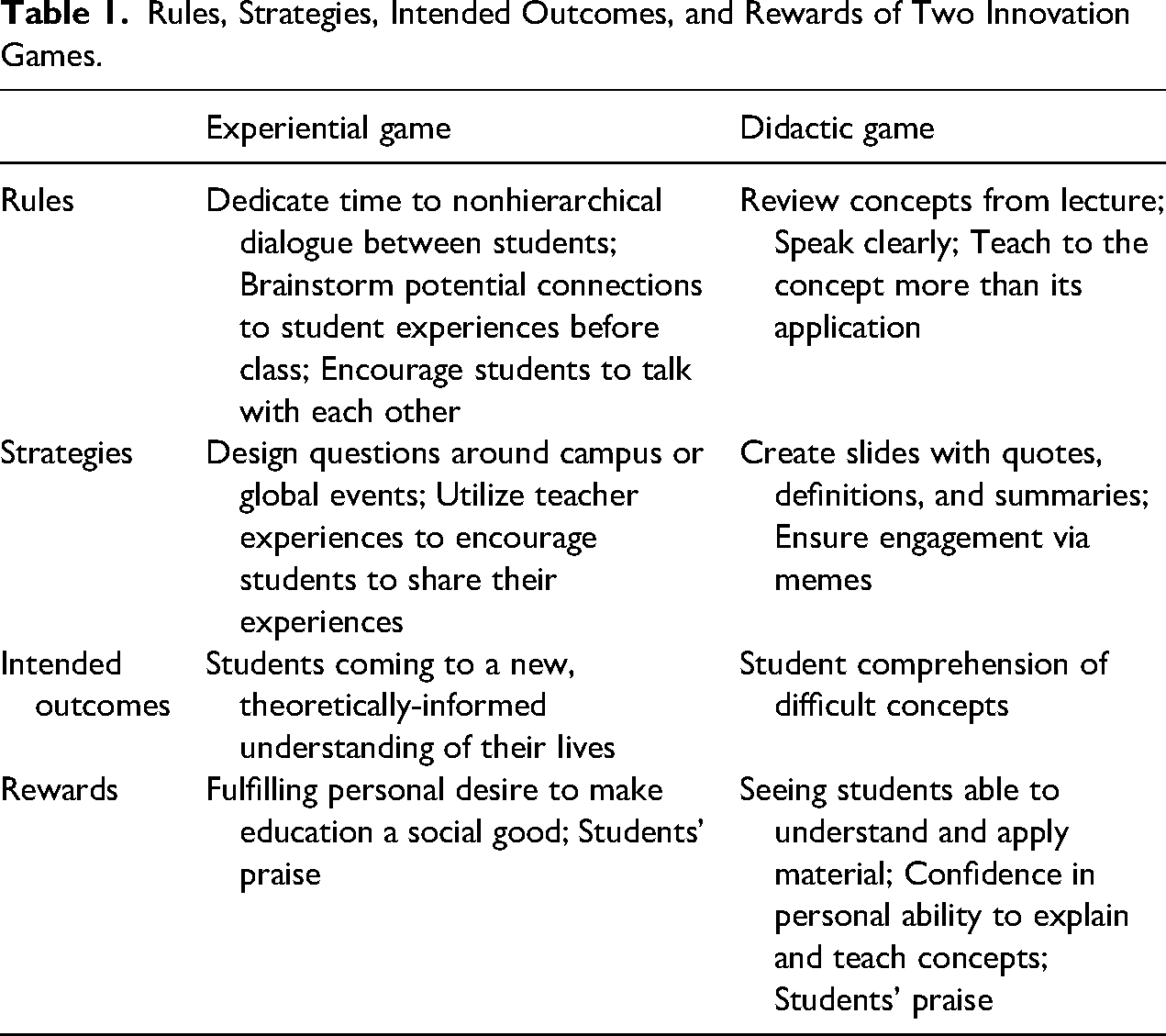
The remainder of this article will explore the genesis of these two innovation games through my IRB-approved ethnographic fieldwork – informed by the extended case method (Burawoy, 1998) and observant participation (Seim, 2021) – as a TA across multiple undergraduate sociology courses. I begin by showing how I gradually developed one innovation game, informed by Freire's problem-posing model of education. Next, I detail how both winning and losing this labor game, as well as my creation of a second innovation game, stimulated me to work harder. Third, I examine how playing the game of games became a key part of my day-to-day work and acted as the main mechanism in which I enchanted my labor, disguising the exploitation that the university benefited from. Finally, I conclude with a discussion of the implications of theorizing labor games as one of two types, and how the ability to create and switch between games upheld my subjective experience of autonomy.
How to Win the Experiential Game
I felt pulled to Freire's problem-posing model when I became a TA since I believed sociology was a discipline well-suited to illuminating theory by drawing from personal experience. Therefore, one of the primary aims of my first few weeks teaching was to help orient my students towards understanding the social structures at play within the specific, social-historical context they were living in. Per Freire's inspiration, relying on my students’ experiences would be just as important as the readings we would be covering.
My drive to be a Freirean educator was not immediately successful, however. Many of my initial attempts at encouraging my students’ conscientização (Freire, 1970) through group dialogue led to prolonged silences and loose connections to the material we were discussing. The fact that I began teaching as the COVID-19 pandemic began to wane likely holds some of the blame for my students’ reticence to speak; many told me one-on-one that they were simply too burned out or anxious to participate as much as they wanted to. At the same time, the manner in which I facilitated these discussions was quite different from how Freire mediated his own. Many of the questions I asked my students – “Is there anything we’ve talked about that resonates with your lives?”; “Does this make sense to you given what you’ve experienced in college?” – were either too broad to encourage discussion or used my students’ lives as mere examples of theoretical concepts rather than conduits to arrive at them. As a result, only a few students spoke, and those who did usually responded directly to me rather than talking with each other.
Not wanting to give Freire up, I changed my tactics. I first decided to conduct more preparatory work while lesson planning, such as brainstorming potential seeds of connection between my students’ experiences and the material. 2 Since I did not have the time or ability to interact greatly with students before the semester began (as Freire advocated), I relied heavily on the fact that I had also been an undergraduate student at the university I was now teaching for, sharing many of the academic and personal qualms my students faced. I could not finalize these seeds of connection (i.e., main discussion threads) during this preparatory phase, as my role in the classroom was a facilitator, not a dictator. Once I created these potential themes, I started writing down detailed discussion questions that could assist my students in making these connections for themselves. Second, I tried taking even more of an observational role during our subsequent discussions. While I was still a central figure in these discussions, I was not there to force students to talk about certain things in certain ways. Instead, I aimed to see where students were taking the conversation, nudge them towards potential themes, and get them to talk with each other.
My first implementation of this new-and-improved discussion format came when the faculty member teaching the course assigned a reading presenting a striking account of young adults’ struggles to achieve a sense of adulthood in the face of job instability and neoliberal policies. As many of my students were concerned about their levels of independence or future career prospects, I thought it would be fitting to locate many of the author's arguments within their recent experiences.
“Who here sees themselves as an adult?” I asked my students abruptly. Given their reactions, the mere thought of being an adult was laughable. Emmie said how she's “still a child,” while Chris questioned whether “people ever really grow up” at all these days. Not everybody felt this way though; Stephen said he was an adult because he was living on his own and had responsibility over his daily decisions (or as he put it, “when to get my hair cut”).
I spent the next half hour helping my students explore why they felt this way, with most connecting their thoughts to self-sufficiency. Christina summed this up well, imagining that she would have to “redefine the standards of what it means to become an adult” since independence seemed out of the question for some time amidst her economic precarity. After facilitating these conversations, it was here that I started to nudge the class back towards the reading, foreshadowing a connection to the argument the author was making about neoliberalism.
Although my nudge to return to the material was more direct than I had wanted, my students took off with it, quickly arriving at their overarching claim about how people have been unable to rely on social institutions for achieving milestones of adulthood the way they did decades ago. By the end of class, my students were shocked: Lilith was “heartbroken” while Chris felt “scammed” by society for making him feel about himself this way. I was ecstatic we had reached this point, as my students had arrived at the reading's main points by using their lives as the primary source for dialogue. Not only could I feel how different this discussion was from my previous ones, but my students made it clear too. As class ended, many left with profuse thanks and remarks about having new existential crises about their future. It did not take long for me to look at the syllabus to see when I could hold another one of these discussions.
What began as a losing struggle to get my students to speak transformed – after a series of self-initiated changes in my labor process – into the first iteration of what I coined the experiential game. Figuring out the type of pedagogy that worked best in my classroom can be reframed as my attempt to create the rules and strategies of a labor game specific to my individual labor process. Brainstorming potential connections with student experiences before class and facilitating discussion without dominating the conversation act as rules of the game, ones I must follow to attain its rewards.
Given these base rules, future iterations of the experiential game revealed some of its most reliable and successful strategies. When creating potential seeds of connection between the material and my students’ experiences, for instance, one strategy I developed was to incorporate relevant current events. I found that integrating discussion about student protests, changes in campus policies, or broader global trends to be especially helpful for getting my students to speak, especially with one another as they all have a shared general awareness of these moments.
Rewards come in multiple forms when playing the experiential game. First, seeing my students view their nascent adulthood contextualized within the neoliberal world aligned with my desire to promote Freire's conscientização. On a smaller scale, receiving praise from my students after the class ended was similarly rewarding, echoing Jeffrey Sallaz's argument that successful social interactions are rewarding enough to stimulate workers’ continued playing of labor games (2015). As demanding as it was getting to this point, receiving these rewards made teaching feel like a fulfilling position that could support my creativity and agency.
Win or Lose, the Game Keeps Being Played
Further confirmation of my Freire-inspired pedagogical approach as a distinct innovation game comes from when I failed to abide by the rules of the game I created. Midway through one semester – as both my students and myself were burned out, eager for the holiday break – I prepared to teach W.E.B. Du Bois’ famed The Souls of Black Folk and “The Souls of White Folk”. I had been looking forward to this class, as these were some of the more vibrant, and theoretically groundbreaking, selections from the syllabus. Yet I was also in the midst of grading 40 midterms and helping students who were struggling to make use of the university's sparse basic needs and mental health services (see Torres Carpio, this issue). This, as my field notes revealed, left me little time to devote to class preparation: “It's 8:00 am and I have not finished the readings for this week nor have I created any sort of lesson plan, even though I teach in four hours. I quickly skimmed through “The Souls of White Folk” as I was able to finish The Souls of Black Folk yesterday. I decided to make today's section fully dialogue-based, although I still had to come up with questions to ask. Since I did not have time to think of anything super detailed…I finished creating questions and pulling out relevant quotes I can mention in about forty-five minutes, with just enough time to shower and watch the lecture online before heading to campus to teach.”
Even before class had begun, the differences between this preparatory labor and that of my aforementioned “successful” discussion are stark. I wanted to conduct this lesson per the rules of the experiential game, yet I ended up breaking them. My students’ experience was far from central in this hastily constructed lesson; I crafted some questions about how Du Bois is relevant in the twenty-first century, but did not make my students’ lives the conduit to arrive at these ideas. I also did not plan out any seeds of connection between the readings and my students, instead creating questions focusing squarely on the material itself. The impact of this on the class was quickly apparent: “I started by asking how everybody is doing and nobody said anything; I saw a nod here and a thumbs up there…I introduced the readings and noted how they are some of the most famous pieces of Du Bois. I then brought up one of the opening quotes he uses and asked what his use of this specific language enables him to do argumentatively throughout the rest of the piece. Then proceeded one of the longest, most awkward silences I have ever experienced….After asking the question again and encouraging them to respond, I just said ‘okay, I get it, we’re all tired, no worries’ and a handful of people laughed. The rest of the section had relatively few people speaking outside of myself, which was odd as I expected people to be really engaged in these readings. The discussion picked up a bit more in the last fifteen minutes when we drew connections to today's society.”
The experiential game implies that when I play it successfully, students will leave class with some newfound sense of awareness about their place within the world. As I packed up my laptop, it was clear this was not the case. Most of the class had been a series of awkward silences (notably rare compared to other sections where we explored issues of race and inequality), which I tried to fill by essentially answering the questions I raised. On one hand, my students’ own reticence to participate captures much of the uncertainty embedded in the labor process of teaching; even if a class is aligned with the rules of the game, student behavior may mediate strategies’ effectiveness. Yet on the other hand, it became clear that the questions I crafted were not designed to stimulate dialogue; rather, they were meant to identify and explain concepts from the text, leaving little room for students to talk with each other. As a result, I did not receive the pedagogical rewards outlined in my game, nor any noticeable praise from my students. Notably, losing the experiential game made me want to win again as soon as possible: “My feelings of guilt around playing the game this way make me want to work harder. I’m already thinking about how I can create an engaging practice activity for next Tuesday, since their next assignment is due two days after…Even though I know I am burned out, I do not want to feel these work-related feelings of guilt due to my lack of preparation, so therefore the solution is to trudge on through the exhaustion and work harder.”
When I won the experiential game by playing by its rules, I left with a drive to win the game again. In turn, this meant devoting greater amounts of effort into the game, and subsequently, my work. Interestingly, I experienced the same push to work harder when I “lost” the experiential game. I wanted to alleviate the sense of guilt I felt by thinking I disappointed my students and achieve the array of rewards I had once earned. Like a long stint at the poker table, each class was a new hand; if I was to win (or if I wanted to recoup my losses) I had to bet big and bet often.
Many factors contributed to this loss of the experiential game – the lack of time I had to perform the requisite preparatory labor, my students’ ability to engage with the material and discussion – and yet my initial response was to place my game-playing at fault, rather than the structural circumstances underpinning my labor. I could have, for example, attempted to speak with Professor Smith (the faculty member teaching the course) about modifying the syllabus to alleviate the reading load I had to perform, but instead I changed my strategies around playing the game by devoting greater time to preparatory labor and introducing more of my own personal experiences to encourage my students to share their own. In other words, I displaced the potential for self-initiated or collective resistance against the structural conditions behind TA labor by getting sucked into the labor game I created. Yet at the same time, the longer I taught the more I realized how the experiential game alone was insufficiently rewarding for my labor process.
Creating the Didactic Game
As effective as the experiential game can be at helping students gain critical awareness (when played by the rules), it struggles at simplifying complex theories and concepts. The experiential game can still promote comprehension of material, but its pedagogical format is better suited for exploration and real-world application. Emma and Olivia, two of my most participatory students, would mention during my weekly Office Hours that our dialogue-heavy classes were illuminating and insightful, but some straightforward review of topics would be helpful as an additional supplement. This aligned with some of my struggles with the experiential game; sometimes the material would simply be hard to discuss because the concepts were too unwieldy or connections with my students’ lives seemed tenuous.
Brainstorming potential solutions brought me to an unexpected place: Freire's maligned banking model of education. Quite opposed to the experiential game which had been my default pedagogical template, the banking model's relatively authoritative lecturing did little to promote students being active participants in their education. This, however, was also its distinct benefit, as it excels at taking hard-to-understand material and clarifying its core insights. If this is what both I and my students were looking for, it was worth testing. Instead of devoting my lesson planning to how the material connects to my students’ lives, I started spending most of my preparatory labor reviewing and selecting core concepts from texts, translating them into more approachable language, and creating slides with bullet points and relevant quotes.
Yet like my early dialogue-based classes, my first attempts at “banking” were far from stellar. My students appreciated the slides as study resources but were less enthusiastic about the lecture-heavy style during the class itself. The main issue appeared to be a lack of engagement. In my earliest days of remote teaching, my classes primarily consisted of a few students with their cameras on, nodding sporadically, and about fifteen blank screens, making it difficult to know whether the way I explained the material made sense. Similar issues occurred while teaching in-person when students began nodding off during class or participated less as mid-semester burnout emerged. The opportunity to identify whether my teaching was effective at its intended outcome of clarifying concepts felt nearly impossible to grasp, and it consistently made me want to creep back towards the experiential game I had already created and become comfortable with. Instead of abandoning this pedagogical style entirely, I tried a new strategy to help me identify whether my students were understanding the material and capture their attention throughout the whole class, not just at the start or end. To do this I started incorporating sociological memes I created into the slides accompanying my banking lectures. I suspected that presenting some concepts in this way would serve a dual purpose: incentivize my students to pay attention to the material, and distill complex themes into a more concise, understandable, and (hopefully) humorous medium.
With this, the didactic game was born. My students, as one of my end-of-the-semester student evaluations summarized, thought the “memes were amusing and useful in understanding materials”. As I became more consistent at incorporating these memes, my students’ engagement became more consistent as well. I decided to place them at points within my slides where I would check for any confusion, which led students to share that they enjoyed the memes or ask a relevant question. From here I had an easier time uncovering whether my students were on the right track and, if they were not, helping them onto it.
Restrategizing my labor process by devoting preparatory labor to sociological meme-making was essential to achieving the didactic game's rewards, whether it was seeing my students comprehend dense theoretical concepts or their appreciation of my ability to explain such concepts (via the memes and general lecturing). Many of my students regularly expressed how their breadth of academic and personal obligations made them too burned out to deeply engage with material, so my lectures helped deliver that information in a more accessible manner. Not only was helping to ease that burden for them a reward in itself, it also revealed how lecturing (or “banking” in Freirean terms) was, surprisingly, a tool to help my students have more time and mental capacity to engage with other aspects of their work, including our more dialogue-oriented plays of the experiential game. The didactic game, when used in this way, gave my students the space they needed to engage with education as a social good.
Just like with the experiential game, my (eventually) successful implementation of the didactic game stimulated me to work harder. Creating sociological memes twice a week is not a significantly daunting task, but it comprises a substantial amount of time in aggregate across months of teaching. Without them, however, I know it would be more difficult to capture my students’ attention and, consequently, gain the rewards from another game victory.
Metagaming: Game Creation, Game Switching, and Enchantment
Innovation games unlock a new mechanic of labor games less readily available in their institutional counterparts: the game of games. Rather than simply playing, the game of games injects two additional dimensions into workers’ labor processes: game creation and game switching. Each provides the worker an avenue to actively establish a better fit between the structural circumstances underpinning their work and the rewards they want to earn.
The sections above detail how the act of game creation composed a great deal of my TA labor. Not only was I focused on my in-the-moment teaching performance, but also on discovering and crafting the guidelines I believed I needed to follow to make my pedagogy worthwhile. Creating the experiential and didactic games was not a quick or deliberate process either; it was gradual and riddled with losses. Much of my day-to-day routine became an effort to figure out how to avoid losses by establishing each game's rules and strategies until they started consistently providing the rewards I sought.
Game switching, or the selection of which innovation games I aimed to utilize each time I started lesson planning, therefore became an additional facet of my labor process. As the opening vignette shows, I selected which games I wanted to play on each day I covered Capital with my students, deciding to play the didactic game first to ensure they understood the major concepts at play before implementing the experiential game to help unearth my students’ personal connections to Marx's theories.
As parts of the labor process, game creation and game switching exacerbate workers’ absorption into their work by making labor games more flexible and adaptable to workers and their environment. Creating rules and strategizing my pedagogical approaches felt less like an add-on to some underlying TA labor process and more like a core component of the job. Not only did I become enraptured by playing the two games I created, I also captivated myself by selecting which game I would play next or deciding whether to test a new strategy. This, in turn, made the withdrawal of consent to my labor process far less appealing. When I encountered an unsatisfying class or became frustrated with the course structure, my path of least resistance was diving back into the game of games rather than devoting less effort or raising concerns with the instructor or university. The more that TAs focus on maximizing the rewards they gain from teaching, the less they may focus on demanding higher pay and better working conditions from the university administration.
Interestingly, as much as I felt like the games I created were unique to me and my orientation towards work and education, the pedagogical approaches they entailed – lecturing and nonhierarchical discussion – are far from idiosyncratic and dovetail with teaching strategies I consistently observed in my own undergraduate career. The personalized fit of my two labor games was illusory, disguising the influence of the structural circumstances framing my labor process, as labor games have been known to do for quite some time.
Aside from this illusion of uniqueness, it was not until revising this article did I realize I had also been hypnotized (or, perhaps, hypnotized myself) into thinking my autonomy was far less constrained than it was in reality. As others in this special issue vividly show, constraints on TAs’ autonomy come in a variety of forms, whether they be from students (Torres Carpio, this issue), instructors (Pasquinelli, this issue), arrhythmia stemming from non-teaching responsibilities (Gepts, this issue), or even the increasingly neoliberal face of the extractive university (Burawoy et al., this issue). The preceding accounts of my own labor recognize some of these (e.g., Emma and Olivia's encouragement of supplementary teaching methods; burnout stemming from increasingly demanding responsibilities), but rarely treat them as objective constraints on the decisions I made and games I played. If anything, I tended to view these constraints as moments to utilize my autonomy. Student demands, in my eyes, enabled me to decide whether or not I wanted to incorporate changes into my pedagogy. Mid-semester burnout felt less like a constraint on which pedagogical approach I would take for the next class and more like an opportunity to think creatively about designing a good section given limited time and mental clarity. In this case what I stubbornly and repeatedly shrugged off was how important student evaluations are in hiring decisions for tenure-track jobs and my subsequent pattern of trying to keep my students content as a result (among other constraints). My autonomy was real, yet its magnitude was illusory. Constraints did not look like constraints when I played my innovation games, they were simply new opportunities to strategize.
What can account for the mismatch between the subjective experience and objective conditions of my autonomy? The seemingly autonomous self stems from how workers engage and build meaning within social relations of production designed to exploit them (Purcell & Brook, 2022). The subjective experience of utilizing autonomy to extract meaning via labor games cannot be separated from the fact that doing so enables the reproduction of existing social relations, specifically those of neoliberal capitalism. Granting workers a sense of relative autonomy has been part and parcel of capitalism since the late 1960s, crucial to convincing workers that capitalism can meet demands for creativity, flexibility, and fairness (Boltanski & Chiapello, 2005). As shown by the newfound prominence of the “creative class” (Florida, 2012) and gig work in the twenty-first century, “being your own boss is raised to the highest pinnacle of labour market freedom” (Purcell & Brook, 2022, p. 397), even if, in reality, the degree of objective autonomy is suspect. The urge to cling to some feeling of autonomy rings especially true for myself, as it is what led me to leave a standard employment relationship to become a PhD student in the first place (taking a fifty-percent pay cut in the process).
Innovation games, therefore, invisibilize constraints while propping up the conditions for workers to “enchant” their work (Endrissat et al., 2015), or, in other words, to become active, creative agents injecting personalized meaning into their labor. Enchantment comes in flashes as a TA: when Emma said she finally understood the concept of symbolic violence; when another student claimed she now thinks about everything around her through the lens of capitalism because of our dialogues; or when the class laughs at a meme I thought was particularly creative. These moments, rewards for winning the game, constitute real practices of meaning-making and fulfillment at work, albeit ones I had to continue to devote great effort towards (hopefully) achieving. As cultural historian Johan Huizinga wrote in his famed account of the role of play in human society, “whether one is sorcerer or sorcerized one is always knower and dupe at once. But one chooses to be the dupe” (1950, p. 23). Opting to feel a sense of autonomy by controlling, and being controlled by, the innovation games I play may make me a dupe, but deciding to be one provides at least some chance at extracting meaning from my labor process.
Just as institutional games provide a template for obscuring and securing the extraction of surplus value under monopoly capitalism, innovation games do the same for the increasingly flexible, autonomous capitalism of the twenty-first century. The bevy of choices involved in playing innovation games – especially those made during the game of games – makes workers feel as if their autonomy is near absolute, disguising the objective constraints that limit their discretion beneath the surface. Whether reveling in a flash of enchantment or strategizing how to reach the next, the real constraints on my autonomy and the exploitative conditions I was experiencing faded into the background. Believing I have more control than I objectively do pulls my attention to the decisions I make and away from the structural constraints of my labor process, locating responsibility for successes and failures on my shoulders rather than the university's, the instructor's, my fellow TAs’, or capitalism more broadly.
In this way, labor games exist on a continuum of relative worker autonomy. Workers playing institutional games – heavily shaped by their coworkers and lower levels of discretion – cannot, as Burawoy claimed, “play the game…and at the same time question its rules” (2019, p. 177). This provides an opportunity for tension to emerge between workers’ desires and their work's rewards (Sharone, 2014), making the withdrawal of consent a viable option for workers to pursue if such tension persists (Sallaz, 2015; Sherman, 2007). As modern capitalism concedes greater autonomy to workers in order to retain a sense of legitimacy (Boltanski & Chiapello, 2005), workers can start changing the rules shaping their labor process and, in turn, preserve their subjective experience of discretion. And not only is it preserved, it is put on a pedestal: a key to extracting meaning from a neoliberal world.
Conclusion
Interrogating the labor games TAs play with an eye to how they experience, and prop up, a sense of autonomy advances two contributions to the field of labor sociology. First, rather than treating all labor games as one, undifferentiated type, they should be distinguished as either institutional or innovation games. TAs, and other workers who possess significant discretion over their labor process and greater isolation from other workers, are more readily able to play the latter. While both institutional and innovation games encourage workers to devote greater effort to their work via the pursuit of monetary and nonmonetary rewards, innovation games allow individual workers to create rules, strategies, and rewards that appear to align well with their distinct preferences, principles, and needs.
They do so by playing the game of games, this ethnography's second primary contribution. Through game creation and game switching, workers can pursue different sets of rewards that they would be unable to achieve through one game alone, or through a collective, institutional game passed onto them by their coworkers. The game of games is especially effective as a way for workers to enchant their work (Endrissat et al., 2015), making the withdrawal of consent a less attractive option when struggles arise and further cementing the neoliberal trend of making individual workers solely responsible for fulfillment at work. Innovation games’ ability to act as a buffer against the withdrawal of consent or reduction of effort becomes even more prescient as work under capitalism becomes increasingly flexible and workers advocate for greater autonomy and creativity (Boltanski & Chiapello, 2005; Florida, 2012). As my experience playing innovation games revealed, autonomy is a double-edged sword; while it helps make work more rewarding, it simultaneously distracts workers’ focus from their exploitation.
The COVID-19 pandemic provides an additional spin on workers’ desires for autonomy, as the rise and budding normalization of remote work creates significant physical separation between workers in similar structural circumstances. The resurgence of attention on independent contract work in recent years has shown that workers continue to reach out to learn from and collaborate with each other, even while physically separated (Qiu, 2016; Schoneboom, 2011; Vasudevan & Chan, 2022). Whether technological communication will be a sufficient replacement for the way physical co-presence stimulates participation in collective institutional games warrants further research.
Future ethnographic research should address other work positions with higher relative autonomy to see how workers create and play innovation games. The university classroom, with the uncertainty stemming from students and the discretion TAs have over lesson plans, makes teaching a well-suited site for studying labor games; looking outside the higher education system may provide additional insight.
This study has also made a first step into understanding critical pedagogy through a labor-centered theoretical framework. In this adaptation of Freirean pedagogy, the banking model (or in my implementation, the didactic game) proves to be more of a liberatory tool than Freire envisioned when practiced alongside more experience-driven teaching. Many scholars have examined Freirean educational models and how they can be implemented in university settings (Wallerstein, 1987), but few have done so with an eye to the pedagogical labor it entails. The feasibility and outcomes of critical education should not be determined without simultaneously addressing the labor processes of those deciding to carry it out. Doing so creates a more comprehensive picture of steps needed to enact beneficial change within increasingly extractive educational systems.
Footnotes
Acknowledgements
The author wishes to thank Michael Burawoy, Margaret Eby, Thomas Gepts, Natalie Pasquinelli, and Elizabeth Torres Carpio for all of their insight and support over the years, and Jeffrey Sallaz, Steve Lopez, and Ofer Sharone for their helpful feedback.
Declaration of Conflicting Interests
The author(s) declared no potential conflicts of interest with respect to the research, authorship, and/or publication of this article.
Funding
The author(s) received no financial support for the research, authorship, and/or publication of this article.
