




Abstract
In this article, we investigate how the strategies employers have for using non-standard employment – screening, workforce adaptability or cost reduction – affect the career outcomes of workers. To investigate this, we use multichannel sequence analysis to produce a typology of employment and income trajectories of workers with non-standard contracts in the Netherlands. The results show that workers starting employment in firms that use non-standard employment as a screening device are most likely to have careers with high levels of employment security. Strong scarring effects on the career are only found for workers who start employment in firms with cost reduction strategies.
Keywords
Non-standard employment – i.e. fixed-term employment, on-call employment, temporary work agency employment or self-employment – has become a structural part of European labor markets, with many workers experiencing some kind of non-standard employment at some time during their career. Non-standard employment is generally considered to be inferior to permanent employment due to lower wages, fewer fringe benefits and fewer promotion opportunities (Booth et al., 2002; McGovern et al., 2004). Researchers have, amongst other things, investigated which institutional factors facilitate the use of non-standard employment (Hevenstone, 2010; Hipp et al., 2015), whether firms’ productivity is harmed by non-standard employment (Castellani et al., 2020; Lisi & Malo, 2017), but first and foremost research has focused on one central question: to what extent does non-standard employment function as a stepping-stone to more stable, permanent employment, or as a trap resulting in persistent spells of non-standard employment and unemployment (e.g. Booth et al., 2002; Gash, 2008; Giesecke & Groß, 2003; Mooi-Reci & Dekker, 2015; Pavlopoulos, 2013; Scherer, 2004)?
In answering this pivotal question, research has mostly overlooked a crucial factor in determining whether non-standard employment leads to a stepping-stone or a trap: employers’ strategies for using non-standard employment (Bills et al., 2017). Research has focused solely on the role of macro-level factors, such as employment protection, unemployment benefits and industrial relations (Babos, 2014; Berton et al., 2011; Cahuc et al., 2016; Scherer, 2004), or on individual factors, such as gender, age, education and individual preferences (Booth et al., 2002; Giesecke & Groß, 2003; Halpin & Smith, 2017). Although these micro-level and macro-level characteristics affect the hiring decisions of the employer, the strategies that employers – consciously or unconsciously – follow with respect to the use of non-standard employment contracts are crucial in determining the careers of workers with non-standard employment contracts. In some firms, non-standard contracts are typically used to screen the productivity of new hires. In these firms, workers with non-standard contracts will get training and gain human capital, non-standard contracts will be converted to permanent ones faster and wages will rise more quickly. In other firms, non-standard employment is mostly used to adapt to temporary demand fluctuations, while in a third group of firms non-standard employment is more often used as a means to reduce labor costs (De Beer, 2018). Starting a non-standard job in a firm belonging to any of these two latter groups may have long-term scarring effects in the career of the individual worker.
This article aims to fill this gap in the literature by investigating how the strategy of the firm concerning the use of non-standard employment affects the careers of workers who start working in this firm with a non-standard employment contract. We do so by investigating the careers of workers who start working in non-standard employment in the Netherlands in 2010 with a multidimensional, processual approach: multichannel sequence analysis. In this way, we evaluate the outcomes of non-standard employment on the basis of both the employment and income security they offer on the long term instead at looking at point-in-time transitions from non-standard to permanent employment. These career outcomes for workers are then linked to the strategies of the firms in which the workers start their non-standard employment contracts. We derive firms' non-standard employment strategies from their practices in using non-standard employment, such as the share of fixed-term contracts in the firm, the transition rate from fixed-term to permanent employment and the excess mobility of employees in the firm.
Theoretical Framework
Defining Non-Standard Employment
Non-standard employment is usually defined as employment with a full-time permanent contract with fixed working hours. This means that the concept of non-standard employment captures a broad range of employment types that offer employers some type of flexibility. In this article, we focus on the types of non-standard employment that offer employers numerical flexibility, i.e. opportunities to adapt the number of workers in the firm (Atkinson, 1984), and ensure lower levels of employment protection than permanent contracts. Specifically, we focus on fixed-term employment, temporary work agency employment, and on-call employment. The first two types are forms of external numerical flexibility and allow employers to adapt their workforce by turning to the external labor market. The last type is a form of internal numerical flexibility and allows employers adapt their workforce without turning to the external labor market (De Beer et al., 2011). Self-employment is considered to be a type of employment that offers external numerical flexibility as well, but due to data limitations, we cannot investigate the outcomes of workers who start working as self-employed. Part-time employment also offers employers internal numerical flexibility. However, in the Netherlands, the equality of treatment of part-time employment and full-time employment is legally safeguarded. Thus, part-time workers enjoy the same employment protection as full-time workers. Moreover, part-time employment is so common in the Netherlands that it is generally not considered to be a type of non-standard employment (Portegijs & Keuzenkamp, 2008). Therefore, we do not include part-time employment in our definition of non-standard employment and in our analyses. 1
Employers’ Strategies for Using Non-Standard Employment
There are three main strategies that employers may have for using non-standard employment in their organization. All three strategies have in common that they make use of one main characteristic of non-standard employment, namely that non-standard employment offers employers a relatively cheap method to discharge workers due to the lower firing costs compared to permanent contracts (Portugal & Varejão, 2009).
The first strategy is related to the original purpose of non-standard employment: to offer firms possibilities for adapting their workforce to economic fluctuations (Atkinson, 1984). Non-standard employment allows employers to adapt the workforce quickly, for instance by hiring new workers when demand increases and laying them off without high firing costs when demand decreases. Non-standard employment is thus used to create a flexible periphery around the core staff. Fixed-term contracts, temporary work agency contracts and on-call contracts are very suitable for such circumstances, as they allow employers to easily adapt the workforce of the firm or the number of working hours to demand fluctuations. Non-standard employment can also be used to replace core employees in cases of illness or leave (Portugal & Varejão, 2009).
The second strategy for using non-standard employment is cost reduction. This strategy is found amongst employers who do not limit the use of non-standard employment to a flexible periphery, but take the opportunity to benefit from the advantages of non-standard employment throughout the firm, also for jobs that are not susceptible to economic fluctuations. If there is no necessity for employers to create a long-term relationship with their workers, using non-standard employment rather than permanent employment can be an easy way to reduce costs. This is for instance the case for employers who offer work that does not require firm-specific skills and can easily be monitored (Abraham & Taylor, 1996). As many people could do that kind of work, workers are easily replaceable, making a long-term employment relationship superfluous. The main difference with employers who mainly use non-standard employment to deal with economic fluctuations and replacement, is thus that cost-reducing employers are also likely to use non-standard employment for jobs that include permanent tasks.
A third strategy for employers to use non-standard employment is screening. Although the labor law offers employers the possibility to use a probation period for new hires, in some cases this period is rather short to reveal the productivity of workers. Non-standard contracts offer a convenient, low-risk method for employers to extend the probation period of new hires (Spence, 1973). If the worker meets the employer's productivity and quality requirements, the employer is likely to offer the employee a permanent contract. If the worker does not meet the requirements, the employer can simply not extend the non-standard contract and lay-off the worker without high firing costs (Portugal & Varejão, 2009).
Outcomes of Non-Standard Employment
The employers’ strategies that are discussed above are related to the core mechanisms that explain the outcomes of non-standard employment for workers. There are two main scenarios that predict the outcomes of non-standard employment. The first scenario, the stepping-stone scenario, suggests that employers mostly use non-standard employment to screen workers (Booth et al., 2002). As in many cases screening will be successful, non-standard employment will for workers mostly function as a stepping-stone to permanent employment at that firm. However, these types of non-standard employment may also benefit workers when moving to other firms. If employers use non-standard employment to screen workers, they are likely to invest in the training of workers during the screening period. This additional human capital might also be an advantage for these workers when they leave the firm (voluntarily or involuntarily) and are looking for employment elsewhere (Booth et al., 2002).
The second, opposing scenario, the trap scenario, argues that employers mostly use non-standard employment to adapt their workforce to economic fluctuations or to reduce labor costs (Giesecke & Groß, 2003; Houseman, 2001). In this scenario, non-standard employment does not result in permanent employment at the same firm. Since employers will not invest in the training of these workers, non-standard employment is likely to result in a human capital disadvantage or human capital depreciation that will also harm the future employment prospects of this group of workers (Booth et al., 2002). Moreover, when these workers search for another job in the external labor market, their previous non-standard employment contract may have a scarring effect: new employers may interpret previous non-standard employment spells as a signal of lower quality. For these workers, this process results in repeated spells of non-standard employment and unemployment, making non-standard employment a trap for them (Mooi-Reci & Dekker, 2015).
Following these scenarios, workers in firms with screening strategies will experience better employment outcomes than workers in firms with adaptability or cost reduction strategies. However, it is likely that working in firm with cost reduction strategies has an even stronger scarring effect on the further career development than working in a firm with adaptability strategies. Though in both types of firms it is likely that employers do not invest much in the human capital of their workers with non-standard contracts, workers from firms with adaptability strategies might still be able to justify to future employers that they were not able to continue at their previous job as their work had a temporary nature. However, this will be less the case for workers who were working in firms with cost reduction strategies. For workers who started a job in such firms, the non-conversion of their previous non-standard contract to a permanent contract may more often be seen as a signal of lower quality by future employers, resulting in a stronger scarring effect.
Detecting Employers’ Non-Standard Employment Strategies
Identifying employer strategies for using non-standard employment is not straightforward. The biggest difficulty in this is that it is questionable whether all employers have an explicit, consciously determined strategy for their use of non-standard employment. Several studies show that many employers use ad hoc non-standard employment in response to external factors beyond their control (Peel & Boxall, 2005; Stanworth & Druker, 2006) and not as part of a conscious strategy with a clear motive. Other employers use non-standard employment mostly because they are mimicking the actions of their competitors (De Beer, 2018).
What is more, even when employers state an explicit strategy for using non-standard employment, sometimes their practices deviate from the stated strategy. For instance, Hakim (1990) finds that firms that report different reasons for using non-standard employment actually do not differ much in the extent they use non-standard employment. Lasierra (2007) also finds that stated strategies deviate from firm practices on the use of non-standard employment. Thus, self-reported information may not always be a reliable measure of employer strategies concerning the use non-standard employment.
Given the absence or ambiguity of strategies as thought-through plans, we concur with Mintzberg (1978) and Procter et al. (1994) that strategies could also be defined as “a pattern in a stream of decisions” (Mintzberg, 1978, p. 935). Though employers do not have a conscious strategy for their use of non-standard employment, or do not practice what they preach, the way these employers use non-standard employment formulates such a consistent pattern that has consequences for workers. In this article, we infer employers’ strategies for using non-standard employment not from what they say that they do, but from what they actually do concerning non-standard employment. In other words, we use the established practices on the use of non-standard employment to derive the underlying – conscious or unconscious – strategies of employers for using non-standard employment. These practices are the share of various types of non-standard employment, the transition rate from fixed-term to permanent employment and excess mobility in and out of the firm.
The shares of various types of non-standard employment can reveal the strategies employers may have when using non-standard employment (Ono & Sullivan, 2013). Employers with screening strategies will mostly use non-standard employment for new hires. Fixed-term contracts are a better tool for a screening strategy than temporary work agency employment or on-call contracts. As a result, employers with screening strategies are likely to have low shares of fixed-term employment (i.e. only for their new hires) and practically no temporary work agency workers or on-call workers. Employers with an adaptability strategy are expected to have low to moderate levels of fixed-term employment as well as high levels of temporary work agency employment and on-call employment (Houseman, 2001). These employers make extensive use of non-standard employment in jobs that are susceptible to economic fluctuations, while very little in other jobs. Finally, employers with a cost reduction strategy are likely to have high levels of fixed-term employment as they are associated with lower direct and indirect labor costs. However, this is not necessarily the case for temporary agency workers or on-call workers. Whether the use of temporary agency workers can be a cost-reduction strategy depends on the sector and the collective agreement that applies to the firm. Hiring via a temporary work agency offers opportunities to circumvent collective labor agreements, as temporary work agency workers fall under their own collective labor agreement and not the one (if any) that applies to the firm. However, hiring workers via a temporary work agency is also associated with additional costs, such as agency fees. This makes it difficult to link cost reduction strategies to a fixed share of temporary work agency employment. On-call work could also provide an option to reduce costs in the margins, for instance because workers can be sent home when work is finished earlier than expected. This is however only relevant when firms expect fluctuations in the amount of work.
A second practice that gives insights in which strategies employers may have for their use of non-standard employment is the transition rate from fixed-term to permanent employment (Masui, 2020). In firms that use non-standard employment to screen workers, this transition rate will be high, as good applicants typically pass the screening procedure. Employers who use non-standard employment to achieve workforce adaptability or cost reduction will have a low transition rate, either as demand fluctuations do not allow it, or as they see such transitions as an unnecessary expense.
The third practice is excess mobility. Excess mobility refers to job turnover that exceeds the net growth or shrinkage of the firm's labor force. Firms that use non-standard employment as a way to achieve adaptability will have a relatively large amount of excess mobility, as many new hires will be laid off as soon as demand decreases again. The same holds for employers who use non-standard employment to reduce costs, who constantly replace workers on non-standard contracts. This results in a large inflow and outflow of workers, without this being related to the growth or shrinkage of the firm. On the other side, firms that use non-standard employment as a screening method will have relatively low excess mobility, as a large share of the new hires will stay at the firm.
Table 1 summarizes the discussion above on the relationship between the ideal types of the three strategies for using non-standard employment and the practices of firms. The employer practices reflect firm strategies on non-standard employment. The table shows example scores for ideal types of the strategies and allow us to relate the strategies to the non-standard employment practices. However, no hard cut-off points on these practices can be defined to strictly distinguish the three strategies from each other. 2 In practice, most firms will not fit perfectly into any of the three main strategies: HR strategies may vary for different types of jobs within the firm. Unfortunately, it is not possible to distinguish strategies on the job-level.
Non-standard employment practices per employer strategy.
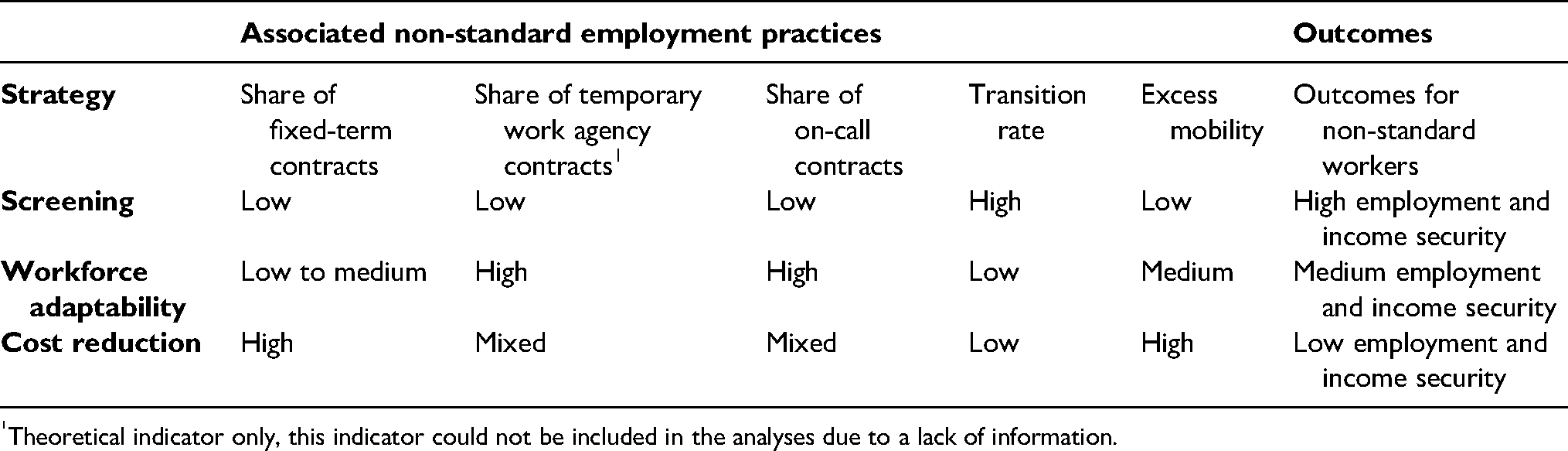
Theoretical indicator only, this indicator could not be included in the analyses due to a lack of information.
In this article, we include measures for four employer practices on non-standard employment: the share of fixed-term contracts, the share of on-call employment, the transition rate from fixed-term to permanent employment as well as excess mobility. We were not able to use a measure for the share of temporary agency workers in the firm as, in our data, these workers are not registered in the firm where they actually work, but in the temporary work agency itself. As a result, we cannot derive from register data how many temporary work agency workers firms have hired, and thus not include this practice in our analyses.
We will test the following expectations. First, we expect that workers who start in non-standard employment in firms with screening strategies have the best employment outcomes in terms of employment and income security. Second, workers who start their career in firms with workforce adaptability strategies are expected to be less likely to experience careers characterized by high levels of employment and income security, but not necessarily more likely to experience precarious careers characterized by non-employment as the scarring effect might remain limited. So, we expect these workers to have medium levels of both employment and income security. Third, workers in firms with cost reduction strategies are most likely to have careers characterized by unstable non-standard employment or non-employment as they are likely to experience a stronger scarring effect of non-standard employment.
Studying Non-Standard Employment Outcomes
In this study, we apply a multidimensional processual approach. It is processual because it allows us to look beyond point-in-time transitions and to analyze all events that occur after starting in a non-standard job, as well as the order, duration and number of the spells that these event define. Moreover, it is multidimensional, because it allows us to assess the quality of career-outcomes of non-standard employment based on employment security and income security. We do so by applying multichannel sequence analysis of the employment positions and incomes of all workers who start working in non-standard jobs (Mattijssen & Pavlopoulos, 2019). This analysis results in a detailed typology that allows for classifying careers in terms of employment and income security. This typology can subsequently be related to both individual and firm characteristics to explain which non-standard employment strategies result in the most successful careers in terms of employment and income security, and which strategies make non-standard employment a trap for employees.
Methods
Data
For the construction of the typologies of non-standard employment we used register data from the System of Social Statistical Datasets from Statistics Netherlands (SSB, Bakker et al., 2014). These data contain information about the employment positions and incomes of all individuals registered in the Netherlands. Since we focus on workers who start in non-standard employment, we use a subset of these data that contains individuals who started a job with a fixed-term contract, on-call contract or temporary work agency contract in 2010. The main rule for including an individual in this dataset is not to have been employed in any of these three types of non-standard employment in the three months before starting this job. This means that these individuals were previously unemployed, inactive, or had a permanent contract. The employment and income trajectories of these workers were constructed with monthly information from the moment of entering non-standard employment in 2010 until December 2016.
Mattijssen and Pavlopoulos (2019) have used the same data on the same population to develop a typology of employment and income trajectories for the 2007 cohort. To make our data for the 2010 cohort comparable to their approach, the following data selections are made. First, only individuals aged between 18 and 60 are included in the analysis. Student side-jobs, which are very common in the Dutch labor market, are excluded by selecting individuals who were not in education the moment they entered non-standard employment. Individuals who received old-age pension benefits, a surviving dependent's pension or annuities for at least 12 months in the observation period are excluded from the sample as well. The main difference with the data of Mattijssen and Pavlopoulos (2019) is that they had 96 months of data available, allowing them to track careers for eight years in total. In our case, we could observe the 2010 cohort until December 2016, limiting us to 72 months per individual. We exclude all individuals who could not be tracked for at least 72 months. This results in a final sample of 599,076 individuals.
For the selected individuals, we had information about their employment positions and incomes during all 72 months. For the employment position, we distinguish between nine types: permanent contract, fixed-term contract, temporary work agency contract, on-call contract, self-employment, unemployed, welfare benefit, student and other. Income was aggregated into 13 categories as sequence analysis only works with categorical variables. We use a smaller range for the lower income groups and a large range for the higher income groups to create balanced brackets. This is also justified by the fact that fluctuations of €250 are likely to have larger consequences at low levels of income than at higher levels of income.
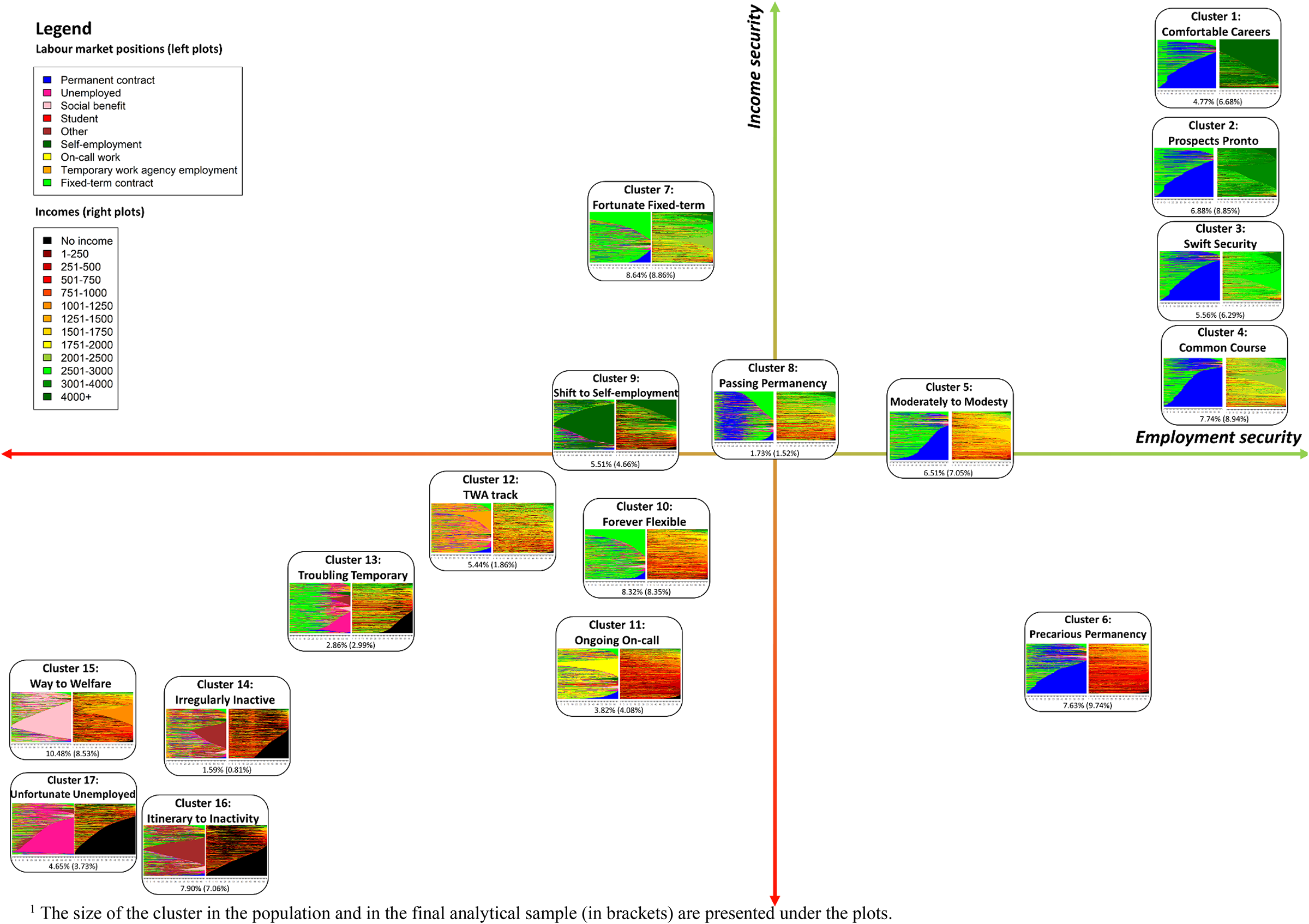
Typology of non-standard employment careers1.
Typology of Non-Standard Employment Trajectories
Our first step is to apply a multidimensional processual approach by creating a typology of non-standard employment trajectories that is representative of the full population of non-standard workers. By creating such a typology, we get an image of the overall types of careers for non-standard workers, that enables us to study, in the second step, how employers’ strategies influence what type of careers workers have. To create the typology, we apply multichannel sequence analysis (Gauthier et al., 2010; Pollock, 2007) in R using the TraMineR package (Gabadinho et al., 2011). Sequence analysis is a method that was originally used to study DNA sequences, but can also be used to study longitudinal phenomena. The main idea behind sequence analysis is to compare all sequences to one another and to calculate their similarity. Subsequently, based on these similarity scores, sequences can be clustered into groups, resulting in a typology.
Due to computational limitations, we could not analyze all 599,076 sequences simultaneously. Therefore, we randomly divide our sample into 14 subsamples of 42,791 or 42,792 individuals. For each subsample, we calculate the similarity of the sequences using the Hamming distance (Hamming, 1950). This distance measure is more sensitive to differences in timing than optimal matching, which is the standard distance measure in sequence analysis (Studer & Ritschard, 2016). Using the Hamming distance for instance prevents careers with late transitions from fixed-term to permanent employment (say, after 60 months) to be classified as similar to careers in which the transition from temporary to permanent employment occurs very early (say, after 6 months). After this, we clustered the sequences based on their similarity using the Ward clustering algorithm (Ward, 1963).
The results from these sequence and cluster analyses for the separate subsamples were compared qualitatively via the replication strategy suggested in Mattijssen and Pavlopoulos (2019) to create a final typology that would be valid for all sequences. This replication strategy is a structured qualitative process in which the outcomes of the sequence and cluster analyses are compared in both the optimal number of clusters as well as the types of clusters that occur in each typology. This strategy ensures that the final typology is reliable and representative. This strategy resulted in a typology of 17 clusters. More (technical) details on the sequence analysis, the replication strategy and the considerations we made in the process can be found in the appendix.
Non-Standard Employment Practices
To create the variables measuring non-standard employment practices, we used the System of Social Statistical Datasets from Statistics Netherlands. However, for this purpose we did not use the subset of workers who entered non-standard employment in 2010, but the full dataset of the working population in 2010 (n = 8,527,549). For all individuals, we had monthly information on their employment status and the (pseudonymized) firm they worked for all months of 2010. With this information, we calculated firm-level measures. Mathematical examples of the construction of the non-standard employment practices, as well as correlations between the four practices, can be found in the appendix.
The first measure of firm practices that we use is the share of fixed-term contracts in the firm. To calculate this measure, we took into account that not all jobs last the entire year. Therefore, the share of fixed-term employment in the firm was calculated as the ratio of the cumulative number of months in fixed-term employment among all workers in the firm divided by total months of employment of all workers in the firm. The same approach was used to calculate the second measure of firm practices, the share of on-call contracts in the firm. The mean share of fixed-term contracts is 33.1%, and the mean share of on-call contracts is 6.2%.
The third measure of firm practices is the yearly transition rate from fixed-term to permanent employment. This was calculated as the ratio of the number of conversions of fixed-term to permanent contracts divided by the number of jobs with a fixed-term contract on the first record within that year. The mean transition rate is 8.6%. This transition rate has been likely underestimated, as we could not observe conversions that occurred from December 31st 2009 to January 1st 2010 and from December 31st 2010 to January 1st 2011.
The fourth and last measure of firm practices is excess mobility, which refers to mobility that is exceeds the net growth or shrinkage of the firm. Excess mobility was calculated as the ratio of the yearly net turnover rate in the firm – i.e. the number of inflows and outflows 3 minus the overall growth of the firm workforce – divided by the size of the total workforce of the firm. The firm-level mean excess mobility is 29.6%.
By constructing the indicators in this way, there is some overlap between the population used to construct the non-standard employment practices and the population of non-standard workers whose trajectories are analyzed. However, we think that this overlap is not problematic for three reasons. First, the population of non-standard workers starting in 2010 is only a small part (7%) of the 2010 workforce in the firms for which we calculated the non-standard employment practices. All other workers either were permanent staff or workers in non-standard contracts who started before 2010. Second, we track the careers of workers beyond 2010. This means that only up to 16.7% (but often less) of an individual sequence is part of the data used to construct these measures of employment practices. Finally, we only link information about the first employer. Many workers switch employers over time, which further reduces any overlap.
Data on firm-level practices were linked to individual-level data that was used to create the typology of non-standard employment trajectories using the pseudonymized firm identification number.
Analytical Strategy
Before testing the relationship between the firm characteristics and workers’ outcomes of non-standard employment, we made some further selections in our analytical sample. First, we only included workers in firms with at least 50 employees to ensure reliability of the measures of non-standard employment practices. This does not mean that our hypotheses do not apply to smaller firms, but it is more difficult to get a reliable image of the strategies of smaller firms using the non-standard employment practices of one year only, as these measures might be inflated by incidental staff changes. Second, we excluded workers who work for temporary work agencies as they are registered as workers of the temporary work agency and not of the firm for which they actually work. Thirdly, we excluded individuals who had missing values in any of the explanatory variables included in the analysis. In total, 278,974 individuals from 17,901 firms were included in the analysis.
To test the relationship between firm practices and workers’ outcomes of non-standard employment, we used a multinomial logistic regression with the 17-cluster typology as the dependent variable. In the analysis, the standard errors are clustered at the firm level to account for the fact that we can have multiple workers from the same firm in our data.
The main independent variables in the analysis are the non-standard employment practices at the firm level: share of fixed-term contracts, share of on-call contracts, share of transitions to permanent employment and excess mobility. With the exception of the share of on-call contracts, these variables were operationalized as continuous. As many firms do not use on-call contracts (55.8% of firms), we decided to group this variable in five categories: no on-call contracts, up to 1% on-call contracts, between 1% and 5% on-call contracts, between 5% and 12.5% on-call contracts, and more than 12.5% on-call contracts. We also investigated whether any interactions between these practices improved the model fit. In the end, we included four interactions: between the share of fixed-term contracts and the share of transitions to permanent employment, the share of fixed-term contracts and excess mobility, the share of fixed-term contracts and the share of on-call workers, and between excess mobility and the share of on-call workers.
To control for other relevant firm-level characteristics, we included the sector, the share of female workers in the firm, the share of high-paid workers, and a dummy for firms with over 250 employees as control variables. At the individual level, we controlled for gender, ethnicity (Dutch, western migrant, non-western migrant), education (low, medium, high and unknown), age and age squared. Though occupational characteristics, such as type of occupation, occupational skill level and task types, would be very relevant variables in the analyses as well, such information is not available in our register data. Descriptive statistics of all included variables can be found in the appendix.
Dominance Analysis
Next to assessing the effects of the non-standard employment practices, it is also relevant to see how the predictive power of these practices compares to the predictive power of individual characteristics and other firm characteristics. For this purpose, we run a dominance analysis using the domin package for Stata (Luchman, 2014). A dominance analysis compares the relative importance of the explanatory variables by running models with all possible combinations of the independent variables and assessing how often the variables have more predictive power than other variables.
A complete dominance analysis for our model, excluding the interaction effects, was infeasible as it would require the analysis of 213-1 = 8191 models. Furthermore, we are mainly interested in comparing the explanatory power of variable sets instead of individual variables. Therefore, we run the dominance analysis with three main sets of variables, limiting the number of required analyses to 23-1 = 7 models. These three sets of variables are individual characteristics (gender, level of education, ethnicity, age and age²), firm characteristics (share of women in the firm, share of high-paid workers in the firm, sector and firm size), and the non-standard employment practices (share of fixed-term contracts, share of on-call contracts, share of transitions from fixed-term to permanent and excess mobility). As interaction effects should not be included in models without their main effects, the interactions between the non-standard employment practices are not included in the dominance analysis. The main model fit indicator we use to compare the strength of the variable sets is the McFadden R².
Additionally, we run a separate dominance analysis to assess which of the firm characteristics contributes most to model fit. In this dominance analysis, we include the individual characteristics and other firm characteristics as sets, while the practices are included separately. The total number of variables/sets in this analysis is thus 6, which means that 26-1 = 63 models are run. With the same approach, we also investigate which of the variables within the sets of individual characteristics and firm characteristics contributes most to the model. These results are included in Table A12 in the appendix.
Results
Typology of Non-Standard Employment Careers
The sequence analysis resulted in a typology of 17 career types that vary in the level of employment security and income security they provide the workers. We gave each cluster an original name that reflects the type of careers that can be found in that cluster. This makes it easier to identify individual clusters from the 17-cluster typology. To further ease the interpretability of the typology, we have placed the clusters on a grid, stratifying the clusters horizontally based on their employment security, and vertically based on their income security (Figure 1). The placement of the clusters on the grid is done qualitatively: there is no hard measure of employment and income security and the distance between clusters should not be seen as absolute. We did, however, take into account several quantitative characteristics to determine the placement of the clusters. For employment security, we took into account the percentage of time spent in employment, the percentage of time spent in permanent employment and the average duration until permanent employment. For income security, we took into account the mean within trajectory income and the average within trajectory income standard deviation. Cluster scores on these indicators can be found in Table A6 the appendix.
On the top right of the grid, we find career types that offer high levels of employment security, and can be seen as the ideal typical stepping-stone careers. In these clusters, workers make the transition to permanent employment quite quickly, albeit a bit slower in Moderately to Modesty. The highest levels of income security can be found in Comfortable Careers, with income levels around €3000-€4000 monthly, while Moderately to Modesty and Common Course have relatively lower, but still decent levels of income security at around €2000 monthly. Combined, the five clusters in this quadrant contain 31.4% of the workers who entered flexible employment in 2010, and 37.8% of the workers in our analytical sample.
On the opposite side of the grid, in the lower left quadrant, we find the clusters that are characterized by low levels of both employment and income security. These clusters can be seen as the ideal typical trap-careers. First of all, we find four clusters that are characterized by non-employment. The workers in Way to Welfare will spend a large share of their trajectory in some kind of welfare benefit, while workers in Unfortunate Unemployed end up unemployed, generally without any benefits. The workers in Itinerary to Inactivity end up leaving the labor market for a longer period of time, for instance for taking on care tasks. The same holds for workers in Irregularly Inactive, but they make this transition a bit later in their trajectories. Together, these four clusters combined contain 24.4% of all workers, and 20.1% of the final sample.
However, this quadrant also contains four clusters with low levels of employment and income security in which workers are mostly employed. In Ongoing On-call, workers spend most of their trajectory in on-call employment, earning relatively low and unstable incomes. The same holds for the Temporary Work Agency (TWA) Track, but then for working in temporary work agency jobs. There are also two clusters in which workers spend most of their trajectories in fixed-term employment. In Forever Flexible, this fixed-term employment is relatively stable, but the incomes are on the lower side. In Troubling Temporary, the fixed-term employment is less stable, with workers often switching between fixed-term employment, other types of non-standard employment and non-employment. As a result, the incomes are less stable as well. Together, these four clusters contain 20.4% of all workers, and 17.3% of the workers in the analytical sample.
Next to these ideal typical stepping-stone and trap clusters, we also encounter a couple of clusters that deviate from the traditional dichotomy. On the bottom right side of the quadrant, we for instance find a cluster that combines relatively high levels of employment security with relatively low levels of income security: Precarious Permanent. In this cluster, workers make the transition to permanent employment at some point in their trajectories, while earning stable but low incomes of around €750-€1000 monthly. This cluster shows that a transition to permanent employment does not necessarily equate a good career in all respects. This cluster contains 7.6% of the total sample of non-standard workers, and 9.7% of the final sample.
On the opposite, upper left side of the grid, we see the exact opposite with the cluster Fortunate Fixed-term. In this cluster, workers mostly remain in fixed-term employment throughout their trajectories. In previous research, these workers would have been classified as precarious. However, when looking at their incomes, these are generally high, stable and often increasing. In this respect, these workers cannot really be classified as precarious, showing that fixed-term employment can also be a good outcome for some. This cluster contains 8.6% of all non-standard workers and 8.9% of the analytical sample.
Two clusters remain harder to classify into one of the quadrants, as they show a mixed image. First, there is the cluster Shift to Self-employment in which workers transition to self-employment. By definition, self-employment does not ensure employment security as the self-employed need to ensure their own employment. The extent to which this works, varies per self-employed. Next to this, we see that the income levels in this cluster are extremely varied: a significant share of these self-employed earn very high incomes of €4000 and over, while another significant share has a very low and unstable income. Therefore, this cluster is located in the middle of the grid. This cluster contains 5.5% of workers and 4.7% of the final sample.
Second and finally, the cluster Passing Permanency shows an interesting trajectory type. In this cluster, workers make the transition to permanent employment quite quickly, but after some time return to fixed-term employment. The incomes in this cluster are mixed, and also the income development varies: some experience income increases while others experience income decreases. This may be an indication that the transition from permanent to fixed-term employment is voluntary for some, while it may be involuntary for others. Therefore, this cluster is placed in the middle of the grid as well. This cluster contains 1.7% of the workers and 1.5% of our analytical sample.
Strategies: The Interplay Between Non-Standard Employment Practices
The effect of firms’ strategies for using non-standard employment was analyzed using a multinomial logistic regression. In these results, the interplay between non-standard employment practices is most relevant in the assessment of the effects of strategies. To interpret the results of this analysis, we use the adjusted predicted probabilities at representative values of the practices. These representative values correspond to the ideal situation for the for each of the three firm strategies as presented in Table 1, related to the observed values in the data. Specifically, for firms with screening strategies, we have chosen 10% of fixed-term contracts, 0% of on-call contracts, a 30% transition rate and 20% excess mobility. For firms with adaptability practices, we also limited the share of fixed-term contracts to 10%, chose a share of on-call contracts between 1% and 5%, a 0% transition rate and 40% excess mobility. For firms with cost reduction strategies, we chose an 80% share of fixed-term contracts, a 0% transition rate and 80% excess mobility, while we did not specify the share of on-call workers. 4 The three chosen combinations are also plotted in the scatterplot in figure A2 in the appendix. As stated before, many firms will in practice not fit exactly into one of these three strategies.
The predicted probabilities for these ideal types can be found in Figure 2. We present these predicted probabilities per cluster, while we placed the plots on the same grid that was used to plot the typology of outcomes of non-standard employment. In these plots, the green bars on the left indicate the predicted probabilities for the screening strategy, the yellow bars in the middle the predicted probabilities for the adaptability strategy, and the red bars at the right those for the cost reduction strategy. The blue horizontal line represents the overall predicted probability of the workers to belong to this cluster. For each probability, the 95%-confidence interval is plotted as well. The exact predicted probabilities can be found in Table A10 in the appendix.
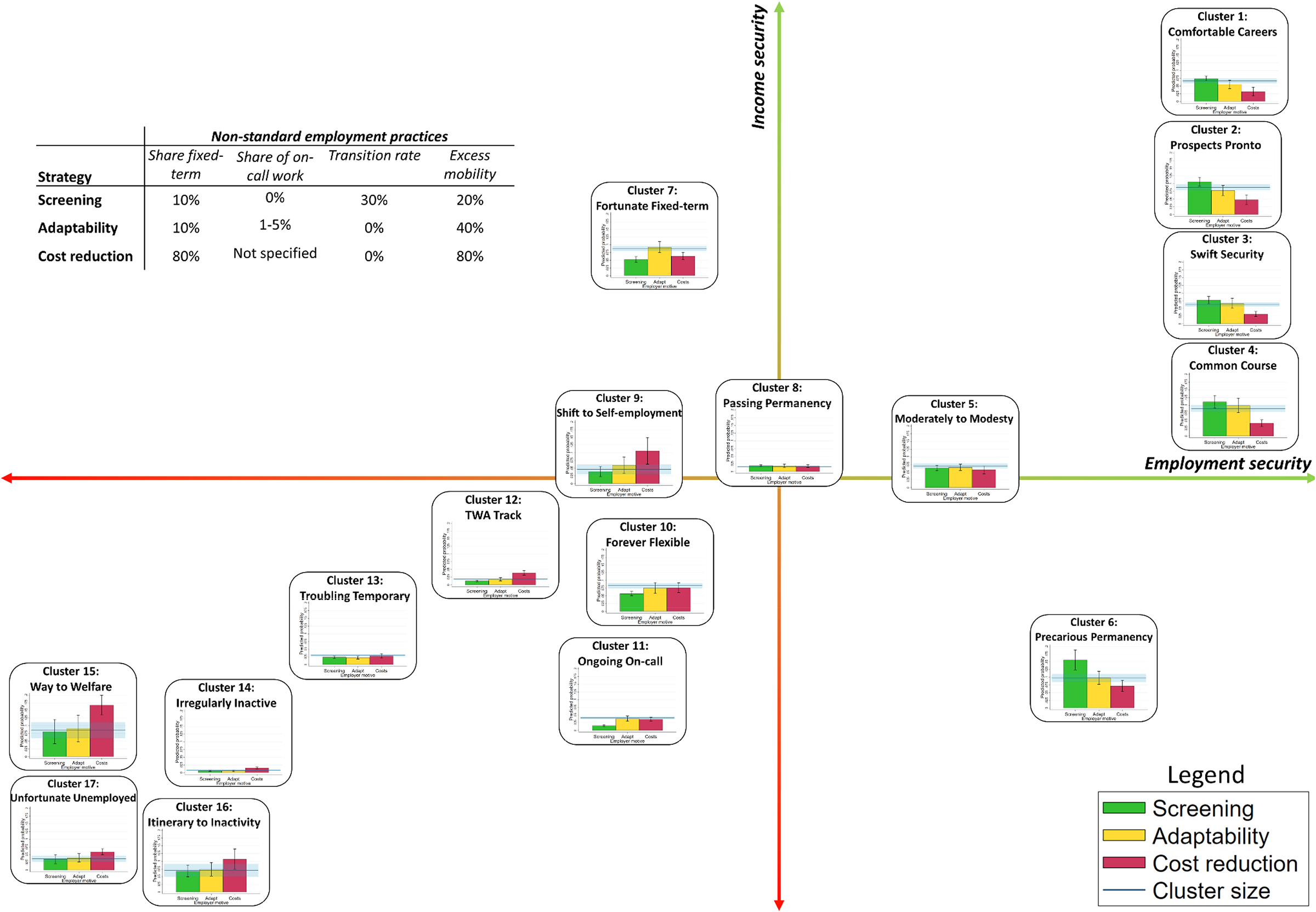
Predicted probabilities to experience a career trajectory, per employer strategy. Note: This graph shows the predicted probabilities of experiencing any of the 17 career outcomes for three ideal typical strategies (bars), constructed using combinations of scores on the non-standard employment practices, as well as the overall predicted probability of experiencing the career types (horizontal line). 95% confidence intervals included.
Starting with firms with screening strategies, we see that workers in these firms are more likely to have careers characterized by high levels of employment security. For instance, they are more likely to experience Comfortable Careers, Prospects Pronto, but also Precarious Permanent careers, and less likely to experience Ongoing On-call or TWA Track careers. They also have lower probabilities to experience careers characterized by non-employment, such as Itinerary to Inactivity, Way to Welfare or Unfortunate Unemployed.
In contrast, workers in firms with cost reduction strategies are more likely to have careers with lower levels of employment and income security, and in particular careers characterized by non-employment such as Way to Welfare, Itinerary to Inactivity and Unfortunate Unemployed. They are also significantly less likely to have careers with high levels of employment and income security, such as Comfortable Careers, Prospects Pronto or Swift Security, and more likely to experience a TWA Track and to make the Shift to Self-employment.
Workers in firms with adaptability strategies hold a middle ground between the screening and cost reduction strategies. On the one hand they have lower levels of employment and income security than workers from firms with screening strategies, for instance due to lower probabilities to have a Comfortable Career or Prospects Pronto and higher chances to have an Ongoing On-call or TWA Track career. They are also more likely to have a Fortunate Fixed-term career, that combines high levels of income security with lower levels of employment security. On the other hand, they are equally likely as workers from firms with screening strategies, and hence significantly less likely than workers from firms with cost reduction strategies, to have careers characterized by non-employment, such as Way to Welfare, Unfortunate Unemployed or Itinerary to Inactivity. This indicates that the scarring effect of non-standard employment may indeed be weaker for workers in firms with adaptability strategies.
Some final interesting findings are those where workers from the three different types of strategies do not differ significantly from each other. This is the case for Moderately to Modesty, Passing Permanency and Troubling Temporary. This shows that the effect is not linear: screening strategies do not protect against all careers with low levels of employment and income security, such as Troubling Temporary, while cost reduction strategies do not preclude careers with higher levels of employment security either.
What Matters Most in Predicting Career Trajectories: A Dominance Analysis
To assess which of the three variable sets explained most variance in the outcomes of non-standard employment, we ran a dominance analysis. The results of the dominance analysis can be found in Table 2. The analysis shows that the individual characteristics have the highest explanatory power: including individual characteristics in the model improves the McFadden R² by 6.4 pp, almost half of the total predictive power. The other firm characteristics further improve the model by 4.1 pp. Finally, the non-standard employment practices significantly contribute to the model as well. Including the non-standard employment practices to the model improves the McFadden R² by 2.5 pp. This amounts to 18.9% of the total explanatory power of all sets combined, showing that employer strategies play an important role in the outcomes of non-standard employment and should definitely not be neglected.
Dominance analyses.
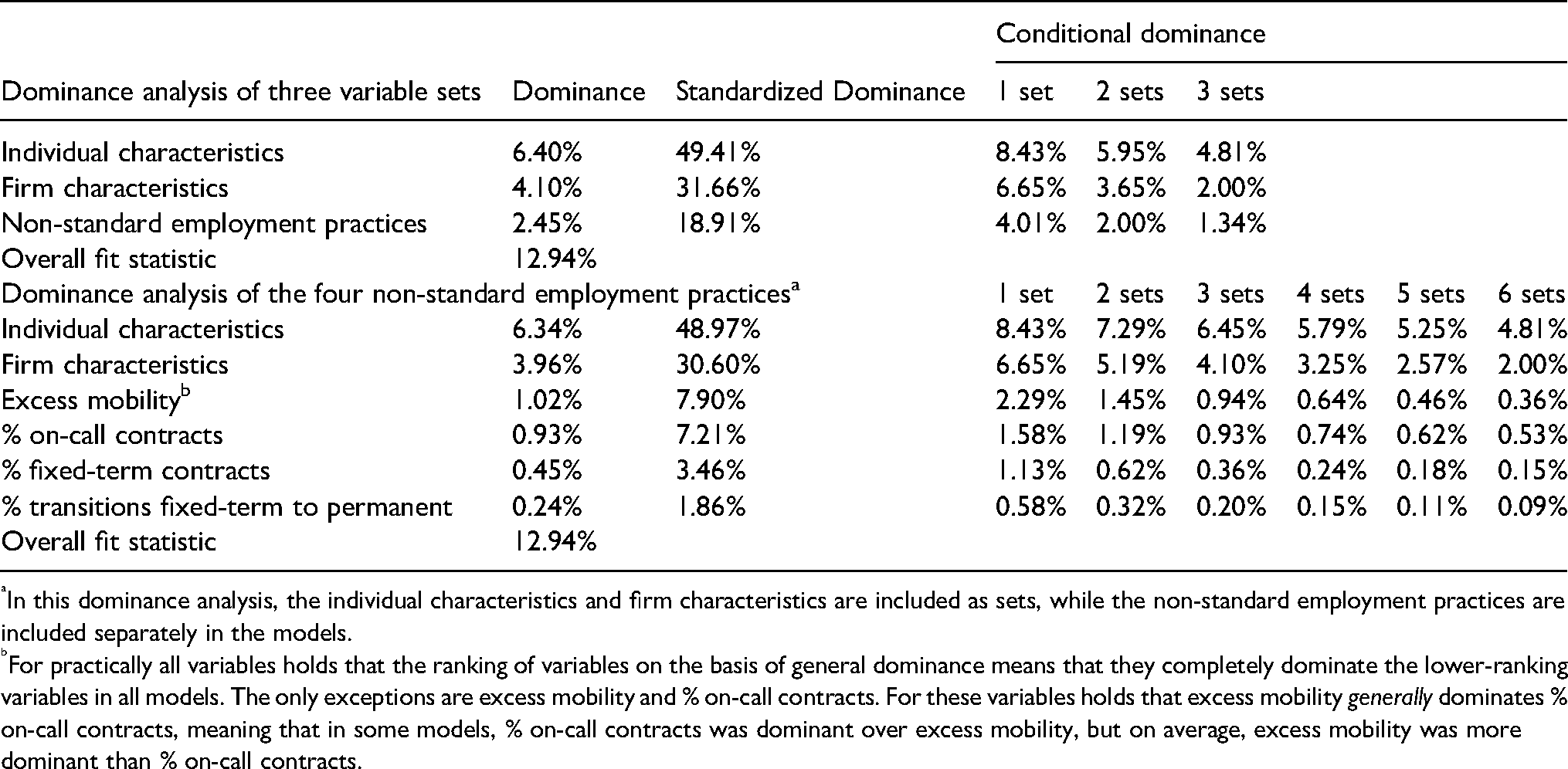
In this dominance analysis, the individual characteristics and firm characteristics are included as sets, while the non-standard employment practices are included separately in the models.
For practically all variables holds that the ranking of variables on the basis of general dominance means that they completely dominate the lower-ranking variables in all models. The only exceptions are excess mobility and % on-call contracts. For these variables holds that excess mobility generally dominates % on-call contracts, meaning that in some models, % on-call contracts was dominant over excess mobility, but on average, excess mobility was more dominant than % on-call contracts.
To see which of the four non-standard employment practices contributed most to the prediction of career types, we also ran a separate dominance analysis. This analysis shows that, of the four practices, excess mobility improves the McFadden R² most (1 pp.), followed by the share of on-call contracts (0.9 pp.). The share of fixed-term contracts (0.45 pp.) and the transition rate from fixed-term to permanent employment (0.24 pp.) contribute least to the model. These results differ slightly from the first dominance analysis, as the correlation between the practices as a set with the other variable sets likely differs from the correlation between the practices separately with the other variable sets.
Conclusion
The aim of this article was to investigate to what extent employers’ non-standard employment strategies affect the career outcomes of workers who start working in non-standard employment in those firms. In this respect, it covers a big blind spot in labor market research that studies the effect of individual or institutional characteristics on career outcomes but typically neglects the role of organizational characteristics. Employers’ strategies are key mechanisms in the main scenarios predicting the employment outcomes of non-standard employment, the stepping-stone scenario and the trap scenario. We distinguish three basic strategies of employers in using non-standard employment: screening, adaptability and cost reduction. It was expected that workers in firms with screening strategies experience better career trajectories than workers in firms with adaptability or cost reduction strategies. Using register data, we created firm-level indicators of non-standard employment practices that reflect employers’ strategies: the share of fixed-term contracts and on-call contracts, the transition rate from fixed-term to permanent employment and excess mobility. Moreover, we classified the careers of all workers in the Netherlands who started working in a non-standard employment contract in 2010 in a 17-cluster typology with multichannel sequence analysis. This way, we got a more nuanced image of the quality of the career trajectories as our approach allows for investigating the long-term consequences of entering the labor market with a non-standard contract.
Our analysis confirms the crucial role that employers’ strategies play in determining the outcomes of non-standard employment for workers. Next to individual level and firm level characteristics, these strategies determine to a large extent whether non-standard employment functions as a stepping-stone or as a trap in workers’ careers. These strategies mostly influence the employment security, but not (directly) income security, of careers. Given the fact that the underlying practices reflect only the use of non-standard employment, and not the wage strategy of the firm, this is not surprising. The results confirm that workers in firms with screening strategies are more likely to have careers with high levels of employment security. This is in line with the stepping-stone scenario, that argues that employers use non-standard employment to screen workers’ quality, invest in their human capital and are more likely offer permanent contracts (employment security) if the quality is confirmed. In contrast, workers in firms with cost reduction strategies are more likely to experience careers characterized by non-employment or precarious non-standard employment. This is in line with the trap scenario, that considers cost reduction strategies as a reason for firms to hire workers on non-standard contracts, resulting in repeated spells of non-standard employment or unemployment for the workers in these firms. Workers in firms with adaptability strategies are more likely to have careers characterized by long-term fixed-term employment compared to workers in firms with other strategies, but are still much more likely than workers in firms with cost reduction strategies to have careers characterized by higher levels of employment security as well. This also indicates that working in firms with adaptability strategies has less of a scarring effect than working in firms with cost reduction strategies.
A main contribution of this article is to show the considerable importance of employers’ strategies on the outcomes of non-standard employment for workers, an aspect that has remained underexposed in previous research despite being the key mechanism in theories on the outcomes of non-standard employment. Although contexts determine the possibilities for using non-standard employment, and individuals make employment decisions based on their own restrictions and preferences (Adler, 2021), employers also have a significant influence on whether non-standard employment functions as a stepping-stone or as a trap for their workers that cannot and should not be neglected. Using non-standard employment practices as indicators of employers’ strategies offers new opportunities to connect the labor demand side to the outcomes on the labor supply side on a large scale, without having to rely on limited survey samples of employers who might not have an explicit or thought-through strategy for using non-standard employment, or whose practices deviate from their stated strategies.
Despite being one of the first studies to attempt to connect employers’ strategies to career outcomes of workers in non-standard employment, this study does have some limitations. Some of these limitations may explain why, contrary to theoretical considerations, non-standard employment practices did not emerge as the most important determinant of career outcomes from our analysis. There are two possible reasons for this. First, due to data limitations, we could not include the share of temporary work agency workers in our analysis. This might be an important indicator of employers’ strategies as firms might hire temporary agency workers instead of fixed-term workers to fulfill their need for flexibility. Second, as the practices are based on firm-level aggregate employee statistics, we can only infer employer strategies at the firm level. However, it is very likely that employers have different strategies for different types of jobs within the firm. The type of occupational tasks that a worker performs may be an important determinant of the strategy that employers have for using non-standard employment contracts (Mattijssen et al., 2020). Unfortunately, our register data contain no information on occupations. Further research with more detailed register data or linked registers with large-scale survey data can tackle these two limitations.
Additionally, we have only included firms with more than 50 employees in our analysis. It would be interesting to know to what extent the practices of smaller firms are different to the strategies of larger firms, and if so, in what way. It could be argued that hiring workers on permanent contracts is a larger risk for smaller firms, as these firms might struggle more with the costs of dismissal or sick leave. Future research could try to find ways to determine the strategies of smaller firms and the consequences of these strategies for workers.
Finally, the results are likely to be specific to both time, as we focus on only one cohort of workers starting in non-standard employment, as well as place, as the Netherlands are a particular case characterized by high shares of non-standard employment and very particular regulations regarding non-standard employment. Future research can shed light into whether the effects of strategies change over time, as well as into cross-country differences as in countries with stricter employment protection for workers in non-standard employment, the cost reduction incentive might be much weaker than it is in the Netherlands.
Supplemental Material
sj-docx-1-wox-10.1177_07308884221076383 - Supplemental material for Scarred by Your Employer? The Effect of Employers’ Strategies on the Career Outcomes of Non-Standard Employment
Supplemental material, sj-docx-1-wox-10.1177_07308884221076383 for Scarred by Your Employer? The Effect of Employers’ Strategies on the Career Outcomes of Non-Standard Employment by Lucille Mattijssen, Dimitris Pavlopoulos and Wendy Smits in Work and Occupations
Footnotes
Acknowledgements
This research is part of the research programme ‘Non-standard employment: Prospect or precarity?’ (project number 406.16.541), which is financed by the Dutch Research Council (NWO). The authors would like to thank Statistics Netherlands for allowing us to use their data. The authors furthermore want to thank prof. Harry Ganzeboom, the members of the SILC research group and the participants of the RC28 2021 conference for their feedback on this paper.
Declaration of Conflicting Interests
The author(s) declared no potential conflicts of interest with respect to the research, authorship, and/or publication of this article.
Funding
The author(s) disclosed receipt of the following financial support for the research, authorship, and/or publication of this article: This work was supported by the Nederlandse Organisatie voor Wetenschappelijk Onderzoek (grant number 406.16.541).

Supplemental Material
Supplemental material for this article is available online.
Notes
Author Biographies
References
Supplementary Material
Please find the following supplemental material available below.
For Open Access articles published under a Creative Commons License, all supplemental material carries the same license as the article it is associated with.
For non-Open Access articles published, all supplemental material carries a non-exclusive license, and permission requests for re-use of supplemental material or any part of supplemental material shall be sent directly to the copyright owner as specified in the copyright notice associated with the article.
