




Abstract
This article examines to what extent the occupational skill level and task types determine whether non-standard employment (NSE) leads to a stepping-stone or a trap in the careers of workers. For this purpose, a typology of the individual careers of workers in the Netherlands who entered non-standard employment in 2007 is created using multichannel sequence analysis. This typology allows for classifying careers in terms of employment security and income security. An analysis of this typology shows that working in occupations with high-level tasks does not preclude trap careers with low levels of employment and income security. Routine tasks do not have an unequivocal effect on career outcomes, while manual tasks generally lead to trap careers. The combination of routine and manual tasks makes it most likely for NSE to function as a trap in workers’ careers.
Keywords
Introduction
Non-standard employment (NSE) contracts (i.e. fixed-term contracts, on-call contracts or temporary agency contracts) are becoming increasingly popular in contemporary labour markets. In the Netherlands, the share of workers with such contracts has soared from 16.1% in 2003 to 26.9% in 2018 (CBS Statline, 2019). The flexibility that these contracts offer is highly valued by employers and policy makers. However, simultaneously, severe concerns have been raised about the consequences of these contracts on workers’ well-being. Since there is consensus that these types of contracts are, at a given point in time, ceteris paribus, inferior to permanent contracts with respect to employment security, earnings, fringe benefits, training and promotion (Booth et al., 2002; de Beer, 2016; OECD, 2014), research has shifted its focus to the career effects of NSE. The scientific debate that dominates the field is whether NSE functions as a stepping-stone to well-paid and more stable types of employment, or as a trap of repeated low-paid non-standard jobs or unemployment (Berton et al., 2011; de Graaf-Zijl et al., 2011; Giesecke and Groß, 2003). However, the answers that previous research has provided on this debate are incomplete as they are limited to the effect of supply-side factors: how individual characteristics, such as gender and education, determine the effect of NSE in the employment career (Booth et al., 2002; Gash and McGinnity, 2007). Although the organization is the key level where the employment relationship is determined (Tomlinson et al., 2018), the effect of demand-side factors has remained largely overlooked until now.
In sociology, occupation has been considered as a factor that summarizes demand-side factors of employment. Specifically, for NSE, occupational characteristics influence the necessity of long-term employer–employee commitment and consequently the careers of the workers in these occupations (Goldthorpe, 2007; van Echtelt et al., 2015). However, only a handful of studies focus on how occupations affect the role of NSE in the career (Kiersztyn, 2016; Polavieja, 2005; Reichelt, 2015). Moreover, both the scope of these studies and their operationalization of career effects are limited. In more detail, the scope of these studies is restricted to studying a single aspect of occupations, that is the skill level, while neglecting other important occupational characteristics. As Acemoglu and Autor (2011) and Goldthorpe (2007) suggest, the types of tasks executed in the occupation are also crucial in determining career dynamics. Furthermore, the operationalization of the career effects of NSE in existing studies is incomplete because they only study point-in-time transitions from non-standard to permanent employment, and in this way neglect career-dynamics both before and after this transition.
The aim of this article is to address the shortcomings mentioned above by introducing two innovations. The first is the investigation of the extent to which both the occupational skill level and the types of tasks executed in the occupation determine whether NSE leads to a successful or a precarious career. The second is that, instead of defining career outcomes as single events, as previous research has done, a processual approach in which employment trajectories are treated as the unit of analysis is adopted. In this processual approach, two dimensions of career quality are studied simultaneously: employment security and income security. These two innovations are achieved by using multichannel sequence analysis on a unique Dutch register dataset that allows for following workers who entered NSE in 2007 on a monthly basis for an eight-year period.
Theoretical framework
NSE: A stepping-stone or a trap?
The sociological and economic literature identifies two opposing scenarios on the effect of NSE on the career. The stepping-stone scenario has its roots in human capital theory and suggests that working with a NSE contract improves career prospects in comparison to remaining unemployed as workers acquire skills, work experience and social capital (Booth et al., 2002; de Graaf-Zijl et al., 2011; Giesecke and Groß, 2004). This is corroborated by the signalling-screening perspective (Spence, 1973), which suggests that employers use NSE as an extended probation period to screen the productivity of new hires. In this way, workers who meet the employer’s expectations are later offered a permanent contract (Booth et al., 2002; Weiss, 1995).
The arguments of the trap scenario are mainly based on dual labour market theory (Doeringer and Piore, 1971; Hudson, 2007). The main argument is that employers mostly use NSE as a means to adapt the workforce to economic fluctuations (Kalleberg, 2003). Therefore, employers are less likely to invest in the human capital of workers with such contracts. From a signalling-scarring perspective, this can have long-term negative effects on the career of workers as future employers consider an employment history containing NSE as a signal of lower worker quality (Berton et al., 2011; Hudson, 2007).
Most research has largely focused on determining which of both scenarios holds. However, these studies adopt an approach that does not correspond to reality in contemporary labour markets. First, most studies focus on point-in-time transitions from non-standard to permanent employment (e.g. Gash, 2008; Reichelt, 2015). This approach is appropriate when linear career pathways leading from non-standard to permanent employment are dominant in the labour market, but less suitable for contemporary labour markets where lifelong jobs are becoming less standard. Second, research generally studies employment and income outcomes separately (Booth et al., 2002; de Graaf-Zijl et al., 2011). However, in contemporary labour markets, individuals trade different types of security by, for example, choosing a high-paid temporary job instead of a permanent job with lower earnings or vice versa. Mattijssen and Pavlopoulos (2019) argue that the outcomes of NSE can best be assessed by adopting a processual approach and treating employment and income trajectories as the unit of analysis, as this leads to a much more complete picture where career quality is assessed on the basis of two dimensions: employment security – the types of (non-standard) employment encountered in the career, the number of changes between labour market positions and the time spent in non-employment; and income security – the income level, growth and stability.
Nevertheless, as the results of previous studies suggest that both the stepping-stone and trap scenarios are plausible, the question is not as much which of both scenarios holds, but when and for whom the scenarios hold. Therefore, the same approach as Mattijssen and Pavlopoulos (2019) will be used, also focusing on the dimensions of employment and income security, to determine to what extent the skill level and task content of occupations play a role in determining the career outcomes.
The effect of occupations on career quality
In research aiming to explain when NSE leads to positive (i.e. stepping-stone scenario) or negative (i.e. trap scenario) outcomes, the focus lies disproportionally on supply-side factors, such as gender and education. However, whether NSE has positive or negative outcomes in the career is predominantly determined by employer motives. In more detail, employers use non-standard contracts as a means to obtain greater flexibility or as a screening device for new hires (Kalleberg, 2003). The former motive probably results in a short-term employment relationship, whereas the latter implies a necessity for long-term employer–employee commitment. When such a necessity exists, employers have an incentive to convert the non-standard contract to a permanent contract after successful screening. In this case, a non-standard contract functions as a stepping-stone in the career of the worker (Berglund et al., 2017; Houseman, 2001). In contrast, when the necessity for a long-term commitment is absent, the trap-scenario for the career is more plausible.
Employer motives (i.e. whether they use NSE for screening or flexibility) is driven by the replaceability of the worker. In more detail, if the worker is easily replaceable, then the employer will have no incentive to use long-term employment relationships and will use NSE contracts as a means to accommodate economic fluctuations. However, if the worker is not easily replaceable, the employer has an incentive to engage the worker in a long-term employment relationship. In this case, the employer will use a NSE contract mostly as a screening device for suitable candidates. The replaceability of workers is closely linked to their occupations and specifically to the tasks that are inherent in these occupations. In research, two aspects of occupational tasks have been recognized as determinants of replaceability and therefore of the career outcomes of NSE: the skill level and the type of tasks executed in the occupation.
Skill level
In the discussion of occupational stratification, Parsons argued that the requirement of rare abilities and competences that can only be acquired by training make differentiation inherent in occupations (Parsons, 1949: 20). Obviously, this means that the level of education of the individual is an important determinant of career outcomes, which is confirmed by numerous studies (e.g. Booth et al., 2002; Giesecke and Groß, 2003). However, irrespectively of the education level, the skill level of the tasks executed in an occupation is relevant as well, as this mainly determines the necessity of long-term employer–employee commitment (Lepak and Snell, 1999). Specifically, in occupations that involve high-level tasks, suitable candidates for the job are scarce (Reichelt, 2015). This motivates employers to establish long-term employment relationships with suitable candidates as replacing them is difficult. In these occupations, non-standard contracts are mostly used as a screening device to assure that the workers are able to perform the high-level tasks adequately. This results in higher levels of employment security for workers in these occupations, as they are more likely to have stable employment and to make the transition to permanent employment.
In contrast, vacancies for jobs in occupations with low-skilled tasks are easier to fill as more job seekers meet the job requirements, making these workers more replaceable. In these jobs, long-term commitment is not as needed and employers hire workers in non-standard contracts for the purpose of adapting their workforce to economic fluctuations. This will make it less likely that a non-standard contract is converted to a permanent contract in low-skilled occupations (Kiersztyn, 2016; Reichelt, 2015), which would result in careers consisting of spells of unstable NSE and even unemployment. In this respect, the skill level of occupational tasks is a more crucial determinant of employers’ motives for using NSE than the educational level of the individual workers: if a high-skilled individual is hired in a low-skilled job, the employer still does not require long-term commitment and has no reason to offer the high-skilled worker employment security.
With respect to income, workers acquire the skills required for the occupation through education and training. Therefore, according to human capital theory, workers will be compensated for these efforts with higher wages (Mincer, 1974). To summarize, the mechanisms discussed above indicate that workers who enter NSE in occupations with high-skilled tasks have careers with more stable employment careers, with fewer NSE contracts and less unemployment (i.e. more employment security), as well as higher and more increasing incomes (i.e. more income security) than workers in occupations with low-skilled tasks (H1).
Task types
Apart from the skill level of the tasks performed in occupations, Autor et al. (2003) suggest that the types of tasks executed in an occupation are crucial in explaining employment outcomes. Their main argument is that the types of tasks executed in occupations determine the extent to which workers are replaceable and consequently how susceptible occupations are to automatization.
Their argument can be connected to Goldthorpe’s (2007) framework, as task types can directly be linked to two broader characteristics of occupations that strongly influence the replaceability of the worker and subsequently the possibility that an initial non-standard contract is converted to a permanent contract: the extent to which workers can be monitored while performing their tasks and the extent to which specific skills are required in order to fulfil these tasks. When monitoring costs are high, employers use incentives, such as a permanent contract (Goldthorpe, 2007) or an efficiency-wage premium (Akerlof and Yellen, 1986) to prevent the worker from shirking. In contrast, when monitoring costs are low, such incentives are unnecessary. Similarly, when specific skills are required for the job, employers seek a long-term commitment with high wages, as investments in the firm-specific skills of workers are costly (Lazear, 1995). Therefore, both the existence of high monitoring costs and the specificity of skills in a job reduce the replaceability of the worker and lead to the necessity of long-term employment relationships. Subsequently, high monitoring costs and high levels of skill specificity lead employers to use an initial non-standard contract as a screening device for new hires, resulting in stepping-stone careers with high levels of employment security.
Monitoring costs and skill specificity are difficult to observe. However, they are jointly represented in a specific aspect of occupational task types: routine. Routine tasks can easily be expressed in a set of rules (Autor et al., 2003), which makes them easy to monitor and easy to execute without requiring specific skills. This would mean that workers in occupations that consist mostly of routine tasks are more likely to have a career with low levels of employment security: providing them with incentives is not necessary, as they can be easily monitored, while they can also be replaced easily, both by other workers and by automatization, as their job requires few specific skills.
Though routine tasks are likely to affect employment security, their relationship with income security is much less evident. Autor and Handel (2013) suggest that routine tasks were the least stable predictor of wages and show that another aspect of tasks is important for income: whether the tasks are manual. In accordance to this, Fouarge et al. (2017) find that manual tasks are more prevalent in the lower income quintiles, while non-manual tasks are more common in the higher income quintiles. Confirming the consideration of Autor and Handel that the level of manual tasks in an occupation is more important than routine, they also find that routine manual tasks are mostly found in the second lowest income quintile, while routine cognitive tasks are equally common in the lower four quintiles. Therefore, it is expected that the careers of workers in routine occupations have more unstable employment careers with more NSE contracts and unemployment spells (i.e. lower levels of employment security) than the careers of workers in non-routine occupations, irrespective of income security (H2a), while workers in manual occupations are more likely to have lower and more unstable incomes (i.e. lower levels of income security), irrespective of employment security (H2b).
Data and methodology
In this article, a unique Dutch dataset that links individual-level information from register and survey data was used. Longitudinal information on employment and income came from the System of social statistical datasets (SSD) from Statistics Netherlands. The SSD contains information for all workers in the Netherlands, from the Dutch tax administration (‘de Belastingdienst’), the register on wages (‘Polisadministratie’) and the Employee Insurance Agency (‘UWV’) (Bakker et al., 2014). A subset of this dataset, which was created specifically for the purpose of studying careers of workers who entered NSE, was used. These data offered exact information, including start and end dates, on the employment status, contract type, income and income sources of individuals aged between 15 and 74 from the moment they entered NSE in 2007 until December 2015 (de Vries et al., 2017). For the analysis, workers who entered NSE between 1 January and 31 December 2007 were selected. These individuals were followed until December 2015, which allowed for studying every individual for 96 months. The information on income included income from paid employment, self-employment and income from benefits.
As the focus lies on career development, student side-jobs were filtered out by only selecting workers who were not enrolled in education at the moment they entered NSE. If someone re-entered NSE in 2007 after leaving education, that job was included as the first job. The age range was restricted to exclude individuals aged under the compulsory schooling age of 18 and workers aged over 60 as they reach the retirement age before the end of the observation period. Workers whose main income was a pension benefit for more than 12 months of the observation period were excluded from the sample as well.
Information on occupation at the time of the entry in NSE as well as additional information on individual characteristics was derived from the Dutch Labour Force Survey (LFS). The LFS is a rotating panel survey that aims at monitoring the Dutch labour market. Respondents are surveyed five times, with an interval of three months between surveys. Each trimester, around 0.9% of households is randomly selected into the sample. The two data sources were linked at the individual level on the basis of the first job of the observation period in the register data: information from the first LFS observation that occurred after entering NSE was linked to the register data. In this stage, 1% of the register data observations could be linked to information from the LFS (N = 6865).
Linkage between the LFS and the register data revealed some inconsistencies. Sometimes, individuals reported in LFS that they did not have a job, whereas in the register data they were registered as employed. This resulted in missing occupations. Taking the information from the register data as leading, this problem was partly solved by extrapolating the first available information about the individual’s occupation from other LFS waves. Despite this correction, for 9.2% of the linked cases information on the occupation remained missing and therefore these cases were excluded from the analysis. 1 After also excluding cases list-wise, the sample consisted of 6004 workers.
Dependent variable
The dependent variable for the analysis is the typology of NSE careers. This typology was constructed with multichannel sequence analysis, taking labour market positions and income as its two ‘channels’. Multichannel sequence analysis is a statistical method that allows for describing multiple series of states that subsequently can be classified in terms of similarity (Cornwell, 2015; Pollock, 2007). Producing a typology that is representative for the population is an inherent problem in sequence analysis, especially when sequences are very heterogeneous, as is the case in this article. Therefore, the typology was built using the representative (‘medoid’) sequences of the typology that was produced by Mattijssen and Pavlopoulos (2019). This typology was created using the same register data and was based on a much larger sample of exactly the same population. The representativeness of this typology was established with a replication strategy. The multichannel sequence analysis was conducted in the statistical software R (R Core Team, 2019) using the TraMineR package (Gabadinho et al., 2011). More details about this procedure can be found in online Supplemental Appendix 1.
Independent variables
The two main independent variables in the analysis are the skill level of the occupation and the types of tasks executed in the occupation. Information on which occupation workers had when entering NSE in 2007 was available in the 4-digit International Standard Classification of Occupations 2008 (ISCO-08). As a measure of the skill level of the occupation, an existing scale constructed by Statistics Netherlands was used, which is based on large-scale representative data, that measures skill level as the mean number of years of education enjoyed by workers in that occupation (Menger and de Vries, 2017). So, for every individual in a given occupation, the occupational skill level is the same. However, within occupations, the individual level of education may vary. A squared term for the occupational skill level was included to allow for non-linearity. The types of tasks executed in occupations was operationalized using task scales created by Acemoglu and Autor (2011). They created scales to measure the importance of five task types in an occupation: non-routine analytic tasks, non-routine interactive tasks, routine cognitive tasks, routine manual tasks and non-routine manual tasks. These scales were based on information from the Occupational Information Network (O*NET) from 2007. The O*NET database contains 128 occupational characteristics, which all have scales that express the importance of that characteristic for that occupation on a scale of 1 to 7. The occupational codes in the O*NET database were matched to ISCO-08, which allowed for the inclusion of these variables in the analysis as well. The task measures were created by taking the mean importance of several tasks that are relevant for the five task types of that occupation. Which exact tasks were included in the task measures can be found in online Supplemental Appendix 2 or in Acemoglu and Autor (2011: 1163). Subsequently, these scales were standardized at the occupation level. 2
The control variables include a categorical measure of working hours per week (< 24 hours, 25–35 hours, 36+ hours), gender, age, age squared, level of education (low, medium and high education) and ethnicity (native Dutch, western migration background and non-western migration background). All control variables were measured at the moment that the individual entered the sample. Descriptive statistics on all independent variables per cluster group can be found in online Supplemental Appendix 3.
Results
Typology of NSE careers
Figure 1 presents the typology of NSE careers that results from the multichannel sequence analysis. This typology consists of 17 career types that are classified based on employment and income security. The operationalization of employment and income security can be found in online Supplemental Appendix 1. The classification was subsequently used to group the clusters into larger cluster groups based on their similarity in employment and income security for the explanatory analysis. Each cluster group is given a name that broadly describes the types of trajectories that it includes. The small cluster plots in the figure are index plots (Scherer, 2001). These index plots consist of stacked horizontal lines. Every horizontal line represents an individual career that is present in that cluster, progressing over time from the left to the right. Colours depict the various labour market positions (left plots) and income levels (right plots) the individuals encounter during their career. For instance, many individuals start in fixed-term contracts (bright green in the left plots) and over time progress into permanent contracts (blue in the left plots).
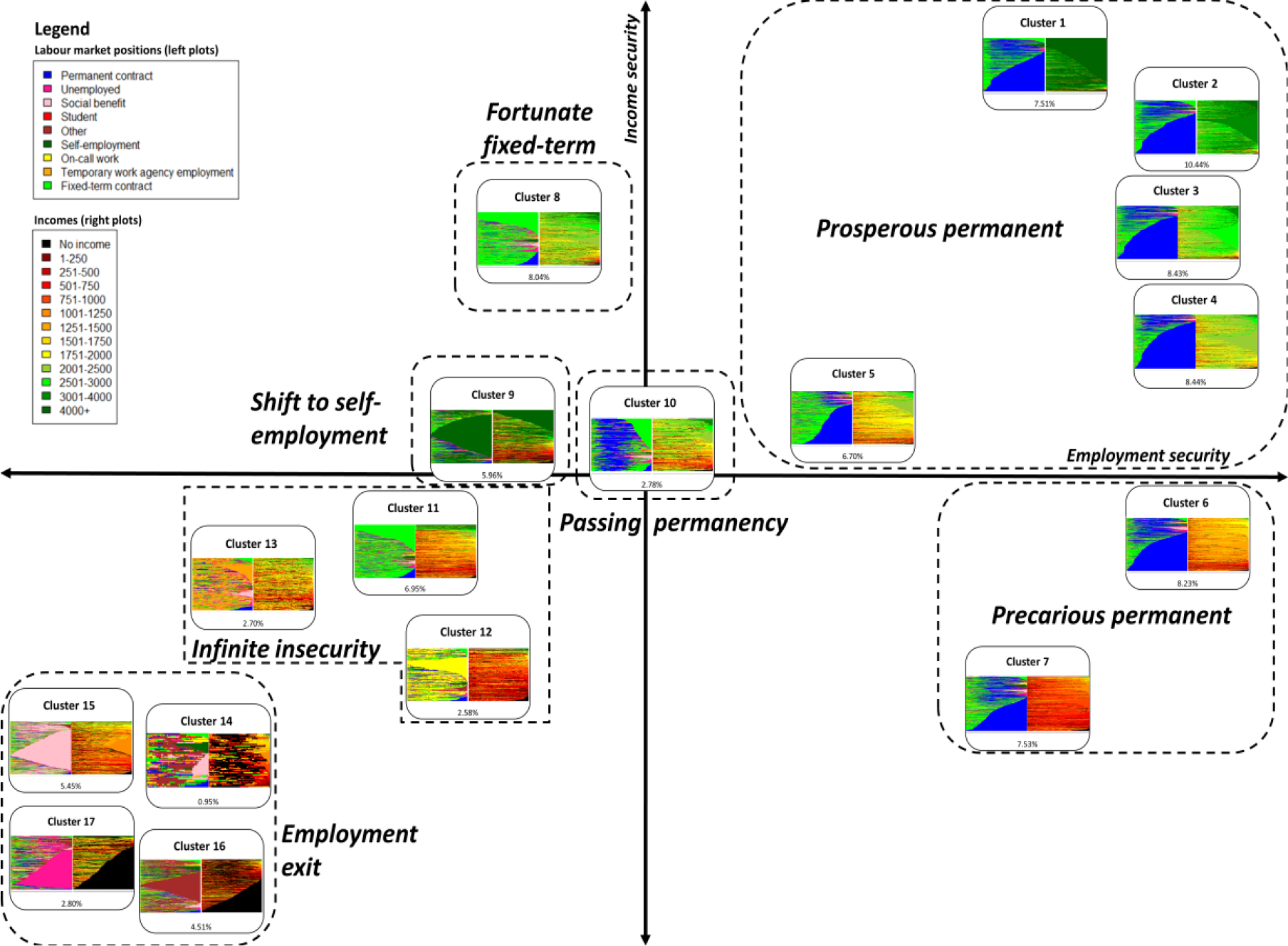
Dependent variable: a typology of non-standard employment careers. Figure is available in colour online.
The stepping-stone clusters with both high levels of employment security and income security are located at the top-right of the grid (clusters 1 to 5). In these clusters, workers make the transition to permanent employment relatively fast and earn decent and stable incomes during this process. For instance, workers in cluster 1 earn incomes of at least €4000 while making a quick transition to permanent employment. For workers in cluster 5, the transition to permanent employment takes somewhat longer, which results in lower employment security, while they earn incomes of around €1700. Together, these five clusters are combined in the cluster group Prosperous Permanent that contains 41.5% of the careers.
The trap-clusters in which workers have both low employment security and low income security can be found at the opposite side of the grid – in the bottom-left quadrant. In clusters 14 to 17, non-employment plays a central role. For instance, workers in cluster 17 end up in unemployment, while workers in cluster 15 end up in welfare benefits. These clusters are combined in the cluster group Employment Exit that contains 13.7% of the careers. However, in this quadrant, there are also clusters consisting of careers where workers are employed in precarious types of NSE and earn low and unstable incomes (clusters 11 to 13). These clusters are combined in the cluster group Infinite Insecurity that contains 12.2% of the careers.
The stepping-stone and trap dichotomy does not describe all careers. The bottom-right quadrant of the grid contains careers that have high employment security, but low levels of income security (clusters 6 and 7). These workers make the transition to permanent employment, but earn quite low wages, making them economically vulnerable. Wages are especially low in cluster 7, with workers earning on average only €800 monthly throughout their careers. These clusters clearly show that permanent employment is not necessarily a good outcome. These two clusters are combined in the cluster group Precarious Permanent and contain 15.8% of the careers.
Cluster 8, in the top-left of the quadrant, consists of careers in which workers have low levels of employment security as they work mostly in fixed-term contracts, but earn quite high incomes, giving them high levels of income security. Therefore, this cluster can hardly be classified as precarious, as would be done in research focusing on transition to permanent employment. This cluster is called Fortunate Fixed-term and contains 8% of the careers.
Finally, two clusters are placed in the middle of the grid. In cluster 9, Shift to Self-employment, workers enter self-employment after some time. This is a very diverse group in terms of income security, as incomes vary from extremely low to extremely high. This makes this cluster harder to classify. This cluster contains 6% of the careers. In cluster 10, Passing Permanency, workers quickly make the transition to permanent employment, but return to fixed-term employment after some time. Some of these transitions are accompanied by income increases, others by income reductions. This cluster, containing 2.8% of the careers, shows that permanent employment is not necessarily the final outcome in careers, as workers either voluntarily or involuntarily leave their permanent positions.
The distribution of workers among the clusters deviates somewhat from the original typology of Mattijssen and Pavlopoulos (2019). The clusters in the top-right quadrant are overrepresented (41.5% instead of 30%) while the clusters in the bottom-left quadrant are underrepresented (25.9% instead of 40%). These differences probably appear due to the fact that the occupation was more often unknown for workers in more precarious careers, or due to the fact that workers with less fortunate social positions are in general less likely to participate in surveys (te Riele, 2002) and therefore are also less likely to be included in these analyses based on linked survey-register data, yet they were present in the register data used by Mattijssen and Pavlopoulos (2019).
The impact of occupations on the NSE career
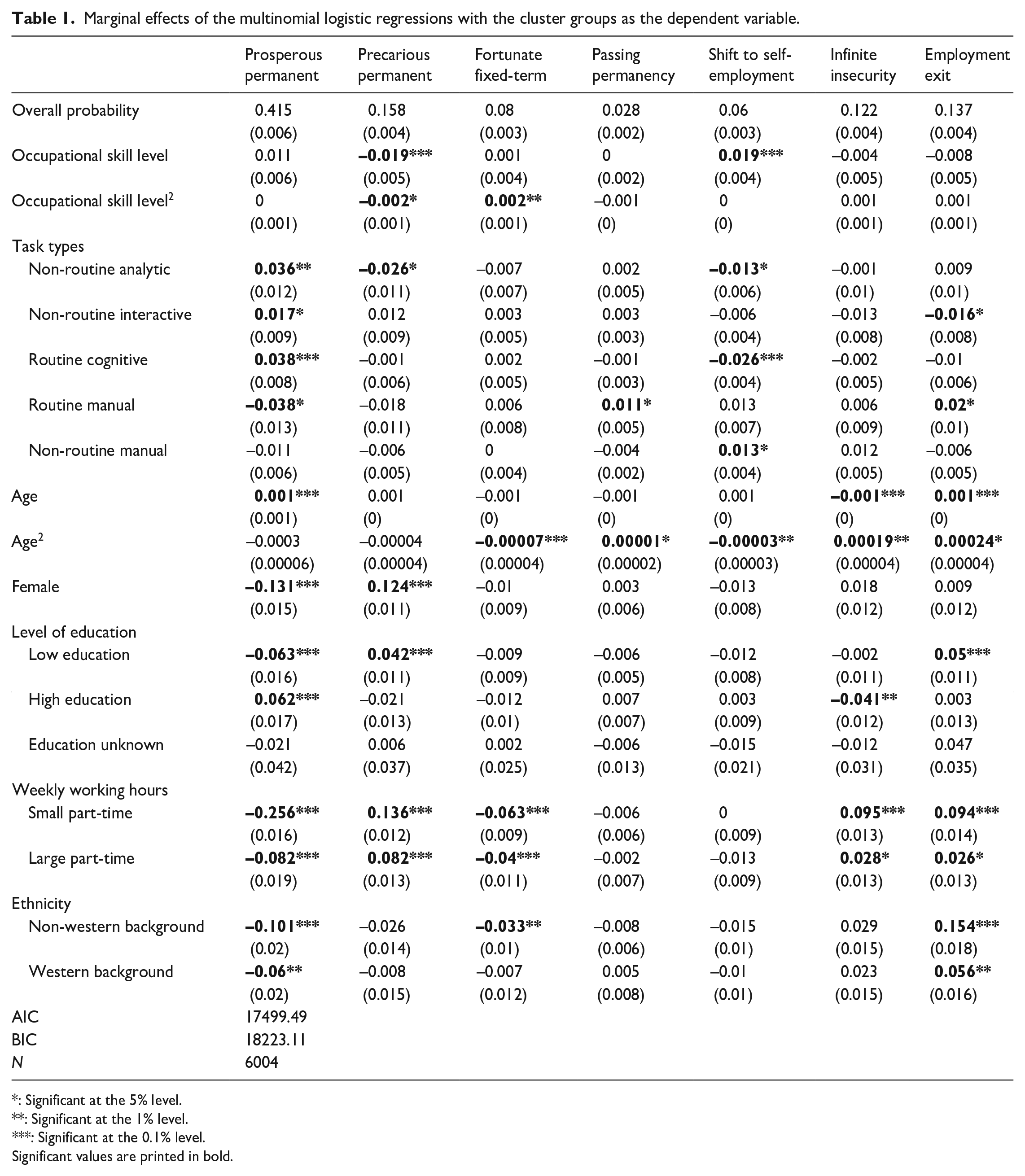
The effect of occupational skill level and task types on the type of trajectory followed by the workers is modelled with a multinomial logistic regression. The main results of this regression are presented in the form of the average marginal effects (Table 1). These average marginal effects show the absolute change in the probability of belonging to a certain career type resulting from a 1-unit increase of the independent variable. The average marginal effects for the control variables and the original regression coefficients from the multinomial logistic regression can be found in online Supplemental Appendix 4.
Marginal effects of the multinomial logistic regressions with the cluster groups as the dependent variable.
*: Significant at the 5% level.
**: Significant at the 1% level.
***: Significant at the 0.1% level.
Significant values are printed in bold.
Hypothesis 1 states that workers who enter NSE in occupations with high-skilled tasks have more stable employment careers with fewer NSE contracts and less unemployment (i.e. more employment security), as well as higher and more increasing incomes (i.e. more income security) than workers in occupations with low-skilled tasks. Moreover, it was expected that this effect prevails even after controlling for the education level of the individual. These expectations are not fully confirmed. Higher-skilled occupations only significantly reduce the probability of having a Precarious Permanent career type. These careers have lower levels of income security, but still have high levels of employment security. This effect is non-linear: the decline of the probability of having this career type speeds up as the skill level increases. For the probability of having career types with lower levels of employment security and/or income security, the level of the tasks executed in the occupation is not relevant. The only exception is that workers in higher-skilled occupations are more likely to make the Shift to Self-employment. Thus, high-skilled occupations do not protect against Infinite Insecurity or Employment Exits. It can, however, be said that when employment security is achieved, workers in high-skilled occupations are less likely to experience low income security, as they are less likely to have a Precarious Permanent career.
Furthermore, the results indicate, in contrast to hypothesis 1, that the individual level of education is more relevant for career development: the higher their level of education, the more likely individuals are to have a Prosperous Permanent career, with the difference between the highest and lowest level of education adding up to 12.5 percentage points. Those with lower levels of education are also more likely to have a Precarious Permanent career or to experience an Employment Exit, while the higher educated are less likely to experience Infinite Insecurity. Additional analyses (see online Supplemental Appendix 5), however, show that the effect of occupational skill level is partially confounded by the effect of individual skills. The limited effects of occupational skill level are thus likely due to the fact that individuals select themselves in occupations that match their individual skill level.
With respect to the type of tasks in the occupation, it was hypothesized that the careers of workers in routine occupations have more unstable employment careers with more NSE contracts and unemployment spells (i.e. lower levels of employment security) than the careers of workers in non-routine occupations, irrespective of income (H2a). Moreover, it was hypothesized that manual tasks lead to lower and more unstable incomes (i.e. lower levels of income security), irrespective of employment security (H2b). The results confirm the hypothesis on manual tasks (H2b) but provide contradicting evidence on routine tasks (H2a). The results show that routine manual tasks, such as operating machines, decrease the probability of having a Prosperous Permanent career – which entails high levels of employment and income security – while they increase the probability of experiencing an Employment Exit – which includes careers with both low employment and low income security. Moreover, routine manual tasks increase the probability of experiencing Passing Permanency, which includes careers with a voluntary or involuntary termination of permanent employment. Taking these results together, routine manual tasks indeed result in lower levels of both employment security, due to being routine, and income security, due to being manual. This would mean, for instance, that conveyor belt workers are very likely to have precarious careers. Furthermore, both non-routine analytic tasks and non-routine interactive tasks increase the probability of having a Prosperous Permanent career, while non-routine analytic tasks protect against Precarious Permanent careers and non-routine interactive tasks protect against Employment Exits. Thus, these non-routine and non-manual tasks lead to the hypothesized higher levels of employment and income security. This would mean that NSE leads to stepping-stone careers for occupations such as teachers or researchers.
However, routine cognitive tasks have a different effect than routine manual tasks as they increase the probability of having a Prosperous Permanent career. Thus, workers in occupations such as accounting are more likely to have careers with high levels of both employment and income security. Non-routine manual tasks have no effect on the probability of belonging to any career type, except for an increased probability of making the Shift to Self-employment. These findings indicate that, contrary to the expectations, non-routine tasks do not guarantee high levels of employment security, while routine tasks do not necessarily result in low levels of employment security.
Taken together, these findings also point to another unexpected result: manual tasks are more important in predicting employment security than routine tasks. Non-routine analytic, non-routine interactive and routine cognitive tasks lead to career types with higher levels of employment security, while routine manual tasks lead to career types with lower levels of employment security. However, as non-routine manual tasks have no effects whatsoever, routine manual tasks mostly drive these findings.
Discussion
In the light of the increase of non-standard employment in the Netherlands, gaining insights into which workers are at risk of ending up in precarious careers due to these types of employment is crucial. Whereas research has originally focused on the effects of individual-level characteristics on the career outcomes of NSE, this article contributes to the existing literature by extending the scope to occupational characteristics as these are the factors that mostly determine employers’ need and motives of the use of NSE.
The results indicate that, although its effects remain limited, occupational skill level contributes to labour market inequalities. However, in contrast to what could be expected based on human capital theory and signalling theory, high-skilled occupations do not protect against trap careers net of individual skill level. Moreover, the results indicate that employers seem to be more likely to base employment decisions on individual-level skills rather than occupation-level skills. Further research should pursue the latter topic as, in the data, only small numbers of low-skilled individuals worked in high-skilled occupations, and vice versa. However, the fact that some effects of occupational skill level remain, even after controlling for individual skill level, shows that this aspect is relevant in explaining inequalities in the outcomes of NSE.
The results also show that occupational task types influence the career outcomes of NSE, although the direction of the relationships is not always consistent with theory. Goldthorpe’s (2007) framework suggests that workers are more replaceable in occupations with tasks that involve low-skill specificity and low monitoring costs. So for these occupations, employers would mainly use NSE contracts to achieve flexibility. Therefore, it was expected that routine tasks, which combine low-skill specificity and monitoring costs, would lead to unstable careers with repeated insecure contracts and unemployment (i.e. low employment security). However, contrary to this hypothesis, routine tasks as such do not determine career pathways. The combination of routine tasks and manual tasks, however, turns out to be crucial. In more detail, routine manual tasks lead to low employment security and income security. This is very interesting, as it implies that employers use short-term employment contracts combined with low salaries when the jobs they offer combine routine and manual tasks.
The importance of manual tasks in explaining employment security is surprising as it is not predicted by theory. There are two possible explanations for this. First, manual tasks are generally associated with lower skill levels, as it is often assumed that manual tasks are easier to learn than non-manual tasks (Mincer, 1958). However, as occupational skill level is controlled for, this explanation is not plausible. A second explanation could be that routine manual tasks result in better measurable output than routine cognitive tasks. This would implicate that the level of routine tasks alone is insufficient to fully capture Goldthorpe’s (2007) dimensions of skill specificity and monitoring costs, and indicates that a combination of the importance of routine and manual tasks in an occupation could be a better measure.
Furthermore, the processual approach applied in this study has allowed investigating the effects of occupations on career quality in the dimensions of employment and income security, giving a more nuanced image of the existing labour market inequalities. With this approach, career outcomes that deviate from the traditional distinction between traps and stepping-stones have been identified as well. However, these deviant career types, that combine high levels of employment security with low levels of income security, or vice versa, are not explained well by occupational characteristics. So, while occupations can clearly stratify between the stepping-stone and trap careers, future research is necessary to identify which factors can explain these deviant career outcomes.
Though all opportunities offered by the data have been used to achieve these results, there are some limitations to this study. First, as the information on the workers’ occupation is only available for 15 of the 96 months of the observation period, the impact of occupational changes on career outcomes cannot be assessed. Second, the main aspects of occupations that, according to theory, determine career outcomes – monitoring costs and skill specificity – are not directly observed in the data and are in general very difficult to measure. Though the combination of routine and manual tasks is believed to be a good indicator of monitoring costs and skill specificity, and the O*NET scales to be the best currently available measurement of tasks, direct measures of skill specificity and monitoring costs can improve the analysis. Moreover, the operationalization of occupational skill level could be improved, as the mean level of education of workers in that occupation, which again was the best indicator available, remains a relatively crude measure of occupational skill level. Future research using more detailed data should attempt to tackle these issues.
Conclusion
The aim of this study is to expand the literature on the determinants of the outcomes of NSE by extending the focus to the extent to which occupational characteristics influence the career outcomes of NSE, specifically focusing on the effects of the occupational skill level and occupational task types. By using a processual approach, multichannel sequence analysis, a typology of NSE careers was created that classifies career types in terms of employment security and income security. Consequently, the results show that occupational skill level and occupational task types are relevant in explaining when workers experience the various career outcomes of NSE. Most importantly, the results show that manual tasks are not only relevant in explaining differences between workers’ careers in terms of income security, but in combination with routine tasks are also crucial in explaining differences in terms of employment security. All in all, this article shows that occupations matter in determining career outcomes as they influence employers’ hiring decisions. Policy makers can benefit from these results, as the results identify for which types of occupations NSE functions as a stepping-stone, and for which occupations as a trap. Recent Dutch governments have already implemented several legislative changes in order to increase the number of transitions from non-standard to permanent employment. These policies, however, do not differentiate between different types of occupations. Making such a distinction is important for two reasons. First, especially in occupations in which NSE functions as a trap, workers have a need for policies aimed at increasing their employment security. Second, if employers have no need for long-term worker commitment, as seems to be the case in the routine manual occupations, legislation aimed at increasing the number of transitions from NSE to permanent employment is less likely to be effective. In order to increase their employment security, these workers might be better off with policies that directly aim to improve their skills.
Supplemental Material
WES902984_appendix – Supplemental material for Occupations and the Non-Standard Employment Career: How the Occupational Skill Level and Task Types Influence the Career Outcomes of Non-Standard Employment
Supplemental material, WES902984_appendix for Occupations and the Non-Standard Employment Career: How the Occupational Skill Level and Task Types Influence the Career Outcomes of Non-Standard Employment by Lucille Mattijssen, Dimitris Pavlopoulos and Wendy Smits in Work, Employment and Society
Footnotes
Acknowledgements
The researchers acknowledge the contribution of Statistics Netherlands (CBS) for making the data available. Furthermore, the researchers want to thank Harry Ganzeboom, Paolo Barbieri and members of the SILC research group at Vrije Universiteit Amsterdam for reviewing earlier versions of the article and for their useful comments and suggestions. We also want to thank the participants of the ECSR Spring School 2018, the 2018 IREC Conference, the 2018 ECSR Conference and the RC28 2019 Spring Meeting for their comments on this article.
Funding
The authors disclosed receipt of the following financial support for the research, authorship, and/or publication of this article: This project is part of the research programme ‘Non-standard employment: Prospect or precarity?’ (project number 406.16.541), which is financed by the Netherlands Organisation for Scientific Research (NWO).

Supplementary material
The supplementary material is available online with the article.
Notes
References
Supplementary Material
Please find the following supplemental material available below.
For Open Access articles published under a Creative Commons License, all supplemental material carries the same license as the article it is associated with.
For non-Open Access articles published, all supplemental material carries a non-exclusive license, and permission requests for re-use of supplemental material or any part of supplemental material shall be sent directly to the copyright owner as specified in the copyright notice associated with the article.
