




Abstract
In drawing out how human lives are always already inextricably entangled with the non-human elements of the world, this paper explores how stone, as a constituent of urban materiality, provokes a wealth of emotional, sensory and affective impacts in the experience of place. The paper discusses how the sonic, tactile and visual qualities of stone contribute to the sensory and affective experience of places, shape the symbolic meanings and affective impacts of diverse memorials, and trigger a powerful sense of geological conviviality.
Introduction
Recent relational theories have extended considerations about what constitutes the social, with greater emphasis increasingly placed upon how human lives are always already inextricably entangled with the non-human elements of the world. One body of thinking explores how rather than solely comprising the functional infrastructure of the urban fabric, materiality provokes a wealth of emotional, sensory and affective impacts amongst city-dwellers. In drawing on these ideas, I focus on how one integral material constituent, stone, contributes to the lived experience of place. Stone, often regarded as hard and impassive, a metaphor for durability and permanence, has been a familiar material companion for humans throughout history. First, I investigate how stone bestows distinctive sonic, tactile and visual characteristics that are felt in bodies and contribute to the sensory and affective experience of place. Second, I consider how stone deployed in the fabrication of memorial forms is expressive of sensory and affective impacts in addition to the symbolic meanings encoded within them that undergird a sense of place. Third, I explore how recent discussion about the Anthropocene reveals that encountering stone can trigger a powerful sense of geological conviviality, fostering a sense of deep time and an affective sense of living with an uncanny, vital materiality, a strangeness accentuated by a dawning awareness that future geological strata will be composed of elements of the human-built environment. Before this discussion, I outline an expanded understanding of place that incorporates the affective and sensory.
Place has been variously conceived as a geographical location, a physical entity with boundaries, a demarcated space of governance, and a space of shared cultural meanings (Edensor et al., 2021). Until recently, ideas about place have perpetrated rather static and sedentary understandings; influenced by colonial strategies of occupation and appropriation, place has commonly been described according to its geology, natural history, architecture, social customs, religious and class constitution, and historical lineage – that is, according to scientific, quantifiable attributes. Subsequent accounts that have critiqued these notions foreground how rather than intrinsic and essential, place is invariably a social construct informed by dominant ideological meanings; for instance, Marxist narratives construe places as predominantly structured by capitalist relations (Harvey, 1989), locations at which capital manifests itself, realises values and fixes its crises. Yet more recent notions, especially Doreen Massey’s (1993) seminal ‘progressive sense of place’, have augmented these conceptions in focusing on how place is shaped by its relations with other places within increasingly larger networks and flows, further challenging earlier narratives of place as bounded, classifiable and static.
These relational accounts that extend understanding about places, and most particularly cities, are continuously emergent material assemblages. Many places have originally been constructed out of locally sourced materials that have been used in reproducing identifiable local building styles. However, in modern times, most cities are continuously reconstituted by a whirl of imported matter, are perpetually emerging assemblages that are depleted, supplemented and restored at diverse temporal scales. In the case of stone, cities are ceaselessly fabricated through sourcing and importing the geological resources of other places (Edensor, 2011, 2020). Formerly reliable sources may be rapidly superseded or exhausted, while new supply sources are discovered. Despite this ferment of material transformation, stone, concrete and brick continue to provide a degree of durability and consistency. However, this apparent durability blinds us to the dynamism of lithic substances, volatile processes that new materialist thinking has brought to attention.
Though these relational and vitalist understandings of place and materiality are significant, only in recent years have they been supplemented by conceptions of place as an affective, emotional and sensory realm, further veering away from scientistic and ‘objective’ depictions. Such accounts emphasise the transpersonal, the potency of affect and atmosphere, and the agencies of other, non-human forces. Drawing on phenomenological, post-phenomenological and non-representational ideas, the focus is on the qualities of place and the ways in which these stimulate feelings and sensations.
Brief reflection reveals a wealth of place-based qualities that foster a range of emotional, affective and sensory responses: the seasonal growth of plants and trees, the familiar sounds of birdsong or music, the ways in which people move and talk, the tastes and smells of local food, the volatile or muted tones of street conversation, the affective intensities that accumulate in spaces of public gathering such as train stations and high streets, everyday pedestrian and vehicular rhythms, the cloudiness or cloudlessness of the sky, the sense of wide openness or being closed in by the looming height of the buildings, the play of light and shadows, the familiar waft of sewage or arboreal scents, and the bright or muted colours of the building surfaces and their particular material textures. In paying attention to such qualities, we better grasp those characteristics of place and landscape that are felt but often barely registered, affectively and sensorially apprehended attributes that solicit an unreflexive and habituated inhabitation rather than the discursive reiteration of a stable catalogue of identifiable characteristics.
Particularly influential in advancing an awareness that place is continuously in process is Tim Ingold’s (1993) notion of the ‘taskscape’, in which inhabitants serially encounter place as a perceptual realm, saturated with historical resonances from their own lives and those of others. In carrying out everyday manoeuvres and routines, people habitually and unreflexively sense place while possessing a competence borne of repeated practice in a familiar realm. Ingold also emphasises that a place owes its character to the sensory experiences it affords to inhabitants, grounded in the kinds of activities in which they engage. Other significant accounts foreground sensation and the everyday practices of inhabitation. Yi Fu Tuan (1975: 152) refers to ‘distinctive odors, textural and visual qualities in the environment, seasonal changes of temperature and color’, while David Seamon (1979) identifies the routine ‘place ballets’ undertaken by residents that foster a sense of belonging and develop competences, such as where to buy particular goods, how to drive a car and take public transport. Crucially, such routines are not merely individual but are also collectively shaped; they intersect with those of others, so that ‘cultural community’ is co-produced by ‘people together tackling the world around them with familiar manoeuvres’ (Frykman and Löfgren, 1996: 10–11). For instance, individual pathways coincide with those of others at key junctures in place, at local shops, bars, cafes, garages and parks and other ‘activity spaces’ (Massey, 1995), spaces of circulation and meeting that contribute to a shared sense of inhabitation.
Accordingly, in moving through and dwelling in place, our bodies are intermingled with the world through a melding of the senses (Serres, 2008). Such phenomenological understandings are supplemented by post-phenomenological explorations that decentre the human body in focusing on a more distributed notion of agency and feeling that foregrounds how lively materialities impact upon the human sensorium. This advocates a recognition that rather than subjects distanced from the world, we experience ‘the entwined materialities and sensibilities with which we act and sense’ (Wylie, 2005: 245). We see with light, we move with surfaces, we feel with stone. Such ongoing experiences of place have rarely been subject to conscious reflection and are typically obfuscated by the symbolic meanings through which people cognitively articulate a sense of belonging.
In exploring the entangled effects and affective and sensory impacts of stone as an element of urban materiality, it is necessary to become attuned to my own sensory experiences of both familiar material realms and places that feel, sound and look different to the places to which I am accustomed. In addition, spells of participant observation focus upon how others interact with lithic matter in parks, along streets, at monuments, shopping centres and stations, paying attention to modes of movement and rest, social interaction and play. Through these two approaches, I seek to provide insights into some of the many ways in which a city’s stone might be sensed
Yet it is also salient to acknowledge that the sensory apprehension and interpretation of space and materiality is also profoundly shaped by bodily capacities and dispositions that are conditioned by age, class, sex and physical ability. The feel of a hard, concrete floor may impact on the experience of a wheelchair user very differently to a sprightly pedestrian, while a cobbled street impacts divergently on the experience of someone using a walking stick, wearing high-heels or cycling. As a mobile, middle-aged white man, I walk, sit upon, linger at, touch, look at and listen to my engagements with the city’s stone in particular ways. Moreover, as Constance Classen (1993) emphasises, the senses do not provide unmediated access to the world but are invariably culturally shaped, informed by epistemologies, values, notions about what should be sensorially prioritised, shared cultural practices, histories and stories. This caveat aside, I hope that the following account will generate resonances amongst readers and solicit comparisons with their own engagements of lithic materialities.
Sensing the colour and textures of urban stone
In moving through, inhabiting and visiting cities, people continuously interact with the numerous lithic materials of the city, and I submit that this contributes to their sensory and affective experience of the built environment.
First, the haptic feel of stone to the touch of the hand is conditioned according to whether it is dense or friable, coarse or smooth. In particular urban settings, an awareness of textural complexity may be solicited when immersed within a mixed material composition that includes different kinds of lithic and other materials, or a contrasting sense of material consistency where a single kind of stone clads surfaces and facades. These tactile affordances also shape the experience of walking upon lithic surfaces, perhaps providing a reassuring, secure grip to the soles of the feet, or alternatively, an irregularity that must be attended to or an unnerving slipperiness when wet. Stone also possesses thermal qualities, determined through its propensity to absorb heat, reflect light and soak up or repel moisture, and it possesses sonic qualities – if struck with a hard implement it may make a chiming sound or a dull thud.
By virtue of these affordances and others, stone is also enrolled into a range of architectural practices that seek to create particular phenomenological relationships between buildings and bodies. For instance, an overwhelming sense of being enfolded within the solid interior of a large early Gothic cathedral such as at Durham is generated by the weight and heft of the stone that covers the walls and out of which mighty columns are composed while, conversely, the delicate tracery and vaulting of later High Gothic styles convey a sense of interior lightness. Contrastingly, the expansive yet solid design of a city square or sporting stadium can deliver a sense of openness and accessibility.
Second, the experience of all material entities is informed by the consistency, variation and depth of their colours, and this may change according to rates of age and biological colonisation that underpin the vitality of stone and the forces that assail, clad and deteriorate it. Though colours are not intrinsic but ‘are a product of both the electro-magnetic spectrum and visual perception’ (Beveridge, 2000: 312), they profoundly impact on sensation and perception. As Diane Young (2006: 173) submits, colours ‘animate things in a variety of ways, evoking space, emitting brilliance, endowing things with an aura of energy or light’ and can be combined to ‘create a medley of affective and sensual impressions’ that are usually interwoven with diverse cultural symbolic associations.
Yet all such encounters with the elements of the material world are invariably relational, for objects and assemblages are always situated in relation to other things within a space, in terms of their positioning within a multifarious material urban environment that contains multiple dimensions, textures, colours, shapes and combinations. Within these spatial fields of perception, the sensing of materiality sensation is always relational. And as long-time inhabitants come to know, these relationalities shift over time as some buildings are demolished, others are built, some are renovated while others decay and erode – processes that continuously change the experience of texture and colour. Moreover, within complex urban environments, stone buildings, surfaces and fixtures can be approached from various perspectives – from above, below, side on and head on, thereby construing different relationships with bodies. These shifting urban compositions and conditions underpin Christopher Tilley’s (2004: 24) contention that ‘meaning is neither imposed on things nor pre-given in consciousness but discovered in the course of practical activity’. In exemplifying the particular textural and colour affordances of place, I now explore how the basalt (or ‘bluestone’) used in the composition of much of Melbourne’s lithic fabric affords a distinctive range of sensory and affective experiences (Edensor, 2020).
In the mid-19th century, as basalt was discovered to be the predominant rock that lay under large swathes of what was to become Melbourne, it was rapidly deployed as a building material for the emergent city. Most prominently, it was used in the construction of cottages, factories, churches, administrative buildings and the widespread laneways and kerbs.
The deep blue-black-brown of the basalt absorbs light so that it stands out as markedly darker than the lighter-toned brick and concrete of the city, and this is accentuated during the intense summer radiance when these lighter-hued surfaces reflect light, sometimes blindingly. The gloomy colour of the bluestone can make a powerful impression on visitors to Melbourne who are unfamiliar with this very particular stone. For example, architect Norman Day contrasts Sydney’s sandstone textures as ‘slippery and fluid, like an upturned jar of honey’, while Melbourne’s basalt ‘turns an ugly wet black when it rains’, and novelist Delia Falconer describes sandstone as ‘a kind of bass note to Sydney’ (Trigg, 2018: 42). In addition, its dark hue means that during the hot summer months, bluestone absorbs heat, and after several hours of exposure to the sun it can be uncomfortable to sit on heated bluestone steps or kerbs, while this is not the case for stone fixtures of lighter colour.
The most revered and pervasive presence of bluestone is found in the 19th-century cobbles of the numerous narrow laneways that crisscross the inner city. At the time of their construction, these compact, raised road surfaces afforded a comfortable journey for the carts that plied these streets, and for their passengers and the horses that pulled them, and importantly, they added extra traction for horses’ hooves. These dense surfaces have proved extremely durable over the past century and a half, although many have been worn down somewhat by heavy automobile traffic, but such effects add to the patina that signifies their age. As such, coming across cobbled streets and laneways such as those in Melbourne can suddenly conjure up a sharp impression of the past as we sensorially imagine their 19th-century affordances and imagine the passage of horse-drawn carts, rhythmic clattering of the unyielding iron of cartwheels and horses’ hooves, and the rich aroma of plentiful horse manure. These stony remnants of an otherwise vanished world of horses and carts also invoke the prevalence of numerous stables built to house the animals.
Besides these time-honoured textures, the effects of the rain are especially notable on the glistening cobbles of the bluestone laneways, their dark colour augmented by their reflective, shiny surfaces, which are rendered especially potent during the reflecting, dim illumination when darkness descends (Figure 1). During rainstorms, these affective qualities are supplemented by gurgling, gushing sounds of the water that courses along the gutters or central channels. But at any time, a wander through a laneway is rarely eurhythmic, for the ground underfoot must be scrutinised for irregularities that might cause a pedestrian to lose balance, especially if equipped with slippery soles or high heels. Yet these uneven affordances also generate pleasurable engagements as the body is enlivened. Walking along an inner suburban laneway in mid-afternoon, I was passed by a young mother who was jogging as she pushed a buggy that accommodated a small child who delightedly uttered an incessant hum tone that changed in pitch according to the variations of the cobbles under the wheels. A more vigorous playful, sporting confrontation with these bluestone cobbles takes place during the annually staged Roobaix, initiated in 2006. During the event, hundreds of cyclists follow a 40-kilometre route, revealed only on the day of the event, organised so that it predominantly runs through the laneways. The occasion is named after a more gruelling sporting competition, the Paris to Roubaix race, that is also staged along aged, cobbled roads. Yet the Roobaix is not a racing competition, and prizes are awarded for elaborate cycling costumes and bicycle décor. Nonetheless, the course offers cyclists a stimulating if shuddering experience of riding along cobbles, soliciting a kind of intimate encounter with a unique aspect of the lithic materiality of their city.
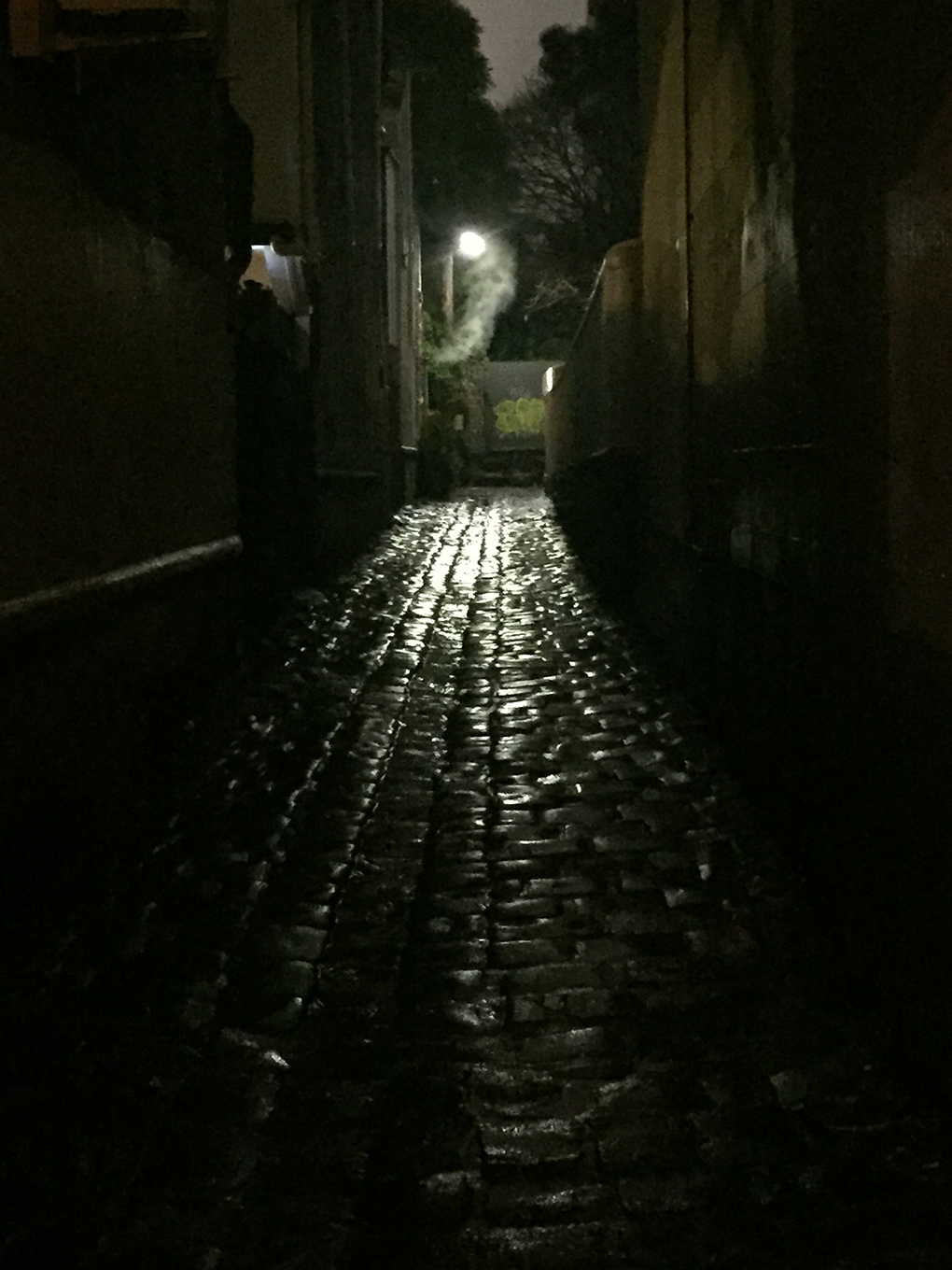
Bluestone laneway in the rain, Melbourne. Photo by author.
The cobbled bluestone laneways have also become a more widely cherished feature of the city, although a few decades ago they were commonly regarded as outmoded, crude, unamenable to ornamentation and unpleasantly dark in tone. In contrast, in recent years they have become officially reappraised as signifiers of the heritage of the city, as an extensive programme of maintenance and repair seeks to ensure their conservation. For instance, the City of Port Phillip offers guidance for restoring and preserving old laneways, kerbs and channels and has celebrated how bluestone embodies Melbourne’s heritage according to a range of virtues: it signifies early settlement patterns, exemplifies specific technologies and historical artisanship, marks the evolution of city-wide infrastructural developments, and possesses a unique aesthetic significance (City of Port Phillip, n.d.). Not only does the city renovate these earlier laneways but it has also developed an extensive programme to replace the asphalt and concrete pavements of the city centre with new Victoria-sourced bluestone paving, further entrenching the importance of basalt to the identity of the city. These newer, much smoother surfaces, cut with advanced machine techniques rather than mallet and chisel, offer pleasing, non-slippery surfaces, and provide a dramatic sensory and affective contrast to the cobbles laid in the old laneways. Yet they richly add to the material diversity of Melbourne’s streets while retaining a link to the city’s historic local building stone.
While bluestone is one ingredient in Melbourne’s variegated lithic fabric, and in this it resonates with the material distribution of stone in most other cities, other settings are more singularly characterised by dominant building stones. For example, most of the light grey stone building material in Aberdeen, which has produced the nickname the ‘Granite City’, has been quarried nearby since the 17th century, with the city’s coastal location also encouraging much granite to be exported. Indeed, it is estimated that of the material used in the city’s construction, over 50% of Aberdeen’s buildings derive from the massive but now disused Rubislaw quarry. Especially in winter, the silvery colour of the granite matches the colour of the skies and cold temperatures of this north-east Scottish city to generate a pervasive greyness. Similarly, the buildings of Paris have for centuries been supplied by a few limestone quarries in the Oise, 25 miles north of the city. The result has been an exceptionally monotone appearance, as Rebecca Solnit (2000: 196) describes: ‘Everything – houses, churches, bridges, walls – is the same sandy grey so that the city seems like a single construction of inconceivable complexity, a sort of coral reef of high culture’.
Another city in the UK, Bath, is also largely fabricated from a single type of stone, the locally supplied Jurassic oolitic limestone sourced from underground quarries to the east of the city. A ubiquitous monotonal yellowish honey hue colours Roman baths, medieval walls, the 16th-century abbey, Palladian crescents, numerous Georgian bridges and squares, as well as contemporary structures both grand and mundane. The yielding quality of Bath Stone means that it has proved easy to quarry and is amenable to the sculptor’s and mason’s chisel, creating a gentle, soft texture to the city. Its mellow tint glows in strong sunlight, producing a colour experience that in its material consistency contrasts with the multi-hued appearance of most other British cities. This unfluctuating historical fabric has encouraged the city to be assigned World Heritage status by UNESCO, who consider this uniformity to have provided ‘an integration of architecture, urban design, landscape setting, and the deliberate creation of a beautiful city’. In adapting to this beneficial accolade and the advantages to the tourist economy that this confers, the local council specifies that new buildings should be created from Bath Stone, further consolidating the city’s identity with this limestone and maintaining aesthetic and sensory continuity over the longue durée.
The historical continuity of Bath’s stony consistency clashes with the ways in which in other places, the contemporary provision of urban material fabric from other than local sources triggers widespread concerns amongst inhabitants, conservationists and architects that a distinctive material identity is being eroded, culminating in the placelessness warned of by Joshua Meyrowitz (1986) and Edward Relph (1976). These anxieties chime with recent apprehensions about the spread of serial monotony inherent in homogeneous architecture, corporate brand stores and global food outlets. Together with festival marketplaces, waterside developments, transport hubs and shopping malls, such realms are typified by Marc Augé (1995: 178) as ‘non-places’, ‘spaces of circulation, communication and consumption, where solitudes coexist without creating any social bond or even a social emotion’.
In discussing stone supply, LGraham ott (2008) points out that before the 18th century, the lithic material used for the material infrastructure of almost all British places was overwhelmingly local. This can be easily evidenced by the traces of medieval quarries that lie adjacent to many villages. Critically, the subsequent development of canal and rail networks during the transformation towards an industrial economy made it possible for many growing settlements to access better quality building materials than the locally available sources upon which they had depended, and which firmly tethered the materiality of a place to its immediate locale.
Since then, this disembedding process has accelerated as increasingly ‘efficient’ transport technologies make stone supply an overwhelmingly global industry. The rise of shipping container, logistics and cargo technologies have enormously expanded contemporary options. Such supply networks tend to render all space within these globally constituted networks abstract, interchangeable and equivalent. This fosters a calculative imaginary of placeless, homogeneous sites that accommodate and interlink manufacturers, technical specialists, shipping and road haulage companies, storage operations and retailers, and ostensibly facilitate frictionless flows of goods, money and people.
Accordingly, as much contemporary building stone is supplied from ever-fewer super-quarries, as economies of scale and technological advances have drastically reduced price, smaller local and national quarries become redundant. For instance, labour costs for Chinese stone manufacture are both cheap and technologically advanced following investment in equipment such as massive saws that can cut multiple slices of stone simultaneously. Fewer regulations, less stringent health and safety measures, fewer worker rights and less exacting environmental standards further lower costs. As a consequence, rather than seeking out local stone sources, redevelopment projects across the world clad their new surfaces with imported marbles and granites. As Matt Huber (2018: 150) points out, as with many other materials and commodities that are globally sourced, the place from which they originate is obscure, part of a wider process through which ‘worker / consumer lives are only socially reproduced through commodities whose ecological origins are opaque and unknowable’.
Such imported stone is exemplified at the large extension appended to the renovated Arndale Centre in Manchester, damaged in a 1996 IRA bomb attack. At its western entrance, Carrara marble from Tuscany lines the walls, a stone used to build renowned buildings and sculptures in Rome and Renaissance Italy. Beyond, wall panels are clad in veneer slabs of grey Sardinian granite and Jurassic Jura Grey limestone from Solenhofen in Germany, a lithic material suffused with fossilised ammonites, belemnites and sponges. The extension’s floor is composed of Verde Maritaca, a Brazilian migmatite, and Impala Black gabbro from South Africa, a further use of imported stone that is replicated in other new developments across Manchester (Edensor, 2009).
Some campaigners and academics are beginning to protest about the mooted placelessness that such imported stone environments produce. Alison Henry (2008) argues that ‘we need to decide whether we would prefer a small number of “super-quarries” restricted to the backyards of an unfortunate few but causing significant environmental impact and exporting tons of stone well beyond their region of production’, or the reopening of abandoned quarries in the face of ‘local opposition from local residents fearful of noise, dust and heavy lorries’. Graham Lott (2008) considers the erasure of the sensory and affective specificity of place, asserting that stone must be used ‘not only to conserve our existing historic stone structures but also to build new stone housing, thus complementing and continuing a vernacular building tradition which has developed over several centuries’, in order to maintain ‘a unique regional architectural identity…and not allow this rich heritage in stone to dwindle away’. In Melbourne, at least, the continuing use of local bluestone in creating new pavements and kerbs reproduces the connection between the city and the stony resources of its environs. Such appeals to the renewal of local identity through the use of traditional urban material resonate with Kenneth Frampton’s (1983: 26) call for a critical regionalism that continues to be embedded within the ‘specific culture of the region – that is to say, its history – in both a geological and agricultural sense’ (p. 26, emphasis added). The sensory and affective experience of cities may well be expanded, redistributed by the importation of an ever-greater variety of lithic materials from an ever-greater range of sources. However, the erasure of the consistent stony characteristics that formerly provided more identifiable sensory experiences perhaps diminishes a more distinctive sense of place that was formerly embedded in its material fabric.
Stone memorials: Plinths and lithic landscapes
Because of its durability, stone has been integral to the commemorative impulses of humans, a key constituent of memorials and other structures intended to last across time. Stone has been used to memorialise esteemed people or significant events, mark sites of sacred significance and glorify deities. Indeed, stone artefacts and buildings constitute a huge repository of human commemorative heritage: Neolithic stone circles and monoliths, Egyptian and Mexican pyramids, Roman colossi, Greek obelisks endure as ancient relics. Medieval market crosses, cathedrals, Indian temple complexes, Easter Island heads and the sturdy walls of Great Zimbabwe. Across the 20th century, stone has been fashioned into memorials to war and independence struggles, further testifying to its widespread availability, durability and malleability. Stone has thus been the pre-eminent material for those who seek to stabilise the past in space, a key signifier of the endeavours of social elites to inscribe their identities, values, tastes and heroes as part of the production of space (Lefebvre, 1991).
Throughout history, stone memorials have been devices through which ‘groups can gain visibility, authority and legitimacy’ (Marschall, 2009: 2), imposing selective meanings and sentiments across space and mobilising ‘ideological and political discourses that authorize their creation’ (Crownshaw, 2014: 220). Accordingly, many memorials are sites of ‘intensity’ that crystallise power relations (Lefebvre, 1991) and, moreover, are points of everyday congregation and passage that line major thoroughfares and dominate squares.
Numerous forms of commemoration have deployed stone to inscribe meanings upon place. Following the First World War, there was a significant shift from memorials that honoured particular figures to the creation of monuments that commemorated all of the fallen. Local war memorials saturated European space and were supplemented by national sites of commemoration, though the immense stone complexes created to remember those lost during the ANZAC campaign dwarf these monuments (Sumartojo, 2015). Following the Second World War, memorials have become more diverse, often honouring those held to have been neglected in official histories and policies of remembrance. As Stevens and Sumartojo (2015: 3) claim, contemporary memorials tend to feature more abstract designs in moving away from didacticism and ‘increasingly take wider, lower landscape forms that are closely integrated with everyday urban public space’. Moreover, they ‘encourage close multi-sensory engagement’, inviting bystanders to recline or clamber upon them.
Here, though, I focus on the Victorian and Edwardian figural statues that continue to pervade urban spaces across the world, notably in European and American and formerly colonised realms. It is largely these memorials that are associated with the malign effects of slavery, colonial exploitation and political oppression that have triggered the recent and widespread controversies over their continued presence in public space.
The 19th-century era of commemoration is evident in the presence of numerous stone and bronze figures installed on stone plinths in squares, parks and streets. Erected through funds raised by groups of citizens or authorities, they are symbols of a desire to produce shared, coherent symbols for growing urban publics, as states or colonial powers sought to reinforce their authority over space. Most 19th-century statues are fashioned in the classic realist style derived from Ancient Greece and Rome, with later 19th-century figures deploying romantic, pre-Raphaelite and realist styles as part of the ‘new sculpture’ (Beattie, 1983). With many figures garbed in togas and robes, such forms rather grandiloquently claim European cultural inheritance, reinforcing dominant ideas about imperial power, tradition and heroism. Lingering as an essential element in the urban fabric, they are typically incorporated into the unreflexively apprehended routine environments in which we work, play and consume. Habitually encountered but rarely considered, they have become a normative element in the organisation of everyday space and materiality.
These memorials conjure up an era in which particular people were routinely commemorated, a practice that has largely vanished from most contemporary cities. For the sentiments they espouse have become outmoded, while the symbolic meanings encoded into their forms have become forgotten, even incomprehensible, and public knowledge about the person commemorated may have evaporated. Such inscrutability is exemplified by Marina Warner (1993), who explores how strategies to materialise revolutionary values in the statuary along the Champs Elysees in Paris drew upon classical allusions that are largely unfamiliar in a contemporary era in which few receive a classical education. Yet Angela Dunstan (2016: 3) contends that for the Victorians themselves, many sculptures were ‘hauntingly present but rarely interrogated, monumental yet mundane, and, above all, disconcertingly difficult to read’. Despite this obsolescence, these monochrome and still likenesses of people who lived long ago continue to haunt the city.
An example of such statues is a bronze rendition of Manchester’s bishop, the obscure James Fraser, who presided from 1870 to 1885, when he died (Edensor, 2019) (see Figure 2). Fraser is one of five statues in Manchester’s 19th-century Albert Square, an archetypal example of what Doreen Massey (1995) terms an ‘activity space’ of intersection and meeting. It is striking that this authoritative patrician figure, reminiscent of an era in which biblical knowledge was commonplace and most people regularly attended church, remains in situ even though few passers-by possess any knowledge of this character. While the sculpture is a finely rendered work, dramatically portraying the bishop dispensing wisdom from his lofty Aberdeen granite plinth, and has been granted Grade 2 listed status by Historic England as an object of heritage, the figure is devoid of contemporary relevance.
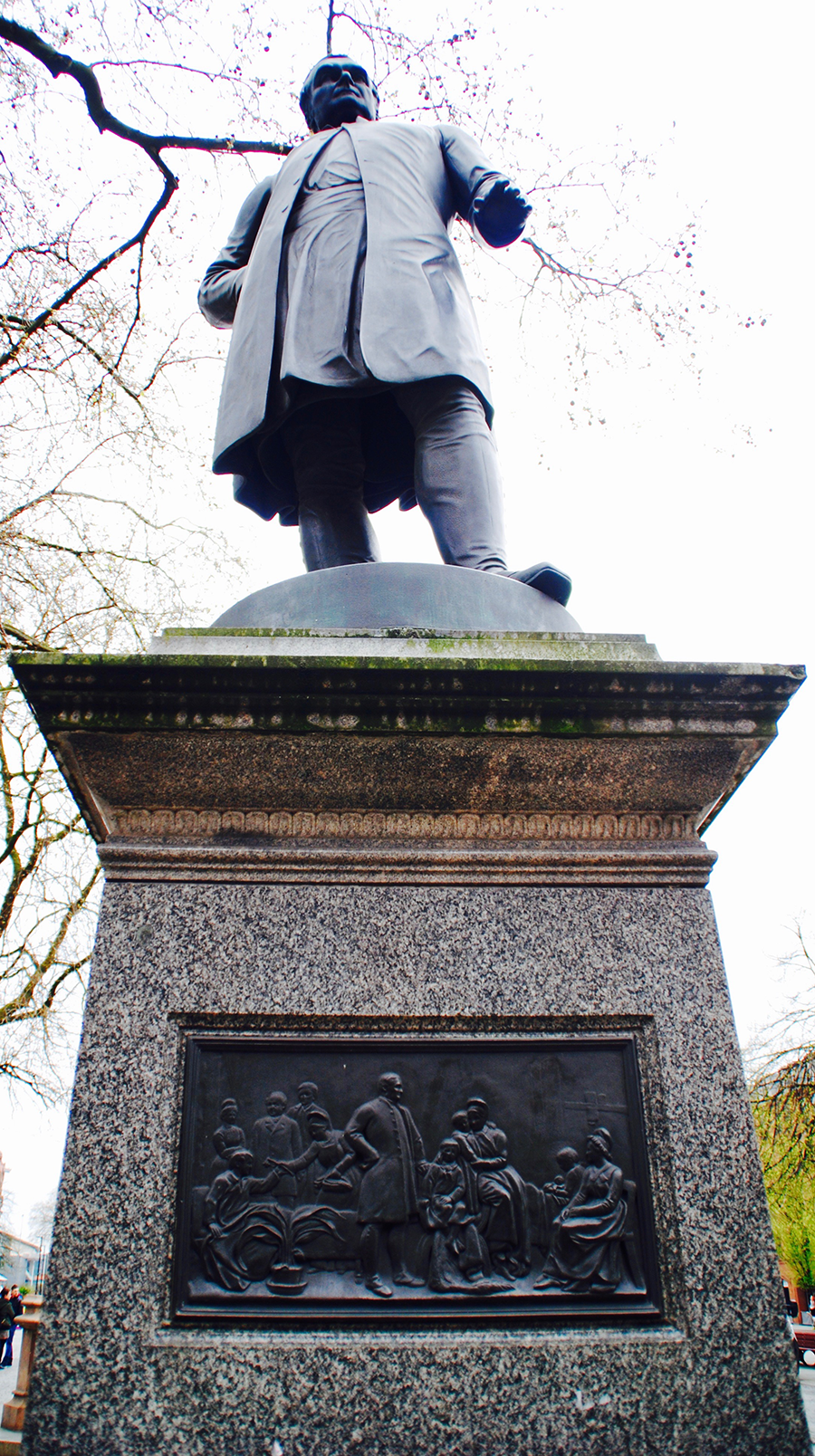
Bishop Fraser atop granite plinth, Albert Square, Manchester. Photo by author.
I suggest that it is its stony and metal materiality, suggestive of immobility and permanence, that deters the removal of the sculpture of the long-forgotten bishop from the square. These weighty material elements suggest an imperturbable solidity and a permanent embedding in the urban landscape. Skilfully rendered to assume a likeness of the bishop on which it is modelled, the removal of the memorial might seem improper, an affective impact intensified by the charismatic persona that is conjured, with his commanding left arm seeming to authoritatively address an assembly while his right arm is braced against his side as he thrusts out his chest in a dominant posture. Given extra potency by his sturdy boots, his thick over-garment and his stern demeanour, the skilfully rendered figure carries conviction as a recognisable human presence even though the man he represents is long departed. Critically, this powerful material impact is undergirded by Fraser’s position on the plinth from which he stands aloft, towering above the pedestrians below.
A plinth is an architectural device that distinguishes a sculpture or memorial from the surrounding environment, elevating its significance as art or commemorative form. The lofty, solid, hard-edged and rectilinear stone plinth discourages physical contact with the sculpture and enhances a sense of its inviolability and immovability. The use of resolute stone material for the plinth is fundamental to realising the intention to produce enduring meanings and memories in space. Especially deployed in classical and Renaissance sculpture, plinths became elaborate and imposing, a tradition that was carried forward to the Victorian era as a means to instantiate power and meaning on place and a strategy amongst sculptors to exalt their work – until artists such as Rodin forestalled its importance by creating sculptures that extended upwards or outwards and engaged with observers at eye level. Stallybrass and White (1986: 21–2) remark that plinths render the statues mounted upon them ‘elevated, static and monumental’, and draw attention to the ‘compelling difference between the human body as represented in popular festivity and the body as represented in classical statuary’ – and by inference, the neo-classical statuary of early modern cities. They argue that while the ‘grotesque’ body is ‘teeming, already part of a throng’, the statue upon a plinth keeps its distance as ‘the radiant centre of a transcendent individualism…raised above the viewer and the commonality and anticipating passive admiration from below’. Artists have deployed critical strategies to interrogate and reveal the politics of the stone plinth, perhaps most glaringly in Rachel Whiteread’s Monument (2001), in which a transparent resin echo of Trafalgar Square’s Fourth Plinth is placed upside-down on top of it. Translucent, the light is refracted through the resin in a way that stone prohibits, creating a sensuous appearance that shifts according to temporary levels of radiance and providing a material lightness that contrasts profoundly with the impassive surface and weighty bulk of the stone below.
It is difficult to avoid the assumption that it is the very form of these memorial sculptures to ‘great men’, and the key role of the stone plinth, that has charged recent controversies about their toppling or removal from public space with heightened affective significance. Such monuments are not threatened with simple removal but of being knocked down off their pedestal, bringing them down to earth, to a level at which they are not able to command attention and assume a superior position over the living inhabitants over which they preside. Such threats undo their power and the meanings encoded into them.
Despite the disappearance of the tastes, styles, cultural values and motivations that once made the memorialisation of these particular people customary, these statues continue to trouble the present. According to Frank and Ristic (2020: 556), they constitute forms of territorialisation that ‘stabilize spatial boundaries and inscribe fixed place identities often exclusive of “others”‘, while their removal acts to deterritorialise space. The designs of more recent memorials diverge from these elevated forms, revealing a broader shift towards what Atkinson (2008: 385) terms the ‘democratisation of memory’ wherein the decentring of ‘top-down’ commemoration is being replaced by a ‘polyphony of voices that start to weave together a complex, shifting, contingent but continually evolving sense of the past and its abundant component elements’. Such memorials typically epitomise calls for ‘heritage from below’ (Robertson, 2016), and often explicitly question dominant historical narratives, memorialise neglected figures and events, and critically interrogate dominant ways of understanding the past through monumentalisation (Edensor and Mundell, 2021).
Yet as with the erection of Victorian statues and plinths, these more accessible commemorative inscriptions of identity, history and value seek to quarry stone, sculpt it with symbolic meanings, and install it in public space, exemplifying the modern cleavage wrought between nature and culture through what Tim Ingold (2010: 2) refers to as the ‘hylomorphic model of creation’. Here, humans impose form ‘with a particular end or goal in mind, while matter – thus rendered passive and inert – was that which was imposed upon’. However, Australian Aboriginal cultures offer radically alternative approaches to remembering with stone. These practices that have endured for many thousands of years are not connected to the construction and installation of stone memorials; strikingly, they remember with the stony materialities that already exist in the landscape. In following traditional lines of travel, key features in the landscape constitute traces of the actions of ancestral beings (McBryde, 2000), and a mnemonic journeying is further underpinned by the singing of song-cycles at significant sites along the route. As Ross Gibson (2002: 68) notes, ‘cultures which do not rely on written records know that their environment is their world of meaning, because landmarks hold the prompts to the stories that constitute knowledge’. As such, these storied landscapes are saturated with memories, disclose the occurrence of important historical events and serve as locations for ritual.
Three examples from Victoria illustrate these ways of remembering with the stone of the landscape. Mount Alexander, or Leanganook – roughly translated as ‘His Teeth’ – is scattered with rows of sharp granite stones that resemble teeth. As an important initiation site for young men on the cusp of puberty, ritual and the place’s symbolic appearance mesh to reinforce a longstanding memory of its significance. Other places in the landscape also evoke ancestral events, their material appearance similarly prompting specific ritual. For example, Nari, or Mount Egbert, is regarded as synonymous with eggs on account of the ovoid granite formations that are scattered across its slopes. Resonating with the associations of eggs with fertility, birthing trees in the vicinity of the stones provide venues at which women give birth.
Another story, based on local experience of volcanic activity some 5000 years ago, focuses on the large, dormant volcano of Tarrengower and a newer volcano, Lalgambook (Mount Franklin), situated further south. The younger, smaller volcano challenged the authority of the older mountain but no matter how much he tried to rumble loudly, and produce copious amounts of ash and smoke, Tarrengower ignored him. The disregard of the older volcano continued even when Lalgambook started to spurt out the rocks that still litter the landscape between the two hills. This ineffective onslaught culminated in Tarrengower summoning his powers for one final furious explosion; yet this was disastrous, for he blew out his core, rendering him an extinct volcano (Culture Victoria, n.d.). These time-honoured stony sites put into cultural and temporal perspective the hylomorphic practices that may slide into historical and symbolic obscurity and weather into indistinguishability. They conjure up a very different, especially powerful affective and sensory relationship with stone, a mode of remembering that implicitly critiques the material impositions of the elite to secure memory and meaning in space.
Historical and geological convivialities
A key effect of the age and durability of stone is that it bears numerous traces of vanished worlds and objects, bearing signs of human engagements, non-human life-forms and geological episodes. The prevalence of these signs is underpinned by new materialist ideas that critique notions that matter is inert and seek to realign human relationship with non-human things. These accounts expand an understanding of how the social is always already an amalgam of human and non-human elements, and as such, stone records convivial relations between humans and non-humans from the past and present and offers speculations about future geologies.
Jane Bennett (2010) appositely emphasises that materials are inherently active and yet humans are often concerned with ordering the material world and of securing it against such vital processes and from entropy through persistent practices of maintenance and repair (Edensor, 2022). In this vein, stone walls, kerbstones, gateposts and cobbles are often engraved by signs that mark the presence of long-gone people and technological practices that have been superseded. Older chiselling techniques are evident in venerable lithic structures while unique mason’s marks engraved into their surfaces can be discerned. Such facades summon up the manual labour of those who lifted and laid blocks into places, slapped on mortar with trowels and checked vertical and horizontal alignments. Other signs of human activity are also evident. For instance, several of the old bluestone laneways of Melbourne, discussed above, are imprinted with the wheel tracks of the iron-rimmed horse carts that once travelled along these streets (see Figure 3). Such evidence of human activity may be supplemented by later work that has sought to maintain and repair stone assemblages (Edensor, 2011), with later stones and mortar inserted into distressed lithic structures to retain their integrity. The profound affective and sensory charge generated by encounters with much older worked lithic materials is depicted by John Harries (2017: 113), who describes how coming across a cache of old stone tools in Newfoundland provoked ‘an ecstasy of knowledge felt in the tactile encounter with that which is present to hand and yet, in its presence, reveals an absent other’, soliciting an intimacy with a long-vanished people. Harries maintains that ‘touch inaugurates a more “proximal” way of knowing’ that ‘proceeds from a reflexive appreciation of the bodily experience of dwelling in the world’. Through touch, he argues, ‘we rediscover the lively being of stone and clay and, through this tactile understanding, some appreciation of the lived experience of long-ago peoples’ (2017: 115). This sensory empathy and strange communion are conveyed by the shape, texture and weight of a stone shaped for human use, by people from the past who share our manual dexterity and our bodily capacities to skilfully use tools.
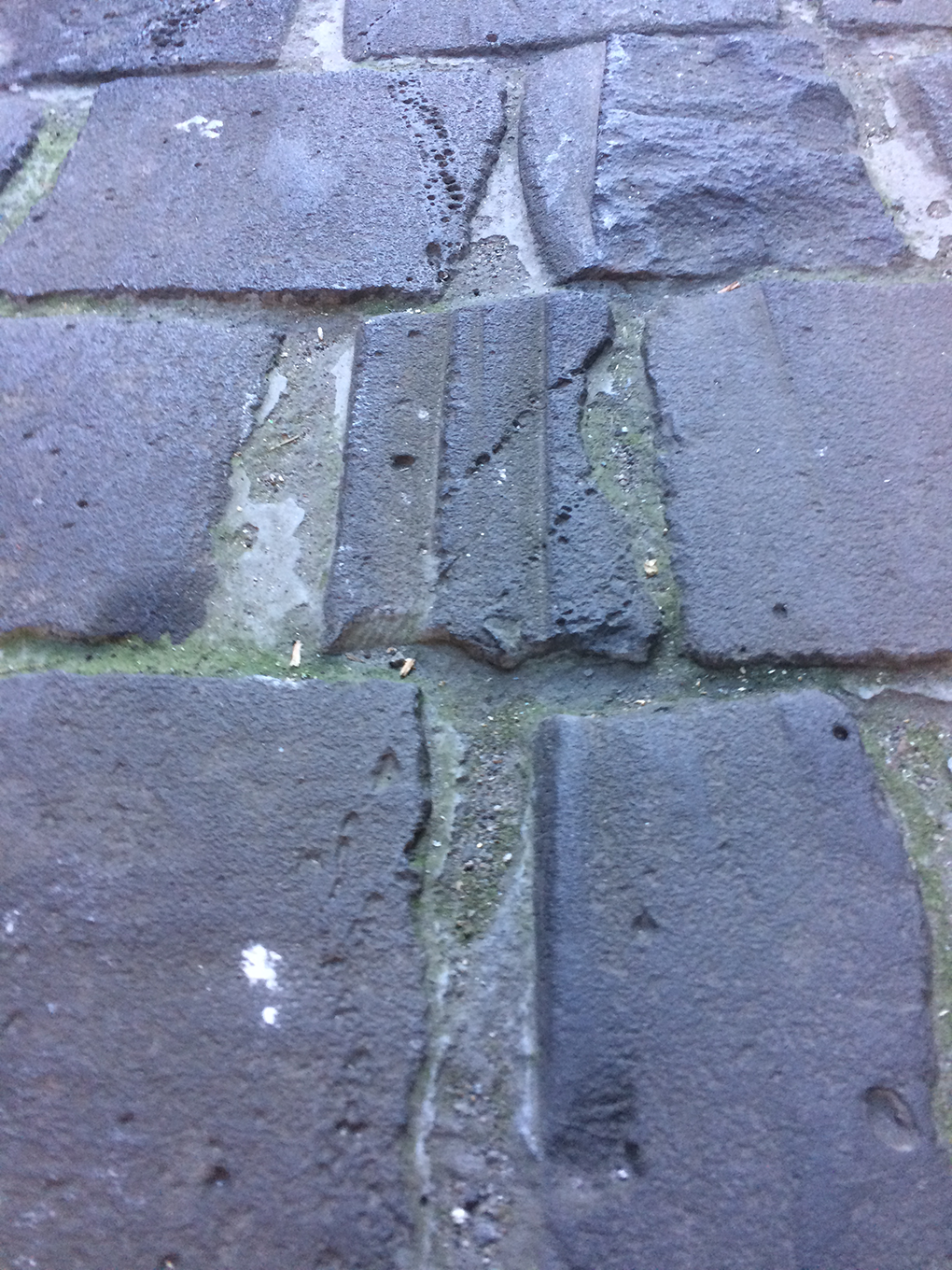
Cart tracks on cobbled bluestone laneway, Melbourne. Photo by author.
Besides the vestiges of prior human life that are embedded in stone, the very constitution of the lithic testifies to ongoing, non-human processes of formation and assemblage. Most evidently, the absorption of long-dead non-humans is apparent in the small marine fossils that compose forms of limestone, such as the Portland Stone used widely as a building material, and can even be found, as discussed above, in the grey German limestone veneers inserted in the Manchester Arndale Centre Extension. This amply evidences Lesley Instone’s (2019: 367) claim that the ‘geo merges and mingles with the bio’, problematising any segregation between living and non-living things. Vannini and Vannini (2020) consider that this awareness of constant companionship can promote a ‘geophilia’ that admires the obstinacy of such long-lasting traces of life and entangles us is these enduring threads of continuity.
As Jeffrey Cohen (2015: 38) asserts: Stone is never a lone element but a partner with water, fire, air, organic life. In stone a sense of place joins a sense of planet, but even that scale is not enough. Stone emphasizes the cosmos in cosmopolitan, the universe of inhuman forces and materialities that stretches to the distant arms of the galaxy.
Uncannily, ‘stone is fluid when viewed within its proper duration’, is ‘part of a continually moving lithosphere’ that belongs to a temporal frame that is impossible for humans to grasp, for these endless transformations are either too slow, too fast or too vast to perceive or easily comprehend. In returning to questions of how stone is deployed to remember, Gary Brierley (2010) refers to how landscapes include a geologic memory of the tectonic, volcanic, sedimentary and erosive forces that have continuously forged topography. The urban landscape too is haunted by these non-human elements in the stone that is supplied to build it, disclosing the realms that existed before human life emerged. For instance, the aforementioned Bath Stone was formed in the Jurassic era on the bed of the shallow sea in the area on which the city now stands. The individual grains deposited as marine sediment were coated by lime, thus forming the spherical ooliths out of which Bath Stone is made. The bluestone fabric of Melbourne, by contrast, belongs to the world’s third largest basaltic plain, created by lava spewed from the vents of hundreds of volcanoes and extending across the state to 400 kilometres west of Melbourne. This is much younger stone, much of it deriving from the Holocene era, with some rock forming only 5000 years ago – as remembered in the Aboriginal story of the two feuding volcanoes recounted above. This resonates with Doreen Massey’s (2005: 9) conception of place as a ‘temporary constellation’ that contains multiple ‘simultaneity of stories-so-far’. Massey (2006: 35) draws upon the image of a glacial erratic to undermine notions of ‘intrinsic indigeneity’ where things are assumed to have been ‘eternally present’. Instead, places and landscapes and stone are perpetually becoming, and very different intertwined simultaneities succeed each other in geological time.
These ideas about the entanglements of stone with non-humans and humans have taken a rather more salient turn with the advent of thinking around the Anthropocene, for it is becoming evident that traces of human action are being and will be incorporated into geological processes of stratification. Humans are profoundly implicated in the reassembling, layering and fracturing of geological strata, since many areas of humanly modified ground contain materials absent from earlier geological compositions. Pottery, glass, brick, tile, metal alloys and plastics join the concrete and tarmac that are becoming constituents of new geological strata. Future strata will also leave vestigial traces of calcium from ‘the spines of millions of intensively farmed ungulates, and the faint outlines of some of the billions of plastic bottles we produce each year’ (Macfarlane, 2019: 76). As Matt Edgeworth (2016: 106) claims, in the future, ‘material traces of present-day human activity – extracted out of the mesh of bodily relations, social networks, world-wide-web and electricity grid – will be preserved in a new configuration of stratigraphic relations’. Living with stone demands recognition of how these ongoing geologic, social and biological entanglements are co-constituting the emergent places we inhabit. Developing Massey’s notion, this can further provoke us to consider the tales that wait to be told, notably about the Anthropocene in which stony constructions, strata and deposits and buildings created through human activity will leave traces aeons after it has been superseded by geological periods to come. Removed from a tethering to human designs, such unique forms of entangled stony matter will enter ‘an interstitial field of non-personal, ahuman forces, flows, tendencies, and trajectories’ (Bennett, 2010: 61).
Conclusion
In this paper, I have argued that conceptions of place have neglected the affective and sensory qualities of the material environment in favour of an overweening emphasis on symbolic and functional attributes. By contrast, I have sought to emphasise how the material world is entangled with everyday experience, and thereby an inextricable part of an extended understanding of the social and of place. By exploring how stone is encountered affectively and sensorially as an integral constituent within the built environment, and as a durable though also vital element, I have firstly drawn out its distinctive role in colouring and texturing place. Second, I have underlined how stone – particularly through the device of the plinth – contributes to the affective power of the commemorative statue and hence serves the desires of the powerful to install particular ideological meanings in space, and I have compared this hylomorphic intrusion to Aboriginal practices of remembering with the stone features of the landscape. Third, in looking more closely at the material composition of stone, I suggest that in being inscribed with signs of human labour, and formed by evident geological and biological processes, traces that disclose its ancient origins, stone is revealed as an earthly companion that has preceded and accompanied human existence and will record traces of this aeons after humans disappear from the earth. As such, it underpins a more judicious, if somewhat uncanny, grasp of the relationships between people and stone that can contribute to the humbler conceptions of humanity’s earthly circumstances demanded by the emergence of more ecocentric thinking.
Footnotes
Declaration of Conflicting Interests
The author(s) declared no potential conflicts of interest with respect to the research, authorship, and/or publication of this article.
Funding
This research received no specific grant from any funding agency in the public, commercial, or not-for-profit sectors.