




Abstract
This article develops the concept of emotional affordances, which is first used to describe the capacities of heritage sites to enable, prompt and restrict particular emotional experiences of their visitors. Secondly, the article asks how the emotional affordances of digital media, particularly those taking effect in digital photography and social media practices, allow visitors to mediate the emotional affordances of a particular heritage site. The argument builds on an ethnographic study of visitors’ digital image practices at the ‘Memorial to the Murdered Jews of Europe’ in Berlin and it demonstrates how visitors ‘capture the feeling’ of the memorial through such practices while also reshaping the experiences the place affords.
Introduction
Anyone visiting a popular heritage site today is witnessing a never-ending stream of visitors taking digital pictures, many of which find their way onto the Internet. Contemporary heritage sites are continuously photographed, digitally shared and ‘liked’ on a massive scale, resulting in vast repositories of images on social media platforms such as Facebook and Instagram. You might, for example, go on Instagram and search for the ‘Memorial to the Murdered Jews of Europe’ in Berlin. 1 What you will find is a continuous stream of hundreds of thousands, likely millions, of images taken and recorded at the site and then shared via the platform. On Instagram, these images are assembled through an algorithm based on user-given geo-location tags. In this way, the platform algorithmically constitutes a digital presence of the memorial on the Internet.
The ubiquity and speed of tourists rushing through this and other memorials with their digital devices in hand raises the question of whether and how the digital presence of heritage sites is still connected to the experiences enabled through their materiality and architecture. Provocatively speaking: have popular heritage places become merely a ‘background’ for tourists’ snapshots? Or is the digital presence of heritage sites on social media still connected to the actual memory practices enacted at them?
In this article, I argue that, despite the seemingly superficial nature of tourists’ digital media practices, place still matters deeply for them. Digital media do not necessarily obfuscate place. On the contrary, they can even serve to bring the physical presence of heritage sites to the fore. They do so not through a mere digital reflection of the architecture and materiality of these places. Instead, they articulate and shape how visitors emotionally experience them. By articulating and shaping emotional experiences made on-site, digital memory practices at heritage sites work through place.
To elaborate on this argument, I apply the concept of affordances and bring it together with theories of emotional and affective practice. This allows me to describe how heritage sites often have strong emotional affordances that can be enacted by visitors as part of emotional memory practices. Secondly, I show how digital media afford visitors to enact the emotional affordances of heritage places through the capturing, sharing and contextualising of digital images and how this process constitutes a particular kind of digital memory practice working essentially through place.
The empirical examples for my argument are visitors’ digital image practices at the above-mentioned ‘Memorial to the Murdered Jews of Europe’ in Berlin – short: ‘Holocaust memorial’ – which I studied through an ethnography at the site as well as on social media, thus combining offline and online approaches (Boellstorff et al., 2012; Hine, 2015; Postill and Pink, 2012). The term ‘digital image practices’ denotes both the digital photography practices at the site (including the staging of pictures, bodily postures, facial expression etc.) and the uploading, contextualising and sharing of these images on social media platforms. Besides the participant observation, I conducted 17 qualitative face-to-face interviews with 41 visitors at the site and 24 chat interviews with users of Instagram and Facebook. 2 Also part of my analysis was the interpretation and coding of 800 social media posts on Instagram and Facebook, which allowed me to relate the analysis of digital images on social media to bodily practices observed at the site.
On the emotional affordances of heritage sites
In this section, I draw upon the concept of affordances and bring it together with the concept of emotional practices (or affective practices) to conceptualize what I call the emotional affordances of material environments, objects or media technologies. I use this concept to describe both the emotional affordances of the memorial’s materiality, but also (in the next section of this article) the emotional affordances of digital media brought along by visitors (see in detail Bareither, 2019).
The concept of affordances was originally introduced by psychologist Gibson (1986), then picked up in a variety of scholarly fields, such as design studies, the interdisciplinary study of technology, new media studies and heritage and museum studies. Of particular interest for this article are anthropological accounts of the concept. While there is no one anthropological conceptualisation of affordances – see for example, the controversy between Keane (2018) and Ingold (2018) – the concept is commonly applied to describe how particular material environments, objects or technologies hold potentials but also enforce restrictions for particular practices. A key goal of affordance theories is to avoid both materialistic or technological determinism on the one hand and radical social constructionism on the other. Material environments and objects, as they commonly appear in the field of museums and heritage, do not determine the practices of their visitors, nor do they allow visitors to do just anything in or with them. Instead, museums and heritage sites (their objects, spaces, etc.) afford a range of practices that can be enacted in relation to them while at the same time they restrict others or render them more unlikely.
In my own work I bring the affordance concept together with practice theories. How affordances are enacted is not only a question of material properties, but also of individual actors’ incorporated knowledge – what Bourdieu (1990) called the ‘practical sense’ – for how to ‘appropriately’ behave in a whole variety of situations in everyday life. Ingold (1992), while not drawing on practice theories in particular, emphasized this point in an early anthropological account of the affordance concept: ‘[a]ffordances are properties of the real environment as directly perceived by an agent in a context of practical action’ (p. 47). The close entanglement of material environments, human actors, their perception, their incorporated knowledge and particular practices is constitutive of how affordances are conceptualized in this article. From this perspective, affordances are never outside of practice, which is why Costa (2018) usefully suggests speaking of ‘affordances-in-practice’.
When looking at heritage sites and museums from this perspective, we see that they often afford memory practices. Through their material spaces and objects, which are contextualised by texts and information, heritage sites and museums enable, prompt and restrict particular ways of ‘past presencing’ (Macdonald, 2013: 16). Crucially for my argument, these memory practices are often emotional or affective practices. Here, I draw upon the concept of ‘emotional practices’ by Scheer (2012, 2016) and the concept of ‘affective practices’ by Wetherell (2013) and Wetherell et al. (2018). Generally speaking, both concepts apply the notion of practice, in the sense carved out by practice theories (and in close relation to the work of Pierre Bourdieu), to understand emotions or affects as part of routinized doings in everyday life. As Scheer (2016) puts it, emotions are not something we have, emotions are something we do in social and cultural encounters (p. 16). For analytical reasons, I will not only speak of doing emotions, but also of the enacting of emotional experiences. Drawing upon the work of Solomon (2007: 244), the notion of emotional experiences goes beyond a static understanding of separable and individual emotions and instead highlights their processuality and heterogeneity.
Bringing these conceptual approaches together with affordance theories in the context of museums and heritage allows us to ask, for example, how the materiality of a particular heritage site shapes the enacting of emotional experiences and therefore the memory practices of its visitors. Similar questions have already been addressed in the area of practice theory (Reckwitz, 2012; Wietschorke, 2016) and, at least implicitly, they are discussed in the more recent literature in the field of heritage and museum studies (e.g. Macdonald, 2013; Piper-Shafir, 2018; Waterton and Watson, 2015; Witcomb, 2012). Certainly, heritage places (and objects) mobilize and shape emotional experiences – or, speaking in the vocabulary of affect theories, they affect their visitors. However, as the authors referenced above point out, they never do so on their own, but always through the bodies of the visitors, through the social and cultural knowledge incorporated by them as well as through the discursive formations in which they are embedded.
Bringing the theory of emotional practices together with affordance theories provides a conceptual approach that accounts for the complexity of these relations. It enables us to analyse how heritage sites and objects do emotion, or how they affect their visitors, without ascribing emotional or affective agency solely to them. Instead, a relational concept of affordances can grasp the emotional capacity and affective power of particular places in relation to practices, incorporated knowledge and discursive formations. I thus propose to think of the Holocaust memorial and other heritage sites or museums as places with particular emotional affordances, that is, places that afford particular emotional practices through which visitors enact particular emotional experiences.
The ‘Memorial to the Murdered Jews of Europe’
The Holocaust memorial in Berlin is an especially telling case in terms of its emotional affordances. It is designed as a labyrinth-like field of 2711 concrete blocks, covering 19,000 m2 in total, in which visitors can enter to experience the materiality of the place through their bodies, senses and emotions. When entering the memorial, visitors do not come across any signs or descriptions explaining its relation to the Holocaust. Therefore, the memorial does not so much afford epistemic practices in the sense of fact-based learning about the Holocaust (although these can be introduced for example by teachers or tour guides and they play a major role when visiting the ‘Information Centre’, a museum below the memorial). Instead, as its architect Peter Eisenman emphasises, the memorial is explicitly designed to afford the intense ‘living memory of the individual experience’ 3 .
This also corresponds with the analytical reading of the memorial by Knudsen (2008), who argues that Eisenman’s memorial is ‘no monument or memorial one visits, reads and circumvents in the ordinary sense’ (p. 13). Instead: ‘[t]he memorial is an experiential site, and that which is consumed is emotional intensity’ (p. 13). Similar observations are made by Dekel (2013), who points out that Eisenman used the term ‘architecture of affect’ to describe the memorial’s architecture that builds ‘on a transformative experience that promotes feeling through mediation’ (p. 56).
And in fact, many visitors experience the memorial with emotional intensity. In my interviews, visitors describe their emotional experiences in and with the memorial as ‘impressive’, ‘very touching, ‘stark’, ‘really strong’ and ‘really moving’. Many of them feel ‘cramped’, ‘claustrophobic’, ‘captured’, ‘small’ and ‘disoriented’ – and respectively the memorial appears to them as ‘depressing’, ‘isolating’, ‘oppressive’ or ‘austere and foreboding’. Others also feel ‘shaken’, ‘nervous’, ‘like in a maze’ or ‘like a rat in a labyrinth’. These emotional experiences can also transform into sadness and contemplation, fostered through the experienced ‘coldness’ of the stone blocks. Based on her extensive ethnographic fieldwork with tour guides and visitors at the memorial, Dekel (2013) highlights (and my own study confirms this point) that many visitors reflect ‘that perhaps “this is how the Jews felt” in the Holocaust: lost, scared, disoriented’ (p. 144).
For many visitors, the emotionally intense experiences at the memorial lead towards a process of emotional reflection and contemplation. A student from Germany explains to me in an interview at the memorial site (my translation): ‘I thought it’s quite different than other memorials, those that have a lot of signs with descriptions on them and so on, where you are always busy reading and here it is, well, you just experience the feeling’. For this young woman, it is the very absence of text that allows the emotional affordances of the place to unfold their potential. Another visitor summarizes this effect in our chat interview: ‘it is cold and quiet. It forces you to think about what happened in the past’.
The force experienced by this visitor is what I describe as the emotional affordances of the memorial. By following her reflection, I do not intend to argue that the memorial actually forces (in a deterministic sense) its visitors into emotional reflection and commemoration. Just as any other kind of affordances, the emotional affordances of the memorial do not exist in a vacuum and therefore do not work in a deterministic way. They always unfold in relation to the visitors’ practices and to the implicit as well as explicit knowledge they ‘bring along’ during their visit. What kind of emotional practices and experiences the memorial affords depends on where visitors come from, on what they know about Germany and the Holocaust, on their individual histories, on their particular ways of dealing with emotions in everyday life, on their mood during their visit, on the friends or family they bring along and how these other actors feel about the memorial.
While these contexts are highly individual (and adolescent visitors in particular routinely deviate from the dominant emotional affordances, for example through playing hide and seek), many visitors have in common that they build upon the Holocaust memorial’s emotional affordances to enact emotional memory practices. In other words: practices of remembrance at heritage sites often work through the emotional affordances inscribed into the place and its materiality. And this is also why digital media have come to play such a crucial role in this context, because they can function as powerful tools for enacting the emotional affordances inscribed into the materiality of heritage sites.
Enacting the emotional affordances of heritage sites through digital media
The question of how digital media shape memory practices is not new in the field of memory studies. Paying particular attention to digital technologies, Andrew Hoskins, Anna Reading and Joanne Garde-Hansen argue that ‘[t]he digital suggests that we may need to rethink how we conceive of memory; that we are changing what we consider to be the past; that the act of recall, of recollection and of remembering is changing in itself’ (Hoskins et al., 2009: 1).
Building upon these and further observations in the field of media and digital memory studies (e.g. Hoskins, 2018; Lohmeier and Pentzold, 2014; Neiger et al., 2011; Schwarz, 2014; van Dijck, 2007), I argue that the concept of affordances can contribute to the study of digital media’s constitutive power in contemporary practices of remembrance. The affordance concept can be used not only to understand the affordances of a particular place, but also the affordances of digital media. Many scholars of digital media usefully point out that the intrinsic relationality of the affordance perspective helps to analyse the interplay of human actors and technology (e.g. Costa, 2018; Hopkins, 2016; Hutchby, 2001).
For the purpose of this article, it is especially helpful to consider digital media’s emotional affordances as part of memory practices. I define ‘the emotional affordances of a specific media technology [as] its capacities to enable, prompt and restrict the enactment of particular emotional experiences unfolding in between the media technology and an actor’s practical sense for its use’ (Bareither, 2019: 15). In the context of memory practices, these emotional affordances enable and restrict practices of presencing the past through emotions.
However, analysing the emotional affordances of digital media in relation to memory is a challenging task, since even a single technological device, such as a smartphone, can already function as an ‘environment of affordances’ (Madianou, 2014: 670) with a huge range of action-capacities and -restrictions. Through their connection with the Internet and the option to download a countless number of software applications, smartphones afford a seemingly indefinite number of digital media practices in everyday life, many of which constitute ways of mobilising and articulating emotions.
Since I am especially interested in digital image practices here, I focus on the emotional affordances inscribed into digital media’s photography and social media functionalities. Thus, my conceptual approach profits greatly from studies of photographic practices in the field of heritage tourism (e.g. Dinhopl and Gretzel, 2016; Larsen, 2014; Sather-Wagstaff, 2008; Urry and Larsen, 2011), including studies that focus on Holocaust remembrance (e.g. Dalziel, 2016; Hilmar, 2016; Lundrigan, 2020). A particularly helpful perspective for the purpose of this article is provided by Till Hilmar in his study of visitors’ photographic practices at the Auschwitz memorial site. ‘With their pictures’, he argues, ‘visitors not only seek to emphasize and materialize certain details about the past, but also to express modes of encountering and experiencing the past on site’ (Hilmar, 2016: 456).
I argue that such encounters and experiences, facilitated through digital image practices, directly relate to the affordances of a place. On a very basic, technical level, digital devices such as smartphones afford the visitors to take pictures (including of oneself through a rear-view camera), to immediately share them on social media such as Instagram and Facebook, and to contextualize them with texts, hashtags, Emojis or links. However, these basic technological affordances quickly unfold into emotional action-capacities and -restrictions on a much larger scale. In short, they allow visitors to mediate how they emotionally experience a place. It is important to note that, in this process of mediation, digital image practices do not simply reflect the ‘original’ experience of place. Instead, the process of mediation also shapes and transforms the experience, thus becoming an integral part of visiting the memorial. In other words: taking pictures of a memorial, contextualising them with captions and sharing them on social media, can constitute a process of enacting the emotional affordances of a heritage place through the emotional affordances of digital media. When this process is successful, the enacting of place through digital media becomes a practice of presencing the past through emotions.
In order to flesh out these conceptual observations, I introduce three (overlapping) digital image practices in the following sections (although there are many more potential examples). When speaking of digital image practices, I go beyond the individual images as such and their representational functions. To understand the visual cultures of remembrance, ethnographic analysis can shift its attention to what Marita Sturken and Lisa Cartwright termed ‘practices of looking’: practices in which you engage to view, understand, appreciate, and make meaning of the world. To look, in this sense, is to use your visual apparatus, which includes your eyes and hands, and also technologies like your glasses, your camera, your computer, and your phone, to engage the world through sight and image (Sturken and Cartwright, 2018: 12).
The ways in which we look at the world are particular ways of engaging it, and digital image practices have become an integral part of this engagement. In the following, I show how three related digital image practices engage with the Holocaust memorial and the past it represents (1) through visualising its architecture in a particular way; (2) through portraying visitors’ bodily interaction with the memorial; and (3) through portraying visitors’ facial expressions as they look straight into the camera.
‘Capture the feeling’
One of the most common image-practices related to the Holocaust memorial displays a view looking down one of the long corridors between the concrete blocks, preferably without any people in it, thereby visualising the depth and size of the field (Figure 1). In interviews, I talked with a variety of visitors about such images and their emotional implications. Natalie, a young woman from Belgium, explains: ‘I really felt like, you know, that you are. . . like the depressing feeling, because it’s so tight. So that’s what I kind of tried to fit in the picture, it’s really that you are such a small one in this huge, massive structure’. Kelly, a young woman from the US, reflects on the same kind of picture in a similar way: I think kinda like, the distance makes you kind of like: ‘how to get out of this memorial?’, like ‘when does this end?’, kind of. And that's probably also how it was for them living in the concentration camps, I would imagine. And I think with the height [of the blocks, C.B.], too, like I said before, you get kind of like an overwhelming feeling of just like: ‘it’s so far to get out of here, and the walls around you are so high.’ Yeah, I think that’s what I was going for with taking a longways picture like that. To get the depth of the memorial.
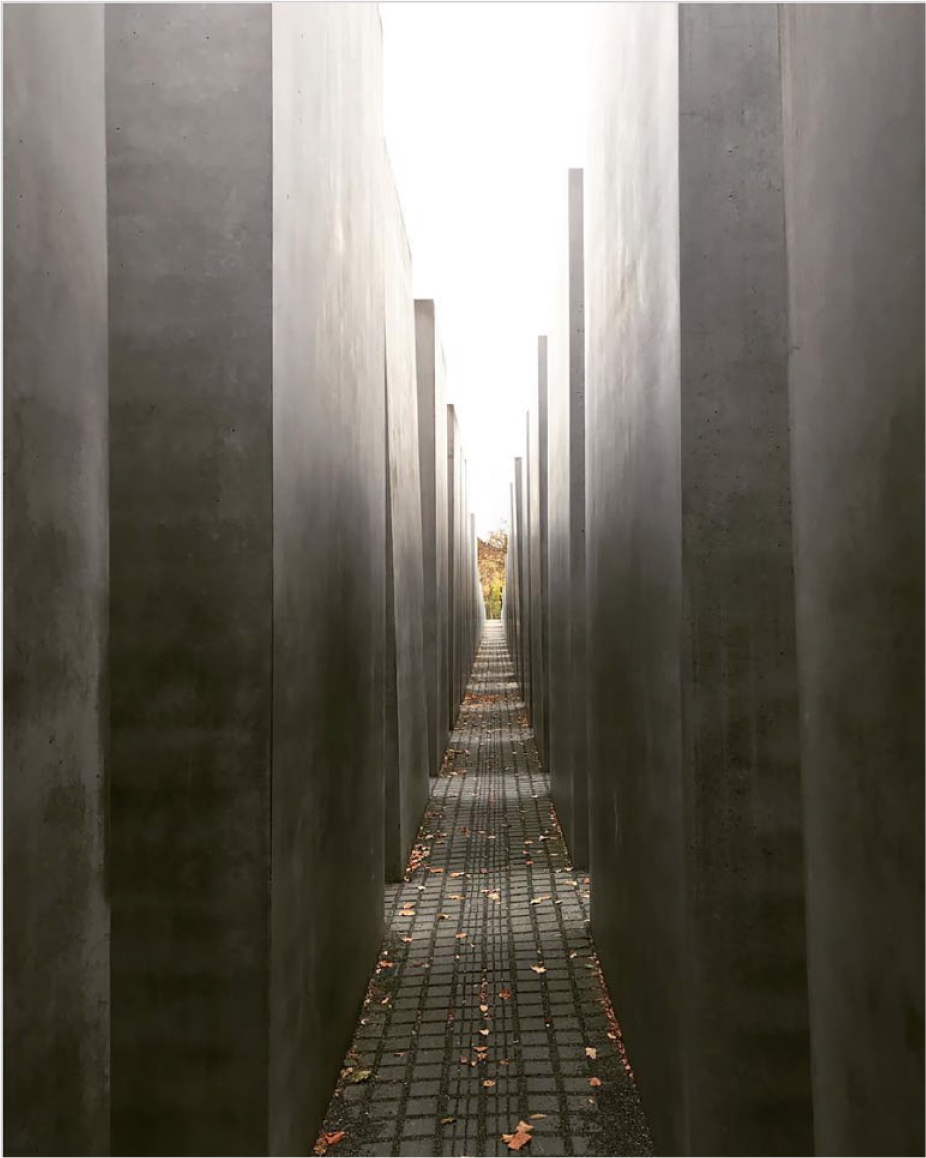
Holocaust memorial (anonymised, used with permission).
Other visitors agree that ‘those pictures of course they want to show that oppression that you feel there’, or – as a young woman from the Czech Republic put it in our chat interview – that they serve to ‘capture the feeling of cold and emptiness that the memorial has’.
To ‘capture the feeling’ is indeed a key expression summarising the function of digital image practices at the memorial. We can shed more light on this process not only through the qualitative interviews, but also by considering captions and comments on social media. For example, visitors might contextualize their posts using short phrases such as: ‘Like passing moments in your deeply hidden memories’ 4 , or ‘Muted in concrete’ 5 or simply ‘Silence’ 6 .
Sometimes, visitors even comment on their images through an elaborate description of the memorial’s emotional affordances and how they personally experienced them – in the following case this is mixed with hashtags used as a style element. A visitor writes: This is a #memorial meant to be #felt. The cement structures are reminiscent of tombs and the layout is modeled after #concentrationcamp structures. There are no signs. As you walk into the installation you are immediately forced to go one by one as the width can not accommodate anymore. The ground becomes uneven. The cement blocks get taller and taller until you can not see or hear anything happening in the city around you. Nobody knows you are there. #Alone. The artist designed it in such a way that you are forced to feel this #despair. What an amazing piece of #art.
7
This caption relies on the image displayed next to it on Instagram, a black and white picture of the depth of the field. The caption makes explicit what kind of emotional experiences the image is aiming to articulate. Such examples demonstrate how the emotional affordances of digital media allow visitors to enact the emotional affordances of the memorial through a process of digital visualisation and contextualisation.
‘To mark my presence there’
While there is a wide variety of image practices that put the architecture and materiality of the memorial in the centre, others focus on the bodily presence of visitors in the field. For example, visitors often portray themselves while they wander around between the blocks, seemingly lost in their thoughts. Other images show people touching the blocks with their hands, as if they wanted to touch the history they represent. A third and very common image practice is the performance of a lonely ‘view into the distance’. Here, visitors are portrayed as lost in their thoughts while – seemingly unaware of the camera’s presence – remembering the past.
Participant observation at the site quickly shows that despite the lonely and thoughtful appearance of visitors in these images, they are commonly staged. Visitors ask their friends to take a picture while they perform this moment of thoughtful commemoration, sometimes quickly taking turns until every person in a group has captured the same kind of image of her or himself.
It might be argued that such performances demonstrate the superficial nature of digital memory practices at the memorial. However, several interviews with visitors reveal that this image practice often is their way of interacting with the memorial’s emotional affordances. In our chat interview, Alina, a young woman from Germany, writes about her Instagram post (Figure 2), on which she performed the ‘view into the distance’ and which received more than 530 likes (my translation): For me it articulates a mix of sadness and thoughtfulness[.] I find the place has a strong impact on your emotions, because you have to think about the cruelties that happened. [. . .] I posted it because the picture fascinates me and it is so calm and sad and I wanted to communicate to my followers [on Instagram, C.B.] that they should think about the past and I wanted to remind them that the way it is now could not be taken for granted in the past.
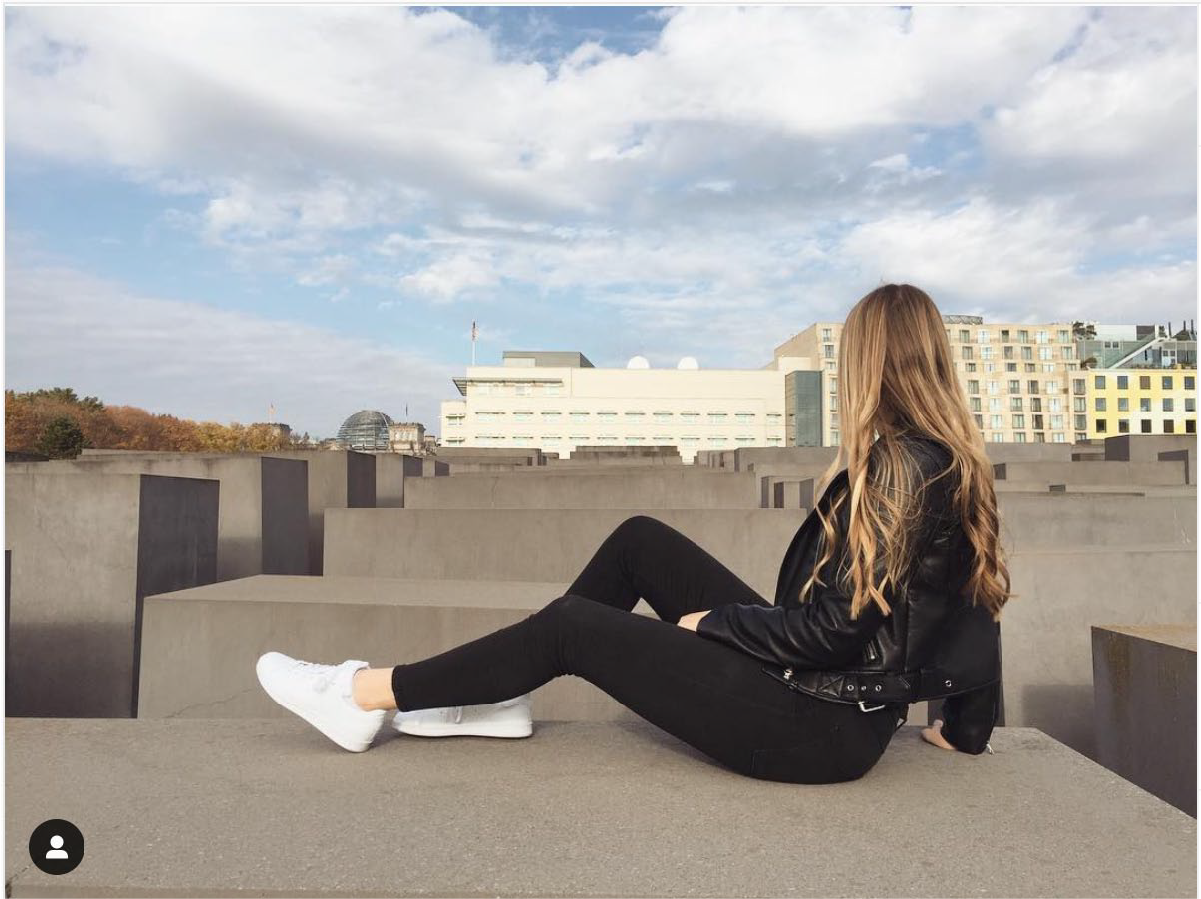
Alina (pseudonymised, used with permission).
Haasim, a young man from Lebanon, who also posted a picture showing his ‘view into the distance’, is even more explicit about his attempt to articulate his emotional experiences through his post. He explains in our chat interview: I [. . .] took a thoughtful concerned look not directly into the objective, to invite the viewer to think with me about what happened on those lands / I intentionally posed for them [his pictures, C.B.] / But the effect [I] wanted was to give a meditating pose / [. . .] So I wanted to convey feelings through my pics, and mark my presence there
For Haasim, similar as for Alina, the practice of ‘marking his presence’ at the memorial through his image practice has a socio-political intent. As he explains in the interview, he has many Instagram followers from Lebanon, where (according to his own experience) anti-Semitic sentiments are common. Through his post, he wanted to provoke discussion and contribute a statement against such sentiments.
Both examples demonstrate that what might be considered superficial acts of aesthetic self-representation can turn out to be complex image practices in which visitors perform particular emotions in order to articulate and share the emotional experiences afforded by the memorial. While the images may not reflect ‘authentic’ moments of thoughtful contemplation at the physical site of the memorial, they succeed through the affordances of digital media in enacting emotional experiences related to the remembrance of the Holocaust. They too are attempts to ‘capture the feeling’ of the place (see above) in order to inspire others to participate in socially shared memory practices.
‘That place touched me deeply and that’s what I felt in the moment’
While the image practices in the last section portray visitors interacting with the memorial, others show them looking directly into the camera. The classical portrait shot is, of course, one of the more common formats in tourist photography and it is also ubiquitous in the context of the Holocaust memorial. In fact, one of the most controversial debates regarding the appropriateness of image practices at the memorial has been sparked through the ubiquity of ‘smiling selfies’ taken at the site. Since the question of whether such ‘happy pictures’ enact emotional indifference is too complex to be discussed here in detail (but see Bareither, 2020; see also Dalziel, 2016; Kansteiner, 2018), it must suffice here to say that portraits and also selfies can serve as tools to enact emotional experiences in relation to the memorial. Surprisingly, many selfies taken at the site show visitors who do not smile into the camera. Instead, many visitors deliberately display a sombre, sometimes angry and often sad facial expression.
Benedikt’s selfie (Figure 3) is a particularly stark and telling example of this image practice. In our chat interview, Benedikt reflects: ‘[i]t was just an honest moment. Not pretending to be fake with all filters or retouches . . . I just wanted to be very honest about my visit there. That place touched me deeply and that’s what I felt in the moment’. As Benedikt puts it, the image articulates how he is ‘touched’ by the memorial. Through the selfie, his facial expression (and the tear rolling down his cheek) becomes a socially shared emotional practice that articulates his emotional experience of the place. Again, the sharing of this moment is a crucial element in his image practice, as he explains: [I] [t]hink that all of us are trying to send the ‘picture’ in a world to show how ‘happy’ we are . . . but are we really? ! I do things how I feel and on that place I felt just sadness . . Just that actually. [. . .] I felt, in a way, good for posting [a] picture of me crying cause I think that is the place where everybody should cry.
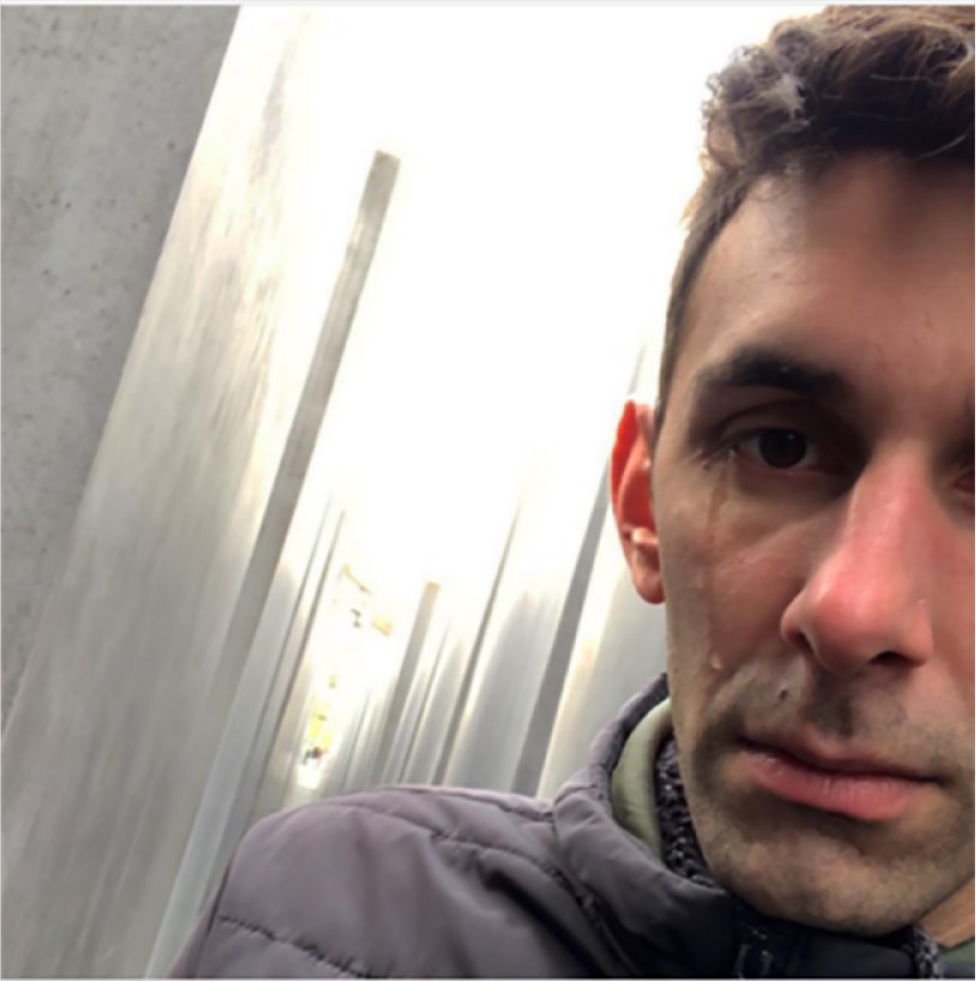
Benedikt (pseudonymised, used with permission).
Evidently, self-portraits and even selfies can serve as practices that constitute, shape and articulate emotional experiences unfolding in between visitors, their bodies, the materiality of the memorial and shared social practices of Holocaust commemoration. As Kate Douglas puts it, in the context of remembrance ‘selfies have the ability to be acts of witness: as engaged responses, as demonstrations of affect and as admissions of complicity and/or communion’ (Douglas, 2017: 13). Another selfie, taken by my interview partner Adam, portrays him doing exactly that by looking into the camera with a serious and almost emotionless expression. He explains: I think that perhaps I wouldn't have taken and shared that photo if I had been on my trip with other people; but I was alone, and it felt important to share the experience in some way. [. . .] when taking the photo I was mindful of doing what I could to be respectful by not making myself the subject of the shot (I kept myself off to the side) and not conveying any specific emotion with my facial expression. I purposely kept a blank face, and on Instagram I intentionally made the selfie the last of the four images I posted, kind of like a ‘stamp’ at the end of the photos to say simply, and without expression, ‘I bore witness to this.’
As Adam points out, even when appearing as one element in a series of pictures, selfies and other digital portraits enable the visitors to articulate a particular relationship to the place. Here, the body of the visitor becomes a key element: through bodily postures, positions and facial expressions captured on camera they articulate how they relate to the memorial’s emotional affordances.
Conclusion
The concept of emotional affordances, which I introduced in this article, is a conceptual tool for analysing the capacities of both the materiality of heritage sites and visitors’ digital devices to enable, prompt and restrict the enacting of particular emotional experiences. These capacities are realized by visitors through complex memory practices unfolding in between heritage sites and digital media. To shed some light on this process, I focussed first on how the Holocaust memorial in Berlin affords particular emotional experiences for its visitors, before describing how these emotional affordances of the place are enacted through the emotional affordances of digital media. I outlined three digital image practices to exemplify this process in detail. All of them demonstrate how visitors use digital media to ‘capture the feeling’ of the place, as one visitor put it. To speak of the capturing of emotional experiences is especially fitting in this context, because the three digital image practices are all enacting the memorial’s emotional affordances in order to presence the past through emotions and share their experiences with others.
These observations contribute to challenging the notion of a ‘placeless memory’ related to digital memory practices, which is at the centre of this special issue (see editorial). When we acknowledge the emotional dimension of visitors’ digital image practices, we see how place matters deeply for them. By capturing the feeling of the place, they are presencing the past through the enacting of emotional experiences. Such digital memory practices, then, do not work independently from place, and despite their sometimes seemingly superficial nature, they do not necessarily distract from place either. On the contrary, the digital memory practices outlined in this article essentially work through place. While I do not claim that they are able to supplement for the experience of the Holocaust memorial through one’s own body, they are attempts to articulate and share this experience. They capture the feeling of place in order to integrate this experience in ongoing social and collective memory practices.
This process of capturing the experience of place is not only relevant for visitors’ experiences at the site. Considering the vast quantity of digital images of the Holocaust memorial on the Internet and the circulation of such images within private networks, it also changes the way in which the place is perceived by others, potentially on a global scale. As Massey (1995) has argued, ‘it may be useful to think of places, not as areas on maps, but as constantly shifting articulations of social relations through time’ (p. 188). From this perspective, by creating shifting articulations of how contemporary visitors socially and emotionally relate to the Holocaust memorial, digital image practices transform the place itself. As Sarah Pink has argued with reference to Massey, we need to account for the fact that amateur photography practices do not merely create representations of places. Instead, considering place as an event, which ‘is continuosuly changing’ and can be understood (with Tim Ingold) as ‘an entanglement or meshwork of lines in movements’ (Pink, 2011: 93), Pink (2011) argues: ‘[a]mateur photographic practices both emerge from and co-constitute events of place’ (p. 101).
The approach outlined in this article can help us in better understanding this co-constitution in the context of memory cultures and heritage sites. By taking pictures of a heritage site, contextualising them and sharing them with others, visitors do not merely reflect this place. Instead, through digitally enacting the place’s emotional affordances and bringing them into (often public) view, visitors participate in its making. Affordance theories offer a useful conceptual vocabulary here to not only describe the emotional affordances of particular heritage sites, but also how these are shaped through digital media and their own emotional affordances. What we observe at the Holocaust memorial, then, is a co-constitution of emotional affordances – those of the heritage site and those of digital media – enacted through the visitors’ digital image practices. From this perspective, digital image practices can have a consitutive function for heritage sites, especially regarding their emotional or affective potentials, and therefore deserve careful analytical attention. The study of such digital image practices, or digital media practices more generally, can contribute to better understanding the changing role of place in contemporary memory cultures.
Footnotes
Acknowledgements
I want to express my gratitude to all visitors and interviewees involved in this project and to the Foundation Memorial to the Murdered Jews of Europe for providing the space to conduct interviews; to several student assistants for their work; and to the members of the Centre for Anthropological Research on Museums and Heritage (CARMAH) and its director Sharon Macdonald for their invaluable support.
Funding
The author disclosed receipt of the following financial support for the research, authorship and/or publication of this article: This research was carried out in the context of Christoph Bareither’s membership at the Centre for Anthropological Research on Museums and Heritage (CARMAH) in Berlin, funded by the Alexander von Humboldt Foundation as part of the research award for Sharon Macdonald’s Alexander von Humboldt Professorship. This article was also supported by the Open Access Publication Fund of Humboldt-Universität zu Berlin.