



Abstract
Woodstock is a grey, windy suburb, squashed between the freeway and the docks in Cape Town, South Africa. Woodstock once had a beach. Physically, the beach is long gone, but it remains in the rain as the smell of salt, the smell of fish and, relentlessly, as sand, swept up again and again, always returning. This article engages the lingering presence of Woodstock Beach in the concrete that now covers it and explores how the memory of the beach orients us towards questions of ruination and process, of how our cities could have been otherwise, and how we can imagine them anew. It also explores the ways in which the material quality of the beach – in this case, as covered in concrete – reveals memories, metaphors and guiding analytical frameworks which in turn point us to pre-existing forms of resistance. This exploration of Woodstock Beach and its ongoing relevance is guided by the analytical attunements of ‘texture as method’. Texture as method engages memories, objects, texts and political processes to explore the emergent and processual qualities of place, and the entanglement between what is absent and what remains.
Point of departure
Woodstock Beach was a long, sandy beach that edged the Cape Town suburb of Woodstock up until the late 1960s. The outer extent of the beach is marked on the one side by the Castle, which was built on its shores (and around which present-day Cape Town’s CBD was built) and on the other by the Salt River mouth. It was a beach for fishing, kite flying, baptisms and bathing. There are black-and-white pictures of children building sandcastles, of Victorian bathing houses on wheels, and fishing boats coming ashore. Oral histories from District Six – the suburb infamously destroyed by the apartheid government in the 1960s – speak of walking down to Woodstock Beach, with buckets and spades, while the children turned ‘somersaults all the way down’ (Jeppie and Soudien, 1990: 59). The area around the beach initially developed slowly – at first it housed only makeshift military hospitals and forts. Later it saw a few isolated buildings – boatsheds, the Old Castle Brewery and the Strand Hotel (‘strand’ is beach in Afrikaans). In the 1870s, a strip of the beach was reclaimed for a road and then again for a railway. The area became increasingly industrial following these developments, with canning factories, tanneries and fertiliser plants polluting the beach air. The beach infilling process intensified dramatically in the 1940s as part of the apartheid modernist vision which focused on industrialisation, technology and infrastructure, but what was left of the beach remained popular, offering a tearoom and a racially segregated bathing pavilion. Up until the 1970s, the space went (officially) unused – leaving 500 acres of empty flat sandland (South African Railway, 1912; The Gateway to South Africa, 1947). The site is now home to railways and freeways, peeling billboards, scrap yards, roaring trucks and crumbling buildings.
Woodstock Beach was also the site of the first indigenous victory in the face of colonial violence. In 1510, the Khoekhoe enacted revenge for years of cattle raids, abductions and extortions by the Portuguese. Dom Francisco de Almeida (a well-known Portuguese ‘explorer’) and 64 of his men were killed in this incident, making this a significant victory over colonial forces (Johnson, 2011). Relatedly, the beach was also home to graveyards; the final resting place of enslaved people, of soldiers, of indentured labourers – many of whom died in the 100+ shipwrecks off its shores. Woodstock Beach was witness to and site of some of South Africa’s most important and most undertold histories, ranging from mundane and everyday stories of livelihoods and leisure, to stories of resistance and colonisation – all of them entangled, all of them histories that have an ongoing relevance in the making of place. Woodstock in its current form shows little evidence of this beach-side heritage, and the way that the histories of Woodstock shaped the city of Cape Town are generally unknown.
In my search for Woodstock Beach, I was expecting a story of topicide, or urbicide (Ernsten, 2021; Pain, 2021) – some reflection of the destruction of place – but this was not what I found. The beach seemed to be remembered more for its presence than mourned for its loss. Instead of individual stories that were clearly situated in place, I was left to sift through a series of seemingly incongruous fragments gleaned from archives, visits to where the beach would have been, memories, stories and comments on Facebook Posts. What could I do with a memory of the South-Easter wind, a piece of graffiti and a letter asking about the policing of shells? What could I do with pictures of a shipwreck rescue operation, a plan for fencing and enormous piles of seaweed? Or penguin eggs and pools? How do these come together? How could I reconcile or even make sense of the sometimes beautiful, sometimes painful and often arbitrary glimpses of life that these fragments afforded me?
Before I had even begun, Woodstock Beach was gesturing to the importance of the gaps, the inconsistencies and the ongoing changes that make up a place.
In this explorative piece, I briefly outline ‘texture as method’, or texturing – a methodological approach that allows me to engage often-overlooked traces of place, its processes, people and memories, to better understand how places come to be. Drawing on thinkers across memory studies, creative geographies and political ecologies, I briefly unpack two key strands of texture as method (‘contact’ and ‘create’) to show how texture as method allows us to critically and carefully harness the political, material and imaginative valence of memory across scale and time. Crucial here is the entanglement between what is absent and what remains, and the need for the critical skills of imagination and creativity to think about how lives remain wrapped around things that are supposedly long gone.
Having outlined texture as method, I then turn my attention to a key texture in the history of the disappearance of Woodstock Beach: concrete. In this final section, I illustrate how texture as method allows us to engage material qualities, imaginative processes and political structures, which in turn allows us to bring seemingly incongruous fragments together to create a story that draws its strength from incompleteness and openness. Texturing the material qualities of Woodstock Beach in concrete allows us to explore questions of resistance, (im)permanence, scale, relevance and possibility.
Texture as method
In this section, I briefly situate texture as an analytical framework and a method, and show what it means, practically, to ‘texture’. Texture is an approach that requires an extended rigour – it requires that impressions, memories, fleeting glimpses and incoherent strands are engaged as thoroughly as traditional theory and text. It requires that theoretical concerns are allowed to emerge, curiously and critically, in context, and through the material.
Texture as a method comes out of the challenges of representing place and all that it holds in all of its unfolding complexity. The root of ‘place’ means to spread (Harper, n.d.). Place holds meaning of social and spatial order. Place is relational – spatially, socially, temporally – and therefore changeable. Place is also storied space. It is space that holds a sense of living, of dwelling, of history and memory. For place writer Robert MacFarlane (2012), this means that ‘[p]laceless events are inconceivable, in that everything that happens must happen somewhere, and so history issues from geography in the same way that water issues from a spring: unpredictably but site specifically’ (p. 147). Here, place holds history, memory, story; and it is also made of history, memory and story. Writing about the necessity of understanding place as shifting, moveable, incomplete and nonlinear, creative geographer Harriet Hawkings (2015) speaks about the need to find alternative ways to ‘research and re-present the textures and complexities of place’ (Hawkins, 2015: 251–252). I landed on texture – not just as something to represent, but as an active mode of representation, research and creativity in and of itself.
Texture is the outcome of objects coming together in some pattern of force, pressure or interaction in a way that produces evidence of, or new configurations in, the objects’ physical and chemical structures. Importantly, much like place, texture is process and it is also evidence of process. Because of this, I propose that texture, as a method, is well suited to approach the moveable fragments that make up place and time. Texturing – engaging texture as method – is an active exploration of and attunement to place that may involve touching, rubbing, writing, walking, thinking, reading or sketching place. Texturing may also involve tracing formative structures, processes and events that are not obviously present but nonetheless make up place. Texturing engages presence and absence, as well as the ongoing making of presence and absence.
Etymologically, ‘texture’ is from the Latin textura – ‘web, texture, structure’. The root ‘teks’ encompasses several words relating to fabrication, making and activity (Harper, n.d.). Written texts are so called because on them letters and words are woven together and meaning is made. ‘Context’: con – text – to make, together (Harper, n.d.). Making, together, is an important approach in doing research, in finding stories. Texture as method is analytically oriented towards moments of making and contact.
Contact
Engaging texture as method involved taking texture tapes from the environment, taking rubbings of different textures (walls, streets, etc.), collecting found objects, and taking photographs, sound recordings and videos. In this case, it involved extensive archival research, and the collection of texts which relate to Woodstock Beach. It also involved me trawling through the memories and comments about Woodstock Beach on various local history groups on Facebook (a covid-imposed limitation). In the process of data collection, I also plotted sites, connections and experiences onto a contemporary map of Cape Town. To make texture tapes, I apply duct tape to a surface (the floor, a tree, a fence, etc.) and see what emerges when I pull it up. The tapes tell a story of my movement through space. The process is in part curated – I choose where to apply the tape – but there is always an element of surprise: pulling up the tape reveals the ‘bottom’ of my chosen texture. In these moments, texture brings issues of imprint, relief, reversal, response and juxtaposition to bear.
Texture allows us to think more immediately, more intimately, about the materiality of our worlds. The textures I find are made up of gaps, ebbs, flows and juxtapositions. The ambiguous ways that contact is evidenced by texture is crucial here; it gestures to the tensions of things coming together and falling apart. The open-ended, ambiguous and contradictory stories that textures tell allow space for alternatives and imagination.
My approach to texture, process and the material is informed by Tim Ingold’s (2016) groundbreaking anthropology of lines. Ingold outlines two distinct types of lines: threads and traces, as well as the varied way they form surfaces over time. His work usefully supports my engagement with texture as both a process (the making of, movement, contact) and a thing (a surface, a text). Texture reveals the multiple threads and traces that make up a single ‘line’; it reveals both the moment of contact and the process of creation. On Woodstock Beach: railway lines, lines on a map, fishing lines, lines that are cracks, lines of inquiry. Repeating lines form patterns. Helen Scalway tracks patterns on fabrics, buildings and skin around London to trace and compose the city’s various heritages (in Hawkins, 2015: 251). Here, the material imprint of a pattern gestures to the politics and lives that enabled their creation, and often to the entanglement of places and scales belied by the presence of a particular pattern here, now. The reading of politics and process across scale is reflected in Stephan Harrison, Steve Pile and Nigel Thrift’s, 2004 edited book Patterned Ground, which outlines an approach that is attuned to the presence of pattern, of texture, in a way that is ‘prepared to imagine the world before its patterns became obvious’ (Harrison et al., 2004: 15). These thinkers provide a strong base from which to engage texture as a way of reading moments of contact: that is, with the imagination and critical awareness to think with the world before its lines, patterns and resulting domains come to seem fixed.
Drawing on these authors, I suggest that an important contribution of texture is that, while texture is intimate, it is not limited by spatial or temporal scale. Instead, it is a way of bringing memories of other times and places into intimate conversation with the immediate moment. Attending to the material – texturing – requires that we notice surfaces, refractions of light, leaks and the paths the wind has cleared. It also requires that we engage with entanglements, disappearances, explosions, decay, assemblages, traces, dreams and politics. It is a way of grounding (beginning) with material realities and following trajectories of what could be.
Texturing the streets of Woodstock Beach, I come across an abandoned emergency water sachet (Figure 1). It is branded Seven Oceans with the image of a ship.
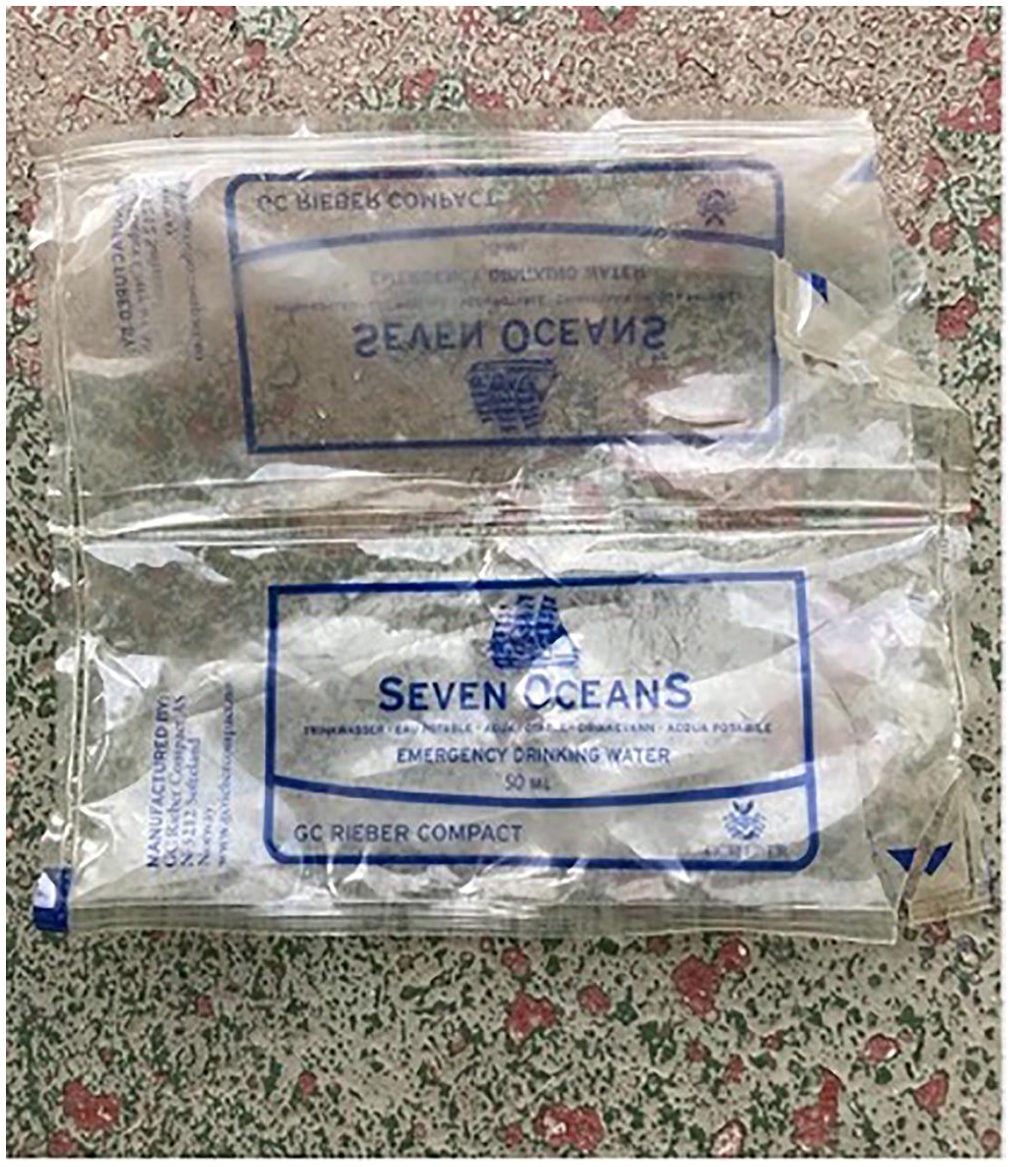
Seven Oceans Emergency Drinking Water found on Beach Road, Woodstock (Anderson, 2020). Image: Author’s own.
Woodstock Beach, appearing here, in litter, in water, in ships.
The material world is important in my search for Woodstock Beach. In words that hum in my chest, De Certeau (2007) writes that ‘objects and words also have hollow places in which a past sleeps, as in the everyday acts of walking, eating, going to bed, in which ancient revolutions slumber’ (p. 257). Here, everyday objects and words are always charged with the past and are always on the verge of awakening from their slumber and bringing the past into the present. This makes objects and movements political. Ann Rigney’s (2017) understanding of objects is similar, but she extends their material powers to include the accidental meanings that objects come to archive as they move across place and time. Objects are part of making place: their affects and accumulations, their origins and movements, the memories they hold and the stories they tell add to the shifting layers that in turn make place an (often unexpected) repository of memory. What are the odds of a ship-branded water sachet on Beach Road, and what stories can it tell?
Cultural geographer Caitlin DeSilvey (2006, 2007, 2010), in her search for memory on a decaying Montana homestead, encounters what she terms ‘ambiguous matter’ – things that are recognisable but unstable, that are busily fermenting and decaying. At Woodstock Beach, we find similarly ambiguous matter – a pile of broken things, chicken bones, fences and bamboo, a cold mossy wall. That abandoned ship-branded water sachet. Attending to the ambiguity and instability of material – of decay and growth – enables ‘an engagement with the past that draws its strength from incompleteness and absence’ (DeSilvey, 2006: 329). Engaging the past through incompleteness and absence expands the reach of our critical energies and demands that the question remains open.
Following the gaps, confusion and loose associations of objects, words and atmospheres allows space for the material world to create, whether it comes together or falls apart. This in turn can ‘open up alternative ways of knowing the past in place’ (DeSilvey, 2010: 492). Here, ‘alternative’ refers to overlapping, multiple and sometimes contradictory pasts, as opposed to a singular ‘other’. To better understand these multiple inscriptions of past on place, DeSilvey (2010) argues that geographers need to attend to the ways that memory moves across places and things (p. 506). In texture as method, I combine DeSilvey’s slow, intimate approach with the more expansive and explicitly political approach offered by anthropologist Ann Stoler. In Stoler’s (2013) work on imperial debris, an engagement through absence demands that we look for the entanglements between what is absent and what remains. It requires attending to the ‘connective tissue’ that continues to bind human lives to the material refuse – toxic soils, polluted waterways, morbidity – of imperial projects (Stoler, 2013: 7–8). This focus on connections usefully expands the spatial and temporal scale at which objects matter.
For Stoler, the interest is in how the long-lasting, often less perceptible, effects of imperial rule come to settle in social and material ecologies (Stoler, 2013: 3–4, 2011, 2002). Stoler’s work is certainly more explicitly centred around the political afterlives of things, but for both DeSilvey and Stoler, the focus on the material ‘is not on inert remains, but on their vital reconfiguration’ (Stoler, 2013: 10). Crucially for texture as method, these approaches necessitate an orientation that works through the material and is both critical and creative. The chicken bones, the fence and that ship-branded water sachet take on a different charge when they are brought into conversation with histories of slavery, burning boats, graveyards and dispossession. Absences and presences, contacts and disconnects, critically refigured.
Karen Till (2008, 2012) and Christian Ernsten (2021) have engaged this kind of approach – refiguring absences and following hauntings – in the context of inner-city Cape Town. Till (2008: 108) looks at ‘spectral traces’ in what she calls ‘wounded places’ – places that have been structured by decades of violence – as a way of thinking with multiple pasts. She argues that attending to multiple pasts offers glimpses to possible futures, which might allow us to return differently to presents (Till, 2012). Ernsten’s work explores how multiple pasts emerge from fragmented materialities in the present. He suggests that the jumbled fragments of ‘official’ heritage (material, policy, plans) are best engaged as local lexicons for spatial ruination, and as invitations to write and visualise entry points to other space-times (Ernsten, 2021: 148). Texture as method draws on these works to emphasise the future-facing elements of the past in place, and centres creative practice and the political valence of memory in challenging dominant regimes of power. Texturing pays attention to the feel of a place, and how this feeling emerges from current and past configurations of diverse material forms, objects and the stories they hold. These fragments and materials do not just reveal, they also actively create.
Create
Texture as a method requires a degree of imagination and creativity, a willingness to follow arbitrary traces, to land in different places and to momentarily suspend disbelief. Texturing a place involves attending to the relationship between writing and materiality, and is an exploration of how best to articulate a sense of absence, loss and possibility. It engages Anna Tsing’s assertion that ‘to enlarge what is possible, we need other kinds of stories – including adventures of landscapes’ (Tsing, 2015: 324). Enlarging what is possible requires new stories, but it also requires an ‘epistemological mood’ that is oriented towards curiosity, wonder and creativity. Maintaining a sense of wonder and curiosity – as a methodology – opens multiple tempos and scales and helps to engage the tricky moment where the materiality of the present gestures to an anticipated future (Ballestero, 2019; Tsing, 2015: 21). To engage these tricky moments, texture as method draws on the critical and caring faculties of creative practice and imagination to create more expansive, affective and curious stories. In my case, these stories and different truths need to be written.
Storying is both method and analysis. The creative and curatorial labour that goes into telling a story does analytical work – it orders events, decides on relevance and tone, and tailors the specifics to the audience at hand. Telling a story of place requires the data and the content, but it also requires the analytic and creative force to make it make sense. Memory and imagination are two key creative and analytic tools in storytelling.
Both Toni Morrison (1990) and Katherine McKittrick (2006) emphasise the role of memory and imagination in their story-telling process. Importantly, these memories and imaginings are tied to places, people and things. For Morrison (1990), writing is
a kind of literary archeology: on the basis of some information and a little bit of guesswork you journey to a site to see what remains were left behind and to reconstruct the world that these remains imply. What makes it fiction is the nature of the imaginative act: my reliance on the image – on the remains – in addition to recollection, to yield up a kind of a truth. (p. 302)
This kind of ‘literary archeology’, this engagement with material remains and their implications, is an analytic and creative act. Morrison (1990) explains that while memory forms the ‘sub-soil’ of her story-telling work, it is the act of imagination that allows her full access to inner worlds (p. 302). Here, memory and imagination come together to create evocative and often urgent truths (McKittrick, 2006). In a similar vein, Ivan Illich (1985), in an expansive and beautiful book about water, writes that imagination is the faculty which forms ‘images of the invisible; it is the faculty that ‘sings reality’’ (p. 21). Imagination – conjuring the invisible, the possible – allows us to access different truths. I suggest that the possibilities of imagination and multiple truths need to be reflected in the text. Texturing pays attention to how stories are written.
The orientation towards imaginative writing is in part an ethical one: it engages a form of ethics that requires active creativity in the imagining and prefiguring of other worlds as possible (Boal, 2006; Mesquita, 2018). It also engages Veena Das’ (2020) assertion that descriptive writing is a moral activity. I ground this ethical imperative in the slow and careful approach to writing as outlined by Kathleen Stewart (2011, 2013) where I need to be critically – and sometimes awkwardly – attuned to the minutiae which make things true. The descriptions which follow draw on the material and theoretical strengths of texturing – incompleteness, different truths, surprise, juxtaposition. The writing itself is important: at times expansive, experimental. There are gaps in this text for us to see other worlds. There are descriptions that suggest, rather than assert. It brings academic rigour, poetry, thinking, affects and texture together in meshes of entanglement; it draws on imagination and a poetics of suggestion; and it uses description and story as an analytic force in and of itself. It is a process where I put myself – my body, my mind – in contact with the materials I find, and see what things are lifted from different kinds of touch, what traces are left on and of me, and how these contacts create stories.
Overall, texture as method is an approach that attends to the ways things come to be. It requires attention to the moment of contact, which may or may not become a connection, but will always leave a mark or a trace. Texture as method – texturing – is a way of exploring, thinking, connecting and making with the world. Theoretically tooled and grounded, I now turn to the concrete that covers Woodstock Beach.
Concrete
Combining through the archives, I come across reams and reams of signatures, names and addresses petitioning for better facilities at Woodstock Beach. There are names and addresses from District Six, and from Beach and Tide streets. These are disappeared places, but the flowing browned ink gestures to lives lived there, with the beach. The processes that destroyed Woodstock Beach and District Six are in many ways incomparable, except in that they were both part of the Afrikaner Nationalist State’s modernist vision for the future. This vision emerged from a techno-nationalism that increasingly emphasised self-sufficiency and innovation, with a strong focus on infrastructure, science, data and research. One material emerges across these processes and ideologies: concrete.
Concrete stands testament to much of apartheid’s architecture – the various roads, bridges and railways laid down in the engineering of spatial apartheid; the rubble of houses destroyed by forced removals; and the mind-numbing monotony of the concrete barracks found in mining compounds and ‘homelands’ (Brink, 2012). Concrete’s magic is its ability to harden under water and Jonathan Cane’s (2021) work on the wave-taming infrastructure, dollose, as well as Isabel (Hofmeyr, 2020; Hofmeyr et al., 2016) work on ports and harbours, both illustrate concrete’s role in inscribing colonial ideologies of control and domination on the ocean: it ‘breaks’ waters and ‘conquers’ waves. Concrete stands testimony to these violent histories, and it also suggests violent futures. The concrete industry emits more CO2 than the whole of India, which has the third largest carbon footprint in the world. Concrete’s weight on the earth is greater than that of every tree, bush or other green thing combined. Concrete is central in driving climate change, in destroying and displacing homes and ecosystems, and in creating and exacerbating vulnerability on a massive scale (Watts, 2019). Concrete puts much-needed roofs over heads, but it is also making our home planet uninhabitable. This material has an ethical orientation.
Concrete took away the beach at Woodstock, but it also still reveals the beach. Although concrete is often accompanied by promises of forever, most concrete lasts only decades (Brigstocke, 2020: 395). The beach in the concrete – the sand and shell and lime that make it – is only momentarily captured, and even then, concrete is a canvas that seems to invite the beach back in – sand calling sand perhaps. The persistent resurfacing of the beach as, and in the ruins of, concrete allows us to revisit the futures promised and not delivered (Anand et al., 2018; Brigstocke, 2020; Larkin, 2013; Levenson, 2018). It is a funny thing, having to reconcile the fact that this odd space that once was Woodstock Beach stands testament to the designs (and failures) of apartheid. These concrete streets, walls and buildings are a ruin of Woodstock Beach. The beach’s presence in ruination creates possibility. For Rebecca Solnit (2006),
a city is built to resemble a conscious mind, a network that can calculate, administrate, manufacture. Ruins become the unconscious of the city, its memory, unknown, darkness, lost lands, and in this truly bring it to life. With ruins a city springs free of its plans into something as intricate as life, something that can be explored but perhaps not mapped. (p. 89)
Woodstock Beach is a ruin of the city – unmappable in the traditional sense due to its ephemeral, shifting nature, but certainly explorable. I wonder about ruins, about sand as a ruin of cement; about what it archives, and what futures it holds.
In Cape Town, all concrete is storied by the ocean. In Barron Street, where people once complained of polluted factory water trickling down the road and onto Woodstock Beach, I find the beach in the grafittied image of a surfer riding a wave in traditional Zulu dress. Driving to the Slave Lodge Museum to look for a slave brig that wrecked off of Woodstock Beach, another concrete wall is painted with the ocean – this time with a woman sailing in a Dutch boat across a green sea that morphs into the roofs of a thousand shacks. Along roads that traced the beach, the walls are similarly storied; a call to ‘Protect the oceans’, another to ‘Bring Back the Beach’ (Figure 2). In an old storehouse in the docklands – where concrete was used to make dryland from the sea – a concrete cast of a dead whale lies heavy on the concrete floor. Concrete, telling the histories of this place, of the beach, in different ways.
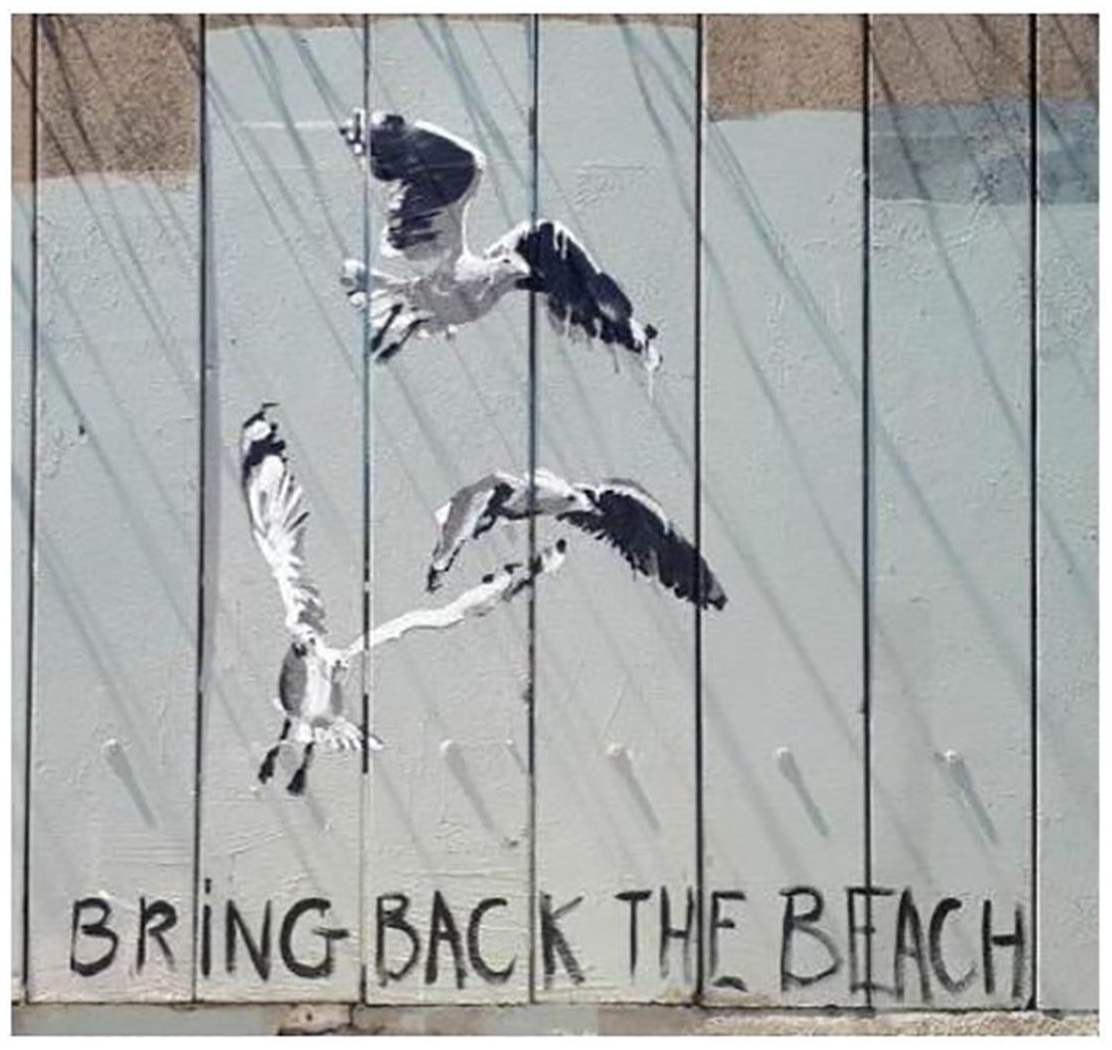
‘Bring Back the Beach’. Graffiti on New Market Street (Anderson, 2020). Image: Author’s own.
Engaging the concrete world that is now Woodstock Beach, I’m reminded of the situationist slogan, ‘beneath the streets, the beach’ or, in French: Sous les pavés, la plage. Its origin lies in the 1968 student movement in France, which – within a few weeks – was joined by nine million people, interrupting service delivery and effectively shutting down the country. This was a complete departure from the normal. In clashes with police, student protesters pulled up cobbles revealing the sand which lay beneath them; literally, the ‘beach’ beneath the streets. Figuratively, the slogan called for alternatives and demanded change, for a new world to be created (Wark, 2011).
The beach beneath the streets is the substrate, the hidden, the structural – all of which supports the creation of everyday life. The beach beneath the streets emerges as a political space – one which challenges the basis of everything – of power, of ‘cemented’ structures, of the taken-for-granted city ‘as is’. Instead, the beach reveals our histories, our vulnerabilities, our points of departure. Attending to the beach beneath the streets is to attend to how things come to be. The beach beneath the streets demands constant questioning, not just of how things are, but also of how they could be. Texturing Woodstock Beach as found in concrete undermines any veneer of inevitability.
Much of the beach beneath the streets is made up of lines. Texturing these lines – as fault lines as well as lines of power – highlights that the disappearance of Woodstock Beach into concrete is neither inevitable nor necessarily permanent. The lines of pipes and drainage systems, so crucial in keeping the beach beneath the streets, are consistently the most expensive items on the council’s budget. The lines of the road and rail – those which covered the beach – are constantly undermined, eroded, and refigured by water and sand. An eight-foot deposit of seaweed, trapped in by concrete dolosse, took weeks to cart away at great expense. In 1924, the Woodstock wind blows a train off the tracks and demolishes a wall in the process. This is not an uncommon occurrence. The lines of the tide determine where the rule of the Crown ends: that is, the spatial extent of British colonial power and law is determined by the waterline. The lines of the tide dictate the pace of beachfront developments (van Rosenveldt, 1913). The beach, as material, does not go gently, or without a fight.
Following the textures of Woodstock Beach – in this case, its lines – allows us to trace what other forms of resistance lie in the concrete, under the concrete and around the concrete.
To think with concrete at a different scale, I put a texture tape, taken from concrete, under a microscope (Figure 3).
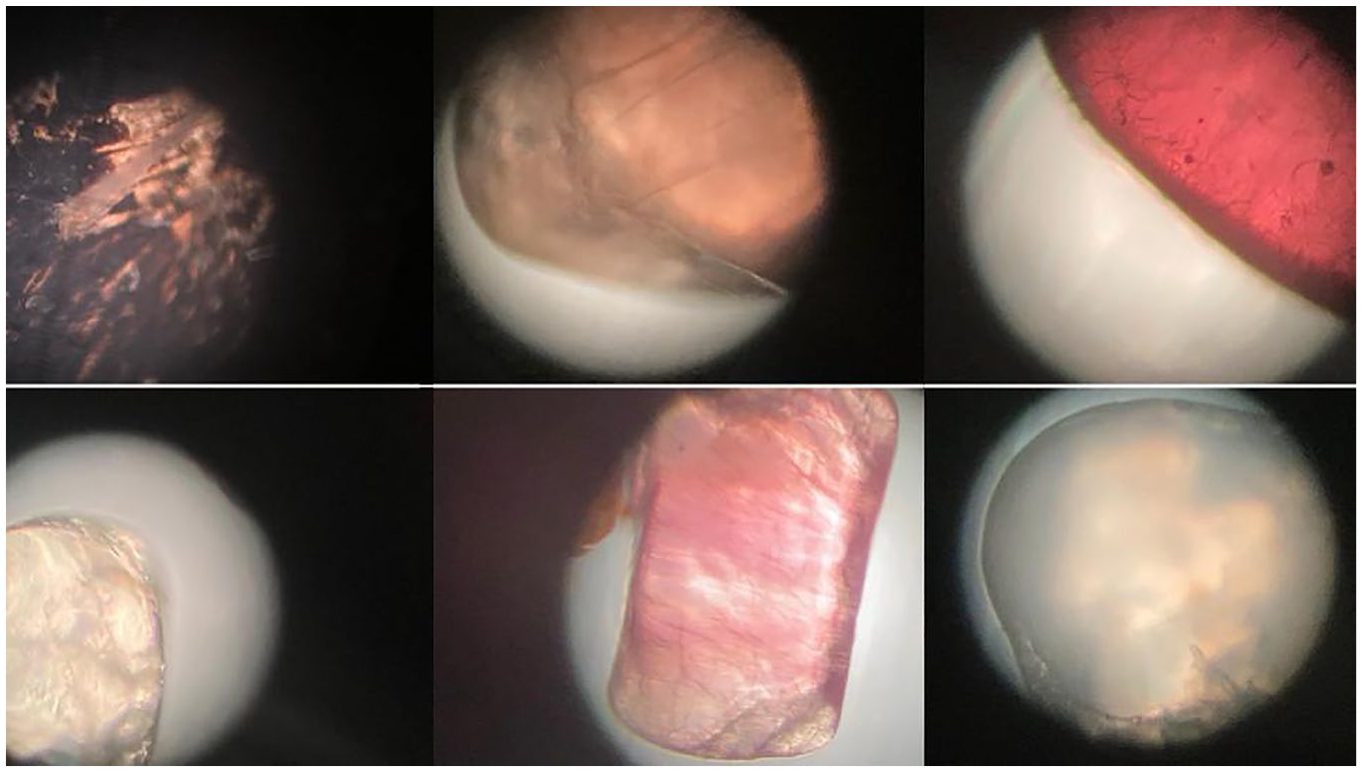
Six individual ‘grains’ from texture tape under a microscope (Anderson, 2020). Image: Author’s own.
Looking at concrete under a microscope is to look at sand. Grainy texture. The colours – pink, green, blue, different shades of white – kaleidoscope under the lens. Textures of the grain fade in and out of focus, layer by layer, frustrating, confusing; these grains remain blurred in places even as they become crystal clear in others. I wonder what I’m doing wrong. Eventually, I realise that the issue might be that the sand that lies on this concrete is ‘immature’ sand – more like grit – where the grains are not yet small enough to be seen clearly in their entirety, at least not at this magnification (Sepp, n.d.; Welland, 2009). This is a useful analytical attunement: that we accept blurriness as a part of clarity. Accepting that not everything can be seen, perfectly, at any one time creates space for possibilities, for layered realities that necessarily shift and move, and for the imaginative process of what may or may not lie in blurred edges.
In the ambiguity of this textural blurriness, questions of resistance emerge. What other forms of classification and simplification are being resisted? What other forms of concrete – cemented power structures, concrete norms – are also wrapped in ambiguity and resistance at their edges?
Woodstock Beach was a site of resistance, and attempts at cementing control were consistently undermined. One particular interaction recorded in the Journal of Jan Van Riebeek, 1651-1655 is often cited to highlight these early forms of resistance:
it happened that about 50 of these natives wanted to put up their huts close to the banks of the moat of our fortress, and when told in a friendly manner by our men to go a little further away, they declared boldly that this was not our land but theirs and that they would place their huts wherever they chose. If we were not disposed to permit them to do so they would attack us with the aid of a large number of people from the interior and kill us, pointing out that the ramparts were only constructed of earth and scum and could easily be surmounted by them and that they also knew how to break down the palisades. (Thom, 1952: 293)
Here, the Khoi refuse to acknowledge the (assumed) power of the Castle’s cemented lines (Twidle, 2013; Worden et al., 1998). The Castle is not seen as inevitable, unshakeable, immovable or static, and stronger power is found in knowledge and relationships. The power of cement, of sand, formed in this particular way, is imagined, and at one time it was able to be resisted.
Several decades later, in 1938, a priest stands on Woodstock Beach with his flock from Langa, one of the earliest black townships (Bickford-Smith et al., 1999). He is performing baptisms and, as he does so, he notes that the bible and religion makes no accordance for the colour bar – the legal instrument used to reserve certain (usually better paid and more highly skilled) professions for ‘whites only’. Here, the beach is a site of spiritual and political connection. Up until the late 1960s, continued resistance by residents meant that Cape Town beaches were not subject to the apartheid-era Beach-Sign Bill, which prevented ‘Whites-Only’ signs from officially and visibly segregating all beaches. These stories are important. They show us that the beach was a site of contestation, that the processes the beach witnessed and was part of – segregation, industrialisation, colonialism – were always resisted. Resurfacing this beach beneath the streets, the beach that exists on, under, and in concrete, highlights that our cities could have been otherwise; that there is space to imagine them anew.
Sand draws us into unexpected relations across time. On Facebook, someone shares a photograph of Woodstock Beach in the early 1900s. The photograph shows a horse-drawn cart loaded with shells, presumably to be taken to a lime kiln where they will be burnt to make cement (Abraham-Adams, 2021). There is a pair of shoes and the imprint of footprints on the shore. I wonder who – in the picture or out of it – these shoes belong to. It is another ongoing intimacy with sand; when we feel it beneath our feet, others before us have felt it too.
In May 2022, a local activist, Tracy Kwaai, calls attention to the fact that a landowner in Kalk Bay, a coastal suburb in Cape Town, has begun to build over a public beach and tidal pool. The landowner, Barry White, plans to build a ‘sunbathing area’ next to his restaurant, the Brass Bell. In an Instagram post, Kwaai highlighted that this tidal pool – like many others – is in fact the remains (ruins?) of ancient fish traps (Kwaai, 2022). She points to the histories of apartheid segregation on these beaches, and its legacy in the policing of who is welcome at these pools. She posts a picture of the earthworks (sandworks, really), with images of Khoi and colonial interactions superimposed on them (this image has been removed from the original post). The message is clear: same colonisers, different ships. The land in question is ‘owned’ and leased out by PRASA, the current form of South Africa’s rail association. The city is currently trying to find evidence of the lease. The resonance with this case and that of Woodstock Beach strike deep. A beach that has been regulated (and cut up) by railway lines. A beach that was once a place for both livelihoods and recreation turned into a space that is exclusive, segregated and, finally, cemented out of sight. Grains and lines.
The textures of Woodstock Beach and the histories they evidence do not just speak to the past. They speak to a future that in some ways seems predetermined, and in others is clearly based on shifting sands and tides. Woodstock Beach is a ruin of the city. It remains unmappable, existing in disappearance, surfacing beneath the streets. Its impermanence suggests possibility.
Possible arrivals
This article has illustrated how the disappeared Woodstock Beach lives on in the world today, and how it figures in lesser known stories of resistance. Knowing the stories of the beach – that it existed, that people lived with it and that people buried it – brings an alternative world into contact with the one we inhabit now. The process of disappearing the beach and related world-building activities need to be seen for what they are: constructions, not inevitabilities. Texture as method accesses these varied stories and scales by combining rigorous on-site observation with imaginative associative ‘leaps’ and creative representation.
Texture is the result of things coming together, and so it is an appropriate lens when so many of these stories speak to forms of contact: the unexpected intimacy of the shared experience of sand under foot, or fish caught and cooked on the beach; or encountering edges, where things coalesce and begin and end. These moments of contact draw ever-entangling lines of connection and relation which tug at understandings of personhood and place. Slowly, slightly, relationships to place and its histories change and – slowly, slightly – relationships to place and its futures change too. In the case of Woodstock Beach, I argue that new alignments of these moments of contact – of colonial encounter, resistance, leisure, violence and development – suggest a different kind of relevance, at different scales. This relevance is one of multiplicities, and so Woodstock Beach is relevant in the making of place and the city, and it is also relevant in understanding histories of slavery and segregation, of transport, urbanisation and industrialisation – and all their material and social effects. Highlighting this multiscalar relevance enables a more dexterous response-ability to overlapping systems and scales of oppression and resistance in the making of place.
The trajectories of concrete as explored here affirm the multiplicities of the beach, and its role in creating place. Texturing concrete reminds us that the afterlives of materials can be future-facing and have an ethical orientation. The refiguring of Woodstock Beach through concrete reveals processes of destruction – of homes and our environment – as well as processes of ruination – of concrete returning to sand, of possibilities emerging from unmappable edges. The concrete of Woodstock Beach is inscribed with stories of destruction, but also with lesser known stories of political and spiritual resistance. Resurfacing the concrete beach, the beach beneath the streets highlights that our cities could have been otherwise and that there is space to imagine them anew.
Footnotes
Acknowledgements
I am deeply grateful to Shari Daya for her supervision of the master’s thesis that underlies this paper and for her support of my attendance at the 2023 Memory Studies Association Conference: Communities and Change. Many thanks also to Catherine Gilbert for her patience and guidance, and to Melissa Levin for nominating my paper for the Best Paper Award.
Funding
The author(s) received no financial support for the research, authorship and/or publication of this article.
