




Abstract
Objective:
The objective of the current research was to examine the association between time spent on social media and serious psychological distress between 2013 and 2017, a period when the rates of both were trending upward.
Methods:
The current study analyzed population-based data from 3 waves of the Ontario Student Drug Use and Health Survey (N = 15,398). Multivariate logistic regression models were used to examine the association between time spent on social media and serious psychological distress controlling for theoretically relevant covariates. Interactions were tested to assess whether the association changed over time.
Results:
The prevalence of serious psychological distress increased from 10.9% in 2013 to 16.8% in 2017 concomitantly with substantial increases in social media usage, especially at the highest levels. In the multivariate context, we found a significant interaction between social media use and the survey year which indicates that the association between time spent on social media and psychological distress has decreased from 2013 to 2017.
Conclusion:
Although both social media use and psychological distress increased between 2013 and 2017, the interaction between these variables indicates that the strength of this association has decreased over time. This finding suggests that the higher rate of heavy social media use in 2017 compared to 2013 is not actually associated with the higher rate of serious psychological distress during the same time period. From a diffusion of innovation perspective, it is possible that more recent adopters of social media may be less prone to psychological distress. More research is needed to understand the complex and evolving association between social media use and psychological distress. Researchers attempting to isolate the factors associated with the recent increases in psychological distress could benefit from broadening their investigation to factors beyond time spent on social media.
Introduction
Recent increases in mental health problems, including depression and suicidality, have been noted in several Western countries, including the United States, 1 –4 the United Kingdom, 5 –7 and Canada. 8 –11 These increases are particularly salient among adolescents and young adults 1 and have mostly taken place since 2012 following a period where reductions in mental health problems were observed. 3,4,12,13 Given that adolescent mental health problems are associated with a range of adult psychological outcomes and difficulties across the life course, 14 it is important to better understand the possible explanations for these upward trends.
One possible explanation for increases in the prevalence of mental health problems among adolescents involves the rapid increases in adolescent social media usage. 15 –17 A growing body of research has begun to examine the link between social media use and poor mental health outcomes. 18,19 While some of this research questions the strength and veracity of this relationship, 20 –23 several cross-sectional studies have found an association between higher amounts of time spent using different types of social media platforms and lower levels of well-being, 18,24 –27 as well as higher levels of psychological distress and depression. 3,18,25,28 –30 Experimental studies provide additional evidence for a link between specific types of social media use and negative affect, 26,31 and recent longitudinal evidence demonstrates that social media use negatively impacts later mental health. 32 –36
Most of the existing research on the association between social media use and negative mental health outcomes either implicitly or explicitly assumes that the harms of social media use, and screen time more generally, increase proportionately with exposure over time. 22,32 From this perspective, time spent on social media is considered a poor substitute for the prosocial activities it replaces. Time spent on social media, in other words, is believed to displace healthy physical activities such as exercise 32,37,38 and sleep, 25,30,39 while facilitating an impersonal mode of communication that decreases close personal connections and increases adolescent depression. 40,41 Increasing social media use is also thought to increase exposure to exaggeratedly positive representations of others’ lifestyles and experiences, contributing to a downward social comparison and increasing depressive symptoms. 32,42 –46 If more time spent on social media is associated with negative mental health outcomes, then other factors being equal, as the amount of time spent on social media changes over time, these negative health outcomes should change in a corresponding manner.
Despite the preponderance of evidence associating social media use and negative mental health outcomes, research has yet to determine the extent to which increases in the amount of time adolescents spend on social media may be associated with the recent upward trend in mental health problems that have been observed on a population level. Thus, the first objective of our research was to empirically evaluate the association between these 2 variables over time, controlling for potential confounders. Our second objective was to examine whether recent increases in mental health problems were moderated by the gender of our respondents. Given that females are more likely than males to report psychological distress, suicidality, and depression, 47,48 and because recent research indicates that the increased prevalence of psychological distress has been disproportionately experienced by females, 1,3 we examined this association.
Methods
Sample
The Ontario Student Drug Use and Health Survey (OSDUHS) is a biennial cross-sectional population survey that is representative of students in grades 7 to 12 from Ontario, Canada. The OSDUHS uses a stratified (region by school level) 2-stage (school, class) cluster design with active-consent procedures. Self-completed anonymous questionnaires were group administered in classrooms, a method that has demonstrated a high level of validity. 49,50 The present secondary data analysis examined a subpopulation of 15,393 student respondents from 3 waves of the OSDUHS—2013 (Wave 1), 2015 (Wave 2), 2017 (Wave 3). Item nonresponse was less than 2% for each of the independent variables, and missing values were listwise deleted. 51,i Our final analytic sample consisted of 15,393 respondents. Each wave of the survey received ethics approval from the Research Ethics Boards of the Centre for Addiction and Mental Health and York University (protocol numbers are 068/2012 for 2013, 068/2014 for 2015, and 029/2016 for 2017). Further details about the methodological features of the OSDUHS are described in greater detail elsewhere. 8
Dependent Variable
Psychological distress
The Kessler 6-item Psychological Distress Scale (K6)i is a screening instrument designed to detect symptoms of anxiety and depression and has been validated among adolescent populations. 52 –55 Respondents were asked “In the last four weeks, how often did you…(1) feel nervous; (2) feel hopeless; (3) feel restless or fidgety; (4) feel so depressed that nothing could cheer you up; (5) feel that everything was an effort; (6) feel worthless. Each item was scored from 0 (none of the time) to 4 (all the time), with a total score ranging from 0 to 24. Consistent with other studies using the K6 measure, 56 –58 a cutoff score of 13 was used to create a dichotomous measure to indicate serious psychological distress (1 = yes, 0 = no). ii Serious psychological distress indicates the presence of a probable mental disorder and is associated with increased treatment utilization, 59 increased prescription medication use, 1 substance abuse, 60,61 and an increased mortality risk. 62
Focal Independent Variable
Time spent on social media
Respondents were asked, “About how many hours a day do you usually spend on social media websites or apps, such as Facebook, Instagram, Snapchat, either posting or browsing?” Consistent with other studies measuring time spent on social media, 24,25,30 response options were coded into the following categories: none, less than 1 hr per day, 1 hr to less than 3 hrs (reference group), 3 hrs to less than 5 hrs, 5 hrs to less than 7 hrs, 7 or more hours.
Covariates and Control Variables
Change in psychological distress over time was modelled by including the wave of the survey as a covariate (1 = 2013, 2 = 2015, 3 = 2017). iii Previous research has linked adolescent mental health outcomes to several demographic variables, including age, 24,29,30 sex, 1,3,19,24 ethnicity and foreign born status, 19,63 and socioeconomic status. 64 –68 These variables were included as control variables in the multivariate analysis. Grade was used to measure age and was coded as a continuous variable (7 to 12), while sex (0 = male, 1 = female), ethnicity (white = reference group), and foreign-born status (0 = born in Canada, 1 = born in another country) were included as categorical variables. The MacArthur family SSS ladder, a validated measure of subjective social status, was included as a proxy for family socioeconomic status. 69,70 Recent research has also linked social media use and psychological distress to a lack of connectedness with peers 40,71,72 and with cyberbullying victimization. 73,74 These variables were included to control for potential confounding effects in the multivariate analysis. Students were asked to evaluate their relationships with peers at school, with higher values reflecting closer relationships to peers (1 to 4). Consistent with other research, 19,29,73 past year cyberbullying victimization was included as a dichotomous variable (0 = no, 1 = yes). Supplemental Table 1 provides more details on the variables used in the analysis.
Analytic Strategy
We first calculated descriptive statistics to determine the prevalence of serious psychological distress and time spent on social media across each wave of data. Next, we estimated a series of nested logistic regression models to estimate the association between time spent on social media and psychological distress controlling for relevant factors. iv Two interaction terms were estimated to test whether the association between sex and serious psychological distress and the association between time spent on social media and serious psychological distress changed between 2013 and 2017. The effect of all other variables was held constant in the interactions. All analyses corrected for characteristics of the sampling design (i.e., stratification, clustering, and weighting) and were conducted using Stata v.16.1.
Results
Table 1 presents the prevalence of serious psychological distress and time spent on social media for Ontario students between 2013 and 2017. Serious psychological distress significantly increased during this time, rising from 10.9% in 2013 (95% confidence interval [95% CI], 9.6% to 12.3%), to 14.5% in 2015 (95% CI, 12.8% to 16.4%), and to 16.8% in 2017 (95% CI, 14.6% to 19.3%). During these same time periods, social media use also increased, especially at the highest levels. The percentage of students who reported spending between 5 and 7 hrs on social media per day increased from 6.6% in 2013 (95% CI, 5.5% to 7.6%), to 9.8% in 2015 (95% CI, 8.7% to 11.1%), and to 12.7% in 2017 (95% CI, 10.8% to 14.8%). Similar increases were observed for students who reported spending 7 or more hours per day on social media, which increased from 3.7% in 2013 (95% CI, 3.0% to 4.5%), to 6.2% in 2015 (95% CI, 5.2% to 7.5%), and to 7.4% in 2017 (95% CI, 6.0% to 9.1%).
Prevalence of Severe Psychological Distress and Time Spent on Social Media for Ontario Students, 2013 to 2017 OSDUHS.
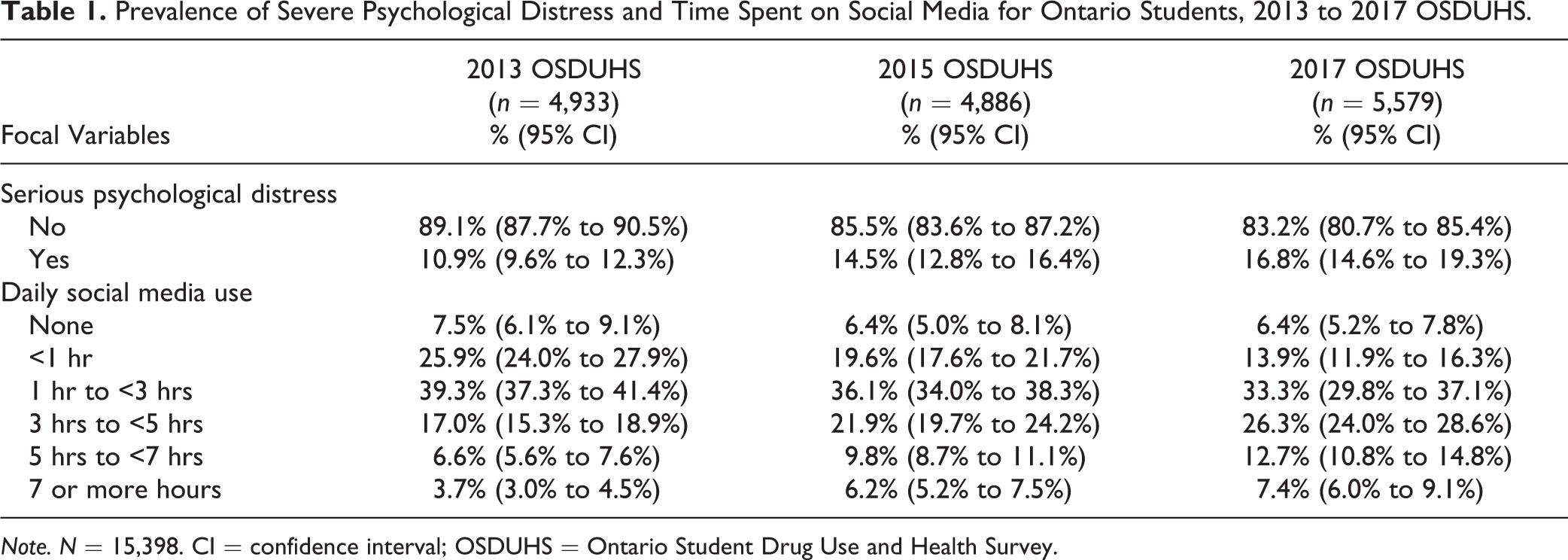
Note. N = 15,398. CI = confidence interval; OSDUHS = Ontario Student Drug Use and Health Survey.
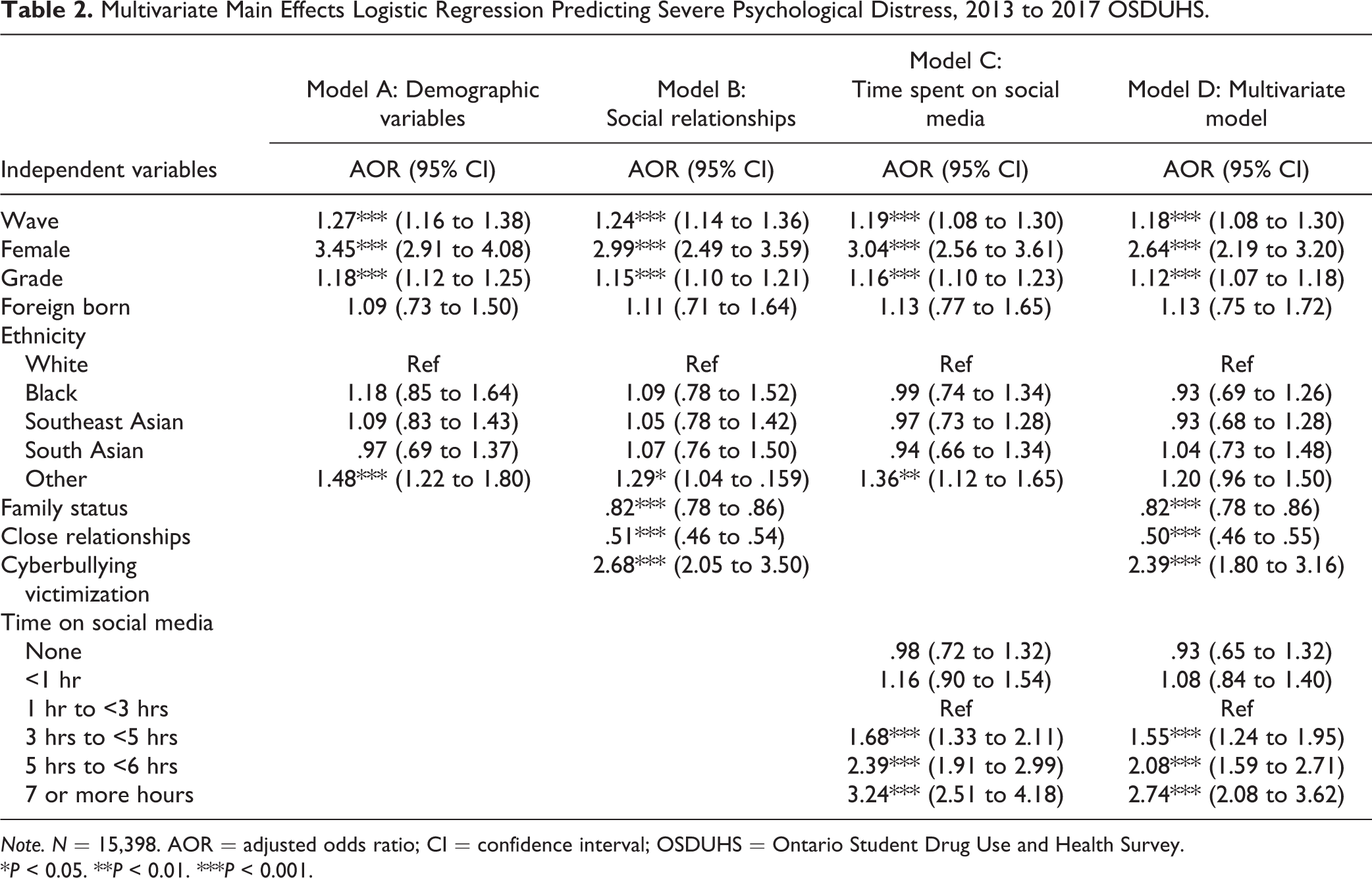
Table 2 presents the results from the multivariate logistic regression models. The trend in serious psychological distress was captured by the wave variable. The odds of distress increased across the 3 waves of data in all models (Models A to D); after controlling for the effect of all other factors (Model D), the odds of distress increased by 18% (P < 0.001). Several of the control variables were also notable predictors of serious psychological distress. In the multivariate context, the odds of distress were lower for students who reported having close social relationships with other students at school (adjusted odds ratio [AOR] = .50; P < 0.001) and for students who reported higher levels of subjective family socioeconomic status (AOR = .82; P < 0.001). Conversely, the odds of distress were higher for older students (AOR = 1.12; P < 0.001) and for students who reported cyberbullying victimization (AOR = 2.39, P < 0.001).
Sex was a significant predictor of serious psychological distress across all models. In the multivariate model (Model D), female students were at 2.6 times the odds of male students for serious psychological distress (P < 0.001). An interaction between wave and sex tested whether the increases in serious psychological distress varied for male and females. The interaction was not statistically significant (F(1) = .12; P > 0.05). Auxiliary analyses confirm that the odds of serious psychological distress for females relative to males, presented separately by wave (see Supplemental Table 4), had overlapping confidence intervals, and the change over time was not statistically significant.
Multivariate Main Effects Logistic Regression Predicting Severe Psychological Distress, 2013 to 2017 OSDUHS.
Note. N = 15,398. AOR = adjusted odds ratio; CI = confidence interval; OSDUHS = Ontario Student Drug Use and Health Survey.
*P < 0.05. **P < 0.01. ***P < 0.001.
Time spent using social media was significantly associated with serious psychological distress (Model C) and this association remained significant in the multivariate context (Model D). Compared to those who reported using social media between 1 and 3 hrs per day (the reference group) and controlling for all other factors, the odds of distress increased with the amount of time spent using social media per day. However, the interaction between social media use and wave was statistically significant (F(5) = 2.76; P < 0.05), suggesting that social media use had a differential relationship with serious psychological distress over time (see Supplemental Table 4 for results stratified by wave). Figure 1 displays the predicted probability of time spent on social media and serious psychological distress over time, holding the effect of all other variables at their mean value. The results from this interaction demonstrate a nonlinear effect over time. At the lowest levels of social media use, the predicted probability of serious psychological distress increased across the 3 waves; however, for students who reported spending 7 or more hours on social media per day, the predicted probability of serious psychological distress decreased from 22% to 17% between 2013 and 2017. v
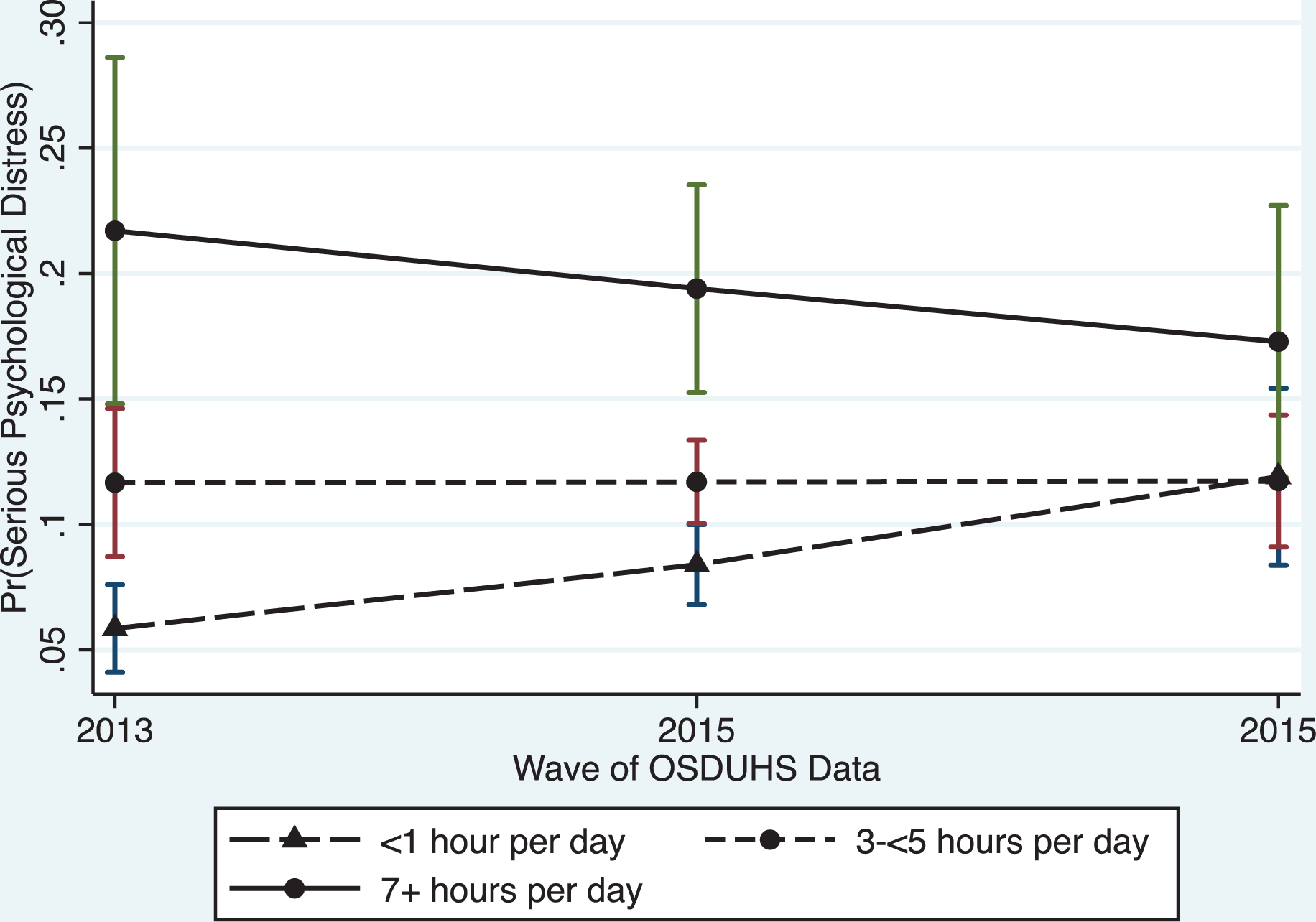
Predicted probability of serious psychological distress by social media use, 2013 to 2017 OSDUHS. OSDUHS = Ontario Student Drug Use and Health Survey.
Discussion
Evidence for increased psychological distress and depression among adolescents and young adults has been reported in North America and Great Britain. 1 –4,30,75 These increases have been accompanied by corresponding increases in suicide-related behaviors, 2,3,76,77 providing ancillary evidence that the recent upward trend in self-reported mental health problems is not an artifact of an increased willingness to disclose negative affect in anonymous surveys, but part of a broader increase in mental health problems among adolescents. 6 Our results add to this emergent literature and show a substantial increase in the proportion of students in grades 7 to 12 in Ontario, Canada, who reported serious psychological distress between 2013 and 2017. This increase of 65% is unprecedented and translates to more than 150,000 students who suffered from a probable mental health disorder in 2017. 8 Given the adverse outcomes associated with serious psychological distress, 1,60 –62 it is extremely important to identify the mechanisms contributing to these recent increases.
It has been argued that increased use of electronic devices, including social media use, has contributed to simultaneous increases in mental health problems such as psychological distress in recent years. 24,27,78 Our results provide support for the proposal that time spent on social media increased concomitantly with increased psychological distress for both males and females. However, the interaction of year and social media use suggests that the relationship between heavy social media use and psychological distress is complex. Even though both social media and psychological distress have increased from 2013 to 2017, the interaction indicates that the association between the two is decreasing over time. Those students who had the lowest levels of time spent on social media showed increases in psychological distress, while those with the highest levels of time spent on social media showed decreases in psychological distress, between 2013 and 2017. These data suggest that while social media use and serious psychological distress are associated with one another at each point in time, overall increases in social media use, and more specifically increases in heavy social media use, do not appear to account by themselves for the recent increases in serious psychological distress.
The influence of social media use on mental health may be complicated and could reflect other, underlying causal pathways. Kelly et al. 25 have suggested that several paths could be involved, and that poor sleep, limited in-person social interactions, reduced physical activity, increased exposure to online harassment, reduced self-esteem, and poor body image may mediate the pathway between social media use and increased mental health problems such as anxiety and/or depression. Other researchers have confirmed the association of high levels of social media use with poor sleep and lack of exercise. 25,30,32,38,39,48 In a recent longitudinal study, Heffer and colleagues, 21 observed that, rather than social media use predicting depression, depression predicted social media use, but only among females. Thus, the nature of the causal pathway between social media use and mental health problems is unclear and it is possible that the relationship is a reciprocal one. 79,80 Given the importance of temporal sequencing and the complexity of factors that may be responsible for the upward trend in psychological distress, more studies using panel data, where individuals are tracked at multiple points in time, are needed to better understand causal pathways and opportunities for prevention.
It is also possible that the changing impact of social media use on psychological distress is related to the novelty of the technology at the time, and the people initially attracted to it. “Early adopters” of social media, in diffusion of innovation terms, 81 may have been individuals already experiencing some predisposition to distress. Certainly, Heffer et al.’s 21 results may support this interpretation, and Zink et al. 80 observed reciprocal relationships between screen time and emotional disorder symptoms in adolescents. As heavy use of social media has become a more salient and normalized feature of adolescent life, vi later adopters of social media may include larger numbers of individuals less prone to distress. Changes in the frequency of time spent on social media do not account for the quality of social media use or for the relative impact that different types of social media use may have on psychological distress. Active social media use, where adolescents use social media to directly communicate with one another and facilitates social connectedness and social capital, may promote psychological well-being. 82 Passive social media use, on the other hand, is characterized by an absence of interpersonal communication and has been associated with lower levels of psychological well-being. 42,43,83 Without more data, including validated measures of different types of social media use, 84 over a longer time period, it is difficult to draw definitive conclusions. Future research will need to track changes in the patterns of social media use as well as changes in the association between social media use and psychological distress over time. If the recent increases in mood disorders are part of a generational shift among a new cohort of adolescents, as has been recently suggested, 30 then the prevalence of serious psychological distress may continue to increase.
Other researchers have suggested that the negative effect of social media use on well-being may be observed primarily among females. 3,24 Our results suggest that increased social media use was associated with increased psychological distress among both males and females in Ontario, and increases in severe psychological distress were observed among both male and female students. While we see differences in the base rate of psychological distress, a finding consistent with other studies, 8,12 we observed increases in psychological distress among both male and female students between 2013 and 2017. Future research examining the etiology of the increases in psychological distress among adolescents should not automatically concede the existence of gender-specific effects without first testing for them.
Our data demonstrate significant increases in serious psychological distress among Ontario students in grades 7 to 12 between 2013 and 2017. While social media use increased simultaneously, we found that the association of heavy social media use with serious psychological distress appeared to decrease over time. This decline may be a positive indicator for the future, suggesting that the negative effect of heavy social media use may be moderating with time. As well, the disassociation of distress and social media use may suggest that the rise in serious distress among adolescents may not be strongly tied with social media use. A closer examination of distress needs to include other social factors, including the increased prevalence of negative news events from around the world. It is possible that adolescents are not just reacting to social media but rather to “real world” distress. Future research to elucidate mechanisms underlying these trends might explore outcomes associated with different social media platforms (e.g., Instagram, Snapchat, Reddit, TikTok) and/or activities performed while using social media (e.g., browsing, posting, direct messaging). This research could help inform the potential moderating role that different types of social media use have on adolescent mental health.
Our results are limited by the cross-sectional nature of the data and their reliance on self-reported surveys. Thus, causal conclusions cannot be drawn, and the results may be subject to bias found with self-report, an issue underscored by recent research suggesting that self-reported estimates of social media use may not be reflective of actual time spent. 85 Another limitation related to the cross-sectional nature of our data is that we cannot assess whether higher social media use predicts psychological distress or vice versa. There is some evidence of a reverse association. 21,79 The possibility of reverse causation provides additional support to our conclusion that it is important to be cautious about the association between social media use and the recent increases in serious psychological distress. These increases appear to have multiple sources, and more research is needed to understand and address the increased prevalence of psychological distress among adolescents.
Supplemental Material
Supplemental Material, sj-docx-1-cpa-10.1177_0706743720987902 - Increases in Serious Psychological Distress among Ontario Students between 2013 and 2017: Assessing the Impact of Time Spent on Social Media: Hausses de la Détresse Psychologique Sérieuse Chez Les Élèves de l’Ontario Entre 2013 et 2017 : Évaluer L’impact du Temps Passé sur les Médias Sociaux
Supplemental Material, sj-docx-1-cpa-10.1177_0706743720987902 for Increases in Serious Psychological Distress among Ontario Students between 2013 and 2017: Assessing the Impact of Time Spent on Social Media: Hausses de la Détresse Psychologique Sérieuse Chez Les Élèves de l’Ontario Entre 2013 et 2017 : Évaluer L’impact du Temps Passé sur les Médias Sociaux by Steven Cook, Hayley A. Hamilton, Shirin Montazer, Luke Sloan, Christine M. Wickens, Amy Cheung, Angela Boak, Nigel E. Turner and Robert E. Mann in The Canadian Journal of Psychiatry
Footnotes
Notes
Declaration of Conflicting Interests
The author(s) declared no potential conflicts of interest with respect to the research, authorship, and/or publication of this article.
Funding
The author(s) received no financial support for the research, authorship, and/or publication of this article.

Supplemental Material
Supplemental material for this article is available online.
References
Supplementary Material
Please find the following supplemental material available below.
For Open Access articles published under a Creative Commons License, all supplemental material carries the same license as the article it is associated with.
For non-Open Access articles published, all supplemental material carries a non-exclusive license, and permission requests for re-use of supplemental material or any part of supplemental material shall be sent directly to the copyright owner as specified in the copyright notice associated with the article.
