




Abstract
Objectives:
Gender inequity in academic medicine persists despite increases in the number of women physicians. We sought to explore gender differences in research productivity for academic psychiatrists in Canada.
Methods:
In a cross-sectional study of the 3379 psychiatrists in all 17 university departments of psychiatry in Canada, research productivity, as measured by the h-index and number of publications, was compared between women and men using a negative log binomial regression model to generate relative rates (RRs), adjusted for career duration (aRR). Findings were stratified by academic rank, institution region, and institution size. A subanalysis of those with 10 or more publications was conducted as a proxy for identifying physicians on a research track.
Results:
Women (43% of the sample) had a lower mean (standard deviation) h-index than men (2.87 [6.49] vs. 5.31 [11.1]; aRR, 0.62; 95% confidence interval [CI], 0.54 to 0.72). Differences were significant only for junior faculty and not for associate and full professors. Comparison by number of publications followed a similar pattern (aRR, 0.46; 95% CI, 0.39 to 0.55). Among those with 10 or more publications (n = 721), differences between men and women were smaller than in the overall cohort for both the h-index (aRR, 0.77; 95% CI, 0.68 to 0.87) and number of publications (aRR, 0.62; 95% CI, 0.53 to 0.72).
Conclusions:
Gender differences in research productivity at the national level in academic psychiatry in Canada support a call to adopt a more systematic approach to promoting equitable opportunities for women in research, especially in early career, to improve diversity and enhance future psychiatric research and discovery.
Gender inequity in academic medicine has been documented across medical specialties. 1 –8 Despite increasing female enrolment in medical school over the past 30 years, there has not been a proportional increase in the number of women in senior academic ranks. 7,9 –11 This is not only an issue related to equity or fairness. Increased female representation in senior academic ranks may increase an institution’s overall productivity as demonstrated by studies examining the benefits of gender diversity in the workplace. 8 Barriers to female physician advancement in academia include time spent on family responsibilities, unconscious sex and/or gender biases limiting opportunities and affecting work evaluations, and receiving less institutional support than their male counterparts. 12 –15 Where gender inequities are identified, systematic action plans can ensure that policies and procedures are in place to level the playing field.
Research conducted by physicians in academic medical centres plays a critical role in advancing the health of our populations. By virtue of their integrated research and clinical care activities, clinician-researchers are in a unique position to bring clinical knowledge to the basic science setting and to translate it back into practice. 16 A workforce in this area that includes women and other diverse groups can enrich and expand the perspective from which this research is done or how findings are interpreted, as well as maximize the impact of clinician-scientists on health care innovation. In academic medicine, research productivity is also widely accepted as a measure of scholarly achievement leading to academic promotion. Inclusion of women clinicians in research may also increase their inclusion in academic leadership more broadly.
The identification of barriers to initiating careers in research for women, as well as to advancement within research, has spurred initiatives across multiple medical specialties to increase mentorship for women and improve support in the early stages of women clinician-researchers’ careers. Yet, in a large longitudinal study of a cohort of 1244 medical specialists in 24 US medical schools followed from 1995 to 2012, women had a 30% lower rate of publications and 20% lower h-indices compared to men, although there were no differences in grant funding. 6 In some medical and surgical specialties, recent data show that while women’s research productivity seems lower in early career compared to men, as they reach mid-career, their productivity equals and even exceeds that of their male counterparts. 3,5,17,18
Contemporary data on gender and research productivity specific to academic psychiatry are not available in Canada. In 1993, Leibenluft et al. 9 reported that male academic psychiatrists in the United States were more likely to have had prior research training, to be principal investigators on peer-reviewed grants, and to attain senior academic ranks than their female counterparts. In a 2004 study of psychiatrists in Ontario, Canada, women were less likely to be involved in research, less likely to hold pharmaceutical industry funding, and less likely to have published within the preceding 5 years. 19 Recently, a large study of 5234 US psychiatrists found that women are still much less likely than men to achieve senior ranks. 20 They also had lower research productivity, although the difference was statistically significant only for assistant professors and not for higher ranks.
Examining whether gender differences in research productivity persist is essential, as the engagement of women in academia has implications on the future of psychiatric research and discovery. Thus, we compared research productivity of women and men psychiatrists from all the university departments of psychiatry in Canada.
Materials and Methods
Study Design and Data Sources
We conducted a cross-sectional study of research productivity among faculty of all 17 university departments of psychiatry in Canada. All data were requested and collected within a 2-month period in 2016 to limit the possibility of ongoing publication during the data collection period and to ensure consistency in measuring productivity across individuals. To identify faculty, we used publicly available data from the university webpages of accredited departments of psychiatry at Canadian medical schools, the Royal College of Physicians and Surgeons of Canada online directory, websites of provincial medical colleges, and SCOPUS. We then shared lists of names and academic ranks with the 17 department chairs and requested corrections if applicable; 15 of 17 departments provided confirmation or corrections. All data were entered into a password-secured database and deidentified for data analysis. The study was approved by the Research Ethics Board of Women’s College Hospital in Toronto, Ontario.
Participants and Eligibility Criteria
All faculty from the 17 accredited university departments of psychiatry in Canada as of July 1, 2016, with an MD degree were considered for inclusion (see online supplemental material). Non-MD faculty (n = 814, 54.2% women) were excluded from this analysis as their career trajectories and expectations may differ from those of physicians. Gender was ascertained from publicly available data to ensure departments did not have to disclose personal health information without explicit consent from their members. We planned to include faculty identifying as nonbinary or gender queer in a separate group. However, we were unable to identify any such faculty from publicly available data sources. We excluded 5 faculty members for whom we could not determine gender from the public data source.
Outcomes
The primary outcome of research productivity was the Hirsh-index (h-index) developed by Jorge E. Hirsch. 21 The h-index is defined as the number of papers (n) published by an individual that have been cited n or more times. It is reported by popular search engines such as Google Scholar, SCOPUS, and Web of Science. The h-index reflects the impact of an author’s work by considering the frequency with which it is cited. It has been widely used to compare research productivity among medical faculty in several medical specialties in the United States and is correlated with academic rank. 1 –5,7,22,23 Because the usefulness of the h-index has been increasingly debated, we used the number of peer-reviewed publications as a secondary outcome. This measure is almost universally used as an academic promotion criterion. 24 SCOPUS was used to determine h-index and individual publication records as it recently amended its cited references database to include publications dating back to 1970, as opposed to other search engines that calculate the h-index using publications since 1996. In SCOPUS, multiple listings for a name were cross-referenced with field of study and academic institution to match individuals accurately to their publication records.
Covariates
Participants were categorized as junior faculty (lecturer/assistant professor), associate professor, and professor. If a participant held a faculty appointment at more than 1 university, the university of higher academic rank was used. Career duration was examined as both a continuous and a categorical variable with categories of early career (<10 years in practice), mid-career (11-20 years in practice), and late career (>20 years). Career duration was determined from the year of residency completion; when this could not be determined (e.g., for some physicians who trained outside of Canada and the United States), we used the year of medical school graduation. We also recorded department size, as defined by the number of faculty members in the department of psychiatry (i.e., <150, between 150 and 300, and >300), and region where the university was situated, as classified by the Canadian Residency Matching Service (see online supplemental material).
Data Analysis
Men and women were described with respect to the distribution of the measured covariates. The mean (standard deviation [SD]) and median (interquartile range) for each outcome were reported for the overall sample, as well as for women and men separately. We then used a negative binomial model to compare each outcome between men and women, generating relative rates (RRs) with 95% confidence intervals (95% CIs), unadjusted and adjusted for career duration. Negative binomial models are used for count data where there is overdispersion of the data (i.e., where the variance of a distribution is greater than its mean). This often occurs when there are many zeros in count data, as would be expected in the current study given previous research in the field. 6 The same comparisons were made with stratification by academic rank, faculty size, and region. In an additional analysis designed to include only faculty members who appear to have chosen a research trajectory, we repeated the analyses in faculty members with a minimum of 10 publications. All analyses were conducted using IBM SPSS Statistics, Version 23 (SPSS, Inc., an IBM Company, Chicago, IL).
Results
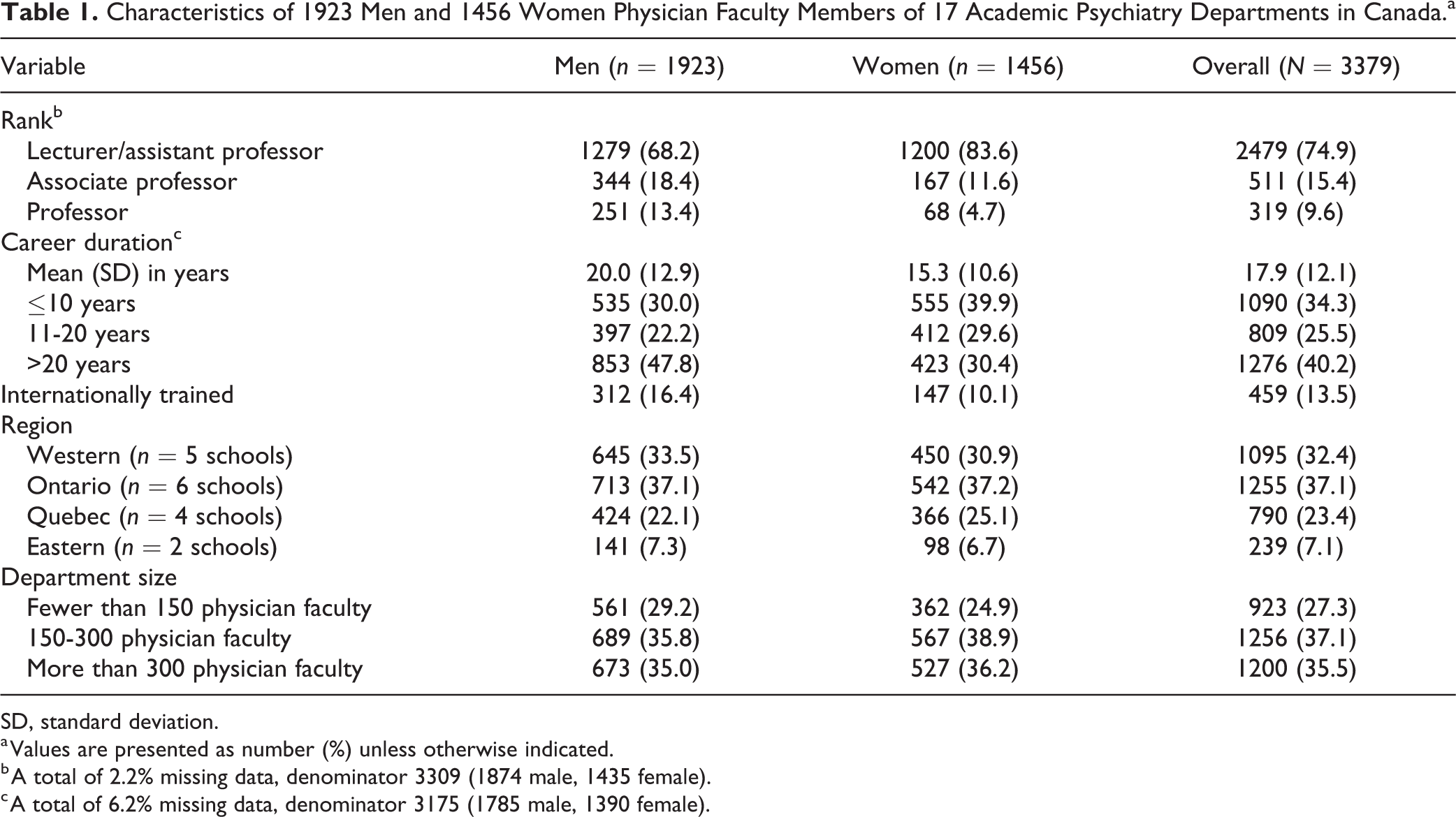
Of 3379 academic psychiatrists across Canada identified for this study, 1456 (43.1%) were women and 1923 (56.9%) were men (Table 1). Women represented almost half of those at the junior faculty level (n = 1200/2479, 48.4%). However, only 32.7% of associate professors (n = 167/511) and 21.3% of professors (n = 68/319) were women. Women had significantly shorter mean (SD) career duration (15.6 [10.6] vs. 20.0 [12.9] years) than men. The distribution of men and women did not differ by department size or by region.
Characteristics of 1923 Men and 1456 Women Physician Faculty Members of 17 Academic Psychiatry Departments in Canada.a
SD, standard deviation.
a Values are presented as number (%) unless otherwise indicated.
b A total of 2.2% missing data, denominator 3309 (1874 male, 1435 female).
c A total of 6.2% missing data, denominator 3175 (1785 male, 1390 female).
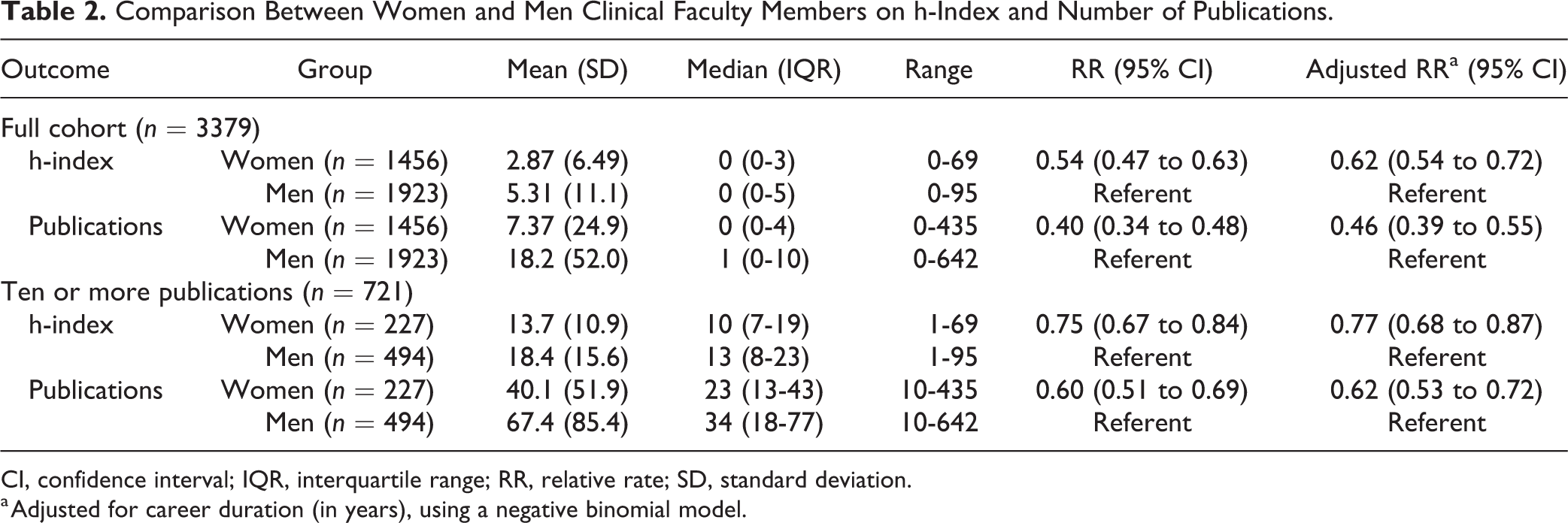
Outcome data for both the h-index and number of publications were both positively skewed and overdispersed, confirming the appropriateness of a negative binomial regression approach to the gender comparisons. The mean (SD) h-index for women was 2.87 (6.49) compared to 5.31 (1.11) for men, corresponding to a crude RR of 0.54 (95% CI, 0.47 to 0.63) (Table 2). This effect was slightly smaller after adjusting for career duration (adjusted RR [aRR], 0.62; 95% CI, 0.54 to 0.72). Women also had fewer publications than men, with a mean (SD) of 7.37 (24.9) versus 18.2 (52.0), an adjusted RR of 0.46 (95% CI, 0.39 to 0.55). In the analysis restricted to those with 10 or more publications (n = 721), the differences were smaller for both the h-index (aRR, 0.77; 95% CI, 0.68 to 0.87) and number of publications (aRR, 0.62; 95% CI, 0.53 to 0.72) (Table 2).
Comparison Between Women and Men Clinical Faculty Members on h-Index and Number of Publications.
CI, confidence interval; IQR, interquartile range; RR, relative rate; SD, standard deviation.
a Adjusted for career duration (in years), using a negative binomial model.
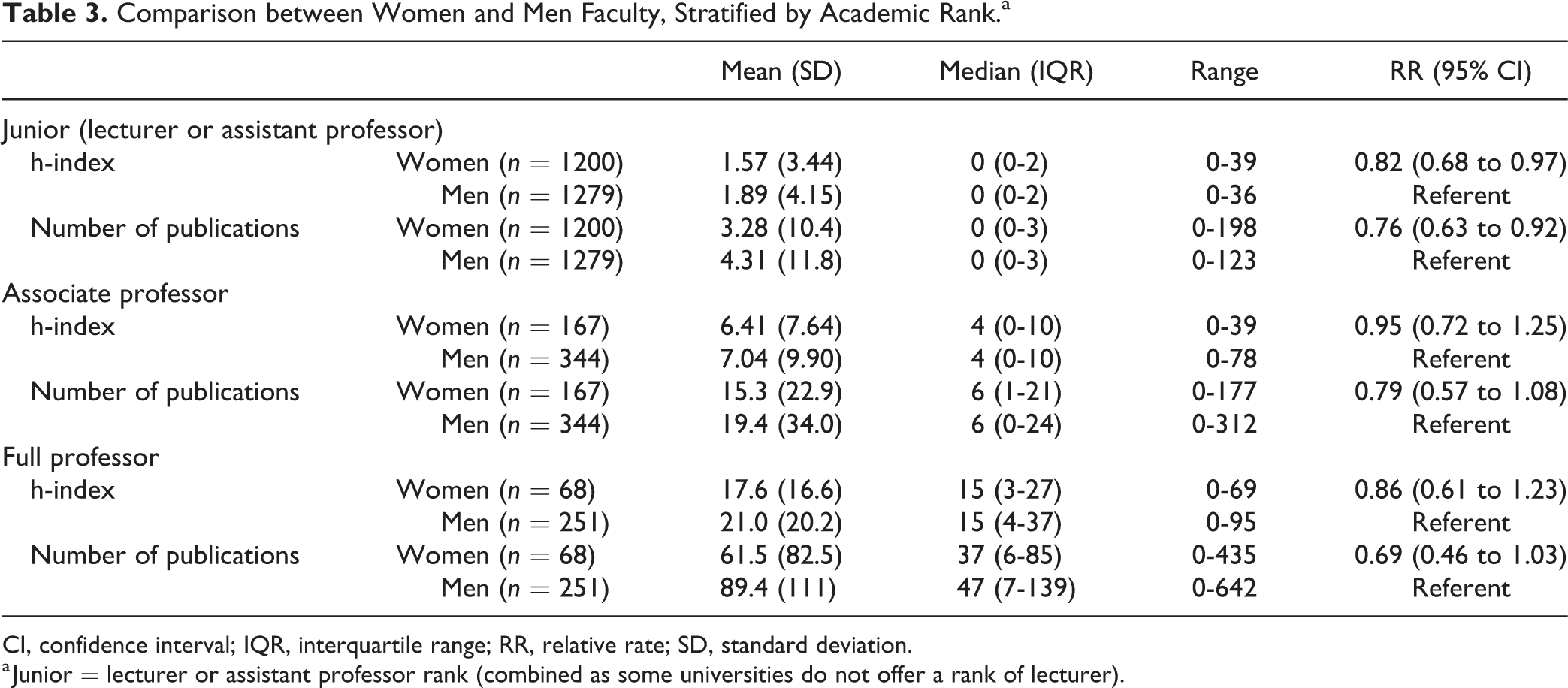
At the junior faculty level, women had significantly lower h-indices (RR, 0.82; 95% CI, 0.68 to 0.97) and fewer publications (RR, 0.76; 95% CI, 0.63 to 0.92) than men (Table 3). Among the 256 junior faculty (n = 109 women, 42.5%) with 10 or more publications, the relative differences persisted but were slightly smaller (h-index RR: 0.85; 95% CI, 0.74 to 0.98; publications RR: 0.83; 95% CI, 0.70 to 0.98). At the associate and full professor levels, neither h-index nor number of publications differed significantly between men and women either in the full cohort (Table 3) or in analyses restricted to those with 10 or more publications (data not shown).
Comparison between Women and Men Faculty, Stratified by Academic Rank.a
CI, confidence interval; IQR, interquartile range; RR, relative rate; SD, standard deviation.
a Junior = lecturer or assistant professor rank (combined as some universities do not offer a rank of lecturer).
After adjusting for career duration, women had significantly lower h-indices than men in Ontario and Quebec (the Central Canadian Provinces) but not in Eastern and Western regions (Figure 1). Women had significantly fewer publications than men across all regions. In the analysis stratified by department size, results were consistent with those of the main analysis (Figure 2). Finally, we conducted an analysis excluding the 2 universities that did not confirm the appointment and rank of their faculty members. The results were similar to those of the main analysis, showing a lower h-index (aRR, 0.60; 95% CI, 0.51 to 0.70) and number of publications (aRR, 0.44; 95% CI, 0.36 to 0.53) in women.
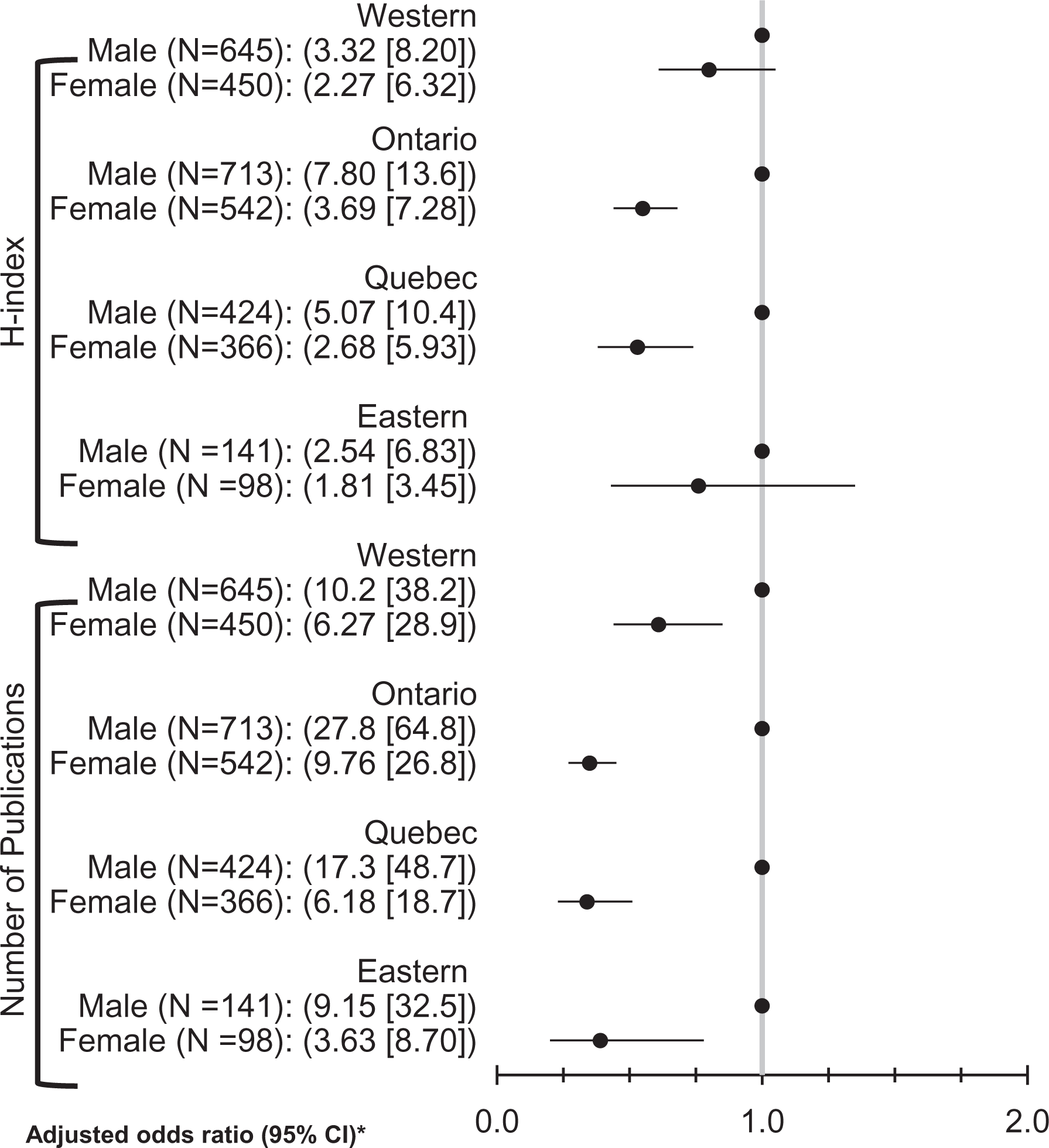
Regional comparisons of h-index and number of publications adjusted for career duration. Men represent the referent group. Mean and SD are reported in parentheses.
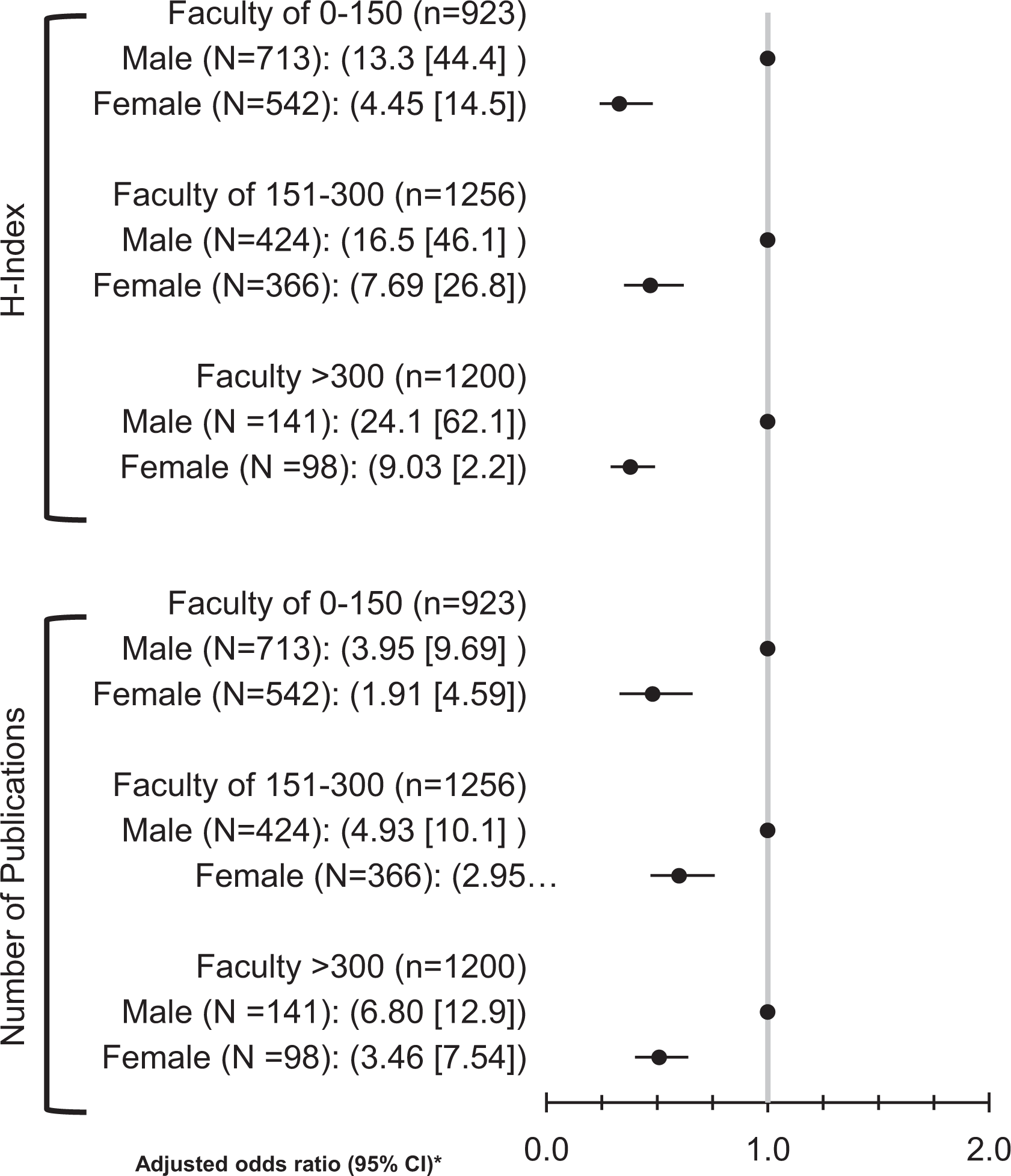
Comparisons of h-index and number of publications across faculty size, adjusted for career duration. Men represent the referent group. Mean (SD) are reported in parentheses.
Discussion
Among 3379 academic psychiatrists representing the entirety of the physician faculty from all 17 psychiatry academic departments in Canada, women had lower h-indices and fewer peer-reviewed publications than men, even after adjusting for career duration. Differences in research productivity were only observed at the junior faculty level; there were no statistical differences among associate and full professors. However, women were vastly underrepresented at these senior ranks. Together, these results suggest that research productivity differences arise in early career, with fewer women than men following an academic research track. Efforts to engage women psychiatrists in research and support them in early career could increase diversity of perspectives in this area, to the benefit of research and innovation, as well as ultimately to the health of the populations we serve.
Our results are very similar to those of a large recent US study of academic psychiatrists in which 42% of the cohort were women, and there was marked underrepresentation of women at the higher academic ranks. 20 As in our study, the mean h-index was significantly higher in men than in women (18 vs. 11, Mann-Whitney U test P < 0.001), but the difference was significant only for assistant professors (mean 8.22 vs. 6.12, Mann-Whitney U test P < 0.001) and not for associate or full professors. We were not able to identify recent gender comparisons of research productivity conducted in other specialties in which, like psychiatry, a large proportion of academic faculty is women (e.g., pediatrics, family medicine, obstetrics and gynecology). Older research from the 1990s and early 2000s in pediatrics and family medicine demonstrates fairly large differences in research productivity, with men having more publications and grants, as well as low representation of women at senior ranks. 25,26 A recent study of academic gynecological oncology departments (42% female) found that women had lower h-indices, with significant differences only at the junior ranks. 4 Our results are consistent with these findings and are also largely in keeping with findings from recent studies in the fields of otolaryngology and ophthalmology, where junior academic women had lower research productivity than men, yet senior academic women were as productive as their male counterparts. 5,17
To our knowledge, the only previous study in Canada on gender differences in academic productivity was a 2004 survey of Ontario psychiatrists (with a 52% response rate) about involvement with research. 19 As in our data, it was reported that men were statistically more likely than women to be involved in research and to have published in a scholarly journal (they were also more likely to have received funds from a pharmaceutical company for research); however, the publication counts were not reported, limiting our ability to determine whether there has been meaningful change since then. However, there are some fields of academic medicine where recent data suggest that gender differences in research productivity may be diminishing over time. As in our study, recent US studies in gastroenterology, radiation oncology, and urology found that men were more likely to hold a senior faculty position, have higher h-indices, and have more publications. 2,3,27 In each of these studies, though, this effect was completely eliminated after adjustment for career duration: men and women had similar h-indices at all academic ranks, including at the junior faculty stage. The authors suggested that observed gender differences in research productivity were likely driven by the longer career duration of men, such that the gender gap may be closing. These studies were conducted in the context of US initiatives to increase female mentorship and support for early career female clinician-researchers in medicine and surgery. 28 To our knowledge, no formal mentorship programs have been widely implemented and tailored to female research mentorship in psychiatry, so this may help explain differences in our findings. 29
Our results suggest that part of the reason for the observed differences is that very few female academic psychiatrists are engaged in a research career. While 43% of our cohort was female, within the subgroup of those with 10 or more publications (i.e., a proxy for those on a research trajectory), less than one-third were women. There has been an important movement toward ensuring that medical education and creative professional activities are appropriately acknowledged and that service in these areas is valued as a marker for promotion and advancement. However, these positive changes do not replace the importance of ensuring gender diversity in psychiatric research. Findings in psychiatry and other medical disciplines indicate that women are more likely to pursue clinician-educator careers rather than clinician-researcher careers 30 and have higher dropout rates from a research track than men. 31 –33 These findings have been attributed partly to women being socialized to take on “caregiving” roles (i.e., engaging in clinical care and teaching), having to deal with domestic responsibilities that lead them to work fewer hours with a more flexible work schedule, and facing a lack of female mentorship in the clinician-researcher stream. 34 There were significant differences in research productivity in the central provinces but not in the East and West Regions, suggesting that regional differences in the challenges facing women psychiatrists in conducting research may be important to consider.
In the analysis restricted to those with 10 or more publications, a proxy for identifying those likely to be in a research track, women still had lower h-indices and fewer publications than men, even after accounting for career duration. It has been suggested that men have more opportunities for collaboration, coauthorship, or mentorship than women. 2,15,28 There is also some evidence that men receive or are able to negotiate higher start-up packages as junior faculty to launch their research programs. 35 Some recent evidence suggests that full-time female professors are less likely than male professors to collaborate with same-sex junior faculty, limiting mentorship and publication opportunities for women at the junior level. 36 There may also be unconscious biases that work against women in terms of the awarding of grant funding, particularly when the focus of the grant review is on the applicant’s previous research and qualifications. 37 Other data reveal a possible gender bias in the academic manuscript review process, with discrimination against women authors attributed to the underrepresentation of women among peer reviewers and editors and same-gender preference among editors. 38
Inherent to the limitations of big data analytics, we were limited in our ability to explain the mechanisms underlying our findings. For example, we were unable to factor in department-level variables such as the proportion of those with academic roles or with protected time for research. Our additional analysis restricting the sample to those with 10 or more publications was an attempt to find a proxy for those in a “research track.” The results from this analysis suggest that the lower research productivity in women is related to their lower likelihood of being in a research track. While we aimed to capture all publications for each participant using SCOPUS, publications could have been misattributed to another individual with the same or similar name, or authors could have published under different names, with changed names after marriage or divorce. A recent Canadian study aimed to determine a “benchmark” for research productivity in psychiatry in Canada by exploring h-index and number of citations. 39 That study did not explore the role of gender and excluded individuals at rank of lecturer, but despite using Web of Science to measure the h-index, the metrics reported were similar to those of our overall cohort, supporting the reliability and validity of our data. Although the h-index is widely used to measure research productivity, it is based solely on academic publications and not on grant funding or on impact or uptake of research findings. It is based on citation rates, which can be influenced by scientific fads, where even poor publications may be highly cited given a trending topic, lack of critical appraisal, or other low-quality publications citing it. 40 The type of publication (i.e., epidemiological, experimental, qualitative, etc.) may also account for variation in citations. It also does not take into consideration contribution to publication as reflected in authorship position (e.g., first or last author), which may reflect higher productivity. 41 Finally, the results from our Canadian data appear to be very similar to US data despite very different parental leave policies in the 2 countries. We do not know whether our results can be generalized to other jurisdictions (e.g., in Asia or Europe).
Conclusion
Women make up over half of the current psychiatry residents and potential academic psychiatrists in Canada. 42 This represents a large pool of potential academic talent who could be recruited to contribute to the future of psychiatric research. Our findings support the need to more optimally support women in early career academic productivity. A recent systematic review of intervention programs intended to support the careers of women in academia (junior and senior) reported on 11 multicomponent interventions for which tangible outcomes, including promotion, retention, grant success, and pay, were measured. 43 These interventions had mixed results, and many were poorly described with low methodological quality, indicating that more evaluation is needed in this area. However, one of the more consistent messages was that interventions that were “bottom-up” (i.e., that required women to be responsible for opting in and participating) were not particularly successful. More success was achieved with “top-down” approaches such as policies and procedures designed to support gender equity in academia, where 1) the responsibility for implementation rested at least partly on senior leaders and managers and not solely on the women themselves, and 2) outcomes were evaluated by meaningful measures, such as targets for equity in accreditation standards. Consideration of such initiatives could increase female contribution to research and improve the health care policies and standards of practice affecting diverse populations.
Supplemental Material
supplemental_table - Gender Differences in Research Productivity among Academic Psychiatrists in Canada
supplemental_table for Gender Differences in Research Productivity among Academic Psychiatrists in Canada by Sarah Chauvin, Benoit H. Mulsant, Sanjeev Sockalingam, Vicky Stergiopoulos, Valerie H. Taylor and Simone N. Vigod in The Canadian Journal of Psychiatry
Footnotes
Data Access
Data were collected from public sources but confirmed by clinical departments under condition that the data be deidentified and not reported by individual institution. In consultation with the approving research ethics board, we may be able to provide access to aggregate data upon request.
Declaration of Conflicting Interests
The author(s) declared no potential conflicts of interest with respect to the research, authorship, and/or publication of this article.
Funding
The author(s) received no financial support for the research, authorship, and/or publication of this article.
Supplemental Material
Supplemental material for this article is available online.
References
Supplementary Material
Please find the following supplemental material available below.
For Open Access articles published under a Creative Commons License, all supplemental material carries the same license as the article it is associated with.
For non-Open Access articles published, all supplemental material carries a non-exclusive license, and permission requests for re-use of supplemental material or any part of supplemental material shall be sent directly to the copyright owner as specified in the copyright notice associated with the article.
