




Abstract
This visual abstract was created by Michael Wong.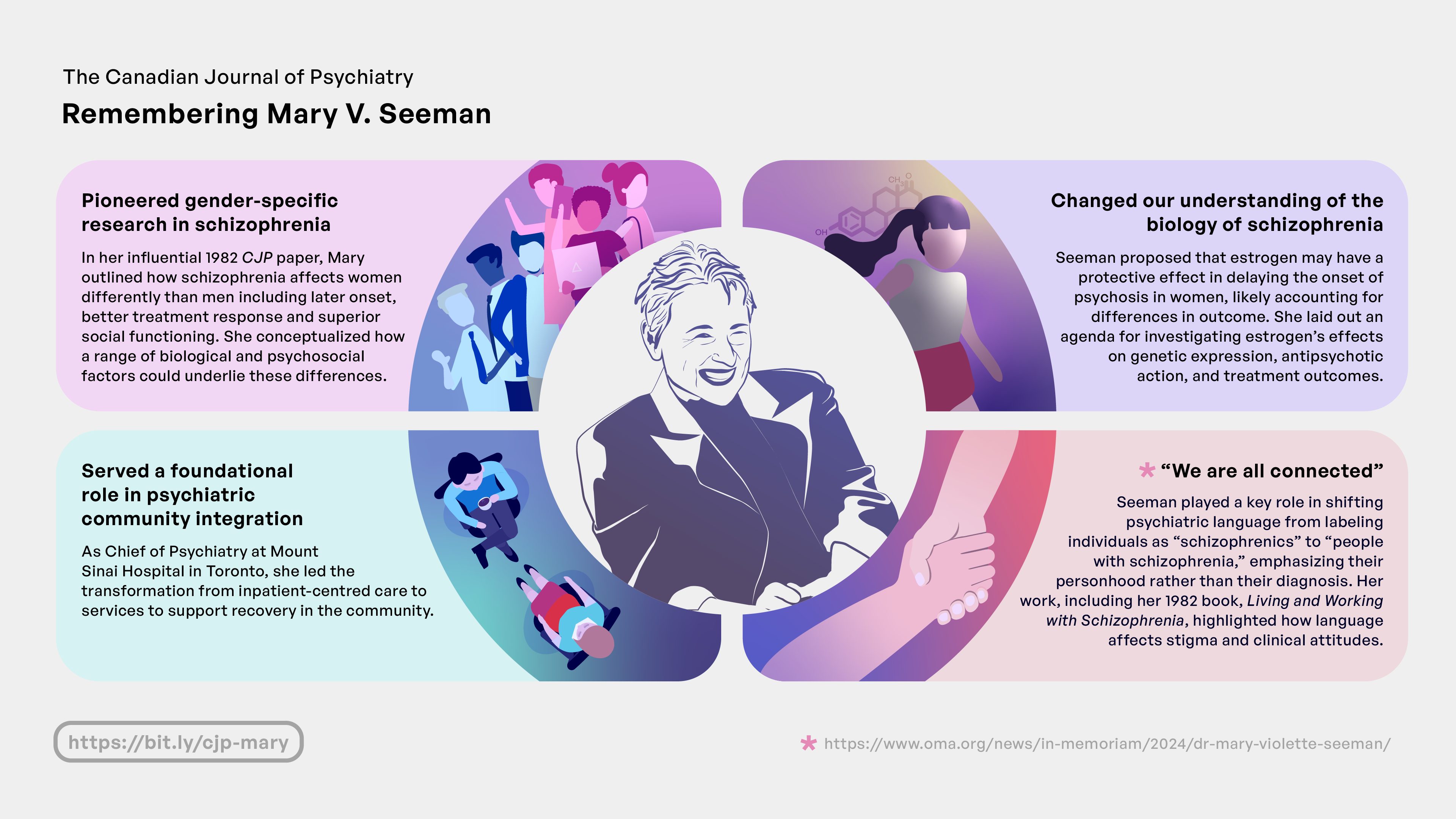
It is sad but fitting that this special issue of the Canadian Journal of Psychiatry, devoted to improving understanding of and care for people with schizophrenia, be dedicated to the late Mary V. Seeman, who died on April 23, 2024, after a brief illness—and after a long, productive, and ongoing career in psychiatry.
Generations of psychiatrists and other mental health professionals, as well as national and international colleagues, knew Mary as an inspiring teacher, a caring mentor, an indefatigable researcher and writer, and a compassionate clinician. Mary always thought broadly about patients, from their neurobiology to their social role function and adaptation. From the earliest days of her training and career, she focused on the needs of people with severe and persistent mental illness. And within that population, she cast her critical eye on what made schizophrenia different in women than in men—from potential causative or exacerbating factors to impact on treatment and quality of life.
Clinical leaders in schizophrenia care in Toronto spoke of her authenticity in clinical interactions and the genuineness of her care. She both enjoyed and taught the complexity of clinical phenomenology, acknowledging both its unique context in individual patients and its reproducible patterns across patients. Mary's generosity in mentorship permeated all aspects of her career as an academic psychiatrist. Mary loved writing. Since her first peer-reviewed publication in 1959, Mary authored or coauthored just under 600 scientific papers and commentaries, primarily focused on schizophrenia—but also more personal reflections on her career path and experience.
Mary studied languages as an undergraduate at McGill University and pursued her passion for literature at the Sorbonne prior to starting medical school. There are many different influences that lead medical students to choose psychiatry as a specialty. Mary loved stories and found that the psychiatrists she encountered in medical school told the most interesting stories about life. Over time it was the stories that she heard from her patients that were most compelling and meaningful. The same can be said of Mary's story.
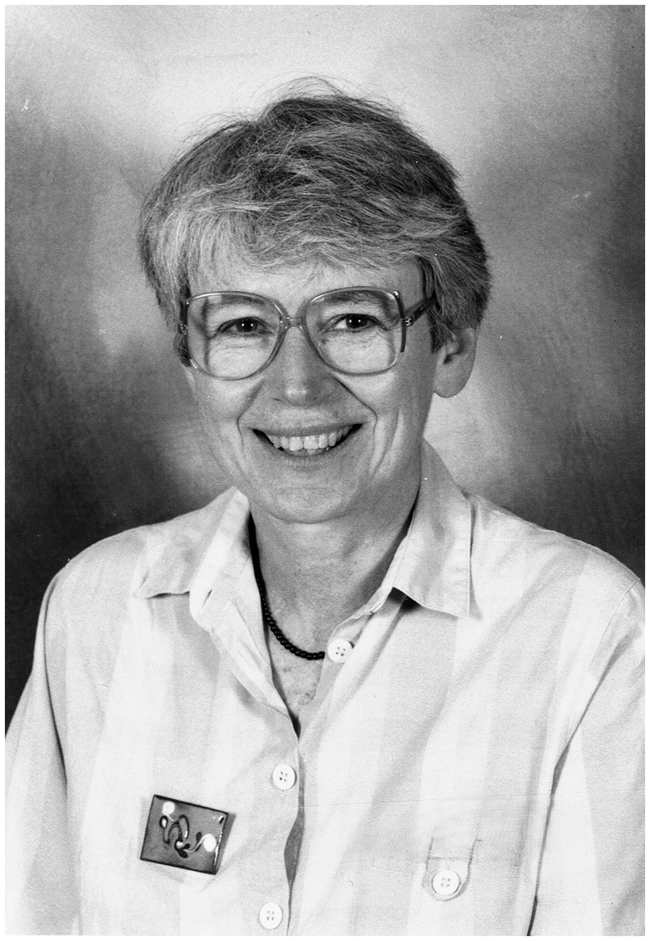
Mary was born in 1935 in Lodz, Poland, into a Jewish family with a rich cultural and intellectual tradition. Her father, Aleksander Szwarc, was a chemist and inventor. Her mother, Sonia Brzezinska Szwarc, had studied literature at the Sorbonne before her marriage. When she was 4 years old, Mary, together with her parents and her older brother, George, were able to escape Nazi-occupied Poland in a harrowing journey through Italy and France to safety in Portugal. Mary recounted this journey in a remarkable interview conducted in 2021 by the Portuguese Programa Nunca Esquecer (Never Forget Program). 1 They lived as refugees in Lisbon for 9 months before sailing across the Atlantic to arrive at Ellis Island en route to their new life in Montreal.
Inspired by her own mother to pursue an enriching career path to benefit others, Mary would read and reread every biography she could find of Marie Curie, also a Polish-born researcher who drew intellectual sustenance from a lifetime partner and scientist husband. Mary entered medical school at McGill in 1956 where she met a fellow student, Philip Seeman, who was to become her husband in 1959 and her life-long soulmate and research partner. His interest in studying pharmacology took him to Rockefeller University in New York City where Mary began her residency training in psychiatry at Columbia University in 1961.
This was a period of remarkable change in psychiatry and in American culture more broadly. Delay and Deniker published the first reports of the efficacy of chlorpromazine in psychotic patients in 1952, and it was introduced into clinical practice in the USA in 1954. 2 The move to the deinstitutionalization of psychiatric care was also in full swing. As described in one of Mary's first papers, “The desire for freedom sweeping the world in the mid-1960's inevitably made itself felt in mental hospitals.” 3 In 1955, the number of psychiatric beds in the United States peaked at over 500,000 and accounted for 50% of all hospital beds in America. 4 This was the world of schizophrenia that Mary entered when she began her career in psychiatry. As she described, “Persons with schizophrenia, just like persons with leprosy, used to be hidden away in institutions.” 5
Mary not only observed the profound beneficial effects of antipsychotic medications in the early years of her career but also the very severe and problematic adverse effects including parkinsonism, akathisia, and tardive dyskinesia. 6 She shared her observations with her husband and encouraged him to use his expertise in pharmacology to investigate how antipsychotic medications lead to such remarkable clinical improvement as well as such distressing and disfiguring adverse effects. His seminal research in this area led to the discovery of the dopamine D2 receptor (he originally called it the “antipsychotic receptor”), the high correlation between the potency of different antipsychotic medications and their binding affinity for this receptor, and the increase in dopamine receptor density following treatment with antipsychotic medication. Individually, Mary and Phil made profound contributions; together, they were very much like the Curies she admired.
The combined impact of the introduction of antipsychotic medication and the rapid push to deinstitutionalization catalysed the field of schizophrenia research. It is instructive that the holistic outpatient program in which Mary's work in Toronto was based at the Clarke Institute of Psychiatry beginning in 1975 prioritized resolving symptoms and medication side effects, minimizing the risk of suicide, violence, and hospitalization, as well as emphasizing the importance of improving quality of life and providing emotional support to families. 5 In 1979, she reported observations made following 135 outpatients with schizophrenia. 5 Of particular note, Mary described differences that were apparent in women compared with men with schizophrenia. Women were more easily accepted by their families, more likely to live with their parents, and more likely to be married. She concluded that “for men and for women the sequelae of schizophrenia are somewhat different.” This appreciation of the differences in the impact of schizophrenia on women compared to men became the central focus of Mary's academic career and the area of research in which she made her pioneering contributions.
In 1982, in the Canadian Journal of Psychiatry, Mary first outlined her views on gender differences in schizophrenia and the potential mechanisms underlying them. 7 The differences observed in women included later age of onset, better response to treatment, lower recurrence rates, better social and work functioning, higher likelihood of being married, and lower risk of suicide. While these findings reflect the contributions of many investigators, Mary conceptualized the factors that could be contributing to these differences with a degree of breadth and depth that has been extremely generative. She proposed that these could include genetic factors, intrauterine and perinatal factors, psychosocial stressors, differential exposure to alcohol and drugs, and stressors that are specific to male primates during adolescent development. It was her belief that understanding gender differences in the expression of schizophrenia could lead to a greater understanding of the aetiology and pathophysiology of schizophrenia. Mary was especially interested in the possibility that hormones, and particularly oestrogens, might play an important role in mediating the risk, timing and expression of schizophrenia in women.
In her seminal paper, “The role of estrogens in schizophrenia gender differences,” published in 1990 in Schizophrenia Bulletin, she summarized research from rodent and primate models of fetal development. 8 She proposed that sex differences in the human brain, including differences in hormone and neurotransmitter receptor number, distribution and affinity states, may contribute to functional differences relevant to the expression of schizophrenia. She hypothesized that differences in the levels of gonadal hormones during critical periods of fetal development may initiate a chain of events leading to gender differences in brain maturation, which may contribute to the earlier onset of schizophrenia in males at genetic risk for the disorder. She described the potential protective effects that high oestrogen levels may have in delaying the onset of psychosis in women at risk for schizophrenia, a delay that may in large part explain the superior outcomes that are found in women with schizophrenia. Lower oestrogen levels in the premenstrual phase may contribute to exacerbations of psychosis, while markedly lower oestrogen levels may contribute both to the development of postpartum psychosis and to the development of psychosis in postmenopausal women.
Importantly, Mary outlined a research agenda that included studying: (1) the effects of oestrogen on the expression of genes that contribute to risk for schizophrenia, (2) the effects of medications, environmental chemicals and diet on oestrogenic activity and in turn on schizophrenia risk and expression, (3) the effects of menstrual phase, fat distribution and hormones on pharmacokinetic and pharmacodynamic factors that underlie antipsychotic response and tolerability, (4) the effect of the menstrual cycle, oral contraceptives, pregnancy, lactation, menopause, and hormone replacement on symptoms and outcome in women with schizophrenia, and (5) the effects of drug exposure and endocrine disorders on the risk of developing schizophrenia using epidemiological methods. 8 Over the course of her career, Mary was able to contribute to research in many of these areas. 9
Mary was a source of inspiration for many researchers interested in advancing our understanding of schizophrenia and specifically its impact on women. She articulated the range the complex issues that needed to be understood to help women with schizophrenia including the effects of antipsychotic medication on fertility, pregnancy, and weight, as well as the impact of the illness on parenting, and the risk of violence, abuse, suicide, and medical comorbidities. As we have prepared this article about Mary and her work, leaders in the field have reached out to us to acknowledge the impact that Mary has had on their work and the field. Carol Tamminga, Professor and Stanton Sharp Distinguished Chair in Psychiatry at the University of Texas Southwestern Medical School described Mary as, Very special in her emphasis on the understanding and treatment of schizophrenia in women. She took this up rather uniquely as a passion, seeing how much it was needed, even though not popular. Women with schizophrenia are unusually vulnerable to negative and destructive forces in this world because of their illness, unless provided with some kinds of protections. Mary made all of us understand this and watch for its manifestations. She made her perspective an imperative in schizophrenia treatment.
Jill Goldstein, Professor of Psychiatry and Medicine at Harvard Medical School and the Helen T. Moerschner Endowed Massachusetts General Hospital Research Institute Chair in Women's Mental Health, described Mary as, A long-time beloved mentor of mine, then colleague and dear friend. She had a deeply generous soul—and was always available to talk. When I think of Mary, I think about her relatedness—her ability to connect regardless of who you were, her genuine warmth and generosity, and her sharp mind that continued to be active until her passing…she leaves behind a lasting legacy reflected in her patients, in her science in the field, and in my mind.
In addition to her scholarly work, Mary took on leadership responsibilities at the hospital and university levels, serving as both Chief of Psychiatry at Mount Sinai Hospital and Vice-Chair of the Department of Psychiatry of the University of Toronto. Her successor at the hospital, Joel Sadavoy, Professor of Psychiatry at the University of Toronto, recalled that, She presided over some difficult and troubling times at Sinai with grace, fortitude and moral clarity. She was never self-serving and always caring, generous and supportive of her staff. She was an egalitarian in thought and action and never saw herself as being above anyone. She firmly believed in the strength of people to get better, motivating her to deemphasize inpatient care in favour of sustaining patients in the community. She closed down several inpatient beds in order to create a transitional day program to further facilitate patient rehabilitation in the community. She understood the importance of caring for the elderly and started the Mount Sinai geriatric psychiatry consultation service.
As a mentor, she was unparalleled. Decades later, former mentees such as Neil Rector, Professor of Psychiatry at the University of Toronto, recalled her style: “She was patient, careful and deliberate in developing and pursuing research questions, she was committed to clear and no-nonsense writing, and her research was truly interested in improving the quality of lives of patients and reducing personal suffering.” Simone Vigod, Professor of Psychiatry and the Shirley A. Brown Memorial Chair in Women's Mental Health Research at the University of Toronto, described Mary's unconditional sponsorship, mentorship and support. Arturas Petronis, Professor of Psychiatry at the University of Toronto, described his meetings with Mary as an “intellectual feast.” It wasn’t just psychiatry, disease differences in men and women, dopamine receptors or epigenetics. Mary shared her most interesting insights on French art, sculpture and literature. Being an immigrant herself, Mary was particularly sensitive and responsive to the needs and concerns of newcomers to Canada. I will never forget Mary's encouragement to always look for new avenues in research, even if they seemed risky and uncharted.
One of us, her youngest son (NS), was struck by how frequently family, friends, and students of Mary echoed a certain sentiment after her passing: “She was like a mother to me.” This refrain resonated through emails, in-person conversations, and online tributes from distant relatives, patients, women colleagues, and patients’ families. Her dedication to an underserved and once-unheard patient population stemmed from a deeply empathetic and protective presence. Her gender-specific approach to care conveyed a safe, nurturing environment, especially for patients who may have lacked maternal support. In her own role as a mother to 3 boys—Marc, Bob, and Neil—she was ever-present, their advocate amid life's trials, a champion for them as she was for her patients when they overcame challenges, and a role model in caregiving, demonstrated by her devotion to her husband and her 6 grandchildren who brought her joy until her final days. During her 2-week hospital stay before returning home prior to her passing, she wore her favourite copper brooch every day, which her son Neil had made when he was 10. She asked her boys to recount stories of their youthful travails and their joys, and they laughed together.
Having escaped the Nazi occupation of Poland, Mary had a personal understanding of trauma, loss, and the importance of protection. This shaped her compassionate, motherly approach to patient care, though she never explicitly articulated it or instructed her students to do this; she simply modelled it. Mary's commitment to destigmatizing mental illness and making information widely accessible to the public suggests a nurturing, educational role akin to that of a mother. As a pioneering woman in psychiatry who empowered female scientists and physicians, she served as a maternal mentor and role model for many of her patients and colleagues.
Mary's leading role in advancing the health of women with schizophrenia was recognized with numerous honours. In 1997, she was appointed as the inaugural Tapscott Chair in Schizophrenia Studies at the University of Toronto. She received an Honourary Doctor of Science degree from the University of Toronto in 2002 and was appointed as an Officer of the Order of Canada in 2006 for her contributions to women's mental health and her research into gender differences in schizophrenia. Earlier this year, she was honoured by the American Psychiatric Association with the 2024 Adolf Meyer Award for lifetime achievement in psychiatric research.
Although Mary was 89 years old at the time of her death, her passion, humour, curiosity, and productivity had not abated. It endures now in the legacy of her scientific work, in her teaching and clinical care and in the many people she inspired to follow her example.
Footnotes
Declaration of Conflicting Interests
The authors declared no potential conflicts of interest with respect to the research, authorship, and/or publication of this article.
Funding
The authors received no financial support for the research, authorship, and/or publication of this article.
