




Abstract
Objective:
Borderline personality disorder (BPD) includes a heterogeneous constellation of symptoms operationalized with 9 categorical criteria. As the field of personality disorder (PD) research moves to emphasize dimensional traits in its operationalization, it is important to delineate continuity between the 9 DSM-IV/Diagnostic and Statistical Manual of Mental Disorders, Fifth Edition (DSM-5) categorical criteria for BPD and the trait dimensions in DSM-5 Section III. To date, no study has attempted such validation.
Methods:
We examined the associations between the 9 categorical DSM-IV/DSM-5 criteria for BPD and the trait dimensions of the alternative DSM-5 model for PDs in consecutively recruited psychiatric outpatients (N = 142; 68% female; age: mean 29.02, SD 8.38). This was investigated by means of bivariate correlations, followed by multiple logistic regression analysis.
Results:
The categorical BPD criteria were associated with conceptually related DSM-5 Section III traits (P > 0.001), except for the criterion of chronic feelings of emptiness. Consistent with the proposed traits criteria for BPD in DSM-5 Section III, we found Emotional lability, Anxiousness, Separation insecurity, Depressivity, Impulsivity, Risk taking, and Hostility to capture conceptually coherent BPD categorical criteria, while Suspiciousness was also strongly associated with BPD criteria. At the domain level, this applied to Negative affectivity, Disinhibition, and Psychoticism. Notably, Emotional lability, Impulsivity, and Suspiciousness emerged as unique predictors of BPD (P > 0.05).
Conclusions:
In addition to the proposed BPD traits criteria, Suspiciousness and features of Psychoticism also augment BPD features. Provided that these findings are replicated in forthcoming research, a modified traits operationalization of BPD is warranted.
Clinical Implications
Eight of 9 BPD criteria are associated with conceptually relevant DSM-5 traits, including the proposed traits for BPD.
Suspiciousness augments the description of BPD features, while Anxiousness may be redundant.
The DSM-5 Section III traits of Emotional lability, Impulsivity, and Suspiciousness comprise potential core features of BPD.
Limitations
The findings may be biased by the distinctive composition of PDs, and the study only involved one interviewer and one interrater.
The sample size may be insufficient to identify a larger range of traits to uniquely predict BPD criteria.
The complete DSM-5 Section III model, including rating of personality functioning (Criterion A), was not employed.
Borderline personality disorder (BPD) is one of the most prevalent and challenging disorders in clinical settings. 1 As such, it is important to have an accurate assessment of BPD that can lead to effective clinical decisions and treatment as well as scientifically sound research. 2 However, researchers and clinical experts have questioned the “construct” of BPD as retained in Diagnostic and Statistical Manual of Mental Disorders, Fifth Edition (DSM-5) Section II due to problems such as within-diagnosis heterogeneity, excessive overlap with multiple disorders, and arbitrary diagnostic boundaries. 2,3 In order to address these problems, the alternative DSM-5 model for personality disorders (PDs), listed in Section III, was developed to better reflect the extant research on personality psychopathology, including BPD. 4,5 This model emphasizes impairment in personality functioning (Criterion A) along with 5 higher-order and 25 lower-order dimensional personality traits (Criterion B) mapping onto 6 categorical PDs, including BPD.
Criterion B, the topic of the present study, is grounded in research on dimensional personality pathology 6,7 as well as the Five-Factor Model of personality. 8 An individual must exhibit certain elevated pathological traits to meet criteria for a PD diagnosis. For BPD, this applies to Emotional lability, Anxiousness, and Separation insecurity from the domain of Negative affectivity; Depressivity from the domain of Detachment; Hostility from the domain of Antagonism; and Risk taking and Impulsivity from the domain of Disinhibition. 5
Research on the Section III model has demonstrated that the traits specified for BPD largely show conceptually expected associations with its DSM-5 Section II counterpart. 9 –20 Studies particularly focusing on BPD have found a large overlap between latent representations of the Section II and Section III BPD models 21 and that the BPD Section III trait profile accounts for the same range of internalizing and externalizing behaviours associated with traditional Section II BPD operationalization. 22 Additionally, it has been clarified that Cognitive and perceptual dysregulation 21 and Suspiciousness 20 augment this prediction by mapping onto the stress-induced symptoms of dissociation and paranoia, respectively, which comprise important elements of BPD. 23
These findings indicate that more parsimonious constellations of traits may better represent BPD. Thus, more research is needed on the specific associations between traits that comprise this disorder and to which degree they accurately capture each of the 9 DSM-IV/DSM-5 categorical BPD criteria. Essentially, a major concern regarding the transition to a dimensional trait model of personality pathology is losing the existing categorical diagnoses, including BPD, which have accumulated substantial empirical literature and have been long used for clinical purposes. Therefore, coverage of and continuity with all 9 categorical BPD criteria are important components of the utility of the DSM-5 trait model. To date, no study has attempted such validation.
In the current study, we examined the empirical associations between DSM-5 Section III traits and the 9 established DSM-IV Axis II/DSM-5 Section II dichotomous criterion variables for BPD. Overall, we hypothesized that the 7 traits specified for BPD (i.e., Emotional lability, Anxiousness, Separation insecurity, Depressivity, Impulsivity, Risk taking, and Hostility) would be associated with the 9 BPD criteria of DSM-5 Section II. Based on previous findings, we hypothesized that additional traits of Suspiciousness 20 and Cognitive and perceptual dysregulation 21 would augment the prediction of paranoid ideations and dissociative experiences, respectively.
Methods
The results of the present study were derived from a secondary analysis of a previously published study 24 comprising interview-rated and self-reported data from patients that were consecutively recruited from a Danish psychiatric outpatient clinic specialized in the assessment and treatment of PDs.
We included 142 patients, of whom 68% were women, with a mean age of 29.02 years (SD 8.38). The majority of patients met the criteria for BPD (71%), followed by Avoidant (49%), Paranoid (49%), Obsessive-compulsive (32%), Antisocial (26%), Dependent (13%), Schizotypal (6%), Narcissistic (6%), Schizoid (6%), and Not otherwise specified PD (5%). Most of the patients met the criteria for 2 or more PD diagnoses.
DSM-IV/DSM-5 Section II categorical criteria for PDs, including the 9 criteria for BPD, were systematically evaluated using the the Structured Clinical Interview for DSM-IV Axis II (SCID-II). 25 All criteria were measured dichotomously (0 = not present, 1 = present). Thirteen of the SCID-II interviews were concurrently interrated by an independent psychologist blind to the original ratings, and optimal interrater reliability was identified based on criterion counts, with an intraclass correlation coefficient of 0.98 (P < 0.001). All SCID-II interviews were performed by the first author and supervised by an experienced psychiatrist. More detailed information is provided in the derivation study. 24
The DSM-5 Section III traits criteria were measured using the Personality Inventory for DSM-5 (PID-5), 6 which is a 220-item self-report inventory describing the 25 traits and 5 higher-order trait domains (Criterion B) of the alternative DSM-5 model for PDs. Patients were required to rate each PID-5 item on a 4-point scale from 0 (very false or often false) to 3 (very true or often true). We used the Danish version of the PID-5, which has demonstrated sound psychometric properties, 26 –28 and official algorithms for the calculation of traits and domains scores were employed. 29
Results
As presented in Table 1, the categorical BPD criteria were substantially associated with conceptually relevant DSM-5 Section III traits, except the seventh criterion of chronic feelings of emptiness, which was only weakly associated with Depressivity. At the higher-order domain level, Negative affectivity, Disinhibition, and Psychoticism were substantially associated with BPD criteria. At the lower-order trait level, the BPD criteria were predominantly associated with Suspiciousness, Hostility, Impulsivity, Emotional lability, Risk taking, Anxiousness, and Depressivity.
Bivariate association between 9 diagnostic criteria for BPD and Section III traits.
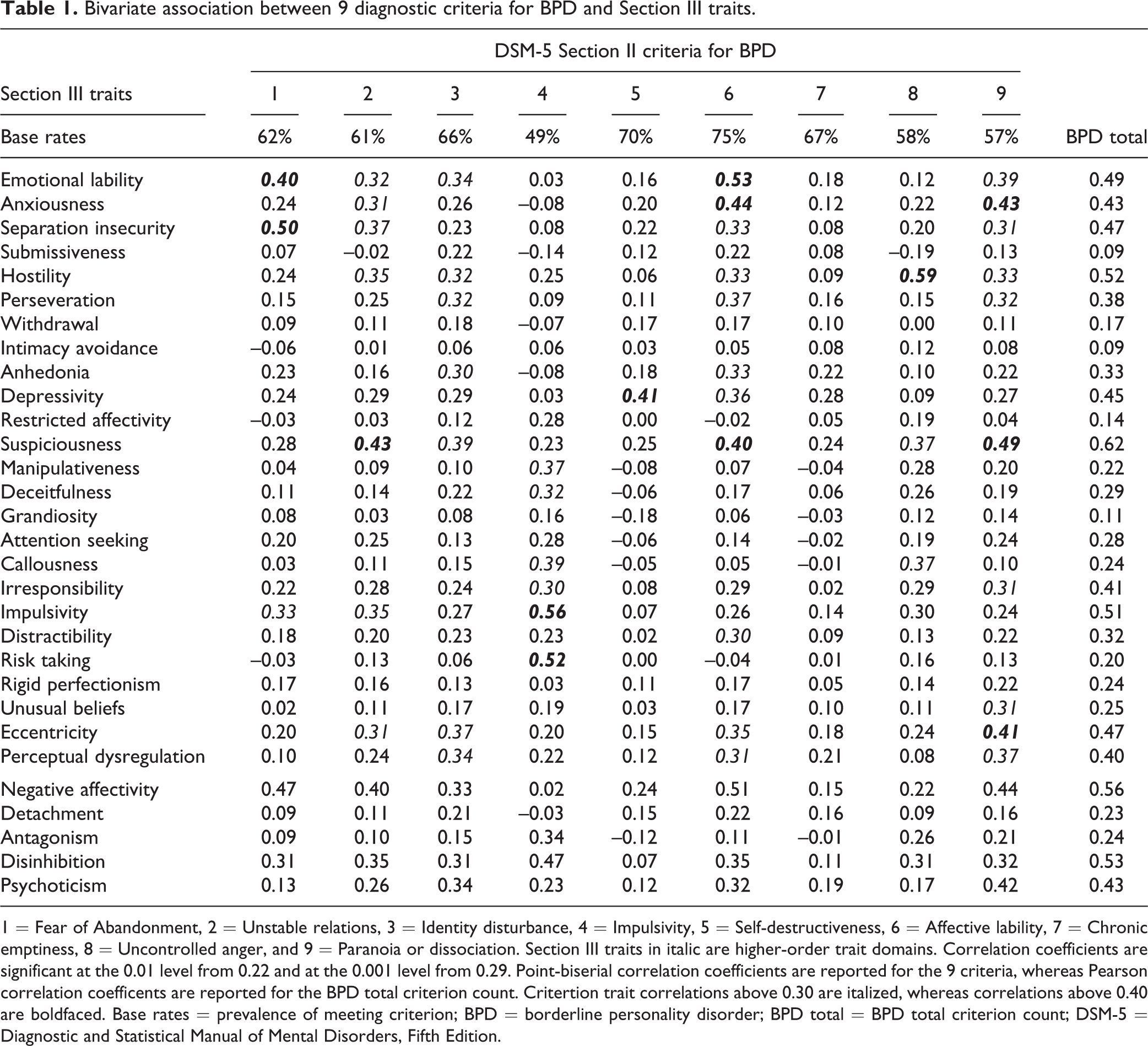
1 = Fear of Abandonment, 2 = Unstable relations, 3 = Identity disturbance, 4 = Impulsivity, 5 = Self-destructiveness, 6 = Affective lability, 7 = Chronic emptiness, 8 = Uncontrolled anger, and 9 = Paranoia or dissociation. Section III traits in italic are higher-order trait domains. Correlation coefficients are significant at the 0.01 level from 0.22 and at the 0.001 level from 0.29. Point-biserial correlation coefficients are reported for the 9 criteria, whereas Pearson correlation coefficents are reported for the BPD total criterion count. Critertion trait correlations above 0.30 are italized, whereas correlations above 0.40 are boldfaced. Base rates = prevalence of meeting criterion; BPD = borderline personality disorder; BPD total = BPD total criterion count; DSM-5 = Diagnostic and Statistical Manual of Mental Disorders, Fifth Edition.
As presented in Table 2, multiple logistic regression analyses were conducted in which each individual criterion was regressed onto traits with r s > 0.30 (moderate effect size; italized in Table 1) for that criterion. These analyses indicated unique predictors for each criterion in a conceptually coherent manner. Emotional lability was associated with criteria 1 and 6; Separation insecurity with criterion 1; Hostility with criterion 8; Depressivity with criterion 5; Impulsivity with criteria 1, 2, and 4; and Risk taking with criterion 4. Anxiousness was the only Section III BPD trait that did not increment any prediction of BPD criteria, whereas Suspiciousness (uniquely predicting criteria 2 and 9) was the only non-BPD trait to increment such predictions.
DSM-5 Section III traits that uniquely predict BPD criteria derived from logistic regression analyses.
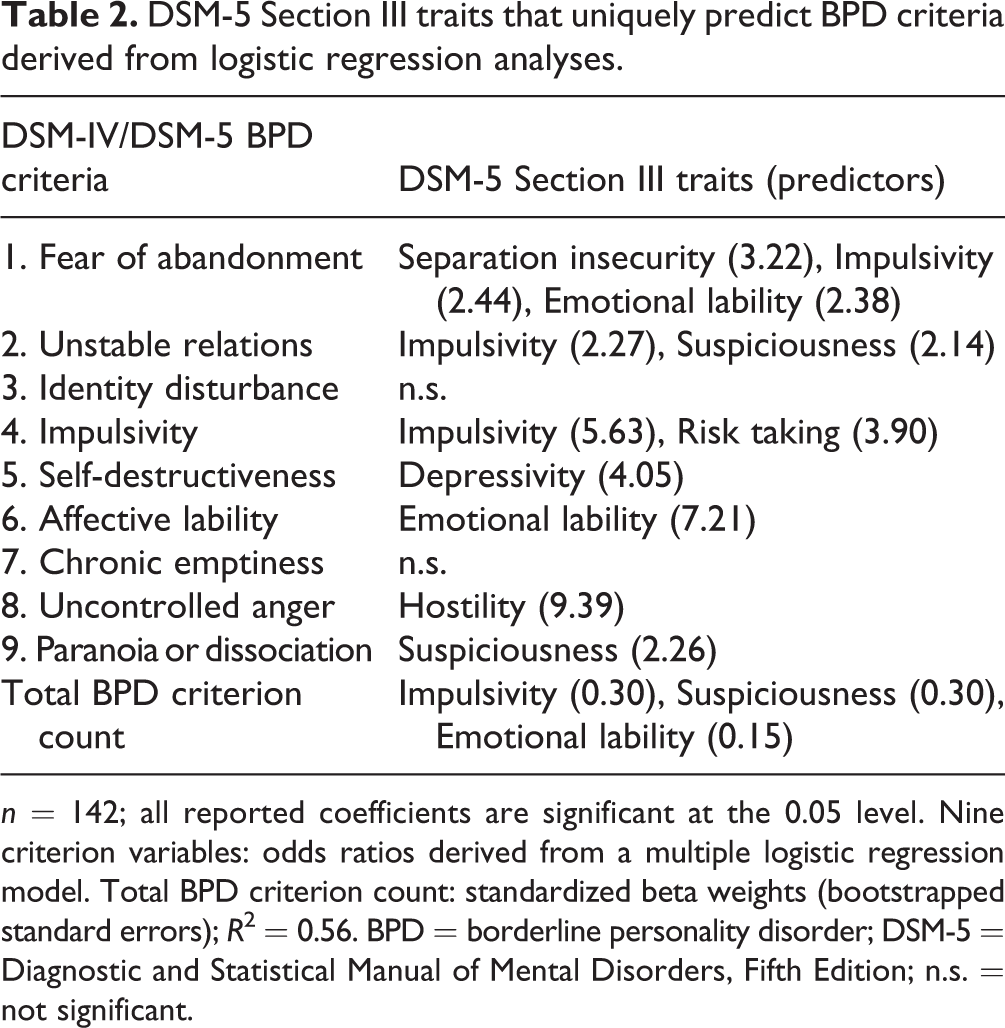
n = 142; all reported coefficients are significant at the 0.05 level. Nine criterion variables: odds ratios derived from a multiple logistic regression model. Total BPD criterion count: standardized beta weights (bootstrapped standard errors); R 2 = 0.56. BPD = borderline personality disorder; DSM-5 = Diagnostic and Statistical Manual of Mental Disorders, Fifth Edition; n.s. = not significant.
Finally, a multiple regression analysis (with bootstrapped standard errors [1000 repetitions] to account for a negatively skewed distribution) was performed in which all traits with r s > 0.40 (boldfaced in Table 1) were entered as predictors of the total criterion-count BPD score. (We selected the more conservative 0.40 rather than 0.30 as this appeared to identify the most meaningful traits and also conserved statistical power.) From this analysis, only Emotional lability, Impulsivity, and Suspiciousness emerged as unique predictors.
Discussion
In this study, we found that all 9 categorical criteria for BPD, except criterion 7 (chronic feelings of emptiness), were substantially associated with Section III traits in a manner that makes conceptual sense. Importantly, the Section III traits proposed for BPD, except Anxiousness, were unique predictors of relevant categorical BPD criteria. Remarkably, Suspiciousness was the only non-BPD trait to increment this prediction. Overall, this pattern is consistent with the proposed Section III criteria for BPD as well as the previously cited findings. 9,13,16,20,21
Despite the fact that features of criterion 3 (Identity disturbance) are not explicitly included in the traits system (Criterion B) but only in the rating of personality functioning (Criterion A), we considered its associations with Eccentricity, Emotional lability, and Anhedonia to be conceptually coherent. Likewise, we considered the substantial associations of criterion 2 (Unstable relations) with Suspiciousness and Separation insecurity to be conceptually coherent. Also, the association between criterion 5 (Self-destructiveness) and Depressivity was considered meaningful since this trait originally was composed from a lower-order feature of self-harm, among others. 6 The strong associations between Suspiciousness and a number of BPD criteria, including criterion 9 (stress-induced Paranoia or dissociation), are consistent with research indicating that increased automatic vigilance for social threat stimuli contributes to affective instability and interpersonal problems in patients with BPD. 30 Finally, the lack of substantial associations with criterion 7 (chronic feelings of emptiness) may indicate that this feature is solely captured in Criterion A (personality functioning).
Conclusion
Overall, the continuity between the categorical BPD criteria and the DSM-5 Section III traits was supported by relevant associations. Provided that these findings are replicated in future research, Suspiciousness, Emotional lability, and Impulsivity should be considered as potential core traits criteria for BPD in the revision of the Section III model, whereas the poor performance of Anxiousness suggests that too many traits from the domain of Negative affectivity may be involved in the operationalization of BPD.
Footnotes
Declaration of Conflicting Interests
The author(s) declared no potential conflicts of interest with respect to the research, authorship, and/or publication of this article.
Funding
The author(s) received no financial support for the research, authorship, and/or publication of this article.