




Abstract
A rare stromatolite form, Platella, is documented for the first time from the Upper Kajrahat Limestone of the Semri Group, Vindhyan Supergroup, Son Valley, India. These are non-columnar stromatolites, characterised by vertically arranged, plate-like laminae. Occasionally, α-branching is observed, but it lacks colonial aggregation. Their distinct structure differentiates them from similar forms, such as Pitella and Parallelophyton. Sedimentary features and associated Fan Fabric Structures indicate a restricted intertidal depositional setting. This discovery contributes to the understanding of the biostratigraphic utility and diversity of the Vindhyan stromatolite, providing insights into the complex microbial-sedimentary interactions that occurred during the Proterozoic.
INTRODUCTION
Bio-sedimentary structures, such as stromatolites, are crucial for understanding the Precambrian biosphere, as they serve as significant biostratigraphic and environmental indicators. Varied stromatolite morphotypes are documented from different parts of the world (Grey & Awramik, 2020; Raaben et al., 2001). Stromatolites form through the trapping, binding, and precipitation of sediment by the growth and metabolic activity of microorganisms (Awramik, 1992; Grey & Awramik, 2020). The stromatolite morphology is considered a time-controlled process, in which microorganisms that build the stromatolite remain undisturbed during the Precambrian, without the presence of grazers (Grotzinger & Knoll, 1999). The Proterozoic Eon is also distinguished by its unique geological processes, including the diversity and abundance of seafloor precipitates, molar tooth structures, and intraformational breccias (Bishop & Sumner, 2006; Kah & Bartley, 2022). From the Vindhyan Supergroup, various types of stromatolites have already been documented (Sharma et al., 2020, and references therein). A complex and intriguing bio-sedimentological morphology has been referred to in the literature (Sharma et al., 2020, and references therein). This communication presents the first formal description of the rare stromatolite morphotype, specifically the Platella form, from the Kajrahat Limestone of the Vindhyan Supergroup in Sonbhadra District, based on field observations. It discusses its significance in the Precambrian biosphere.
GENERAL GEOLOGY & AGE
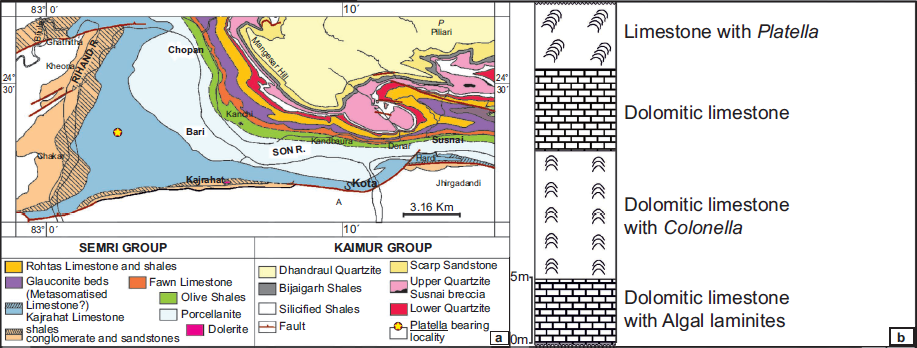
The Vindhyan Supergroup is an intracratonic basin in India, lithostratigraphically subdivided into four groups: the Semri, Kaimur, Rewa, and Bhander Groups (Auden, 1933), with a thickness of ~5,000 metres (Figure 1a). The deposition of sediments in the Vindhyan basin occurred under shallow-marine, lagoonal, and fluvial conditions, forming the Vindhyan Supergroup (Sharma et al., 2020, and references therein). The age of the Vindhyan Supergroup ranges from Late Palaeoproterozoic to Late Neoproterozoic (Lan et al., 2021; Pandey et al., 2024; Ray et al., 2002; Sharma et al., 2020; Tripathy & Singh, 2015). The lower Kajrahat Limestone is predominantly characterised by several sedimentary structures (Singh et al., 2020). The upper part of the Kajrahat Limestone is algal/stromatolitic limestone. Along with the well-developed stromatolites, characteristic Fan Fabric Structures (FFS) are also recorded from the upper part of the Kajrahat Limestone (Singh et al., 2021). In the present study, Platella was recorded from the topmost part of the Kajrahat Limestone exposed in the Bari section, Sonbhadra District, U.P. (24°28ʹ 03.4ʹʹ N; 83°02ʹ 14.7ʹʹ E) (Figure 1b).
a) Part of the geological map of the Vindhyan Supergroup exposed in the Son Valley (after Auden, 1933); b) Litholog of the Kajrahat Limestone, exposed near the Bari, Sonbhadra District.
RESULT AND DISCUSSION
The stromatolite assemblages of the Semri and Bhander Groups exhibit distinct and unique stromatolitic forms, characterised by their morphological differences (Kumar, 1980; Sharma et al., 2020, and references therein). The Semri Group predominantly exhibits passive branching and is mainly dominated by the coniform stromatolites such as Conophyton, Siren, Cyathotes, Thyssagetes, Ephyaltes, Calypso (Misra & Kumar, 2005), and Misstasania (Kumar & Misra, 2007), which are conspicuously absent in the Bhander Limestone. Whereas the Bhander Limestone from the Son Valley shows an abundance of columnar, branched stromatolites, notably Baicalia baicalica, Baicalia burra, Tungussia, Patomia ossica, and Maiharia maiharensis (see Sharma et al., 2020 and references therein). The stromatolite described in the present report shows active branching, which was hitherto unknown in the stromatolites of the Semri Group. This distinct morphological variation enables stromatolites of the Vindhyan Supergroup to serve as a perfect entity for inter- and intra-basinal correlations (Kumar, 1980).
Komar (1966) recorded Platella protensa from the Debengdin Formation of the Olenek Uplift, N. Siberia. In India, Raha (1980) reported Platella talwarensis from the Jammu Limestone in the Talwara region of Jammu. Gupta (2004) and Singh (2024) photo-documented Platella from the Vindhyan Supergroup but did not formally describe it. In fact, none of these publications from India provides detailed characteristics of Platella.
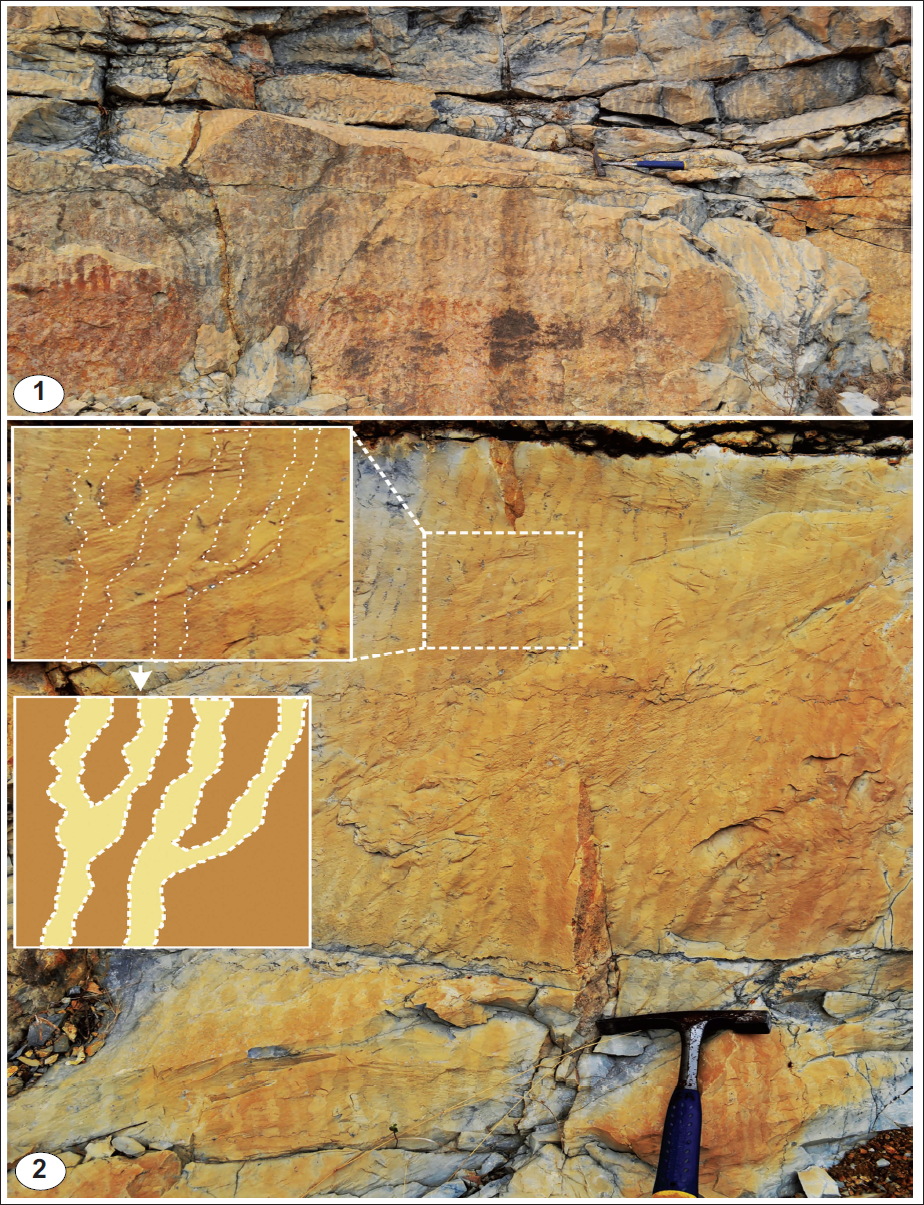
Besides the occurrence of Platella in the lower horizons of the Bari section, two other types of stromatolites, namely Colonella kajrahatensis and Conophyton vindhyanensis, were also recorded (Mishra et al., 1977). Platella stromatolites resemble the shape of an array of plates, stacked in a vertical column, arranged parallel to one another. This parallel stacking is unique, and the lateral section resembles a narrow column. The width of columns is 1–5 cm, and the length varies between 50 and 400 cm (Plate 1, Figure 1). The buildups can reach several metres in height. Further, detailed observation in transverse sections shows elongation, and planar sections show growth perpendicular to the bedding plane. Occasionally, the columns exhibit α branching (Plate 1, Figure 2; also see enlarged view of inset). In general, no wall separates the parallel stromatolitic stacks. The individual columns are similar in appearance and do not show any bulging at any level.
1) Platella, a new form of stromatolite from the Kajrahat Limestone, Bari Section, Sonbhadra District; 2) Platella represents plates stacked in vertical columns and arranged parallel. The characteristic alpha (α) branching is observed, where the branching width of the parent column remains constant before branching (see enlarge view of inset). The reconstruction of the alpha branching is shown with white dotted lines. Scale: Geological Hammer (size =28 cm).
Platella is frequently misidentified as Pitella or Parallelophyton due to its flattened columns, which are strikingly similar to those of the other two morphoforms, making differentiation among the three morphoforms challenging. The variation in the size and structure of the columns of the stromatolite marks the difference. Both Parallelophyton and Pitella are much smaller in dimensions and distinct in character. Except for Platella, none of the other stromatolites has substantial elongation. The transverse section of Pitella shows a lanceolate and rhombohedral shape (Raaben et al., 2001).
The extensive occurrence of stromatolite in the upper part of the Kajrahat Limestone may have provided the organic-rich base for initiating the characteristic FFS (Singh et al., 2021). Mostly, Kajrahat stromatolites occur as mounds, reefs, bioherms, and biostromes. However, contrary to this, the distinctive growth pattern of Platella represents one of the rarest forms of stromatolite. The three-dimensional development of the stromatolite in this form exhibits a systematically organised, sequential stacking of laminae. Notably, the growth shows an anomalous vertical (z-axis) extension within wall-like structures that function as septa during the accretion of each lamina. This pattern suggests a complex microbial process in which organosedimentary structures form through pronounced lateral (planar) expansion.
CONCLUSIONS
The interplay between sedimentary and microbial processes is essential to understanding the unique growth patterns (metre-long vertical arrangement) of Platella. All the previous occurrences of Platella were documented from the Lower and Middle Riphean (1,600–1,000 Ma). The occurrence of Platella in the Kajrahat Limestone extends the advent and antiquity of this type of stromatolite to the Late Palaeoproterozoic era (>1,600 Ma), which adds to our knowledge. The precise biogenic and sedimentary mechanisms responsible for this distinctive morphogenesis remain poorly understood and require further investigation to elucidate their origins in detail.
Footnotes
Acknowledgements
DS and SKP are thankful to the Director, Birbal Sahni Institute of Palaeosciences (BSIP), Lucknow, for providing the laboratory facilities. The Head, Department of Geology, Banaras Hindu University, is also acknowledged for the support extended to DS and BP. Field work was supported by the Birbal Sahni Research Fellowship awarded to DS. DS also gratefully acknowledges the financial support received from the Council of Scientific and Industrial Research (CSIR), India, in the form of a Research Associate Fellowship (RA).
Data Availability Statement
All the data are available from the corresponding authors.
Declaration of Conflict of Interests
The authors declared no potential conflicts of interest with respect to the research, authorship and/or publication of this article.
Ethical Approval and Informed Consent Statement
Not applicable.
Funding
The authors disclosed receipt of the following financial support for the research, authorship and/or publication of this article: DS also gratefully acknowledges the financial support received from the Council of Scientific and Industrial Research (CSIR), India, in the form of a Research Associate Fellowship (Award No. 331-2777-9532/2K24/1). MS is thankful to the CSIR for the Emeritus Fellowship (21/1161/24) and to the Integral University for the working facility.
