




Abstract
This study presents the detrital zircon U–Pb ages of the Upper Bhander Sandstone from the Bhopal Inlier, Central India. The age spectra of Upper Bhander Sandstone show the dominance of a detrital zircon population between 1,500 and 1,900 Ma, a subordinate cluster of 2,400–2,600 Ma and a single youngest zircon grain of ~770 Ma. These detrital zircon ages correlate with the timing of granite magmatism in Bundelkhand, Aravalli and Central Indian Tectonic Zone (CITZ), implying their derivation from these terranes. The geochemical and geochronological data, together with the existing paleocurrent data, suggest that the magmatic and metasedimentary rocks exposed in the Satpura Mobile Belt (CITZ) are the major sources of the detritus for the Upper Bhander Sandstone exposed in the Bhopal Inlier. These data are combined with existing palaeobiological evidence to address the issue of lack of convergence between geochronology and biochronology of the Upper Vindhyan succession of Son Valley, Central India. The finding of a single grain of zircon of 770 ± 12 Ma as an outlier is a pointer that Vindhyan deposition may have extended into the late Tonian.
Introduction
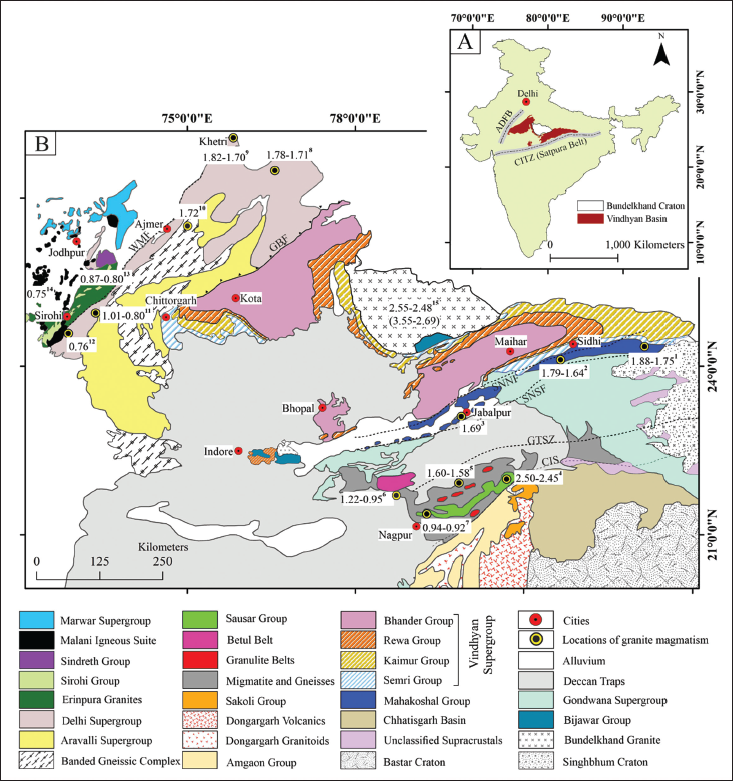
The Proterozoic supercontinent cycles played a pivotal role in shaping the Indian subcontinent and largely controlled the development and evolution of the exceptionally well-preserved ‘Purana’ basins (Meert et al., 2010; Meert & Pandit, 2015; Wang et al., 2021). Some of these ‘Purana’ basins of the Indian subcontinent are hosted by Archean craton-dominated landmasses composed of the Banded Gneissic Complex (BGC), Bundelkhand, Bastar and Singhbhum cratons separated by Aravalli–Delhi Fold Belt (ADFB) and Central Indian Tectonic Zone (CITZ) (Figure 1A, B; Basu & Bickford, 2015; Chakraborty et al., 2020; Kaur et al., 2022; Meert & Pandit, 2015; Wang et al., 2019). The Vindhyan Basin, one of the largest Proterozoic basins in the world, evolved in response to the breakup of Columbia and the amalgamation of Rodinia supercontinents (Figure 1A, B; Basu & Bickford, 2015). It hosts the thickest Proterozoic sedimentary succession of the Indian subcontinent, referred to as the ‘Vindhyan Supergroup’. The Lower Vindhyan (Semri Group) and the Upper Vindhyan (Kaimur, Rewa and Bhander Groups) successions have been extensively studied in terms of palaeobiology (Azmi, 1998; Azmi et al., 2008; Bengtson et al., 2009, 2017; De, 2003, 2006; Kumar & Pandey, 2008; Kumar & Sharma, 2012; Kumar & Srivastava, 2003; Pandey et al., 2023; Pandey & Kumar, 2013; Retallack et al., 2021; Seilacher et al., 1998; Sharma, 2006; Sharma & Shukla, 2009a, 2009b; Sharma et al., 2016; Shukla & Sharma, 2016; Srivastava, 2002, 2009, 2012) and geochronology (Bickford et al., 2017; Colleps et al., 2021; George et al., 2018; Gilleaudeau et al., 2018; Gopalan et al., 2013; Kumar et al., 2001, 2002; Lan et al., 2020, 2021; Malone et al., 2008; McKenzie et al., 2011; Mishra et al., 2018; Rasmussen et al., 2002; Ray, 2006; Ray et al., 2002, 2003; Sarangi et al., 2004; Turner et al., 2014; Tripathy & Singh, 2015) to constrain their depositional ages. The age of Lower Vindhyan (Semri Group) is geochronologically well-constrained, whereas the Upper Vindhyan succession lacks robust age constraints due to the absence of volcanic tuffaceous/pyroclastic materials (e.g., Tripathy & Singh, 2015). Detrital zircon geochronological data from the Upper Vindhyan sandstones generally show a lack of zircons younger than 1,000 Ma, and that has been used to infer the closure of the Vindhyan Basin at ~1,000 Ma (Chakraborty et al., 2020; Malone et al., 2008; McKenzie et al., 2011; Turner et al., 2014). Additionally, paleomagnetic evidence suggests the termination of Vindhyan sedimentation at the end of the Mesoproterozoic (Malone et al., 2008; Meert et al., 2013; Turner et al., 2014; Venkateshwarlu & Rao, 2013). Other radiometric dates, such as Pb–Pb and Sr-isotopic ages, suggest that the deposition of the Upper Vindhyan succession continued until at least ~800 Ma (George et al., 2018; Gopalan et al., 2013; Ray et al., 2003; Srivastava & Rajagopalan, 1988). Additionally, palaeobiological evidence suggests an Ediacaran age for the deposition of the Bhander Group, the youngest unit of the Upper Vindhyan Group (De, 2006; Kumar & Pandey, 2008; Pandey et al., 2024; Prasad, 2007; Prasad et al., 2005).
The recent mistaken identification of the Ediacaran fossil ‘Dickinsonia’ from the Upper Bhander Sandstone (Maihar Sandstone) at Bhimbetka from the Bhopal Inlier, Madhya Pradesh (MP) by Retallack et al. (2021) and its recognition later as extant beehive impressions (Meert et al., 2023; Pandey et al., 2023) together with the occurrence of a single youngest 548 Ma zircon grain from the Maihar Sandstone at Maihar (MP) (Lan et al., 2020) has raised interest in the reassessment of the closure age of the Vindhyan Basin. The Bhopal Inlier has exposure to Vindhyan rocks with extensive development of the Bhander Group, which is detached from the main Vindhyan outcrops in the Son Valley and the Rajasthan sector. Vindhyan sequences exposed in these two sectors have been studied by several workers to interpret their provenance (e.g., Chakrabarti et al., 2007; Banerjee & Banerjee, 2010; Lan et al., 2020, 2021; Malone et al., 2008; Quasim et al., 2018, 2020; Raza et al., 2010, 2012; Sen et al., 2014, 2023; Sen & Mishra, 2020; Shukla et al., 2020; Turner et al., 2014). A detailed geochemical study indicates that the source for the Semri and Kaimur Group of sediments in the Rajasthan sector is younger than the equivalent sections exposed in the Son Valley sector (Shukla et al., 2020). In contrast, the Rewa and Bhander sequences derived sediments from similar sources in both sectors (Shukla et al., 2020). However, limited data exist for understanding the provenance of the sequences exposed in the Bhopal Inlier, especially using geochemistry and geochronology (Shrivastava et al., 2023). Here we present the U–Pb detrital zircon geochronology of the Upper Bhander Sandstone exposed in the Bhopal Inlier. We integrated zircon age data with our petrographic and geochemical data along with the published paleocurrent data (e.g., Akhtar, 1978; Ansari, 1994; Bhattacharyya & Morad, 1993; Raza & Casshyap, 1996) to provide an improved understanding of the provenance for these Proterozoic sandstones.
Geological Background
The Vindhyan Basin
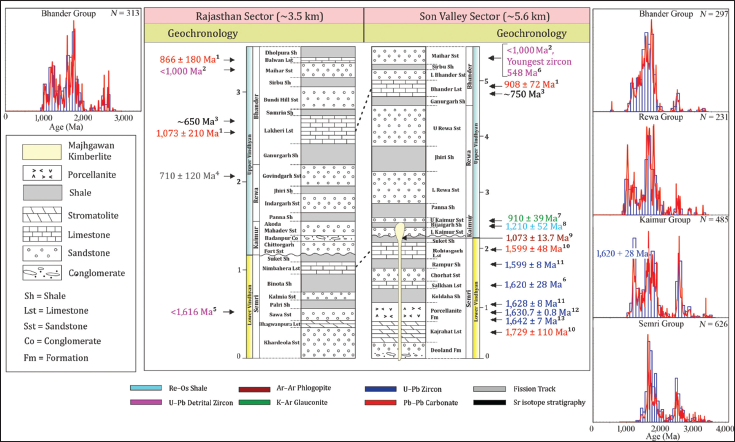
The Vindhyan Basin is a large intracratonic basin filled with unmetamorphosed and mildly deformed Proterozoic sedimentary rocks (Bose et al., 2001). It is an arcuate basin developed in the central part of the Indian shield, bounded in the west by the ADFB and in the south and southeast by CITZ (Figure 1 A, B; Chakraborty, 2006; Chakrabarti et al., 2007; Ramakrishnan & Vaidyanadhan, 2010). Low-grade metamorphic rocks of the Mahakoshal Group form the eastern margin of the basin, whereas it is bordered by recent alluvium in the north and covered by Deccan lavas in the south (Figure 1B; Chakraborty, 2006; Chakrabarti et al., 2007; Ramakrishnan & Vaidyanadhan, 2010). The Bundelkhand massif divides the Vindhyan Basin into the Son Valley sector and the Chambal Valley sector or the Rajasthan sector (Kumar, 2012; Valdiya, 2016). The rocks of the Vindhyan Supergroup are stratigraphically divided into the following four groups: Semri, Kaimur, Rewa and Bhander (Figures 1B and 2). The presence of a pronounced regional unconformity at the base of the Kaimur Group divides the succession into the Lower Vindhyan and the Upper Vindhyan (Kumar, 2012; Kale, 2016; Valdiya, 2016). The Semri Group forms the lower part of the Vindhyan Supergroup, which comprises five formations in the Son Valley sector, that is, Deoland, Kajrahat, Porcellanite (Deonar Formation), Kheinjua and Rohtas, in order of superposition (Figure 2). The Semri Group is composed predominantly of carbonates and shales with subordinate sandstone and volcaniclastic rocks and deposited mainly in shelf and shallow marine environments (Bose et al., 2001). The Upper Vindhyan is constituted by the Kaimur, Rewa and Bhander groups in ascending order (Figure 2). Overall, the Vindhyan Basin is characterised by a ~5,000 m thick succession composed of sandstone, shale, conglomerate and carbonate with subordinate felsic volcanics. The depositional environment for the Vindhyan sediments ranges from continental (alluvial fan) to marine shelf (tidal flat to storm-dominated shelf; Bose et al., 2001).
Debate on the Termination Age of Upper Vindhyan Sedimentation
The occurrence of carbonate sequences such as Kajrahat, Salkhan and Rohtas limestone, as well as volcaniclastic materials in the Porcellanite Formation of the Semri Group, enables the determination of the absolute age of the Lower Vindhyan succession. Based on several radiometric data, such as U–Pb zircon ages of volcanic tuffs and rhyolite (Bickford et al., 2017; Mishra et al., 2018; Rasmussen et al., 2002; Ray et al., 2002) and Pb–Pb ages of carbonates (Ray, 2006; Sarangi et al., 2004), the age of the Lower Vindhyan succession has been reliably constrained between ~1,750 and 1,500 Ma (Figure 2). In contrast, the Upper Vindhyan succession shows the absence of volcanic tuffaceous material, and therefore detrital zircon U–Pb geochronology has been applied to constrain its maximum depositional age. U–Pb concordia dates of the youngest detrital zircons within the Upper Bhander Sandstone unit of the Upper Vindhyan, constraining its maximum depositional age to ~1,020 Ma (Malone et al., 2008). Several studies argue for a late Mesoproterozoic to early Neoproterozoic age for the Upper Vindhyan based on palaeomagnetic studies and the general absence of zircon grains younger than ~1,000 Ma in the Upper Vindhyan succession (Figure 2; Chakraborty et al., 2020; Malone et al., 2008; McKenzie et al., 2011; Turner et al., 2014). However, Kumar et al. (2002) proposed a 700–570 Ma age range for the Bhander Group on the basis of oxygen, carbon and strontium isotopic signatures. Based on Sr isotope stratigraphy of carbonates from the Upper Vindhyan (Son Valley sector), a mid-Neoproterozoic age (750–650 Ma) has also been suggested for the Bhander Group (Figure 2; Ray et al., 2003). Strontium isotope stratigraphy and δ13C shift in the Balwan Limestone (Figure 2), together with their Pb–Pb age (866 ± 90 Ma), present strong evidence for the continuation of Upper Vindhyan sedimentation during the Tonian period (Figure 2; George et al., 2018; Gopalan et al., 2013). Recently, Lan et al. (2020) reported the youngest detrital zircon of 548 Ma age from the Maihar Sandstone (Figure 2); however, also see Bickford and Basu (2021) for different views. From these multiple datasets, it is observed that there is no consistency in the stratigraphic ages proposed by different authors. Notably, the geochronology also shows divergence from the ages proposed on the basis of palaeobiological evidence. The presence of Arumberia and other Ediacaran-like fossils suggests an Ediacaran age as the upper limit of the Vindhyan sedimentation (Ansari et al., 2023; De, 2006; Kumar & Pandey, 2008; Pandey et al., 2024).
Upper Bhander Sandstone (Equivalent to Maihar Sandstone) from the Bhopal Inlier
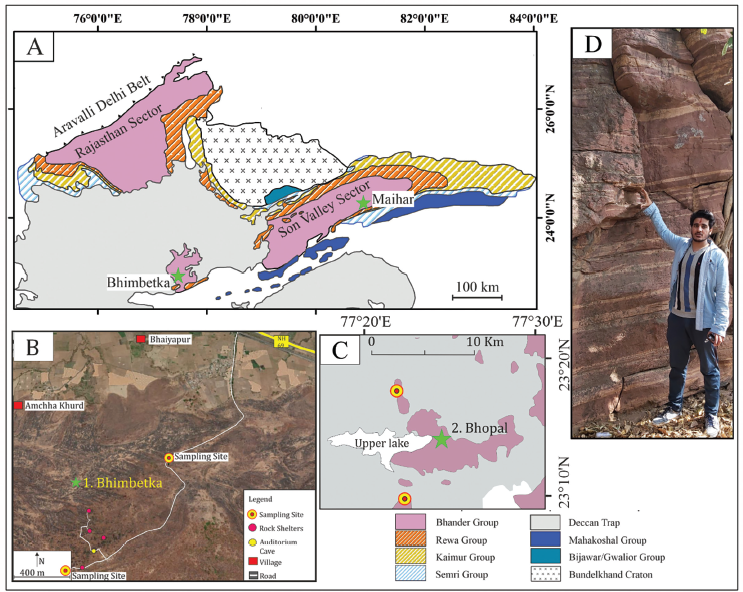
Sandstones exposed in the Bhopal Inlier belong to the Upper Bhander Sandstone (Bhander Group) of the Vindhyan Supergroup (Figure 3A–C; Ramakrishnan & Vaidyanadhan, 2010). The equivalent Maihar Sandstone in its type area, composed of sandstone, siltstone and subordinate shale, is considered to be the youngest stratigraphic horizon of the Bhander Group, showing gradational contact with the underlying Sirbu Shale. The Upper Bhander Sandstone in and around Bhopal occurs as isolated outcrops forming the southwestern part of the Vindhyan Basin (Figure 3A; Mohammadi, 2015; Mohammadi et al., 2014). They are primarily red-coloured sandstones that are interbedded with yellow/brown siltstone (Figure 3D). These ferruginous and non-calcareous sandstone beds dip northward at ~10 degrees. Planar bedding is the most prominently developed sedimentary structure in the Bhimbetka Sandstone (Figure 3D). Structures such as ripple marks and trough cross-bedding are also observed in some places.
Results
Petrographic Study
Sampling and analytical methods are reported in Supplementary Materials. The sandstone is composed of quartz, subordinate feldspar and lithic fragments with accessory mica, tourmaline and zircon. Subangular to subrounded quartz grains constitute the major portion (~90%) of the sandstone, sometimes exhibiting iron-oxide coatings. Monocrystalline quartz dominates over the polycrystalline quartz grains. Potassium feldspar accounts for about 5% of the bulk sample, followed by lithic fragments (quartzite and chert) comprising ~3%. Petrographic investigations reveal that the sandstone is medium- to fine-grained, moderate- to well-sorted quartz arenite, with a high degree of compositional and textural maturity. The presence of polycrystalline quartz grains along with undulatory extinction in some grains indicates metamorphic rocks as one of the possible sources for these sandstones.
Whole-rock Geochemistry
Major and trace element data for Upper Bhander Sandstone from the Bhopal Inlier are presented in Supplementary Table 3. These sandstones show high concentrations of SiO2, ranging from 73.9 to 88.2 wt%. High SiO2 content accords well with the abundance of quartz in these sandstones. The samples exhibit moderate amounts of Al2O3 (4.3–7.4 wt%) and Fe2O3 (2.4–9.1 wt%) and very low amounts of TiO2, MnO, CaO, K2O, Na2O and P2O5. The K2O/Na2O ratio is greater than 1, indicating the dominance of potash feldspar over plagioclase feldspar, and is also consistent with the petrographic observations. The chondrite-normalised REE pattern of these sandstones shows LREE enrichment, with La N /Sm N ranging from 3.13 to 4.48 and a flat HREE pattern with Gd N /Yb N value in the range of 0.99–1.72 (Figure 4A). All the samples show a prominent negative Eu anomaly, which ranges from 0.35 to 0.59 (Figure 4A). The LREE-enriched pattern with negative Eu anomaly and very high La/Yb ratio (9.7–16.2) suggests the cratonic environment and is most likely a felsic source for these sandstones.
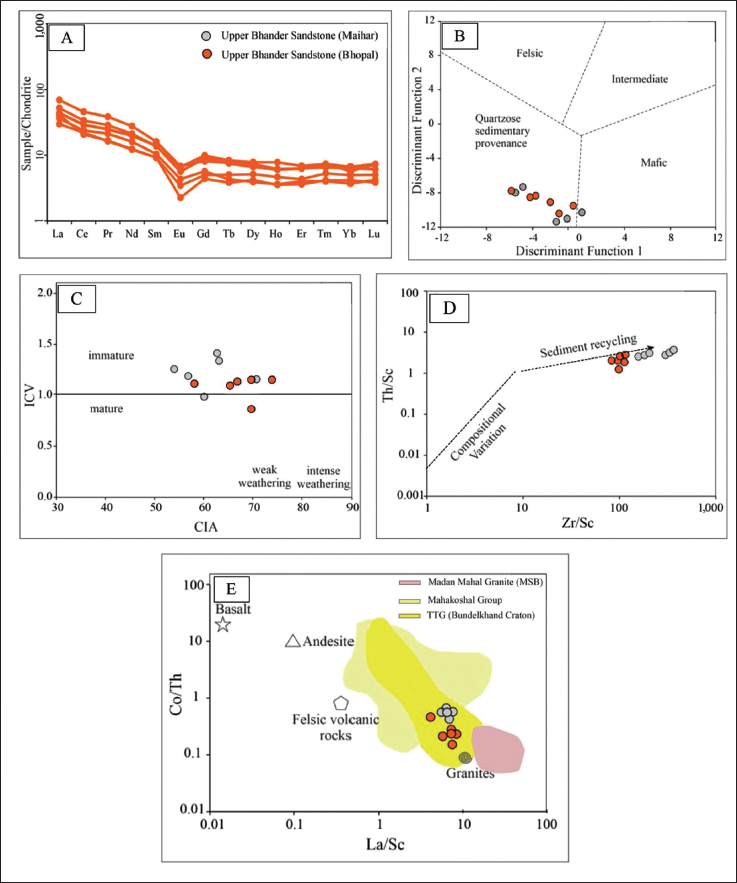
The discriminant diagram proposed by Roser and Korsch (1988) is used to discriminate among felsic igneous, quartzose sedimentary, intermediate and mafic igneous provenances. All the samples fall in the field of quartzose sedimentary provenance, indicating recycled granitic/gneissic or sedimentary source (Figure 4B). The Index of Compositional Variability (ICV; Cox et al., 1995) was calculated for the samples to understand their compositional maturity. ICV for Upper Bhander Sandstone samples is close to 1 (0.9–1.2; Figure 4C), which suggests that these sandstones are compositionally mature and possibly deposited in tectonically stable/cratonic environments where sediment recycling was prominent. Recycling can also be confirmed by the Zr/Sc versus Th/Sc plot (McLennan et al., 1993) for these samples. First-cycle sediments generally show a good correlation between these ratios, whereas recycled sediments are characterised by very high Zr/Sc as compared to the Th/Sc ratio (Figure 4D). The La/Sc versus Co/Th plot shows that the samples fall in the common field of TTG of the Bundelkhand Craton and the rocks of the Mahakoshal Belt (Figure 4E). It can be inferred that these sedimentary rocks may have been derived from the older crust (TTG) and the metasedimentary and granitic rocks (e.g., Madan Mahal) of the Mahakoshal Belt exposed in the surrounding terrain (Figure 4E).
Detrital Zircon Geochronology and Trace Element Analysis of Zircons from the Upper Bhander Sandstone of Bhopal Inlier, Central India
Detrital Zircon Geochronology
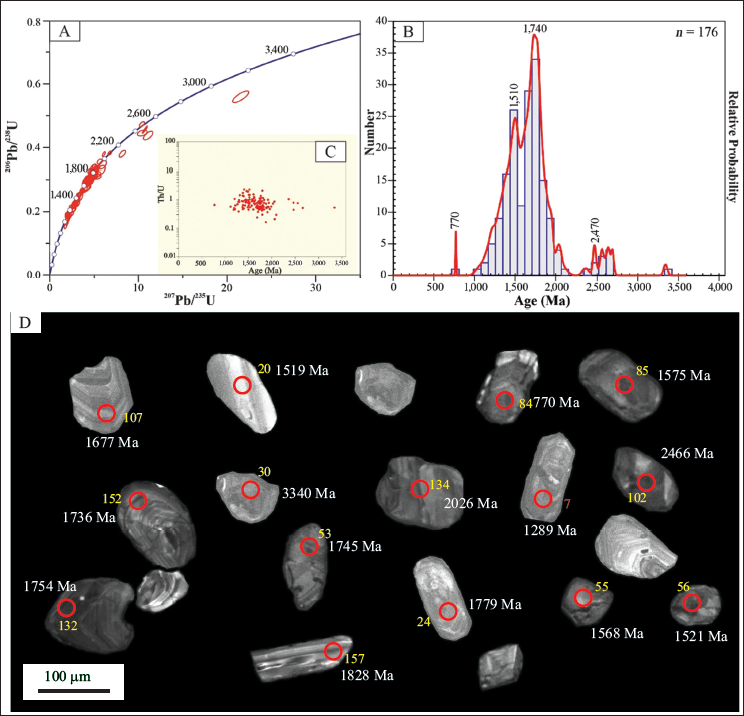
A total of 227 zircons were analysed from the Upper Bhander Sandstone at Bhimbetka, of which 176 grains provided concordant ages (<10% discordance) and have been used for provenance and age interpretation. The data are reported in the Supplementary Table 1. Zircon grains of the sandstones from Bhimbetka are subangular to subrounded in shape and range in size from 50 to 200 µm. Cathodoluminescence (CL) images show some oscillatory zoned zircon crystals. Representative CL images of grains with their concordant ages are shown in Figure 5D. Near-concordant ages have been plotted in the Wetherill concordia diagram, which shows several age clusters (Figure 5A). Age distribution of the samples is shown in a probability density plot (Figure 5B). The sample has the most dominant population of detrital zircons between the age interval of 1,400 and 1,800 Ma, with a primary peak at 1,740 Ma and a secondary peak at 1,510 Ma. Another prominent peak at ~2,470 Ma is also recorded. One Paleoarchean zircon grain is present with a 207Pb/206Pb age of 3,340 ± 47 Ma. A small cluster of zircon grains occurs in the interval of 2,150–2,000 Ma, with a subordinate peak at 2,044 Ma. A few grains reveal ages in the interval of 1,000–1,300 Ma, with a peak age at 1,220 Ma. The youngest grain in the sample has a 206Pb/238U age of 770 ± 12 Ma. This particular grain exhibits a high degree of concordance (~95%); therefore, the age can be considered to be robust.
The Compilation of the Magmatic Events (Mainly the Ages of Gneisses and Granitoids) from the Satpura Mobile Belt (CITZ), Aravalli-BGC Craton and Bundelkhand Craton.
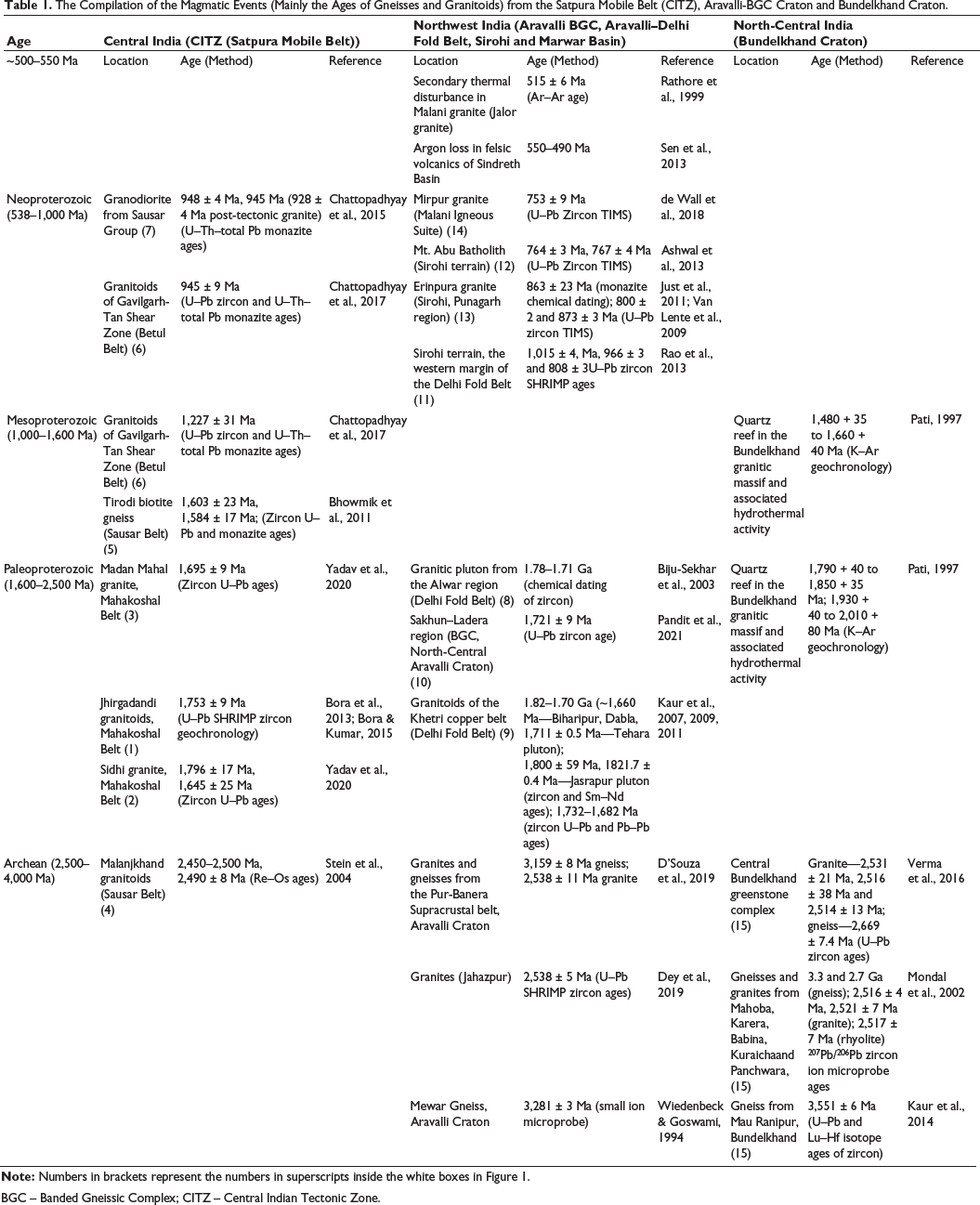
BGC – Banded Gneissic Complex; CITZ – Central Indian Tectonic Zone.
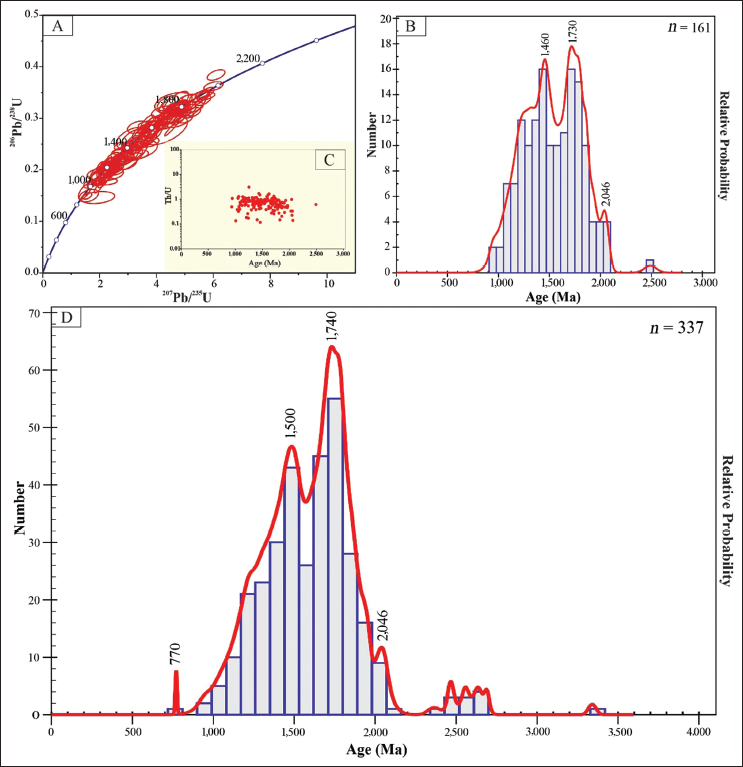
Additionally, a total of 179 zircons were analysed from Upper Bhander Sandstone exposed in and around Bhopal city, of which 161 grains provided concordant ages (<10% discordance) and have been used for provenance and age interpretation. These data are reported in Supplementary Table 1. Zircon grains of these sandstones are also subangular to subrounded in shape and range in size from 50 to 200 µm. Near-concordant ages have been plotted in the Wetherill concordia diagram, which shows several age clusters (Figure 6A). Age distribution of the sample is shown in a probability density plot (Figure 6B) with Th/U ratio versus U–Pb ages plotted in Figure 6C. The sample has the most dominant population of detrital zircons between the age interval of 1,400 and 1,800 Ma, with a primary peak at 1,730 Ma and a secondary peak at 1,460 Ma. Another subordinate peak at ~2,046 Ma is also recorded from these sandstones. One relatively older zircon grain is present with a 207Pb/206Pb age of 2,490 ± 116 Ma. A few grains reveal ages in the interval of 1,000–1,300 Ma. Overall, the detrital zircon geochronology of the Upper Bhander Sandstone from the Bhopal Inlier (Bhopal city and Bhimbetka collectively) suggests that the grains cluster predominantly around ~1,740 and ~1,500 Ma (Figure 6D).
(A) U–Pb Concordia Diagram, (B) Relative Probability Density Diagram and (C) Th/U Ratio Versus U–Pb Ages Plot for Detrital Zircons of Upper Bhander Sandstone Sample from Bhopal Region. (D) Combined Relative Probability Density Diagram for All Upper Bhander Sandstone Samples from the Bhopal Inlier (Bhimbetka and Around Bhopal City).
Trace Element Analysis of Zircons
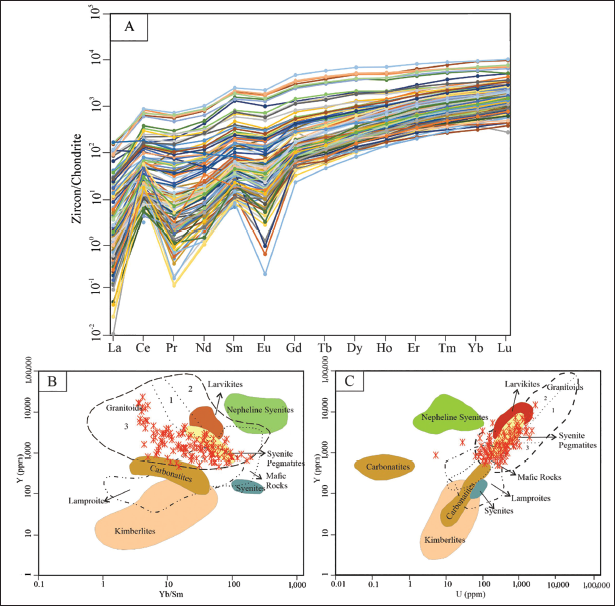
Concentrations of trace elements of zircons in the sandstone from Bhimbetka are reported in Supplementary Table 2. The sample has U content ranging from 42 to 1021 ppm with Th/U ratios varying from 0.16 to 2.31 with an average of 0.81 (Figure 5C). The CL images of the grains coupled with their Th/U ratio suggest a magmatic origin for these detrital zircons. The total REE content of the zircon grains varies from 69 to 17,845 ppm with an average value of 2,066 ppm. The majority of the grains exhibit a uniform chondrite-normalised REE pattern showing LREE depletion and HREE enrichment (LREE/HREE = 0.01–0.67; Figure 7A). The REE pattern of zircons shows negative Eu anomaly (0.01–0.90, average—0.43) and variably positive Ce anomaly (0.96–187.44, average—14.56). This HREE-enriched REE pattern with negative Eu and positive Ce anomaly is typical for zircons occurring in granitoids (Figure 7A; Belousova et al., 2002). In addition, the Y concentrations of zircons varying from 411 to 18,223 ppm fall within the range of Y of zircons from granitoids (Belousova et al., 2002; Poller et al., 2001). The (Lu) N (where N = value normalised to chondrite) values varying from 344 to 14,955 are comparable to zircons from granitoids (500–20,000 ppm; Hoskin & Ireland, 2000). A cross plot of Y (ppm) versus U (ppm) and Y (ppm) versus Yb/Sm has been used for discriminating the origin of zircon grains (Figure 7B, C). The discrimination plots reflect that most of the samples fall in the field of granitoids (Figure 7B, C). Thus, the trace element concentration obtained from the analysed grains is typical for magmatic zircon.
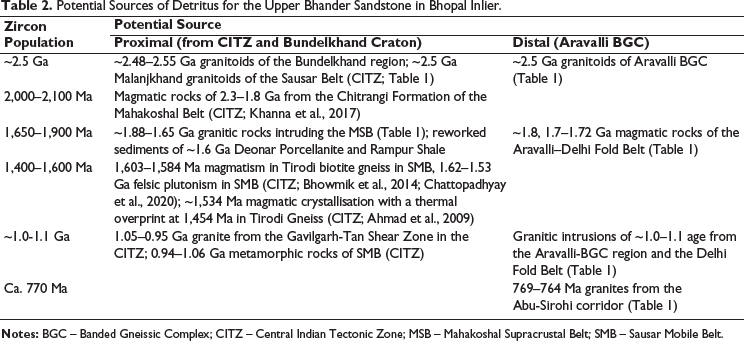
Potential Sources of Detritus for the Upper Bhander Sandstone in Bhopal Inlier.
Discussion
Potential Sources of Detrital Zircons of Upper Bhander Sandstone Exposed in Bhopal Inlier
U–Pb detrital zircon geochronology of the Upper Bhander Sandstone at Bhopal and Bhimbetka shows an overall age range of 2,600–1,000 Ma, with a single youngest grain of 770 ± 12 Ma age. The documentation of zircon grains of 2,450–2,560 Ma age is comparable with the ~2,480–2,550 Ma age proposed for the emplacement of granitic suites in the Bundelkhand Craton (Kaur et al., 2016; Mondal et al., 2002; Verma et al., 2016). The ages of the gneisses and granitoids of the Bundelkhand (3,600–2,400 Ma) basement rocks and the Aravalli BGC (3,500–2,500 Ma) indicate that the Archean and Paleoproterozoic zircons of the Vindhyan sandstones are largely derived from these terrains (Figure 1A, B; Lan et al., 2020, 2021; Malone et al., 2008; Turner et al., 2014).
The detrital zircon cluster in the interval of 1,500–1,900 Ma and a small cluster between 2000 and 2100 Ma are more likely sourced from the Mahakoshal Supracrustal Belt (MSB) along the Satpura Mobile Belt in CITZ (Figure 1B). The MSB lying in the vicinity of these Upper Bhander outcrops records magmatic rocks of 2,300–1,800 Ma age from its basal Chitrangi Formation (Khanna et al., 2017) and the overlying Parsoi Formation (1894.3 ± 9.4 Ma; Sharma et al., 2022). Furthermore, granites of ~1,880, ~1,780, ~1,750 (Bora et al., 2013; Bora & Kumar, 2015) and ~1,790 Ma (Yadav et al., 2020) ages have been reported from the MSB, suggesting an age bracket of 1,880–1,750 Ma for a tectonothermal event (Figure 1B; Yadav et al., 2020), and this correlates well with the Upper Bhander zircon ages that cluster between 1,900 and 1,700 Ma. Madan Mahal granite (1,695 ± 9 Ma; Yadav et al., 2020) from the western part and Sidhi granite (1,640 ± 9 Ma; Yadav et al., 2020) from the eastern part of the MSB preserve records of post-collisional events (Figure 1B). The ages of these magmatic rocks are comparable with the age cluster between 1,600 and 1,700 Ma in the sample under discussion.
The samples show a significant distribution over a range of 1,400–1,600 Ma, which is centred at ~1,500 Ma. Igneous and metamorphic rocks of this range are also known from the CITZ, as it records an orogenic event at ~1,620–1,540 Ma (Bhowmik et al., 2014; Chattopadhyay et al., 2020). The evidence of this orogenic event is preserved in the Sausar Mobile Belt (SMB) in the southern part of the CITZ, where felsic plutonism affected the SMB between 1,620 and 1,530 Ma (Figure 1B; Ahmad et al., 2009; Bhowmik, 2019; Bhowmik et al., 2011; Chattopadhyay et al., 2020). The age of magmatism in the SMB is comparable with 1,400–1,600 Ma detrital zircon ages. Apart from this, the source for ~1,600 Ma zircons could also be reworked sediments of the Porcellanite Formation and the Rampur Shale of Lower Vindhyans (Bickford et al., 2017; Mishra et al., 2018; Rasmussen et al., 2002; Ray, 2006). Granite magmatism at 1,700–1,800 Ma also affected the ADFB (Figure 1B), making them a plausible source for these zircon grains.
A few grains of ~1,000–1,100 Ma age present in the samples are likely to be derived from the CITZ, which experienced ~1,000 Ma orogeny (Figure 1B). Geochronological data record 940–1,060 Ma metamorphism in the SMB in response to the collision of the North and South Indian tectonic blocks (Bhowmik et al., 2012). Early Neoproterozoic (1,050–950 Ma) granite magmatism has also been reported from the Gavilgarh-Tan Shear Zone exposed in the CITZ (Figure 1B; Chattopadhyay et al., 2020). Moreover, granitic intrusions of ~1,000–1,100 Ma reported from the Aravalli-BGC region and the Delhi Fold Belt can also be related to ~1,000–1,100 Ma zircon grains of this study (Just et al., 2011; Pandit et al., 2003; Turner et al., 2014). The youngest single concordant grain has been recorded in the sandstone with the 206Pb/238U age of 770 + 12 Ma. No detrital zircon younger than ~900 Ma has been reported from the Upper Vindhyan sequence to date, except for one grain of 548 Ma from the Maihar Sandstone (Lan et al., 2020). This age correlates with the Neoproterozoic magmatic events recorded from Northwest India. The Abu-Sirohi corridor, which lies between the Delhi Fold Belt and Malani Igneous Suite (MIS) terrane, records granitic intrusions of the late Neoproterozoic (Figure 1B and Table 1). This tectonically active region experienced magmatic activity and resultant emplacement of granites dated between 769 and 764 Ma (Figure 1B; Ashwal et al., 2013). The rocks of the Eastern Ghat Mobile Belts (EGMB) also record Neoproterozoic tectono-metamorphic events (870–690 Ma; Chatterjee et al., 2017; Hippe et al., 2016) and Pan-African thermal events (611–484 Ma; Upadhyay, 2008). However, the Satpura highlands (CITZ), which act as a barrier between the EGMB and the Vindhyan Basin, likely prevented the transport of the detritus from the EGMB (Turner et al., 2014). Rocks of ~770 Ma age have so far not been reported from North and Central India. One possible source for the zircon of ~770 Ma age in the Upper Bhander Sandstone could be the granites of ~700–800 Ma from Northwest India (possibly MIS and its equivalent; Table 1).
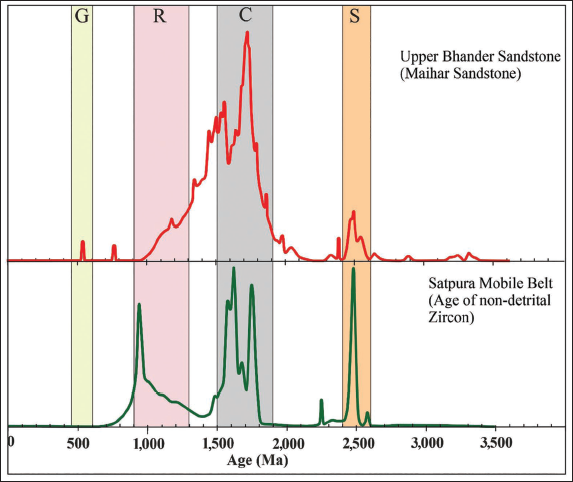
The U–Pb detrital zircon geochronological data of the Upper Bhander Sandstone exposed in Bhopal and Bhimbetka (Bhopal Inlier) reflect a mixed source, which is also supported by petrographic observations and the whole-rock geochemical study (Figure 4A–E). A large variation in the Nd-isotopic values of siliciclastic rocks of the Bhander Group (Son Valley) reported by Chakrabarti et al. (2007) is also in agreement with the interpretation of a mixed provenance for these rocks. Co–Th–La–Sc systematics used to understand the source rocks for these sandstones suggest that the source for the Upper Bhander Sandstone (Bhopal Inlier) includes both igneous and metamorphic rock suites from the CITZ and the Bundelkhand massif (Figure 4E). The interpretation of modal data (Banerjee & Banerjee, 2010; Mohammadi et al., 2014) and the whole-rock geochemical attributes (Banerjee & Banerjee, 2010) of the Upper Bhander Sandstone exposed in the vicinity of Bhopal indicate their derivation mainly from granitic plutons and high-/low-grade metamorphic rocks, with a minor contribution from recycled sedimentary rocks (Banerjee & Banerjee, 2010; Mohammadi et al., 2014, 2015). Furthermore, it is believed that the underlying Kaimur Group of Son Valley has largely received sediments from the Mahakoshal Belt (Mishra & Sen 2012; Quasim et al., 2018). Combining past studies and the present geochronological data, potential sources for these zircons could be inferred as the Archean Bundelkhand Gneissic complex, gneissic and granitic rocks of the CITZ (mainly the Mahakoshal Belt), which are exposed close to the Vindhyan Basin, and the recycled sedimentary rocks/sandstones of the Rewa and Kaimur Groups. It is important to note here that north-, northwest- and west-directed paleocurrent patterns have been reported for the Upper Vindhyan sediments (Akhtar, 1978; Ansari, 1994; Bhattacharyya & Morad, 1993; Verma & Shukla, 2015), which indicate that the detritus is largely sourced from the south, southeast or east of the Vindhyan belt. Multiple lines of evidence including the north- and northwest (west)-directed paleocurrent patterns (Akhtar, 1978; Ansari, 1994; Bhattacharyya & Morad, 1993; Raza & Casshyap, 1996; Verma & Shukla, 2015) and detrital zircon geochronology suggest the Satpura-Mahakoshal/Bijawar highlands (CITZ) lying in the south and southeast (east) of the basin as the dominant source of detritus for the Upper Vindhyan sandstones exposed in and around Bhopal (Figure 8; Chakraborty, 2006). However, rocks from the ADFB may also constitute a secondary (distal) source for these sediments.
Post-1,000 Ma Zircon Grains: Their Bearing on the Depositional Age of Upper Vindhyan Succession
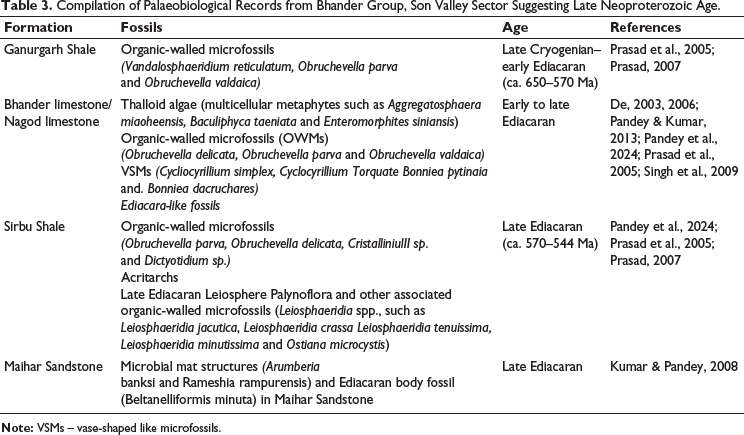
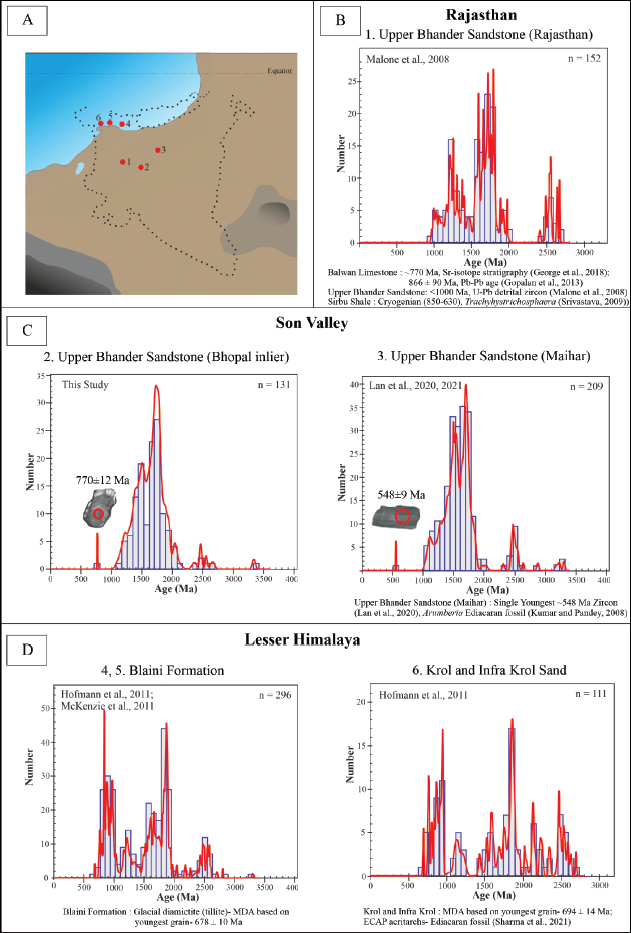
It is noteworthy that earlier palaeontological findings (Table 3) have been used to assign an Ediacaran age (<1,000 Ma) for the Bhander Group in the Son Valley Sector. The Upper Bhander Sandstone from Maihar and Bhopal regions has thus far yielded two post-1,000 Ma zircon grains of ~548 (Maihar) and ~770 Ma (Bhimbetka) age, respectively. The detrital zircon geochronology of the Upper Bhander Sandstone in the Rajasthan Sector also suggests a ~1,000 Ma closure age for the sedimentation of Upper Vindhyan (Figure 9A, B; Malone et al., 2008). In contrast, a Cryogenian (850–630 Ma) age-marker microfossil, Trachyhystrichosphaera, from the Sirbu Formation of the Bhander Group, Rajasthan (Srivastava, 2009) and ~770 Ma age (on the basis of Sr isotope stratigraphy coupled with Pb–Pb age) of the Balwan Limestone (George et al., 2018; Gopalan et al., 2013), overlying the Upper Bhander Sandstone, suggest post-1,000 Ma sedimentation in the Rajasthan sector of the Vindhyan Basin (Figure 9B). The Proterozoic sedimentary packages of the Lesser Himalayan sector and the Ganga Valley have been linked with the rocks of the Vindhyan Basin in the cratonic area (McKenzie et al., 2011; Xiao et al., 2016). Recently, Negi et al. (2023) have estimated an MDA of ≤850 Ma for the Rautgara Formation of Inner Lesser Himalaya. This estimation suggests that the sedimentation in the Inner Lesser Himalaya, which is the extended part of the northern Indian cratonic margin, continued till the Neoproterozoic. In addition, the siliciclastic rocks of the Blaini Formation (Cryogenian) and Krol and Infra Krol (Ediacaran) successions of the Outer Lesser Himalaya have also yielded Neoproterozoic zircon populations (Figure 9D; Hofmann et al., 2011; McKenzie et al., 2011). Considering several of these datasets—palaeobiological, geochronological and isotopic—along with the two young zircon ages, that is, 548 and 770 Ma (<1,000 Ma), reported from the Upper Bhander Sandstone as robust data points, a ~1,000 Ma age for the termination of Upper Vindhyan sedimentation needs re-examination (Figure 9C).
Compilation of Palaeobiological Records from Bhander Group, Son Valley Sector Suggesting Late Neoproterozoic Age.
Conclusion
Geochemical and geochronological studies suggest that the magmatic and metasedimentary rocks exposed in the Satpura Mobile Belt (CITZ), south and east of the Vindhyan Basin, are the major sources of the detritus for the Upper Bhander Sandstone exposed in the Bhopal Inlier. However, the underlying older Vindhyan sedimentary rocks and those from the Bundelkhand Craton and ADFB likely also acted as provenance for the Upper Vindhyan sandstones. The occurrence of zircon grains of ~548 (Maihar) and ~770 Ma (Bhimbetka) as outliers in the two samples, taken together with the previously published palaeobiological evidence, serves as a pointer that the Vindhyan sedimentation could have possibly extended at least into the Tonian and possibly up to the Ediacaran, needing further investigations.
Footnotes
Acknowledgements
The authors would like to thank the Indian Institute of Science Education and Research Bhopal for all its resources, including a doctoral student fellowship to Vandana Kumari. We thank Professor Gregory John Retallack for careful reading of an earlier version of this manuscript that resulted in its improvement. We thank the Superintending Archaeologist, Archaeological Survey of India (ASI), Bhopal, for their approval to take samples from Bhimbetka. The authors would also like to acknowledge two anonymous reviewers and Professor Mukund Sharma (editor) for their constructive reviews that have improved this manuscript.
Declaration of Conflicting Interest
The authors declared no potential conflicts of interest with respect to the research, authorship and/or publication of this article.
Funding
The authors disclosed receipt of the following financial support for the research of this article: this research is partially supported by an MHRD (FAST 2016/17) and a DST-FIST (SR/FST/ES-1/2020/70) grant.
Supplemental Material

References
Supplementary Material
Please find the following supplemental material available below.
For Open Access articles published under a Creative Commons License, all supplemental material carries the same license as the article it is associated with.
For non-Open Access articles published, all supplemental material carries a non-exclusive license, and permission requests for re-use of supplemental material or any part of supplemental material shall be sent directly to the copyright owner as specified in the copyright notice associated with the article.
