




Abstract
Despite evidence of palaeo-wildfires during the formation of Indian coal deposits, studies on their fire intensity, temporal variability and relation to palaeo-oxygen levels remain limited. A comprehensive investigation of wildfire signatures in Indian Permian coals is required to bridge this knowledge gap. The Carboniferous to Permian Period is characterised by prevalent coal formation and a substantial occurrence of palaeo-wildfires. However, the occurrence of these wildfires and their spatial distribution exhibited temporal variability throughout this period. An inclusive investigation (including petrological compositions, especially inertinites and scanning electron microscopy (SEM)) was executed on coal samples from Bastacolla Mines, Jharia Coalfield, India, to investigate variations in palaeo-wildfire signature and palaeo-wildfire temperature during peat formation. The dominance of vitrinite with a significant inertinite content (as a by-product of palaeo-wildfire) in studied coal samples reveals that wildfire activity occurred during peat formation. The inertinite reflectance values ranging from 1.42% to 2.62% (mean: 1.88%) and 1.20% to 2.48% (mean: 1.67%) in Bottom-II and Top-III seam, respectively, indicate wildfire in Permian was dominated by mainly ground fires and partially surface fires. SEM images show various typical structures, including cellular/fibrous structure, uniseriate and biseriate tracheid, indicating the dominance of gymnosperm flora during peat formation. Further, the presence of typical structures by SEM, charcoal lenses on the sample surface (macroscopic) and high inertinite in investigated coal seams reveals the occurrence of wildfire during its formation. The significantly high atmospheric oxygen levels (pO2˃23%) provide compelling evidence for frequent wildfires in the Jharia Coalfield during the coal-forming period.
INTRODUCTION
Wildfire activities have significantly impacted environmental disturbances, ecosystems and climate dynamics throughout Earth’s history (Flannigan et al., 2009; Glasspool et al., 2015; Jasper et al., 2013; Scott, 2024). The dynamics of palaeo-wildfire systems are regulated by the intricate interaction of vegetation, climatic conditions and atmospheric composition, with terrestrial vegetation acting as a primary fuel source for these events (Scott, 2000). A wildfire, also known as a forest fire/bushfire, is an unplanned, unpredictable and uncontrolled fire occurring in areas with combustible vegetation. There are three main types of wildfires: ground fires, surface fires and crown fires (Petersen & Lindström, 2012; Scott, 1989, 2000; Shen et al., 2023; Wang et al., 2019; Zhou et al., 2024). Ground fire primarily burns the decayed roots below the surface and in the duff layer (inertinite reflectance ˂1.85% and temperature below 400℃) (Petersen & Lindström, 2012; Shao et al., 2024). Ground fires are sustained by growing combustion without flames and can go undetected for an extended period because they produce little to no smoke and spread slowly. Surface fires, on the other hand, burn loose needles, herbaceous vegetation, moss, small trees, shrubs and saplings on or near the ground’s surface, primarily through flaming combustion (inertinite reflectance range from 1.85% to 4.5% and temperature from 350℃ to 650℃) (Petersen & Lindström, 2012; Scott, 2000). Crown fires burn forest canopy fuels, including branches, live and dead foliage and tall shrubs that lie well above the surface fuels (inertinite reflectance ˃4.5% and temperature ˃600℃) (Brown et al., 2012; Petersen & Lindström, 2012). Wildfires are a significant factor that influences not only the release of CO2 and aerosols into the atmosphere but also the distribution and evolution of biological populations (Bowman et al., 2009; Scott, 2010; Wang et al., 2019). Therefore, investigating the interactions among climate, fire ecology and vegetation is essential for understanding past climate dynamics.
Coal is a vital energy resource and sediment susceptible to environmental changes across the extensive evolutionary period (Shao et al., 2012). The maceral compositions in coal can reveal variations in palaeoclimate, palaeovegetation and palaeodepositional settings (Petersen & Ratanasthien, 2011). Notably, inertinite group macerals have been recognised as partially combusted charcoal and strongly associated with peatland wildfires (Zhang et al., 2016a). Fusinite reflectance indicates the formation temperature of these charcoals (Scott & Glasspool, 2007). Macroscopic charcoal has been documented in various geological formations worldwide, including India (Jasper et al., 2013; Mahesh et al., 2015; Murthy et al., 2023; Shivanna et al., 2017; Shukla et al., 2023), China (Liu et al., 2022; Xiao et al., 2020; Zhang et al., 2016b), Australia (Glasspool, 2000), Germany (Uhl et al., 2008), Italy (Uhl et al., 2013), Brazil (Benicio et al., 2019; Degani-Schmidt et al., 2015; Kauffmann et al., 2016) and Canada (Grasby et al., 2011). Since the inertinite content in coal is correlated with atmospheric oxygen concentrations (pO2), it can also be utilised to assess the palaeodepositional environment during peat accumulation (Diessel, 2010; Glasspool et al., 2015). However, the debate over whether inertinite macerals originated from fire has persisted since the beginning of coal petrography. Studies by Falcon (1989) and Taylor et al. (1988) suggested that the high abundance of inertinite macerals in Gondwana coals is not attributable to pyrogenic processes. In contrast, Scott (2000, 2002, 2010), Scott and Glasspool (2007) and Hudspith et al. (2012) presented extensive evidence indicating that inertinite macerals represent charcoal and are directly associated with wildfire activity.
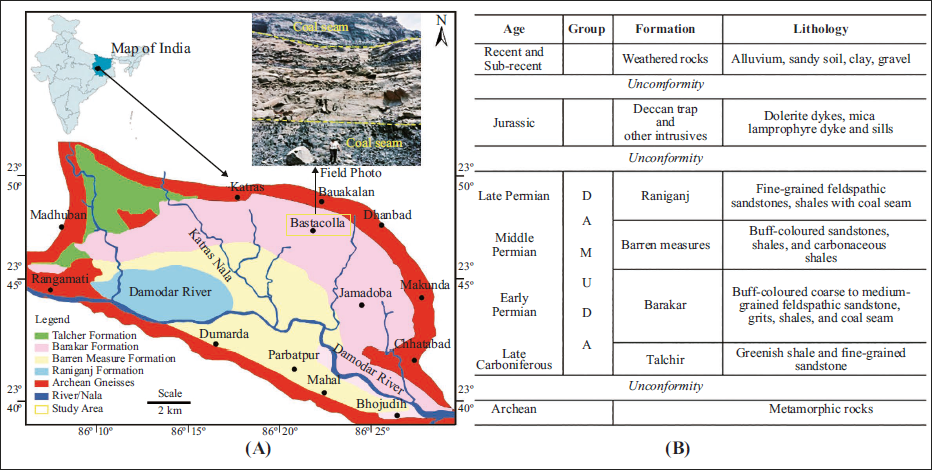
Direct evidence of palaeo-wildfires from the Carboniferous to Permian, involving the occurrence of inertinite in coals and the presence of charcoal or fusain remains, has been extensively documented previously in various regions of the globe (DiMichele et al., 2004; Jasper et al., 2013; Shen et al., 2023). These insights offer a valuable opportunity to examine the patterns and dynamics of Palaeozoic palaeo-wildfires. However, these investigations are very limited and rare in the case of Indian Gondwana coals (Rajak et al., 2019; Shivanna et al., 2017). Therefore, this study aims to investigate Palaeozoic palaeo-wildfires in Bastacolla coals of Jharia Coalfield (Figure 1A), India, by analysing inertinite distribution and their controlling factors influencing palaeo-wildfires within the region.
STUDY AREA
Jharia Coalfield is one of the richest coalfields in India (Figure 1B). It is located south of the Dhanbad district, Jharkhand, and contains the highest-rank coal reserve in India. The Jharia coal basin has a structural framework characterised as a ‘half-graben’. The axial trend of the basin follows an east-west orientation with a westward plunge. A major fault truncates the southern flank, referred to as the south boundary fault, exhibiting a displacement exceeding 1500 meters. In the Jharia Coalfield, the strata exhibit a southward dip of approximately 10°. The formations are oriented along the boundary of the coalfield, exhibiting east-west and northwest-southeast strike directions. This alignment results in the beds dipping towards the centre, forming a structural basin. This geological configuration plays a crucial role in governing the distribution of coal seams and influencing mining activities.
The sedimentary succession of the Jharia Coalfield commences with the Talchir Formation, which unconformably overlies the Archaean gneissic basement (Figure 1B). This is succeeded by a stratigraphic sequence progressing upward through the Barakar Formation, the Barren Measures, and the Raniganj Formation, all deposited within an intra-cratonic extensional regime. The studied coal samples are associated with the Permian age of the Barakar Formation (Figure 1B). The coal-bearing strata of the Lower Gondwana Supergroup represent freshwater depositional environments formed within extensive fluvial valleys and lacustrine systems that prevailed across the Gondwana continent during the Permian and subsequent geological periods. During the early and mid-Palaeozoic eras, peninsular India, along with its northern extension into the region currently occupied by the outer Himalayas and extending eastward beyond Nepal, constituted a unified ancient landmass.
METHODOLOGY
The coal samples were collected from two exposed seams (five samples from Bottom-II and six samples from Top-III) of Bastacolla Mines, Jharia Coalfield, Dhanbad (Figure 1A). The coal samples were kept instantly in sealed plastic bags to avoid contamination/oxidation. Samples were analysed in the MP Singh Lab of Coal & Organic Petrology of Banaras Hindu University. Samples were crushed to 1 mm size to prepare a polished particulate mount (pellet) for petrology. The pellets were subjected to maceral analysis to know their maceral composition and inertinite (fusinite) reflectance measurement under reflected white and ultraviolet (UV) light using a Leica DM4P advanced petrological microscope attached with a photometer. The photometer was calibrated using spinel (reflectance: 0.4230%), gadolinium gallium garnet (GGG) (reflectance: 1.7160%) and zirconium (reflectance: 3.1700%) standards before the reflectance measurement. For the maceral composition, 500 points were counted from each pellet. Maceral identification and reflectance measurements were conducted according to ICCP System 1994 (ICCP, 1998, 2001; Pickel et al., 2017) and ISO 7404-5 (2009) norms. The combustion temperature of wildfire has been calculated using the linear regression equation (Jones, 1997).
This study subjected representative samples from both seams to scanning electron microscopy (SEM) analysis. The SEM analysis used a high-resolution SEM (Nova Nano SEM 450). These samples were coated with gold for a minimum of 30 seconds using a sputter machine. The photomicrographs of the samples were taken in both secondary electron (SE) and backscattered electron (BEC) modes. This approach allowed for detailed visualisation of morphological and compositional features, including the overall texture, fractures, minerals, organic matter, matrix and pore spaces within the coal.
RESULT AND DISCUSSION
Macroscopic characterisation
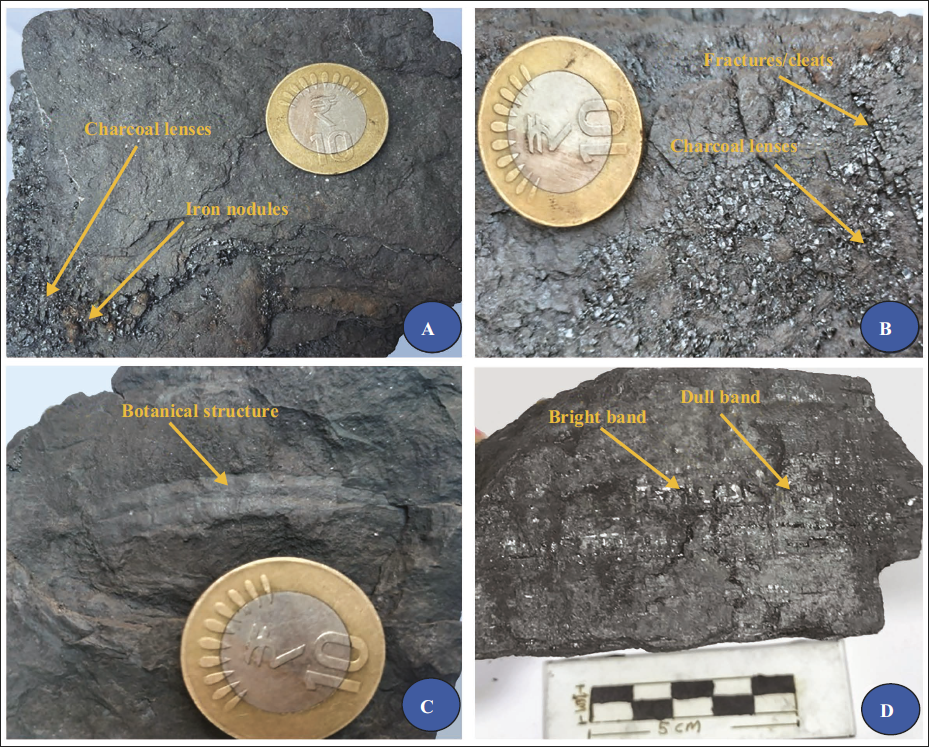
The macroscopic examination of Bastacolla coals was conducted using the Gondwana coal classification scheme (Singh, 2017). The studied samples are greyish-black to black, with alternate dull and bright bands, charcoal lenses, botanical structures, cleats and iron oxide nodules (Figure 2A–2D). According to the lithotype scheme, the investigated coal is categorised as a banded dull coal lithotype. Coal samples also show charcoal lenses with butt and face cleats (Figure 2A–2B) and botanical structure (Figure 2C). Some coal samples display bright charcoal lenses with iron oxide nodules (Figure 2A). The presence of macroscopic fossil charcoal in the studied coal samples has been attributed to a pyrolytic origin (Shivanna et al., 2017). Fossil charcoal in studied coal seams (Figure 2A–2B) further provides evidence of wildfire activity during coal formation (Scott, 2001).
Lithotype observed in coals of Bastacolla Mines, Jharia Coalfield, Jharkhand.
Maceral composition and inertinite reflectance
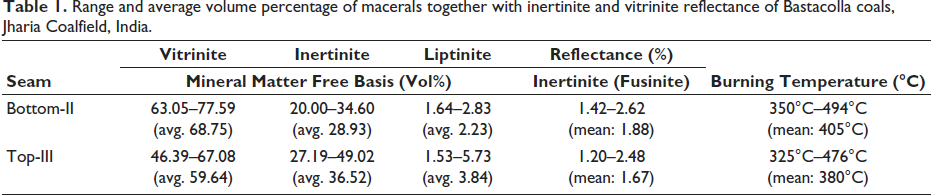
The maceral analysis was performed on collected coal samples from the Bottom-II and Top-III seam of the Barakar Formation, Bastacolla Mines, Jharia Coalfield, Dhanbad, India. The results of the petrographic study are presented in Table 1. The findings reveal that all the samples from both seams are dominated by the vitrinite maceral group (Bottom-II: 63.05%–77.59%, mean: 68.75%; Top-III: 46.39%–67.08%, mean: 59.64%). Inertinite accounts for the second predominant maceral group, ranging in content from 20.00% to 34.60%, with a mean of 28.93% (in Bottom-II seam) and 27.19%–49.02%, with a mean of 36.52% (in Top-III seam). The Liptinite group represents low content, varying from 1.64% to 2.83%, with a mean of 2.23% (in Bottom-II seam) and 1.53%–5.73%, with a mean of 3.84% (in Top-III seam) (Table 1).
Range and average volume percentage of macerals together with inertinite and vitrinite reflectance of Bastacolla coals, Jharia Coalfield, India.
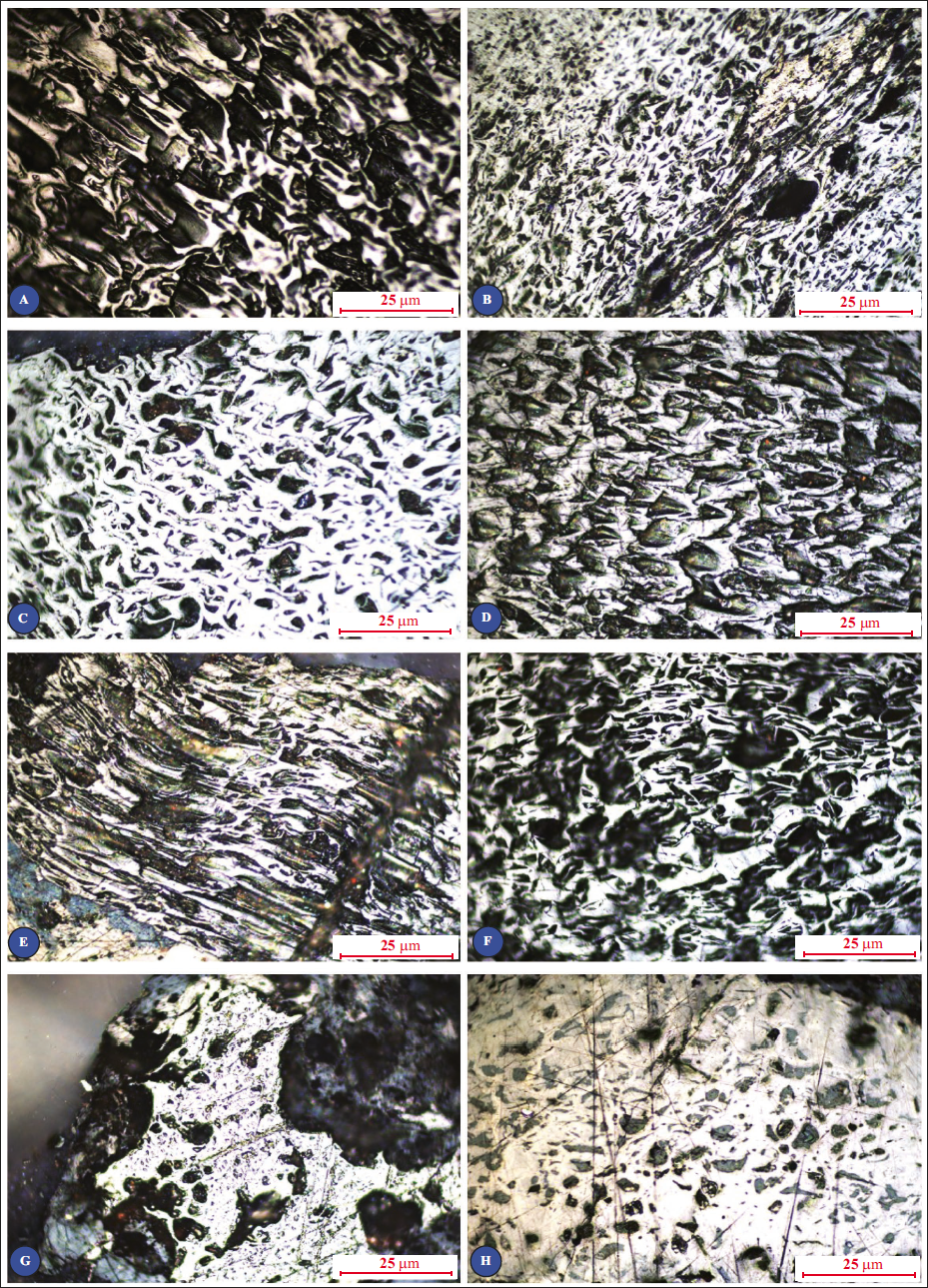
This study mainly focused on the inertinite group maceral, especially pyrogenic inertinites (i.e., fusinite, semifusinite and inertodetrinite); therefore, the description of pyrogenic inertinite is discussed here. The inertinite group is greyish to bright white with high reflectivity under reflected light (Figure 3). This group comprises semifusinite, fusinite and inertodetrinite (Figure 3A–3H). Fusinite has a well-preserved cell wall with open cellular structures commonly filled with mineral matter (Figure 3A–3F). The semifusinite also has an open cellular structure with a less preserved cell wall often associated with mineral matter (Figure 3G) and unfused vitrinite grains (Figure 3H). Semifusinite is supposed to result from exposure to elevated temperatures in low-oxygen conditions or partial oxidation during prolonged subaerial exposure before burial. Semifusinite may form in peat swamps with fluctuating water tables, where periodic drying exposes organic material to oxidation. Most fusinite show homogeneous cell walls (Figure 3A–3D), while some have irregular ones (Figure 3E–3F). Fusinite is considered to be derived from fossilised charcoal formed through wildfire, which is partially or fully carbonised plant material. Its presence in coal indicates periodic fires in peat-forming environments, leading to the incorporation of charred remains into the accumulating peat. The small (size ˂10 µm) detached inertinite remains are identified as inertodetrinite (Figure 3G). It is typically derived from the breakdown of other inertinite macerals, such as fusinite and semifusinite, through degradation processes. The inertinite reflectance (Rr) values of the Bottom-II seam vary between 1.42% and 2.62% (mean: 1.88%), while that of the Top-III seam range from 1.20% to 2.48% (mean: 1.67%) (Table 1).
Representative photomicrographs of inertinites (fusinite and semifusinite) observed in the coal samples of Bastacolla Mines, Jharia Coalfield Dhanbad.
SCANNING ELECTRON MICROSCOPE
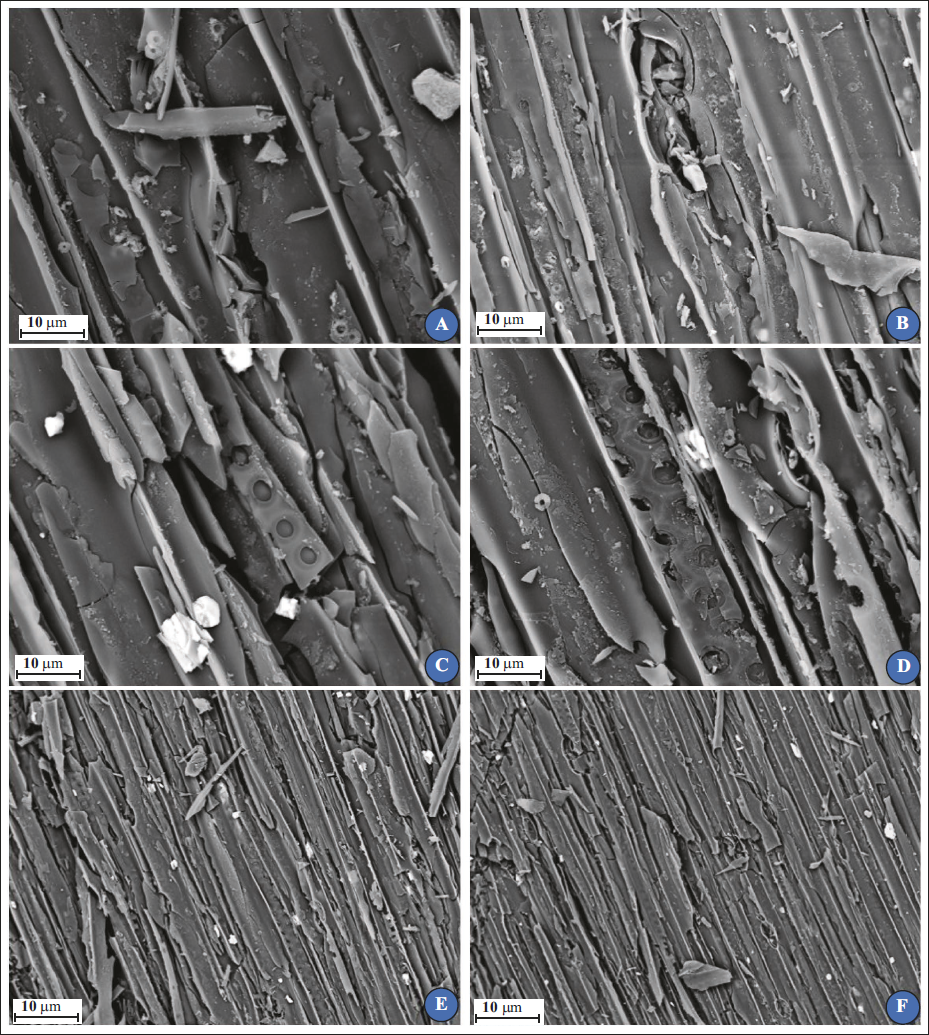
SEM is a valuable technique for examining coal microstructures, biomass structures, mineral composition and relationships with other minerals by scanning the surface with a focused electron beam (Rai et al., 2022; Zygarlicke & Steadman, 1990). SEM photomicrographs of Bastacolla samples display the parent vegetation’s woody cellular structure (fibrous structure) with fractures and micro-cleats (Figure 4A–4E). The preservation of vascular tissue, that is, uniseriate and biseriate tracheid with the open pit in studied coal samples, indicates organic material mainly derived from gymnosperm flora (Figure 4C–4D). These typical structures and textures (i.e., uniseriate and biseriate tracheid with bordered pit walls) reveal the plant material encountered in wildfire activity (Demchuk, 1993). Macroscopic charcoal, identified as having a gymnospermous affinity through SEM analysis, further suggests that wildfire events occurred during the Bastacolla coal formation. Moreover, the homogeneity of cell walls (Figure 4C–4D) indicates that the wood was charred at a minimum temperature of 300°C–325°C (Scott, 2010).
Representative SEM images of studied specimen of Bastacolla Mines, Jharia Coalfield, Dhanbad.
Palaeo-wildfire temperature and fire type
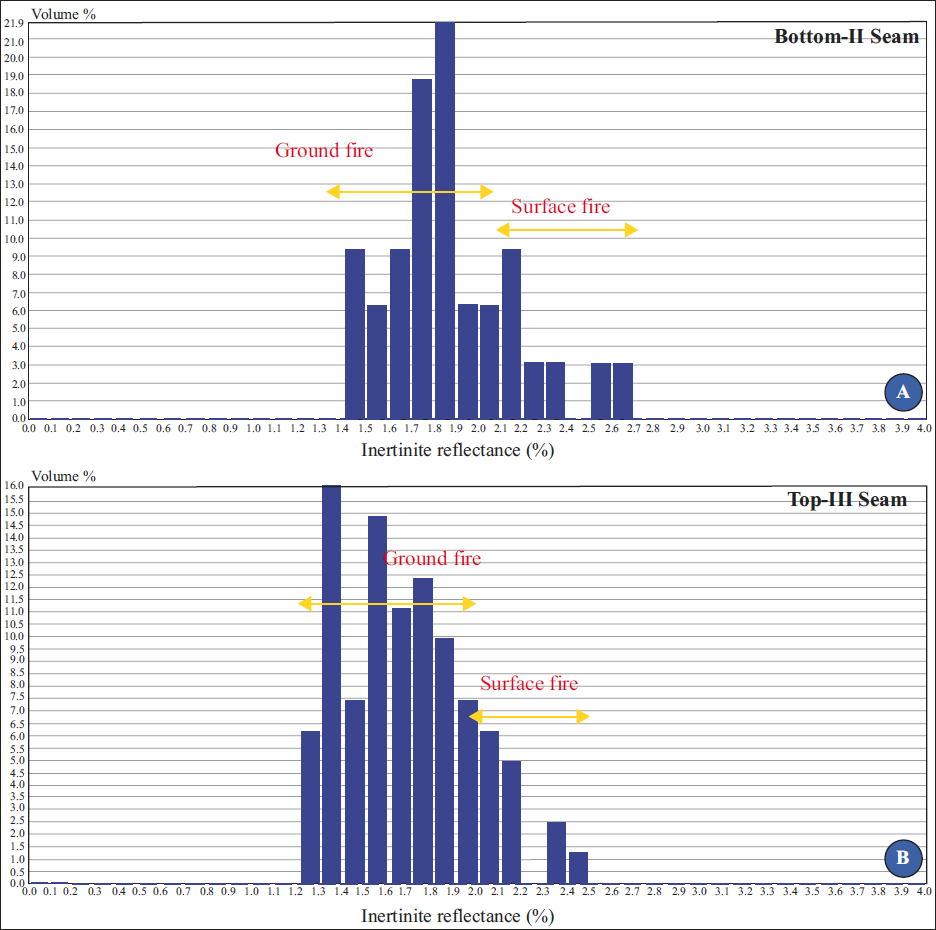
The reflectance measurements of inertinite macerals (specifically fusinite) indicate the formation temperature of these charcoals during peat accumulation (Scott & Glasspool, 2007). Research investigations have shown that the reflectance values of charred plant tissues rise as the charring temperature increases (Scott, 2010; Uhl et al., 2007). Therefore, the palaeo-wildfire combustion temperature for studied coals in Bastacolla Mines was determined using the relationship between combustion temperature and inertinite reflectance described by Jones (1997) and provided in Table 1. The combustion temperature of wildfire for the Bottom-II seam is 350°C–494°C with an average value of 405°C (inertinite reflectance; 1.42–2.62 mean: 1.88); the wildfire combustion temperature for the Top-III seam is 325°C–476°C with an average value of 380°C (inertinite reflectance; 1.20–2.48, mean: 1.67). The palaeo-wildfire temperature range in Bastacolla indicates that the stage was primarily ground fires and suggests a transition from ground to surface fires during the peat accumulation stage (Figure 5).
Histogram of inertinite reflectance measurements of (A) Bottom-II and (B) Top-III seam of Bastacolla Mines, Jharia Coalfield, Dhanbad.
Oxygen level during coal formation
Atmospheric oxygen (pO2) levels strongly regulate the occurrence and intensity of wildfires (Glasspool et al., 2015; Shao et al., 2024). Belcher et al. (2010) established 16% oxygen as the minimum threshold for sustaining vegetation combustion, below which fire cannot persist. Fire activity is notably suppressed below 18.5% oxygen. Belcher (2013) reported widespread wildfires at 23% oxygen, even in moist vegetation. Jones and Chaloner (1991) recognised 35% oxygen as the upper combustion limit, enabling complete vegetation burning under all conditions. Charcoal (inertinite) occurrence in swamp environments is controlled by atmospheric oxygen levels (Glasspool & Scott, 2010). Furthermore, the abundance of inertinite (specifically fusinite) may serve as a proxy for reconstructing atmospheric oxygen concentration trends over the past 400 million years. Apart from the strong relationship between oxygen levels and inertinite content (Glasspool & Scott, 2010), several other environmental factors influence wildfire activity, such as palaeohumidity, climate shifts and depositional conditions. Peat-forming environments in seasonally dry or arid climates are more susceptible to wildfires, leading to increased inertinite content (Bond & Keeley, 2005). Low humidity facilitates fuel drying, making vegetation more flammable (Scott, 2000). In contrast, persistently wet conditions suppress fire activity by maintaining high moisture levels in vegetation and peat (Bond & Keeley, 2005). Peat deposits formed in continuously waterlogged conditions tend to have lower inertinite content. Warm periods with high seasonality promote vegetation growth, followed by dry periods that create fire-prone conditions. Peat bogs with fluctuating water tables experience oxidation and periodic drying, increasing the likelihood of fire events and inertinite formation (Diessel, 1992).
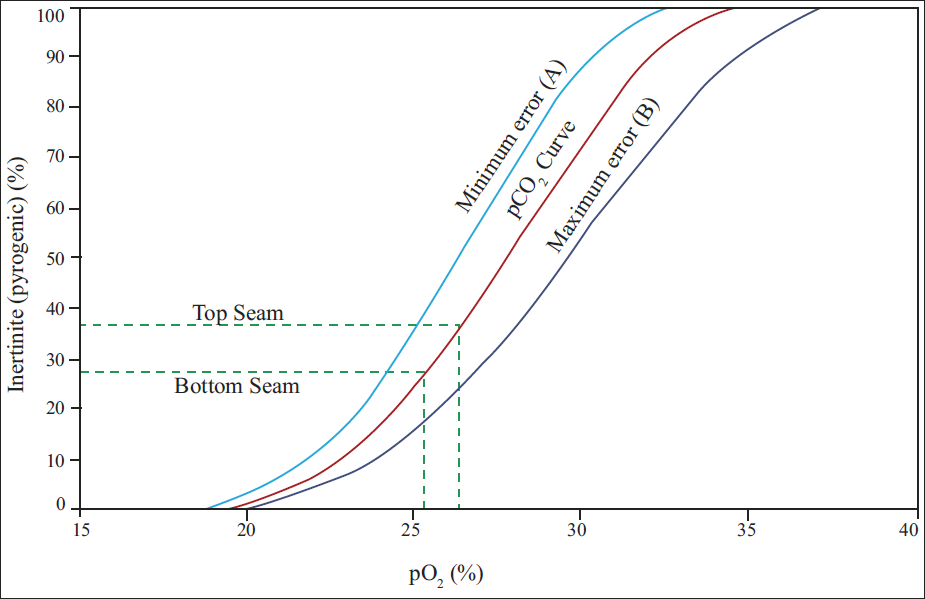
Based on available inertinite data, Glasspool et al. (2015) formulated an equation and subsequently proposed a model (Figure 6) to estimate atmospheric oxygen levels across different geological periods. The mean inertinite content of Bottom-II and Top-III coal seams of Bastacolla Mines, Jharia Coalfield, was computed to be 28.93% and 36.52% respectively. The notably elevated atmospheric oxygen levels, beyond 23%, indicate the frequent occurrence of wildfires in the Jharia Coalfield during the coal-forming period.
Relationship between inertinite content and atmospheric oxygen levels for the Bastacolla coals in the Jharia Coalfield, Jharkhand, India (after Glasspool et al., 2015).
Like Bastacolla coals from the Jharia coalfield, the coal of Raniganj coalfields also contains woody charcoal with gymnospermous affinity and notable inertinite fraction, often attributed to frequent wildfire activity (Jasper et al., 2012; Murthy et al., 2023). Talcher coals, formed in a predominantly fluvial-lacustrine environment, generally have lower inertinite content than Jharia and Raniganj coals. The presence of macroscopic charcoal fragments embedded in the coal and carbonaceous shales of Talcher Coalfield suggests the repeated occurrence of wildfires during peat accumulation (Mishra et al., 2021). Singrauli coals exhibit intermediate inertinite content, with evidence of palaeo-wildfire activity similar to Jharia and Raniganj. However, the reflectance values of inertinite in Singrauli are generally lower (Gopinathan et al., 2024), suggesting lower wildfire temperatures or a more significant influence of oxidative alteration.
CONCLUSIONS
An SEM study of macroscopic charcoal revealed a gymnosperm affinity, indicating the presence of wildfires during the formation of Bastacolla coal.
Palaeo-wildfires in the studied coal seams of Bastacolla Mines from Jharia Coalfield, India, were predominantly high-intensity ground fires transitioning to surface fires.
The wildfire combustion temperature for the Bottom-II seam ranges from 350°C to 494°C (mean: 405°C) and from 325°C to 476°C (mean: 380°C) in the Top-III seam.
The significantly elevated atmospheric oxygen levels (˃23%) provide strong evidence for the frequent wildfire occurrence in the Jharia Coalfield during the coal-forming period.
Footnotes
Acknowledgement
The authors express heartfelt gratitude to the Department of Banaras Hindu University, Varanasi, for providing access to the research facilities. AK sincerely acknowledges the Science and Engineering Research Board (SERB), the Government of India and the National Postdoctoral Fellowship scheme (File No. PDF/2023/000040). Furthermore, special thanks to the officials of Bastacolla Mines, Jharia Coalfield, for assistance during the sample collection.
Authors’ Contributions
Alok Kumar was involved in investigation, writing—original draft and writing—review and editing.
Saumya Dubey helped in sample collection, organic petrography, formal analysis, review and editing.
Ishita contributed to sample collection, organic petrography, formal analysis and review and editing.
Prakash K Singh helped in conceptualisation, supervision, validation and writing—review and editing.
Declaration of Conflicting Interests
The authors declared no potential conflicts of interest with respect to the research, authorship and/or publication of this article.
Funding
The authors received no financial support for the research, authorship and/or publication of this article.
