




Abstract
The present study comprises the record of a silicified freshwater ostracod assemblage from a newly discovered intertrappean locality (late Cretaceous/early Paleocene), Chhindwara district, Madhya Pradesh. The use of energy dispersive X-ray analysis demonstrates that ostracod carapaces have been silicified, which is possible in relation to the circulation of generated silica-rich water that was formed by the adjacent Deccan volcanic terrain. The identified ostracods include 12 species of 11 genera. The endobenthic crawler Limnocytheridae (Frambocythere, Limnocythere and Gomphocythere) dominate the assemblage and indicate a freshwater body of standing water (lake or pond). The accompanying fish (Lepisosteus) and mollusk (Physa, Viviparus) specimens provide additional evidence for the environmental condition of the lake or large pond water. In addition, the taxa Gomphocythere, Paracypretta, Eucypris and Cypriodopsis support the endemism hypothesis, while the species Cypria, Limnocythere and Gomphocythere provide evidence in favour of the ‘Out-of-India’ idea.
INTRODUCTION
The Deccan Traps volcanic activity of Peninsular India is considered to be one of the largest volcanic eruptions in the Phanerozoic history. It was initiated in the latest Cretaceous, and ceased in the early Paleocene (Baksi, 1994; Courtillot et al., 1986, 1988; Duncan & Pyle, 1988). The name ‘Deccan’ comes from the Sanskrit word dâkshin that means ‘south’, and ‘Trap’ comes from the Dutch word trappa that means ‘stairs’. The ‘Trap’ topography is clearly seen in the Western Ghats region of western India, which has a thickness of around 3,500 m and a gradual slope towards the eastern side (Chenet et al., 2009). The Deccan Traps at present cover an area of around 500,000 km2 in parts of central, western and southern eastern Peninsular India in the eight states namely, Gujarat, Chhattisgarh, Maharashtra, Madhya Pradesh, Karnataka, Andhra Pradesh and parts of Rajasthan and Uttar Pradesh. It is believed that the Deccan Volcanic Province (DVP) originally covered far more extensive area (about 2 million km2) than at the present time (Krishnan, 1982). The DVP is divided into four sub-provinces: the main Deccan sub-province, the Saurashtra sub-province, the Malwa sub-province and the Mandla sub-province (Kale et al., 2020).
During the past four decades or so, numerous studies (magnetostratigraphic, radioisotopic and paleontological) have been conducted on the Deccan Traps to constrain the age and duration of the volcanic activity. Overall, these studies have clearly shown that most (~80%) of the Deccan volcanic activity erupted around 65 Ma with a short duration of less than half a million years (e.g., Chenet et al., 2008, 2009; Duncan & Pyle, 1988). These studies have highlighted the role of Deccan volcanism in the Cretaceous–Paleogene (K/Pg) mass extinctions and form a major alternate hypothesis to the extraterrestrial impact model of Alvarez et al. (1980). Proponents of volcanism hypothesis believe that the K/Pg boundary mass extinctions took place due to adverse climatic conditions caused by the Deccan volcanism by adding toxic and greenhouse gases, including SO4, CO2 and CH4 (Jaiprakash et al., 1993; Keller, Adatte, et al., 2009; McLean, 1985; Samant & Mohabey, 2005; Self et al., 2022).
The sediments deposited, respectively, in relation to lava flow are known as infratrappean (sediments lie below the first lava flow, e.g., Bagh Beds), intertrappean (sandwiched between lava flows) and supratrappean (sediments lie above the last lava flow). The intercalated sediments (intertrappean beds) that were deposited during non-eruptive phases of the Deccan lava flows created a window for fossils within the Deccan Traps. Diverse fossil assemblages have been reported from the intertrappean beds, including macro- to microvertebrates such as dinosaurs, mammals, crocodiles, lizards, snakes, frogs and fishes (Kapur & Khosla, 2019; Mantilla et al., 2022; Prasad, 2012; Yadav et al., 2023a, 2023b). Invertebrates as ostracods, gastropods, benthic and planktic foraminifera, as well as charophytes and plant fossils, have also been documented from Deccan intertrappean deposits (see Kapur & Khosla, 2019).
Silicification of fossils is a complex process influenced by various biological and environmental factors. It occurs more frequently in marine deposits than continental ones and is more prevalent in Palaeozoic strata than younger deposits (Butts, 2014). Silicification in intertrappean deposits is documented in fossilised plant remains, such as stems, fruits and mollusk shells, with a silicified palm fruit from the Deccan Intertrappean beds described as a new genus, Hyphaeneocarpon (Bande et al., 1982; Smith et al., 2015). The present article documents the assemblage (12 species) of freshwater silicified ostracods from a newly discovered intertrappean locality located near Navegaon village, Chhindwara district, Madhya Pradesh. The fossilised teeth of Lepisosteus and Osteoglossidae have also been yielded from this locality. Associated invertebrates from this site include molluscs such as Lymnaea and Platyphysa, as well as charophytes.
GEOLOGICAL SETTING
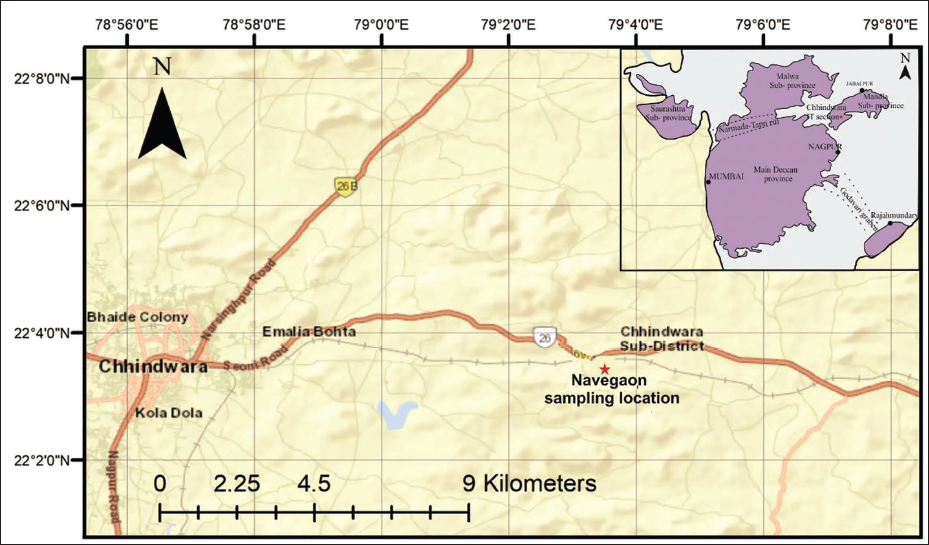
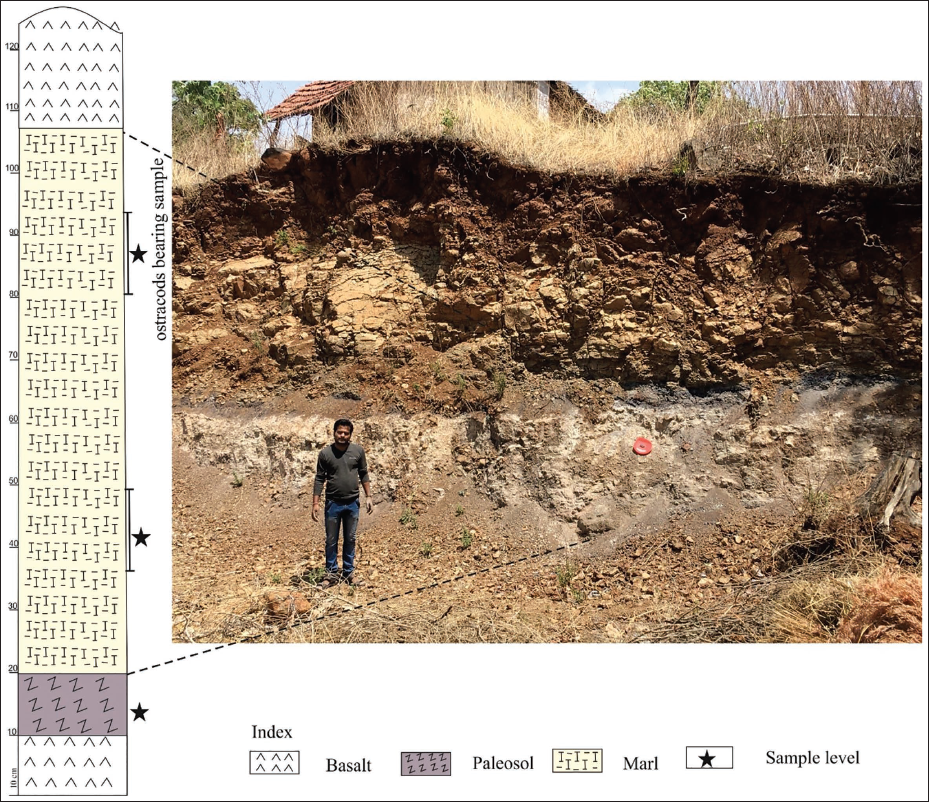
The examined Deccan intertrappean (Navegaon) locality (Figure 1) (coordinates: 22°3’ 31.55“N, 79°3’ 31.93“E) lies in the upper reaches of the Narmada Valley, which is oriented in the east–northeast and west–southwest direction, and the section comprises two lithounits: palaeosol (12 cm) and marl (86 cm) which are interbedded between the upper and lower lava flows (Figure 2). This portion of the Narmada Valley is part of the easternmost province of the Deccan Traps, which is known as Mandla sub-province. It has a thickness of around 900 m (Kaila, 1988), spreading into the Jabalpur, Seoni, Mandla, Dindori and Amarkantak areas of Madhya Pradesh (Solanki et al., 1996). A total of 37 distinct lava flows have been distinguished in Mandla sub-province based on petrographic and major elemental studies (Shrivastava & Ahmad, 2005; Shrivastava et al., 2014). Stratigraphically, the regions (Mandla, Jabalpur and Chhindwara, Madhya Pradesh) comprise basement granite gneisses (>2.5 Ga), the Mahakoshal Group (2.5-1.6 Ga), Mandla Mahal Granite (1.6 Ga), Jabalpur Group (190-140 Ma), Lameta Group (140-66 Ma), Deccan Traps with associated intertrappean beds (67-63 Ma) and Alluvium (recent), in ascending order (Solanki et al., 1996). The pre-Deccan sedimentary beds (Lameta Formation) of Late Cretaceous age in the Narmada Valley are represented by four major lithological units, which are Green Sandstone, Lower Limestone, Mottled Nodular Bed and Upper Limestone, in upgrading sequence (Matley, 1921).
The field photograph has a stratigraphic succession.
Initially, the Deccan Traps were believed to date to the early Eocene period (Hislop, 1860; Hora, 1938). A revised age proposed later based on paleontological and isotopic analyses suggested that the volcanic activity in Deccan Traps started in the latest Cretaceous (67 ma), ceased in the early Paleocene (63 ma), and that more than 80% of Deccan Traps erupted within less than one million years (Bajpai & Prasad, 2000; Chenet et al., 2007; Courtillot et al., 1986; Duncan & Pyle, 1988; Keller, Khosla, et al., 2009; Schoene et al., 2019; Self et al., 2022 and references therein; Vandamme et al., 1991). Mandla sub-province has been considered to be relatively younger (early Paleocene) than the other central and western parts of the Deccan Traps based on geochronological (Shrivastava et al., 2015, 2017) and magnetostratigraphic data (Athavale, 1970), as well as early Paleocene planktonic foraminifer discovered from the Jhilmili intertrappean section (Keller, Khosla, et al., 2009). However, the present study did not find age diagnostic fossils (Igdabatis, dinosaur remains) from Navegoan locality. The collected fossils included ostracods, fishes (Lepisosteus) and gastropods (Viviparaus, Physa); none of them is significant as biostratigraphy but are helpful in the paleo-ecological reconstruction of the locality. The present ostracod assemblage shows similarity with previously dated late Cretaceous or early Paleocene age ostracods, which were recovered from infratrappean and intertrappean deposits (Bajpai & Whatley, 2001; Bhatia & Rana, 1984; Bhatia, Prasad, et al., 1990; Bhatia, Srinivasan, et al., 1990, Bhatia et al., 1996; Khosla & Nagori, 2005, Khosla & Nagori, 2007b; Khosla, Nagori, Jakhar, & Rathore, 2009; Khosla, Nagori, et al., 2011; Kshetrimayum & Parmar, 2019; Kshetrimayum et al., 2021; Sharma & Khosla, 2009; Whatley & Bajpai, 2005; Whatley, Bajpai, & Srinivasan, 2002a, 2002b; Whatley, Bajpai, & Whittaker, 2003a).
HISTORICAL BACKGROUND
Ostracods have been well studied compared with other fossil groups from intertrappean sediments. The two species referred to are Cypris cylindrica and Cypris subglobosa, as described by James Sowerby from the Deccan Intertrappean sedimentary beds of the Sichel Hills, Andhra Pradesh. Later, Carter (1852) and Jones (1860) described three and five new ostracod species from the areas of Bombay and Nagpur, respectively. Following a 125-year gap in the documentation of ostracods, Bhatia and colleagues supported their Laurasian relationships (Bhatia & Rana, 1984; Bhatia, Srinivasan, et al., 1990; Bhatia et al., 1996). Additionally, records of six new ostracod species from intertrappean beds in Rajasthan were documented by Mathur and Verma (1988). From the Anjar intertrappean beds, Bhandari and Colin (1999) reported 11 ostracod species, including two new species and sub-species with significant diversity. After then, several reports on ostracods from Kachchh (Gujarat), Gulbarga (Karnataka), Chhindwara (Madhya Pradesh) and Kota (Rajasthan) were also published (Bajpai & Whatley, 2001; Bajpai et al., 2004; Whatley, Bajpai, & Srinivasan, 2002a, 2002b; Whatley, Bajpai, & Whittaker, 2002, 2003a, 2003b, 2003c). Whatley and Bajpai (2006) refuted previous assertions of paleobiogeographic affinities of Deccan intertrappean ostracods with Chinese and Mongolian taxa (Bhatia, Prasad, et al., 1990; Bhatia et al., 1996) and supported the idea that Indian intertrappean ostracods exhibit widespread endemism. Following that, Khosla and Nagori worked together on ostracods in intertrappean localities such as Anjar, Gujarat (Khosla & Nagori, 2005); Mohgaon Haveli, Madhya Pradesh (Khosla & Nagori, 2007a); Takli, Maharashtra (Khosla & Nagori, 2007b) and Jhilmili, Madhya Pradesh (Khosla, Nagori, Jakhar, & Rathore, 2009; Khosla, Nagori, et al., 2011). Fourteen freshwater ostracods were also encountered from the Deccan traps northernmost intertrappean locality (Papro intertrappean locality), which is situated in the Lalitpur district of Uttar Pradesh (Sharma et al., 2008). Another significant finding on ostracods was also added to the intertrappean fossil collection from Jhilimili, Chhindwara district, Madhya Pradesh (Khosla, 2015; Sharma & Khosla, 2009). In the Khargaon district (Madhya Pradesh), 12 known non-marine ostracod species were documented from the Khar intertrappean locality (Rathore et al., 2018). The ostracod fauna (12 species), including two new species (Gomphocythere testudo and Candona phaseolus), was described by Kshetrimayum et al. (2021) from the Gujri intertrappean locality in the Dhar district of Madhya Pradesh. In addition, ostracod fauna has also been reported from a couple of intertrappean localities such as Uthawali (Kshetrimayum & Parmar, 2019), Manawar (Kapur et al., 2019), Kakarda and Bara Bheralya (Kshetrimayum et al., 2022) from the Dhar district of Madhya Pradesh (India). Eleven species of ostracods were encountered in the Kesavi locality (Yadav & Maurya, 2023) of the Dhar district, where, for the first time, a species of Cordyliform lizard, and associated morphotypes of teeth were investigated from the deposits of Deccan Traps (Yadav et al., 2023a, 2023b). Dhiman and Prasad (2024) reviewed recent biota from Deccan infra- and intertrappean deposits.
MATERIALS AND METHODS
A bulk sampling from lithological units, including palaeosols, found within marl beds, has been done from the Navegaon intertrappean locality. The samples were broken into small chunks, then soaked overnight (minimum 12 hours) in a 1:4 hydrogen peroxide (H2O2) and water solution. The soaked material was wet-sieved through different size sieves (ASTM 40, 60), and the sieved material was placed in the oven at a temperature of 45 °C for drying. The binocular stereo zoom microscope (Leica M205, Germany) was used for picking and sorting fossils. The high-resolution images of selected specimens were captured by a scanning electron microscope (SEM) at SEM-Lab, Department of Earth Sciences, Indian Institute of Technology Roorkee (IITR). The energy-dispersive X-ray (EDX) analysis of the ostracod carapaces was carried out using the Carl Zeiss Ultra Plus (Field Emission Scanning Electron Microscope: FESEM) instrument at Institute Instrumental Centre, IITR. All specimens are deposited in the palaeontology lab, IITR, with the catalogue number with the prefix CIITO (Central India Intertrappean Ostracods).
RESULTS
Systematic Palaeontology
The present work for the taxonomic classification of ostracods follows the Moore and Pitrat (1961), Whatley and Bajpai (2000a, 2000b) and Whatley, Bajpai, and Srinivasan (2002a, 2002b); Whatley, Bajpai, and Whittaker (2002, 2003a, 2003b, 2003c). The general terms for the sizes of ostracods are based on the following ranges of length: very small (<0.4 mm); small (0.4–0.50 mm); medium (0.51–0.70 mm); large (0.71–1.0 mm); very large (1.10–2.0 mm).
Class: Ostracoda (Latreille, 1802)
Subclass: Podocopa (Sars, 1866)
Order: Podocopida (Sars, 1866)
Suborder: Cytherocopina (Baird, 1850)
Superfamily: Cytheroidea (Baird, 1850)
Family: Limnocytheridae (Klie, 1938)
Subfamily: Timiriaseviinae (Mandelstam, 1960)
Genus: Frambocythere Colin (Colin & Danielopol, 1981)
Frambocythere tumiensis anjarensis (Bhandari & Colin, 1999)
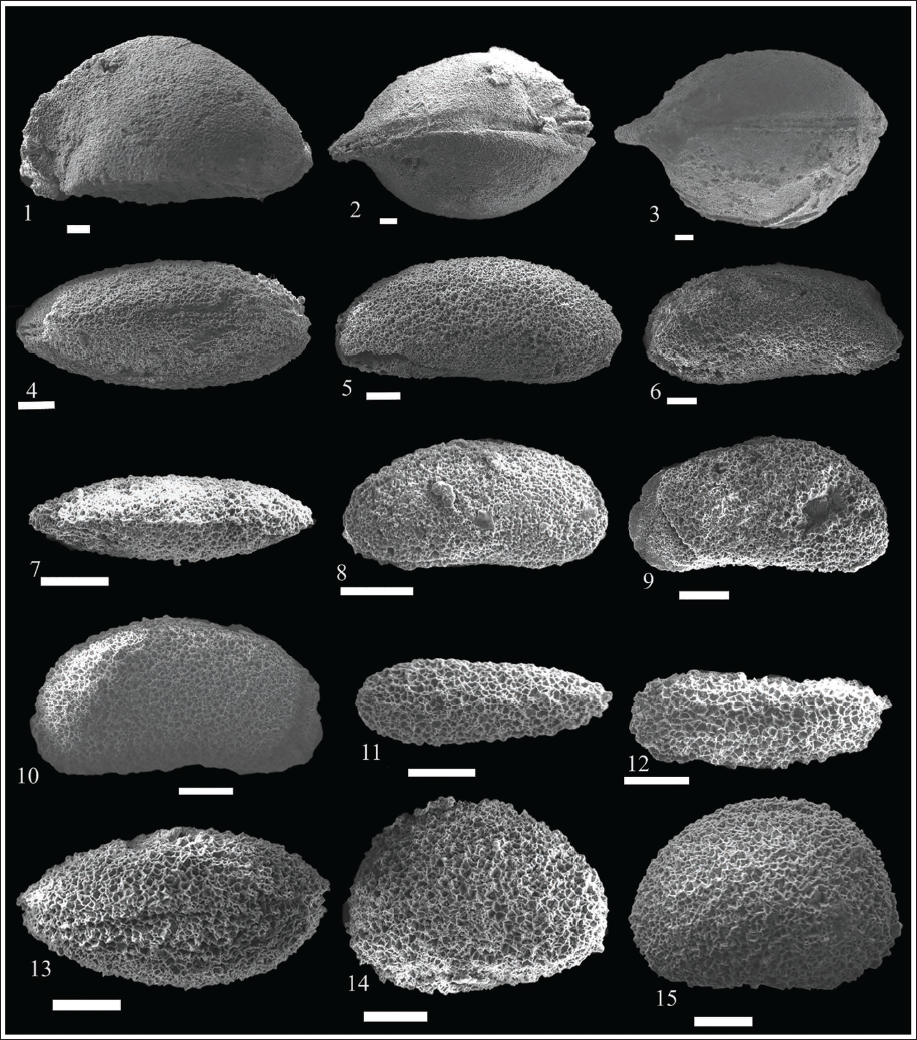
(Pl. 1, 1–4)
Metacypris strangulata (Jones)—Bhatia and Rana (partim) (1984, pl. 2, Figs. 6, 7).
Metacypris strangulata (Jones)—Prasad (1986, p. 72).
Frambocythere tumiensis tumiensis (Helmdach)—Bhatia, Srinivasan, et al. (1990, p. 118, pl. 1, Figs. 1–3).
Frambocythere tumiensis tumiensis (Helmdach)—Bhatia et al. (1996, p. 229).
Frambocythere tumiensis anjarensis (Bhandari & Colin)—Bhandari and Colin (1999, pp. 12–13, pl. 1, Figs. 1–10).
Frambocythere tumiensis anjarensis (Bhandari & Colin)—Whatley, Bajpai, and Srinivasan (2002, pp. 166–168, pl. 1, Figs. 8, 9).
Frambocythere sp. cf. F. tumiensis anjarensis (Bhandari & Colin)—Whatley, Bajpai, and Whittaker (2003, p. 78, pl. 1, Figs. 10, 11).
Frambocythere tumiensis anjarensis (Bhandari & Colin)—Khosla and Nagori (2005, p. 574, pl. 1, Fig. 4).
Frambocythere tumiensis anjarensis (Bhandari & Colin)—Khosla et al. (2005, p.137, pl. 1, Figs. 3, 4).
Frambocythere tumiensis anjarensis (Bhandari & Colin)—Khosla and Nagori (2007a, p. 215, pl. 1, Figs. 10–12).
Frambocythere tumiensis anjarensis (Bhandari & Colin)—Khosla and Nagori (2007b, p. 6, pl. 1, Figs. 4–7).
Frambocythere tumiensis anjarensis (Bhandari & Colin)—Khosla, Nagori, Jakhar, and Rathore (2009, p. 725, pl. 2, Fig. 8).
Frambocythere tumiensis anjarensis (Bhandari & Colin)—Sharma and Khosla (2009, p. 202, pl. 1, Figs. D–E).
Frambocythere tumiensis anjarensis (Bhandari & Colin)—Khosla et al. (2010, p. 118).
Frambocythere tumiensis anjarensis (Bhandari & Colin)—Khosla, Nagori, et al. (2011, p. 232, pl. 1, Figs. 12–14).
Frambocythere tumiensis anjarensis (Bhandari & Colin)—Khosla, Rathore, et al. (2011, p. 226, pl. 1, Figs. 10, 11).
Frambocythere tumiensis anjarensis (Bhandari & Colin)—Rathore et al. (2018, p. 225, Figs. 4.7–4.10).
Frambocythere tumiensis anjarensis (Bhandari & Colin)—Kapur et al. (2018, p. 1148, Figs. 3K–M).
Frambocythere tumiensis anjarensis (Bhandari & Colin)—Kshetrimayum and Parmar (2019, p. 15, Figs. 2d–f).
Frambocythere tumiensis anjarensis (Bhandari & Colin)—Kshetrimayum et al. (2021, p. 6, Figs. A–E).
Frambocythere tumiensis anjarensis (Bhandari & Colin)—Kshetrimayum et al. (2022, p. 5, Figs. 2A–D).
Frambocythere tumiensis anjarensis (Bhandari & Colin)—Yadav and Maurya (2023, p. 1, Figs. 4–8).
Material: 240 carapaces.
Locality and horizon: Navegaon, District Chhindwara, Madhya Pradesh, Deccan Intertrappean beds; late Cretaceous/early Paleocene.
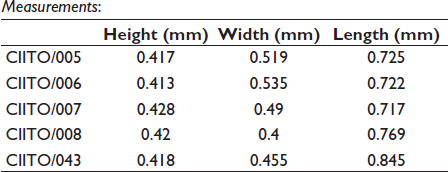
Measurements:
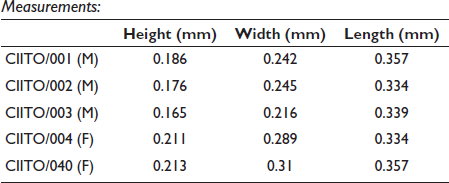
Description: Carapace very small; sub-rectangular shape with two sulci in lateral view; middle sulcus prominent; both anterior and posterior margin lines rounded; dorsal margin straight; ventral margin slightly concave; dimorphism present; heart shape in dorsal view; posterior portion of the female carapace more inflated; outer carapace ornamentation not preserved; internal features unknown.
Remarks: Bhandari and Colin (1999) described this species from the Anjar intertrappean bed and was since then reported from several intertrappean sites: Gitti Khadan (Bhatia & Rana, 1984); Chandarki and Yanagundi (Whatley, Bajpai, & Srinivasan, 2002); Mamoni (Whatley, Bajpai, & Whittaker, 2003); Mohgaon Haveli (Khosla & Nagori, 2007a); Takli (Khosla & Nagori, 2007b); Jhilmili (Sharma & Khosla, 2009); Khar (Rathore et al., 2018); Gujri (Kapur et al., 2019; Kshetrimayum et al., 2021); Kakarda and Bara Bheralya (Kshetrimayum et al., 2022) and Kesavi (Yadav & Maurya, 2023). Additionally, it was also described from the infratrappean bed (Lameta Group) of Dongargaon (Khosla et al., 2005) and the Pisdura Hill Section (Khosla, Rathore, et al., 2011).
Genus Limnocythere (Brady, 1868)
Limnocythere deccanensis (Khosla et al., 2007)
(Pl. 1, 17–19)
Limnocythere bhatiai (Bajpai et al. 2004, p. 150, pl. 1, 2, Figs. R, A–B).
Limnocythere deccanensis (Khosla et al. 2005, pl. 1, Figs. 1–2).
Limnocythere deccanensis (Khosla et al.)—Khosla and Nagori (2007a, p. 215, pl. 1, Figs. 6–9).
Limnocythere deccanensis (Khosla et al.)—Khosla and Nagori (2007b, p. 6).
Limnocythere deccanensis (Khosla et al.)—Keller, Adatte, et al. (2009, p. 51, Figs. 6.9–6.10).
Limnocythere deccanensis (Khosla et al.)—Khosla et al. (2009, p. 725, pl. 2, Fig. 12).
Limnocythere deccansis (Khosla et al.)—Sharma and Khosla (2009, p. 199, pl. 1, Figs. G–J).
Limnocythere deccanensis (Khosla et al.)—Khosla, Nagori, et al. (2011, p. 231, pl. 1, Figs. 7–11).
Limnocythere deccanensis (Khosla et al.)—Khosla, Rathore, et al. (2011, pp. 225–226, pl. 1, Figs. 5–9).
Limnocythere deccanensis (Khosla et al.)—Khosla (2015, p. 234, Fig. 5, I).
Limnocythere deccanensis (Khosla et al.)—Rathore (2018, p. 6).
Limnocythere deccanensis (Khosla et al.)—Yadav and Maurya (2023, p. 7, pl. 1, Figs. 1–3).
Material: 51 carapaces.
Locality and horizon: Navegaon, District Chhindwara, Madhya Pradesh, Deccan Intertrappean beds; late Cretaceous/early Paleocene.
Measurements:
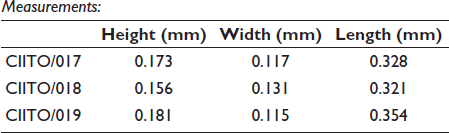
Description: Carapace size very small; quadrate shape in lateral view; anterior margin broad and obliquely round; posterior margin narrow and evenly rounded; both ends compressed; dorsal margin straight to inclined; ventral margin slightly concave at the middle; median vertical sulcus present; sexual dimorphism present; male carapace longer than female carapace; internal details not known.
Remarks: This species was first reported as Limnocythere bhatiai (L. bhatiai) by Bajpai et al. (2004) from the intertrappean bed of Phulsagar, Mandla district. Khosla et al. (2005) reported that the name L. bhatiai was preoccupied as an ostracod species (Mathur, 1972) from the Tatrot Formation, Upper Siwalik. It was thus replaced by Limnocythere deccanensis by Khosla et al. (2005), which recovered from the Lameta Formation (Maastrichtian) of Dongargaon, Nand-Dongargaon basin (Maharashtra), India. So far, this species has been documented in the intertrappean beds of Mohagaon-Haveli and Jhilmili in Chhindwara district (Khosla & Nagori, 2007a; Sharma & Khosla, 2009); Kesavi in district Dhar (Yadav & Maurya, 2023); Takli in Nagpur district (Khosla & Nagori, 2007b) and the Lameta Formation of Pisdura Hill, Nand-Dongargaon basin (Khosla, Rathore, et al., 2011).
Genus Gomphocythere (Sars, 1924)
Gomphocythere strangulata (Jones, 1860)
(Pl. 1, 5–8)
Cypris strangulata (Jones, 1860, p. 187, pl. 10, Figs. 73a–d).
Metacypris strangulata (Jones)—Bhatia and Rana (1984, p. 33, pl. 2, Figs. 8, 9).
Cytheridella strangulata (Jones)—Bhatia, Prasad, et al. (1990, p. 47, pl. 3, Figs. 1, 2).
Cytheridella strangulata (Jones)—Bhatia, Srinivasan, et al. (1990, p. 118, pl. 1, Figs. 4, 5).
Cytheridella strangulata (Jones)—Bhatia et al. (1996, p. 299, pl. 3, Figs. 1, 2).
Cytheridella strangulata (Jones)—Udhoji and Mohabey (1996, p. 413, pl. 2, Figs. 1–3).
Limnocythere falsicarinata—(Whatley & Bajpai, 2000a, p. 390, pl. 1, Figs. 1–5).
Gomphocythere strangulata (Jones)—Whatley, Bajpai, and Srinivasan (2002, p. 169, pl. 1, Figs. 10–11).
Limnocythere falsicarinata (Whatley & Bajpai)—Khosla and Nagori (2005, p. 575, pl. 1, Fig. 1).
Gomphocythere falsicarinata (Whatley & Bajpai)—Khosla and Nagori (2007b, p. 6, pl. 1, Figs. 8, 9).
Gomphocythere strangulata (Jones)—Khosla, Nagori, Jakhar, and Rathore (2009, p. 725, pl. 2, Fig. 10).
Limnocythere falsicarinata (Whatley & Bajpai)—Sharma and Khosla (2009, p. 202, pl. 1, Fig. F).
Gomphocythere strangulata (Jones)—Khosla, Nagori, et al. (2011, p. 232, pl. 1, Figs. 16–19).
Gomphocythere strangulata (Jones)—Khosla, Rathore, et al. (2011, p. 227, pl. 2, Figs. 2–5).
Gomphocythere strangulata (Jones)—Rathore et al. (2018, p. 226, Figs. 4.16–4.20).
Gomphocythere strangulata (Jones)—Kapur et al. (2018, p. 1150, Figs. 3F–G).
Gomphocythere strangulata (Jones)—Kshetrimayum and Parmar (2019, p. 16, Fig. 2c).
Gomphocythere strangulata (Jones)—Kshetrimayum et al. (2021, p. 5, Figs. 3F–J).
Gomphocythere strangulata (Jones)—Kshetrimayum et al. (2022, p. 5, Figs. 2E–I).
Gomphocythere strangulata (Jones)—Yadav and Maurya (2023, p. 7, pl. 1, Figs. 13–14).
Material: 65 carapaces.
Locality and horizon: Navegaon, District Chhindwara, Madhya Pradesh, Deccan Intertrappean beds; late Cretaceous/early Paleocene.
Measurements:
Description: Carapace medium to large; lensoidal shape in lateral view; strong dimorphism present; male carapace more elongated and less inflated posteriorly than female carapace; valve surface marked by two sulci: a deep one positioned centrally and a smaller groove located in the anterior ventral region; surface ornamentation not preserved.
Remarks: There have been earlier reports of this species from the intertrappean beds of Nagpur (Jones, 1860), Takli (Bhatia, Prasad, et al., 1990; Bhatia et al., 1996; Khosla & Nagori, 2007b), Mamoni (Bhatia, Srinivasan, et al., 1990), Asifabad (Bhatia et al., 1996), Lakshmipur (Whatley & Bajpai, 2000a), Yanagundi (Whatley, Bajpai, & Srinivasan, 2002), Jhilmili (Khosla, Nagori, Jakhar, & Rathore, 2009; Sharma & Khosla, 2009), Anjar (Khosla & Nagori, 2005) and Khar (Rathore et al., 2018), Uthawali (Kshetrimayum & Parmar, 2019), Manawar (Kapur et al., 2019), Gujri (Kshetrimayum et al., 2021), Kakarda and Bara Bheralya (Kshetrimayum et al., 2022), Kesavi (Yadav & Maurya, 2023) and the infratrappean bed (Lameta Formation) of Dongargaon, Nand-Dongargaon basin (Khosla et al., 2005; Khosla, Rathore, et al., 2011).
Gomphocythere paucisulcatus (Whatley et al., 2002)
(Pl.1, 9–12)
Gomphocythere? sp. 1—(Bhandari & Colin, 1999, p. 13, pl. 1, Figs. 11–13).
Gomphocythere paucisulcatus (Whatley et al.)—Whatley, Bajpai, and Srinivasan (2002, pp. 107–109, pl. 1, Figs. 1–6).
Gomphocythere paucisulcatus (Whatley et al.)—Khosla and Nagori (2005, p. 574, pl. 1, Fig. 3).
Gomphocythere paucisulcatus (Whatley et al.)—Khosla et al. (2005, p. 137, pl. 1, Figs. 7, 8).
Gomphocythere paucisulcatus (Whatley et al.)—Khosla and Nagori (2007b, p. 8, pl. 1, Figs. 10, 11).
Gomphocythere paucisulcatus (Whatley et al.)—Sharma et al. (2008, p. 178, pl. 1, Figs. E–G).
Gomphocythere paucisulcatus (Whatley et al.)—Khosla, Nagori, Jakhar, and Rathore (2009, p. 725, pl. 2, Fig. 9).
Gomphocythere paucisulcatus (Whatley et al.)—Khosla, Nagori, et al. (2011, p. 232, pl. 1, Fig. 15).
Gomphocythere paucisulcatus (Whatley et al.)—Khosla, Rathore, et al. (2011, p. 227, pl. 1, Figs. 12, 13; pl. 2, Figs. 1a, b).
Gomphocythere paucisulcatus (Whatley et al.)—Rathore et al. (2018, p. 225, Figs. 4.13–4.15).
Gomphocythere paucisulcatus (Whatley et al.)—Kapur et al. (2018, p. 1150, Figs. 3H–J).
Gomphocythere paucisulcatus (Whatley et al.)—Kshetrimayum and Parmar (2019, p. 15, Figs. 2a, b).
Gomphocythere paucisulcatus (Whatley et al.)—Kshetrimayum et al. (2021, p. 6, Figs. 3K–N).
Gomphocythere paucisulcatus (Whatley et al.)—Kshetrimayum et al. (2022, p. 5, Figs. 2J–M).
Gomphocythere paucisulcatus (Whatley et al.)—Yadav and Maurya (2023, p. 7, pl. 1, Figs. 9–12).
Material: 149 carapaces.
Locality and horizon: Navegaon, District Chhindwara, Madhya Pradesh, Deccan Intertrappean beds; late Cretaceous/early Paleocene.
Measurements:
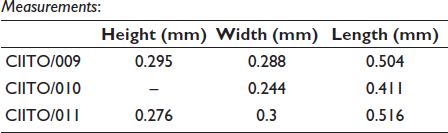
Description: Carapace small- to medium sized; subrectangular in lateral view; feebly developed sulcus situated medial of a valve; anterior margin outline well rounded comparatively to posterior margin outline; ventral margin line straight; carapace sub-fusiform in dorsal view; anterior portion more compressed than posterior portion in dorsal view; maximum width present in the posterior portion; maximum height lies close to the middle line of the carapace, internal features unknown.
Remarks: So far, this ostracod species has previously been described from many intertrappean localities, including Anjar of Kachchh district (Bhandari & Colin, 1999; Khosla & Nagori, 2005); Mohgaon Kalan of Chhindwara district (Whatley, Bajpai, & Srinivasan, 2002); Takli of Nagpur district (Khosla & Nagpur, 2007b); Papro of Lalitpur district (Sharma et al., 2008); Jhilmili of Chhindwara district (Khosla, Nagori, Jakhar, & Rathore, 2009; Khosla, Nagori, et al., 2011); Khar of Khargoan district (Rathore et al., 2018); near Gujri (Kapur et al., 2018; Kshetrimayum et al., 2021), Kakarda and Bara Bheralya of Dhar district (Kshetrimayum et al., 2022); Kesavi of Dhar district (Yadav & Maurya, 2023); and additionally from the infratrappean beds (Lameta Group) of Dongargaon (Khosla et al., 2005; Khosla, Rathore, et al., 2011) and Pisdura Hill Section (Khosla et al., 2010; Khosla, Rathore, et al., 2011), Nand-Dongargaon basin.
Family: Candonidae Kaufmann, 1900
Subfamily: Cyclocypridinae Kaufmann, 1900
Genus: Cypria (Zenker, 1854)
Cypria cyrtonidion (Whatley & Bajpai, 2000)
(Pl. 2, 13–15)
Cyprios sp. (Bhatia & Rana, 1984, p. 33, pl. 2, Fig. 12).
Cyprios sp. (Mathur & Verma, 1988, p. 173, pl. 1, Figs. 1, 2).
Cypria cyrtonidion (Whatley & Bajpai, 2000a, p. 404, pl. 6, Figs. 9–14).
Cypria cyrtonidion (Whatley & Bajpai)—Bajpai and Whatley (2001, p. 101, pl. 2, Figs. 7–9).
Cypria cyrtonidion (Whatley & Bajpai)—Whatley, Bajpai, and Srinivasan (2002, p. 184, pl. 6, Fig. 19).
Cypria cyrtonidion (Whatley & Bajpai)—Whatley, Bajpai, and Srinivasan (2002, p. 112, pl. 2, Fig. 13).
Cypria cyrtonidion (Whatley & Bajpai)—Khosla and Nagori (2005, p. 574, pl. 1, Fig. 10).
Cypria cyrtonidion (Whatley & Bajpai)—Khosla et al. (2005, p. 144, pl. 3, Figs. 9, 10).
Cypria cyrtonidion (Whatley & Bajpai)—Khosla and Nagori (2007a, p. 219, pl. 3, Figs. 12, 13).
Cypria cyrtonidion (Whatley & Bajpai)—Khosla and Nagori (2007b, p. 14, pl. 3, Figs. 11, 12).
Cypria cyrtonidion (Whatley & Bajpai)—Sharma et al. (2008, p. 182, pl. 1, Fig. O).
Cypria cyrtonidion (Whatley & Bajpai)—Khosla, Nagori, Jakhar, and Rathore (2009, p. 725, pl. 2, Fig. 3).
Cypria cyrtonidion (Whatley & Bajpai)—Sharma and Khosla (2009, p. 204, pl. 3, Figs. L, M).
Cypria cyrtonidion (Whatley & Bajpai)—Khosla et al. (2010, p. 118, Figs. 4f, g).
Cypria cyrtonidion (Whatley & Bajpai)—Khosla, Nagori, et al. (2011, p. 240, pl. 3, Figs. 15, 16).
Cypria cyrtonidion (Whatley & Bajpai)—Khosla, Rathore, et al. (2011, p. 249, pl. 7, Figs. 3, 4).
Cypria cyrtonidion (Whatley & Bajpai)—Rathore et al. (2018, p. 225, Figs. 4.4–4.6).
Cypria cyrtonidion (Whatley & Bajpai)—Kshetrimayum et al. (2021, p. 11, Figs. 4J–M).
Cypria cyrtonidion (Whatley & Bajpai)—Kshetrimayum et al. (2022, p. 10, Figs. 3N-Q).
Cypria cyrtonidion (Whatley & Bajpai)—Yadav and Maurya (2023, p. 8, pl. 2, Figs. 4–6).
Material: 96 carapaces.
Locality and horizon: Navegaon, District Chhindwara, Madhya Pradesh, Deccan Intertrappean beds; late Cretaceous/early Paleocene.
Measurements:
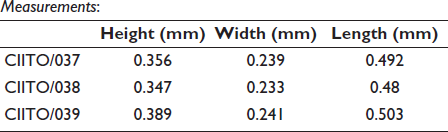
Description: Carapace medium; sub-circular in lateral view; dorsal margin outline convex; ventral margin outline straight; anterior margin outline bluntly rounded; left valve bigger than the right valve; left valve overreaches the right valve along all sides except dorsal side (hinge line); fusiform shape in dorsal view; maximum length and height medially present.
Remarks: This ostracod species of Cypria has been reported from the intertrappean sections, namely, Lakshmipur village, Kutch district (Whatley & Bajpai, 2000a); Kora, Kutch district (Bajpai & Whatley, 2001); Anjar, Kutch district (Khosla & Nagori, 2005); Mohgaon Haveli, Chhindwara district (Khosla & Nagori, 2007a); Jhilmili, Chhindwara district (Khosla, Nagori, Jakhar, & Rathore, 2009; Khosla, Nagori, et al., 2011; Sharma & Khosla, 2009); Yanagundi and Chandarki, Gulbarga district (Whatley, Bajpai, and Srinivasan, 2002); Papro, Lalitpur district (Sharma et al., 2008); Gujri, Dhar district (Kapur et al., 2018; Kshetrimayum et al., 2021); Kakarda and Bara Bheralya, Dhar district (Kshetrimayum et al., 2022) and Kesavi, Dhar district (Yadav & Maurya, 2023); as well as from infratrappean (Lameta Group) of Dongargaon (Khosla et al., 2005; Khosla, Rathore, et al., 2011) and Pisdura (Khosla et al., 2010; Khosla, Rathore, et al., 2011), Nand-Dongargaon basin.
Subfamily: Cyclocyprididae (Kaufmann, 1900)
Genus: Cyclocypris (Brady & Norman, 1889)
Cyclocypris amphiboles (Whatley et al., 2002)
(Pl. 1, 13–16)
Cyclocypris amphibolos (Whatley, Bajpai, and Srinivasan, 2002, p. 182, pl. 6, Figs. 6–18).
Cyclocypris amphibolos (Whatley et al.)—Whatley, Bajpai, and Whittaker (2002, p. 170, pl. 2, Figs. 12–15).
Cyclocypris amphibolos (Whatley et al.)—Whatley, Bajpai, and Whittaker (2003, p. 84, pl. 1, Figs. 8, 9).
Cyclocypris amphibolos (Whatley et al.)—Khosla et al. (2005, p. 143, pl. 3, Figs. 7, 8).
Cyclocypris amphibolos (Whatley et al.)—Khosla and Nagori (2007a, p. 219, pl. 3, Figs. 8–11).
Cyclocypris amphibolos (Whatley et al.)—Khosla and Nagori (2007b, p. 12, pl. 3, Figs. 8–10).
Cyclocypris amphibolos (Whatley et al.)—Khosla, Nagori, Jakhar, and Rathore (2009, p. 725, pl. 2, Fig. 2).
Cyclocypris amphibolos (Whatley et al.)—Khosla et al. (2010, p. 118, Figs. 4c–e).
Cyclocypris amphibolos (Whatley et al.)—Khosla, Nagori, et al. (2011, p. 238, pl. 3, Figs. 13, 14).
Cyclocypris amphibolos (Whatley et al.)—Khosla, Rathore, et al. (2011, p. 248, pl. 6, Figs. 15, 16).
Cyclocypris amphibolos (Whatley et al.)—Rathore et al. (2018, p. 223, Figs. 4.1–4.3).
Cyclocypris amphibolos (Whatley et al.)—Kshetrimayum et al. (2022, p. 10, Figs. 3J–M).
Material: 76 carapaces
Locality and horizon: Navegaon, District Chhindwara, Madhya Pradesh, Deccan Intertrappean beds; late Cretaceous/early Paleocene.
Measurements:
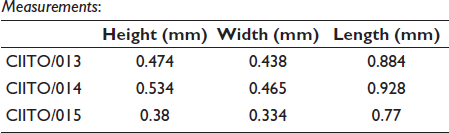
Description: Specimen size large; sub-ovate in lateral view; anterior margin broad; both anterior and posterior extremities rounded; dorsal margin convex anterio-dorsally; fusiform shape in dorsal view; maximum height lies near the anterio-dorsal portion; maximum length below the middle line towards the ventral side; carapace internal detail not known.
Remarks: Previous records indicate that this species was recorded in the intertrappean beds of Yanagundi, Gulbarga district (Whatley, Bajpai, & Srinivasan, 2002); Kora, Kutch district (Whatley, Bajpai, & Whittaker, 2002); Mamoni, Kota district (Whatley, Bajpai, & Whittaker, 2003); Mohgaon Haveli (Khosla & Nagori, 2007a); Jhilmili, Chhindwara district (Khosla, Nagori, Jakhar, & Rathore, 2009; Khosla, Nagori, et al., 2011); Takli, Nagpur district (Khosla & Nagori, 2007b); Kakarda and Bara Bheralya, district Dhar (Kshetrimayum et al., 2022); as well as from the Lameta Group of Dongargaon (Khosla et al., 2005; Khosla, Rathore, et al., 2011); Pisdura, Nand-Dongargaon basin (Khosla et al., 2010) and Jabalpur (Khosla, Rathore, et al., 2011).
Subfamily Candoninae (Daday, 1900)
Genus Candona (Baird, 1845)
Candona amosi (Whatley et al., 2002)
(Pl. 2, 7–10)
Candona (Candona) sinensis (Hou, in Hou et al., 1997, p. 160, pl. 7, Figs. 34–54).
Candona cf. sinensis (Ho, 1978)—Bhandari and Colin (1999, p. 13, pl. 2, Fig. 7).
Candona? sp. (Bhandari & Colin, 1999)—Bajpai and Whatley (2001, p. 102, pl. 2, Fig. 13).
Candona amosi—(Whatley, Bajpai, & Srinivasan, 2002, p. 178, pl. 4, Figs. 20–22; pl. 5, Figs. 1, 2).
Candona amosi (Whatley et al.)—Khosla and Nagori (2007b, p. 12, pl. 3, Figs. 5–7).
Candona amosi (Whatley et al.)—Khosla et al. (2010, Fig. 4h).
Candona amosi (Whatley et al.)—Khosla, Rathore, et al. (2011, p. 244, pl. 6, Fig. 1).
Candona amosi (Whatley et al.)—Kshetrimayum et al. (2022, p. 10, Figs. 3A–D).
Candona amosi (Whatley et al.)—Yadav and Maurya (2023, p. 8, pl. 2, Figs. 1–3).
Material: 26 carapaces.
Locality and horizon: Navegaon, District Chhindwara, Madhya Pradesh, Deccan Intertrappean beds; late Cretaceous/early Paleocene.
Measurements:
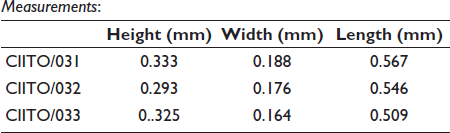
Description: Carapace size medium; sub-horizontal shape in lateral view; anterior and posterior margin lines sub-rounded; dorsal margin straight at hinge line; ventral margin weakly concave medially; greater height lies within the anterior portion; apices below mid-height; fusiform shape in dorsal view; maximum width seen medially; internal details not seen.
Remarks: This ostracod species has been reported from the intertrappean localities of Chandkari and Yanagundi, Gulbarga (Whatley, Bajpai, & Srinivasan, 2002); Kora, Kutch (Bajpai & Whatley, 2001); Takli, Nagpur (Khosla & Nagori, 2007b); Kakarda and Bara Bheralya (Kshetrimayum et al., 2022) and Kesavi, Dhar (Yadav & Maurya, 2023); also found from the Lameta (infrarappean) formation of Pisdura Hill Section (Khosla et al., 2010; Khosla, Rathore, et al., 2011).
Family Cyprididae (Baird, 1845)
Subfamily Eucypridinae (Bronshtein, 1947)
Genus Eucypris (Vávra, 1891)
Eucypris intervolcanus (Whatley & Bajpai, 2000a)
(Pl. 2, 4–6)
Eucypris intervolcanus sp. nov. (Whatley & Bajpai, 2000a, p. 401, pl. 5, Figs. 16–19).
Eucypris intervolcanus (Whatley & Bajpai, 2001, p. 103, pl. 3, Figs. 4, 7).
Eucypris intervolcanus (Whatley & Bajpai)—Whatley, Bajpai, and Srinivasan (2002, p. 177, pl. 4, Fig. 11).
Eucypris intervolcanus (Whatley & Bajpai)—Whatley, Bajpai, and Srinivasan (2002, p. 112, pl. 2, Fig. 12).
Eucypris intervolcanus (Whatley & Bajpai)—Bajpai et al. (2004, p. 154, pl. 2, Fig. m).
Eucypris intervolcanus (Whatley & Bajpai)—Khosla and Nagori (2005, p. 574, pl. 1, Fig. 11).
Eucypris intervolcanus (Whatley & Bajpai)—Khosla and Nagori (2007b, p. 10, pl. 2, Figs. 16, 17).
Eucypris intervolcanus (Whatley & Bajpai)—Sharma et al. (2008, p. 180, pl. 1, Figs. H–K).
Eucypris intervolcanus (Whatley & Bajpai)—Khosla, Rathore, et al. (2011, p. 245, pl. 6, Figs. 5, 6).
Eucypris intervolcanus (Whatley & Bajpai)—Rathore et al. (2018, p. 223, Figs. 3.12–3.14).
Eucypris intervolcanus (Whatley & Bajpai)—Kapur et al. (2018, p. 1150, Figs. 3A–C).
Eucypris intervolcanus (Whatley & Bajpai)—Kshetrimayum et al. (2021, p. 14, Figs. 5K–O).
Eucypris intervolcanus (Whatley & Bajpai)—Kshetrimayum et al. (2022, p. 15, Figs. 4T–W).
Eucypris intervolcanus (Whatley & Bajpai)—Yadav and Maurya (2023, p. 8, pl. 2, Figs. 7–9).
Material: 118 carapaces.
Locality and horizon: Navegaon, District Chhindwara, Madhya Pradesh, Deccan Intertrappean beds; late Cretaceous/early Paleocene.
Measurements:
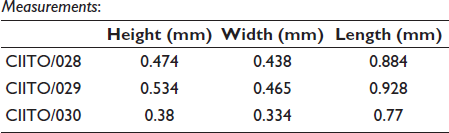
Description: Carapace elongate and large size; subovate-subreniform in lateral view; both extremities rounded; anterior margin narrowly rounded relative to the posterior margin; dorsal margin line convex; ventral margin line weakly concave; maximum length and height medially present; carapace fusiform; anterior portion more compressed than posterior portion in dorsal view; left valve larger than right valve; internal structures unknown.
Remarks: The present species of Eucypris was previously described from the intertrappean localities, including, Lakshmipur (Whatley & Bajpai, 2000a), Kora (Bajpai & Whatley, 2001) and Anjar (Khosla & Nagori, 2005) in Kutch district; Phulsagar (Bajpai et al., 2004), Yanagundi and Chandarki (Whatley, Bajpai, & Srinivasan, 2002a) in Gulbarga district; Mohgaon Kalan in Chhindwara district (Whatley, Bajpai, & Srinivasan, 2002b); Takli in Nagpur district (Khosla & Nagori, 2007b); Khar in Khargoan district (Rathore et al., 2018); Gujri (Kapur et al., 2018; Kshetrimayum et al., 2021), Bara Bheralya and Kakrada (Kshetrimayum et al., 2022), Kesavi, in Dhar District (Yadav & Maurya, 2023); as well as from Lameta (infratrappean) deposits of Chui Hill, Jabalpur (Khosla, Rathore, et al., 2011).
Subfamily Cyprettinae (Hartmann, 1964)
Genus Paracypretta (Sars, 1924)
Paracypretta jonesi (Bhatia & Rana, 1984)
(Pl. 2, 1–3)
Paracypretta jonesi (Bhatia & Rana, 1984, p. 30, pl. 2, Figs. 1–3).
Altanicypris sp. (Sahni & Khosla, 1994, p. 458, Figs. n–p).
Leiria jonesi—(Bhatia et al., 1996, p. 304, pl. 3, Fig. 7).
Paracypretta jonesi (Bhatia & Rana)—Udhoji and Mohabey (1996, p. 413, pl. 2, Figs. 4–6).
Paracypretta sp. (Bajpai & Sahni, 2000, p.258, Fig. 2f).
Paracypretta bhatiai (Khosla & Sahni)—Whatley and Bajpai (2000b, p. 174, pl. 1, Figs. 1–3).
Paracypretta jonesi (Bhatia & Rana)—Bajpai and Whatley (2001, p. 95, pl. 1, Figs. 2, 4).
Paracypretta jonesi (Bhatia & Rana)—Whatley, Bajpai, and Whittaker (2002, p. 166, pl. 1, Figs. 8, 9).
Paracypretta jonesi (Bhatia & Rana)—Whatley, Bajpai, and Whittaker (2003c, p. 1293, pl. 2, Figs. 14, 17).
Paracypretta anjarensis– (Khosla & Nagori, 2005, p. 576, pl. 1, Figs. 13–16).
Paracypretta anjarensis (Khosla & Nagori)—Khosla et al. (2005, p. 139, pl. 1, Figs. 11, 12).
Paracypretta jonesi (Bhatia & Rana)—Khosla and Nagori (2007a, p. 215, pl. 1, Figs. 13–16; pl. 2, Figs. 1–3).
Paracypretta jonesi (Bhatia & Rana)—Khosla and Nagori (2007b, p. 8, pl. 1, Figs. 15, 16).
Paracypretta jonesi (Bhatia & Rana)—Khosla, Nagori, Jakhar, and Rathore (2009, p. 725, pl. 2, Fig. 13).
Paracypretta jonesi (Bhatia & Rana)—Sharma and Khosla (2009, p. 204, pl. 2, Figs. I–N).
Paracypretta jonesi (Bhatia & Rana)—Khosla et al. (2010, p. 118, Figs. 3a–c).
Paracypretta jonesi (Bhatia & Rana)—Khosla, Nagori, et al. (2011, p. 233, pl. 2, Figs. 3, 4).
Paracypretta jonesi (Bhatia & Rana)—Rathore et al. (2018, p. 221, Figs. 3.1–3.3).
Paracypretta jonesi (Bhatia & Rana)—Kshetrimayum and Parmar (2019, p. 15, Figs. 2g, h).
Paracypretta jonesi (Bhatia & Rana)—Kshetrimayum et al. (2021, p. 11, Figs. 4N–R).
Paracypretta jonesi (Bhatia & Rana)—Kshetrimayum et al. (2022, p. 10, Figs. 3R–V).
Material: 7 carapaces.
Locality and horizon: Navegaon, District Chhindwara, Madhya Pradesh, Deccan Intertrappean beds; late Cretaceous/early Paleocene.
Measurements:
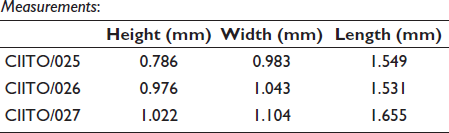
Description: Carapace size very large; subtriangular shape in the lateral view; anterior margin lateral compressed and broadly rounded; dorsal margin symmetrically convex; ventral margin straight to slightly concave; largest length and height present medially; carapace strongly inflated in medial; left valve overreaches right valve along all margins; internal details unknown.
Remarks: This species of Paracypretta was first reported by Bhatia and Rana (1984) from the intertrappean section of Gitti Khadan, Nagpur. Apart from this, the species has been documented in various intertrappean localities of Kora, Kutch (Bajpai & Whatley, 2001); Chandarki, Gulbarga (Whatley, Bajpai, & Srinivasan, 2002); Mohgaon Haveli and Jhilmili, Chhindwara (Khosla & Nagori, 2007a; Sharma & Khosla, 2009); Takli, Nagpur (Khosla & Nagori, 2007b); Khar, Khargoan (Rathore et al., 2018); Gujri (Kshetrimayum et al., 2021), Bara Bheralya and Kakrada, Dhar (Kshetrimayum et al., 2022); the Lameta Formation (late Cretaceous) of Dongargaon (Khosla et al., 2005; Khosla, Rathore, et al., 2011), Pisdura (Khosla et al., 2010; Khosla, Rathore, et al., 2011), Nand-Dongargaon basin; Chui Hill and Bara Simla Hill sections, Jabalpur basin (Khosla, Rathore, et al., 2011).
Subfamily Cypridopsinae (Kaufmann, 1900)
Genus Zonocypris (Müller, 1898)
Zonocypris sp. (Whatley & Bajpai, 2000)
(Pl. 1, 21–23)
Zonocypris sp. (Whatley & Bajpai, 2000, p. 5, pl. 2, Figs. 1–2).
Material: 19 carapaces.
Locality and horizon: Navegaon, District Chhindwara, Madhya Pradesh, Deccan Intertrappean beds; late Cretaceous/early Paleocene.
Measurements:
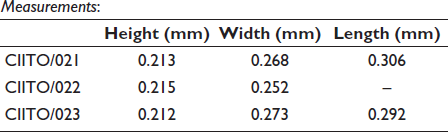
Description: Carapace size is very small and tumid; sub-ovate in lateral view; dorsal margin arched; ventral margin nearly straight; posterior end broadly rounded than anterior margin; largest height in the middle; posteriorly inflated and anteriorly compressed in dorsal view; maximum width lies slightly behind the middle of the carapace; spiral ribs are present but not regularly seen.
Remarks: The present specimens resemble, in size, shape and general outline, Zonocypris gujratensis, but important morphological features such as spiral ribs are not seen because of preservation. The lack of preservation of morphological features cannot be assigned to species.
Genus Cypridopsis (Brady, 1868)
Cypridopsis hyperectyphos (Whatley & Bajpai, 2000a)
(Pl. 1, 20, 24)
Cypridopsis hyperectyphos (Whatley & Bajpai, 2000a, p. 397, pl. 4, Figs. 4–10).
Cypridopsis hyperectyphos (Whatley & Bajpai)—Bajpai and Whatley (2001, p. 96, pl. 1, Figs. 6–8).
Cypridopsis hyperectyphos (Whatley & Bajpai)—Whatley, Bajpai, and Srinivasan (2002, p. 174, pl. 3, Figs. 11–13).
Cypridopsis hyperectyphos (Whatley & Bajpai)—Whatley, Bajpai, and Whittaker (2003, p. 80, pl. 1, Figs. 12, 13).
Cypridopsis hyperectyphos (Whatley & Bajpai)—Khosla and Nagori (2005, p. 574, pl. 1, Fig. 17).
Cypridopsis hyperectyphos (Whatley & Bajpai)—Khosla et al. (2005, p. 141, pl. 2, Figs. 3, 4).
Cypridopsis hyperectyphos (Whatley & Bajpai)—Khosla and Nagori (2007b, p. 9, pl. 2, Fig. 9).
Cypridopsis hyperectyphos (Whatley & Bajpai)—Sharma et al. (2008, p. 178, pl. 2, Figs. A–C).
Cypridopsis hyperectyphos (Whatley & Bajpai)—Khosla, Nagori, Jakhar, and Rathore (2009, p. 725, pl. 2, Fig. 4).
Cypridopsis hyperectyphos (Whatley & Bajpai)—Sharma and Khosla (2009, p. 204, pl. 3, Figs. A, B).
Cypridopsis hyperectyphos (Whatley & Bajpai)—Khosla et al. (2010, p. 118, Figs. 3h, i).
Cypridopsis hyperectyphos (Whatley & Bajpai)—Khosla, Nagori, et al. (2011, p. 236, pl. 3, Figs. 8–11).
Cypridopsis hyperectyphos (Whatley & Bajpai)—Khosla, Rathore, et al. (2011, p. 241, pl. 5, Figs. 4–6).
Cypridopsis hyperectyphos (Whatley & Bajpai)—Rathore et al. (2018, p. 221, Figs. 3.9–3.11).
Cypridopsis hyperectyphos (Whatley & Bajpai)—Kapur et al. (2018, p. 1148, Figs. 3d, e).
Cypridopsis hyperectyphos (Whatley & Bajpai)—Kshetrimayum et al. (2022, p. 15, Figs. 4D–H).
Material: 6 carapaces.
Locality and horizon: Navegaon, District Chhindwara, Madhya Pradesh, Deccan Intertrappean beds; late Cretaceous/early Paleocene.
Measurements:
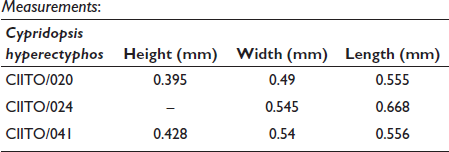
Description: Carapace medium and highly inflated; triangular sub-ovate in the lateral view; dorsal margin convex; ventral margin with little concavity; anterior end narrowly rounded and apices below mid-length; posterior end broadly rounded and apices at mid-length; height and length sometimes equal, internal morphological details not known.
Remarks: This species has been recorded from the intertrappean beds of Lakshmipur (Whatley & Bajpai, 2000a), Kora (Bajpai & Whatley, 2001), Anjar (Khosla & Nagori, 2005), Kutch district; Yanagundi, Gulbarga district (Whatley, Bajpai, & Srinivasan, 2002); Mamoni, Kota district (Whatley, Bajpai, & Whittaker, 2003a); Takli, Nagpur district (Khosla & Nagori, 2007b); Papro, Lalitpur district (Sharma et al., 2008); Jhilmili, Chhindwara district (Khosla, Nagori, Jakhar, & Rathore, 2009; Khosla, Nagori, et al., 2011; Sharma & Khosla, 2009); Khar, Khargoan (Rathore et al., 2018); Gujri (Kapur et al., 2018), Bara Bheralya and Kakrada, (Kshetrimayum et al., 2022), Kesavi, Dhar district (Yadav & Maurya, 2023); the Lameta Group (infratrappean) of Dongargaon (Khosla et al., 2005; Khosla, Rathore, et al., 2011), Pisdura Hill Section (Khosla et al., 2010; Khosla, Rathore, et al., 2011), Nand-Dongargaon basin; Chui Hill (Khosla, Rathore, et al., 2011), Jabalpur basin.
Superfamily: Darwinulacea (Brady & Norman, 1889)
Family: Darwinulidae (Brady & Norman, 1889)
Genus Darwinula (Brady & Robertson, 1885)
Darwinula sp.
(Pl. 2, 11–12)
Material: 4 carapaces.
Locality and horizon: Navegaon, District Chhindwara, Madhya Pradesh, Deccan Intertrappean beds; late Cretaceous/early Paleocene.
Measurements:
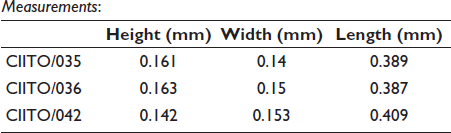
Description: Carapace very small to small, narrow and elongated; sub-cylindrical in the lateral view; anterior margin is more narrowly rounded than the posterior margin; maximum length near the middle line; maximum height slight upper to the middle line.
Remarks: The present specimen has a general outline to that of the Darwinula torpedo (Whatley, Bajpai, & Srinivasan, 2002a), but it is comparatively smaller in size. Their generic status cannot be confirmed with certainty due to limited material and a lack of morphological features.
DISCUSSION
Palaeoecological aspects
The ostracods live in all environmental conditions, that is, fresh to brackish and marine water conditions (Horne, 2003; Smith & Horne, 2002). Total ostracod species represented here includes 12 taxa (Frambocythere tumiensis anjarensis (28%), Gomphocythere paucisulcatus (17%), Eucypris intervolcanus (14%), Cypria cyrtonidion (11%), Cyclocypris amphibolos (9%), Gomphocythere strangulata (8%), Limnocythere deccanensis (6%), Candona amosi (3%), Zonocypris sp. (2%), Paracypretta jonesi (1%), Cypridopsis hyperectyphos (1%) and Darwinula sp. (0.6%). Whatley and Bajpai (2005) suggested the ecological condition of intertrappean ostracods based on their length (size) and a comparative study with extant species. They classified ostracods into two groups: non-swimmers and swimmers. Non-swimmers are mainly walkers, crawlers, endobenthic and epibenthic who like to live in seasonal to permanent water bodies. However, swimmers indicate moving water bodies, floodplains or permanent water bodies. The ostracod assemblage indicates a mixed group of both swimmers (Cypria, Cyclocypris, Candona, Paracypretta, Cypridopsis and Zonocypris) and non-swimmers (Frambocythere, Gomphocythere, Limnocythere, Darwinula and Eucypris). The Limnocypridae family includes Frambocythere, Gomphocythere and Limnocythere, in which Frambocythere and Gomphocythere inhabit permanent water body, and Limnocyhtere likes to live in temporary pools (McKenzie, 1971; Whatley & Bajpai, 2005). Darwinula is also a non-swimmer. The non-swimmer Eucypris dwells in seasonally dry water bodies and lays desiccation-resistant eggs that hatch with rain (Smith & Martens, 2000; Whatley & Bajpai, 2005). Cypria is a good swimmer and prefers to live in permanent, oligohaline water bodies. Cyclocypris (swimmer) likes to live in small ponds or lake (Khosla, 2015). Paracypretta can swim well and prefers to live in permanent water bodies (Khosla, 2015; Whatley & Bajpai, 2005). Cypridopsis is a good swimmer that thrives in an aquatic environment with abundant vegetation and migrates to greater depths within lakes during periods of low precipitation (Pérez et al., 2010). Zonocypris also can swim, but it is presumably slow due to its extensively spiral-ringed ornamentation (Whatley & Bajpai, 2005). Candona are able to walk and crawl, and they live in fresh to oligohaline aquatic environments such as lakes, marshes, coastal lagoons and slow-moving streams. The dominance of Limnocytheridae family ostracods, around 59%, indicates a freshwater standing water body (lake/pond). Additionally, the common intertrappean fish (Lepisosteus) and pulmonate gastropods (Physa) were collected from the ostracods bearing horizon, supporting the freshwater environment conditions.
EDX analysis and silicification processes
The silicification process had an impact on the preservation of surface ornamentation—such as pits, ribs, spines, and tubercles—on ostracod carapaces in this study. Despite some alteration, key morphological features necessary for identification remained intact. The EDX analysis of the ostracod carapace shows a high silica peak (average value 50 wt%), a low calcium peak (average value 3 wt%) and the negligible presence of other elements (Figure 3). Along with ostracods, gastropod shells were also silicified found. Silicification is known from the continental and lake deposits but comparatively less than the oceanic deposits. According to the researchers (Butts, 2014 and references therein; Ver Straeten, 2009), silicification is widespread in sedimentary deposits attributed to the volcanic terrain and ash beds. Ash beds are most likely recognised as a great source of silica. Because volcanic ash has a poor crystallinity, it dissolves easily in high-pH water (Williams et al., 1985). It could change the chemical composition of adjacent water bodies that may have an effect on the ecosystems around them. However, the hydrothermal fluid found in the volcanic terrain is also recognised as a source of silica. These fluids, typically characterized by high silica and low calcium concentrations, have the capacity to infiltrate sediment layers, leading to the dissolution of calcium and the subsequent precipitation of silica. This process occurs under specific pH and temperature conditions. Additionally, weathering of the Deccan Volcanic Province may provide a further supply of silica-rich material, which is considered a contributing factor to the observed silicification.
The figure explains the elemental values (EDX data) of the ostracod carapace.
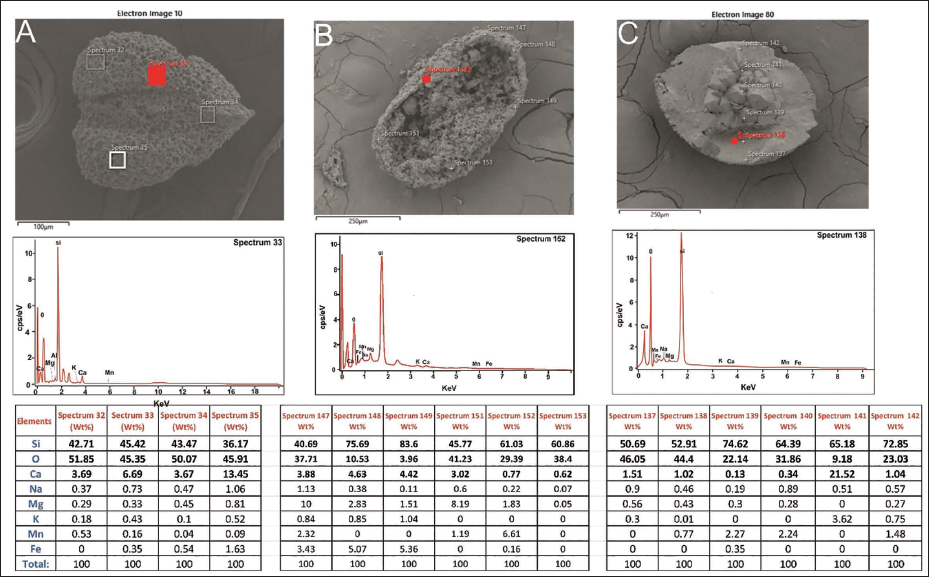
Plate Showing sem pictures of ostracods collected from the navegaon intertrappean locality. 1–4: Frambocythere tumiensis anjarensis (Bhandari & Colin, 1999); (a) carapace (CIITO/001), right lateral view; (b) carapace (CIITO/002), left lateral view; (c) male carapace (CIITO/003), dorsal view; (d) female carapace (CIITO/004), dorsal view; 5–8: Gomphocythere strangulata Jones, 1860; (e) carapace (CIITO/005), left lateral view; (f) and (g) male carapace (CIITO/006, 007), dorsal view; (h) female carapace (CIITO/008), dorsal view; 9–12: Gomphocythere paucisulcatus (Whatley et al., 2002b); (i) carapace (CIITO/009), right lateral view; (j) carapace (CIITO/010), left lateral view; (k) carapace (CIITO/011), dorsal view; l: carapace (CIITO/012), ventral view; 13–16: Cyclocypris ambhibolos (Whatley et al., 2002a); (m) carapace (CIITO/013), left lateral view; (n) carapace (CIITO/014), right lateral view; (o) and (p) carapace (CIITO/015, 016), dorsal view; 17–19: Limnocythere deccanensis (Khosla et al., 2007); (q) carapace (CIITO/017), left lateral view; (r) carapace (CIITO/018), right lateral view; (s) carapace (CIITO/019), dorsal view; 20, 24: Cypridopsis hyperectyphos (Whatley & Bajpai, 2000a); (t) carapace (CIITO/020), right lateral view; 21–23: Zonocypris sp.; (u) and (v) carapace (CIITO/021, 022), left lateral view; (w) carapace (CIITO/023), dorsal view; (x) carapace (CIITO/019), dorsal view; Scale bar: 100 µm.
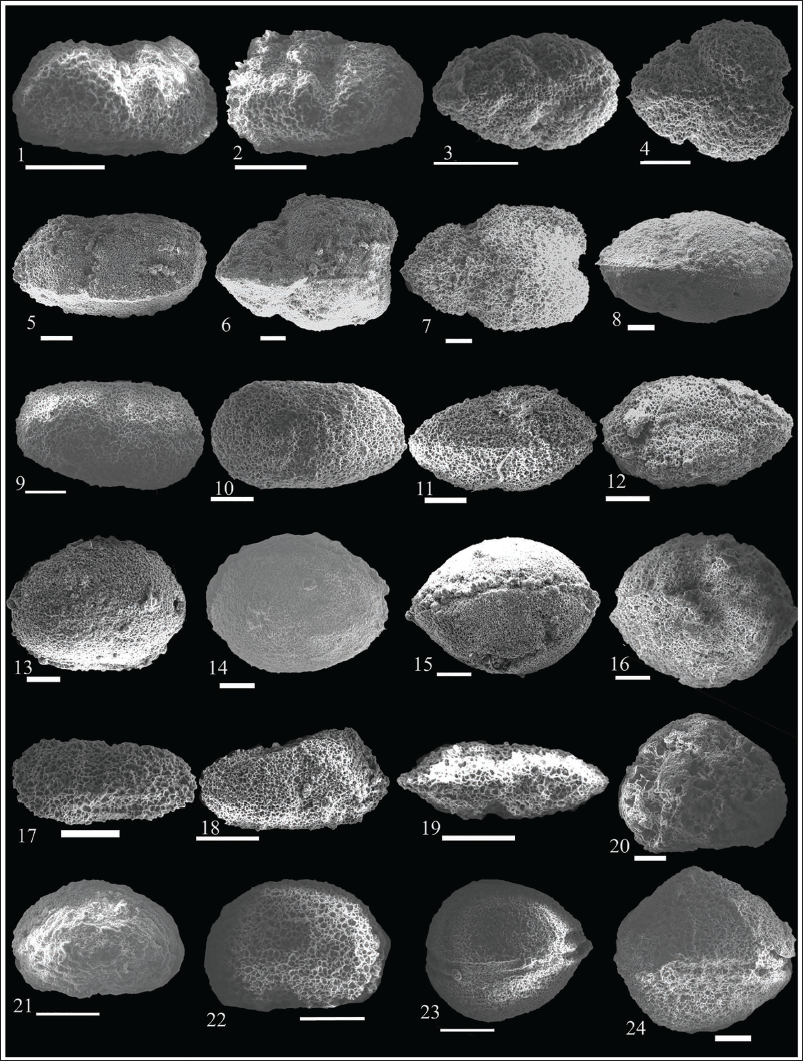
Plate showing SEM pictures of ostracods collected from the navegaon intertrappean locality. 1–3: Paracypretta jonesi (Bhatia & Rana, 1984); (a) carapace (CIITO/025), left lateral view; (b) and (c) carapace (CIITO/026, 027), dorsal view; 4–6: Eucypris intervolcanus (Whatley & Bajpai, 2000a); (d) carapace (CIITO/028), dorsal view; (e) carapace (CIITO/029), left lateral view; (f) carapace (CIITO/030), right lateral view; 7–10: Canadona amosi (Whatley et al., 2002a); (g) carapace (CIITO/031), dorsal view; (h) and (i), carapace (CIITO/032, 033), right lateral view; (j) carapace (CIITO/034), left lateral view; 11–12, ?Darwinula sp. (k) carapace (CIITO/035), dorsal view; l: carapace (CIITO/036), lateral view; 13–15: Cypria cyrtonidion (Whatley & Bajpai, 2000a); (m) carapace (CIITO/037), dorsal view; (n) carapace (CIITO/038), left lateral view; (o) carapace (CIITO/039), right lateral view; Scale bar: 100 µm.
Zoogeographical aspects
In the context of paleobiogeography, the Indian subcontinent is interesting as it was a former landmass of the southern continents (Gondwana) that travelled a long journey of around 9,000 km (covering 160 million years) until collision with the Eurasian plate (Chatterjee et al., 2017). The Indian subcontinent’s isolation during its northward journey from Gondwana to Asia resulted in unique biogeographical patterns. While geophysical data suggested a 35-million-year isolation period (Prasad & Sahni, 2009), paleontological evidence reveals a more complex history.
The fauna record (dinosaurs, mammals, lizards, snakes, turtles and frogs) from the intertrappean and infratrappean shows both Gondwana and Laurasian affinity. The Gondwanan fossils from the intertrappean and infratrappean deposits include gondwanatherian (sudamericid) mammals, abelisaurid theropods and titanosauriform sauropods; notosuchian crocodiles; nigerophiid and madtsoiid snakes; bothremydid turtles; and the myobatracid, leptodactylid, ranoid, and hylid frogs (Chatterjee et al., 2017; Khosla, 2019; Parmar & Prasad, 2020; Prasad & Sahni, 2009). These Gondwanan clades have been interpreted as evidence for the existence of dispersal routes that allowed terrestrial faunal exchanges between the southern landmasses, especially India, Madagascar and Africa, although the exact routes of dispersal continue to be debated (Parmar & Prasad, 2020). Apart from the Gondwanan affinity fossils, several intertrappean and infratrappean taxa exhibit possible Laurasian affinities (Rage et al., 2020 and references therein; Sahni & Bajpai, 1991), including frogs (Pelobatidae, Gobiatinae and Costata), lizards (anguimorph), charophytes and palynomorphs, suggesting faunal and floral exchanges between India and Eurasia, possibly via the Kohistan–Dras island arc system (Ali & Aitchison, 2008; Chatterjee et al., 2017 and references therein; Goswami et al., 2011; Khosla & Verma, 2015). Except for the Gondwanan and Laurasian affinity taxa, endemism is also known in the Indian subcontinent (Whatley & Bajpai, 2006). In understanding the biogeographic affinities of intertrappean ostracods with a series of articles contributed by Whatley and Bajpai (see Whatley & Bajpai, 2000), who argued against an Asiatic origin of the intertrappean Ostracoda and concluded that they are highly endemic. Subsequently, Whatley and Bajpai (2006) documented extensive endemism (90 species) in the Deccan intertrappean ostracods (see Whatley & Bajpai, 2006, Tables 1 and 2). All of the ostracod species recorded in the present study show endemism. The taxa, such as Cypridopsis, Limnocythere, Eucypris and Candona, support the ‘Out-of-India’ hypothesis. Genera such as Paracypretta and probably Gomphocythere are confined to the Indian subcontinent. The present data also supports the extended isolation of the sub-continent during the Cretaceous and the ‘Out-of-India’ hypothesis with respect to its biogeographic relations.
CONCLUSIONS
The present study comes with an assemblage of freshwater ostracods, including the 12 species of eleven genera from the new intertrappean locality (latest Cretaceous/early Paleocene), situated near Navegaon village, district Chhindwara, Madhya Pradesh, in the upper Narmada Valley of Mandla sub-province of the Deccan traps. In this study, first-time silicified ostracods are described from the intertrappean beds of the Mandla sub-province. The species in the present ostracod assemblage named Gomphocythere, Paracypretta, Eucypris and Cypriodopsis reaffirm the endemism in the Indian subcontinent during the late Cretaceous/early Paleocene period. Furthermore, some encountered taxa, for example, Cypria, Limnocythere and Gomphocythere support the ‘Out-of-India’ hypothesis. Here encountered ostracod species, along with the fish (Lepisosteus) and mollusk (Physa), conclude the freshwater depositional environment.
