




Abstract
Bivalves and Gastropoda are collected from the Siju Formation of South Garo Hills, Meghalaya, India. Eighteen molluscan taxa are recorded, that is, nine taxa of bivalves and nine taxa of gastropods. These are comprising Ostrea (Ostrea) adbasaensis, Lucina rakhiensis, Lucina (Lucina) yawensis, Trachycardium minbuense, Mactra (Mactra) protoreevesii, Pitar (Calpitaria) carteri, Paphia (Callistotapes) pseudoliratus, Tellina (Peronaea) planta, Corbula (Bicorbula) praexarata, Natica coxi, Seila stracheyi, Euspira soriensis, Semicassis mekranica, Oliva (Strephona) australis var. indica, Conus (Lithoconus) kyudawonensis. Dolium (Eudolium) arabicum, Gistortia (Vicetia) depressa and Planorbis sp. The detailed systematic description of the present molluscan fossils is studied. One zone is established, that is, Lucina yawensis–E. soriensis zone, for correlation purpose and dating. Overall, the zone is based on the total range of molluscan species and name accordingly. The present zone has been assigned to Middle Eocene in age.
Introduction
Meghalaya is the wettest state in India, which is bound to the south by Mymensing and Sylhet, to the west by Rangpur of Bangladesh, and to the north and east by India’s State of Assam. The landform of this Hills state is divided into Jaintia Hills, Khasi Hills, Garo Hills and Ri-Bhoi. The Garo Hills is located in the western part of Meghalaya, adjacent to the Khasi Hills and bordering Assam. The Garo Hills is a part of the Shillong Plateau on the westernmost part of Meghalaya and located in the south of the Tura Ranges, which is bounded to the south by the Dapsi fault (Fox, 1937), and in the south by Bangladesh, in the north and the west by Assam, and in the east by the West Khasi Hills district of Meghalaya.
The Siju Limestone/Siju Formation is Nummulites-bearing limestone (Fox, 1937), equivalent to the Upper Sylhet Limestone unit of Prang Limestone in Khasi-Jaintia Hills of the Middle Eocene age (GSI, 2009) and the Garampani limestone of North Cachar Hills of Assam (Singh et al., 2023). The rich assemblage of calcareous algae and foraminiferal assemblages has been reported and assigned shallow marine with inner ramp depositional condition from the Prang Limestone (Kishore et al., 2007; Misra et al., 2011). Dinoflagellate cysts, spores and pollen grains have been documented on the Siju Formation of Garo Hills (Sarkar et al., 2014; Saxena & Sarkar, 2000; Singh et al., 2021, 2022). A lower Bartonian brissid echinoid, Eupatagus, is recorded from the Siju Formation exposed at about 7 km southeast of Adugiri village (along Dilni River), Garo Hills (Srivastava & Garg, 2014).
In the present study, the molluscan fossils were recorded from the Siju limestone exposed in and around the Tagatchugiri limestone quarry, Garo Hills, Meghalaya. This study focuses only on a detailed systematic description of bivalves, gastropods and biostratigraphy.
Geological Setting
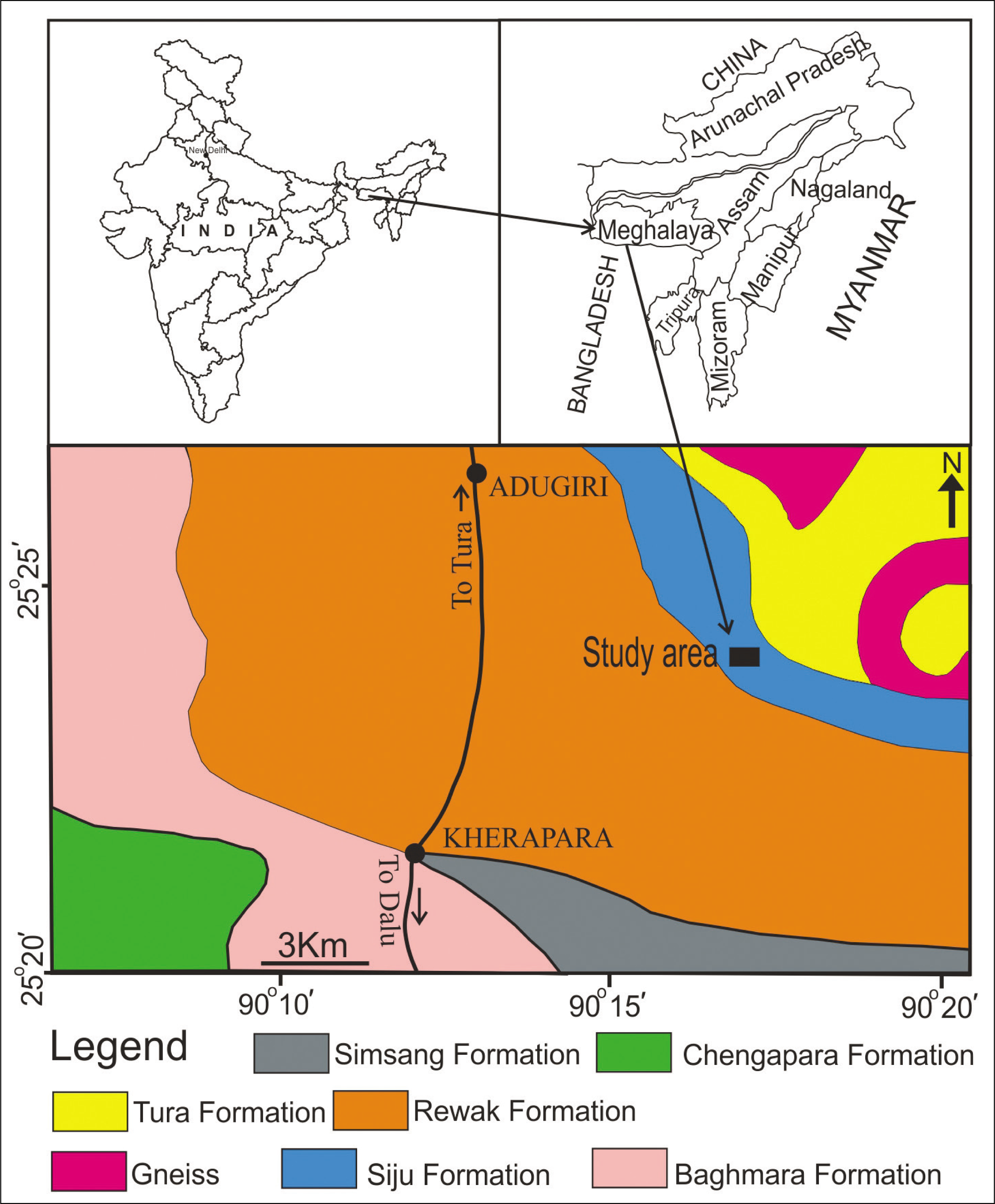
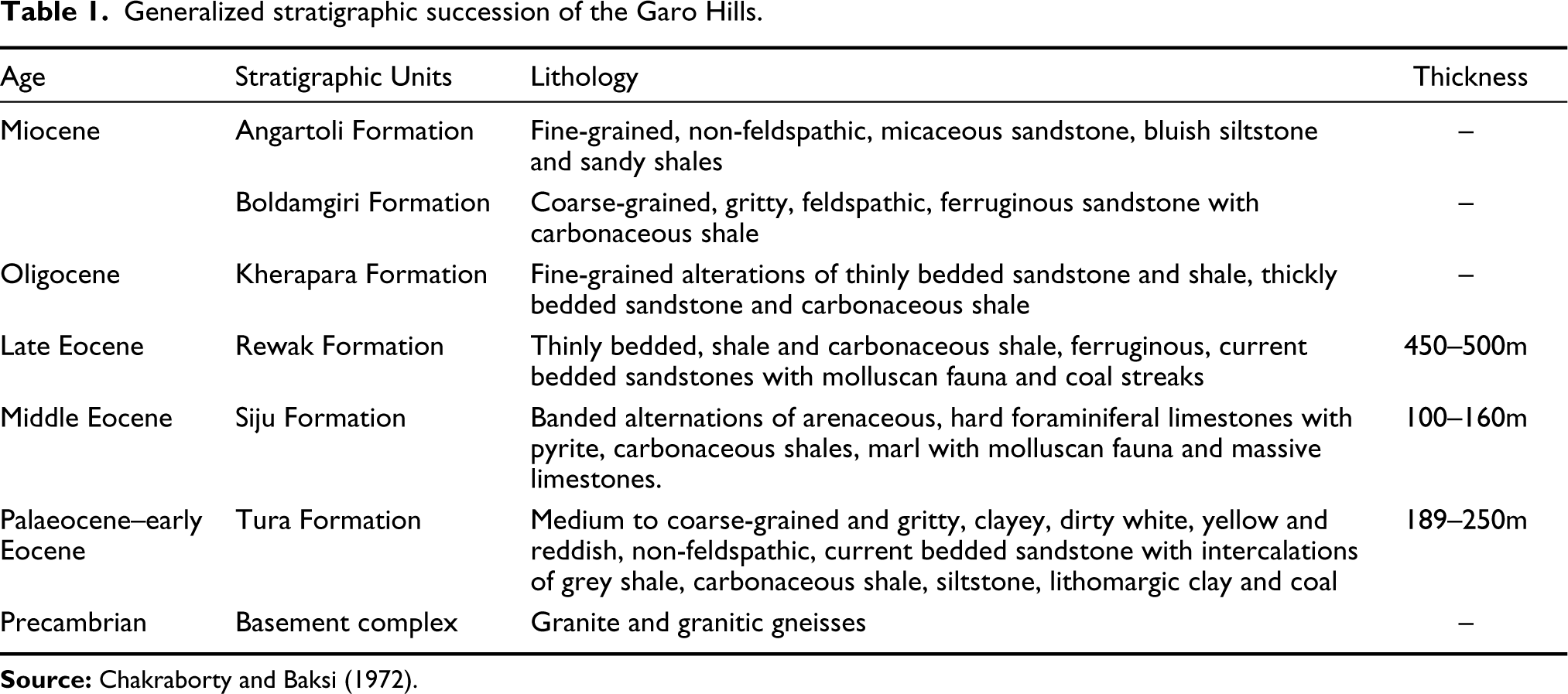
In Garo Hills, the Precambrian Basement Complex is unconformably overlain by the Cretaceous–Tertiary sedimentary succession (Figure 1). The thick sedimentary successions are represented by the Tura, Siju, Rewak and Kopili formations in the ascending order of the stratigraphy and occupy the southernmost portion of the Garo Hills of Meghalaya (Table 1). The litho-units comprise shales, carbonaceous shale, fossiliferous limestones, coal, sandstone, siltstone, marl and clay. The Tura Formation is further subdivided into lower, middle and upper members. The lower member of this formation consists of massive sandstone with pebbly interbands, whereas the middle is made up of ferruginous argillaceous sandstone, shale, with lithomargic clays and coal seams. The upper member is arenaceous with a pebble-bearing layer. The Tura Formation is overlain conformably by the Siju Formation (Figure 1). The highly fossiliferous Siju Formation consists of hard, yellow, arenaceous and fossiliferous limestone with marl (Table 1). This succession is followed by the predominantly argillaceous Rewak and younger successions (Singh et al., 2021).
Geological map of Garo Hills, Meghalaya and the study area. Source: GSI (1976).
Generalized stratigraphic succession of the Garo Hills.
Material and Methods
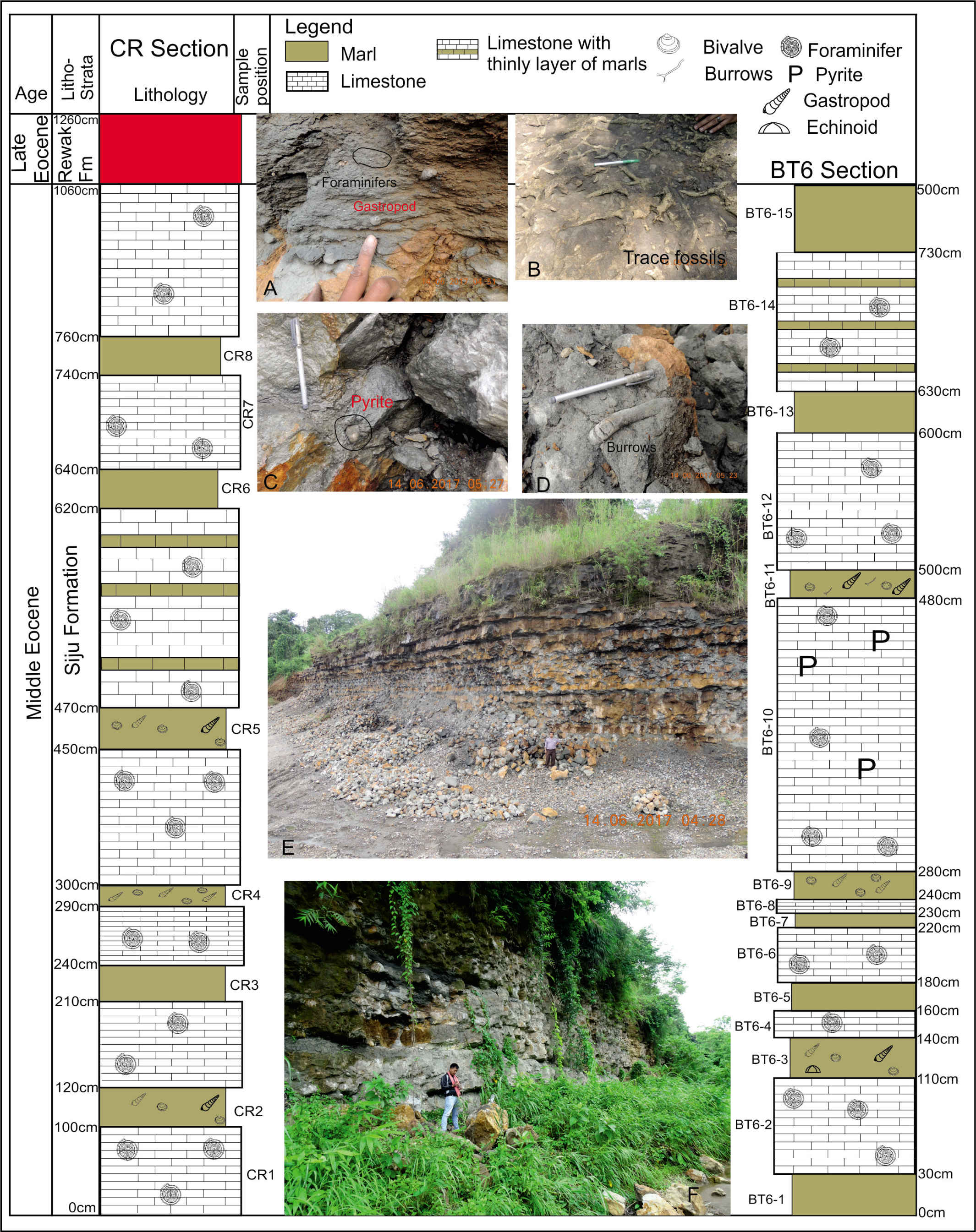
Well-preserved molluscan taxa, including bivalves, gastropods, echinoids, larger foraminifers and trace fossils, are recovered from the marls of the Siju Formation (Figure 2 c, d). These fossils are collected from two localities (namely sections 1 and 2 of Figure 2), which are closely exposed in and around Tagatchugiri area along PWD road about 20 km from Chokpot towards Dalwagre village, South Garo Hills, Meghalaya (GPS: N25˚23ʹ39.4ʺ: E90˚17ʹ31.3ʺ; N25˚23ʹ53.67ʺ: E90˚17ʹ20.52ʺ respectively). The molluscan taxa of bivalve and gastropod specimens recovered here are mainly body fossils. The present paper mainly focuses on the molluscan fossils of bivalves and gastropods.
Two lithostratigraphic sections, namely CR and BT6 in and around Tagatchugiri, Garo Hills; (A) Mollusca and foraminifers fossils; (B, D) Trace fossil; (C) Pyrite; (E) Field photo of BT6 section; (F) Field photo of CR section.
Specimens
A rich molluscan fossils of bivalves and gastropods are documented here. These fossils are well preserved in the marl litho-units of the Siju Formation. Eighteen molluscan taxa belongs to nine taxa of bivalves and nine taxa of gastropods. These are Ostrea (Ostrea) adbasaensis Devi, L. rakhiensis Eames, Lucina (Lucina) yawensis Cotter, Trachycardium minbuense (Noetling), Mactra (Mactra) protoreevesii (Noetling), Tellina (Peronaea) planta Linné, Pitar (Calpitaria) carteri (d’Archiac and Haime), Paphia (Callistotapes) pseudoliratus Vredenburg, Corbula (Bicorbula) praexarata Cox, Seila stracheyi (d’Archiac and Haime), Natica coxi Mukherjee, Euspira soriensis Eames, Semicassis mekranica Vredenbung, Oliva (Strephona) australis Duclos var. indica Vredenburg, Conus (Lithoconus) kyudawonensis Vredenburg, Dolium (Eudolium) arabicum Vredenburg, Gistortia (Vicetia) depressa Sowerby and Planorbis sp. Batra. The identification of bivalves and gastropods has been followed by Newell (in Moore et al., 1969) and Davies (1971, 1975). Fossils are mostly body fossils and identify the genera and species based on the external features.
Systematic Palaeontology
Phyllum Mollusca
Class Bivalvia Linné, 1758
Subclass Pteriomorphia Beurlen, 1944
Order Pterioida Newell, 1965
Suborder Ostreina Ferussac, 1822
Superfamily Ostreacea Rafignesque, 1815
Family Ostreidae Rafignesque, 1815
Subfamily Ostriinae Rafignesque, 1815
Genus Ostrea Linné, 1758
Type species: Ostrea edulis Linne’; SD Gray,1847; Living England
Subgenus Ostrea s.str.
Ostrea (Ostrea) adbasaensis Devi, 2010 (Pl. I, fig. 5)
2010. Ostrea (Ostrea) adbasaensis Devi, p. 274, pl. III, fig. 5.
Material: Two specimens; one is broken.
Locality: Tagatchugiri limestone quarry, Garo Hills
Dimension: (mm)
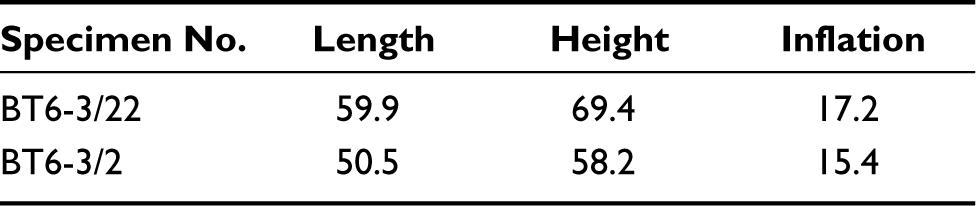
Description and Remarks: Two right valve specimens are recorded. Shells are medium-sized, obliquely ovate, thin and almost flat, with a small umbo, ventral margin small and slightly convex, visible radial component, muscle scar is shallow and semicircular in outline. The description is given in Devi et al. (2010), and the comparison is with Figure 5 in Pl. III, found very similar in all respect, except slightly different sizes. Hence, the name is Ostrea (Ostrea) adbasaensis Devi. This species is being reported for the first time from North Eastern India.
Subclass Heterodonta Neumayr, 1884
Order Veneroida Adams and Adams, 1856
Superfamily Lucinacea Fleming, 1828
Subfamily Lucinidae Fleming, 1828
Genus Lucina Bruguiere, 1797
Type species: Venus jamaicensis Spengler, 1784; SD Gray, 1847, Recent, USA.
Lucina rakhiensis Eames, 1951 (Pl. I, fig. 8)
1951 Lucina rakhiensis, Eames, p. 353, pl.14, fig. 81, a, b,
Material: Three specimens
Locality: Tagatchugiri limestone quarry, Garo Hills
Dimension: (mm)
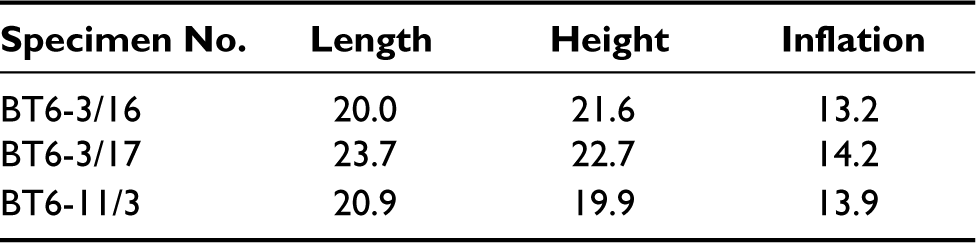
Description and Remarks: The present specimens are well preserved, moderate size, strong inflation, suborbicular in outline, umbo small, not projecting much and ventral margin strongly convex. The ornamentation consists of thin, sharp, distinct, widely spaced concentric lamellae. Overall, the characters match well when compared with the cited figures in Eames 1951. Hence, the specimen is assigned to this species, L. rakhiensis Eames.
Subgenus Lucina s.str.
Lucina (Lucina) yawensis Cotter, 1923 (Pl. I, fig. 9)
1923. Lucina yawensis Cotter, p.17. pl. iv, figs. 6, 7
2000. Lucina yawensis Cotter; Kachhara et al. p. 217, pl. I, fig. 1
2010. Lucina (Lucina) yawensis Cotter; Devi et al. p. 271, pl. I, fig. 5 a, b
Material: Three complete specimen
Locality: Tagatchugiri limestone quarry, Garo Hills
Dimension: (mm)
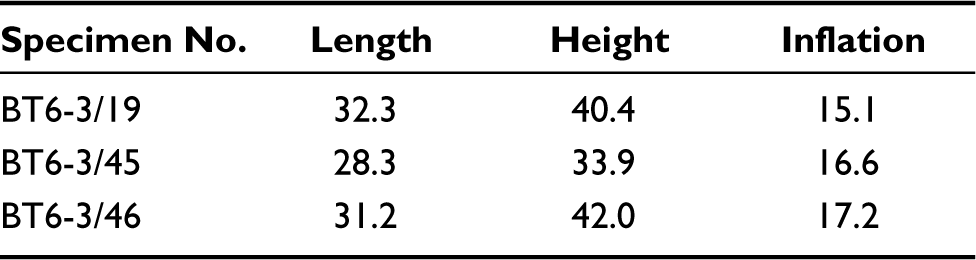
Description and Remarks: As compared with Myanmaris specimen (GSI, type No. 12374) under the nomenclature L. yawensis Cotter; and Devi et al. (2010, pl. I, fig. 5 a, b), the present specimen (BT6-3/19) resembles in most of the characters except in having more truncated posterior and slightly convex ventral margin. However, these two minor differences are insufficient for its isolation from this species. The other two species (BT6-3/45; BT6-3/46) are slightly broken here and there, but the nature of the umbo, posterior area and elongated anterior region agree with this species. Hence, the assignment.
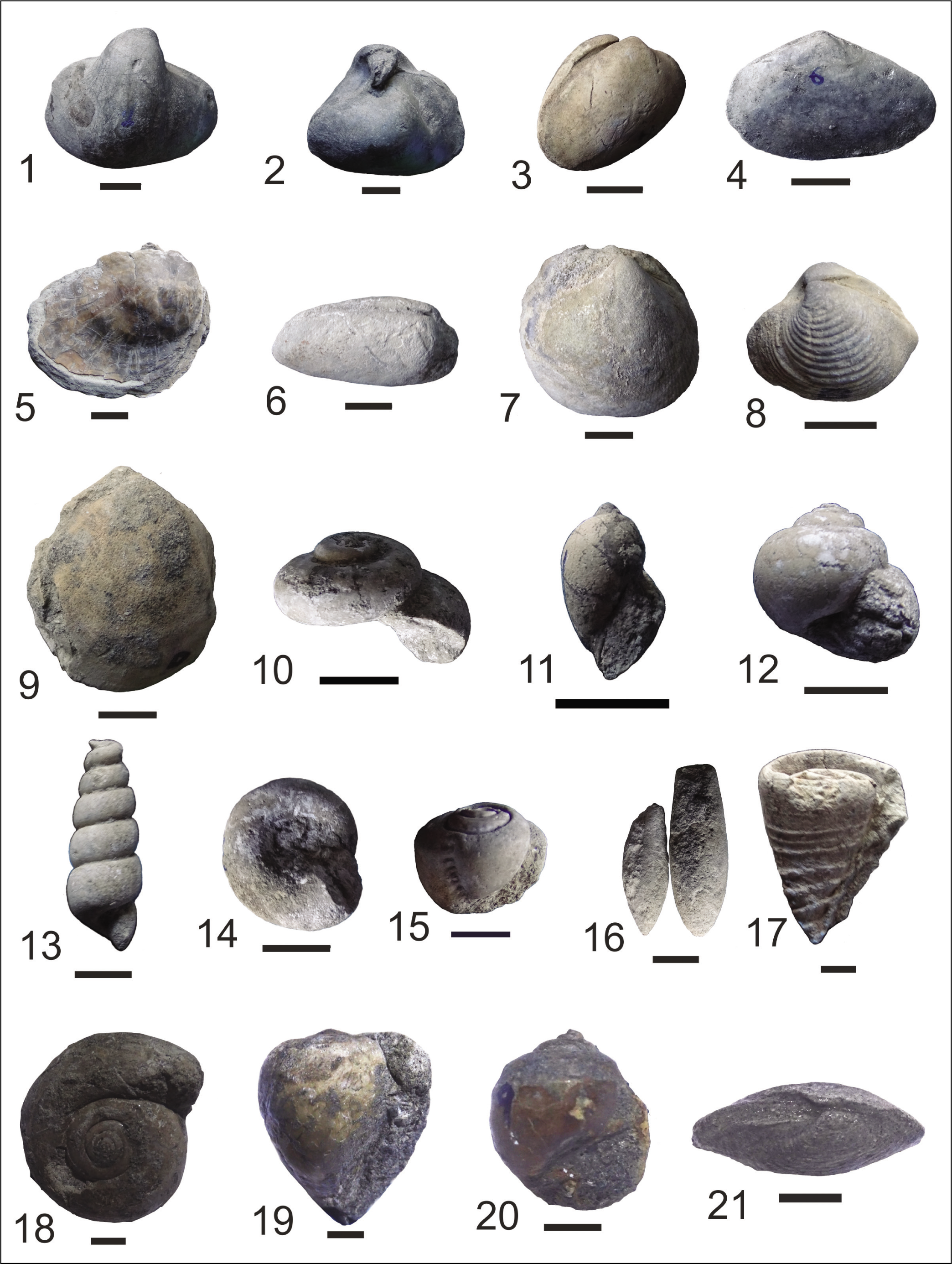
Exterior of RV; 2. Exterior of LV Corbula (Bicorbula) praexarata Cox, Specimen No. BT6-3/1; 3. Posterior view Pitar (Calpitaria) carteri BT6-3/23; 4. Exterior of RV Mactra (Mactra) protoreevesii Noetling, Specimen No. BT6-3/6; 5. Exterior of LV Ostrea (Ostrea) adbasaensis Devi, Specimen No. BT6-3/22; 6. Exterior of RV Paphia (Callistotapes) pseudoliratus Vredenburg, Specimen No. BT6-3/4; 7. Exterior of RV Trachycardium minbuense Noetling, Specimen No. BT6-3/21; 8. Exterior of LV L. rakhiensis Eames, Specimen No. BT6-3/16; 9. Exterior of LV Lucina (Lucina) yawensis Cotter, Specimen No. BT6-3/19; 10. Apertural view 14. Apical view Planorbis sp. Batra, Specimen No. BT6-3/12; 11. Apertural view N. coxi Mukerjee, Specimen No. BT6-3/15; 12. Apertural view E. soriensis Eames, Specimen No. BT6-3/11; 13. Apertural view S. stracheyi d’Archiac and Haime, Specimen No. BT6-3/13; 15. Apertural view S. mekranica Vredenbung, Specimen No. BT6-3/25; 16. Apertural view Oliva (Strephona) australis Duclos var. indica Vredenburg, Specimen No. BT6-3/29; 17. Apertural view Conus (Lithoconus) Kyudawonensis Vredenburg, Specimen No. BT6-3/27; 18. Apical view 19. Apertural view Gistortia (Vicetia) depressa Sowerby, Specimen No. BT6-11/1; 20. Apertural view Dolium (Eudolium) arabicum Vredenburg, Specimen No.BT6-3/9; 21. Dorsal view Tellina (Peronaea) planta Linné, Specimen No. BT6-3/44 (Scale bar represents 1 cm).
Superfamily Cardiacea Lamarck, 1809
Family Cardiidae Lamarck, 1809
Subfamily Trachycardiinae Stewart, 1930
Genus Trachycardium Morch, 1853
Type species: Cardium isocardia Linne’, 1758; SD von Martens, 1870, Recent, W. Indies
Trachycardium minbuense Noetling, 1901 (Pl. I, fig. 7)
1901. Cardium minbuense Noetling, p. 181, pl. x, figs. 12, 13
1939. Cardium (Trachycardium) minbuense Noetling; Mukerjee, p. 16, pl. I, fig. 9, pl. II, fig. 5.
Material: One specimen
Locality: Tagatchugiri limestone quarry, Garo Hills
Dimension: (mm)

Description and Remarks: The lone specimen shows strong inflation; height is slightly higher than the wide, smooth cardinal area, ornamented by around 55 thin radial ribs that appeared flat-topped towards the posterior, rounded close set anterior. The recorded specimen tallies well with Cardium (Trachycardium) minbuense Noetling by Mukerjee (1939), especially GSI type specimen No. K22/899, from the Garo Hills. Therefore, the present specimen also belongs to this species.
Superfamily Mactracea Lamarck, 1809
Family Mactridae Lamarck, 1809
Subfamily Mactrinae Lamarck, 1809
Genus Mactra Linné 1767
Type species: Cardium stultorum Linne’, 1758; SD Fleming, 1818. Recent; Circumtrop.
Subgenus Mactra S. str.
Mactra (Mactra) protoreevesii Noetling, 1901 (Pl. I, fig. 4)
1901. Mactra protoreevesii Noetling, p. 236, pl. XVI, figs. 1–2
1939. Mactra protoreevesii Noetling; Mukerjee, p.14, pl. II, fig. 4
2003. Mactra (Mactra) protoreevesii Noetling; Tiwari, p. 65, pl. II, fig. 16
Material: One complete specimen.
Locality: Tagatchugiri limestone quarry, Garo Hills
Dimension: (mm)

Description and Remarks: The lone specimen is medium in size, with a thin, smooth surface, the presence of posterior carina, elongated anterior and short posterior areas, and all the characteristic features of the species are well marked, and the present specimen is identical to the GSI type No 7639. Therefore, it is qualified to be identified as Mactra (Mactra) protoreevesii Noetling.
Superfamily-Tellinacea de Blainville,1814
Family-Tellinidae de Blainville,1814
Subfamily-Tellininae, de Blainville,1814
Genus-Tellina, Linné, 1758
Type species: Tellina radiata Linne’, 1758; SD Children, 1823. Recent, West Indies.
Subgenus-Peronaea, Poli 1791
Type species: Tellina planata Linnaeus, 1758, OD Linnaeus, 1758. Oligoce-Recent, Europe, Asia.
Tellina (Peronaea) planta Linné, 1971 (Pl. I, fig. 21)
1971: Tellina (Peronaea) planta Linné, Davies, Vol. I, p. 236, 237, fig. 536.
Material: Two complete specimens
Locality: Tagatchugiri limestone quarry, Garo Hills
Dimension: (mm)
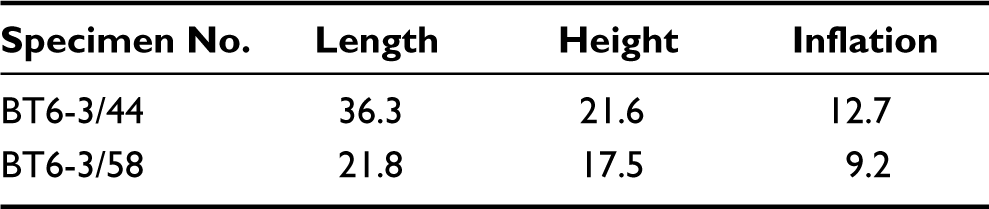
Description and Remark: Shell oval and sub-equilateral, left valve slightly flatter, smooth, ornamented with fine commarginal lines and small umbo. Compared with the figure cited in Davies, vol.1, p. 236, 237, fig. 536, under the named Tellina (Paronaea) planata Linné, matches well. Thus, the identity. This species is reported for the first time from the Garo Hills.
Superfamily Veneracea Rafimesque, 1815
Family Veneridae Rafimesque, 1815
Subfamily Pitarinae Stewart, 1930
Genus Pitar Romer, 1857
Type species: Venus tumens Gmelin, 1791; Monotype. Recent; West Africa.
Subgenus Calpitaria Jukes-Browne, 1908
Type species: Cytherea sulcataria Deshayes, 1825; OD. Eocene, Europe, N. America-SE Asia.
Pitar (Calpitaria) carteri (d’Archiac and Haime),1951 (Pl. I, fig. 3)
1854. Cypricardia carteri d’Archiac and Haime, p. 261, 367, pl. XX, fig. 14 (a)
1951, Pitar (Calpitaria) carteri (d’Archiac and Haime); Eames p. 423, pl. XVI, fig. 117 (a–c)
2014. Pitar (Calpitaria) carteri (d’Archiac and Haime); Singh et al. (2014), p. 214, pl. I, figs. 2, 3.
Material: Two complete specimens
Locality: Tagatchugiri limestone quarry, Garo Hills
Dimension: (mm)
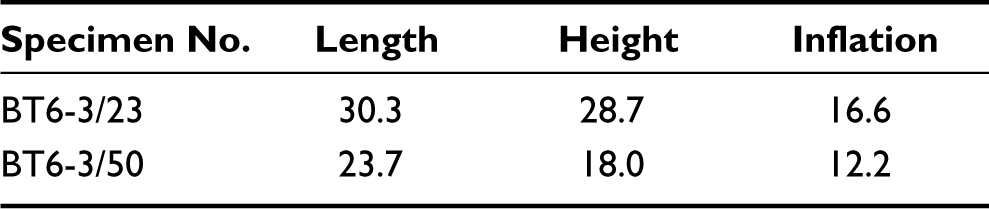
Description and Remarks: The specimens are medium, ovate, strong inflation, beak prominent, prosogyrate, lunule cordate, escutcheon long, ornamented with commarginal growth lines. Pitar (Calpitaria) carteri (ď Archiac and Haime) very well discussed by Eames 1951, p. 423, pl. XVI, fig. 117, and Singh et al. (2014), p. 214, pl. I, figs. 2, 3. The recorded specimen resembles the figure given by Eames (1951) and Singh et al. (2014) leaving no doubt about its assignment to this species.
Subfamily Tapetinae Adams and Adams, 1857
Genus Paphia Roding, 1798
Type species: Paphia alapapilionis Roding, 1798; SD Dall, 1902; Recent, West Pacific.
Subgenus Callistotapes Sacco, 1900
Type species: Venus vetula Basterot, 1825; OD. Recent; Europe, Asia, New Zealand.
Paphia (Callistotapes) pseudoliratus (Vredenburg), 1928 (Pl. I, fig. 6)
1928. Tapes (Callistotapes) pseudoliratus Vredenburg, p. 457, pl. XXXI, fig. 2, 5
1992. Paphia (Callistotapes) pseudoliratus (Vredenburg); Tiwari, p. 148, pl. XVI, figs. 2, 4
Material: Thirteen specimens
Locality: Tagatchugiri limestone quarry, Garo Hills
Dimension: (mm)
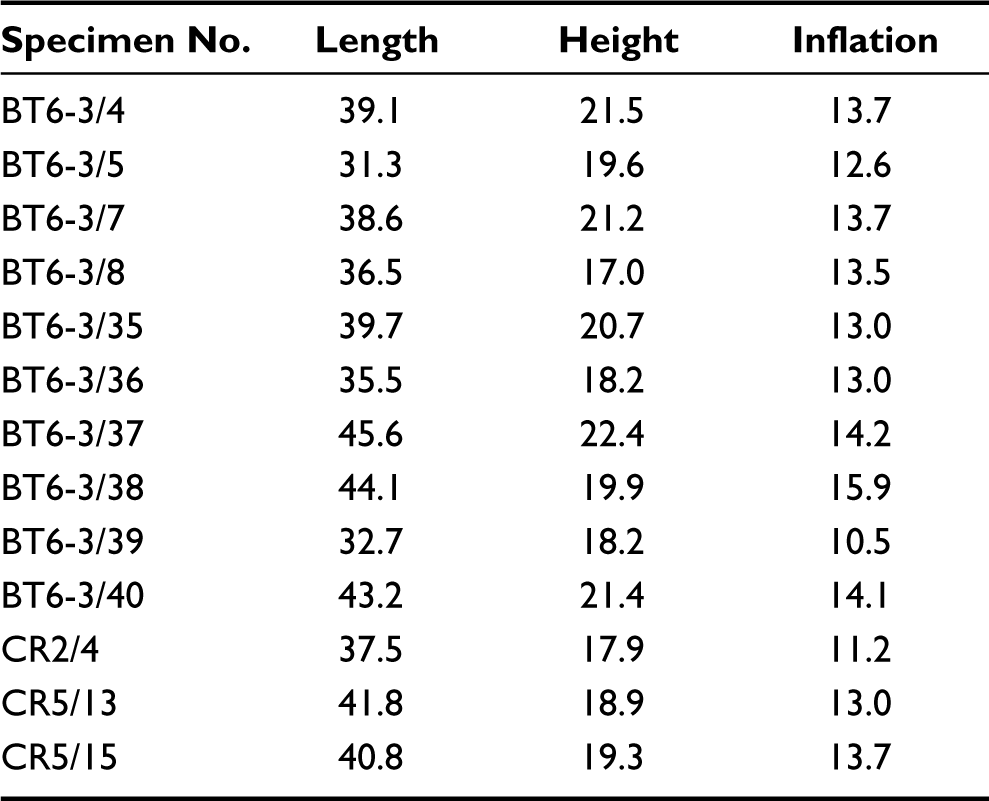
Description and Remarks: the present specimens are small to medium in size, compressed and transversely elongated—ovate. These possess a lunule, which is elongated and extends up to the anterior extremity. Though the external surface is worn-out but, it shows closet concentric ornamentation with narrow intervals. All these characters remind the species Paphia (Callistotapes) pseudoliratus (Vredenburg); moreover, these have been compared with the GSI type No. 13532 and the description given in the Vredenburg (1928), and also from the collection made by Tiwari (1992) from Mizoram to which these show close similarity. Thus, there is no doubt to assign in this species. This species is hitherto not known from the Garo Hills.
Order Myoida Stolicgka, 1870
Suborder Myina Stolicgka, 1870
Superfamily Myacea Lamarck, 1809
Family Corbulidae Lamarck, 1818
Subfamily Corbulinae Gray, 1823
Genus Corbula Bruguiere, 1797
Type species: Corbula sulcata Lamarck, 1801; SD Schmidt, 1818. Recent; West Africa.
Subgenus Bicorbula Fischer, 1887
Type species:Corbula gallica Lamarck, 1801; Monotype. Eocene. France.
Corbula (Bicorbula) praexarata Cox, 1930 (Pl. I, figs. 1, 2)
1930. Corbula (Bicorbula) praexarata Cox, p. 212, pl. XXII, figs. 10–13.
2011. Corbula (Bicorbula) praexarata Cox; Kachhara et al., p. 87. pl. I. fig. 8 (a, b, c).
Material: Three complete specimens
Locality: Tagatchugiri limestone quarry, Garo Hills
Dimension: (mm)
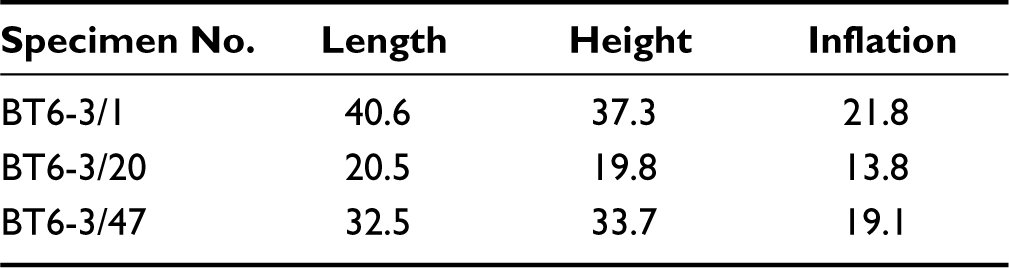
Description and Remarks: Three specimens are small to medium size, ovate-subtriangular, thick valve, inequivalve (left valves are smaller), posteriorly rostrate and commarginal concentric lines are ornamented. The specimens tally very well with the figures cited in the synonymy and their similarity with the GSI type specimen No. 14716 and Kachhara et al. (2011), Sp. No. N2/3. There is no doubt in its identity as Corbula (Bicorbula) praexarata Cox.
Phylum Mollusca Linné, 1758
Class Gastropoda Cuvier, 1797
Order Mesogastropoda Cox, 1959
Superfamily Cerithiacea Fleming, 1822
Family Cerithiopsidae
Genus Seila Adams, 1861
Type species: Triphoris dextroversus A. Adam and Reeve, SD, 1850; Recent, New Zealand
Seila stracheyi (d’Archiac and Haime), 1975 (Pl. I, fig. 13)
1854.Cerithium stracheyi d’Archiac and Haime. P. 304, pl. 29, fig. 9, 9a.
1975. Seila stracheyi (d’Archiac and Haime), Mathur, p. 31, fig. 5C
1984. Seila stracheyi (d’Archiac and Haime), Bhatia and Singh, p. 121, fig. 5C, J.
1987. Seila stracheyi (d’Archiac and Haime), Batra, p. 247, pl. III, figs. 8–9
Material: Four specimens.
Locality: Tagatchugiri limestone quarry, Garo Hills
Dimension: (mm)
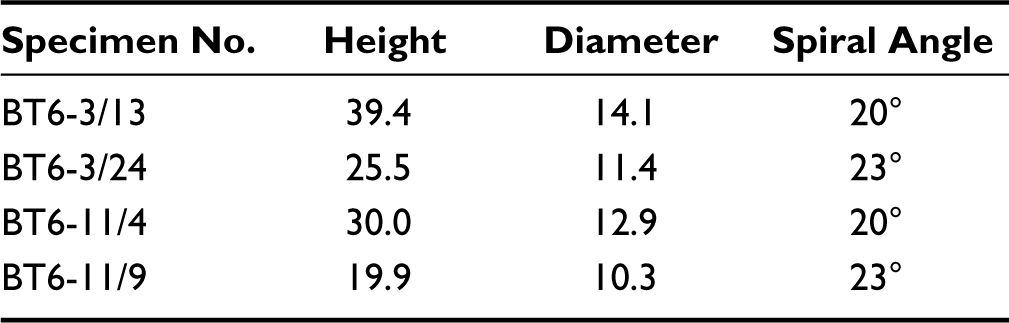
Description and Remarks: Four external moulds are recorded here, and some broken pieces are also collected but not included, matching very well with figs. 8–9 in pl. III of S. stracheyi (d’Archiac and Haime) was given by Batra (1987) in details of ornamentation, as well as the figure given by Mathur (1975). Numerous whorls characterise the species. Hence, it is identified as S. stracheyi.
Superfamily Naticacea Gray, 1817
Family Naticidae Forbes, 1838
Subfamily Naticinae Forbes, 1838
Genus Natica Scopoli, 1777
Type species: Natica vitellus Linne’; SD, Harris 1897. Recent; Western Pacific.
Natica coxi Mukerjee, 1939 (Pl. I, fig. 11)
1939. Natica coxi Mukerjee, p. 42, pl. III, figs. 11–12
1992. Natica coxi Mukerjee; Tiwari, p. 161
Material: Three specimens
Locality: Tagatchugiri limestone quarry, Garo Hills
Dimension: (mm)
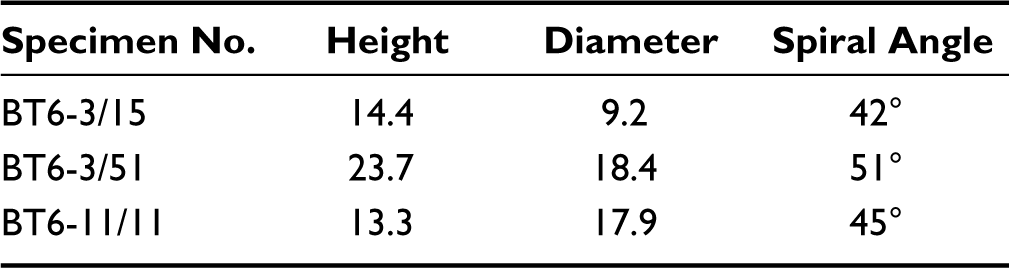
Description and Remarks: The species is being differentiated from other species of this genus by its shape, that is, sub-globose (elongate ovate), which is well marked in all the recorded examples. Additional characteristics of the taxon are also discernible, like small size, smooth and glory surface, flattening of whorls at posterior suture and sub-crescentic ovate aperture. Evan, in comparison with Holotype No. 16383, matches very well. Hence, it is referred to as the species N. coxi Mukerjee.
Subfamily Polinicinae Gray, 1847
Genus Euspira Agassiz, in Sowerby, 1838
Type species: Euspira glaucinoides J.Sowerby, 1812; SD; Cretaceous–Recent, Cosmop.
Euspira soriensis Eames, 1952 (Pl. I, fig. 12)
1952. Euspira soriensis Eames, p. 76, pl. III, figs. 78–79
1975. Euspira soriensis Eames, Mathur, p. 32, fig. 5, M
1984. Euspira soriensis Eames, Bhatia and Singh, p. 119–120, fig. 5, D
1987. Euspira soriensis Eames, Batra, p. 248, pl. IV, fig. 8
Material: Five specimens
Locality: Tagatchugiri limestone quarry, Garo Hills
Dimension: (mm)
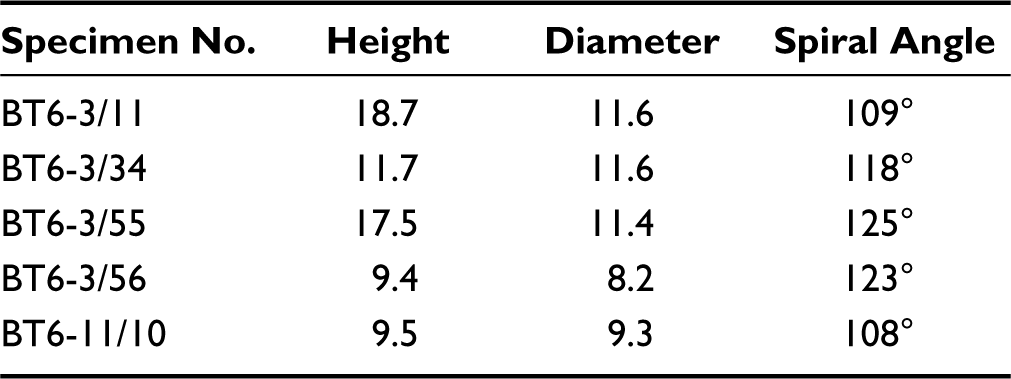
Description and Remarks: Specimens are well preserved and much similar to the Holotype (G-682460) of E. soriensis Eames (1952, p. 76, pl. III, figs. 78–79). It exhibits perfect similarity in globose, obliquely coiled with a very short spire, grooved suture and semicircular aperture thus it is named E. soriensis.
Family Cassidea Mörch, 1852
Genus Semicassis Reeve, 1852
Type species: Cassis japonica Reeve; SD, Harris, 1807. Recent; Japan
Semicassis mekranica Vredenburg, 1925 (Pl. I, fig. 15)
1925. Cassidea (Semicassis) mekranica Vredenburg, p. 267, Pl. III, figs. 7–9
Material: Eight specimens
Locality: Tagatchugiri limestone quarry, Garo Hills
Dimension: (mm)
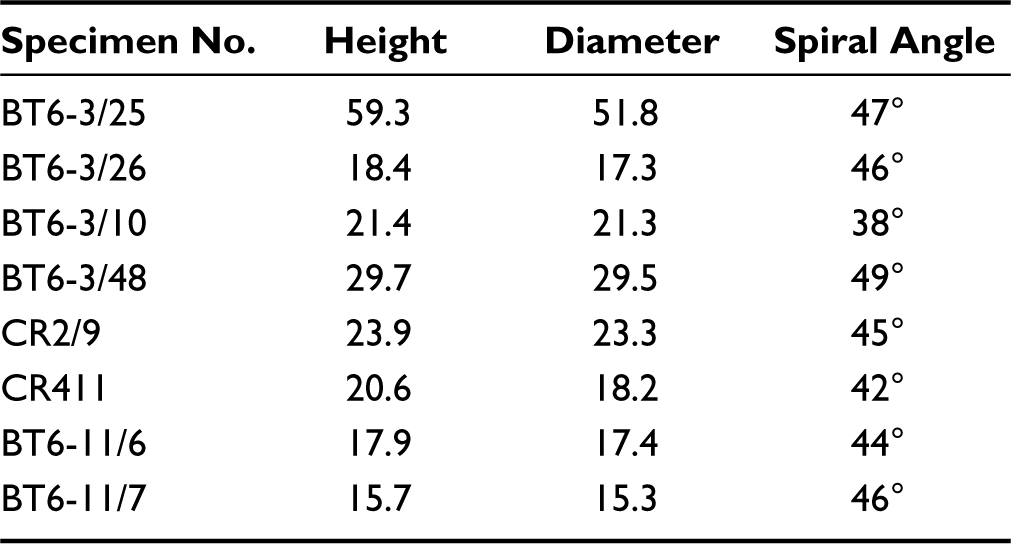
Description and Remarks: Specimens are approaching S. mekranica Vredenburg in respect of small to medium size, almost flat spire, that is, very short and much-expanded body whorl. Identity is further established by directly comparing with GSI-type material to which Garo Hills examples. (BT6-3/25, BT6-3/10) tally well with No. 12590 and No. 12589 in all details. Hence, these are especially inseparable from S. mekranica Vredenburg.
Family Olividae Latreille, 1825
Sub Famly Olivinae Latreille, 1825
Genus Oliva Martyn, 1786
Type species: Oliva corticata Martyn; SD, Dall, 1905. Recent; Coast of Guinea.
Subgenus Strephona Morch,1852
Type species: Oliva (Strephona) flammulata Lamarck, SD 1822; Recent, West Indies, west Africa.
Oliva (Strephona) australis Duclos var. indica Vredenburg, 1925 (Pl. I, fig. 16)
1815. Oliva australis Duclos, Reave, pl. XIX, sp. 42
1853. Oliva australis Duclos, Chenu, pl. VIII, figs. 3–4
1888. Oliva australis Duclos, Tryon, p. 85, pl. XXXII, figs. 19, 20
1899. Oliva (Strephona) australis Duclos, Cossmann, p. 49
1901. Oliva (Strephona) rufula Duclos, Noetling, p. 326, pl. XII, figs 4–5
1925. Oliva (Strephona) australis Duclos var. indica Vredenburg. P. 105, pl. VI, figs. 3–5
1939. Oliva (Strephona) australis Duclos var. indica Vredenburg: Mukerjee p. 68, pl. III, figs. 19–20
1961. Oliva (Strephona) australis Duclos var. indica Vredenburg, Dey p. 89
1997.Oliva (Strephona) australis Duclos var. indica Vredenburg, Jain, p. 251, pl. XXVI, figs. 8–11
Material: Six specimens
Locality: Tagatchugiri limestone quarry, Garo Hills
Dimension: (mm)
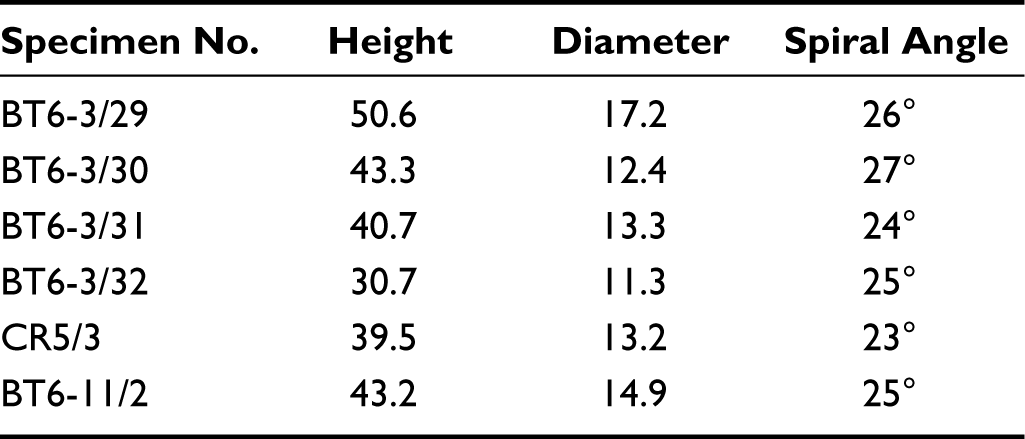
Description and Remarks: The variety indica differs from the typical species Oliva australis Duclos with respect to the maximum diameter, a slightly posterior extremity of the body whorl. According to Vredenburg, it is closer to the living Indian species rather than the living Australian species. In fully preserved specimens, enamel even covered the sutures, and the specimens appear entirely smooth, and only in eroded specimens are the sutures clear. On direct comparison, these specimens are found to tally well with the representatives reported by Mukerjee (1939) from Garo Hills and Kathiawar examples (Jain, 1997) in every respect. Hence, it is assigned to this species.
Superfamily Conacea, Refinesque, 1815
Family Conidae, Rafimesque, 1815
Genus Conus Linné, 1758
Type species: Conus marmoreus Linne’,1758; SD Children 1823. Recent, Indo Pacific.
Subgenus Lithoconus Morch, 1852
Type species: Conus (Lithoconus) millepunctatus Lamarck, 1822, SD; Cossman, 1896. Recent, Indo-Pacific.
Conus (Lithoconus) Kyudawonensis Vredenburg, 1921 (Pl. I, fig. 17)
1921, Conus (Litho conus) Kyudawonensis Vredenburg, p. 187, pl. XV, fig. 6.
1939, Conus (Litho conus) Kyudawonensis Vredenburg Mukerjee, p. 83
Material: Five specimens
Locality: Tagatchugiri limestone quarry, Garo Hills
Dimension: (mm)
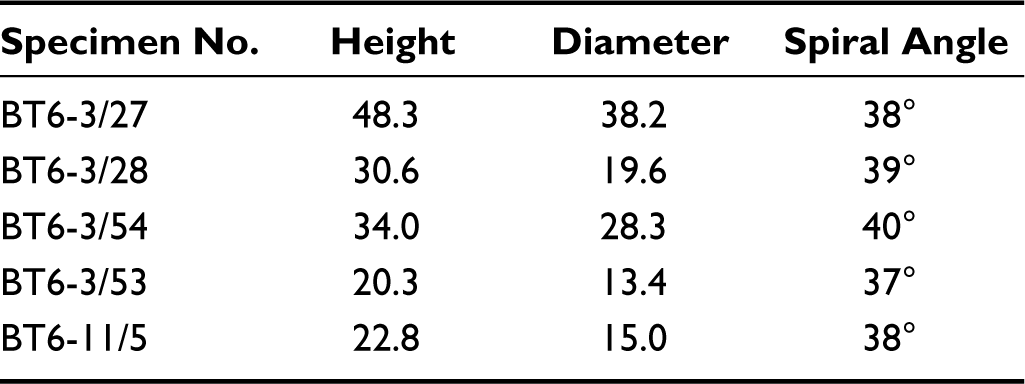
Remarks: This specimen is slightly different from Conus (Lithoconus) ineditus Michalotti with respect to the absence of stepped spiral whorls, and instead of a groove, a rim is present out of the sutures. On direct comparison, the specimens were similar to the GSI type No. 12336, establishing their identity as Conus (Lithoconus) Kyudawonensis Vredenburg.
Family Doliidae Latreille, 1825
Genus Dolium Lamarck, 1801
Type species: Buccinum galea Linnaeus, 1758, OD, Recent, West Africa, Western Pakistan, Japan.
Subgenus Eudolium Dall, 1889
Type species: Dolium crosseanum Monterosato, 1869. Monotype, Recent, Indo- Pacific
Dolium (Eudolium) arabicum Vredenburg, 1925 (Pl. I, fig. 20)
? 1905 Dolium lowisendi Newton Geol. Mag. Doc. 5, vol. II, p. 301, pl. XVII, fig.1
? 1905. Dolium cf. hochstetteri Martin, sec. Newton Soc. Cil., p. 302, pl. XVII, fig. 2 (? Fig. 3)
1925. Dolium (Eudolium) arabicum Vredenburg, p. 287, pl. X, figs. 5, 6.
Material: One specimen
Locality: Tagatchugiri limestone quarry, Garo Hills
Dimension: (mm)

Description and Remarks: The lone specimen is medium-sized and globose, with a low spire, ornaments of broad spiral ribbons, and a body whorl large with a wide aperture. The overall character is approaching Dolium (Eudolium) arabicum Vredenburg. Identity is further established by directly comparing it with the GSI type specimens No. 12595 and 12596. Hence, the specimen is assigned as Dolium (Eudolium) arabicum Vredenburg.
Earlier workers have also not reported this species from any area of North Eastern India.
Family Cypraeidae Rafinesque, 1815
Genus Gisortia Jousseaume, 1884
Type species: Ovula gisortiana Passy,1859, OD; Eocene; India, Pakistan.
Subgenus: Vicetia Fabiani, 1905
Type species: Ovula hantkeni Lefevre, 1878. OD, Eocene; Europe, Pakistan.
Gistortia (Vicetia) depressa Sowerby, 1927 (Pl. I, figs. 18, 19)
1840. Cypraea depressa Sowerby, Trans. Geol. Soc. Lond., Sen.2, V-V, p. 329, pl. XXIV, fig. 12.
1927. Gisortia (Vicetia) depressa (Sowerby), Vredenburg, p. 72, Pl.XXIX, figs. 1, 2
Material: One specimen
Locality: Tagatchugiri limestone quarry, Garo Hills
Dimension: (mm)

Description and Remarks: Specimen large, conical shape, five spiral whorls preserved, spire almost flat and carinate. The body whorl has a very large, elongated aperture and the dorsal surface is very convex and carries two transverse ridges across its dorsal surface. The specimen matches very well with the GSI type specimen No. K8/382 recorded by Vredenburg as Gisortia (Vicetia) depressa (J.de C. Sowerby) (p. 72, Pl. XXIX, Figure 1). Therefore, the recorded specimen is assigned to Gisortia (Vicetia) depressa (J. de C. Sowerby). This is the first record of the species from North East India.
Order Basommatophora Keferstein, 1865
Superfamily Lymnaeoidea Rafinesque, 1815
Family Planorbidae Rafinesque, 1815
Subfamily Planorboidea Rafinesque, 1815
Genus Planorbis Müller, 1774
Type species:Helix planorbis Linnaeus, 1758, SD, Recent, Madagascar, Europe, Asia.
Planorbis sp. (Pl. I, figs. 10, 14)
1987. Planorbis sp. Batra, p. 25, pl. 4, fig. 5
2000. Planorbis sp. Batra; Mathur and Juyal, p. 94, pl. 16, fig. 3
Material: One broken specimen
Locality: Tagatchugiri limestone quarry, Garo Hills
Dimension: (mm)

Description and Remarks: Specimen small, globose, three spire whorls, spire gently convex, separated by deep sutures; body whorl large, aperture semicircular and is also similar to the example given by Mathur and Juyal (2000) (Figure 3). Due to its poor preservation as well as worn out surface, it is difficult to further identification up to its specific level. Hence, it is assigned to Planorbis sp.
Biostratigraphy
The sedimentary sequence exposed around the Thagutchuri limestone quarry area of the Siju Formation (Garo Hills) is very thick but all the lithic units are not fossiliferous. As mentioned earlier only six horizons are fossiliferous, that is, three each marls horizons of CR 2,4,5 and BT6-3,9,11.
The molluscan fossils from the Siju formation of the study area consist of 17 genera and 17 species of molluscs; one form is left in open nomenclature. Although the majority of these taxa have long range, some species have restricted ranges suitable for biozonation. One biostratigraphic zone, that is, L. yawensis–E. soriensis zone has been established in the study area. This zone is based on the total ranges of the molluscan species; hence, the ranges zone and named after the molluscan species, which is more or less restricted in the range of the zone. Age of the species are correlated with the Pakistan (Eames, 1951, 1952); Kachchh (Devi et al., 2010); Nagaland (Singh et al., 2014). A checklist of the taxa is recorded here as follows:
Restricted to L. yawensis–E. soriensis zone:
Ostrea (Ostrea) adbasaensis Devi (Middle Eocene), L. rakhiensis Eames (Middle Eocene), Lucina (Lucina) yawensis Cotter (Middle–Late Eocene), Pitar (Calpitaria) carteri d’Archiac and Haime (Early to Middle Eocene), Corbula (Bicorbula) praexarata Cox (Late Palaeocene to Eocene), S. stracheyi d’Archiac and Haime (Early–Middle Eocene), E. soriensis Eames (Early–Middle Eocene).
Associated long ranging taxa:
T. minbuense Noetling (Eocene–Miocene), Mactra (Mactra) protoreevesii
Noetling (Eocene–Miocene), Tellina (Peronaea) planta Linné (Eocene-Miocene), Paphia (Callistotapes) pseudoliratus Vredenburg (Eocene-Miocene), N. coxi Mukherjee (Eocene–Early Miocene), Semicassis mekranica Vredenbung (Eocene–Miocene), Oliva (Strephona) australis Duclos var. indica Vredenburg (Eocene-Middle Miocene), Conus (Lithoconus) kyudawonensis Vredenburg (Eocene–Early Miocene), Dolium (Eudolium) arabicum Vredenburg (Eocene–Early Miocene), Gistortia (Vicetia) depressa Sowerby (Eocene-Miocene) and Planorbis sp. Batra (Eocene).
For the purpose of biostratigragraphic set up, the restricted taxa in the present molluscan fauna has be considered with their FAD and LAD limits. In this zone, if we consider the LAD and FAD of different taxa are represented by Ostrea (Ostrea) adbasaensis (Middle Eocene), L. rakhiensis (Middle Eocene), Lucina (Lucina) yawensis (Middle–Late Eocene), Pitar (Calpitaria) carteri (Early to Middle Eocene), Corbula (Bicorbula) praexarata (Late Palaeocene to Eocene), S. stracheyi (Early–Middle Eocene), E. soriensis (Early–Middle Eocene). The youngest FAD limit is represented by the taxa viz. Ostrea (Ostrea) adbasaensis, L. rakhiensis and Lucina (Lucina) yawensis, which is Middle Eocene. The oldest limit of LAD is shown by the taxa Ostrea (Ostrea) adbasaensis, L. rakhiensis, S. stracheyi, E. soriensis, which is Middle Eocene. The taxa Corbula (Bicorbula) praexarata is not considered in this FAD and LAD analysis due to the long range from Late Palaeocene to Eocene in the restricted Eocene taxa. The Siju Formation has been supported the above age based on Echioidea (Srivastava & Garg, 2014), foraminiferal assemblage (Sarkar et al., 2014) and dinoflagellate cysts (Sarkar et al., 2014; Saxena & Sarkar, 2000; Singh et al., 2022). This zone has been assigned to the Middle Eocene.
Repository
All the illustrated specimens are housed in the Department of Earth Sciences, Manipur University, Canchipur, Imphal (India).
Conclusion
All horizons of limestones and marl are highly fossiliferous except a few marl horizons. These mollusca fossils are abundant in the different horizons of CR2, CR4 and CR5 of the CR section and BT6-3, BT6-9 and BT6-11 of the BT-6 sections, respectively. From these horizons, the molluscan fauna are described here as Ostrea (Ostrea) adbasaensis Devi, L. rakhiensis Eames, Lucina (Lucina) yawensis Cotter, T. minbuense (Noetling), Mactra (Mactra) protoreevesii (Noetling), Tellina (Peronaea) planta Linné, Pitar (Calpitaria) carteri (d’Archiac and Haime), Paphia (Callistotapes) pseudoliratus Vredenburg, Corbula (Bicorbula) praexarata Cox, S. stracheyi (d’Archiac and Haime), N. coxi Mukherjee, E. soriensis Eames, S. mekranica Vredenbung, Oliva (Strephona) australis Duclos var. indica Vredenburg, Conus (Lithoconus) kyudawonensis Vredenburg, Dolium (Eudolium) arabicum Vredenburg, Gistortia (Vicetia) depressa Sowerley and Planorbis sp. Batra. One biostratigraphic zone, that is, L. yawensis–E. soriensis Zone has been established in the study area and assigned to Middle Eocene in age.
Footnotes
Acknowledgements
The authors acknowledge the valuable comments of reviewers. Mr N. Sanjit Singh is also gratefully acknowledged for his help during the field work.
Declaration of Conflicting Interests
The authors declared no potential conflicts of interest with respect to the research, authorship and/or publication of this article.
Funding
The authors disclosed receipt of the following financial support for the research, authorship, and/or publication of this article: Financial support from SERB, New Delhi (Grant No. EEQ/2016/000062; EEQ/2022/000263; CRG/2023/004591) is gratefully acknowledged.