




Abstract
The Kachchh basin is located on the northwestern margin of India. The basin consists of a relatively continuous sequence of sediments from the Mesozoic, followed by the Deccan Traps and finally a complete sequence of the Cenozoic sediments. The Cenozoic sediments of Kachchh basin are mainly shallow marine deposits characterised by five formations viz. Matanomadh, Naredi, Harudi, Fulra Limestone and Maniyara Fort Formation. The Maniyara Fort Formation belongs to the Oligocene age. The field and petrographic characteristics of the Oligocene limestones from the Golay river section were studied in order to understand the depositional environment. The petrographic investigation of the carbonate rocks of three members of the Maniyara Fort Formation, namely Lumpy Clay Member, Coral Limestone Member and Bermoti Member provides important information for understanding the depositional facies and diagenetic signatures. The Lumpy Clay Member has shale-siltstones with interbedded limestones, characteristically composed of a significant proportion of detrital grains of quartz and some lithic fragments. The lithic fragments are sub-angular to rounded, which indicates substantial transport. They are also worn down and broken, bear small cracks which are filled by micritic matrix or mud. The presence of stylolitic seams within the limestone (though not significant) along with mud filling is also noticed. The dissolution is not prominent, pointing towards shallow burial of the sediments. Paucity of marine fossils as well as the rarity of foraminifera in the Lumpy Clay Member indicate a restricted to semi-restricted shallow marine environment. The limestones of the Coral Limestone Member are petrographically classified as packstone, wackestone and mudstone. Thus, the environment of deposition seems to have varied from restricted lagoonal to shallow marine environment. The Bermoti Member is characterised by a lens of claystone, which consists of both greyish to yellow coloured claystones interbedded with limestones. The Bermoti limestones are petrographically classified as packstone, wackestone and mudstone assemblage. The limestones were observed to be highly micritised, which indicates open, shallow marine settings. The Maniyara Fort Formation, thus characterised by wackestone-packstone-mudstone facies of carbonates, is interpreted to be part of a carbonate ramp system. The limestones from Maniyara Fort Formation exhibit signatures of marine as well as meteoric diagenesis.
Keywords
Introduction
The Kachchh basin is a peri-cratonic basin along the western margin of India (Figure 1A), bound by the Nagar Parkar Uplift in the north and Kathiawar Uplift in the south (Biswas, 1992, 2005). The basin exhibits a relatively complete stratigraphic sequence, which consists of syn-rift Middle Jurassic to Upper Cretaceous sediments and Post-rift Upper Palaeocene to Pliocene, as well as Quaternary sediments (Biswas, 2016). The Cenozoic sediments are developed mainly in the western part of the basin (Figure 1B) with most of it occurring offshore up to the present continental shelf (Catuneanu & Dave, 2017). These Cenozoic sedimentary rocks mainly occur in the coastal plains of Kachchh mainland and in the plains bordering the highlands (Figure 1B). The Cenozoic deposits consist of sandstone, shales and limestones which can be distinguished into various units separated by stratigraphic breaks (Biswas, 1992). Such disconformities are defined by lateritised surfaces, biogenic cut and fill structures and regional overlaps (Catuneanu & Dave, 2017). The Cenozoic sedimentation is mainly controlled by eustatic sea level changes and the sediments have been deposited in a stable shelf environment as evidenced by their lateral continuity (Catuneanu & Dave, 2017). These Cenozoic successions rest unconformably on Deccan Trap Basalts (Banerjee et al., 2012b) and they start with terrestrial ‘trap-wash type’ deposits (Roy et al., 2017; Saraswati et al., 2014; Valdiya, 2015) followed by Eocene to Miocene marine sedimentation ending with Late Miocene-Pliocene regressive setting (Biswas, 2000). The presence of laterally continuous bands of important biostratigraphic horizons have helped in building up a precise lithostratigraphic succession of these rocks (Biswas, 1992).
(A) Map showing location of study area in Kachchh basin; (B) Geological map of Kachchh basin. Source: Biswas (1992) and Banerjee et al. (2018).
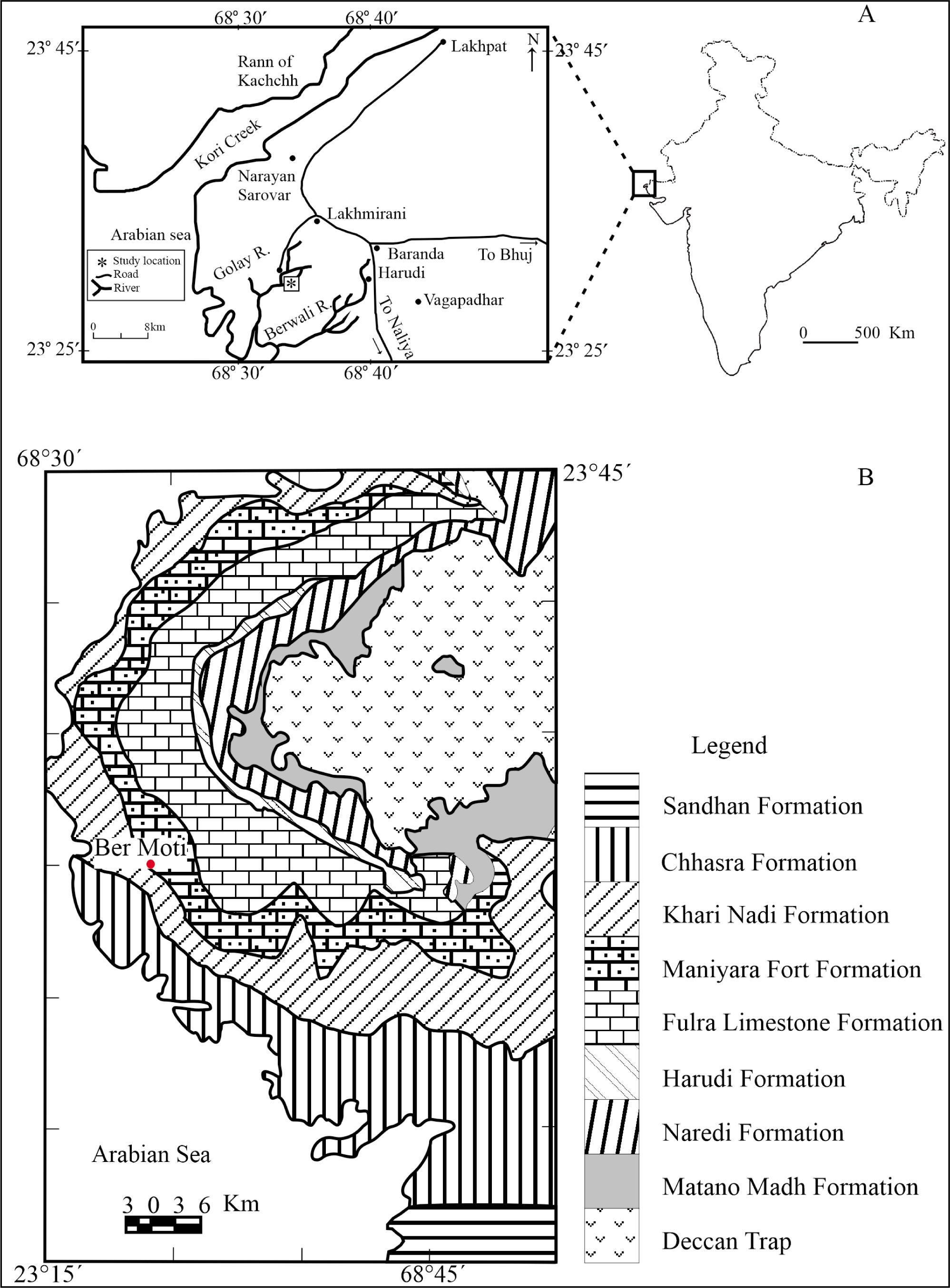
The Palaeogene-Neogene sedimentation occurs in a post-rift marginal sag basin (Biswas, 1992). Marine transgression commenced in the Late Palaeocene and continued cyclically till the Mid Eocene, after a hiatus in Late Eocene, sea transgressed up in Oligocene and continued till the Mid Miocene, with final regression in the Pliocene (Valdiya, 2015). Eocene to Miocene sediments are mainly claystones, siltstones and limestones (Biswas, 2016). Amongst these Cenozoic formations is the Oligocene Maniyara Fort Formation which is underlain by Late Eocene Fulra Limestone Formation and overlain by Khari Nadi Formation of Miocene age (Biswas, 1992). These sediments have progressively thickened from onshore to offshore owing to the reactivation of step-faults which subdivide the basement into blocks (Valdiya, 2015).
Maniyara Fort Formation has been extensively studied for its palaeontological aspects. Kar (1977, 1985) proposed the palynostratigraphy of Maniyara Fort Formation. Humane and Kundal (2005) reported the presence of calcareous green algae Halimeda and Ovulites from Maniyara Fort Formation and assigned a lagoonal or back reef environment for this formation. Kumar et al. (2009) identified ten species of coralline algae from various sections of Maniyara Fort Formation and opined that these carbonates were deposited in warm, shallow, subtidal environments. Saraswati et al. (2018) reviewed the foraminiferal biostratigraphy and discussed the updated Palaeogene stratigraphy. Reuter et al. (2013) reported the presence of large benthic foraminifera and tempestite at the base of Maniyara Formation. According to them, the isolated inner ramp sedimentation of Maniyara Fort Formation took place during third-order sea level highstands separated by erosional gaps. Based on the major biotic assemblages in Maniyara Fort Formation, Reuter et al. (2013) deduced the activity of cyclones of varying intensity during the deposition of Maniyara Fort Formation. Solomon and Nagendra (1998) carried out sedimentological studies of Oligocene limestones from Babia hills and stated that these sediments were deposited in shallow marine environments with low to moderate energy conditions. As far as the petrographic analysis of Palaeogene rocks is concerned, there are very few reports available for Maniyara Fort Formation. Banerjee et al. (2012b) studied the glauconites from Maniyara Fort Formation. Based on the occurrence of pyrite and low cerium anomaly, they attributed the formation of the glauconite to sub-oxic micro-environment, formed due to decomposition of organic matter. Four distinct carbonate facies have been recognised by Banerjee et al. (2018) as mudstone, Nummulite grainstone, Lepidocyclina packstone and Spiroclypeus packstone. Based on the sedimentary structures and petrographic characteristics of these four rock facies, Banerjee et al. (2018) have assigned the environment of depositions for these four facies as restricted lagoonal for mudstone, shallow marine for the Nummulite grainstone facies, warm shallow reefal setting for Lepidocyclina Packstone and lagoonal for Spiroclypeus packstone. Similar conclusions were drawn by Srivastava and Singh (2018) for Eocene Fulra Limestone Formation, where seven facies have been described, namely Discocyclina wackestone, Foraminiferal packstone-wackestone assemblage, Nummulitic grainstone, ripple-bedded bioclastic packstone, hummocky cross-bedded packstone, bioclastic packstone-grainstone assemblage and Nummulitic packstone. Though the Palaeogene of Kachchh is a good example of carbonates deposited in circum-Tethys belt, there are no dedicated attempts to infer the variation in the deposition through petrographic studies. Hence, in this paper, we attempt petrographic studies to explain the microfacies association as well as observed signatures of diagenesis in the carbonates of the Maniyara Fort Formation.
Geological Framework
The Maniyara Fort Formation is named after the Maniyara Fort near the village Ber Moti. It unconformably overlies Fulra Limestone Formation, and it is unconformably overlain by Miocene Khari Nadi Formation (Banerjee et al., 2012b; Biswas, 1992; Kumar et al., 2009). Biswas (1992) has divided this formation lithostratigraphically into four members namely Basal Member, Lumpy Clay Member, Coral Limestone Member and Ber Moti Member.
Basal Member consists of alternating foraminiferal, glauconitic, brownish to yellowish coloured siltstones and calcareous gypseous claystones (Biswas, 1992). Along with the foraminiferal assemblages, the presence of Pecten, Ostrea and other fossils can also be noticed in Basal Member (Biswas & Raju, 1971).
The Lumpy Clay Member consists of grey to brown coloured calcareous claystones with limestone bands and marl beds with rare occurrences of foraminifera (Biswas, 1971, 1992). Coral Limestone Member mainly contains dirty white coloured nodular limestone which weathers in bouldery pattern. The lower part consists of dirty white massive limestone with alternating calcareous claystones. The upper part of the Member consists of grey to dirty white coloured massive limestones with some corals forming bioherms occasionally (Biswas, 1992). This member is richly fossiliferous and is characterised by larger benthic fora-miniferal assemblage of Nummulite ftcheli-intermedius and Lepidocyclina (Eulepidina) with commonly occurring heart shaped echinoids Schizaster granti (Biswas & Raju, 1971). The uppermost Bermoti Member is characterised by friable glauconitic argillaceous sandstone in the lower part and bedded, grey to yellow foraminiferal limestones with some silty marlite beds containing Spiroclypeus (Biswas, 1992).
Samanta (1989) identified foraminiferal zones defined by Miogypsinoides complanta, Miogypsinoides bermudenzi and Planoliderina fruedenthali representing Chattian Stage of Maniyara Fort Formation (Biswas, 1992; Humane & Kundal, 2005; Samanta, 1989). According to Banerjee et al. (2012a), the bottom part of the Maniyara Fort Formation represents a transgressive succession with glauconitic shale and nummulitic grainstone, while the unconformity on the top of the Maniyara Fort Formation represents a eustatic sea level fall at the end of Chattian Stage (Banerjee et al., 2012a; Haq et al., 1987).
Methodology
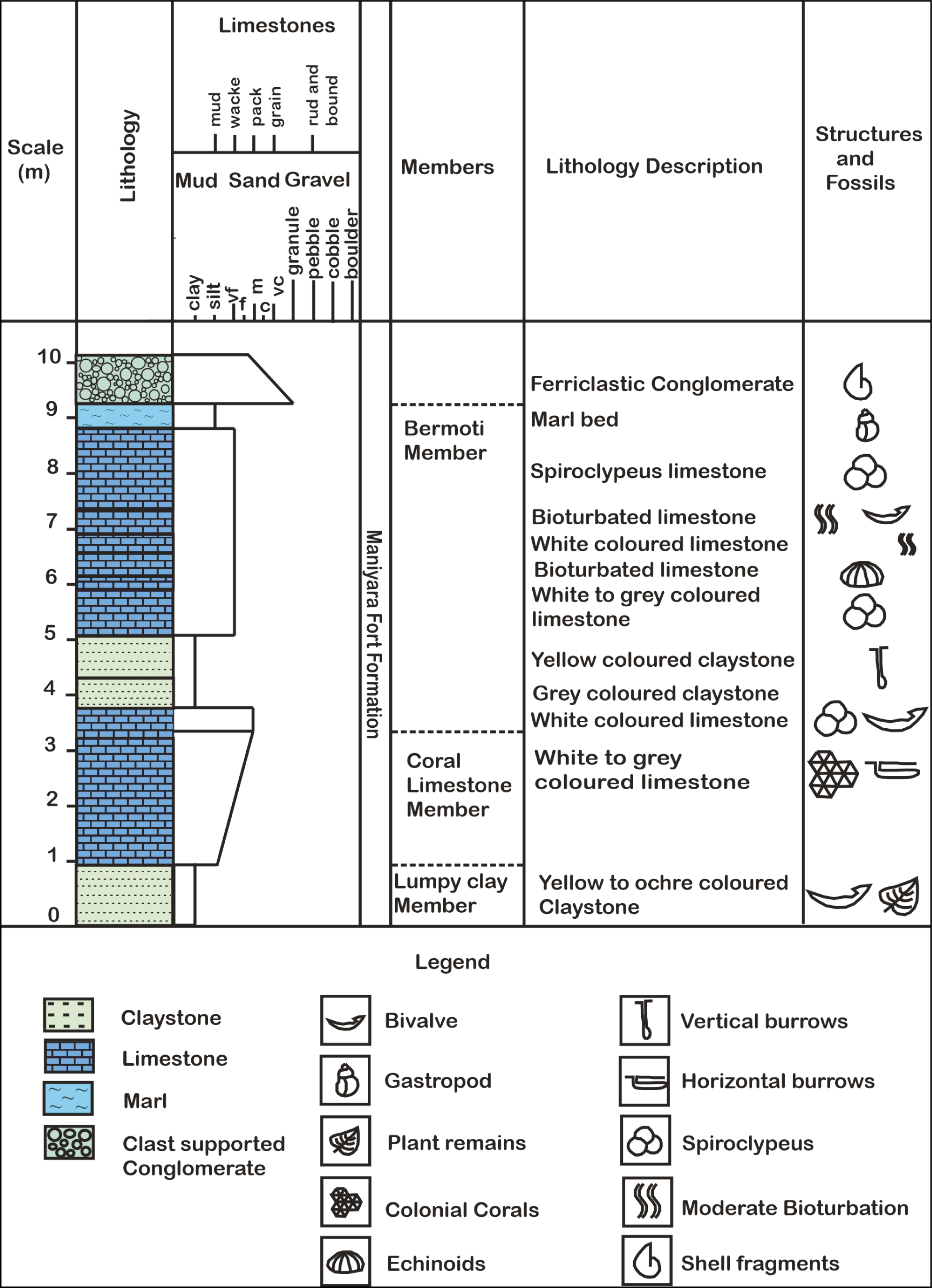
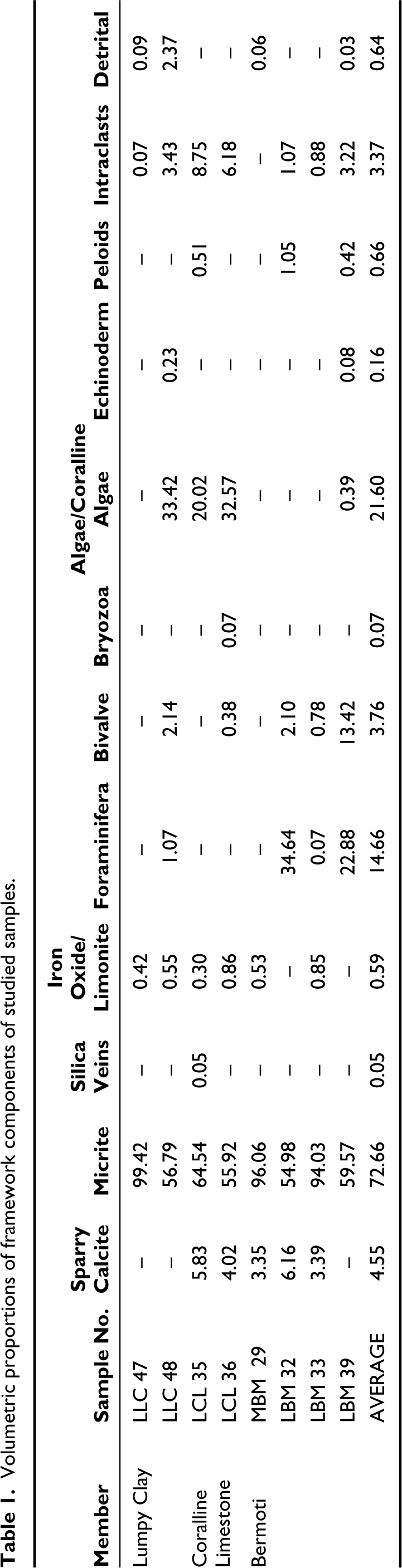
A detailed field investigation was carried out in type localities, in the area between village Bermoti (23º27’46.5’’N, 68º36’08.9’’E) and Maniyara Fort (23º28’16.6’’N, 68º37’03.9’’E). The exposures were studied in the Golay River section. The field studies involved identification of lithologies, contacts between the beds, faunal assemblages and their association with the lithologies. During the fieldwork, 53 representative samples of the studied sections were collected systematically by stratigraphic method of sampling. A log representing the lithologies, structures and fossils was recorded (Figure 2). Four representative samples were subjected to digestion by HCl and the proportion of insoluble residue was calculated. Eight representative samples of carbonates and siliciclastic sediments were selected for thin section analysis. These thin sections were studied under an optical microscope and the volumetric proportion of various samples was calculated using ISH500 Tucsen© Professional CMOS camera and ISCapture 4.1.3 (Tucsen© Photonics) microscope image analysis software. This volumetric analysis was confirmed and cross-checked by the point counting method. The obtained volumetric proportions of framework components are given in Table 1. The samples under study were classified using Folk (1959) as well as Dunham (1962) classification.
Composite litholog of Maniyara Fort Formation.
Volumetric proportions of framework components of studied samples.
Field Characteristics
Lumpy Clay Member
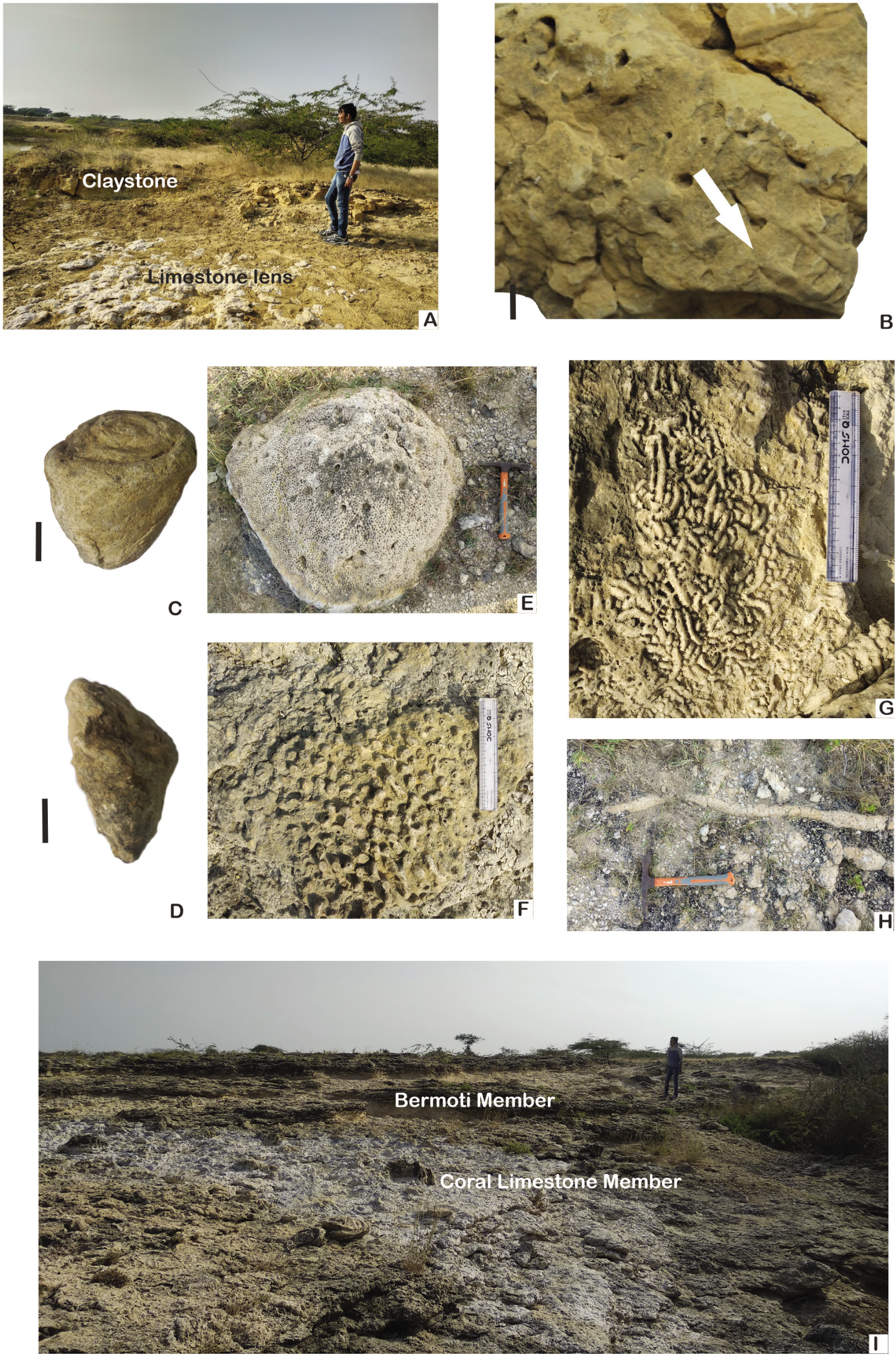
The Lumpy Clay Member is characterised by yellow to ochre coloured calcareous claystone beds. It consists of lenses of limestones within calcareous claystone (Plate 1A). These beds of claystone contain a few leaf impressions and some bivalve shells. At some localities, these limestones are characterised by U-shaped burrows (Plate 1B). The limestones are white to turbid in colour with rare occurrences foraminifera. There is the presence of giant gastropod fossils within the lensoidal limestone, which are deformed, probably due to the local faulting activity (Plate 1C and 1D).
(A) Upper contact of Limestone lens with the claystone of Lumpy Clay Member. Person’s height: 180 cm; (B) Claystone showing ‘U’ shaped burrows. Bar scale = 1 cm; (C) Large shell of gastropod observed within the limestone lens of Lumpy Clay Member; (D) Side view of the same shell of gastropod as seen in (C) showing the deformation due to local faulting activity. Bar Scale = 2 cm; (E) Hexa corals within the limestones of Coral Limestone Member. Hammer length: 31 cm; (F) Bulbous corals within the limestones of Coral Limestone Member. Scale length: 15 cm; (G) Brain coral within the limestones of Coral Limestone Member. Scale length: 15 cm; (H) Large diameter horizontal burrows within the foraminiferal limestone beds of Coral Limestone Member. Hammer length: 31 cm; (I) Erosional diastem between Coral limestone Member and Bermoti Member. Person’s height: 180 cm.
Coral Limestone Member
The Coral Limestone Member mainly consists of whitish to greyish-coloured limestones. These limestones are characterised by a variety of fossilised corals in the upper part of the formation (Plate 1E–H). The corals vary from solitary to large bioherms. The occurrence of solitary corals is rare in the Member. The corals vary in size as well as in shape from elongated hexacoral colonies (Plate 1E), bulbous (Plate 1F), to brain corals (Plate 1G). Large-diameter, horizontal burrows are also observed in these limestones (Plate 1H); some of these have yielded very well-preserved crab fossils. Foraminifera are common in these limestones. An erosional diastem occurs between the Coral Limestone Member and Bermoti Member and is seen at Walsara waterfall section (23°26’15.35”N 68°47’14.22”E). Disappearance of corals and appearance of larger benthic foraminiferal species Spiroclypeus (Plate 1I) are very evident, indicating a diastem.
Bermoti Member
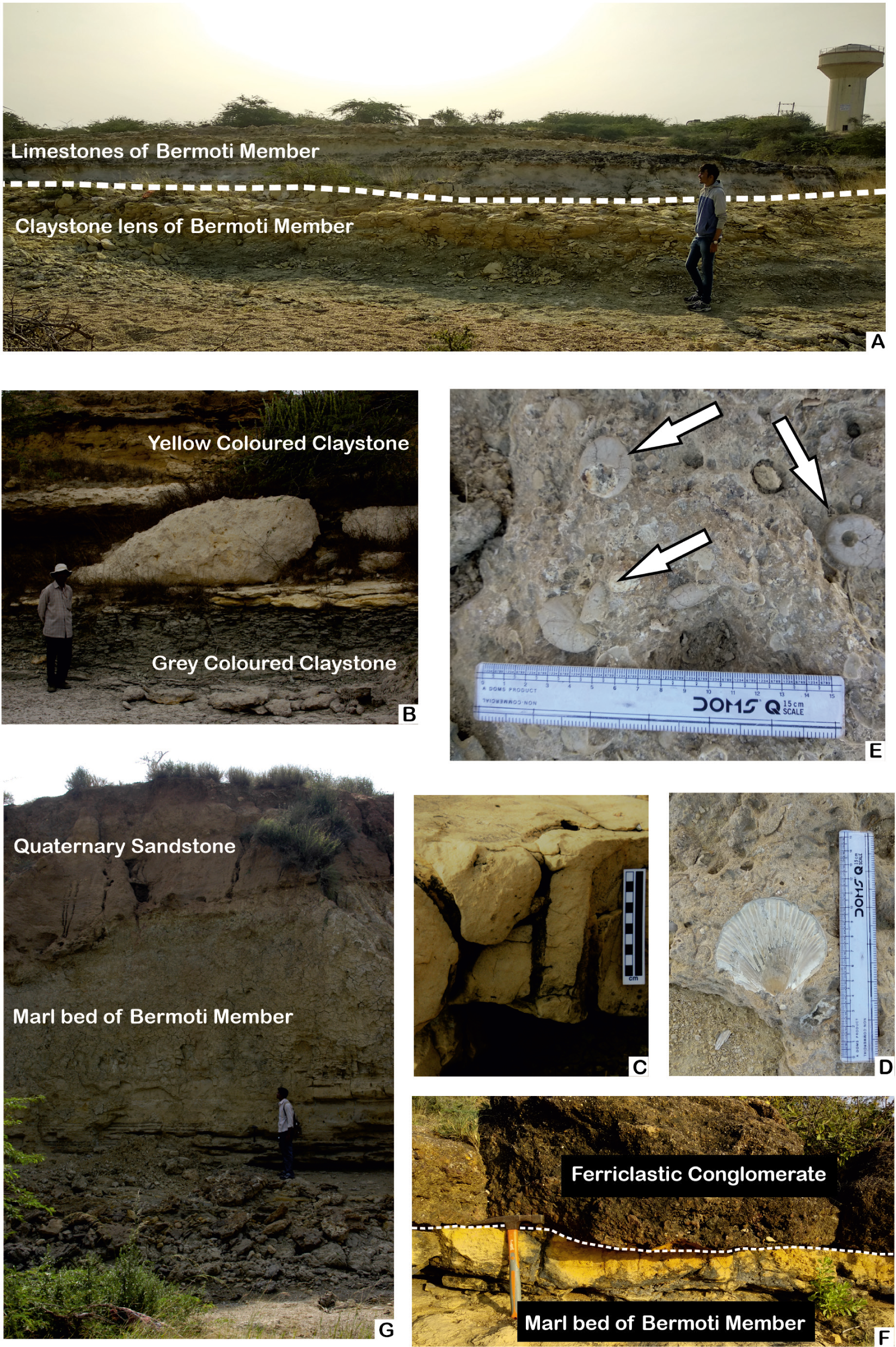
The Bermoti Member is characterised by a significant variation in the lithologies. The white coloured limestone at the base of the member consists of fossils of pectinid bivalves and foraminifera Spiroclypeus; the presence of the latter is the distinguishing character of the Bermoti Member. In the lower part of the Member there are abundant large burrows. A claystone lens occurs interbedded between the limestones (Plate 2A). It shows the presence of two distinct units, that is, lower grey-coloured claystone and upper yellow to ochre-coloured claystone (Plate 2B). The lower grey-coloured claystone rarely contains fossils. The top yellow to ochre-coloured claystone is calcareous in nature. Burrows are rare in the claystone lenses occurring in the Bermoti Member. However, leached mineralised solutions seem to have altered the claystone, leaving behind dark colouration that helps in detecting these burrows which are ‘T’ and ‘Y’ (Plate 2C) and tubular in shape; rarely U-shaped burrows are also seen. The limestone overlying the claystone lens is white to turbid greyish coloured, which contains a large variety of fossilised pectinid bivalves, which are quite well preserved (Plate 2D). There is a particular trend observed within the limestones with echinoids present in the lower part (Plate 2E) and pectinid bivalves in the upper part. A layer of bioturbated limestone with a network of ‘T’ and ‘Y’ shaped burrows is also observed. The topmost layer consists of Spiroclypeus bearing limestones overlain by a marl bed. This marl bed is characterised by its brownish yellow colour and consists of abundant gastropod fossils. Occasionally the marl is recrystallised to sparry calcite.
The limestones of the Bermoti Member are cut by sets of intersecting joints. In some parts of this section, the marl bed is overlain by a clast-supported conglomerate (Plate 2F). The conglomerate consists of grains ranging in size from pebble to granule with medium-fine-grained sandy-silty matrix and calcareous cement. This polymict conglomerate consists of clasts of Nummulites, quartz, basalt, ferruginous (limonitic) pebbles, broken shell fragments together with calcareous nodules. The presence of well-crystallised sparry calcite is also observed in this conglomerate. At some localities, the marl bed of the Bermoti Member is unconformably overlain by Quaternary sandstone (Plate 2G). The Khari Nadi Formation conformably overlies this conglomerate. In the downstream direction, the Khari Nadi Formation is overlain by the soil cover.
(A) Claystone lens of Bermoti Member. Person’s height: 180 cm; (B) The Claystone lens showing colour variation as lower grey coloured claystone and upper yellow coloured claystone. Person’s height: 153 cm; (C) Vertical burrows observed in Claystone Member. Note the presence of iron oxide along the burrow wall. Scale length: 10 cm; (D) Pectinid bivalves present within the greyish to turbid-coloured limestones of the Bermoti Member. Scale length: 15 cm; (E) Echinoids present within the limestones of the Bermoti Member. Scale length: 15 cm; (F) Marl bed of Bermoti Member overlain by Ferriclastic conglomerate. Hammer length: 31 cm; (G) Marl bed of Bermoti Member overlain by Quaternary Sandstones. Hammer length: 31 cm.
Petrography
Of the eight samples of limestones of the Maniyara Fort Formation that were selected for thin section studies, two samples (LLC 47 and 48) belong to Lumpy Clay Member, two samples (LCL 35 and 36) belong to Coralline Limestone Member and four samples (LBM 32, 33, 39 and MBM 29) belong to the Bermoti Member. These limestones consist of a high proportion of micritic matrix (avr. 72.66%) and low amounts of sparry calcite cement (avr. 4.55%). The allochems are represented by bioclasts (avr. 40.25%), intraclasts (avr. 3.37%) and peloids (avr. 0.66%). Negligible amounts of detrital grains (av. 0.64%) and limonite (avr. 0.59%) are also noted. Bioclasts mostly comprise foraminifera, calcareous algae, bivalve shell fragments, echinoderms and bryozoans. Detrital grains are represented by quartz and rare lithic fragments. The limestone samples from Maniyara Fort Formation are characterised by a considerable proportion of insoluble residue, which varies from 4.22% to 9.84% and averages to 7.30%.
The samples from Lumpy Clay Member are classified as mudstone (LLC 47) and bioclastic packstone (LLC 48) according to Dunham’s (1962) classification and micrite and biomicrite according to Folk’s (1959) classification. These samples contain low proportions of silt-sized, angular, detrital quartz grains and lithic fragments of carbonaceous shale (Plate 3A). Bioclasts in these samples are mainly represented by calcareous algae (Plate 3B), bivalve shell fragments and occasional foraminifera (Plate 3C). Occasionally, in these samples, clay-filled stylolitic seams are noticed (Plate 3D). The presence of reddish-brown limonitic silt/clay percolating along cracks can also be observed. Fine sand-sized limonite grains are also noticed.
Samples studied from the Coral Limestone Member are classified as wackestone (LCL 35) and bioclastic packstone (LCL 36) according to Dunham’s (1962) classification and biomicrite according to Folk’s (1959) classification. These samples contain bioclasts which are represented by bivalve fragments, coralline algae (Plate 3E) and bryozoa. The presence of well-rounded intraclasts (Plate 3F) and micritisation of bioclasts is commonly noticed in these samples. Sample LCL 35 shows the presence of thin, irregular silica veins, showing offsets and cutting across the allochems (Plate 3F). Occasionally, in these samples, sparry calcite occurs as veins and pore-filling cement. Coarsening of calcite spar towards the pore centre is also noticed (Plate 3G).
(A) Photomicrograph of a mudstone of Lumpy Clay Member under cross polars, the arrow pointing towards a lithic fragment seen in the mudstone; (B) Photomicrograph of bioclastic packstone of Lumpy Clay Member under cross polars, note the presence of calcareous algae; (C) Photomicrograph of a mudstone of Lumpy Clay Member under cross polars, the arrow points to a foraminiferal test; (D) Photomicrograph of a mudstone of Lumpy Clay Member under cross polars, the arrow points to stylolitic seam filled with reddish-brown ferruginous mud; (E) Photomicrograph of bioclastic packstone of Coral Limestone Member under cross polars, the arrow points towards a medium sand-sized bioclast of coralline algae; (F) Photomicrograph of a wackestone of Coral Limestone Member under cross polars, showing well rounded intraclasts. Note the presence of irregular, thin silica vein cutting across the intraclast, as well as sparry calcite cement; (G) Photomicrograph of a packstone of Bermoti Member under cross polars. Note the presence of pore-filling, equant sparry calcite cement, with calcite crystals coarsening towards the pore centre; (H) Photomicrograph of a bioclastic packstone of Bermoti Member under cross polars, note the fragments of foraminiferal tests in the packstones. Internal structure of the foraminiferal tests is also well preserved; (I) Photomicrograph of a bioclastic packstone of Bermoti Member under cross polars, the arrow points towards the dissolution of foraminiferal test and embayment of micrite; (J) Photomicrograph of a mudstone of Bermoti Member under cross polars. Note the presence of a granule- to coarse sand-sized nodule of dark reddish-brown limonite.
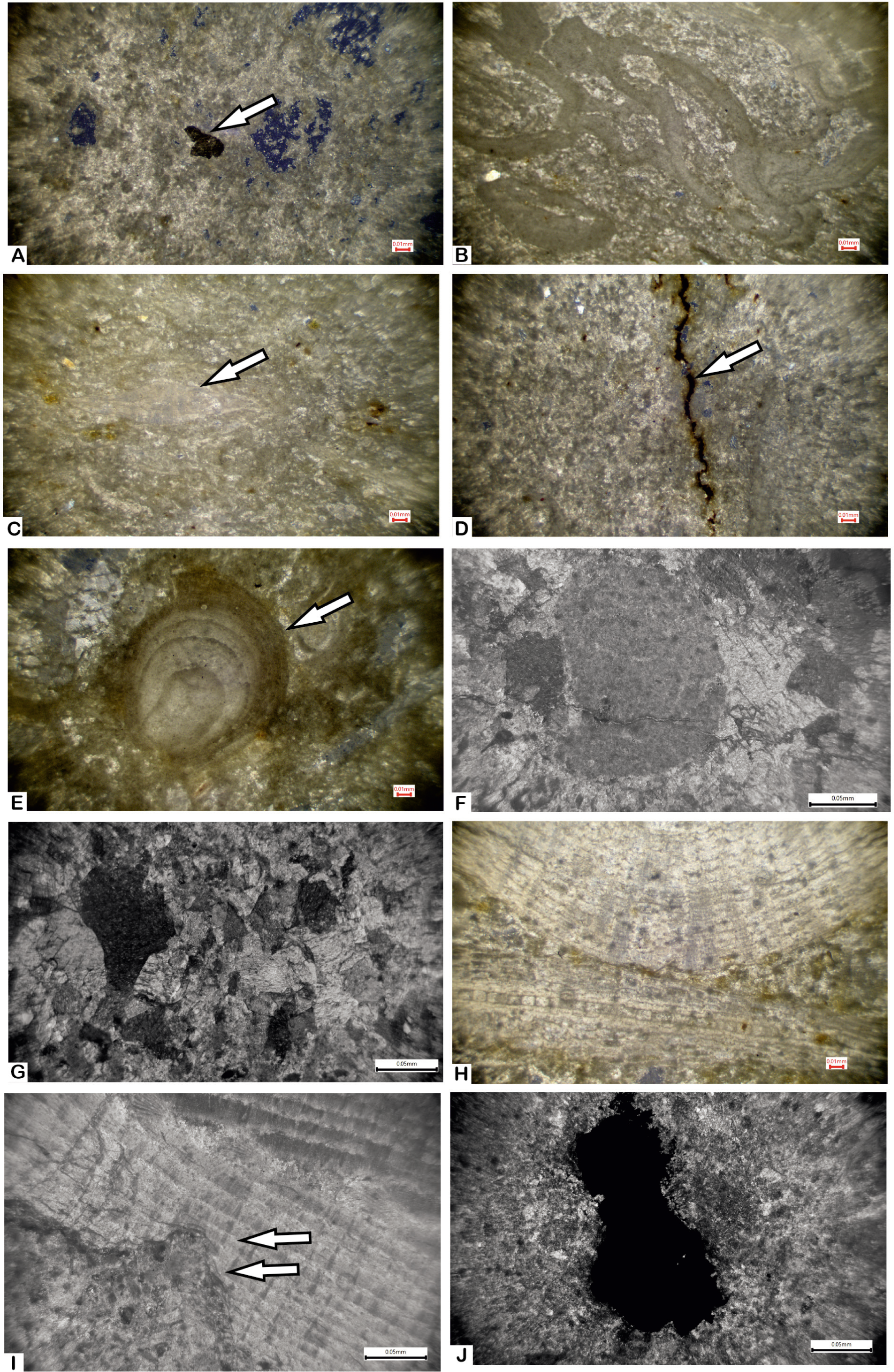
The Bermoti Member is represented by two bioclastic packstones (LBM 32, 39) and the rest of the samples are mudstones. These samples are classified as biomicrite according to Folk’s classification (1959). Packstone samples consist of abundant larger benthic foraminiferal tests (Plate 3H), bivalve shell fragments and intraclasts. Within these foraminiferal tests, well preserved internal structure of lateral chamberlets is observed (Plate 3H). Broken fragments of foraminifera tests can also be observed. At some places, pore-filling sparry calcite cement patches and signs of neomorphism are noticed in these samples. These calcite rhombs are observed to be coarsening towards the pore centre. The presence of ferruginous clay is commonly seen in these samples. At places, the foraminiferal tests are dissolved and micrite is embayed within these bioclasts (Plate 3I). Granule to coarse sand-sized nodules of dark reddish-brown limonite are also observed. Percolation of limonite, thereby imparting brown colour to the surrounding micritic matrix is seen around such nodules (Plate 3J).
Discussion
The Maniyara Fort Formation is overall characterised by bioclastic mudstone-wackestone microfacies association with dominance of bioclasts of benthic foraminifera and coralline algae with occasional bivalves, and considerable proportion of micritic matrix; hence interpreted to be deposited in a gently sloping platform settings, that is, middle to inner ramp environment (Abdula et al., 2015; Bilal et al., 2022; Hussain et al., 2021; Lehrmann et al., 2003; Rehman et al., 2021; Yini et al., 2022). Significant proportion of insoluble residue (avr. 7.30%) is in accordance with their algal nature and shallow marine depositional environment (Bilal et al., 2022; Flügel, 1982; Kale et al., 2021). The thin sections of the limestones from the Lumpy Clay Member reveal their mud-supported nature, with a subordinate proportion of detrital grains, intraclasts and bioclasts. The lithic fragments are sub-angular to rounded. Dominance of calcareous algae and a lesser proportion of other marine bioclasts indicate a restricted to semi-restricted shallow marine environment (Abd El-Moghny & Afifi, 2022; Al-Ali et al., 2019; Borgomano, 2000; Lucas et al., 2015; Vaziri-Moghaddam et al., 2010). The presence of stylolitic seams (though not prominent) within the limestone may indicate weak compaction during early diagenesis (Bathurst, 1987; Bilal et al., 2022; Fossen, 2010; Rustichelli et al., 2015). Infilling of clay within these cracks is interpreted to be residual clay (Toussaint et al., 2018). The Coral Limestone Member is characterised by various types of corals from elongated hexa corals to brain coral to bulbous corals. The coral bioherms show domal to columnar growth forms, thus reflecting the moderate wave energy and low rate of sedimentation (Tucker, 2003). The domal to columnar bioherms with frequent borings indicate formation in ramp environment, below normal wave base (Batten Hender & Dix, 2008; Olivier et al., 2011). Thin sections of the Coral Limestone Member are represented by bioclastic packstones and wackestones, which mainly consist of bioclasts and intraclasts, indicating shallow marine depositional environment (Nichols, 2009). The presence of bioclasts of bivalves, foraminifera, coralline algae, echinoid spines, etc., within the thin sections of the samples under study indicate deposition in warm, shallow tropical waters (Flügel, 1982; James & Jones, 2016; Scholle & Ulmer-Scholle, 2003). The Bermoti Member is characterised by a lens of claystone, which consists of both greyish to yellow coloured claystones interbedded with the limestones. The lower greyish coloured claystones are more or less, barren or devoid of fossils. The yellow-coloured claystones consist of fossils of pectinid bivalve, which are found quite abundant in number. The Bermoti limestones are highly bioturbated with pectinid bivalves, echinoids and larger benthic foraminifera Spiroclypeus. The marl present in the member is characterised by turriform gastropod fossils. These Bermoti limestones are petrographically classified as packstone, wackestone and mudstone assemblage, indicating their deposition of shallow marine, inner to middle ramp environment (Bilal et al., 2022; Hussain et al., 2021; Lehrmann et al., 2003; Rehman et al., 2021; Yini et al., 2022).
The limestone samples under study exhibit micritisation of bioclasts, indicating shallow marine diagenesis and subaerial exposure (Boggs, 2004). Micritisation of bioclasts suggests alteration due to the activity of endolithic microbes on the seafloor or just below the sediment–water interface (Boggs, 2004; Tucker & Wright, 2009). Micritisation is a relatively weak diagenetic process that occurs just below the sediment–water interface (Azizi et al., 2014; Tucker & Wright, 2009) in shallow marine environments (Boggs, 2004), when carbonate grains rest on the seafloor for longer periods of time (Wei, 1995). The biological reworking of the sediment by boring, burrowing and sediment ingestion can be so intense that the carbonate grain may entirely get converted to micrite (Boggs, 2004). Within the samples under study, micritisation has affected the foraminiferal test. The foraminiferal tests broken to fragments indicate transportation by waves and currents (Azizi et al., 2014). According to Melim et al. (2001), shallow marine carbonates commonly undergo meteoric diagenesis. Dissolution of bioclasts, as observed in some of the limestones under study, occurs mostly in diagenetic realm, in meteoric waters (Ahmad et al., 2021; Choquette & Pray, 1970; Khan et al., 2020). The limestone samples under study show neomorphism, the presence of ferruginous vadose silt and/or clay along the cracks and pore-filling equant sparry calcite cement. These sparry calcite crystals are often seen to be coarsening towards the pore centre and form a dense mosaic. These signatures are interpreted to be indicative of meteoric diagenesis and related subaerial exposure (Armstrong-Altrin et al., 2011; Bain & Foos, 1993; Flügel, 2010; Folk & Land, 1975; Melim et al., 2001; Moore & Wade, 2013; Quinn, 1991; Tucker & Wright, 2009). The presence of sparry calcite veins observed in these samples may be attributed to the last phase of cementation (Ahmad et al., 2021) in deep phreatic environment (Singh, 1987). In addition, signatures of shallow marine diagenesis, such as micritisation of bioclasts, are also noticed, in the samples under study. The presence of silica veins and silicification observed in limestones of Coral Limestone Member may be attributed to early diagenesis in marine-meteoric mixing zone (El-Saiy & Jordan, 2007) before significant burial and compaction (Ahmad et al., 2021; EL-Sorogy et al., 2016; Mansour, 2004). The meteoric diagenesis and associated subaerial exposure of the samples under study may be attributed to eustatic sea level fall at the end of Chattian stage (Banerjee et al., 2012a; Haq et al., 1987).
Conclusion
The field observations combined with detailed petrographic analysis of carbonates of Maniyara Fort Formation reveal that the deposition of these carbonates took place in shallow, warm tropical waters in middle to inner ramp environmental settings, below the normal wave base. The limestones deposited towards the top of the exposed section show signs of neomorphism as inferred from the signatures of diagenesis. The diagenetic changes and indicators of subaerial exposures as seen in the thin sections are attributed to the eustatic sea level fall at the end of Upper Oligocene (Chattian Stage).
Footnotes
Acknowledgements
The authors thank Dr. Rajendra Shinde, Principal, St. Xavier’s College, (Autonomous), Mumbai and Dr. Pravin Henriques, Head, Department of Geology, St. Xavier’s College, Mumbai, for providing the infrastructure and permission to publish this paper. The authors thank Dr. Anand Kale and Dr. Shilpa Patil Pillai for their extensive reviews that have helped elevate the manuscript manifold.
Declaration of Conflicting Interests
The authors declared no potential conflicts of interest with respect to the research, authorship and/or publication of this article.
Funding
The authors received no financial support for the research, authorship and/or publication of this article.