




Abstract
Introduction
Osteoporosis (OP) is determined as a chronic systemic bone disorder, characterized by low bone mass and microarchitectural degradation of bone tissue, thereby increasing the vulnerability of bone and susceptibility to fracture. 1 A recent report derived from the International Osteoporosis Foundation represents that approximately four million men and 16 million women are affected by OP in the six countries of the European Union. 2 Hip fractures and vertebral fractures are the most common fracture associated with bone fragility, which have led to extensive morbidity, mortality, and other adverse health consequences. It was estimated that approximately 2.7 million hip fractures happened due to OP in 2010 worldwide. 1 Pharmacological therapies, including Bisphosphonates, Denosumab, Raloxifene, Teriparatide, and Abaloparatide, have been applied to reduce the fracture risk in individual osteoporotic patient.1,3 However, these medications also brought about some adverse events, such as upper gastrointestinal adverse reactions, skin rash, breast pain and muscle cramps, and so on. 1 Recently, scientists have found that traditional Chinese medicines (TCM) have great potential in preventing and treating OP on account of good curative effect and minimal side effects. Cistanche tubulosa, 4 Muscone, 5 Xian-Ling-Gu-Bao prescription, 6 and Morinda officinalis have been explored to be beneficial for osteoporosis with different mechanisms. Although these TCMs have been examined to be potential treatment efficacy for OP, the best one is not yet found.
The 40 structurally divergent ginsenosides are isolated and identified from the P. ginseng root.


Flowchart of the systematic procedure to investigate the mechanisms of ginsenosides in the treatment of osteoporosis.
Materials and methods
Screening of ginsenosides pharmacologically active ingredient
Ginsenosides are kinds of active substances of traditional Chinese medicine ginseng. We obtained the drug active component information by searching the Traditional Chinese Medicine Systems Pharmacology Database and Analysis Platform (TCMSP, http://lsp.nwu.edu.cn/index.php) 11 based on the keyword: renshen (ginseng). Absorption, Distribution, Metabolism, Excretion 12 properties of each active component of medicinal herbs could be derived from the TCMSP database, which contains related information, such as Oral Bioavailability (OB), Drug-Likeness (DL), Half-Life (HL), and so on.
First, we gained ginsenosides from all active substances results of ginseng by TCMSP. Then, the ingredients of ginsenosides with OB ≥ 30% and DL ≥ 0.7 were selected as main research subjects in this study. We also acquired the three–dimension (2D) chemical structures of these selected ginsenosides from the TCMSP database in mol2 format.
Prediction of potential target proteins for ginsenosides
The TCMSP database has given some potential target proteins of each active component. Some targets results are supported by Drug Bank database (https://www.drugbank.ca/). 13 We first stored these results as part of potential targets of selected ginsenosides. Second, Pharmmapper database (http://www.lilab-ecust.cn/pharmmapper/) were used to identify other potential human target proteins for the ginsenosides. Pharmmapper could identify potential target candidates for a given small molecule structure by a pharmacophore mapping approach. Three dimensions (3D) chemical structure of each selected ginsenoside was uploaded to the Pharmmapper with default parameters of database. 300 potential target candidate results of each ginsenoside were downloaded after handling. 14
Third, we chose human proteins from Pharmmapper results as target candidates. Together with results of TCMSP in the first step, we got the potential target proteins for selected ginsenosides. Then we used Cytoscape software to visualize the relationship between selected ginsenosides and potential targets. 15
Screening the potential target genes related to osteoporosis
Phenopedia database (http://www.hugenavigator.net/HuGENavigator/startPagePhenoPedia.do) is an application based on web page with persistently renewed from PubMed, which is able to explore the literatures associated with human genes and diseases. 16 In this analysis, the keyword “Osteoporosis” was firstly searched in the Phenopedia database to obtain the target genes related to OP. DisGeNET database (http://www.disgenet.org/) is a standardized intellectual management platform based on multiple scientific literatures, which covers a full range of human diseases and related genes. 17 The target genes associated with OP were also explored in this database. Then, we took the union results gained from both Phenopedia and DisGeNET databases as the potential target genes of OP. The jvenn tool 18 was used to cross-validate the ginsenoside target proteins and OP-related potential target genes to procure possible target genes of ginsenoside treating OP.
Gene Ontology and Kyoto Encyclopedia of Genes and Genomes pathway enrichment analysis for target proteins related to osteoporosis
For the OP target proteins of selected ginsenosides we obtained above, we put to use the Search Tool for the Retrieval of Interacting Genes (String) database (https://string-db.org/) to perform Gene ontology (GO) (Biological Process (BP), Cellular Component (CC), and Molecular Function (MF)) and KEGG (Kyoto Encyclopedia of Genes and Genomes) enrichment analysis by default analysis parameters. 19 For the analysis results harvested from String, we made use of R language (version 4.0.0) to visualize them in the form of bubble charts. In order to ensure the visualization effect, we only visualized the top 10 items of GO and KEGG enrichment pathway. For pathways related to osteogenesis, we further applied the R package “pathview” to visualize their pathways and related targets. 20
Protein-protein interaction analysis for key target proteins related to osteoporosis treatment
To explore the interaction between the protein targets of …… and identify the key proteins, the overlapping genes were imported into the STRING 11.0 database (https://string-db.org/), and the species was set to “Homo sapiens” after “Multiple Proteins” was selected; the other parameters were defaulted (combined score >0.4, medium confidence). The obtained protein interaction results were saved in TSV format. The files' node 1, node 2, and combined score information were retained and imported into Cytoscape software to draw the interaction network. The Network Analyzer tool in Cytoscape software was used to analyze the network. The node size and color were set to reflect the size of the degree value to obtain the final protein-protein interaction (PPI) network. Then we made use of the MCODE plug-in of Cytoscape to analyze the key sub-network of the obtained PPI network to study the important topological sub-network structure in the entire network. 21 The analysis parameters of MCODE were set to degree cur off = 2, node score cut off = 0.2, Max depth = 100, k score = 2, and MCODE score >5.
Molecular docking verification of ginsenoside to target proteins related to osteoporosis treatment
In order to elucidate how the ginsenosides bind to target proteins to exert the therapeutic efficacy, we used the SwissDock tool to make docking predictions. Four proteins (IL1B, TNF, IFNG, and NFKBIA) with the most connections in the Figure 7, which are the major factors in the osteoclast differentiation pathway (Figure 5), were selected to make the binding prediction. We obtained the Protein Data Bank (PDB) identifications (IDs) 22 of key target proteins related to OP treatment from the PDB database (PDB, http://www.pdb.org/). With the 3D-structure in mole format of selected ginsenoside, target proteins were uploaded to SwissDock website to make docking predictions. 23 The model with minimal G scores was considered as the most excellent docking model. For the optimal prediction results we got, we took advantage of UCSF Chimera and Pymol software to visualize them. 24 In order to verify the prediction results of Swissdock, we downloaded the three-digit structure files of the four proteins from the PDB database and used AutoDock software (V4.2.6) to do molecular docking of ginsenosides and proteins.
Results
Pharmacologically active ingredients of ginsenosides and 2D chemical structure
The eight active ingredients of ginsenosides obtained for traditional Chinese medicine systems pharmacology database and analysis platform (oral bioavailability ≥ 30%; drug-likeness ≥ 0.7).
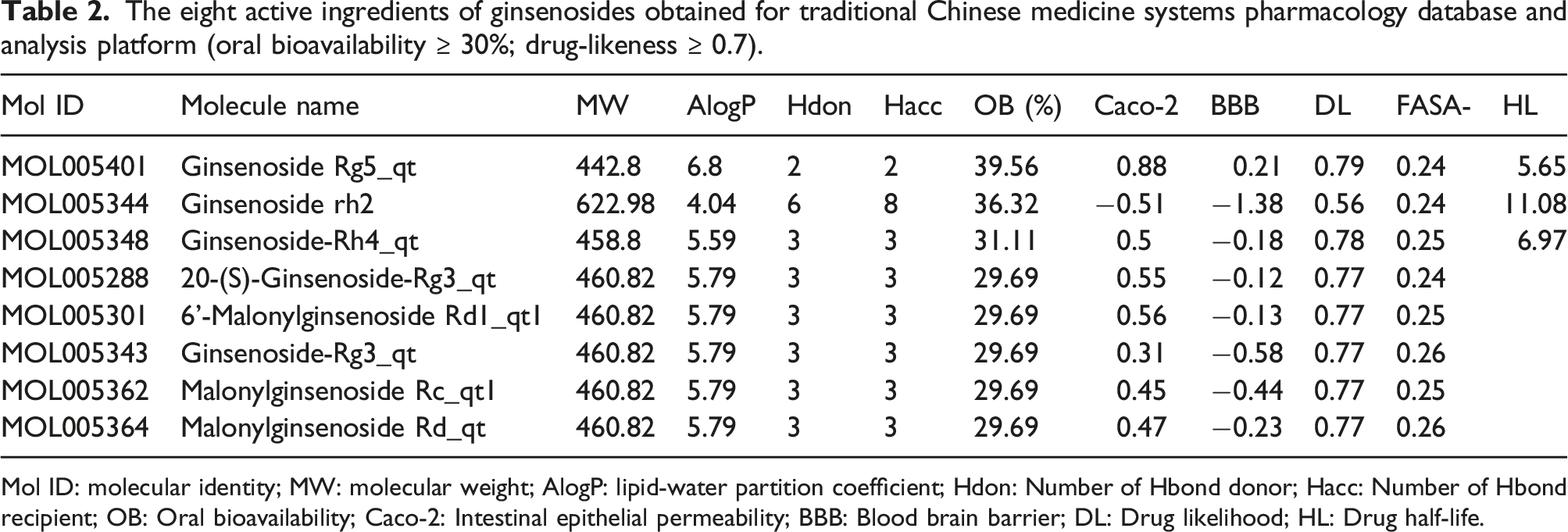
Mol ID: molecular identity; MW: molecular weight; AlogP: lipid-water partition coefficient; Hdon: Number of Hbond donor; Hacc: Number of Hbond recipient; OB: Oral bioavailability; Caco-2: Intestinal epithelial permeability; BBB: Blood brain barrier; DL: Drug likelihood; HL: Drug half-life.

The 2D chemical structures of the eight ginsenoside active components.
Prediction of target proteins in the eight ginsenoside active components
In the TCMSP database, only ginsenoside rh2 and Ginsenoside-Rh4_qt got the predicted target proteins. Therefore, we explored the target proteins of these eight ginsenoside active components in the Pharmmapper database. A total of 66 and 14 target proteins were secured in the Pharmmaper and TCMSP database, respectively. Finally, a network with 80 target proteins and eight ginsenosides was constructed (Figure 3). The larger the red circle, the more connections. As we can see, ginsenoside rh2 contains the most connections. Network of target proteins in the eight ginsenoside active components.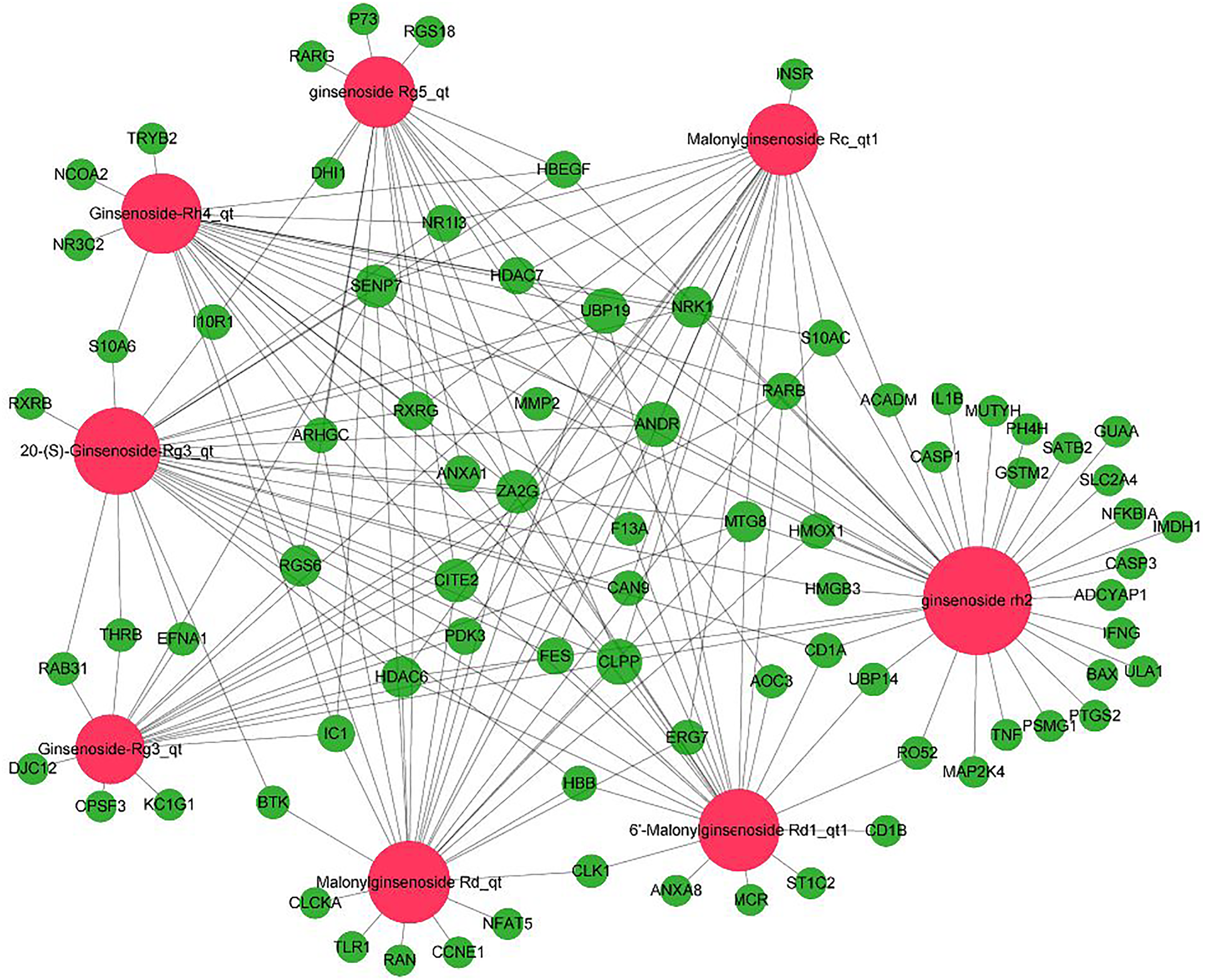
The potential target of ginsenoside treating osteoporosis
The cross-validation was performed between OP-related genes and ginsenoside target protein. Then, we took the cross-validated intersection as the possible targets for ginsenoside in the treatment of OP. As seen in the Figure 4, a total of 1304 OP-related genes were obtained, and a total of 17 overlapping genes were achieved after cross-validation with 80 ginsenoside target proteins. These 17 overlapping genes are IL1B, BAX, MMP2, HBB, TNF, IFNG, RXRG, RXRB, RARB, THRB, CASP1, CASP3, SLC2A4, RARG, HMOX1, NFKBIA, and NCOA2. Except BTK, four of the five genes involved in the osteoclast differentiation pathway are contained in these 17 overlapping target genes. String gene ontology and KEGG enrichment results of the target proteins. (●) Biological Processes, (▅) Molecular Function, (▲) Cellular Components, and (+) KEGG. Note: Only the top 10 items are listed in the figures above. “FDR” is on behalf of the number and ratio of the candidate target genes located in a pathway. A higher FDR suggests a greater degree of enrichment. A larger size of a dot indicates a greater deal of target genes belonging to the pathway. Various colors of a dot implicates diverse p values. KEGG: Kyoto Encyclopedia of Genes and Genomes.
Gene ontology and Kyoto Encyclopedia of Genes and Genomes pathway enrichment results of target proteins of ginsenosides
To further explore the various mechanisms of the anti-osteoporotic activity of ginsenosides, we performed a GO and KEGG enrichment analysis (BP, MF, and CC) of the 17 target genes. The GO and KEGG pathway enrichment analysis of target proteins in these eight ginsenosides were performed in the String database. The results with the top 10 enriched BP terms, MF terms, and CC terms are shown as bubble chart in the Figure 5. The top five BP terms were as follows: (1) cellular response to chemical stimulus, (2) cellular response to organic substance, (3) response to organic substance, (4) response to chemical stimulus and (5) response to steroid hormone. In the MF terms, the top five terms are (1) steroid hormone receptor activity, (2) nuclear receptor activity, (3) signaling receptor activity, (4) biding, and (5) lipopeptide binding. The top five CC terms were as follows: (1) membrane raft, (2) membrane-bounded organelle, (3) intracellular, (4) intracellular organelle, and (5) cell part. Then, in the KEGG enrichment analysis, the tumor and inflammation related biological pathways are the primary pathways concerned to our target proteins, except osteoclast differentiation pathway (Figure 5). Finally, we found five target proteins participated in the osteoclast differentiation pathway, including BTK, IFNG, IL1B, NFKBIA, and TNF. The completed pathway chart was showed in the Figure 6. The ginsenoside target proteins (red) in the osteoclast differentiation pathway. The venny diagram of ginsenosides and osteoporosis intersection target genes. Note: 1287 OP non-intersection potential targets (left), 17 OP-ginsenoside intersection potential targets (middle) and 63 ginsenoside non-intersection potential targets (right).

Protein-protein interaction network of anti-osteoporosis targets of ginsenosides
A mature complicated algorithm called MCODE is used by Metascape to automatically extract target complexes embedded in the large network.
25
It provides dense interactome neighborhoods and the interpretation of these biological enrichment pathways. The 17 key anti-OP target proteins were used to perform PPI analysis in the String database. Then, the PPI network obtained above was further analyzed in the plug-in MCODE of Cytoscape to construct a second network. There were 16 nodes in this PPI network, beside HBB (Figure 7(a)). Nevertheless, in the PPI sub-network, the important nodes (genes) became 14 ones (Figure 7(b)), including IL1B, MMP2, TNF, IFNG, RXRG, RXRB, RARB, THRB, CASP1, CASP3, RARG, HMOX1, NFKBIA, and NCOA2, beside BAX, HBB, and SLC2A4. Therefore, the potential key targets were reduced to 14 ones. In the PPI network, TNF and IL1B were shown to have the most interactions with other ginsenoside targets in the cluster, indicating that ESR1and AKT1 played an important role in connecting other nodes. PPI network of the anti-osteoporosis target proteins (a) The PPI network constructed using String and Cytoscape . (b) The cluster generated from (a). Node size is proportional to the degree of interaction. PPI: Protein-protein interaction.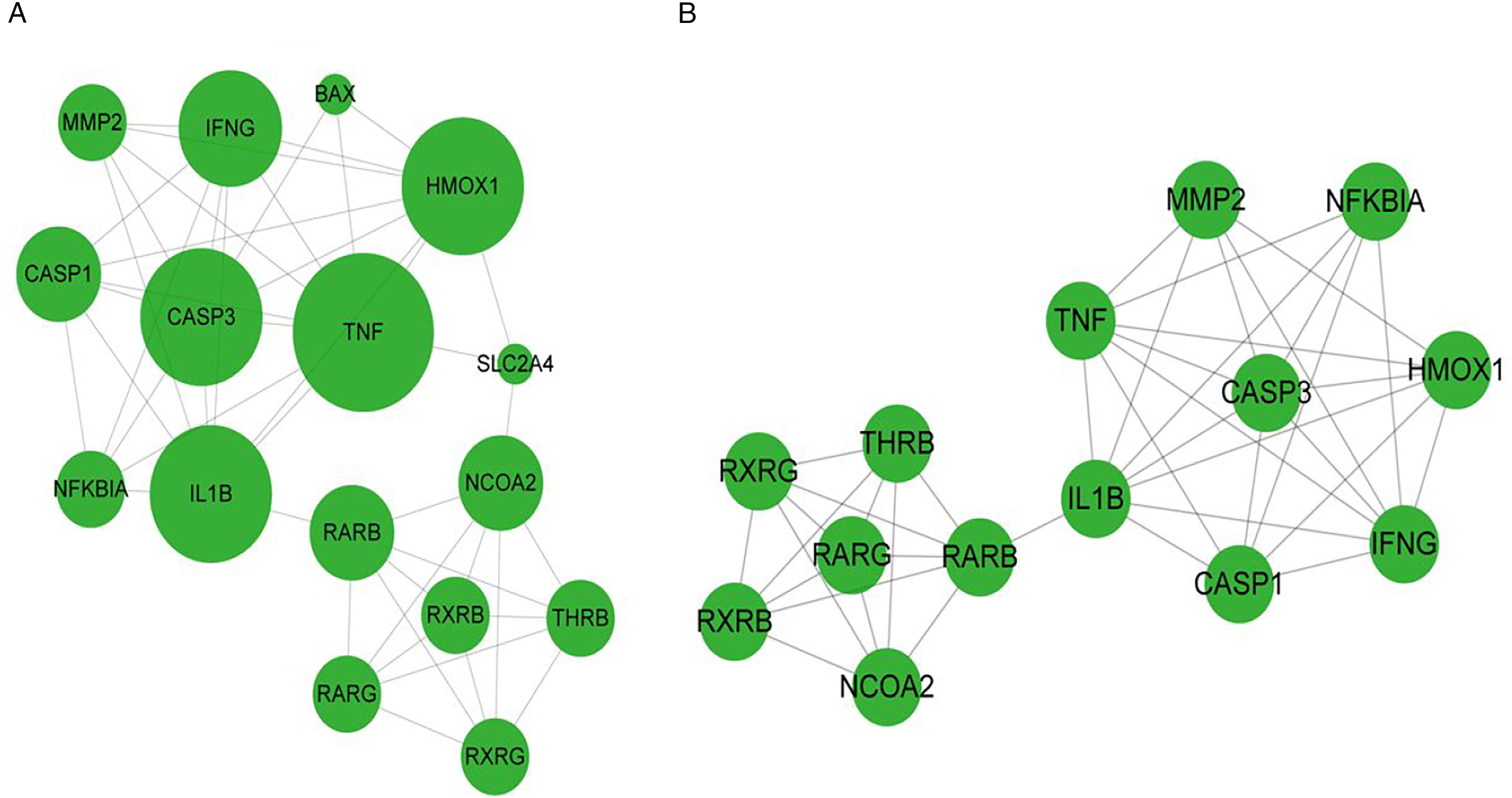
Prediction of ginsenosides binding to target proteins associated with osteoporosis
The SwissDock database was utilized to predict the binding of ginsenosides and target proteins related to OP. We chose one as the representative drug from the eight main ginsenoside active ingredient with the largest MW, the longest drug HL, and the most target proteins, which was ginsenoside rh2 (MOL005344)and was currently the main ginsenoside drug on the market. Prediction analysis of four target proteins IL1B, TNF, IFNG, and NFKBIA binding to ginsenoside rh2 was performed. The results with optimal docking are shown in Figures 8 and 9. Prediction of ginsenoside rh2 binding to IL1B and TNF associated with osteoporosis. ΔG = −8.17 kcal/mol, up plots; ΔG = −7.23 kcal/mol, down plots. Note: The large structures like a string is the target protein, the small is ginsenoside rhs. The left plot is made by Chimera software; the middle and right plots are drew by Pymol software. Prediction of ginsenoside rh2 binding to IFNG and NFKBIA associated with OP. ΔG = −7.55 kcal/mol, up plots; ΔG = −8.36 kcal/mol, down plots. Note: The large structures are ginsenoside rhs, the small is target protein. The left plot is made by Chimera software; the middle and right plots are drew by Pymol software.

Validation of binding prediction
Through the validation in the AutoDock software (V4.2.6), two of the four proteins got the last valuable outcomes, which are IFNG and IL1B, seeing Figures 10 and 11. In the Figure 10, the ginsenoside binds to the Pheylalanine 201 residue (F201), Asparagines 205 residue (N205), Lysine 208 residue (K208), Aspartic acid 41 residue (D41), and Serine 40 residue (S40) of NFKBIA. As shown in Figure 11, the ginsenoside binds to the Lysine 103 residue (K103) and the methionine 148 residue (M148) of the IL1B. These showed that the ginsenoside could interact with these two proteins to play the therapeutic effect in anti-osteoporotic. Molecular docked structure of IFNG‐ginsenoside complex. Docking was performed using AutoDock software (V4.2.6) and various amino acid interactions are mentioned in the respective passage. The larger helical lamellar structure is IFNG protein and the smaller hexagon is ginsenoside. Molecular docked structure of IL1B‐ginsenoside complex. Docking was performed using AutoDock software (V4.2.6) and various amino acid interactions are mentioned in the respective passage. The larger helical lamellar structure is IL1B protein and the smaller hexagon is ginsenoside.

Discussion
Plenty of osteoporosis-associated morbidities have been on the rise in women older than 55 years and men older than 65 years. OP has become a common disorder that has greater potential to threaten the elderly health. Many previous literatures have reported that oxidative stress response, deficiency of estrogen, bone immune disorder, chronic inflammative reaction, bone marrow microcirculation dysfunction, and glucocorticoid-induced bone loss may be contributed to the pathogenesis of OP.26,27 Network pharmacology has been broadly used to study drug and relevant disease and made full sense of drug research due to big data analysis. 28 In the clinical practice, ginsenosides have been widely utilized to treat different kinds of disease because of good effectiveness and low side effects. In this study, the network pharmacology was conducted to explore the potential key targets and mechanisms associated with OP treatment by building and analyzing drug target networks, enrichment analysis.
The potential key targets
Fourteen potential key targets were obtained by cross-validation of intersection and PPI network analysis, which are IL1B, MMP2, TNF, IFNG, RXRG, RXRB, RARB, THRB, CASP1, CASP3, RARG, HMOX1, NFKBIA, and NCOA2. All of these target genes or proteins were considered to be associated with ginsenosides treating OP, some of which have been reported in the recent literatures. However, IL1B, TNF, IFNG, and NFKBIA were most important target proteins because of involving in osteoclast differentiation. IL1B was detected as an increased inflammation-relevant gene of OP in Kashin-beck disease patients, and was regulated by ginsenoside rhs in treating idiopathic pulmonary fibrosis.29,30 MMP2 has been showed that might be a new possible therapeutical target in precaution and treatment of glucocorticoid-related OP. 31 TNF-α and CASP3 expression were regulated to alleviate OP by Sinomenii Caulis extract. 32 A recent Cis-eQTL analysis have elucidated that IFNG expression was positively related to OP and abdominal obesity. 33 RARB was examined to be a bone mineral density loci by genome-wide association studies in Koreans. 34 High glucose induced caspase-1 and IL-1B activation and inhibition of efferocytosis in osteoclast-mediated diabetic osteoporosis. 35 Fufang Lurong Jiangu Capsule significantly alleviating oxidative stress in osteoblasts induced by Nrf2/HMOX-1axis might provide new perception to the treatment of osteoporosis. 36 And, ginsenoside rb3 defends cardiomyocytes against oxidative injury via activation of PERK/Nrf2/HMOX1 axis. 37 Acteoside significantly influenced osteoclastogenesis by down-regulated NFKBIA expression to prevent the development of osteoporosis. 38 Most of these genes have been linked to the treatment of mechanism of OP. However, RXRG, RXRB, THRB, and RARG have not been demonstrated to be associated with OP or ginsenosides in the previous studies. This implicates that these genes might be new potential targets for ginsenosides treating OP worth being explored in the future.
The Functional and pathway enrichment analysis
As shown in the Figure 4, the enrichment analysis built by String can provide a great number of enrichment results regarding to GO and KEGG. In the results of GO, steroid hormone is one of most important factor. It is “response to steroid hormone” in BP, “steroid hormone receptor activity” and “hormone receptor binding” in MF, and in CC. OP has been considered as one of most common adverse side effects after glucocorticoid therapy. Recent studies have suggested that the changes of steroid hormone levels are important factors in the development of OP. 39 Moreover, some researches have found that ginsenosides could attenuate the glucocorcoid-induced OP. Zhang et al. in their study reported that ginsenosides Rg3 weakened glucocorticoid-induced OP through regulating BMP-2/BMPR1A/Runx2 signaling pathway. 40 In Gao et al.’s report, they described that ginsenoside-Rb2 promoted GPR120 induction in bone marrow-derived mesenchymal stem cells to inhibit dexamethasone-induced OP. 10 The results of the KEGG enrichment analysis showed that the cancer pathway were more enriched compared with the osteoclast differentiation signaling pathways. A possible explanation is that the cancer pathways are more associated with gisenoside. Some examples have demonstrated that different ginsenosides active ingredients have anti-tumor effect in various cancers.41,42 However, gisenosides and osteoclast differentiation also have a strong correlation. Gisenosides prevent osteoporosis by inhibiting osteoclast differentiation. Ginsenoside Rb3 reduced osteoclast generation by inhibiting the MAPK/AKT/NF-κB signaling pathways. 43 Another report showed that ginsenoside Rb2 inhibits osteoclast differentiation associated with blocking NF-κB and STAT3 signaling pathways. 44 Our GO and KEGG results show ginsenosides may attenuate steroid hormone-induced OP by inhibiting osteoclast differentiation.
Prediction of ginsenosides binding to target proteins
The results shown in the Figures 10 and 11 represent the detail 3D optimal docking images, which indicates that ginsenosides can bind with different targets and played a role in anti-osteoporotic. What the most valuable in these outcomes is that ginsenoside not only could combine with their targets to play a role, but also present the precise docking site of the targets. This computational method has been demonstrated to play a key role in the development of drug discovery/design. Furthermore, the advantage of this molecular docking is to reduce time and save money, lastly, accelerate the identification of potential drug candidate. 45 As we have known isothermal titration calorimetry, circular dichroism, nuclear magnetic resonance, atomic force microscope, and molecular docking method are the common approaches to study the interaction between proteins and small molecule. The Autodock software was used to verify the results of that from Swissdock. This provided believable and meaningful outcomes and could save the time in this kind of study.
The value of our study
We apply the network pharmacology approach to illustrate the molecular mechanisms of ginsenosides treating OP in this study. The network pharmacology suggests great advantages in exploring the types of drugs and mode of action. Additionally, let me emphasize the limitations of this study. First, our research is based on pharmacological network methods to study potential targets of ginsenosides in treating OP, lacking cell and animal experiments to support. Second, because of the difficulty of obtaining data, the database might not contain all known or unknown key targets and protein–protein interactions. This could be improved in the future if more data becomes available.
Conclusion
In the present study, 14 potential targets of ginsenosides treatment for OP were determined by a network pharmacological method, which was validated by functional enrichment analysis. IL1B
Footnotes
Declaration of conflicting interests
The author(s) declared no potential conflicts of interest with respect to the research, authorship, and/or publication of this article.
Funding
The author(s) disclosed receipt of the following financial support for the research, authorship, and/or publication of this article: This present study was supported by funds from the Key Technology Research and Development Program of Shandong (grant no. 2019GSF108257 and 2018GSF118192) and Shandong Provincial Medical and Health Science and Technology Development Project (2019WS500). Funding agencies have no role in research design or manuscript writing.
