



Abstract
Adequate amounts of fruit and vegetables (F&V) are an important part of a healthy diet, yet intake is suboptimal in most population groups worldwide. To better understand the evidence of strategies aiming to improve F&V intake, we conducted a scoping review of interventions assessing the impact on F&V intake, including those aiming to improve F&V intake explicitly and those targeting diet, health, lifestyle, or food environment generally. Among all eligible interventions reviewed, most of which were implemented in high-income countries, about half reported a significant positive impact on fruit and/or vegetable intake. Interventions that used a multicomponent strategy (61%) and those that focused on F&V specifically (72%) were most likely to find a significant increase in fruit and/or vegetable intake. Detailed summaries are provided in 2 accompanying articles. In the present article, we put these findings into perspective. Specifically, we considered the evidence for 4 target countries of the Fruit and Vegetables for Sustainable Healthy Diets Initiative: Benin, the Philippines, Sri Lanka, and Tanzania. When considering available evidence at the national level, there is a paucity of information from intervention trials despite evidence of inadequate F&V intakes in each of these countries. When considering available evidence at the global level, and especially for low-and-middle income countries, there is a critical need to strengthen the evidence across various intervention strategies, particularly related to targeting, timing, intensity, duration, frequency, and other key characteristics, to better understand how to enhance their impact on F&V intake in various population groups and contexts.
Plain Language Summary
Eating enough fruit and vegetables is important for health, but most population groups worldwide do not eat enough. To better understand the evidence of strategies aiming to improve fruit and vegetable intake, we conducted a scoping review of interventions assessing the impact on fruit and vegetable intake. We considered intervention strategies that aimed to improve fruit and vegetable intake specifically and also those targeting diet, health, lifestyle, or food environment generally. Most of the eligible interventions were conducted in high-income countries. About half of all eligible interventions reviewed reported a significant positive impact on fruit and/or vegetable intake. Interventions that used a multicomponent strategy (61%) and those that focused on F&V specifically (72%) were most likely to find a significant increase in fruit and/or vegetable intake. Detailed summaries are provided in 2 accompanying articles. Here, we put these findings into perspective. Specifically, we considered the evidence for 4 target countries of the Fruit and Vegetables for Sustainable Healthy Diets Initiative: Benin, the Philippines, Sri Lanka, and Tanzania. When considering available evidence at the national level, there is limited information from intervention trials despite evidence of inadequate fruit and vegetable intakes in each of these countries. When considering available evidence at the global level, and especially for low-and-middle income countries, there is a critical need to strengthen the evidence across various intervention strategies, particularly related to targeting, timing, intensity, duration, frequency, and other key characteristics, to better understand how to enhance their impact on fruit and vegetable intake in various population groups and contexts.
Introduction
Poor dietary quality resulting in either undernutrition or overweight and obesity is a cause for concern globally. Over half of preschool-aged children and two-thirds of nonpregnant women of reproductive age worldwide are estimated to have at least 1 vitamin or mineral deficiency. 1 In 2022, 43% of adults aged 18 years or older were overweight including 16% living with obesity. 2 The prevalence of obesity more than doubled since 1990. 2 The prevalence of overweight and obesity has also increased among adolescents. 3 Poor dietary quality is also 1 of the risk factors of noncommunicable diseases (NCDs), which lead to 18 million premature deaths (ie, before the age of 70 years). 4 Considering the large proportion of people affected by micronutrient deficiencies, overweight and obesity, and NCDs, the nutrition-related burden of disease remains unacceptably high worldwide.5–7
To ensure overall health and reduce risk of NCDs, a healthy diet low in fat, sugars, and sodium and high in fruit and vegetables (F&V) is recommended. 8 Specifically, healthy diets should provide adequate amounts of essential nutrients, be well-balanced in energy sources, contain a wide variety of nutritious foods and limit foods associated with determinantal health effects. 9 However, F&V intake is below the World Health Organization (WHO) recommendation of 400 g per person/day in most population groups globally.10–12 Causes and reasons for inadequate F&V intake are complex and include challenges related to desirability, affordability, accessibility, and availability. In 2022, approximately one-third of countries did not have adequate amounts of F&V available to meet the recommended 400 g per person/day. 13 When modeling the costs of the EAT-Lancet diet, which includes 200 g of fruit (ranging from 100 to 300 g) and 300 g of vegetables (ranging from 200 to 600 g), 14 it was estimated that the costs of the most affordable EAT-Lancet diets globally would exceed the household per person income for 1.58 billion people, and that the largest proportion of costs (31.2%) would be spent on F&V. 15 At the policy level, WHO recently recommended implementing policies to subsidize foods that contribute to a healthy diet. 16 However, in addition to the major constraints of availability and affordability, Kaur 17 identified a wide range of barriers related to F&V intake including sociodemographic factors, environmental conditions, individual and cultural factors, and macrosystem influences.
In an effort to increase the intake of F&V, the Fruit and Vegetables for Sustainable Healthy Diets (FRESH) Initiative led by CGIAR is using end-to-end approaches to simultaneously address the context specific desirability, affordability, accessibility, and availability constraints to intake of F&V. 18 Increases in F&V intake are expected to contribute to improving diet quality, nutrition, and well-being while also achieving benefits for livelihoods and environmental outcomes through impacts across the value chain. 18 As part of the FRESH Initiative, we conducted a scoping review of interventions that measured dietary intake of F&V, including those interventions aiming to improve F&V intake specifically, as well as those targeting health, lifestyle, or food environment more generally, using a range of single or multicomponent approaches.19,20 Briefly, the scoping review included studies implemented in low-, middle-, and high-income countries targeting any population age group, included a comparison group and assessed dietary intake of fruit, vegetables, and/or F&V combined. Studies were not eligible if they targeted populations with a specific health condition. In the present article, we aim to (1) provide a summary of this scoping review and (2) share our perspectives on the identified evidence, knowledge gaps, and research needs at the global and national level of the 4 target countries of the FRESH Initiative (Benin, the Philippines, Sri Lanka, and Tanzania).
Summary of Scoping Review Findings
Here, we briefly summarize the findings of the 2 foregoing articles reporting on the scoping review, the first article by Azupogo et al 19 provided a summary on the study designs and intervention strategies along with a general overview of their impact, and the second article by Koyratty et al 20 summarized the intervention impact on dietary intake of F&V by type of intervention strategy in more detail. Of the identified articles, 223 unique studies were eligible for inclusion in the scoping review and those provided evidence from 284 intervention comparison groups (ie, comparison between one intervention group vs the respective comparison group). Of these, the vast majority were implemented in high-income countries (HICs; 68%). Adults were the target population in approximately one-third of intervention comparisons (32%), followed by school-aged children (18%), children under 5 years of age (14%), and adolescents (14%). Of the interventions eligible for inclusion in the scoping review, health and nutrition communication was the most frequently employed intervention strategy either alone (76%) or in combination with other intervention components (14%). About half of the intervention comparisons using health and/or nutrition communication alone found a significantly positive impact on fruit, vegetable or F&V intake (56%; Table 1). Of the 284 eligible intervention comparisons, only 13 assessed social protection, 4 food environment restructuring, and 3 agriculture interventions as stand-alone strategies, making it hard to draw conclusions about these strategies. Nevertheless, among the limited interventions reviewed in these categories, some of the intervention trials providing either social protection or environmental restructuring alone showed positive results on F&V intake, while stand-alone agricultural interventions tended not to show a positive impact. Of the 46 multicomponent interventions, 61% of intervention comparisons found a significant positive increase in fruit and/or vegetable intake. Across all types of strategies, interventions were more likely to report a significant positive impact on fruit and/or vegetable intake, if the intervention focused specifically on F&V (72%). A significant impact was reported for about half of the intervention comparisons which focused on diet (53%) and less than half if the intervention used a more general lifestyle approach (44%).
Overview of Evidence of Intervention Strategies on Dietary Intake of Fruit and/or Vegetables From Low-, Middle-, and High-Income Countries.a
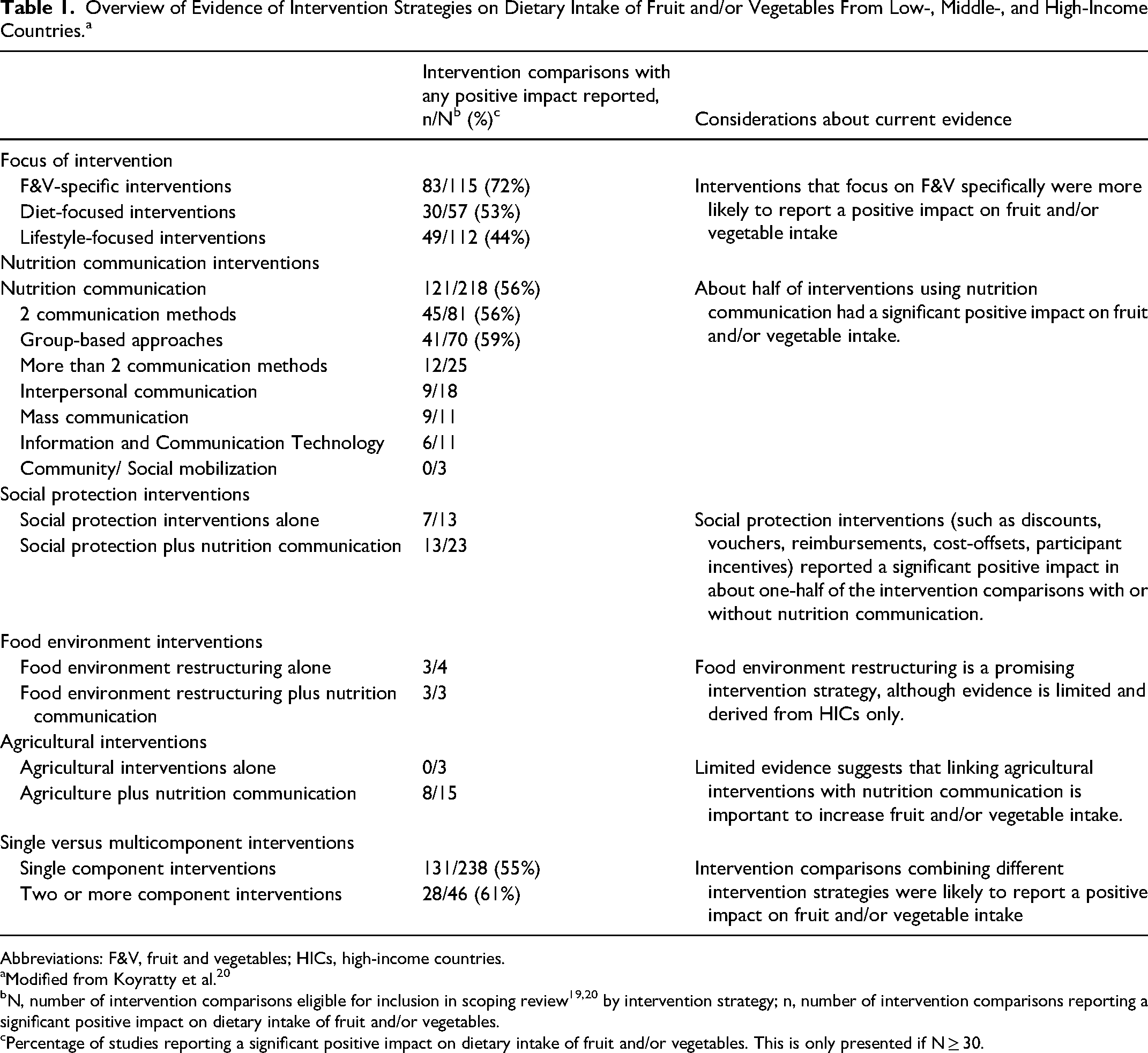
Abbreviations: F&V, fruit and vegetables; HICs, high-income countries.
Modified from Koyratty et al. 20
N, number of intervention comparisons eligible for inclusion in scoping review19,20 by intervention strategy; n, number of intervention comparisons reporting a significant positive impact on dietary intake of fruit and/or vegetables.
Percentage of studies reporting a significant positive impact on dietary intake of fruit and/or vegetables. This is only presented if N ≥ 30.
Global-Level Perspective
Only 32% of the evidence evaluating the impact of various interventions on dietary intake of fruit and/or vegetables derives from low- and middle-income countries (LMICs). 19 Specifically, only 10% of intervention comparisons were implemented in Africa and 19% in Asia. This inequity is particularly a concern considering that 19% and 59% of the world's population live in Africa and Asia, respectively, 21 and considering that F&V intake is particularly low in low-income countries. 22
It has long been recognized that diet-related NCDs (such as type 2 diabetes and cardiovascular diseases) and overweight and obesity can be prevented at the individual level by increasing F&V intake along with other improvements in dietary quality and engaging in regular physical activity.2,8 Thus, it is likely that the rise in the prevalence of NCDs, and overweight and obesity first observed in HICs led to an increased interest in improving dietary quality, which in turn may have led to more funding and resources allocated to these types of studies in HICs. However, considering the increase in the prevalence of obesity in many LMICs, 23 WHO recognizes that no country is protected against the obesity epidemic. 24 Moreover, 82% of the premature deaths attributable to NCDs occur in LMICs. 4 Thus, the imbalance in research focusing on interventions to increase F&V intake between HICs and LMICs needs to be addressed in future research.
Several valuable findings emerged as lessons that can be transferred between HICs and LMICs. 20 First, the proportion of studies showing consistent effectiveness of nutrition communication interventions for combined F&V intake across economic contexts was similar, 50% of intervention comparisons showing a positive impact in HICs and 53% in LMICs. This suggests that nutrition communication interventions can achieve similar success rates across different economic settings when adapted to the local context. Among the different nutrition communication strategies, group-based interventions were most frequently used in both HICs and LMICs. It was interesting to note that information and communication technologies (ICTs) and tailored feedback approaches were more frequently evaluated in HICs. It is envisioned that, as digital access increases in LMICs, adapting successful ICT approaches to promote F&V intake could be valuable. However, based on the available evidence, it is not clear whether ICT would be more effective, and little is known about the cost-effectiveness of the different communication strategies. Moreover, when trying to increase F&V intake, existing evidence highlights the value of F&V-specific messaging rather than general nutrition or lifestyle interventions.
Second, in terms of agricultural interventions, the limited evidence suggests that stand-alone agricultural interventions failed to improve F&V intake, while approximately half of the agriculture plus nutrition communication interventions succeeded. 20 This underscores that increasing availability through production alone is insufficient to change consumption behaviors, a finding that is consistent with evidence from a review of nutrition-sensitive agriculture programs. 25 Behavior change and nutrition communication components that build knowledge, skills, and motivation around F&V intake are critical complementary elements regardless of economic context. While study duration is important for addressing seasonal growing cycles and allowing sufficient time for crop maturation, the contrasting outcomes over the course of an intervention (eg, a positive impact on dietary diversity after 1 year of a homestead food production intervention, which disappeared after 3 years of intervention in Tanzania 26 ) imply that interventions may have to overcome various barriers over time to support sustainability of impacts.
Nine of the 14 social protection strategies providing either cash or in-kind food transfers plus nutrition communication found a significant positive impact on F&V combined with 4 out of 6 intervention comparisons in HICs and 5 out of 8 intervention comparisons implemented in LMICs showing positive impacts on combined F&V intake. 20 Combining approaches may have created additive or potentially synergistic effects across economic contexts, a finding that is consistent with reviews of other nutrition and health outcomes.27,28 For example, a comprehensive review found that social assistance programs improved dietary diversity and intake of micronutrient-rich foods among women and children, with in-kind transfers (nearly all including fortified foods) showing greater effectiveness for certain nutrition outcomes compared to cash transfers alone. 28
Lastly, food environment restructuring interventions were exclusively implemented in HICs, and most of them in school settings. Although the number was limited, 6 of the 7 intervention comparisons implementing food environment restructuring with or without nutrition communication found a significantly positive impact on either fruit and/or vegetable intake. As both the formal and informal food environment develop in LMICs, food environment interventions represent an untapped opportunity that could be adapted to settings in LMICs with consideration of various opportunities in and differing characteristics of the local food environment. 29 Moreover, in both Africa and Asia, there is a need for comprehensive research to better understand the connection between the food system, the different food environments and dietary practices.30,31
As we stated in the accompanying scoping review, 20 one of the weaknesses of the currently available evidence is the limited number of studies assessing the impact of stand-alone social protection programs, food environment restructuring and agricultural programs on the dietary intake of F&V. While some of these intervention strategies have shown impacts on sales, purchases, and/or homestead food production of F&V as an outcome,32–34 few of these studies assessed dietary intake of F&V, suggesting a need for more multidisciplinary research including experts in agriculture, postharvest processing, food environment, nutrition, sociology, economics, and policy. Such multidisciplinary collaborations may allow the assessment of outcomes along the whole food value chain.
At the global level, these cross-contextual findings suggest that, while certain intervention strategies may transfer between settings, implementation approaches need careful adaptation to local contexts. More research on better understanding facilitators, norms, barriers, and resources may be required. The current evidence of the impact of interventions on F&V is heterogenous and due to the limited number of some of the interventions, none of the strategies could be disregarded. However, multicomponent intervention strategies aiming to address multiple drivers of F&V intake and interventions focusing specifically on F&V were most likely to result in a significant positive increase in either fruit and/or vegetable intake. Because the intervention strategies included in the scoping review were diverse, the dietary assessment methods used varied widely and the number of studies per intervention strategy was low, we were not able to compare the intervention impact by study methods and intervention characteristics. There is a need to strengthen the evidence related to targeting, timing, duration, intensity, frequency, and other relevant characteristics for each of these intervention strategies to better understand how to increase the respective impacts on F&V intake. Evidence is also needed from implementation research to understand the short-term versus long-term impacts and sustainability of impact over time.
National-Level Perspectives
As mentioned above, WHO recommends at least 400 g of F&V consumed daily as part of a healthy, well balanced diet low in sugar and fat. 8 In line with this global recommendation, the daily intake of F&V is an important component in the country-specific food-based dietary guidelines of Benin, the Philippines, Sri Lanka, and Tanzania.35–39 These guidelines were developed based on available evidence to promote health and well-being in consideration of sociocultural factors and local consumption patterns. For example, based on regional consideration, Tanzania developed separate food-based dietary guidelines for the Mainland and Zanzibar due to the difference in available foods and dietary practices.38,39
Benin
Benin is a lower middle-income country, 40 with a poverty rate of 36.2% in 2022, 41 and a high burden of undernutrition among children under 5 years of age (stunting 36%, wasting 8% and underweight 21%, respectively) and a high prevalence of overweight and obesity affecting about a third of adults (30%).42,43 Benin's dietary guidelines recommend to “eat plenty of vegetables such as tomatoes, carrots, eggplants, and green leafy vegetables each day, either separately or as part of a sauce” and to “eat fruits every day.” 35 However, diets are generally cereal-based and monotonous with low intake of F&V among all population groups. 44 It is estimated that 57% of the population in Benin cannot afford a healthy diet, and that especially F&V are expensive relative to starchy staples when comparing the cost of healthy diets. 13 There has been very limited research on assessing impact of interventions designed to increase F&V intake conducted in Benin,19,20,44 with only 1 quasi-experimental study of solar-powered drip irrigation showing a positive impact on women's dietary diversity over the course of 1 year. 45 Considering the low F&V intakes and the high rates of poverty and food insecurity in Benin, further research on multicomponent interventions may be useful. For example, evidence suggests that social protection combined with nutrition communication showed promising results in LMICs and HICs. 20 This type of combined strategy may be impactful in Benin if well-designed and implemented.
To increase availability, affordability, and desirability of F&V in Benin, a recent foresight analysis recommended that policy makers should create an enabling policy and regulatory environment that guarantees compliance with quality and marketing standards, invest in research and development of the horticulture sector, promote diversification of the whole horticulture value chain, create business opportunities, and raise awareness of the health benefits of F&V. 46 In addition, the government's school feeding program, which covers nearly all primary schools, represents a strategic opportunity to promote early consumption of F&V among children. This could be achieved by serving balanced, healthy meals in school canteens and by promoting school gardens, as emphasized in the national food and nutrition policy. 47 School gardens can play a critical role in making the provision of F&V in school lunch both feasible and sustainable by serving as a reliable, low-cost source of fresh produce, reduce dependence on external supply chains, and foster children's familiarity with F&V. This approach may be more successful when combined with nutrition communication as several studies found significant impacts on F&V intake among school children in both HICs and LMICs. 20
The Philippines
The Philippines has been one of the most dynamic economies in the East Asia and Pacific region. 48 The agricultural sector plays a fundamental role in sustaining livelihoods, ensuring food security, and contributing to national economic growth. However, it faces multiple challenges that significantly affect its overall development and stability including land fragmentation, rural migration, access to finance and market opportunities, high equipment costs, and inefficient agricultural supply chain. 49 Findings from the National Nutrition Surveys conducted between 1978 and 2018 to 2019 show a declining trend in the mean per person per day consumption of F&V among Filipino households from 104 g to 34 g for fruit and 145 g to 127 g for vegetables, respectively.50,51 A recent scoping review found that across all population and sociodemographic groups, Filipino diets lacked diversity, with high intakes of energy dense, nutrient-poor foods, such as refined rice and sugar-based foods and beverages, contributing to inadequate micronutrient intakes. 50 The poor dietary diversity and inadequate F&V intake of Filipinos may contribute to the increasing risk of the double burden of malnutrition as reflected in the high prevalence of undernutrition among children 6 to 59 months of age (stunting 24%, underweight 27%, and wasting 5%); and the high prevalence of overweight (30%) and obesity (10%) among adults in the most recent national nutrition survey in 2023. 52 The Philippines is one of the frontrunner countries implementing the WHO acceleration plan to stop obesity. 24 Strategies implemented include restricting the marketing to children of foods high in fat, sugar, and salt, putting in place front-of-pack labeling, promoting better access to affordable healthy foods, and encouraging local government units to make space for safe walking, cycling, and recreation. 53
The food-based dietary guidelines in the Philippines recommends to “eat a half-plate of fruit and vegetables per meal, approximately ½ – 1 ½ cups of cooked vegetables, and 1 slice/piece of fruit per meal.” 36 While the Philippines has extensive information on the low dietary intake of F&V from the regular nationally representative nutrition surveys, the evidence on effective interventions is very scarce. 50 Specifically, our scoping review identified no interventional trial implemented in the Philippines out of 223 articles eligible for inclusion in the review.19,20 Although research implemented in other countries can provide relevant information on promising interventions, the Philippines is an archipelago and comprises of over 7600 islands and faces unique challenges. Moreover, the evidence of intervention impact on F&V intake was very heterogenous and no single intervention strategy or combination of strategies stood out as most effective.19,20 Thus, any intervention strategy aiming to increase F&V intake needs to be chosen based on the local context and adapted to the target Filippino population group and known enablers and barriers of F&V intake.
Sri Lanka
Sri Lanka, a lower middle-income country in South Asia, also faces a critical challenge in addressing malnutrition despite progress in health and social indicators. The country experiences a double burden of malnutrition, with high prevalence of child undernutrition among children under 5 years of age (stunting [14%], wasting [20%], and underweight [23%]) and among adult women, high prevalence of overweight (39%), obesity (13%), and undernutrition (13%). 54 Moreover, anemia and deficiencies in zinc, vitamin D, and vitamin B12 were reported as major public health problems among different age groups of the population. 54 Across various population groups and different regions within Sri Lanka, the intake of F&V is below the daily amount recommended by WHO and the food-based dietary guidelines for Sri Lankans.37,55 The latter recommends that “at least 5 varieties of fruits and vegetables should be consumed each day.” 37
Our scoping review identified only 1 interventional trial 56 implemented in Sri Lanka out of 223 unique studies eligible for inclusion in the review.19,20 This highlights a significant research gap in F&V intake interventions within the country. In this 12-month, cluster randomized trial conducted with school as a cluster, researchers examined the effect of a child-initiated intervention on weight, physical activity, and dietary habits of their mothers and found no significant difference between the intervention and control groups in individual-level food intake including that of F&V. 56 This limited representation of Sri Lanka in global intervention studies underscores the need for more research on understanding the barriers and opportunities for increasing F&V intake to design and evaluate context-specific interventions.
Sri Lanka's diverse ecosystems and extensive home gardens support the cultivation and conservation of numerous tropical and subtropical fruit, vegetables, and underutilized species, contributing to agricultural biodiversity and household nutrition. 57 Beyond enhancing local F&V production and supply chain, income-based interventions—such as cash transfers and financial incentives—may be more effective than price-based interventions to improve F&V intake. 58 Additionally, several key strategies have been proposed to increase F&V intake in Sri Lanka, including strengthening nutrition education and behavioral change programs in schools, workplaces, and communities, addressing food safety concerns through promoting good agricultural practices and reducing postharvest losses.55,59 However, the impact on dietary intake of F&V of these strategies has not been evaluated in the Sri Lankan context. Policy and regulatory support, including stronger national strategies and public-private partnerships, may be required to drive sustainable improvements in F&V production and consumption. Investing in research and innovation may provide evidence-based solutions to address barriers and develop effective interventions. A combination of short-term efforts, such as subsidies and school meal programs, with long-term investments in supply chain improvements and home gardening, may be needed for Sri Lanka to increase F&V intake, improve diet quality, and strengthen food security.
Tanzania
Despite increased investments and progress in implementing programs and policies aiming to improve nutrition outcomes in Tanzania, 60 stunting among children under 5 years of age and overweight and obesity among adults remain public health concerns. 61 Across all population groups, F&V intake is below the WHO recommended 400 g per day and the Tanzanian dietary guidelines, 61 which recommend the consumption of seasonally available and different colored vegetables every day to ensure diversity.38,39 Some studies suggest that the low F&V intake is due to both the low frequency and small amounts of intake and because many households do not consider fruit as part of the meal. 62 Low F&V intake is associated with socioeconomic status (low education, low-income occupations), cultural and traditional beliefs and practices, young age, being male, high tobacco, and low healthcare use among other factors. 63
Among the 4 target countries of the FRESH Initiative, Tanzania had the highest number of intervention trials with 3 studies assessing the impact on F&V intake. 19 Two of the studies included in the scoping review assessed the impact of homestead food production accompanied with nutrition education activities. One of these studies of home garden promotion found a significant increase in dietary diversity among women in eastern Tanzania over 1 year, 64 yet this difference in dietary diversity between the intervention and the control group disappeared after 3 years of intervention even though the proportion of women who grew at least 1 crop more was significantly larger in the intervention group. 26 Similarly, a multicountry study found no impact on the diet after 2 years despite an increase in household vegetable production in the Tanzania study site. 65 A third study assessed the impact of a nutrition-sensitive agroecology intervention including lessons on legume intensification, nutrition and women empowerment among food-insecure smallholder farmers and after 2 growing seasons the intervention increased the proportion of children meeting minimum dietary diversity in the postharvest season, but not the growing season. 66 Thus, despite using multicomponent intervention strategies, the impact of these interventions on F&V intake was limited. Authors reported that the reasons for this were multiple, including that participants preferred selling vegetables over consuming them and that the participation in nutrition training was low. 65 A meta-analysis of the association between production diversity and diet among small farm households found little evidence to support the assumption that increasing farm production diversity results in improved diets. 67 Overall, these results suggest that there is a need to better understand the barriers to F&V intake. While our scoping review19,20 did not identify any specific intervention as most effective, the evidence is considerable, and the existing evidence can be used to help choose and design future intervention strategies, which have to be adapted based on the needs of each target population group.
Future Directions
Considering the high prevalence of NCDs worldwide and the double burden of malnutrition in most LMICs, improving the quality of diets of most population groups is urgently needed. Actions are required at all levels to transform the food system 68 and address barriers to adopt and maintain a healthier diet. To encourage the consumption of recommended amounts of F&V, interventions should focus specifically on F&V as those were found to be more likely to be effective. Similarly, interventions combining multiple strategies tended to be more effective. The choice of intervention strategies needs to be adjusted to the local context and the target population group. For example, if costs of F&V are major concerns, social protection strategies and/or agricultural interventions combined with nutrition communication may be needed to address both the issue of affordability as well as desirability and preferences. While actions are needed to improve the dietary intake of F&V as part of a healthy diet globally, research should continue to strengthen the current evidence to better inform targeting, timing, duration, intensity, and frequency of strategies and programs needed to increase F&V intake in different population groups.
Conclusions
Despite the strong evidence of health benefits, the intake of F&V is inadequate in most population groups worldwide, particularly in LMICs. Available evidence from interventions that assessed impact on F&V intake is mixed with about half of the interventions showing a positive impact. This observation did not differ between HICs and LMICs. More research is needed to better understand the drivers of F&V intake in different population groups and across socioeconomic characteristics. Sufficient evidence is lacking to completely disregard any of the intervention strategies included in the scoping review, although the small number of stand-alone agricultural interventions consistently failed to increase F&V intake. Not one single intervention strategy stood out in our scoping review as more effective than others. However, intervention strategies that focused on F&V specifically and those implementing multiple components were more likely to result in increased fruit and/or vegetable intake. There is a need to strengthen the evidence related to targeting, timing, duration, intensity, frequency, and other relevant characteristics for each of these intervention strategies to better understand how to increase the respective impacts on F&V intake. In addition to investments in research, efforts are needed at the governmental level to foster a shift of the food system to ensure biodiversity, sustainability, and public health.
Footnotes
Authors’ Contributions
SYH led the writing of the manuscript, and SYH, IAA, JK, IMM, RS, and MT each drafted different sections. All coauthors edited the manuscript and approved the final manuscript.
Declaration of Conflicting Interests
The author(s) declared no potential conflicts of interest with respect to the research, authorship, and/or publication of this article.
Funding

Ethical Considerations
This perspective article did not involve human subjects.