



Abstract
Background:
It has been assumed that economically developed countries are well nourished compared to developing countries, but little is known about how economic status affects dietary micronutrient intake in the future childbearing generation.
Objective:
We analyzed the trend of dietary micronutrient adequacy in young adults in Japan, as one of the representative countries with advanced dietary habits and economic progress.
Methods:
We conducted a retrospective analysis using 2 web-accessible databases, namely the Japanese National Health and Nutrition Survey and the World Development Indicators.
Results:
Japan has been facing a progressive insufficiency of dietary vitamins A and C and iron, especially among young adults, over the past 25 years. The hidden progression of silent malnutrition has become more apparent since the 2010s, coinciding with a series of economic recessions and natural disasters.
Conclusions:
Given that parental dietary habits play a critical role in ensuring a balanced diet for their children, our findings underscore the importance of proactive nutrition counseling and education, especially for young adults of childbearing age who have been identified as vulnerable to micronutrient deficiencies. In line with this policy, we would like to suggest the use of digital transformation platforms as a potential solution in the future, especially for the digital native population.
Plain language title
Micronutrient deficiencies among young adults in Japan
Plain language summary
The Japanese diet, characterized by relatively high intakes of vegetables, fruits, soya products, seaweed, and fish, played an important role in Japan’s rise to the ranks of developed countries after World War II. Over the past 25 years, however, Japan has witnessed a progression of silent malnutrition, especially among young adults. It is possible that the progression of hidden hunger would have a non-negligible effect on the clinical picture of noncommunicable diseases in the developed country. With the 2019 coronavirus disease pandemic and Russia’s unprovoked invasion of Ukraine posing a global threat to the world’s food supply, we would like to emphasize well-coordinated educational approaches using information technology, especially for such a digital native population.
Keywords
Short Communications
The implementation of the public health system and economic growth after World War II have worked synergistically to give Japan the longest life expectancy. It is possible that the Japanese diet, which is characterized by relatively high intakes of vegetables, fruits, soya products, seaweed, and fish, also has played an important role in Japan’s ascension to the ranks of developed countries. 1 However, since the late 1990s, the country experienced a prolonged period of low economic growth followed by widening disparities in people’s income and nutrition status. During the latest 25 years, there has been a series of economic crises and natural disasters, including the Great Hanshin–Awaji Earthquake (1995), the Asian Financial Crisis (1997), the bursting of the dot-com bubble (2000), the Great Recession (2008), and the Great East Japan Earthquake (2011). Furthermore, it is uncertain whether the coronavirus disease 2019 pandemic and Russia’s unprovoked invasion of Ukraine (2022) pose a global threat to the world’s food supply. In addition, global environmental issues such as biodiversity, global warming, and greenhouse gas emissions need to be addressed. With uncertain times ahead, it is therefore highly justified to discuss practical solutions to the nutritional problems that lie ahead. At a global level, the United Nations Children’s Fund’s 2023 report showed that 419 million children under the age of 5 were stunted, 45 million were wasted, 39 million were overweight or obese, and 340 million were micronutrient deficient. 2 Despite the impending need to address these issues, little is known about the trend of dietary micronutrient intakes and their relevance to the economic situation even in the developed countries. In an attempt to obtain future perspectives of our dietary habits, we analyzed the Japanese National Health and Nutrition Survey (NHNS) database which provides us post-tabulated data on the mean and standard deviation of dietary intakes level from 1995 to 2019, categorized by gender and age. 3 The age distribution of the cross-sectional surveillance was as follows; 1 to 14 years (14.1% of participants), 15 to 49 years (38.3%), and over 50 years (47.4%). We obtained dietary data from 288 054 participants, including 135 540 males and 152 514 females, to analyze their dietary intake levels of vitamins (A, B1, B2, B3, B5, B9, B12, C, D, and K) and minerals (sodium, potassium, magnesium, phosphorus, iron, copper, and zinc) with known age- and gender-adjusted estimated average requirements (EARs) which are available to individuals aged 15 years and older (Figure 1). 4 We calculated the relative micronutrient intake ratio compared to the official EARs and performed an intergenerational analysis with a focus on the age-related disparity between young adults (15-49 years) and older adults (50 years and older). First, we found a small but nonnegligible decline in calorie and protein intake levels, particularly among young female adults. In contrast, these levels remained largely unchanged in males. According to the NHNS on self-image awareness in healthy individuals in their twenties, 63.8% of females, even those with a body mass index below the standard, still had a strong intention to lose weight. In contrast, only 29.4% of males expressed such an intention. 5 This suggests that self-image awareness, such as an obsession with slimming, may have played a significant role in the gender difference. Second, there has been a progressive insufficiency of oral intake of dietary vitamins A and C, as well as iron, which became more pronounced following the economic recession in the 2010s. Third, female dietary micronutrient intake, despite being currently maintained in relatively higher level, has declined faster than male intake over the last 2 decades. It is worth noting that the National Health and Nutrition Examination Survey in the United States also revealed that more than 60% of young adults, that is, 14 to 18 years females, 14 to 18 years males, 19 to 30 years males, had dietary vitamin C levels below the EARs, 6 as reported in our analysis. From a practical point of view, we believe that dietary vitamin C intake, particularly daily fruit, and vegetable intake, is one of the most sensitive indicators for scrutinizing trends in oral micronutrient status. However, before applying our findings to practical considerations, it is important to understand the specific limitations of this public database analysis. First, this surveillance did not include the habitual dietary intake of supplements and/or fortified foods, which are widely available among young adults. Second, in this cross-sectional survey, we were unable to analyze the correlation between micronutrient deficiencies and certain pathological conditions, such as night blindness, keratoconjunctivitis, scurvy, and anemia.
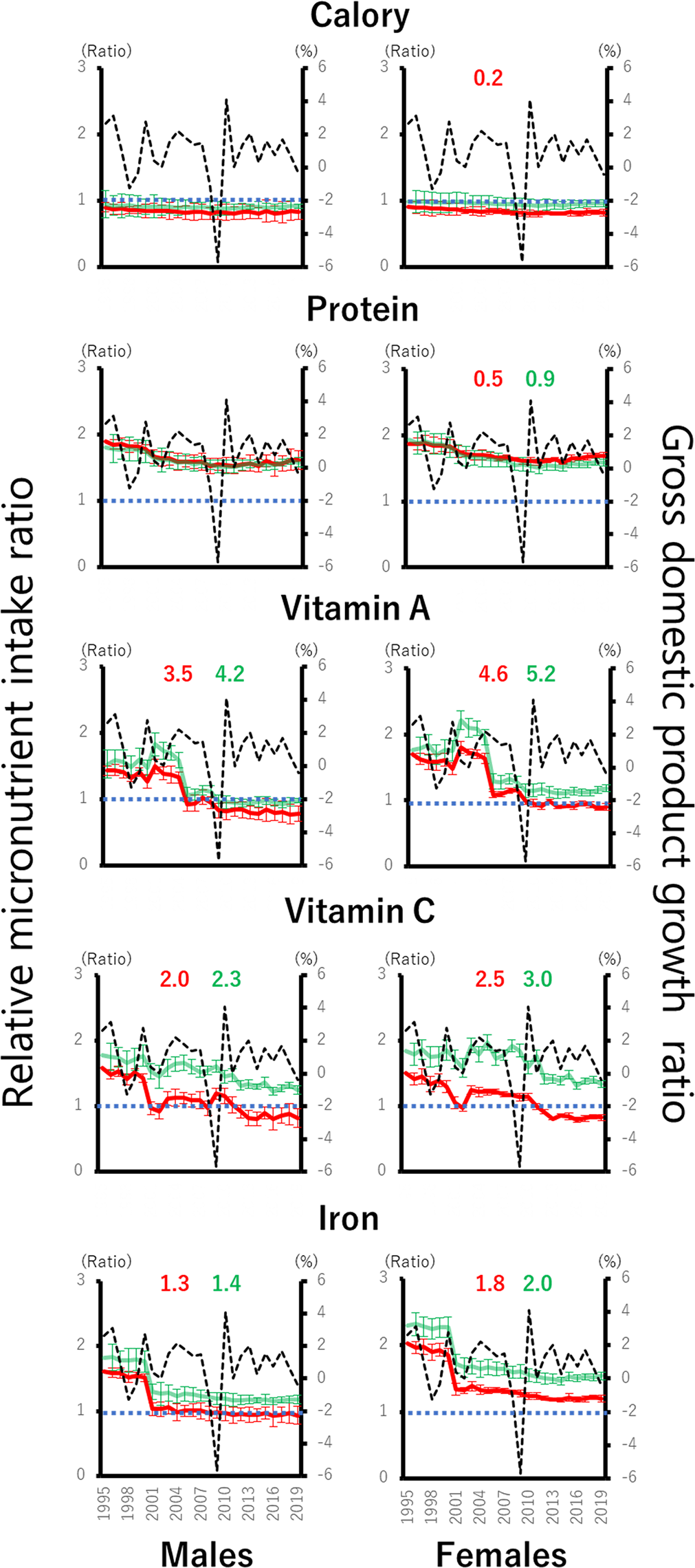
Trends in micronutrient intake adequacy in the Japanese population over the last 25 years. The left y-axis shows the relative micronutrient intake ratio for the corresponding element in relation to the age- and gender-adjusted estimated average requirements (EARs). The colored lines highlight the age-related difference between young adults (15-49 years, red) and older adults (50 years and older, green). Data are expressed as mean ± standard deviation. The annual decline ratio (percentage displayed) is shown with statistically significant difference by regression coefficient analysis (P < .05). The horizontal dashed blue line represents the standard line of the EAR, intake ratio of 1.0. The right y-axis represents the growth rate of Japan’s gross domestic product from the previous fiscal year (data was processed from world development indicators: https://datatopics.worldbank.org/world-development-indicators/). The annual change is shown by the dotted black line.
Indeed, nutritional status can vary widely among countries and individuals. However, we would argue that the emergence of subclinical micronutrient deficiencies is a sobering reality even in developed countries. Despite the growing concern about the relationship between a balanced diet and health, traditional nutrition counseling has relied on descriptive records and face-to-face interviews, which pose practical challenges to its feasibility. Given the future challenges of health literacy, we believe that the use of digital transformation platforms would be promising for new health promotion in the Anthropocene era. We propose 3 measures worth trying: (1) on-demand search of web-accessible appropriate public data repositories; (2) promotion of telemedicine to facilitate medical nutrition counseling anytime, anywhere; and (3) proactive introduction of user-friendly mobile applications, such as smartphones, to optimize diet and recipes in daily life. It is possible that current advances in accurate food image recognition and machine learning will provide practical solutions for healthy eating habits based on scientific knowledge in the near future. 7 We believe that a series of digital technologies can open up new avenues for health promotion, which will greatly improve nutritional status. Given that parents’ dietary habits may be one of the most important determinants of their children’s balanced diet, we would like to emphasize the importance of proactively introducing nutrition counseling and education, particularly to young adults of childbearing age, namely digital native population. We believe that a series of well-coordinated educational approaches can provide practical solutions to both long-standing and emerging nutritional problems.
Footnotes
Authors’ Note
Ethics approval was not necessary because the data were collected by the Ministry of Health, Labour and Welfare (MHLW) under the Statistics Act, and did not contain any individual identifiable information. The authors do not have permission to share data.
Author Contribution
Dr Kenichiro Kobayashi conceptualized and designed the research scheme, performed data curation and formal analysis, and wrote the paper. Dr Takashi Torii and Dr Toshiro Maihara contributed to the data interpretation and critically revised the manuscript. All authors approved the final manuscript as submitted and agreed to be accountable for all aspects of the work.
Declaration of Conflicting Interests
The author(s) declared no potential conflicts of interest with respect to the research, authorship, and/or publication of this article.
Funding
The author(s) received no financial support for the research, authorship, and/or publication of this article.