



Abstract
Background:
In response to calls to increase nutrition-sensitive agriculture (NSA), the Federal Ministry of Agriculture and Rural Development developed the Nigeria Agricultural Sector Food Security and Nutrition Strategy 2016-2025 (AFSNS). Capacity development activities to facilitate the AFSNS implementation subsequently commenced.
Objective:
This study analyzed the processes and outputs of initial capacity development efforts, examined findings from the analysis using existing literature, and identified critical next steps for nutrition capacity development in the Nigerian agriculture sector.
Methods:
The study reviewed documents including a proposal for nutrition training of agriculture sector actors, reports of meetings held among 6 resource persons who designed and/or delivered training, training reports, participants’ pre- and posttraining assessments, and participants’ training evaluation. Interviews were conducted with 2 resource persons involved in training design and delivery. Documents and interviews were coded and analyzed to identify emergent themes. Participants’ pre- and posttests results were compared using paired t test in Stata 12.0.
Results:
Knowledge and practice gaps were more extensive than had been anticipated. Training had some but limited effects on knowledge scores at the federal level. Modules addressing implementation practices had to be scaled down for participants to keep up with the learning pace. Existing literature indicates that such training would have been better planned as part of a broader sectoral nutrition workforce strategy, to facilitate greater tailoring of training to participants’ job roles.
Conclusion:
Effective AFSNS implementation requires developing and operationalizing a comprehensive short-, medium- and long-term Agriculture Sector Nutrition Capacity Development Strategy for Nigeria.
Introduction
The nutrition community has recognized the importance of agriculture and food security in reducing malnutrition for many years. 1 Still, the publication of the 2013 Lancet Series on Maternal and Child Nutrition significantly increased the attention given to the role of nutrition in improving agriculture. The Series showed that achieving 90% coverage of hitherto prioritized nutrition actions will reduce stunting by just 20%. 2 The Series further called for “effective, large-scale nutrition-sensitive [agriculture] programmes” among other nutrition-sensitive actions. 3
Nigeria bears a considerable portion of the global burden of malnutrition. 4 Most recent evidence indicates a stunting prevalence of 37% and a wasting prevalence of 7%. 5 Twelve percent (12%) of women of reproductive age are underweight, while 28% are overweight or obese. 5 In 2021, Nigeria had serious hunger levels with a Global Hunger Index of 28.3. 6 According to the 2020 State of Food Security and Nutrition in the World report, about a third of the Nigerian population (33%) cannot afford diets that provide sufficient energy; 72% cannot afford diets that contain recommended amounts of nutrients and 91% cannot afford diets that meet requirements of a healthy diet. 7 Given the health and economic consequences of hunger and malnutrition, reducing food insecurity and malnutrition in Nigeria is imperative for development.
The agriculture sector in Nigeria was historically focused on generating income, creating jobs, and providing raw materials for industry. Food security was not always emphasized, neither was nutrition explicitly addressed. Rather, both food security and nutrition were assumed to be natural dividends of agricultural development. 8,9 Yet, due to decades of underinvestment, Nigeria became a net food and raw material importing country. The increasing global calls for nutrition-sensitive agriculture (NSA) coincided with reforms in the agriculture sector, and the Federal Government of Nigeria, from about 2010, began to take strategic steps to maximize the potential for agriculture to improve nutrition. 8 A unit in the Federal Ministry of Agriculture and Rural Development (FMARD)—the Women in Agriculture Unit—was converted into the Nutrition and Food Safety Unit and was shortly upgraded to become the Nutrition and Food Safety Division. Further, an Agricultural Sector Food Security and Nutrition Strategy 2016-2025 (AFSNS) was developed to articulate NSA actions that the Nigerian government has prioritized to advance in collaboration with other stakeholders. 10
Nigeria has 774 local government areas (LGAs) across 36 states and a Federal Capital Territory. The responsibility for agriculture is shared among the federal, state, and LGA levels. The role of FMARD is to develop agricultural policies and strategies at the federal level, disseminate them to the states and then monitor and evaluate the implementation of the policies and strategies. Federal Ministry of Agriculture and Rural Development comprises divisions and units responsible for developing specific agricultural produce value chains. While several divisions and units assert that nutrition is a priority, their strategies do not include definite nutrition objectives and activities. The majority of the divisions and units instead consider that improving the value chain of nutrient-dense foods will automatically improve nutrition. 9 At the state level, State Ministries of Agriculture (SMAs) and State Agricultural Development Programmes (SADPs) are responsible for agriculture. State Ministries of Agriculture translate federal-level policies and strategies into state priorities and actions; while SADPs coordinate extension services and support farmers to implement policies and strategies. Local government area departments of agriculture organize farmers and facilitate access to agricultural inputs, irrigation, and mechanization. 9
An assessment of the readiness of the agriculture sector to implement NSA at federal, state, and LGA levels found that despite strong interest, both institutional and personnel capacity were weak. 11 There was no staff with formal nutrition training in the Nutrition and Food Safety Division or the Ministry of Agriculture at any level. Desk Officers for various value chain units including those of nutrient-dense commodities had inadequate ability to view their activities through a nutrition lens. Nutrition knowledge was generally low among agriculture sector personnel, and nutrition capacity building for staff was ad hoc and limited. 11 Capacity development activities were therefore initiated at the federal and state levels in 2017 in order to facilitate implementation of the AFSNS. The activities included disseminating the AFSNS and training key personnel about NSA and using the AFSNS. Yet, 6 months after initial training of federal- and state-level participants, little to no implementation of the AFSNS was taking place and integration of nutrition into agricultural actions had not meaningfully improved. Key personnel, including those who participated in trainings reported not knowing how to integrate nutrition into routine activities.
The overall aim of this study was to identify training gaps that may have contributed to the participants’ reported lack of knowledge. The specific objectives included to analyze the processes and outputs of preliminary training activities, examine the findings from the analysis using existing literature, and identify gaps and critical next steps for nutrition capacity development in the Nigerian agriculture sector. Following this introduction, a methods section describes the study activities undertaken. The processes and outputs of the trainings are highlighted in the results section, and the discussion section draws inferences from the results based on the work of other authors.
Methods
The study was conducted by reviewing reports/documents from training activities and interviewing 2 out of 6 persons involved in designing and/or delivering the training. Reports reviewed included the proposal for nutrition training of agriculture sector actors, reports of meetings held among resource persons who designed and delivered training, and reports of training at federal and state levels. Other documents from the training included pre- and posttraining assessments of participants, daily feedback forms, and overall training evaluation by participants.
Reports, participant feedback forms, training evaluations, and interviews with resource persons were coded and analyzed to identify emergent themes and subthemes. The results of pre- and posttests conducted for participants were analyzed and differences between pre- and posttest scores at both federal and state levels were assessed using the paired t test in Stata 12.0. The probability of decision error, α, was set at 0.05. The interviews and data analysis were conducted in 2018 by 1 of the 6 resource persons involved in the design but not the training delivery.
Results
Process of Training Design and Delivery
A Training of Trainers approach was employed for the training. Activities commenced in February 2017 with the formation of a team of 6 resource persons from universities and development organizations who would design and execute training activities. A pretest was then administered to officers assigned roles to improve nutrition (nutrition focal persons) across the departments and agencies of FMARD. These officers were intended to be trained as master trainers and then supported to cascade training received to the state level. Questions (Table 1) were asked to include routine, potentially novel, and practice-related matters. The purpose of the pretest was to determine existing knowledge and guide training content.
Federal Level Pre- and Posttest Questions and Participants’ Performance.
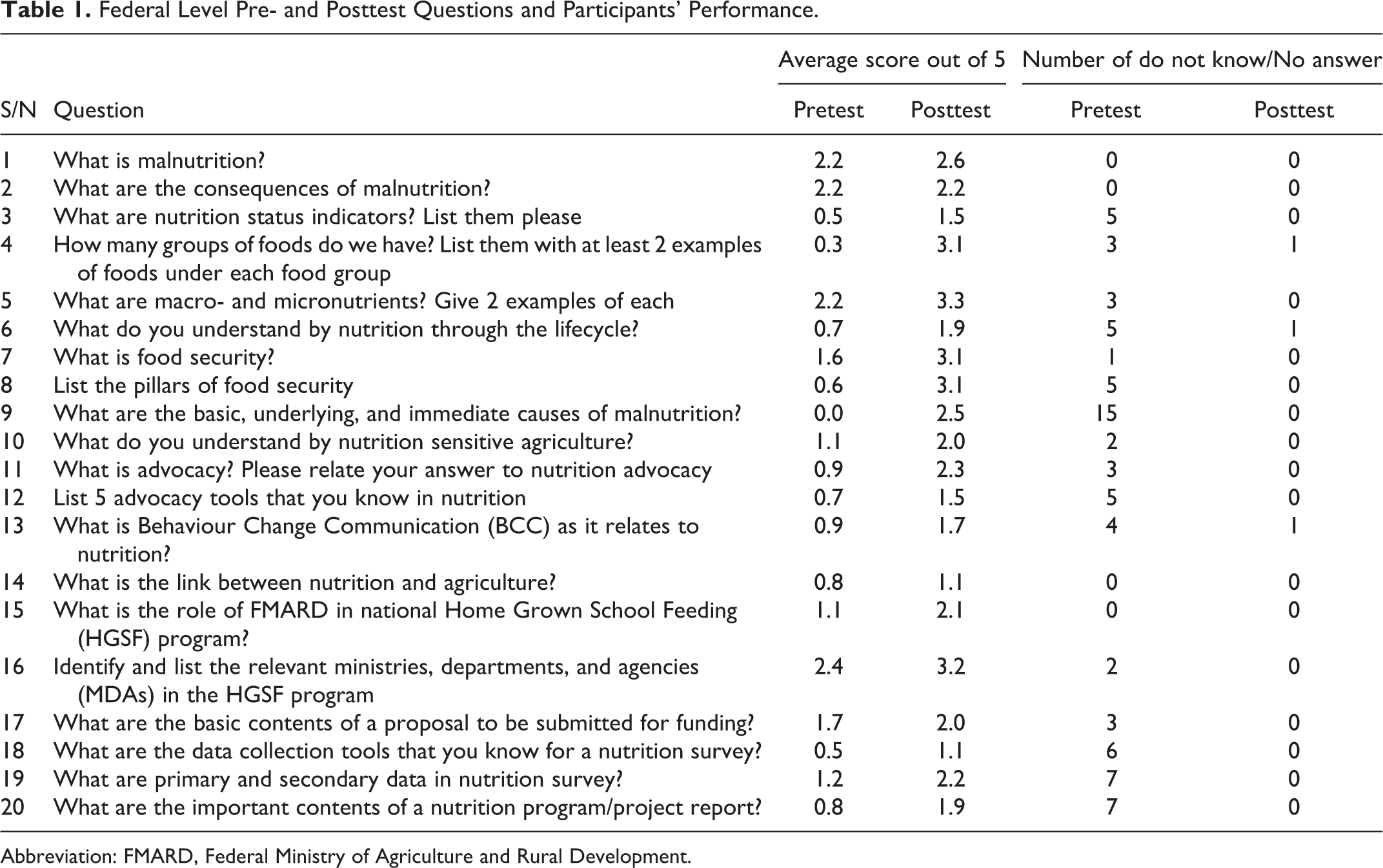
Abbreviation: FMARD, Federal Ministry of Agriculture and Rural Development.
Following the pretest, the team of resource persons held a meeting to set scoring criteria for the pretest, review and score participant responses, and outline each team member’s training content and contributions based on their expertise. Team members subsequently developed the training content into a manual comprising 10 modules that addressed recognized knowledge and practice gaps, and included case studies and activities. The 10 modules were—Introduction to Nutrition; Nutrition throughout the Lifecycle; Causes and Consequences of Poor Diets and Malnutrition; Addressing Malnutrition; Nutrition and Agriculture; Nutrition Advocacy, Education, and Behaviour Change Communication; Measuring Nutritional Status; Designing and Planning Nutrition Interventions; Leadership and Management of Nutrition Programmes; Use of the AFSNS and Monitoring and Evaluation.
The federal-level training was held for 6 days in May 2017. Daily training feedback was obtained on modules taught and was used to assess participants’ attitudes to NSA. The training was structured to cover 2 of the 10 modules per day. The manual was thus covered in 5 days, and the sixth day was spent doing a field practice of nutrition measurement and nutrition education activities. A posttest was conducted at the end of the training to determine changes in participants’ knowledge. Participants were also required to evaluate the training overall and highlight areas of adjustment needed for state-level training.
The state-level training modules were reviewed and revised using the feedback from the federal-level training. Notably, the manual was scaled down into 7 modules—Introduction to Nutrition; Nutrition throughout the Lifecycle; Causes and Consequences of Poor Diets and Malnutrition; Nutrition Interventions; Implementing Nutrition Programmes; Nutrition Education, Behaviour Change Communication and Advocacy; and the AFSNS. State participants were selected from each of the 6 geopolitical zones in Nigeria and were then trained in 2 batches for 3 days each, in November and December 2017. The state-level training participants included nutrition focal persons from the health sector and those from the agriculture sector, to foster cross-sectoral collaboration in program implementation. Each of the participants at both the federal- and state-level trainings received a hard copy of their training manual. Participants were accommodated at the training venue for the training duration.
Outputs of Federal-Level Training
There were 17 participants at the training, 15 of whom had taken the pretest. Of the 17 participants, 14 had educational qualification(s) in agriculture, 2 in food science and technology, and 1 in rural development. None of the participants had formal nutrition education. The participants were all affiliated with a department or agency of the FMARD.
At the pretest, 16 questions (80%) had at least one participant recording no answer or responding “do not know” (Table 1). Participant knowledge was relatively low, even for questions that were expected to be routine. For instance, participants were unable to list food groups; food groups were confused with nutrient classes by all but one participant. Also, pillars of food security were unknown; participants perceived behavior change communication as the transmission of information; and the role of FMARD in the home-grown school feeding program was poorly conceptualized, even though the program was already being implemented and documentation exists about the role of agriculture. Participants could only conceptualize food and consumption pathways for aspects such as links between agriculture and nutrition. The average pretest score per question was 1.2 points out of 5.0 possible points. The average number of no response/“do not know” answers per question was 3 participants. Table 1 presents the score and no response/“do not know” breakdown per question. The total score for participants in the pretest ranged from 6.8% to 57.9%, with a mean of 23.8%.
The training successfully increased the knowledge of participants. Just 3 questions (15%) had no response/“do not know” answers and only one of such answers was recorded for each of these 3 questions. The difference in the number of no response/“do not know” answers between the pretest and posttest was statistically significant (P < .0001). The overall average posttest score per question was 2.2 out of 5.0 possible points, significantly different from the 1.2 points of the pretest (P < .0001). Total participants’ scores at posttest ranged from 20.0% to 67.0%, with a mean of 46.2%. The difference in participants’ scores from pretest to posttest was also significant (P < .0001).
Feedback from participants was that the training content appeared overloaded for the allotted 6 days and that retraining/refresher training using the manual should be routinely planned to enable better assimilation. Other recommendations made by the participants included: Division of subsequent training into 2 phases, with each phase focusing on 4 or 5 modules Simplifying and limiting the number of modules included in state and LGA-level trainings, with considerations for the caliber of trainees that are likely to be at these levels Increasing practical illustrations and exercises to explain the modules Increasing the training time allocated to each module
Given the performance of the federal-level trainees at the posttest and the training feedback, it was considered that the participants did not yet qualify to be master trainers. It was further decided that the team of resource persons would conduct the initial state-level training, while using the federal trainees as support staff to further enhance their knowledge and facilitation skills.
Outputs of State-Level Trainings
A total of 53 participants were trained from 19 states across 5 of the 6 geopolitical zones in Nigeria. There were 3 participants each for 13 states, 2 participants each from 5 states, and 4 participants from one state. Nearly 30% of the participants were from state ministries of health or state primary health care development agencies, including state nutrition officers for several states. These participants from the ministries of health generally had formal training in nutrition and/or had attended other nutrition training/workshops. The other participants were from SMAs and SADPs and had much less nutrition training.
In keeping with the recommendations from the federal-level training, the state-level training content was scaled down. The pre- and posttests were also down scaled to 10 knowledge questions (Table 2).
State-Level Pre- and Posttest Questions.
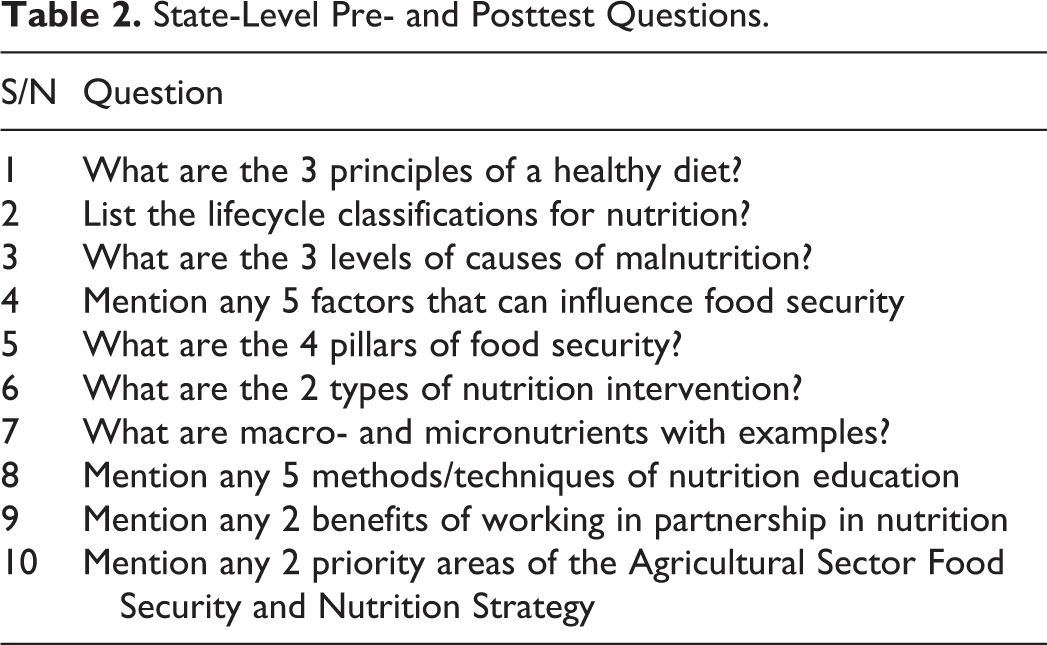
Like the federal level, the training successfully increased participants’ knowledge. For the pretest, the average total participant score was 22.5%, while in the posttest it was 83.2% (P < .0001). Pretraining knowledge was significantly different by sector. While the average pretest score for participants from the health sector was 31.7% (range of 0%-76%), the average pretest score for SMA and SADP participants was 18.5% (range of 0%-47%, P = .01). After the training, there were no significant differences in knowledge by sector. The average posttest score for health sector and agriculture sector participants was 81.6% and 83.3% respectively (P = .81).
Future training recommendations from participants included increasing the duration of the training and the time spent on each module; incorporating many more examples of good practices; and including demonstration sessions, field visits, and other types of experiential learning.
Key Informants’ Perspectives About Trainings
The major theme from interviews was that the trainings had not sufficiently built capacity. Despite the substantial increase in participants’ knowledge, knowledge was adjudged to still be inadequate, as less than 50% of participants got full marks for most posttest questions. Participants struggled to understand the new knowledge and replace previous misconceptions with the new knowledge. It was reflected that the training participants could not yet facilitate the training of frontline agricultural workers in NSA, because of the significant gaps that remained in their knowledge and understanding of NSA and its applications in service delivery. Part of the limited ability of the training to enable implementation of NSA was attributed to the unexpectedly large participants’ knowledge and skill gaps. The readiness assessment from which the training had been developed did not document the depth of capacity gaps, but merely that they existed. Planning for the training had assumed that participants will have some knowledge and skills, for example, knowing what food groups are, but this was not the reality.
A second theme was that the training was able to improve attitudes toward multisectoral collaboration. At the commencement of the state-level trainings, several of the nutrition focal persons from the health sector perceived that they should have been the support staff/cofacilitators for the training, rather than the staff from FMARD. This perception was rooted in the fact that they already had considerable nutrition knowledge and expertise and had been involved in nutrition at the state level for many years. With the training sessions that emphasized the role of different sectors and the necessity for cross-sectoral collaborations and partnerships, this sentiment waned.
Discussion
This study aimed to assess the potential effect of training on the nutrition knowledge of agricultural actors and their ability to implement NSA, and to identify additional capacity development needs. Training targeted agricultural, civil service policymakers at federal and state levels, and agriculture and health, civil service policy implementers at state level. The study found that while training significantly increased participants’ knowledge, there were still extensive knowledge and skill gaps to be addressed for implementing NSA.
One strength of the trainings was that it was based on a capacity assessment. The readiness assessment 11 mentioned earlier had been undertaken just a few months before the training and was the basis of the training. An output of the assessment had been the development of a theory of change for individual capacity, which had identified key training elements as alignment of training content with participants’ expressed needs; increasing knowledge and skills and changing attitudes toward the role of agriculture in addressing nutrition; and joint training for agriculture and nutrition sector actors. The assessed trainings fulfilled these criteria highlighted by the Maximising the Quality of Scaling Up Nutrition (MQSUN) programme that conducted the readiness assessment. 11 Other authors have emphasized the need for effective NSA capacity development to be preceded by assessments, 12 -14 and to bring together the agriculture and nutrition (health) sectors. 15,16
A second strength of the training was that it included both federal- and state-level participants and increased acceptance of the role of agriculture sector actors in addressing nutrition. Crisp et al 17 highlight 4 domains for capacity building: top-down organizational approach (targeting policies/practices), bottom-up organizational approach (targeting knowledge and skills of frontline workers), partnerships approach (targeting collaboration and coordination among stakeholders), and community organizing approach (targeting beneficiary responsiveness and self-efficacy). These authors 17 further highlight that effective capacity building requires strengthening more than one domain. Other authors 14 similarly emphasize the need to train policymakers; researchers, planners, and trainers; and program implementers for adequate capacity development. The training assessed in our study targeted personnel involved in developing policies and standardizing practices (federal level) as well as personnel involved in managing frontline workers and expanding their knowledge and skills (state level). The training further increased the potential for nutrition partnerships among staff from various departments and divisions within FMARD, as well as between agriculture and health sector actors. An additional strength of the training is that the topics covered at the federal level were in line with critical knowledge considered necessary for nutrition actors in this era. 18 This knowledge includes nutrition leadership, advocacy, implementation, monitoring, and evaluation.
Despite these strengths, the trainings did not have the desired effects. Participants’ knowledge increased but did not increase to a sufficient extent at federal level and was based on partial content at the state level. The work of other authors suggests several actions that could have made the training more effective. The limited improvements in capacity following the trainings are not unique. Several authors 16,19 -21 similarly reported limited progress in the ability to undertake NSA-related activities following training in some case studies. Based on the works of these and like authors, crucial factors for training effectiveness for improved implementation have been identified that were missing from the federal- and state-level trainings that our paper reports.
First, the training was not explicitly developed as part of a broader capacity development strategy and was not tailored to the job description and roles of specific participants. Instead, the training included content related to the collective roles of all participants. Some authors have emphasized that trainings are most effective when implemented as part of a “Nutrition Workforce Strategy,” 13 and when considering workforce capacity development as including not just the individuals involved but also the institutions/systems, organizations, and communities. 14,22,23 Such an effective workforce capacity development strategy will include contextually defined competencies for each cadre of personnel involved in service design, planning, and delivery, and a plan to develop the competencies. In other words, capacity building must focus on performance and what those trained would use the capabilities for. 12 -15 The strategy will further need to be developed in collaboration with its target audiences to be effective. 24 Relatedly, capacity building needs to be conceptualized as a continuous process and not a project with an end date. 12 Thus, the capacity strengthening strategy must include short-, medium-, and long-term actions encompassing preservice training, in-service training, and continuing education/lifelong learning. Strategies for empowering organizations, processes, and systems, as well as ensuring the availability of necessary tools and job aids, must additionally be articulated. 13,14
Regarding implementing a capacity strengthening strategy, existing literature indicates that a training component will achieve desired changes in approach and behavior if it is theory based, including use of adult learning approaches, and influenced by formative research. Effective training further adjusts for trainers’ capacity and time availability, is implemented with fidelity, and meets the logistics and other needs of the target population. 25,26 In-service training could involve blended learning with some aspects taught via distance learning and others taught face-to-face with trainers/mentors. 14 Indeed, ensuring that the characteristics of trainers, including knowledge, skills, and experience, are suited to the training audience is crucial for training success; and several criteria have been suggested for selecting trainers. 27
Moreover, unlike the training our study assessed, effective training requires a focus on attitudes, skills, and behaviors and not primarily an emphasis on increases in knowledge. 23 Development of skills and behaviors particularly requires practice sessions and/or supportive supervision as part of the training. 28 Additional approaches that can be used to improve attitudes, skills, and behaviors include mentoring, technical assistance, and communities of practice. 28,29 In addition to attitudes, skills, and behaviors, other authors 30 highlight further domains in which individual capacity can be strengthened, including confidence, motivation, and professional satisfaction.
Conclusion
Organizing training to develop the capacity to implement NSA interventions has increased over the past few years since the release of the 2013 Lancet Nutrition Series. The experience of the NSA training targeting federal- and state-level public actors in Nigeria adds to the literature that even carefully designed training may not have desired impacts. Effective training to improve implementation cannot occur in isolation and cannot precede the development of a workforce capacity strengthening strategy. Such a strategy targets not just individual workers within the context of their job roles but also the tools and processes with which they work as well as the organizations, institutions, and communities in which they work. The capacity strengthening strategy for these different components/domains must be explicit, agreed upon by relevant stakeholders, and documented.
Following the lessons learned from this study, efforts to produce and implement a Nigeria Agricultural Sector Nutrition Workforce Development Strategy commenced in 2019 with the preparation of a background document. This document highlights nutrition strategic directions for the Nigerian agricultural sector; the existing supply of nutrition capacity in the sector across institutional, organizational, and individual levels; and the current and future demand for nutrition capacity in the sector given the strategic directions. The background document identifies 6 particular cadres within the agricultural sector whose nutrition capacity needs to be developed at federal, state, and LGA levels: nutrition focal persons, extension agents, value chain officers, monitoring and evaluation officers, elected and legislative policymakers, and tertiary-level students in agricultural fields of study. Beginning in 2022, the nutrition competencies and capacities required for each cadre, at each level of government, is being developed as the next step toward finalizing the Agricultural Sector Nutrition Workforce Development Strategy. While these processes have been ongoing, capacity development of nutrition focal persons at FMARD has continued through workshops on specific nutrition-sensitive topics/activities and establishment of partnerships with civil society actors to enable hands-on involvement with active NSA interventions.
Footnotes
Declaration of Conflicting Interests
The author(s) declared no potential conflicts of interest with respect to the research, authorship, and/or publication of this article.
Funding
The authors disclosed receipt of the following financial support for the research, authorship, and/or publication of this article: The Bill and Melinda Gates Foundation funded the trainings reported in this article as well as the article’s publication.
