




Abstract
Background:
Changes in preparation, preference, and consumption of traditional staple foods between rural and urban areas in sub-Saharan Africa may be associated with the nutrition transition.
Objective:
Millet porridge thickness and postprandial hunger were investigated in Mali with the aim of understanding consumer preference and satiety properties.
Methods:
Rural and urban residents from 3 regions (N = 60) were surveyed regarding their porridge consumption frequency and thickness preference. Influence of millet porridge thickness on satiety was investigated. Ten participants consumed 4 porridges of different thicknesses (3 of millet and 1 thin porridge of rice) and rated their subjective hunger on 4 different days.
Results:
Thicker porridges were consumed more frequently in rural areas than in urban (P < .05). For the satiety study, thicker porridges induced higher satiety than thinner ones at 2 and 4 hours postconsumption (P < .05; Visual Analog Scale rating). A greater amount of flour, but not volume, was consumed for the thicker porridges (P < .05).
Conclusions:
Urban participants preferred and consumed porridges that are less satiating, potentially contributing to higher food consumption related to the nutrition transition in Africa.
Introduction
In sub-Saharan Africa, changes in lifestyle factors, mainly driven by migration to urban areas, have influenced dietary habits and food preferences. 1,2 This is also true of the Malian population, where increased urbanization has been noted to accelerate the nutrition transition that leads to obesity and associated nutrition-related diseases. 3 More broadly, in Africa, obesity has become an important public health concern, especially in urban female populations. 4 The resemblance of dietary habits and food preferences to Western diets and rise in noncommunicable metabolic disease prevalence in African urban areas contrast the relatively high levels of infant mortality, undernutrition, and low caloric intake in its rural areas. 5
In Sahelian West Africa, thick cereal porridges constitute a major part of the diet and anecdotally are known to promote “fullness.” In Mali, pearl millet and sorghum flours are typically used to make a highly viscous thick porridge known as tô. 6 Preparation of tô includes cleaning and decorticating the grain, grinding to flour, sieving to separate coarse and fine flours, mixing the coarse flour in water (38 °C), bringing it to boil, and adding the final fine flour. Preparation methods of thick porridges vary across countries in the West African region with porridges differing in degree of thickness, with some being thick to the point of holding a stiff peak shape when served. 7 Sensory attributes including color, taste, aroma, and porridge texture influence consumer preference, although prior studies show texture is the primary consideration. 7,8 High viscosity, as is found in thick porridges, can induce a prolonged sense of fullness and delayed sense of hunger, as well as lower appetite. 9,10 Highly viscous foods have also been found to delay gastric emptying time, 11 which aligns with previous work of ours showing in Bamako participants that millet and sorghum thick porridges had delayed gastric emptying times compared to nontraditional starchy foods—white rice, white potato, and well-cooked macaroni pasta. 12 Viscous foods cause high postprandial gastric volumes, which as stated by Marciani et al 13 could trigger a satiety mechanism related to the activation of mechanoreceptors in the stomach. Another clinical trial assessing viscosity and fullness showed similar results regarding postprandial feelings of hunger, desire to eat, and fullness when isocaloric samples varying in viscosity were used. 9 It seems reasonable that differences in thickness (ie, viscosity) of African thick porridges may affect appetite as well as subsequent food intake.
Given that populations consume millet porridges with different degrees of thickness in sub-Saharan Africa, 7 we supposed it possible that individuals may change their preference for and preparation of porridge in a manner related to satiety. Accordingly, an individual in an urban area, where there is easy access to more food options, may prefer porridge that is less thick than an individual in a rural area, where there may be limited access to diverse food options and a need to consume more satiating foods providing sustained energy. Thus, the objective of this study was to identify differences in food preparation, preference, and consumption for Malian millet tô porridge thickness between urban and rural populations and to determine the influence of porridges varying in thickness on satiety. We hypothesized that rural residents would consume thicker tô related to better satiety and feeling of sustained energy, while urban residents would consume less thick and perhaps less satiating tô. Results are discussed in relation to the problem of the nutrition transition in cities in Africa.
Participants and Methods
Participants
In 3 regions of Mali (Mopti, Ségou, Sikasso), participants (N = 60 total) were recruited by community leaders from rural village-level communities (Koporope, Konogola, N’Kourala, respectively) and their respective urban centers (Mopti, Ségou, Sikasso; populations between 92 000 and 145 000, Figure 1; https://www.worldometers.info/world-population/mali-population/). All participants in rural communities were farmers, whereas in urban areas they had different occupations. A preference questionnaire and semistructured interviews were used to obtain information regarding porridge consumption and preference. A subset of participants (n = 10; 6 females, 4 males) agreed to partake in a feeding study to determine the effect of millet porridge thickness on satiety. All parts of the study were conducted in accordance with guidelines laid down in the Declaration of Helsinki. Verbal informed consent was obtained from all participants, mostly due to their education level. Verbal consent was witnessed and formally recorded.
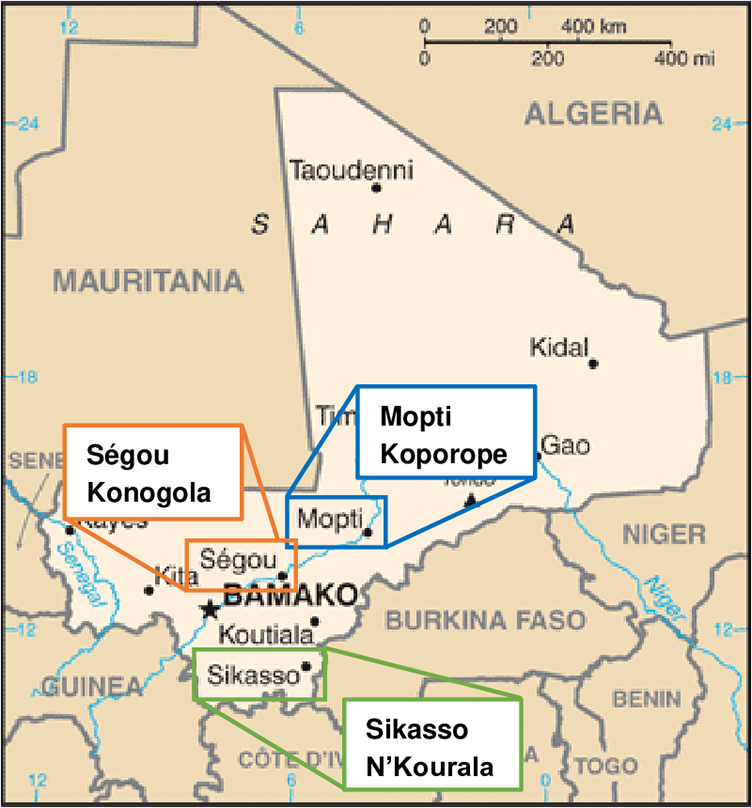
Locations of rural areas and their respective urban counterparts. Rural areas: N’Kourala, Konogola, and Koporope. Urban areas: Sikasso, Ségou, and Mopti.
Assessment of Porridge Consumption Frequency and Thickness Preference
Porridge consumption frequency, thickness preference, cereals used to prepare porridge, and reasons for thickness preference were determined using a semistructured interview and preference questionnaire. Participants were asked to prepare porridge as was customary and 2 samples (0.1 kg each) were collected from each participant during lunch and dinner times. Porridge thickness was determined 2 and 12 hours after preparation using a Universal Portable Penetrometer (H1252, Humboldt Mfg. Co) and assessed using CIRAD (1995) guidelines: 14 very thick tô (VTT; penetration depth ≤ 4 mm), thick tô (TT; 4 mm < penetration depth < 7 mm), medium thick tô (MTT; 7 mm ≤ penetration depth ≤ 8 mm), thin tô (8 mm < penetration depth < 10 mm), and very thin tô (penetration depth ≥ 10 mm).
Porridge Preparation for Satiety Study
Food materials
Pearl millet grain (8 kg) was obtained from a local producer (Koporope, Mali). White rice and sweetened condensed milk (for the thin rice porridge [TRP]), and the sauce and stew ingredients, were purchased from the local market in Koporope, Mali.
Millet was decorticated by mechanical abrasion until 15% decortication rate was achieved by weight and was subsequently winnowed, washed to remove impurities, and then dried and ground to flour. The flour was sifted using a 0.001 mm sieve. Fine (throughs) and coarse (overs) flours were used as described in the next section.
Millet thick porridge preparation
Very thick tô was prepared using 1.7 kg of coarse flour, 4.2 kg of fine flour, and 11 L of water; TT was prepared using 2.1 kg of coarse flour, 3.3 kg of fine flour, and 12.9 L of water; and MTT was prepared using 1.4 kg of coarse flour, 3.5 kg of fine flour, and 14 L of water. Porridge solid concentrations for VTT, TT, and MTT were 34.9%, 29.3%, and 25.9%, respectively. Porridge samples were prepared by stirring coarse flour in 2 L of ambient temperature water (∼38 °C). The slurry was poured into boiling water, mixed using a wooden spatula, and cooked for 16 minutes in a 20 L cooking pan for VTT and TT porridges and 11 minutes for MTT porridge. Fine flour was added and the mix was cooked for 40 minutes for VTT and TT samples and for 50 minutes for MTT samples. Porridge samples were removed from the cooking pan and placed onto plastic plates. Sauce and stew, prepared as described below, were added in a minor and consistent amount to each porridge for palatability.
Porridge sauce was prepared by mixing 4 L of water with 0.3 kg of fermented African locust bean, 0.35 kg of dry baobab leaf powder, 0.02 kg of dried smoked fish, 0.01 kg of bouillon cube, and 0.1 kg of salt. The mixture was stirred using a wooden spatula and cooked for 40 minutes. Stew was prepared by frying 0.06 kg of dried onions in 0.2 L of peanut oil, then 0.075 kg of Parkia biglobosa seeds, 0.20 kg of smoked fish, 0.01 kg of bouillon cube, and 0.03 kg of spices were added. The mixture was cooked for 10 minutes, and 3 L of water was added. The stew was then cooked for an additional 30 minutes.
Rice thin porridge preparation
White rice (3 kg) was winnowed and washed to remove impurities, dried, and ground into flour. Rice flour was cooked for 40 minutes with 14 L of boiling water. The mixture was stirred at 2 minute intervals during cooking, and an additional 4 L of water was added to the porridge as it thickened. The cooked porridge was removed from the pan and transferred into a 20 L container. The cooking pan was rinsed with 3 L of water which was added to the porridge. The porridge was slightly cooled by gentle stirring. Sweetened condensed milk (1 kg) and 1 kg of sugar were added to the porridge. In Mali, very thin porridges are normally sweetened, and this practice was adhered to since our objective was to assess viscosity while avoiding changing a cultural factor.
Evaluation of Porridge Thickness for Satiety
A study was conducted over 4 days to determine the effect of millet porridge thickness on satiety. Three tô porridges of different thicknesses (VTT, TT, and MTT) were compared to a TRP. Ten panelists from the agricultural research substation and the village of Koporope were instructed to eat each porridge ad libitum until fullness. A minor and consistent amount of sauce and stew (see preparation method above) were added to VTT, TT, and MTT porridges for palatability. Amount consumed was determined by plate weight difference before and after meal consumption. To evaluate satiety (sense of hunger), hunger ratings were monitored at 2 and 4 hours after porridge consumption. Participants’ hunger ratings were scored on a scale of 4 points; 0 = satisfied, 1 = slightly hungry, 2 = hungry, and 3 = very hungry.
Statistical Analysis
Statistical analyses were carried out using the Statistics Package for Social Sciences version 16. Descriptive statistics including means and standard deviations were assessed for the groups. Student t tests were used to assess differences in porridge consumption frequency and thickness preference, while analysis of variance with Tukey honest significant difference (HSD) post hoc comparisons were used to evaluate differences in porridge thickness hunger scores and amount consumed. Significance level was set at P < .05. A power analysis to determine the number of participants to include in the satiety study was not performed prior to the study. However, we performed a post hoc analysis using our data (hunger ratings) to determine the power achieved (G*Power 3.1.9.7). Given an α of 0.05, sample size (n = 10 participants), number of porridge treatments (4 types of porridges), and effect size (1.45 maximum difference in hunger ratings), we achieved a power of 0.79, similar to the typically desirable power of 0.80.
Results
Porridge Consumption Frequency and Thickness Preference
Porridge consumption frequency differed between rural and urban areas (P < .05; Table 1), such that rural residents consumed tô porridge more frequently than urban residents. Notably, all participants reported consumption of “> once a day” in the Sikasso area village (N’Kourala) compared to only 30% “> once a day” and 70% “only once a day” in Sikasso city. Participants reported consumption between “once a day” and “> once a day” for the other 2 villages compared to within the range of “once a week” and “once a day” for their corresponding cities.
Frequency of tô Porridge Consumption as Related to Location.a
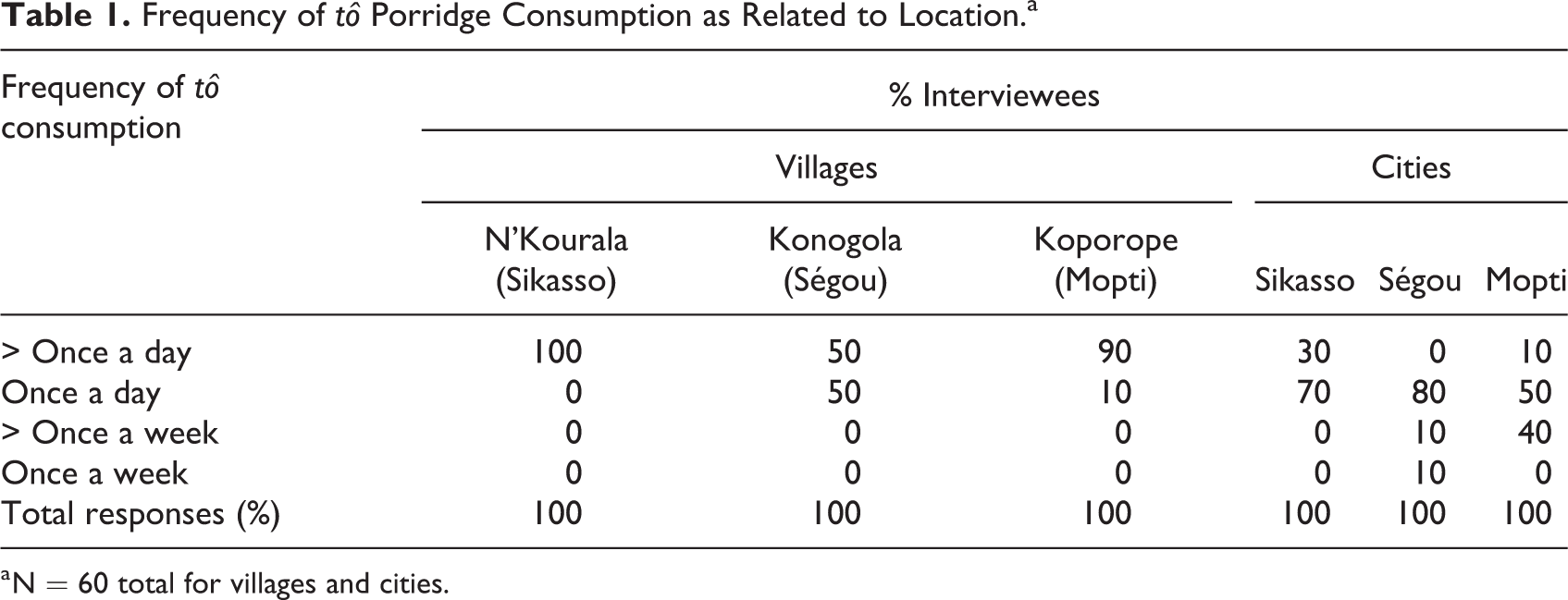
a N = 60 total for villages and cities.
As for tô porridge thickness preference, rural residents preferred very thick and thick porridges compared to their urban counterparts for the 3 regions (P < .05; Table 2). Specifically, all (100%) participants in Konogola village in the Ségou region preferred very thick or thick porridges, while 90% and 50% of participants showed this preference in Koporope and N’Kourala villages, respectively. In urban areas, a lower percentage of participants preferred very thick and thick porridges, with 40% in Sikasso and only 10% each in Ségou and Mopti. Regarding preference, a higher percentage of urban participants disliked very thick porridge (50%, 10%, and 40% of the participants in Sikasso, Ségou, and Mopti; data not shown) compared to rural participants (20%, 0%, and 10% in N’Kourala, Konogola, and Koporope; data not shown).
Survey Results for Preference of tô Porridge Thickness.a
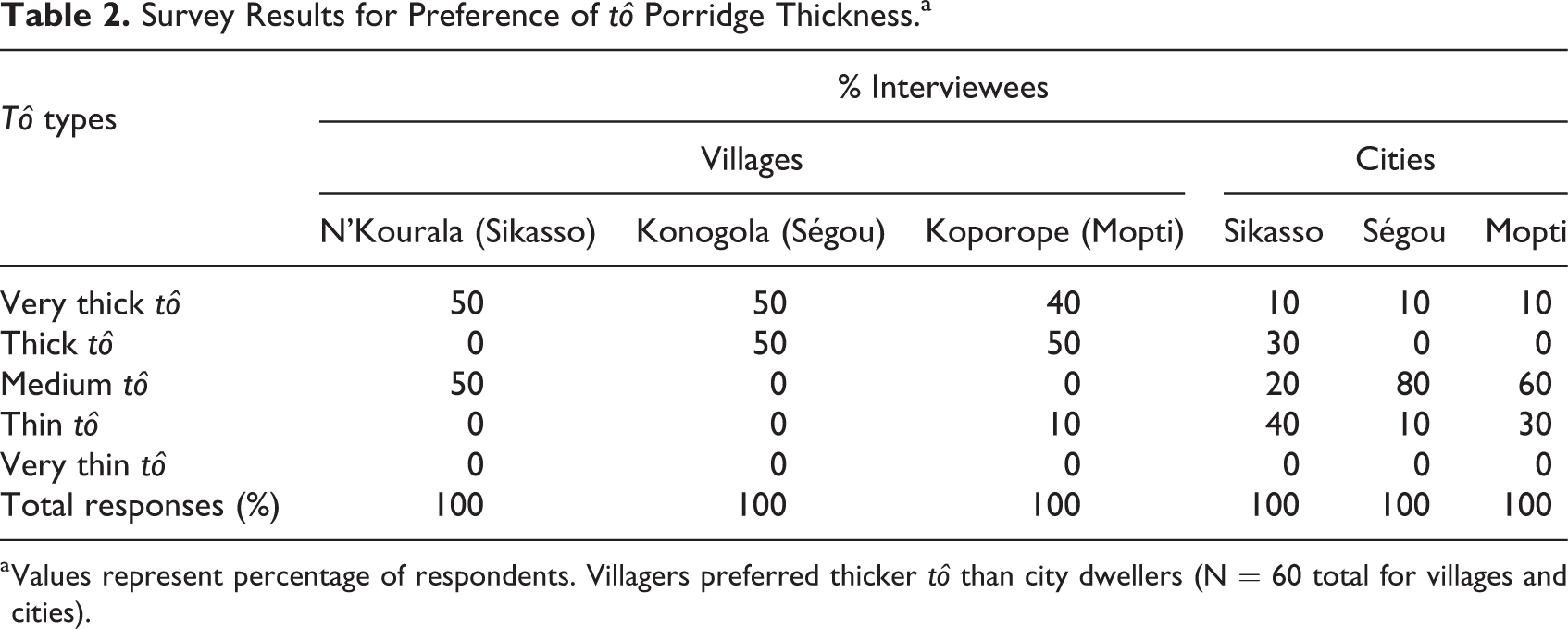
a Values represent percentage of respondents. Villagers preferred thicker tô than city dwellers (N = 60 total for villages and cities).
Penetrometer evaluation of prepared tô porridge thickness between rural and urban areas is presented in Table 3. Porridges prepared in the Koporope village and its city counterpart (Mopti) were thicker (using the CIRAD guidelines, Koporope constituted VTT and Mopti constituted TT to VTT) than those prepared in the N’Kourala and Konogola villages and their corresponding city counterparts (Sikasso and Ségou, respectively; all constituting TT to thin tô with the majority being thin tô porridge; P < .05). At 2 hours after preparation, porridges prepared in villages were thicker than those prepared in their corresponding city counterparts (P < .05), with the exception of N’Kourala and Sikasso, the paired village and city in the Sikasso region. At 12 hours after preparation, porridges for regions (Mopti and Sikasso) were thicker in the villages than cities (P < .05), and in the Ségou region were not significantly different (P > .05).
Penetrometer Evaluation of tô Porridge Thickness as Related to Location.a,b
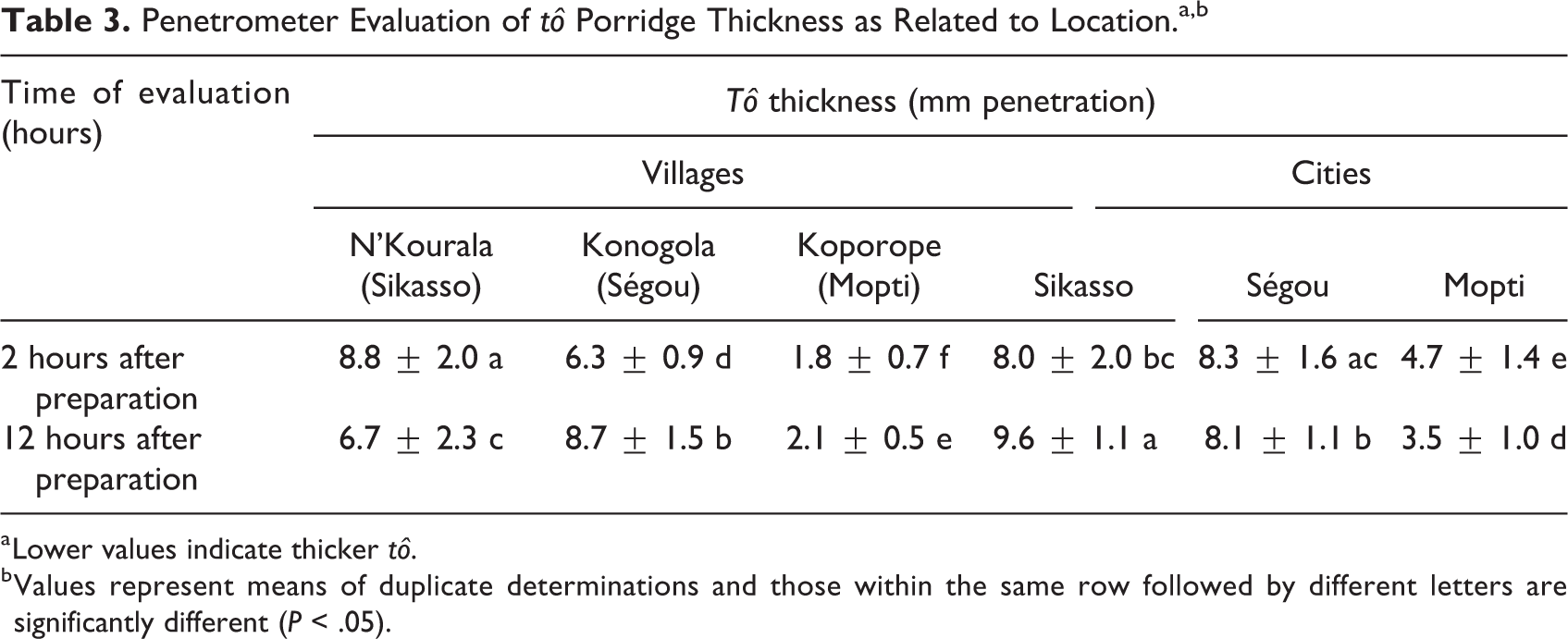
a Lower values indicate thicker tô.
b Values represent means of duplicate determinations and those within the same row followed by different letters are significantly different (P < .05).
Satiety Study on Porridge Thickness
The majority of participants preferred VTT and TT porridges for a fullness feeling (from semistructured interview). Participants who preferred MTT porridge said this was for its digestibility and palatability. All participants recognized the capability of porridges to induce fullness, particularly the ones with higher viscosity. They also recalled preparing and consuming thicker porridge specifically to induce fullness.
For the satiety study (Figure 2), participants reported lower hunger ratings 2 hours after eating to fullness of VTT and TT porridges than after consumption of TRP (P < .05), with significant difference also achieved between VTT and MTT porridges (P < .05). At 4 hours, both VTT and TT porridges had lower hunger ratings than MTT and TRP (P < .05). These findings show that satiety increased as porridge thickness increased (Figure 2).
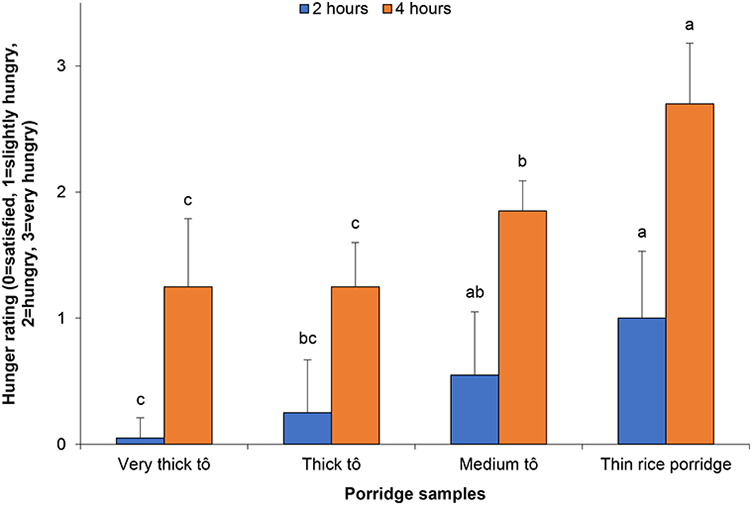
Hunger scores at 2 and 4 hours after tô porridge consumption (N = 10; 6 females, 4 males). The satiety study was designed so that participants consumed as much tô as they wanted until they felt “full.” Participants were asked at 2 and 4 hours after consumption to judge their feeling of hunger. Values with different letters are significantly different (P < .05) per time point. Error bars represent standard deviation.
Although the amount (or volume) of porridge consumed trended downward as porridge thickness increased (although not statistically significant; P > .05; Figure 3), dry weight amounts of flour consumed were higher for VTT and TT porridges than for TRP (P < .05; Figure 3). Average caloric intake from porridges, based on dry weight amount of flour contained in the millet porridges and sugar added for the rice porridge, was 1488, 1432, 1120, and 873 kcal per serving for VTT, TT, MTT, and TRP, respectively. The stew added to the millet porridges was minor and consistent and not considered in the calculations.
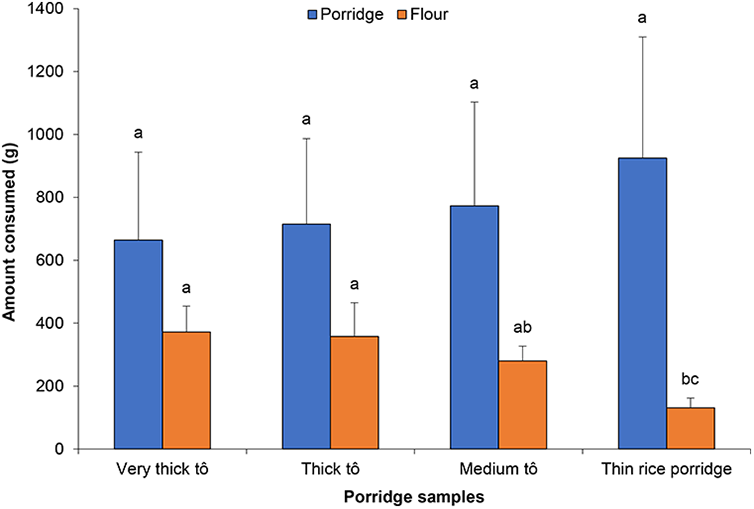
Amount of tô porridge, and corresponding dry flour, consumed by panelists (N = 10; 6 females, 4 males). Although less volume of very thick porridge was required for participants to feel full (at time of consumption), they consumed more millet flour. Values with different letters are significantly different (P < .05), with separate comparisons for porridges and flours. Error bars represent standard deviation.
Discussion
Millet tô porridges were generally shown to increase satiety compared to the TRP, with the thick and very thick porridges corresponding to a higher level of satiety. Notably, participants living in rural areas of Mali showed higher preference for thicker millet porridges and reported consuming porridges more frequently than those living in urban areas. The converse that urban participants preferred thinner, less satiating porridges is relevant to the change in diets occurring in African urban areas (ie, the nutrition transition) and could potentially lead to higher food intake. The nutrition transition has been linked to the rising prevalence of obesity and nutrition-related noncommunicable diseases in urban areas. 1 -3 Several dietary factors have been reported to contribute to the nutrition transition, including higher consumption of refined carbohydrates, added sugars in sweetened beverages, and saturated fats from animal sources and refined oils. 15 These changes were further identified at the macroeconomic level by Imamura et al, 16 who showed that the consumption of healthy items in sub-Saharan African diets decreased between 1990 and 2010, and the consumption of unhealthy items substantially increased. However, change in preparation and consumption of traditional foods, as shown in the present study, might also be part of the nutrition transition.
There are 3 possible reasons for the higher satiety property of the viscous thick millet porridges. First, the slow gastric emptying of thick millet and sorghum porridges 12 could be related to the low hunger scores of the millet thick tô porridges, as high gastric volumes activate mechanoreceptors. 13 Although there are mixed results in the literature, slow gastric emptying rate has been associated with satiety. 11,13,17 Zhu et al 18 showed that increased viscosity of semisolid meals slowed gastric emptying rate and reduced postprandial hunger and desire to eat. Second, highly viscous porridges may have slow starch digestion that could be extended into the small intestinal ileum, where the ileal brake and gut-brain axis mechanisms have been shown to be triggered. 19,20 Third, viscous foods may slow eating rate to increase satiety. Zhu et al 18 showed that highly viscous semisolid meals reduced appetite and slowed eating rate compared to less viscous meals. However, Mattes and Rothacker 9 found satiety is affected by factors other than eating rate, showing lower hunger ratings for isocaloric beverages of higher viscosity while consumed at the same eating rate.
Although diet changes are occurring in sub-Saharan Africa, 21 it is notable in the present work that 100% of rural villagers and ≥ 60% of urban residents reported consuming tô at least once per day. This shows its importance in diets of this region. Additional research is required to determine whether the high satiety property evidenced for millet thick porridge leads to a reduction in food intake. If so, strategically promoting the consumption of thicker millet porridges in sub-Saharan Africa may be a means to counteract the rising rates of obesity and related metabolic diseases (by decreasing food intake). Furthermore, millet has a slow carbohydrate digestion property 22 -25 related to its starch structure 22 and phenolic content, 26 which augment its role as a health-promoting food.
Conclusions
Pearl millet thick porridge is a staple food in sub-Saharan Africa that contributes significantly to the total caloric intake of this population. 27 Our study shows that Malian urban residents prefer less viscous porridges that have lower satiety than rural villagers who prefer thicker porridges. This raises the question whether such foods might be one of the factors contributing to the nutrition transition associated with the onset of obesity and related diseases. Further research assessing food intake related to consumption of millet porridges of different thicknesses would show if less satiating lower viscosity thick porridge is a driver of higher food consumption.
Supplemental Material
Supplemental Material, sj-docx-1-fnb-10.1177_03795721211047435 - Malian Thick Porridges (tô) of Pearl Millet Are Made Thinner in Urban Than Rural Areas and Decrease Satiety
Supplemental Material, sj-docx-1-fnb-10.1177_03795721211047435 for Malian Thick Porridges (tô) of Pearl Millet Are Made Thinner in Urban Than Rural Areas and Decrease Satiety by Mohamed Diarra, Pablo Torres-Aguilar, Anna M. R. Hayes, Fatimata Cisse, Iro Nkama and Bruce R. Hamaker in Food and Nutrition Bulletin
Footnotes
Acknowledgments
The original map image for Figure 1 was obtained from  . MD, IN, and BRH designed research. MD, FC, and IN conducted research. MD, PTA, AMRH, and BRH analyzed data. MD, PTA, AMRH, and BRH wrote the paper. BRH had primary responsibility for final content. All authors read and approved the final manuscript.
Declaration of Conflicting Interests
The authors declared no potential conflicts of interest with respect to the research, authorship, and/or publication of this article.
Funding
The authors disclosed receipt of the following financial support for the research, authorship, and/or publication of this article: This research was made possible in part by the support of the American People provided to the Feed the Future Innovation Lab for Collaborative Research on Sorghum and Millet through the United States Agency for International Development (USAID). The contents are the sole responsibility of the authors and do not necessarily reflect the views of USAID or the United States Government. Program activities are funded by USAID under Cooperative Agreement No. AID-OAA-A-13-00047.
Supplemental Material
Supplemental material for this article is available online.
References
Supplementary Material
Please find the following supplemental material available below.
For Open Access articles published under a Creative Commons License, all supplemental material carries the same license as the article it is associated with.
For non-Open Access articles published, all supplemental material carries a non-exclusive license, and permission requests for re-use of supplemental material or any part of supplemental material shall be sent directly to the copyright owner as specified in the copyright notice associated with the article.
