




Abstract
Background:
Nutrition-sensitive agriculture (NSA) interventions can contribute to improved food security and household dietary diversity. As well as undertaking trials, contextual factors that influence sustainability need to be scoped.
Objective:
To explore locals’ views of an NSA initiative, designed to improve food security and reduce malnutrition in children younger than 5 years, scoping future prospects 6 months after the conclusion of the trial.
Methods:
The initiative that was formally trialed over 6 months (November 2014 to April 2015) entailed keeping hens and home gardens. It occurred in the ethnic hill tribes of northern Thailand. In November 2015, 20 in-depth interviews were undertaken with villagers who had been involved in the initiative. Dialogue occurred in Thai with assistance of a translator and was recorded, transcribed, and translated to English. A detailed thematic analysis was undertaken.
Results:
Eggs produced by the hens were appreciated and fed to children, and the message of providing children with an egg a day was widely remembered. Subsequently, the hens ceased laying or died. The home gardens had seasonal scarcity of water. Less visible, but fundamental, women lacked time for these activities due to heavy burdens of farm labor.
Conclusion:
Keeping hens has potential to become a sustainable activity. Home gardens need water infrastructure to be viable. Women do not necessarily have spare capacity for such initiatives. The required labor needs deliberation by villagers.
Introduction
The hill tribes are located in a remote northern area of Thailand where heavy seasonal rain affects food production and road access, 1 with food insecurity a major issue. 2 The term hill tribe is a translation of the phrase “Chao Khao” that is often used when referring to the ethnic highlander communities (and is not disrespectful). Reflecting poverty and food insecurity, one-third of Thai hill tribe children aged 0 to 5 years of Karen and Lua ethnicity are stunted, 3 despite marked improvements in the nutritional status of other Thai children being achieved since the 1980s. 4,5
Prior to the 1990s, the villagers practiced subsistence “shifting cultivation” or “swidden agriculture,” involving annually moving plots to maintain nutrient-rich soil. 1 Crops included legumes, rice, peanuts, and shallots. In more recent times, there has been a shift to “cash crop” farming (mainly maize for animal feed), mono-cropping, and fixed field farming. 6 This involves repetitive use of one plot of land that leads to depletion of nutrients from the soil and a greater reliance on fertilizers. 2 These changes in agriculture practices place an extra strain on the Thai hill tribes due to new costs and labor requirements of farming. 2
Nutrition-sensitive agriculture (NSA) initiatives have been proposed in order to address poor nutrition attributed to food insecurity. 7 Specifically, local small-scale initiatives to improve food for households by growing produce or raising animals have been implemented in several remote farming communities. 8 -10 There is good evidence that NSA initiatives of this type can improve proxy indicators such as dietary diversity in children, 8,9,11,12 and some evidence that childhood wasting can be reduced. 8,10,13
Both acceptability and durability of NSA initiatives are recognized as important for achieving benefits in terms of food security and nutrition. 12 In addition to consultation prior to any initiative and collaboration throughout, attention should be paid to local accounts of an initiative after its conclusion, encompassing both positive and negative aspects. 14 This enables experiences and learning to be incorporated into future endeavors. In keeping with this, the present study sought in-depth reflections from Karen and Lua villagers who had participated in an NSA initiative in the north of Thailand 6 months after the formal trial phase ended.
The NSA initiative was co-designed and supported by the World Agroforestry Centre, The Knowledge Support Center for the Greater Mekong Sub-region, and HealthBridge Canada. The 4 villages involved were randomly selected from an initial 8, with the remaining 4 serving as control sites. Households were eligible to take part in the initiative if they had children aged 0 to 5 years. In consultation with the villagers, an NSA decision framework 1 was used to determine the most viable NSA options, for which it was envisaged that women would take primary responsibility. In November 2014, participating households were given 5 laying hens (ISA-Hisex Brown) preceded by a workshop on building chicken coups and looking after chickens. Participants received 5 varieties of vegetable seeds (ivy gourd, yard long bean, pakchoi, chillies, and eggplant) for home gardening. It was recommended that seeds were planted close to home so they could be tended to easily and potentially save water. A 1-hour session on infant and young child feeding (IYCF) was held, which included promotion of an egg daily as complementary food for infants and for children up to age 5 years. Advice about caring for hens and gardens and provision of feed for hens and other support were provided to the participating households by the Chiang Mai university research team monthly for 6 months. At this time, the trial was successfully concluded. Visits by the research team ceased and 6 months elapsed before the current study was undertaken.
An assessment of the NSA initiative in terms of food security, children’s diet, and growth measurements has been undertaken. 15 Briefly, among participating households, a higher proportion of children consumed eggs compared to children in comparison households. No other differences were demonstrated. The quantitative measures do not allow insights about how the initiative was received by the villagers and how it fared after external support ended. Such in-depth understanding is important to scope future potential; thus, the aim of this study was to explore the locals’ views on these matters.
Methods
Study Setting
This study was conducted in the Chiang Mai province of Thailand, approximately 100 km from the Myanmar border. Four villages were involved, 2 of Karen and 2 of Lua ethnicity. The villages range in size from 50 to 150 households and are several hours drive from Mae Chaem, a city of approximately 2500 inhabitants, 16 in which food, household, and farming supplies are available. Only one of the villages had an electricity supply.
Study Design
An NSA initiative was implemented in 2014 (with details reported elsewhere 15 ). The 4 villages in which the NSA initiative occurred are the setting for this study. Six months after the trial ended, in-depth interviews were undertaken by the first author with villagers (n = 20). This time frame allowed the annual seasonal cycle to be completed before locals’ views were sought. The first author had built relationships with the villagers over a 3-year period. 17 Villagers were recruited by a “random walk” door-to-door strategy. 18 Only villagers who had participated in the intervention were eligible. Villagers were provided with a participant information sheet and a verbal explanation. All eligible villagers approached agreed to be interviewed.
Approval for the research was obtained from the Research Institute of Health Sciences Chiang Mai Thailand Human Experimentation ethics committee (no. 40/2014, project no. 6/57) and the University of Adelaide, Australia (HREC# H-2014-51).
Data Collection and Analysis
The interviews were semistructured and guided by an interview schedule that had been reviewed by a local public health officer and the University of Chiang Mai research team. The following topics were covered: what is important to the villagers, awareness of and thoughts about the NSA initiative, what happened after the initiative, and any awareness, interpretation, and practice of relevant IYCF messages. Interviews were conducted in the homes of the villagers although that was optional, with public spaces available as an alternative. Where possible, Thai language was used between the interviewer (first author) and villagers, although a translator was present to assist with finding Thai words when necessary. For 3 of the interviews, the villager had a friend or family member assist with translating to and from local dialect and Thai.
Interviews with the villagers continued until data saturation appeared to be reached. Interviews were audio recorded. The recordings were simultaneously transcribed and translated to English by a bilingual Thai/English translator and checked by the interviewer. Participants’ names have been changed for confidentiality.
Translated transcripts were coded and organized using NVivo 10 software. A detailed thematic analysis was conducted by the first author. 19 The analysis was guided by a social constructionist epistemology, 20 and therefore attention was given to all voices. Themes emerged during an iterative coding process. The initial coding words included hens/chickens, gardens, IYCF, and the initiative including “thai yangun” (the Thai term used for sustainable); around these, repeated patterns of meaning were sought. Workload and effort associated with the intervention were specifically noted as well as awkwardness and silences. Themes, extracts, and interpretations were continuously shared with co-authors, and cross-referenced with the first author’s field notes and shared with the Chiang Mai University research team.
Results
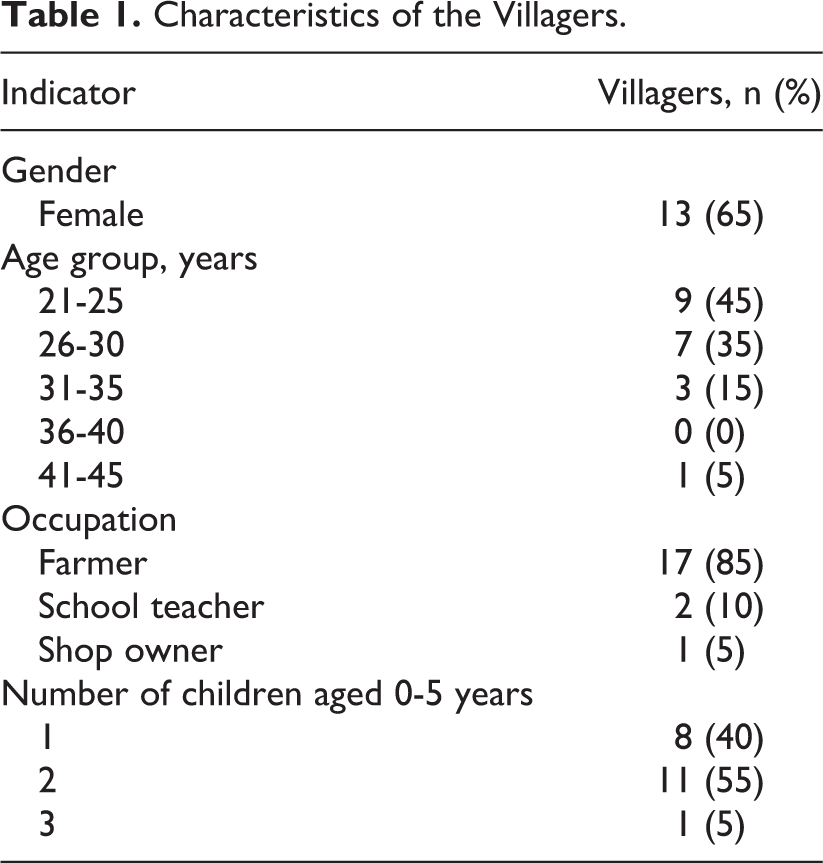
In-depth interviews were undertaken with 20 villagers, 13 being women. Participating villagers were predominantly farmers (85%), ranging in age from 23 to 45 years. All but 1 was the parent of 1 or 2 children aged up to 7 years (the remaining villager being an uncle; see Table 1).
Characteristics of the Villagers.
Hens and Gardens
All villagers interviewed mentioned eggs as a beneficial aspect of the initiative. A number said that children had increased their egg consumption due to the increased availability. Before we had to buy eggs in the market, but since [the research team] came we now eat eggs every day. Before this time we did not eat eggs every day. (P1, father) Before [during the 6-month initiative] we had chickens and eggs and we did not have to buy eggs…Now we have to buy chicken eggs again as the chickens died. (P2, mother) Eggs are costly, so eggs from the chickens were good and we did not need to go to Mae Chaem. (P6, father) Because the weather changed, the chickens died…they do not like the cold weather. (P1, father) For about 4 to 5 months the chickens did not give any eggs, so we ate them. (P3, father) The [chickens] all died a long time ago. The chicken feed ran out and the chickens died. (P4, uncle) It was good when [the research team] came, as the strain of pumpkin provided was different. (P5, father) When they [the research team] came we planted vegetable seeds and did not have to buy vegetables. (P3, mother) In summer season we will plant eggplant around the home, but in rainy season we will plant in the fields as we do not have to water it. (P5, father) In the hot season we can use water only for drinking and showering. There is not a lot of water. (P14, mother) We planted the seeds and when the vegetables sprouted they were just small and then insects came and ate all the vegetables. We did not eat the vegetables…the insects ate all of them. (P7, mother)
Infant and Young Child Feeding Beliefs and Practices
Previously identified infant feeding practices and beliefs
17
continued to be articulated, including providing water to the infant to clear the throat, that rice is required to strengthen the child from an early age and breast milk alone is insufficient after a few months. As we described previously,
17
these beliefs are the facilitators for the mother to return to work in distant fields within a few months of giving birth. When the mother is at home [with the 2-month-old child], the child has the milk of their mother, but when the mother returns to work, we give them rice. (P8, father) [The child is] one year and one month and just started eating vegetables because they are able to. (P10, mother)
Women’s Role in the Initiative
The likely impact of the intervention on women’s time was assessed as part of the prior consultation and judged to be small.
1
Women were encouraged to participate in training and to take primary responsibility for hens and home gardens. It is important to acknowledge that men were not excluded from the initiative although their engagement appeared to be lower. The villagers said that women primarily attended meetings related to the initiative, although grandparents and fathers were also involved. For example: The mother went to listen. (P4, uncle) When the teacher came every month, they recommended and repeated the messages lots of times. We listened and they repeated until we understood. (P6, father) It is difficult while the child is small. I am located with child. This child is difficult. I need to look after the child but I also have to work. (P12, mother) I need help with looking after the chickens so they do not die and also the cow and buffalo that I am looking after. (P15, mother) This season we have pumpkin…[her husband] The father is located in house but he needs to take corn to Mae Chaem. We need to work every day…I am located with the child morning and evening…Sometimes I go to work and return in the late morning. (P16, mother)
Discussion
Villagers’ perspectives on an NSA initiative were explored 6 months after the end of a formal trial phase. Overall, villagers expressed positive views about the initiative, but threats to continuation emerged quite quickly. Villagers’ accounts of what ensued will be valuable in planning enduring initiatives.
The supply of eggs from hens was widely seen as a highlight of the initiative, said to translate to an increased intake of eggs by children. Quantitative data from the trial corroborates, with an 18% increase in the proportion of children consuming eggs in the initiative households compared to children in control village households. 15 Hens and eggs have also been welcome in similar initiatives in neighboring countries. 9,12
This trial was intended as a demonstration project, a necessary step before the resources required to scale up such an initiative can be appraised and committed. 21 Some limitations to sustainability were apparent through formative research undertaken before the initiative, 1 but a more fine-grained understanding has been provided by this research.
At a minimum, an initiative involving laying hens would need to include roosters and a component on breeding hens to be sustainable. 22,23 In the hill tribe villages, this gives rise to questions about how to ensure feed for poultry. Commercial hen feed was provided during the trial and it was recommended to supplement this with rice and greens to make it last longer, which some villagers did. Appropriate, locally sourced food for hens, would need to be organized, possibly as a collective undertaking, in order for this initiative to continue independently.
The seasonal lack of water is a major issue. When the NSA initiative was first proposed, improvements to water systems were considered, but were not feasible due to time and budget constraints. 1 Water deficits have commonly been identified as a critical barrier in agriculture initiatives. 11,24 For example, in a home gardening initiative in Cambodia, only half of participants could maintain the garden year-round. 24 In response to seasonal variations in water, “developed gardens” have been implemented by Helen Keller International (HKI), including drought-resistant crops, 9
Although arrangements to carry water to the gardens might be possible, this is laborious, and attending to water infrastructure would have other benefits. It is estimated that half of child malnutrition is associated with repeated diarrhea or intestinal worm infections due to unsafe water and inadequate sanitation and/or hygiene. 25 -29 In the hill tribes, a high prevalence of worms in children has been reported. 30
Ongoing support of some kind appears to be essential for initiatives to be sustained. 11,31,32 An example of how to provide this is the village model farm, 33,32 headed by a villager who has received training in order to support his or her fellow villagers. The HKI has implemented model farms in a number of Southeast Asian countries. 8,9,11,24 In Nepal, a positive association between technical support using this model and child dietary diversity has been demonstrated 11 and points to the importance of long-term planning for such initiatives.
The NSA literature emphasizes attention to women’s empowerment as a means to improve child nutrition, 12,21 drawing on an extensive history establishing the role of care in good nutrition 34 and articulating the resources needed to care. 35 The development and realization of the capacity to care, usually linked to women’s education and health, are underpinned by women’s status. More overtly related to gender equity, the conditions facilitating care comprise autonomy, workload, and social support. 35 The initiative in the hill tribes followed best practice, 1 but would appear to be an example of the complexity of empowerment that is more recently being appreciated. 36
Similar to the situation of small-scale farmers across Southeast Asia, 21,37 women in the hill tribes frequently share access to land and ownership of assets with their husbands and are involved in decision-making and control household budgets. However, this does not mean there was gender equity. Childcare and some aspects of farm labor are strongly gendered, with Akter et al 21 similarly noting, for example, that land preparation was usually undertaken by men and weeding by women.
As highlighted previously, 17 women in the hill tribes have a heavy burden of farm work, with little time for cooking or care of children. In this regard, they are quite different from the women on rice farms in central Thailand depicted by Akter et al, 21 who often grew vegetables and raised poultry, and for whom “workload does not appear to be a big problem…even during peak season…. Free time is used for prayer, shopping, watching television or listening to the radio, and chatting with friends and family.”21(p276) Farm machinery appears to have alleviated some of the drudgery of these women’s lives. 21
Elsewhere, including Bangladesh and Nepal, Meinzen Dick et al 36 recently reported that women did not have a sense of control over their time, and poor rural women have heavy workloads that were, in many instances, increasing. This resonates with accounts of women in the hill tribes 17 and begs questions about why this is happening. Rigg 38 theorizes that different types of poverty are evident in Southeast Asia. From this perspective, the hill tribes experience “old” poverty, of the type that was widespread before development, as well as “produced” poverty, an unintentional consequence of development. The shift from swidden agriculture to semi-subsistence living, at the margins of the market economy, has created new vulnerabilities. In contemporary Thailand, it has been estimated that a household would require 10 hectares of irrigated rice land to make a decent living; 39 the median amount of land owned by households in the hill tribes is 2 hectares. As in other parts of Thailand, 21 there are insufficient alternative forms of paid work and, in any case, these also tend to be precarious. 40
Women in the hill tribes work long hours tending crops such as maize and caring for large animals, marketable commodities compatible with the remoteness of the villages and the seasonally untraversable roads. As expounded by Komatsu et al, 41 (p264) care needs to be taken “not to encroach on the time of women in poor households if the returns and perceived benefits of the agricultural activities do not offset the time lost.” The benefits to households of the new NSA initiatives were envisaged in terms of diet diversity, not income, as there is no ready access to markets 42 (and selling to other villagers was not likely to become a viable “business” as illustrated in literature on micro-finance initiatives for the very poor). 43 But where was the time to be found?
Women’s workloads arguably need greater attention in relation to empowerment and child nutrition. 44 Agricultural interventions that put constraints on women’s time could have negative consequences for child nutrition. 12 In a global literature review, Johnston et al 45 found that agricultural interventions generally increased the time devoted to agriculture, by women and other members of the family, but it was usually unclear what activities were foregone or redistributed to make way for this, and implications for nutrition were highly variable.
We, therefore, make some challenging suggestions. First, as hinted at in the latest Women’s Empowerment in Agriculture Index report, 36 a redistribution of labor might need to be considered. Ideally, women should be given respite from farm work in distant fields so that infants can be exclusively breast fed for the recommended 6 months. From the latter stages of pregnancy and during this period of “maternity leave,” women might be able to contribute to keeping hens and home gardens. Such changes in the organization of work and childcare would need to be sanctioned and supported by the community, requiring deep dialogue and negotiation, but there is at least one successful example. 46 Alternatively, perhaps the primary responsibility for hens and home gardens should not be women’s to begin with. This key tenet of the NSA literature may no longer hold in circumstances of marked feminization of agriculture 47 and the changing contours of poverty. In some circumstances, women may not be empowered by agricultural initiatives, which need to be led by others. Grandparents and older children might be possibilities, perhaps in a collective endeavor. Again, this is a matter that communities would need to understand, decide on, and lead.
Some limitations of this work should be acknowledged. A probability sample rather than a convenience sample would have provided a stronger basis for generalization. All researchers were outsiders, although the first author and the Thai co-author have spent considerable time in the hill tribe villages. Interviews were conducted in Thai, not the local dialect, and this may have limited expression of villagers’ perspectives and exploration of their views. Family members and friends sometimes assisted with translation and/or interpretation and, while this was appreciated, it may have influenced the views expressed. However, interviews were not rushed and people were encouraged to take the time they need to think or explain. Due to time and resource constraints, only 1 researcher coded the data; it would have been preferable for a subset of interviews to have been coded by others and cross-checked.
Conclusion
In the 6 months that an NSA initiative received external support, villagers were able to keep laying hens and establish home gardens. The initiative was seen as beneficial by the villagers, especially eggs for children. Keeping hens would appear to have good prospects for becoming a sustainable activity. Home gardens appear to be more difficult, requiring improvements in water infrastructure. In these semi-subsistence households, women had heavy workloads and already faced time constraints in providing care for children, so women should not necessarily be responsible for the extra work. Villagers will need to deliberate how the labor requirements are to be met.
Footnotes
Authors’ Note
AR, VM, LS, and PW designed the research, AR collected the data. AR, VM, LS, and AR analyzed the data and drafted the article. All authors critically revised the article and read and approved the final manuscript.
Acknowledgments
The authors thank all participants including the villagers, village health volunteers, and public health officers. The authors also thank the KSC-GMS/ICRAF for support in arranging the research and completing the interviews.
Declaration of Conflicting Interests
The author(s) declared no potential conflicts of interest with respect to the research, authorship, and/or publication of this article.
Funding
The authors disclosed receipt of the following financial support for the research, authorship and/or publication of this article: AR was supported by a scholarship from the Faculty of Health and Medical Sciences, University of Adelaide.

References
Supplementary Material
Please find the following supplemental material available below.
For Open Access articles published under a Creative Commons License, all supplemental material carries the same license as the article it is associated with.
For non-Open Access articles published, all supplemental material carries a non-exclusive license, and permission requests for re-use of supplemental material or any part of supplemental material shall be sent directly to the copyright owner as specified in the copyright notice associated with the article.
