




Abstract
The rapid changes that societies have gone through in the last few decades have led to the increase in the prevalence of malnutrition in all its forms and to the degradation of natural resources and the environment. The change in the dietary habits and production systems are responsible for much of this change. Some territorial diets have been shown as potentially capable of reversing these trends by positively contributing to the health of people and the environment such as the Mediterranean Diet and the New Nordic Diet. In this paper, we review the contribution of these 2 diets to health and nutrition and to environmental, sociocultural, and economic sustainability proposing pertinent indicators. Learning from a culturally established diet and a constructed one, tradeoff could be reached to ensure better health and sustainability outcomes. Strong factors for achieving this goal lie in building on the sociocultural appropriation of diets, having the proper tools and indicators, investing in cross-sector collaboration and policy coherence, and having the necessary political support to push the agenda of sustainability forward.
Keywords
Introduction
One of the major challenges of our times is malnutrition in all its forms (undernutrition, micronutrients deficiencies, and overweight and obesity). The latest available numbers of the malnourished show the extent of this challenge: 821 million people have hunger, 2 billion people have micronutrient deficiencies; and over 2 billion persons are overweight or obese. 1 While the underlying causes of malnutrition are complex and multifaceted, diets remain one of its major direct causes. Recent research also shows that unhealthy diets top the list of the main risk factors for the global burden of disease. 2
On the other hand, what we eat influences to a large extent what and how we produce, procure, distribute, and dispose of food and impacts the natural resources used along such processes. At the global level, food production accounts for the use of 48% and 70% of land and fresh water resources, respectively. 3 Research also shows that different types of diets contribute to greenhouse gas emissions differently. 4
Facing such challenges, healthy diets that can play a role in addressing both malnutrition and environmental concerns while being anchored in economic and sociocultural contexts that privilege their uptake by the concerned populations, are of great relevance to global and national agendas related to sustainability.
The Second International Conference on Nutrition 5 showed that food systems are responsible for not delivering healthy diets and a global call for their transformation was launched. In this paper, we argue that some territorial diets (sometimes called regional) can be a catalyst in this transformative process by playing an active role in shifting consumption and production in a way that strikes a balance between health and nutrition and the different dimensions of sustainability, that is, environmental, economic, and cultural. Two such diets, the Mediterranean Diet (MD) and the New Nordic Diet (NND), are becoming increasingly interesting for this catalytic role, especially within the context of Sustainable Development Goals (SDGs).
The Mediterranean Diet
The MD is a territorial diet that has its roots entrenched in the history of the Mediterranean Sea and its region that was for centuries a meeting point and melting pot for different cultures and civilization; each conferring some of its specificities to the evolving diet of the region. It became known as a healthy diet in the early 1960s as a result of the work of Ancel Keys who showed the protective effects of the diets eaten in Southern Europe against coronary heart disease. 6 The traditional MD was defined originally as a diet with high consumption of whole cereals, legumes, vegetables, fruits, nuts and olive oil, a low to mild consumption of dairy products, and a low consumption of meat and poultry. 7
In 2010, UNESCO added the MD to its list of intangible cultural heritage of humanity, not only because of its nutritional attributes but also because of it being a way of life that encompasses “a set of skills, knowledge, practices and traditions from landscape to table, including crops, harvesting, fishing, conservation, processing, preparation and, in particular, food consumption.” 8 These additional dimensions have a value of their own and are also proving to be important for health and nutrition outcomes. Today, research points to how commensality supports healthy food habits and reduces the risk of overweight and obesity, especially among children. 9,10
Despite its constancy over time and space, the MD was shaped by the specificities of its local contexts and manifested itself in different local versions reflecting the diversity of local food systems and cultural contexts across countries while preserving the main characteristics of the traditional MD.
New Nordic Diet
The NND is a new constructed diet built with strong anchorage onto the Nordic food traditions to positively contributing to both health and the environment. It was launched in 2004 by a group of reputable chefs from the Nordic region who embarked on rediscovering local produce. 11 It is characterized by a high content of local fruits and vegetables (especially berries, cabbages, root vegetables, and legumes), fresh herbs, potatoes, plants and mushrooms, whole grains, nuts (native), fish and shellfish, seaweed, free-range livestock (including pigs and poultry), and game. 12 It comprises foods traditionally sourced in the Nordic countries and focuses on those from the wild countryside and from the sea and lakes.
The NND knew a fast-paced diffusion in the Nordic region possibly because it was conceived as an identity movement. However, the support it received from the Nordic Council of Minsters 13 because it was seen as an opportunity for Nordic cooperation and as a new source of shared Nordic identity 11 contributed to its wide-spread uptake by the public. The Nordic food culture was purposefully promoted in national and global events by the Nordic diplomacy and policy makers. Local national versions of the NND emerged and were used in national media and political discourse. The valorization of the national food traditions in each of the Nordic countries helped in the cultural appropriation and in increasing the number of adapts to a label without a previous history in the culinary domain. The incorporation of concerns for environmental sustainability and planetary health in the NND has also contributed to the uptake of this new diet as a way of life.
Health Benefits of Selected Territorial Diets
The Mediterranean Diet
The literature on the relationship between the MD and positive health outcomes is abundant. Adherence to the MD has been associated with a significant reduction in total mortality, mortality form cardiovascular disease (CVD) and cancer, and with cancer-risk lowering potential. 7,14-16 A recent review 6 has confirmed the favorable influences of the MD on the risk for metabolic syndrome, obesity, type 2 diabetes mellitus, cancer, and neurodegenerative diseases.
In 2017, a meta-analysis of observational studies in relation to CVD showed a 27% lower risk of CVD incidence when comparing high to low MD adherence categories; the results showed that the MD reduced the risk of CVD incidence by 45%. 17 On the other hand, for CVD mortality, a 25% lower risk was found when comparing high versus low adherence to the MD pattern as well as 41% decreased risk of CVD mortality.
The MD is believed to have favorable effect in reducing blood pressure in hypertensive or healthy individuals; however, there is not enough information to estimate the strength of the observed effect, and therefore, more studies are necessary in this regard. 18
Evidence however exists that people who adhere to the MD have lower incidence of cancer. Except for pancreatic cancer, all other cancers of the digestive tract showed significantly reduced incidence with the MD. 19
A recent systematic review on the effect of MD in relation to cognitive function 20 showed inconsistent results for cognitive function and brain morphology or connectivity. However, a significant and clinically relevant effect sizes were found for cognitive composites in the Prevención con Dieta Mediterránea (PREDIMED) study. 21
Four studies assessing the association between MD and the risk of frailty were identified in a systematic review. Higher adherence to an MD was associated with significantly lower incident frailty risk than lower adherence. 22
Nonalcoholic fatty liver disease (NAFLD), 23 which has inflammation and oxidative stress as major risk factors, has been studied in relation to MD. With the MD being low in saturated fats, animal protein, high in antioxidants and fibers, and having an adequate omega-3 to omega-6 fatty acids balance, it has been suggested to be effective in NAFLD. Although the results from the available studies are encouraging, there is still need of trials with larger sample size. 24
A systematic review on the management and prevention of rheumatoid arthritis in human prospective studies reported improvement in the pain visual analogue scale and a decrease in the score for health assessment questionnaire for rheumatoid arthritis, in the MD groups. One study reported a reduction in the 28 joint count disease activity score for rheumatoid arthritis for the MD group. 25
In Spain, it was observed that a 10-point increase in the adherence to the Spanish Food Pyramid recommendations was associated with a 14% (odds ratio [OR] = 0.86; 95% CI: 0.79-0.94) lower odds of obesity in men. The odds of abdominal obesity also decreased globally by 12% (OR = 0.88; 95% CI: 0.84-0.93). 26
As was mentioned previously, different versions of the MD exist in the Mediterranean region at present. Researchers have used different indices to characterize the different MD patterns employing sometimes different food groups in each. In 28 studies included in 6 meta-analyses evaluating the relation between the MD dietary pattern and primary prevention of CVDs, some typical foods were identified. 27 Table 1 shows 10 such indices and their associated food groups.
Selected Scores for Measuring the Adherence to the Mediterranean Diet and Their Corresponding Foods/Food Groups.
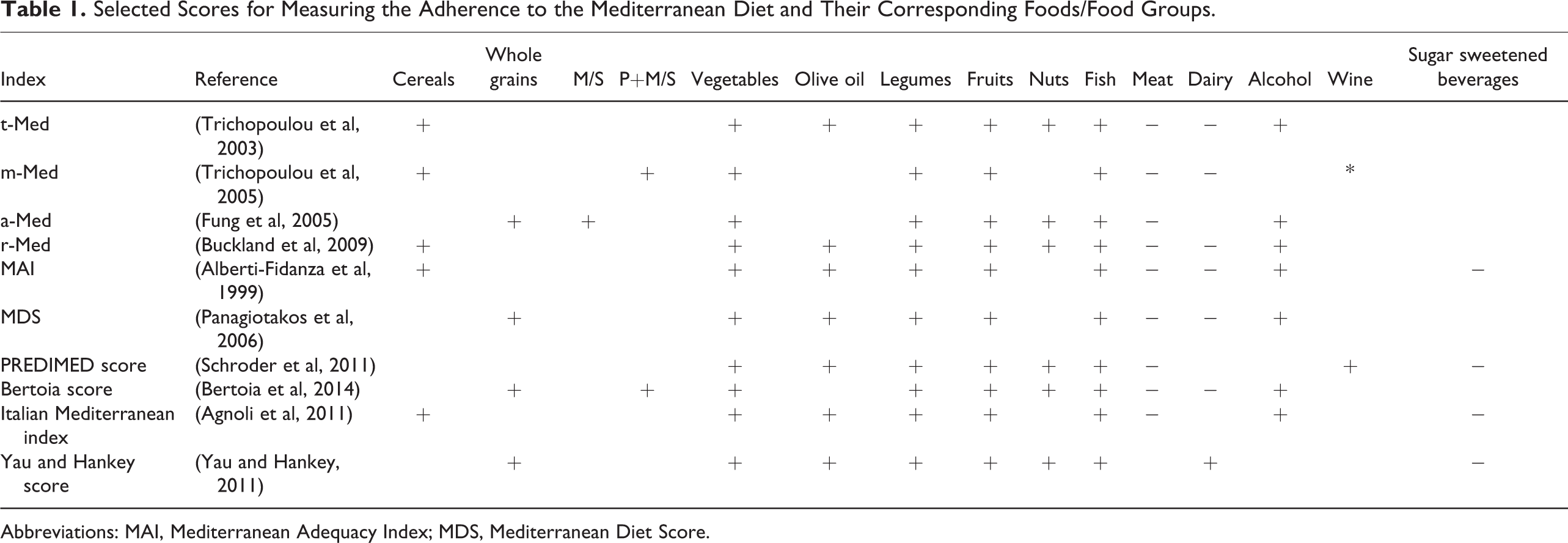
Abbreviations: MAI, Mediterranean Adequacy Index; MDS, Mediterranean Diet Score.
The 10 a priori indexes are tMed, 14 m-Med, 15 a-Med, 28 r-Med, 29 MAI, 30 MDS, 31 PREDIMED score, 32 score according to Bertoia, 33 Italian Mediterranean Index, 34 and score according to Yau and Hankey. 35
In children, the KIDMED index 36 was the most widely used score to assess adherence to the MD. 37
New Nordic Diet
Evidence on the health benefits of the NND are less abundant than the MD. However, the dietary components of the NND benefit from a well-established and substantial evidence of health-promoting properties. 12 Recent investigations into the associations between the local versions of the NND and health outcomes show an inverse relationship with several cardiovascular risk factors, 38 abdominal obesity, 39 body fat, 40 inflammatory markers and serum lipids, 41 colorectal cancer risk, 42 and total mortality. 43
Adherence to the NND has been shown to lower cause-specific mortality among Swedish women 44 and facilitate optimal gestational weight gain and fetal growth 45 in Norwegian women participating in the Mother and Child Cohort Study.
Other studies have shown that adherence to a healthy Nordic food index was inversely associated with the risk of type 2 diabetes 46 and that NDD improves blood pressure, cholesterol, and triglycerides in comparison to a control diet. 47
Sustainability
Interest in the relationship between diets and sustainability is not new. It goes back to the late 1980s when the case was made for the need to consider environmental concerns and the protection of natural resources in dietary guidelines.
48
This idea was revived in 2010 by FAO that gave a definition to sustainable diets as those diets with low environmental impacts which contribute to food and nutrition security and to healthy life for present and future generations. Sustainable diets are protective and respectful of biodiversity and ecosystems, culturally acceptable, accessible, economically fair and affordable; nutritionally adequate, safe and healthy; while optimizing natural and human resources.
49
An impetus has been given again to the importance of consumption in sustainability discussions following the Second International Conference on Nutrition 5 that highlighted the role of dietary consumption in the malfunctioning of our food systems. This recognition rose to a higher level with the adoption of the 2030 Sustainable Development agenda. While the FAO definition provided a holistic framework for analysis, where diets’ sustainability was considered in its contribution to health and nutrition, economic, and sociocultural aspects while preserving the environment, the lack of guiding principles for operationalizing the concept and the associated indicators needed for this to happen made using the concept very complicated, especially for countries.
The following section will focus on the indicators to use in assessing the sustainability of diets, considering the 3 dimensions of sustainability: environmental, social, and economic.
Relevant Indicators
In order to assess the sustainability of diets, an indicator framework is necessary. Relevant indicators need to represent the whole system and identify trade-offs. In this respect, an internationally acknowledged indicator framework is the SDG indicator framework.
The first global-scale analysis quantifying the performance of national food system of 156 countries, considered 7 dimensions of sustainability (nutrition, environment, food affordability and availability, sociocultural well-being, resilience, food safety, and waste) employing 25 sustainability indicators across different dimensions. 50
Recently, a workshop that brought together 23 international environmental footprint experts from 17 institutions defined an environmental footprint family relating to the planetary boundaries concept. As a result, a paper 51 was produced defining which footprint indicators are relevant for a footprint family (Figure 1) and clarifying the difference between pressure and impact indicators, as indicated by 2 other studies. 54,55 The former quantifies resource use and/or pollution, like carbon or water footprints (WF). The latter quantifies impact, such as water stress. 56 Environmental footprints are thus pressure indicators but can include in a second stage an impact assessment. Life cycle assessment (LCA) is generally impact-oriented, although it also has an inventory stage. In 2018, a study 57 conducted the first global assessment of the relation of the food system with 5 of these footprints (carbon, land, water, N, and P). Footprints have the advantage that they measure pressure along the whole supply chain, up to the consumer level. They can therefore be used to assess environmental sustainability of whole diets, not only products.
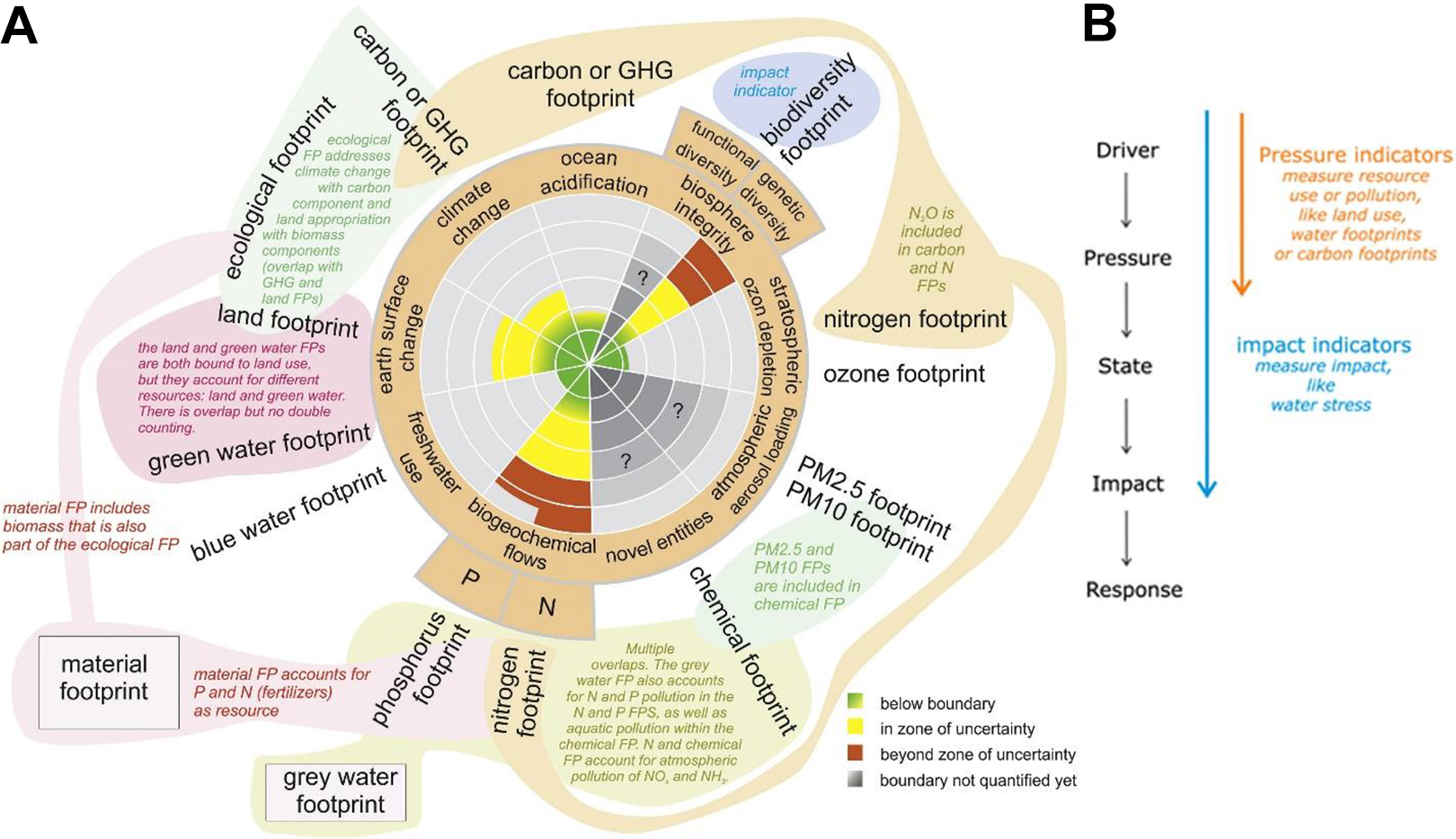
A, Planetary boundaries (Steffen et al, 2015) 52 with indication relevance of environmental footprint indicators, as displayed in (Vanham et al, 2019) and (B) DPSIR (Driver-Pressure-State-Impact-Response) framework (OECD, 2003) 53 and its relationship with pressure and impact indicators, adapted from (Vanham et al, 2019).
To measure environmental and social sustainability, Tables 2 and 3 propose a list of relevant indicators within these 2 dimensions of sustainability. Relevant indicators on economic sustainability include food affordability, poverty index, or income equality. 50 Such a list can be extended with many more indicators. But selection needs to occur on (1) relevance, (2) possibility of quantification/measurement, and (3) assessment of trade-offs between indicators. It is noted that only certain indicators are also SDG indicators, whereas some (in)directly relate to specific SDG indicators.
Selected Indicators That Are Relevant to Measure the Environmental Sustainability of Diets/the Food System.a
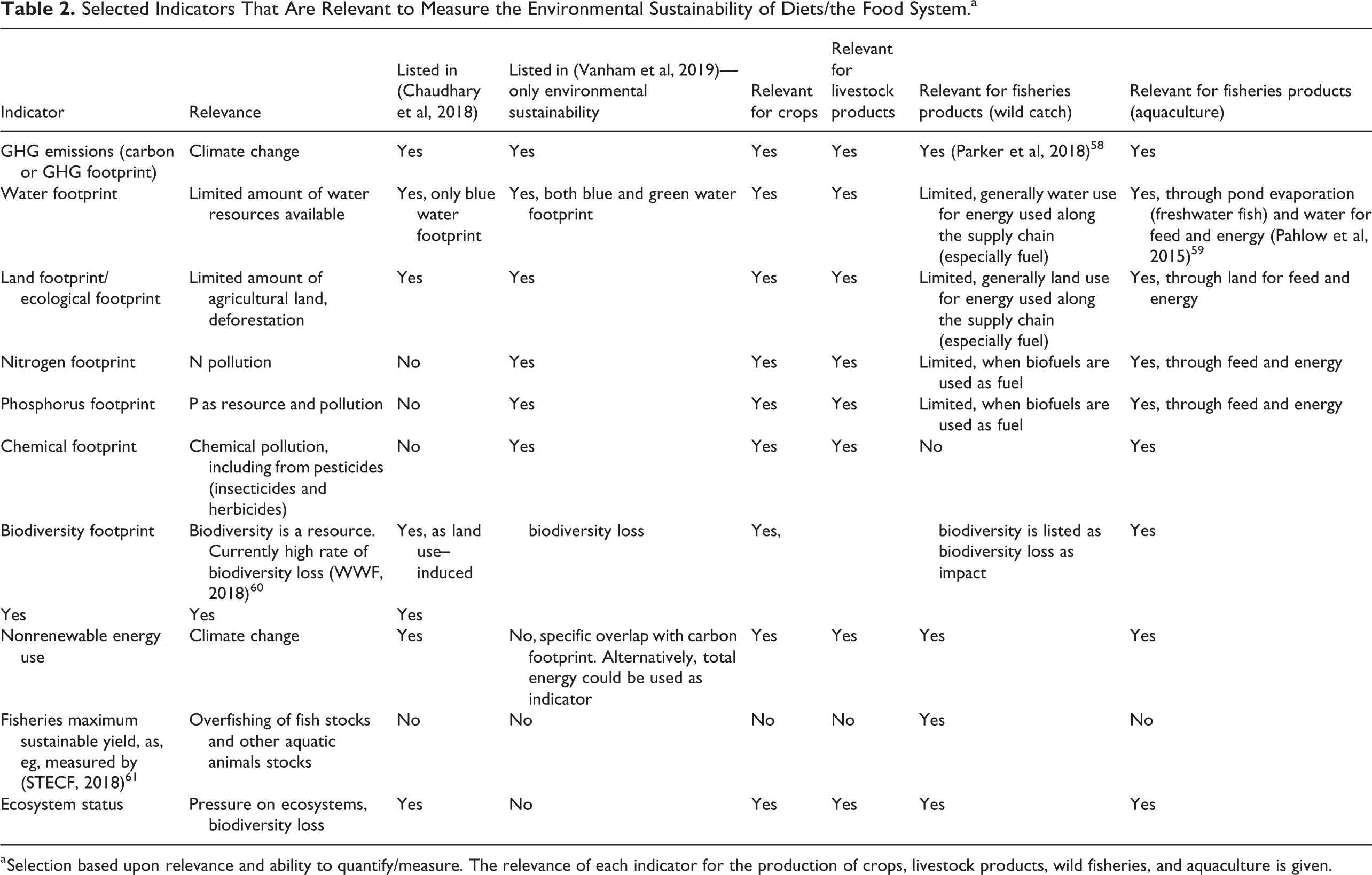
a Selection based upon relevance and ability to quantify/measure. The relevance of each indicator for the production of crops, livestock products, wild fisheries, and aquaculture is given.
Selected Indicators That Are Relevant to Measure the Social Sustainability of Diets/the Food System.a
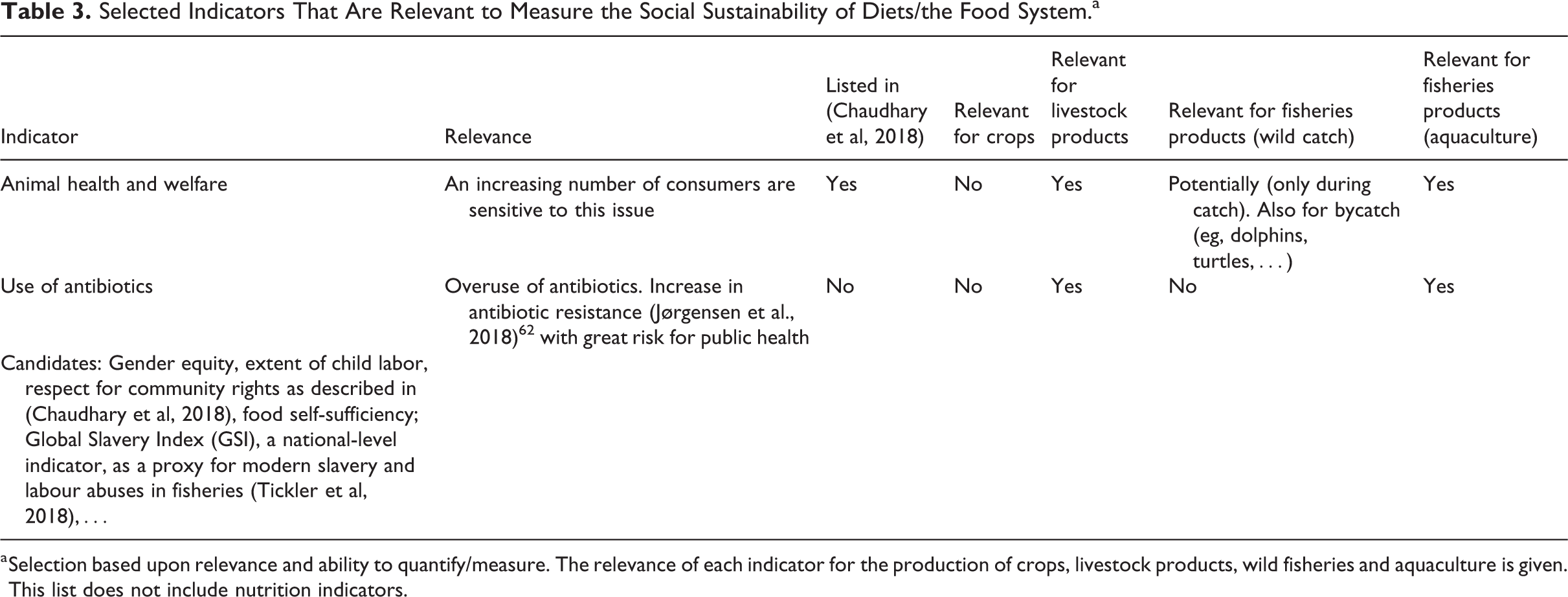
a Selection based upon relevance and ability to quantify/measure. The relevance of each indicator for the production of crops, livestock products, wild fisheries and aquaculture is given. This list does not include nutrition indicators.
Some of these indicators have already been included in national food-based dietary guidelines (FBDG) as in the revised FBDG of the Netherlands 63 and Flanders (Belgium), 64 which include indicators perceived as important by consumers and are easy to communicate like carbon and WFs and animal welfare.
Sustainability Assessment of the MD and NND
Sustainability of the MD
In general, the MD is associated with lower environmental pressures in relation to other healthy diets containing meat but not when compared to pescetarian or vegetarian diets.
A study 65 assessed the WF related to food consumption in 13 Mediterranean cities, for the current diet and 3 diet scenarios (MD including meat, pescetarian, and vegetarian diets based on MD). An MD leads to WF reductions of 19% to 43% with respect to the current diet. A pescetarian and vegetarian diet scenarios lead to WF reductions of 28% to 52% and 30% to 53%, respectively. Both green and blue water components are included. For these components separately, consistent reductions are observed but are bigger for green as compared to blue water. For Ankara and Istanbul, the total WF of the MD (3090 liters per capita per day or l/cap/d) is significantly lower as compared to the diet recommended by national Turkish FBDG (4115 l/cap/d).
Another study 66 quantified the WF related to food consumption in the EU South zone (Portugal, Spain, Italy, Slovenia, Croatia, Greece, Malta, Cyprus), for current diets and 3 diet scenarios (MD including meat and vegetarian diet based on MD). With respect to current diets, the WF decreases by 30% for an MD and by 41% for a vegetarian diet, when green and blue WF are considered. For only the blue WF component, the reductions are 26% and 36%, respectively.
A new assessment for 9 countries—Spain, France, Italy, Greece, Turkey, Egypt, Tunisia, Algeria, and Morocco—finds that the MD reduces the WF of the European countries and Turkey within the range of 18% to 35%. Within the Maghreb countries and Egypt, the MD WF is quite similar to current diets WF, but the proportions of food product groups differ. 67
A study 68 compared the WF of the MD with the American diet as recommended by the United States Department of Agriculture, with application to Spain and the USA. The American diet showed a 29% higher WF in comparison with the MD, regardless of products’ origin. The researchers used blue, green, and gray WF.
A group of researchers 69 found that adherence to the MD in Spain would reduce greenhouse gas emissions (72%), land use (58%), energy consumption (52%), and to a lower extent water consumption (33%). The fish and seafood group was not considered in the water and land use footprints because it was assumed that all fish is wild catch. For the energy and carbon footprints, this food group was considered. Another study 70 estimated that the shift from a modern Italian diet to an MD would reduce the carbon footprint by 30%, the ecological footprint by 24%, and the WF by 18%.
In the case of the Netherlands, a study 71 found that the MD has a 6% lower carbon footprint and 17% lower land footprint than the diet recommended by the 2006 Dutch Dietary Guidelines. Vegetarian and vegan diets, on the other hand, had lower environmental pressures than the MD.
For Italy, and comparing to a healthy diet according to the national dietary guidelines, a study 72 showed that the energy and carbon footprints of the MD are 4% and 5% lower, respectively, than the recommended healthy diet. A vegetarian diet had carbon footprint 7% lower than the MD.
Taking global warming potential and biodiversity loss scores as criteria, a study 73 found that a vegan diet fares better than an MD on both.
Sustainability of the NND
In general, the NND is associated with lower environmental pressures and/or impacts in relation to other healthy diets containing meat but not when compared to pescetarian or vegetarian diets.
A study 74 assessed the WF related to food consumption in 9 Nordic cities, for the current diet and 3 diet scenarios (NND including meat, pescetarian, and vegetarian diets). An NND leads to WF reductions of 9% to 24% with respect to the current diet. A pescetarian diet leads to WF reductions of 29% to 37%. A vegetarian diet leads to WF reductions of 36% to 44%. Both green and blue water components are included.
In Denmark, a study 75 calculated the carbon footprint of 3 diets: the Average Danish Diet (ADD), a diet based on the Nordic Nutrition Recommendations (NNR), 76 and a diet based on the NND. All 3 diets were adjusted to contain a similar energy and protein content. For all scenarios, taking into account food transport or not (locally produced versus imported food), or taking into account a high fraction of organic agriculture in the NNR or not, the carbon footprint of the NND and NNR were lower than for the current Danish diet.
Another study 77 evaluated the environmental impact of the ADD and NND, by means of 16 environmental impact categories (LCA) which were monetized to evaluate the overall socioeconomic effect of a shift from an ADD to an NND. Three features—composition, transport (rate of import), and type of production (conventional or organic, the latter being to a high level characteristic for the NND)—were separately investigated. When both diet composition and transport were taken into account, the NND reduced the environmental impact relative to the ADD measured by all 16 impact categories. Choosing the NND results in a cost saving of 32% of the overall environmental cost of 835 €/person/year associated with the ADD. This reduction is mainly driven by reduced meat consumption but higher quality meat consumption and less imported commodities from long distance. When the actual 8% content of organic produce in the ADD and the 84% content of organic produce in the NND were also taken into account, the NND reduced the environmental impact relative to the ADD on only 10 of the 16 impact categories, whereas 6 increased. For the latter scenario, the socioeconomic impact of choosing NND resulted in 5% (42 €/person/year) reduction in the overall environmental cost of ADD. It has to be noted that the latter scenario does not include indicators like animal welfare (Table 3).
Adherence to the MD and NND
Adherence to the MD
Despite its increasing popularity worldwide, adherence to the MD is decreasing in the Mediterranean region. Researchers 78 have referred this decline to increasing urbanization, the globalization of the agricultural market, the development of mass food culture, the relative prosperity of the developed and developing Mediterranean countries, and the change of family structure from an extended to a more nuclear form, with consequent rupture of the traditional way of transmitting culinary know-how, among other things.
Methods to assess the adherence to the MD diet rely on the use of scores that are built using food groups or foods that are considered part (or not) of the MD. Positive or negative values are assigned to these food groups or foods for a score to be calculated. The source of data to be used for the calculation of these scores are either the FAO food balance sheets (FBS) or the food consumption surveys. The only score that uses the FAO FBS is the Mediterranean Adequacy Index (MAI). 30 Recently, a study 79 was undertaken to evaluate the adherence to the MD in 41 selected countries and to assess time trends over the last 50 years. Data from the FAO/FBS covering the periods: 1961 to 1965, 2000 to 2003, and 2004 to 2011 were used. The MAI was calculated for all 41 countries. Those adhering the most to the MD were reported to be Egypt, Morocco, Algeria, Iran, and Tunisia. Countries, where the majority of studies have been conducted, that is, Greece, Italy, and Spain, ranked 10, 14, and 18, respectively. In general, the Mediterranean countries showed descending MAI scores between all the study periods. From 2017 to 2019, FAO assisted 2 countries in the Mediterranean region—Lebanon and Tunisia—to assess their adherence to the MD and used for this purpose the MAI in addition to other scores. The results of the MAI 80 in the 2 countries confirm the results of the previous study 79 showing a 40% decrease in adherence to the MD in Lebanon and 46% in Tunisia between 1961 and 1963 and 2012 and 2013.
As for children and adolescents, the MD adherence varied largely within the Mediterranean countries, with also large differences being observed among European countries. The majority of studies were performed in local settings and not in nationally representative samples. Few data were available for non-Mediterranean countries. 37
Adherence to the NND
Research on the adherence to the NND is still early to consider as the lapse of time that extends between its creation and the present time does not allow robust conclusions to be made.
Principles Applicable to Other Populations and Contexts and Lessons Learned
In 2018, the Nordic Food Policy Lab, 1 of 6 flagship projects under the Nordic prime ministers’ Nordic Solutions to Global Challenges initiative, published the report “The solutions menu,”
81
which assembles 24 innovative Nordic food policy solutions. This includes school meals, food waste reduction schemes, gastronomic resource centers, and nutrition recommendations. The document states that these policies have been possible and highly successful because they are: Evidence-based: focusing on the most robust and current data at hand Democratic: fostering equality by making good food affordable and accessible Progressive: promoting innovation and fresh perspectives Open: enabling collaboration and dialogue to address complex issues Holistic: accounting for the interconnectivities between policy solutions and global challenges Sustainable: safeguarding the health of humankind and the planet Overall, the policies in the Solutions Menu are noninvasive, that is, they often meet less resistance because they are codeveloped and have multiple benefits for stakeholders involved
On the other hand, lessons could be learnt from the process of developing the Nordic Nutrition Recommendations (NNR), which is based on cumulative knowledge from systematic reviews by an expert steering group and inputs from over 100 stakeholders and is supported politically and financially by the Nordic countries and the Nordic Council of Ministers.
The NNR serve as the scientific basis for national food and nutrition policy in the Nordic countries, as well as for the planning and evaluation of diets, teaching, and dietary information. National authorities translate the recommendations into guidelines that can be adjusted depending on the challenges of each individual country. The NNR also serve as the common reference point for almost all partners in the Nordic food system—from health campaigners to the food industry.
The NNR have enjoyed a high level of trust and impact at national and regional levels due to: their strong grounding in science, and the collaborative and open nature of their process of development that included different Nordic countries, Ministries and stakeholders.
With such a process, they have also become the foundation for partnerships and international cooperation, contributing with important data to international nutritional policy.
As the MD pattern has evidently many positive health and environmental outcomes, it seems relevant to try to promote its principles in non-Mediterranean contexts. Recently, a review identified successful strategies used to encourage non-Mediterranean populations to adopt an MD pattern. 82 It showed that the components of studies with high compliance to an MD pattern were mostly individualized like dietitian-led education; recipe books, meal plans, and food checklists; food hampers; and components where contact was maintained on regular basis like in cooking classes. However, taking the MD to community settings is a challenging task. Potential obstacles to the adoption of the MD in the general population were identified by the researchers as: lack of access to dietetic/health care professionals, high meat intake, pervasive processed foods, and fast food outlets. For non-Mediterranean countries to promote an MD pattern, collective support from government, key stakeholders and policy makers, food industry, retailers, and health professionals is necessary. This is not strange knowing the importance of the local context and the sociocultural aspects in the uptake and adherence to diets. A study from the Netherlands 83 concluded that an adaptation of the historical diet to the revised Dutch FBDG, which fits better into the present eating habits, climate, cultural, and agricultural tradition of the Netherlands, is easier to be achieved than a transition to a more “foreign” MD or NND. They also found that the new Dutch dietary guidelines as well as the Low Lands Diet show lower carbon and land footprints as compared to the MD and NND.
A recent WHO Europe review 81 reports that despite the availability of more scientific evidence on the health benefits of the MD, the Nordic countries have more programs/interventions/policies in the region based on the ND. It also highlights that the 5 Nordic countries have adopted a collaborative regional approach to improve the diet, reduce production and consumption impacts on the environment, increase intervention sustainability, and facilitate the achievement of the SDGs.
The identification of which policies contribute best to a sustainable food system is the topic of much research. 84 The recent conference: “People’s food - people’s health: Towards healthy and sustainable European Food Systems” resulted in a Policy Brief 85 concluding that, in order to redesign the food system, greater cross-government and cross-sector collaboration will be crucial as well as an enabling food policy framework.
Challenges and Recommendations
In a world where demographic, economic, cultural, and nutritional changes are happening rapidly and within limited global natural resources to sustain such changes and nourish the population for better health outcomes, territorial diets that can perform double duty actions (low environmental pressures and impacts and positive health and nutritional outcomes) like the MD and the NND are potentially interesting to learn from. This is particularly important because of the tension that exists naturally between these 2 dimensions of sustainability. In some low-income countries, for example, locally consumed diets are plant-based in the majority of cases and could be considered quite sustainable environmentally, but they could fall short of meeting the nutritional needs of the local population, especially children.
Taking the discussion beyond the health and environmental aspects adds more to the complexity of the discussion and necessitates the reconciliation of additional opposing considerations. The widespread uptake of the NND, which was designed with high palatability, gastronomic appeal, and overt leanings on the common Nordic culture to increase its acceptability, has been criticized for its elitist nature and nationalistic identity that excludes lower class and ethnic immigrant food cultures present in the Nordic region. 11
On the other hand, studies on the affordability of the NND by consumers and its economic consequence for national programs have shown an appreciable rise in its associated cost. In 2013, a study 86 showed that the NND is 24% to 25% more expensive than an ADD at the current market prices and 16% to 17% expensive, when adjusting for energy content. This is supported by the findings of several studies suggesting that a healthy diet with high emphasis on nutritious and low-energy components such as fruits, vegetables, and seafood tends to be more costly for consumers. 87 In 2007, researchers from France 88 used nutrient profiling to rank 7 major food groups and 25 subgroups in terms of their contribution to dietary energy, diet quality, and diet cost for 1332 adult participants in the French national dietary study (INCA1). The researchers found that meat and the fruit and vegetables food groups had the highest nutritional quality but were associated with highest energy costs. This suggests that food prices may be a barrier to the adoption of diets, which promote fruits and vegetables, at least by low-income households.
On the other hand, the cost of adopting an MD in countries outside its region has benefited from a large number of studies. Most of these studies point to the fact that adopting such a diet will increase the cost for the consumer. Few studies however were conducted in Mediterranean countries. One such study 89 was carried out in 2019 to examine the cost of 3 dietary patterns in a Spanish cohort of 18 429 people, and the results showed that in terms of monetary cost, the Western pattern was the most affordable while the Mediterranean pattern was the most expensive.
However, cost–benefit analyses of dietary patterns and specific contributions of product groups are only holistic when they also include the costs of environmental degradation and loss of ecosystem services as well as human health–related costs. As an example, the recent United Nations Environment Programme report 90 estimates the total annual economic cost of wetland losses at US$2.7 trillion. It estimates the costs of chemical pollution to the environment and human health amounting to hundreds of billions of USD. Global health savings for reaching a 2° C target are estimated to be approximately US$54 trillion, compared with global policy costs of approximately US$22 trillion.
When we add to the economic cost of diets elements that tend to be forgotten but are important for sustainability, like taste, preference, convenience, and practicality, finding diets that support these different elements together with other dimensions of sustainability become a very difficult task.
Learning from a constructed diet like the NND and a culturally and environmentally evolving diet like the MD, sustainable and healthy diets need to be defined within their local, cultural, and economic contexts. The territorial approach to diets offers the potential to respond to the triple burden of malnutrition and to the environmental challenges while ensuring a higher uptake by the targeted population. It has the added value of making local diets a lever for social and economic development by contributing to local economy, job creation, and inclusion of all segments of the population while preserving biodiversity, revitalizing traditional production practices in a modern way, and contributing to social peace.
Tools for assessing these territorial diets need to be elaborated in order to inform strategies, policies, and decisions. These tools should encompass the different dimensions of sustainability and not be restricted to the binary dimensions: health and environment. The social, cultural, and economic dimensions are equally important, but evidence shows that they are often neglected.
Data relevant to the different dimensions of sustainability and context-specific indicators are needed to make the tools more appropriate for countries. Agreeing on the type of data is a participatory process that builds on multisectoral collaboration and engagement. Academia, governments, nongovernmental organizations, and the food industry need to work together to make this happen.
Data need to go beyond the production and agriculture sector and be consumer sensitive. It is important to understand the drivers of consumer food choices, and how these are shaped.
In addition, aspects related to palatability and gastronomic potential of diets need to be taken into account when addressing the issue of healthy and sustainable diets. The challenge for producing the needed data becomes more pronounced in countries and societies where huge inequalities and low capacities exist.
Policy makers can build on the evidence produced and use other sources of information in order to decide on the trade-offs that can be tolerated in deciding how to reach/promote a local version of territorial sustainable healthy diets. Policy coherence that affects what people eat is a prerequisite. In some countries, policy makers might privilege policies with high economic returns that might produce unintended harm for the environment or health like incentivizing the export of olive oil or subsidizing cheaper vegetable oil changing, thus the local dietary patterns and reducing the associated health benefits.
Given the different ways of understanding the sustainability of healthy diets in the different sectors, there is a need to communicate and agree on definitions among stakeholders. The territorial approach lends itself well into such a communication need as it can offer entry points of relevance to different sectors.
Finally, policy makers and consumers can benefit from making their national FBDGs anchored in territorial diets and from involving productive and environmental sectors as well as social actors in the process of their development. This can ensure a greater appropriation of the FBDGs by the targeted population and more tangible contribution to the transformation of food systems for better health and sustainability.
Footnotes
Authors’ Note
This is an open access article distributed under the terms of the Creative Commons Attribution IGO License ( ), which permits unrestricted use, distribution, and reproduction in any medium, provided the original work is properly cited. In any reproduction of this article there should not be any suggestion that WHO or this article endorse any specific organisation or products. The use of the WHO logo is not permitted. This notice should be preserved along with the article's original URL.
Declaration of Conflicting Interests
The author(s) declared no potential conflicts of interest with respect to the research, authorship, and/or publication of this article.
Funding
The author(s) disclosed receipt of the following financial support for the research, authorship, and/or publication of this article: This paper was made possible in part with funding from FAO.