




Abstract
Background:
The global policy discourse on sustainability and health has called for dietary transformations that require diverse, concerted actions from governments and institutions. In this article, we highlight the need to examine sociocultural influences on food practices as precursors to food policy decisions.
Discussion:
Sociocultural food practices relate to ideas and materials that give rise to food choices and food patterns of a group. We begin with a discussion of how individuals experience, interpret, negotiate, and symbolize the food world around them. We examine primarily the ideational pathways, such as identity, gender, religion, and cultural prohibitions, and their influence on food practices. We then provide guiding questions, frameworks, and a brief overview of food choice values to support policy planning and design. Lastly, we explore how sociocultural change for sustainable or healthy diets is already happening through food movements, food lifestyles, and traditional diets.
Keywords
Introduction
The current global food policy discourse on sustainability and health views healthy diets as key for preventing malnutrition in all its forms. 1 Individual food choices that result in dietary patterns are considered important for achieving sustainability targets. 2 Scientists are calling for dietary transformations, urging diverse, coherent actions from governments and institutions. 3
From a policy perspective, orchestrating dietary change requires considerable effort. While large dietary transformations have happened, they have occurred alongside dramatic shifts in livelihood, food production, and distribution. In Latin America, for example, rapid economic development that led to changes in urbanization, livelihoods, and food systems was accompanied by the “nutrition transition” (ie, significant shift from plant-based diets to diets with a higher proportion of energy from animal-source foods, more vegetable oils and fats, and more added sugars 4 ). More often, dietary change has been slower, more subtle, and dependent on sociocultural food practices. 5 This article highlights the sociocultural influences on food choices and the importance of analysis of cultural food practices in the shaping of desirable and effective policy actions.
Cultural Food Practices
Cultural food practices refer to material and ideational (cognitive) elements that give rise to specific dietary patterns within a geographic region or social group. 6 Material elements include food production systems that grow, transport, and distribute food; financial resources to acquire food; and meal preparation (acquisition, cooking, storage) and eating location. Ideational aspects include cuisine, “rules” for meals, the ritualistic uses of foods, prestige and status attributed to foods, and social organization (roles, status) around food production, preparation, and consumption. 6 In this article, we focus on ideational aspects of culture as an entry point to shifting norms on how we grow, procure, and prepare our foods.
Food practices are learned mainly through transmission from parents to children. The structure and timing of meals, where food can be consumed (at table, with others, etc), and how to eat (eg, food manners, eating pleasure) are learned from social groups (eg, families, schools, and peers). The learning process is both explicit, such as verbal communication about what to eat and exposure to information, 7 and implicit, such as in daily routines structured for children 8 and in modeling of food behaviour. 9,10 Cuisine (food combinations, flavors, and seasonings) is a major influence in food acceptance 11,12 and helps shape food preferences among children. 13,14 Experiences that shape learning also transmit information about values and attitudes for food and eating. 15 This transmission is partly responsible for the relative stability of food practices over time. 5 Cultural food practices change in the process of acculturation when immigrants are exposed to new foods and to different culinary and food acquisition practices. 16
Personal System of Food Choice
The personal food system is important in understanding the many factors that influence food choice at the individual level and the role of culture in driving those choices. Food choice is about why people eat the foods they do, and decisions about food are the outcome of processes that are complex, influenced by biological, psychological, economic, social, cultural, physical, and political factors. Food choice behaviors are connected to social and economic expression of identities, preferences, and cultural meanings and are an important determinant of nutritional status and health.
Decisions about individual food choice involve multiple behaviors including acquiring, preparing, storing, giving away, serving, eating, and cleaning up. 17 These complex decisions involve many considerations about what to eat and when, where, and with whom to engage in food behavior. Decisions are dynamic in both historical time and within an individual’s life course in both short- and long-term time frames.
There are 3 dominant perspectives for analyzing food choice. 17 The rationalist perspective assumes that individuals make decisions to maximize benefits and minimize costs. The structuralist perspective assumes that social institutions and environmental factors determine (ie, enhance or constrain) decisions of individuals. The constructionist perspective assumes that in the process of decision-making, individuals experience, define, interpret, negotiate, manage, and symbolize the world around them. In this section, we use a structuralist perspective to understand the determinants of individual food choice and a constructionist perspective to understand the processes through which food choice occurs. 17
Determinants of Individual Food Choice
The determinants of food choice can be represented through a multilevel socioecological framework with concentric circles (Figure 1). 18 These multilevel determinants interact to influence food-related attitudes and beliefs. Interactions of the individual with the social and physical environment influence food choices and dietary behaviors.
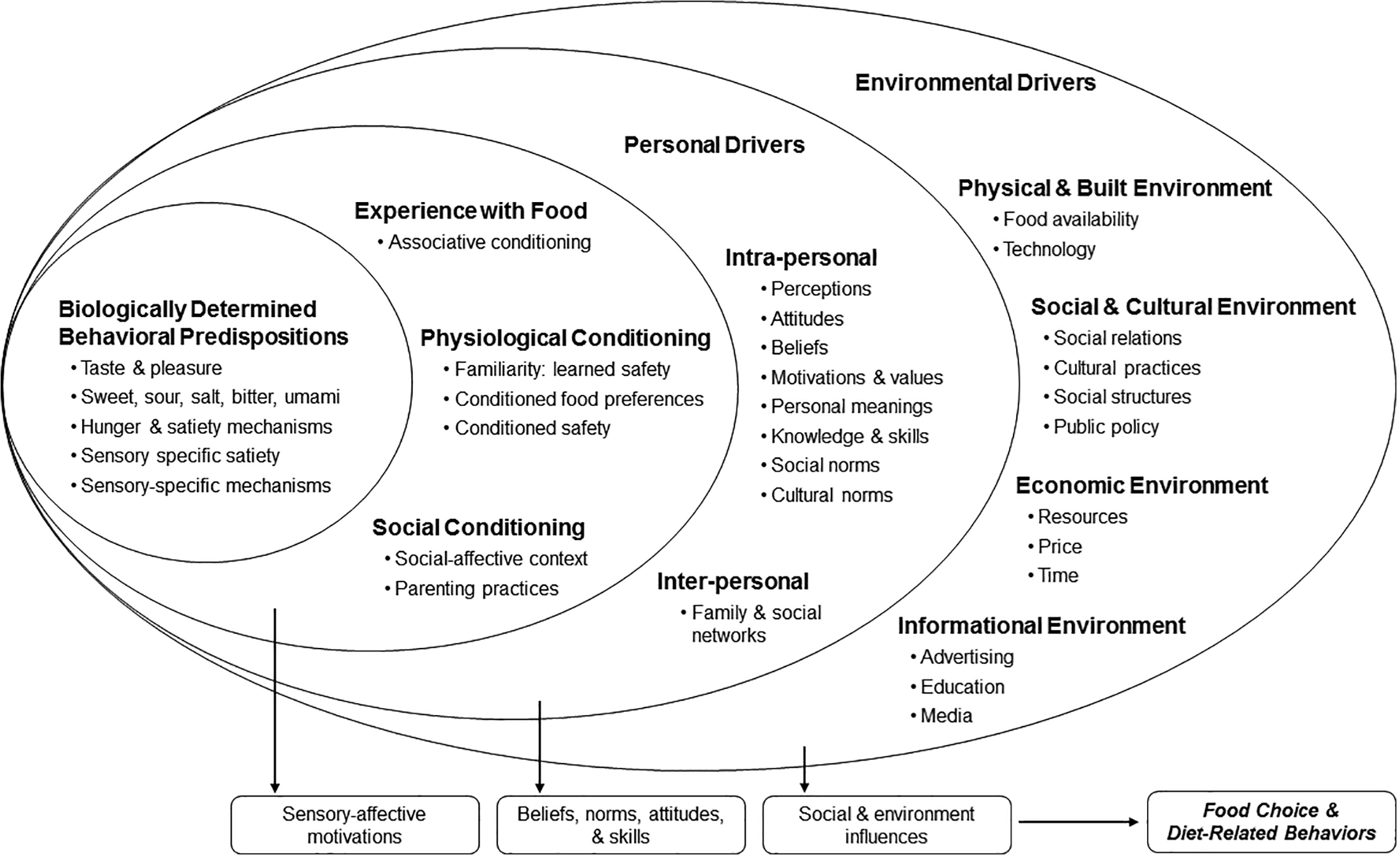
Social and environmental influences at multiple levels on food choice and diet-related behaviors. 18
At the inner-most circle, our food choices are influenced by biology. The basic tastes (sweet, sour, salty, bitter, and umami) and olfaction contribute to the overall perception of food flavor, and these are influenced by genes, physiology, and metabolism. Some foods elicit strong sensory pleasure responses. The oral sensation of fat is highly rewarding, especially in the presence of sugar, 19 and the combination of sugar and fat is linked to the stimulation of pleasure receptors in the brain. 20 The food industry has been criticized for creating sweet, salty, and high-fat foods with the intent of capitalizing on innate biological predispositions. 21 The seeking of sweet and energy-dense foods may have had adaptive value when food was scarce or uncertain. The biological mechanisms that regulate food intake may not be a match for the current food supply that provides low-cost palatable energy-dense foods with high reward potential and limited nutritional value. The biological factors that control food intake can be tempered by learning, experience, or be altered through disease states. The second circle deals with interactions between the individual and their food choices and relates to familiarity and learned safety, conditioned food preferences, 22 and conditioned satiety. 23
The specific foods that people like and their patterns of food acceptance are largely learned through physiological conditioning acquired through experience of exposure to foods. 22,24 New foods gain preference through repeated exposure. 25,26 Feelings of satiety are also modified through physiological conditioning and emotional responses to the social context in which eating occurs. Parents substantially shape the context in which children encounter food by providing, modeling, encouraging, restricting, and rewarding with food. 24,27
In the third circle are the intrapersonal determinants (eg, attitudes, beliefs, motivations and values, personal meanings, knowledge and skills), 18 social and cultural norms, and interpersonal determinants (eg, family and social networks). Attitudes, beliefs, motivations and values, and knowledge and skills develop as individuals move through their life course and become exposed to social and cultural norms. These determinants have influence on the foods that individuals acquire and prepare for consumption. Individuals assume identities related to food which in turn influence food choice. 28 Family and social networks also determine food choice through observations of what others choose, negotiation with others with whom food is shared, and support or lack of support from others in making desired food choices.
The fourth circle brings in broader environmental and societal influences of food choices, many relating to the food supply, marketing, and societal food and nutrition policies and programs. The social and environmental (economic, informational, culture, physical) determinants noted by Contento 18 is described as “context” in the food choice process model. 17
How Food Choice Occurs
One way to understand how food choices occur is through the perspective of the life course. 17 Life course refers to the prior events and experiences of individuals and involves multiple trajectories, transitions or turning points, and context. The life course is the backdrop from which current influences on food choice occur. 17
The biology, intrapersonal factors, and the social and environmental factors (economic, informational, culture, physical) all influence choice in complex ways. For example, ideals formed through personal attitudes and beliefs and cultural norms that provide individuals with references to evaluate food behaviors. The role of biology and intrapersonal factors might give rise to personal identities that individuals develop over time and through which they act. Personal resources, such as income, skills, relationships, may be used to select certain foods and food patterns over others. For example, a lack of time may dictate a preference for more convenience foods or not knowing how to cook might influence a pattern of eating out.
Resources are the many types of assets that are weighed when making food choice. Assets include income and wealth, lack of cooking equipment and space to cook, appropriate skills and knowledge, relationships and networks, and values and traditions. Some resources may enhance food choices, for example, income to provide access to foods. Others may constrain food choices, for example, lack of time dictating convenience foods, and force trade-offs among different resources. Social systems are the set of relationships of individuals in which individuals encounter food with others; choices are made considering values and interests among them.
Food choice, at the individual level, occurs within the personal food systems as cognitive processes guiding their food behaviors in settings. 17 Central to personal food systems are food choice values (eg, taste, cost, health, convenience, relationships), along with the meanings and feelings that are associated with those values. Food choice values vary among individuals and over the life course. Negotiations among food choice values are essential to sort out which values are most important to satisfy. Negotiations may be subconscious, automatic, or less deliberate. In general, however, the negotiation process is largely conscious, often among values of an individual, but also can be among values of multiple individuals (eg, who are in a family).
Linking cognitive evaluation of food choice and behavior are food choice strategies. 17 Strategies are simplified rules used by individuals to convert food choice values to behaviors. Strategies expedite food choice by acting as a guide. Strategies that serve well become carefully constructed over time into routines which make food choice predictable and comfortable while accounting for other life demands. 29
Ideational Aspects of Food Practices
Ideational aspects relate to symbols, meaning, and value given to food. Foods might even be akin to language. 30 Ideational aspects are expressed primarily through the social organization (roles, status) around food production, preparation, and consumption, 6 as well as the prestige attributed to foods and ritualistic uses of foods. In this section, we examine the dominant pathways in which ideational aspects influence food practices, in alignment with the intrapersonal, interpersonal, and social–cultural determinants in Figure 1.
Pathway 1: Identity and Food
Food practices communicate “who we are” in several ways. Food can be a symbol of personal identity, group affiliation, 28 and cultural identity. 31 Adolescents, for example, may use “junk food” to signal belonging to a peer group, while healthy foods signal family. 32,33 Food gifts and food sharing are important forms to express social belonging. 5 Foods communicate a way of life. In livelihoods centered on food production, food holds deep significance compared to a utilitarian significance in urban societies, where food is purchased rather than produced. 34 Food also signals social status. Foods consumed by the wealthy are often associated with refinement, 30,34 while low-prestige foods are associated with food insecurity status 35 or severe food shortage. 36
Pathway 2: Gender and Food
Gender expresses many of the ideational and normative aspects of food practices. Beliefs around femininity or masculinity contribute to gendered food selection, 37 such as the strength and masculinity afforded to meats. 38 In Western cultures, there are differences among the female and male food consumption patterns. For example, women eat less food, but also lighter meals and delicate foods, such as vegetables and fruits. 37 In patrilineal societies, men are given preferential treatment with regard to animal-source foods, which are prestigious. 39 Women are subject to prohibitions on the basis of fertility, pregnancy, or quality of breast milk. 39 Compared to men, women in rural Nepal consumed fewer prestige foods and had lower intake of calories, beta carotene, vitamin B2, and vitamin C. 40
Tasks associated with food production, acquisition, preparation, cooking, and disposal are also gender-specific, and task distribution differs by cultures. In traditional patrilineal societies, for example, the norm is that women are unpaid homemakers, with tasks organized within and around the home. Food caring tasks are often bound to identities of “being a good mother.” 41 In some contexts, it may be culturally acceptable for men to earn a wage as cooks in restaurants, but men will not engage in any food-related tasks at home. 5 Thus, food caring tasks can contribute to gender stereotypes. Also women’s food tasks restrict their leisure time, rest, 42 and participation in public life. 43 For example, in some rural communities in sub-Saharan Africa, time spent collecting fuelwood for cooking can range from 4 to 15 hours per week, depending on distance traveled, and this is often the responsibility of women, young, and old. 44 Class and income modify the gendered nature of intrahousehold food tasks, with higher income households using paid (female) staff to acquire food, cook, and cleanup.
The gendered division of household labor influences food access and control of financial resources for food. 40 When women have more access to economic resources, they generally will purchases more nutritious food 45 and ensure a more equitable sharing of food among women and children. 46
Pathway 3: Religion and Food
Religions help define food practices through various rules, symbols, and meanings. Fieldhouse cites De Garine 47 who notes that foods serve 6 general functions in religious practice: (1) communication with God or other supernatural forces, (2) demonstration of faith through symbolic acts and rituals, (3) rejection of worldliness, (4) enhancement of feelings of identity or belongingness, (5) expression of separateness, and (6) reinforcement of ecological pragmatism. These functions often define food proscriptions, food acceptability, and food practices among religious groups.
Pathway 4: Food Prohibitions
Food prohibitions exist in every culture 48 for a number of reasons, such as sympathetic magic, transmigration of souls, religious sanctions, and health. 47 Food prohibitions may apply to individuals based on their age, sex, or hierarchical position. Some food prohibitions are associated with menstruation, pregnancy, and lactation. 47 During pregnancy, fears of miscarriage, difficult birthing, and implications for who the child might become impose food restrictions that affect food and nutrient intakes. Not all prohibitions are nutritionally relevant, because the food being prohibited can be substituted for another, the restriction is temporary (lasting a few days or weeks), or the social consequences for breaking the prohibition are inconsequential.
Sociocultural Influences on Sustainable Healthy Diets
The acceptability of and desirability for sustainable healthy diets will be influenced by sociocultural factors. For example, cultural prohibitions might exist for eggs and insects, 2 protein sources with low greenhouse gas emissions. Prohibitions for eggs may arise because eggs have commonly represented fertility and fecundity, 47 which in some contexts, are associated with fear of barrenness, lasciviousness, or injury to the unborn child. Today, in North America and Europe, eating insects is largely unthinkable due to their “disgust” factor. 49 The influence of gender on sustainable healthy diets is also relevant. Policies that encourage using less processed food (to reduce packaging) and more cooking at home may discriminate or further subjugate women. Where animal-source foods are preferentially offered to men, the promotion of plant-based foods may further condone women’s inadequate access to animal-source food. In societies with many religions, exploring religious food practices would be relevant when considering system-wide actions, such as taxation on lamb or goat meat, symbols of religious affiliation, with high greenhouse gas emissions. 50
Sociocultural Influences of Food Practices and Policy Planning and Design
Having summarized the individual and sociocultural influences on food practices, we now examine the frameworks and concepts that may assist in policy planning and design. It is extremely important to include experts in anthropology and sociology so that pertinent questions are posed—see list of guiding questions in Table 1—and useful inquiry and analytical frameworks are selected. The sociocultural analysis should be conducted at the group level (not at the country level), because there is significant variation among and within social groups with regard to the ideational aspects of culture, which often results from situational factors. 51 Sociocultural analysis permits exploration of this diversity to avoid stereotypical inferences and unintended consequences.
Example Questions on Sociocultural Influences on Food Practices for Policy Planning and Design.
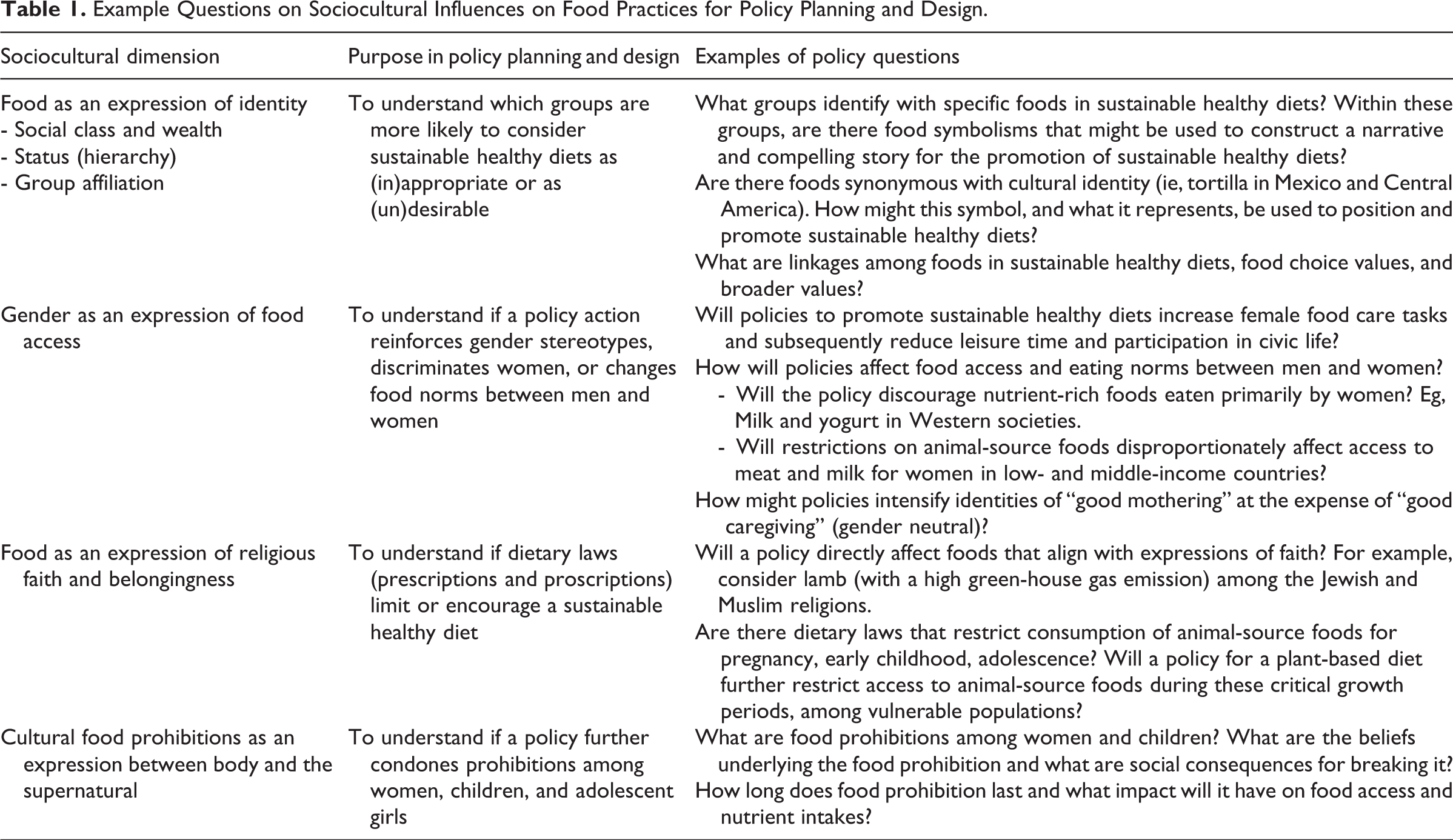
The biocultural framework 52 is an inquiry framework that examines the production, distribution, acquisition, preparation, and consumption of food. It explores the physical and natural resources for food production; social systems that facilitate the import or export of food; social organization of households, social institutions, and political and economic structures; and technologies needed for food production, processing, and preparation. It explores beliefs and values that affect and relate to the acquisition, preparation, and consumption of food. These data are collected through in-depth research, such as in focused ethnographic studies. 53 -55
The Passim and Bennett’s classification is a descriptive framework useful for examining dietary practices at group level. 56 This classification draws on food use and frequency of consumption (Table 2). In this framework, core foods are staple foods, which are used by most of the population (eg, rice in Philippines, tortilla in Mexico, bread in the Netherlands). The secondary core includes widely (but not universally) used foods such as fruits and vegetables, dairy products, and their various preparations, such as instant, ready-to-eat, or frozen, and use forms (meals, snacks, etc). Secondary core foods also include foods prepared for special events (ie, weekly family gatherings, festivals). The periphery category foods are rarely used, or used by a small subgroup of the population, such as very modern food innovations (eg, probiotic drink), expensive and prestigious foods, or food “cravings” of pregnant women. The Passim and Bennett classification is useful for policy planning and design because it identifies food categories that are amenable to dietary change.
Passim and Bennett’s Classification for Food Among Subgroups and for the Evolution of Food Practices. 56
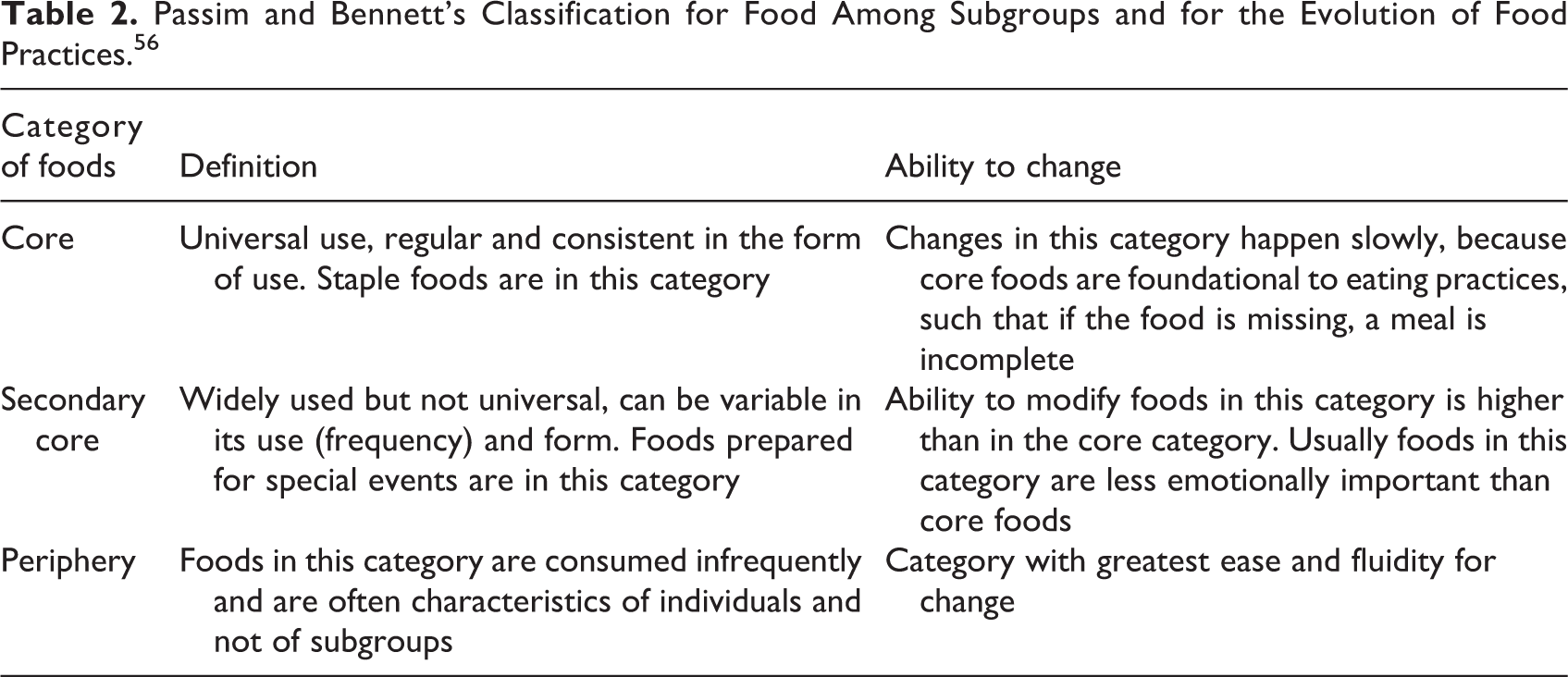
Over time, the classification of foods evolves due to lower food prices, improvements in food storage and cooking technologies, and marketing of specific foods, so the Passim and Bennet framework is a useful tracking tool for the evolution of food practices. Countries that already collect food frequency, 24-hour recall, or dietary record data through surveys can apply the Passim and Bennett classification for an examination of core, secondary core, and periphery foods by different population subgroups and regions.
Values and Food Choice Values and Their Relevance to Food Practices
The ideational elements of culture, such as symbols, ideas, and meanings, are often expressed in values. We draw on the anthropological (evaluations of our mode of conduct) 57 and psychological (beliefs about an end state of existence) 58 definitions of values.
Values help negotiate food choices and/or simplify choices. Lewin 59 argues that a system of values is the foundation that influences decisions on food and bring about conflicts of varying intensities. Values are linked with feelings and emotions. 60 Cultural values are the shared ideals of what is good and desirable for a group, and these values are the basis for behavior norms. 61 For both individuals and societies, there is a hierarchy of the relative importance of values, and the relative importance changes over time. 58,61
In the food choice literature, 62 -65 the “food choice value” label captures diverse ideas (see Table 3), from a food attribute (taste, appearance, naturalness), to food procurement (availability, cost), and food preparation and eating (variety, convenience). Other food choice values refer to an end state (safety and healthfulness), modes of conduct (managing social relationships, fairness), or the material world (origin, environmental impact). Because we use values to negotiate food choices, 17 it is important to determine how food choice values are linked to food symbols, meanings, and behaviors.
A List of Selected Food Choice Values From the Published Literature.
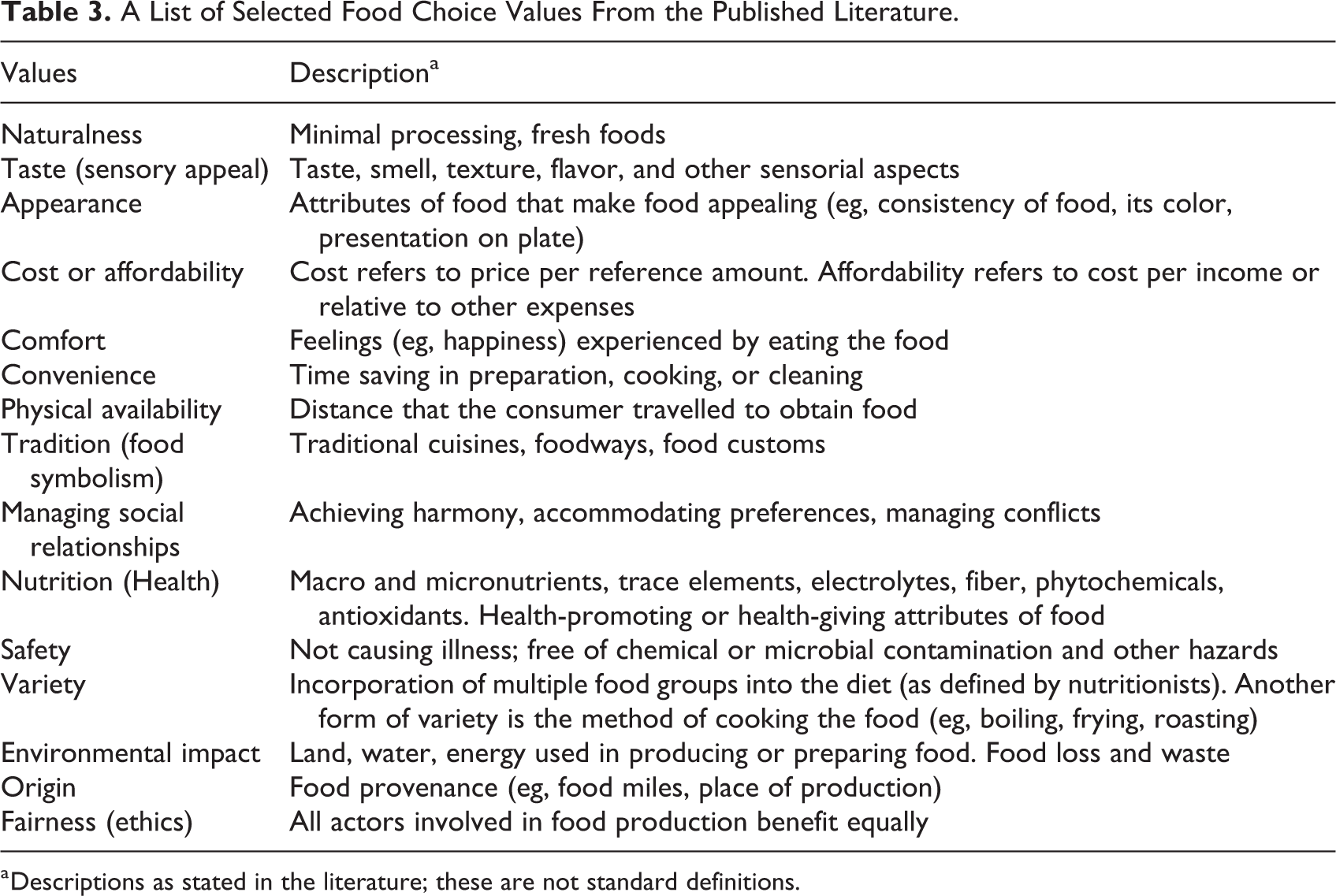
a Descriptions as stated in the literature; these are not standard definitions.
Concluding the extent to which food choice values determine food choice is difficult because of 2 methodological challenges. The first relates to defining values and the purpose they serve in food choice. There are multiple definitions of the term “value”; sometimes values are confounded with attitudes, motives, or needs. Authors may not distinguish between instrumental and terminal food choice values, with the former as means to an end and the latter as a desirable end state (eg, ethical consumption). 58 Because many personal food choice values are continuously negotiated, 17 they are probably used to achieve an end. 63
The second challenge relates to establishing attribution in the links between food choice values and behavior. The prevailing notion in decision theory is that deliberative and automatic process drive choice. 66 Many (food) decisions are automatic or subconscious, 67 intuitively understood, 68,69 or embedded in food routines and habits. 29 Food choice values, on the other hand, are a cognitive concept which can be articulated, and food choice values are used in deliberative decision-making. 29 In automatic decision contexts, 68 a food choice value (often measured through survey and self-reports 70 ) may reflect a choice justification rather than choice prediction, 66 so it is difficult to assign causal attribution of a food choice value to a food-related intention or behavior. 68
Nevertheless, analysis of values is useful for policy planning and design. The utility of values lies in their ability to capture culturally relevant ideas, meanings, emotions, and beliefs and thus can be used to drive intentions 58 and to change norms and encourage new lifestyles (modes of existence). 71 When food choice values align with personal or cultural values, we find associations with food purchase intentions, for example, with organic foods in Europe, 72 meat choices among Dutch consumers, 73 and environmentally friendly consumption behaviors among the Danish. 74 Values may help create stories, myths, and narratives because values capture deep, universal truths. 75 Emotions and forging emotional connections are indispensable for creating promotional campaigns that motivate consumers toward health and sustainability. 76,77
Promoting Sociocultural Change in Food Practices
Sociocultural change for sustainable or healthy diets is already happening through food movements, food lifestyles, and traditional cuisines. Food movements are built on multiple values that address how to grow, transport, source or buy, and cook foods. Some values encompass ethical, moral reasons, which create a strong emotional connection with consumers. 78 Movements thrive by fostering collective identities and building shared emotional experiences. 79
In Western countries, progressive food movements aim to support sustainable healthy diets. The “slow food movement” seeks a consumer class that selects food based on health, sustainable livelihoods, and respect for the environment. 80 This movement uses multiple values, such as sensory pleasure, naturalness, origin, fairness, and environmental impact. Variations of this movement are “locavores” or “naturalistic foodways” that support local, sustainable agriculture and unprocessed foods. 81 The organic food movement centers on nonchemical production of crops and livestock. 82 Organic food and “slow food” movements may or may not promote policy change. 82 Progressive movements are often criticized as elitist.
Radical food movements, built on moral orientations (what we ought to do), are “food justice” or “food sovereignty.” In Western countries, “food justice” addresses class and racial inequities. 83 In the global south, “food sovereignty” eschews dominant neoliberalism to food production, being based on principles of human rights, sustainable agrarian livelihoods, local agroecology, and knowledge. 84 Food production is driven by needs and aspirations of local people (rather than the market or corporations) for healthy and culturally appropriate foods. 85
Food lifestyle is a system of cognitive categories (beliefs/attitudes) that link a set of goods (eg, food) to a set of values, and lifestyles are enduring dispositions of behavior. 86,87 For example, veganism eschews exploitation of animals for food, clothing, medicines, testing of drugs, or additives. 88 Lifestyles, such as veganism and vegetarianism, are also bound to social 89 and religious identity.
The return to traditional cuisines values how food is produced, creating emotional linkages with the cuisine of the past. 90 The new food-based dietary guidelines of some Latin America are redefining “traditional cuisine” not only as traditional recipes and meals but also consuming minimally processed foods. The Brazilian food-based dietary guidelines, for example, recommends consuming natural or minimally process foods and eating in accordance with Brazilian food culture. 91 A similar frame is evoked in the Uruguayan food-based dietary guidelines. In contrast to traditional cuisines, Indigenous people’s diets explicitly link food, health, environment (biodiversity, land use), and cultural identity (rites, traditions). 92
A critical question is whether traditional ways of eating are associated with both better health and lower environmental footprints. In HIC, there is evidence on positive health and environmental impacts for the Mediterranean 93 and New Nordic diet. 94 Among Canadian Artic Indigenous Peoples, meats and fish, native to the Artic, support daily intakes of vitamins (B6, A, C, D, E, riboflavin) and minerals (iron, zinc, selenium, among others) for adults and children. 95 In other contexts, however, the relationship between health and environmental footprint may be more complex. For example, agropastoralist in Kenya, who depend on milk and meat from goats, camel, or cattle, have better nutrient intakes of vitamin A and B12, 96 but families who shift to plant-based diets show an increase in the risk of anemia among children. 97
Conclusions
Policy planning and design to determine what actions could be taken to promote sustainable healthy diets should include a sociocultural analysis to understand the acceptability and desirability of any policy action. Individual choices are influenced by the broader sociocultural context, where in the process of decision-making individuals experience, define, interpret, negotiate, manage, and symbolize the world around them. The ideas, symbols, and meanings associated with foods are part of our shared sociocultural context. Values are another way to link the individual and sociocultural level. Food movements, food lifestyles, and traditional diets are examples of how values, symbols, and ideas can be leveraged for collective action, for alternative ways to grow, procure, and consume foods. Businesses and civil society organizations can support and mobilize consumers toward more ethical and citizen-oriented food actions.
An analysis of the sociocultural influences on food practices is needed so that food policy fully aligns with society and culture. This can be achieved by using the frameworks and concepts we discussed, along with empirical data collected through in-depth qualitative methods and surveys. For example, an ethnographic module could be applied to a subsample of dietary survey participants. This tool will be useful not only for identifying symbols, meanings, and values but also for examining food practices and its associations with the ideational aspect of culture. Policy makers should rely on local or international technical experts and agencies to facilitate the convergence of feasible methods and carry them out. Global normative agencies should advocate for sociocultural analysis to assess the acceptability and desirability for sustainable healthy diets.
Footnotes
Acknowledgments
E.A.F. drafted the section personal food system and food choice. E.M. drafted all other sections of the manuscript. All authors contributed to the conceptualization of the paper, revisions, and reviewed and approved the final draft of the manuscript. A version of this paper was presented at the International Consultation on Sustainable and Healthy Diets, FAO headquarters, Rome, Italy, July 1-3, 2019. All authors received a stipend from FAO for this paper.
Declaration of Conflicting Interests
The author(s) declared no potential conflicts of interest with respect to the research, authorship, and/or publication of this article.
Funding
The author(s) disclosed receipt of the following financial support for the research, authorship, and/or publication of this article: This paper was made possible with funding from FAO.
