




Abstract
This article highlights the important contributions that the Institute of Nutrition of Central America and Panama longitudinal study has made to global development efforts. The studies have made a unique contribution to our understanding of the role of early life nutrition on many outcomes of interest to the global nutrition community and have strengthened narratives such as human capital.
Introduction
The cutting-edge Institute of Nutrition of Central America and Panama (INCAP) longitudinal study (1969-1977), was among the first carefully designed large-scale community-randomized trials worldwide (2392 children aged 0-7 years). Initially designed to document the impact of early life nutrition interventions on child development, with growth as a secondary outcome, over time this cohort has been the subject of several additional investigations on a comprehensive range of outcome measures, including physical growth and health (eg, strength, body composition, cardiometabolic risk factors); education attainment and cognitive functioning; occupation, income, and asset accumulation; and maternal–child interactions.
This article highlights the important contributions that the INCAP Longitudinal Study has made to global development efforts and the global nutrition community. As described in this supplement, many researchers have built on the initial findings, with more than 200 publications produced on the relationships between child growth and development of human capital. 1 The studies have also contributed to our understanding of the impact of improving nutrition during early childhood on adult well-being and health, including in the increasingly critical context of rising overweight/obesity, and on the growth and development of the next generation. Fifty years after the study began, it continues to contribute to building a case for investing in young children, including the new narrative on building human capital.
Building the Case for Investing in Young Children
The INCAP Longitudinal Study contributed to a consensus in the international community that the first 1000 days of life are a critical “window of opportunity” for nutrition interventions, with long-term impacts on human capital. The original evaluation was one of the first rigorously designed studies to show that interventions to improve maternal nutrition significantly improve birth weight and size. 2 It also was one of the first studies to show that impacts of nutrition interventions differed depending on child age, with implications for programmatic targeting and investments. A cohort of children exposed to the atole supplement (high-quality protein, energy, and micronutrients) in the first 3 years of life had reduced the risk of stunting, but no effects were found among children exposed at later ages (3-7 years). 3 Follow-up studies on this cohort in the Human Capital Study (2002-2004) found that the impact of atole exposure on adult productivity (measured by wages) was greatest for children exposed from 0 to 2 years and least for children exposed at 3-6 years. 4
Data from the INCAP Longitudinal Study were included, with data from 4 other prospective cohort studies (from Brazil, India, the Philippines, and South Africa), in seminal analyses of the associations between child growth and size with adult schooling and economic productivity in the Lancet Series on Maternal and Child Undernutrition. 5 A strong body of research, including findings from the INCAP Longitudinal Study, contributed to estimates of high economic returns from investments in nutrition, as a result of improvements in health, cognitive capacity, and productivity of women and children. 4,6 Global movements such as Scaling Up Nutrition (https://scalingupnutrition.org/) and 1000 days (http://thousanddays.org) contributed to increased prioritization of this target group by civil society, governments, and international donors and stakeholders, ultimately increasing the focus on pregnant women and young children in national nutrition policies and programs.
The research on the impact of early childhood nutrition interventions on cognition has been carefully documented by several researchers, including Pollitt et al, 7 who showed substantial impacts among adolescents and young adults on tests of general knowledge, numeracy, reading, and vocabulary. The most recent among these analyses, carried out between 2014 and 2018, examines the links with metabolic 8 and cognitive outcomes and shows that both the number of grades passed and literacy rates for both men and women have increased over time between 1975 and 2015, 9,10 albeit it is not clear how much of this improvement is attributable to the early exposure to atole versus overall development and access to services.
The results presented by DiGirolamo et al 9 and by Haas and Rivera-Dommarco 11 suggest a strong relationship between indices of a child’s early nutritional status and motor and cognitive development in infancy and through the preschool years, continuing into adolescence, particularly for males. Nutritional supplementation with atole during a critical period of gestation through 2 years of age was associated with improvements in motor development and small but consistent improvements in cognitive development during infancy and the preschool years, with similar results of greater magnitude found with cognitive functioning in adolescence. Findings remained strong even after controlling for various sociocultural factors such as socioeconomic status (SES) and attendance to supplementation centers, as well as schooling.
Among adolescents, positive effects of atole were seen in a wide range of indicators of human capital formation. Significant interactions were found with SES and with years of school attained; differences in performance favored adolescents exposed to the nutritional intervention in gestation and early childhood over nonexposed adolescents, with differences greatest for participants of low SES and among those who had higher levels of schooling. Referring to the beneficial effects of atole observed on vocabulary, Haas and Dommarco note, “the findings…that the effect was sufficient to cancel the expected score differences between the lowest and highest SES distribution, can be interpreted as the supplementation acting as a social equalizer.” 11 The results provide strong evidence for the importance of providing low income, at risk mothers, infants, and children with programs to address unmet nutritional needs and the important potential beneficial effects for human cognitive development.
Ramakrishnan describes the intergenerational transmission of malnutrition (small mothers have small babies, who grow up to be small mothers) and how the INCAP Longitudinal Study has been uniquely able to study how nutrition interventions affect the growth of future generations. 2 Notably, the INCAP Longitudinal Study demonstrated that women exposed to atole in childhood had offspring with greater birth weight and other improvements in growth (with effects larger for boys compared to girls). 12 Future work is needed to examine the impact of nutrition in the first 1000 days on cognitive functions and well-being of the offspring.
The article by Behrman et al in this supplement summarizes research based on the INCAP Longitudinal Study that demonstrates the positive effects of the atole intervention on prime-age adult cognitive skills and productivities. 10 The findings are interpreted in the context of a life-cycle stages model in which various factors and investments at each stage of life influence outcomes not only in that stage but in subsequent ones. The results point to the likely importance of improvements in adult cognitive skills due to better early life nutrition on adult male labor market outcomes, as well as on women’s “home productivity.” Based on the data available, the team estimated that exposure to early nutrition interventions between 0 and 36 months increased adult comprehension skills by 0.28 standard deviation (SD) and adult reasoning skills by 0.24 SD, demonstrating that early nutrition can have impacts on adult cognitive skills, which translate into economic benefits. Interestingly, they hypothesize that given the high returns to these adult cognitive skills in the labor market, the critical pathway appears to be through improving adult cognitive skills through improved early nutrition, rather than through adult health. Not only are investments in early life nutrition important for immediate welfare; they have significant productivity payoffs in adulthood. 10 The findings from these longitudinal studies have been key to conceptualizing the new narrative within the World Bank on Human Capital and the new Human Capital Index (HCI).
The HCI and Its Links With Nutrition
Up until recently, nutrition was considered primarily an issue of food consumption, and the agenda was limited to a narrow field of researchers and practitioners in nutrition. It was only marginally included in the Millennium Development Goals (MDGs) as a subcategory almost hidden under MDG 1 focusing on poverty reduction. With recent research advances, there has been an evolution in understanding the importance of addressing linear growth failure and stunting versus underweight, and that good nutrition is an outcome of good health and healthy environments, access to better food, and care in early life. After many efforts, nutrition has been repositioned as central to development, with an understanding that poverty not only as a cause of malnutrition but also the reverse: malnutrition as the source of impoverishment. 13 As a result, nutrition has risen to greater prominence in the global development agenda, with a distinct target included under the new Sustainable Development Goals (SDGs; target 2.2). And most recently, the narrative on human capital and as a key component of the new HCI has brought even more legitimacy and urgency to investing in nutrition, to address both undernutrition and obesity.
The HCI (note 1) was developed at the World Bank to represent a combination of the knowledge, skills, and health that people accumulate throughout their lives, enabling them to realize their potential as productive members of society. While technological progress is boosting the demand for higher-order skills, half the world’s children are trapped in low productivity. The HCI, launched in 2018 covering data from 157 countries, shows that nearly 60% of children born today will at best be half as productive as they could have been if they had access to good health, nutrition, and education. The question that each country’s index tries to address is “How much human capital can a child born today expect to acquire by age 18, given the risks of poor health, nutrition and education that prevail in the country where she lives?” This has strong implications for productivity, inclusive economic growth, and the goal of ending poverty by 2030. As of 2019, more than 40 countries have signed on to actively participate in the Human Capital Project, an accelerated effort to encourage investment in people through nutrition, health care, quality education, jobs, and skills.
Figure 1 shows how nutrition is central to the HCI through contributions to increasing survival to age 5, increasing the quality of learning, and improving child growth and adult survival. As summarized in this article, the INCAP Longitudinal Study has made important contributions to the case for sustained nutrition during the critical early years to improve a child’s life in the short term as well as for longer-term benefits to well-being and development.
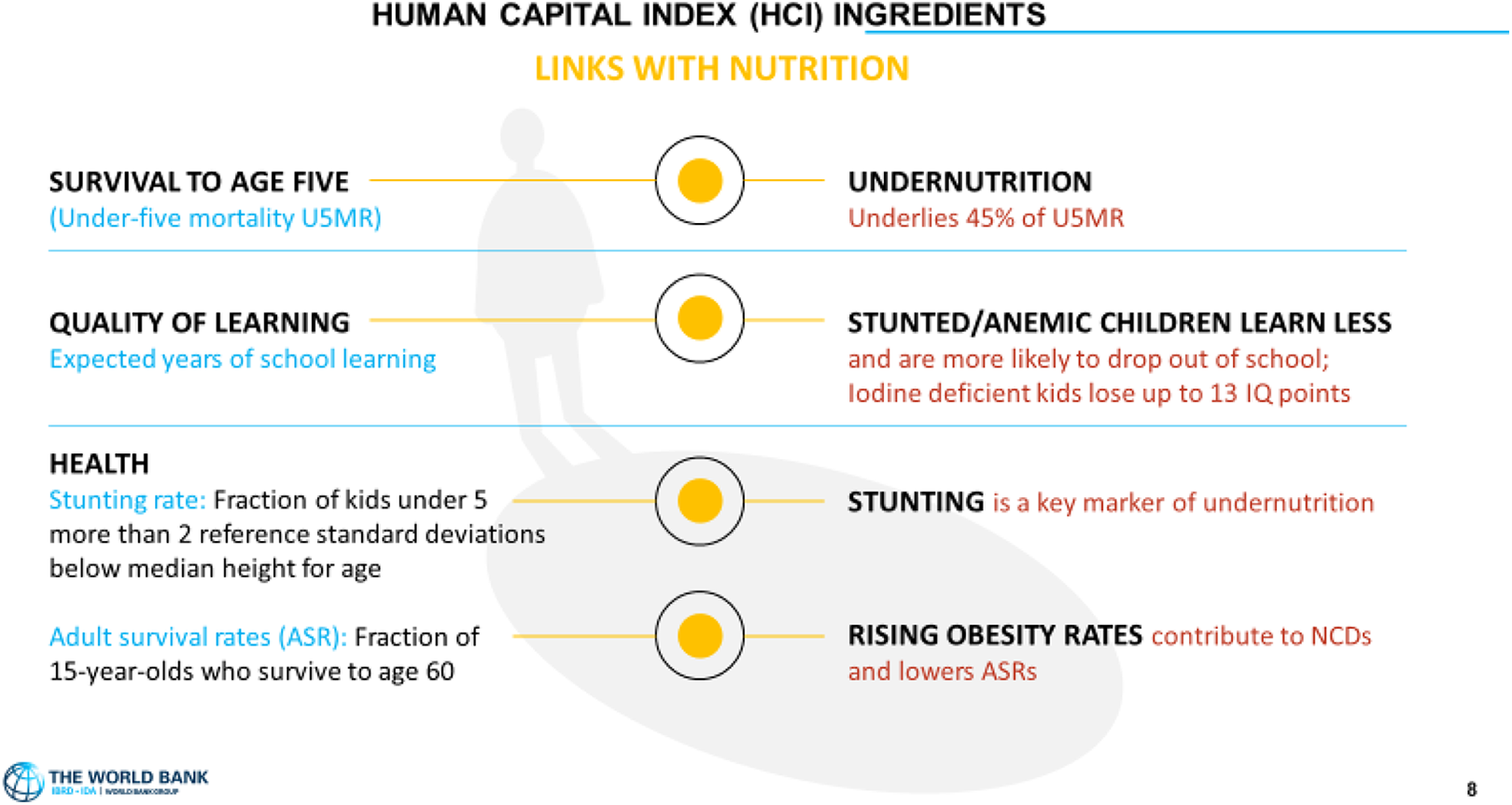
Human Capital Index ingredients: Links with nutrition. NCDs indicate noncommunicable diseases; U5MR, under 5 mortality rate.
Increasing Focus on Obesity
While the good news is that globally child stunting rates have declined over the last 3 decades from 39% to 22% (albeit with important regional inequities), 14 micronutrient deficiencies remain high, and obesity rates are rising. A new World Bank report notes that worldwide, in 2016, approximately 6% of children younger than 5 years, 20% of children aged 5 to 19, and 44% of adults aged 20 years and older were overweight or obese (see Figure 2). 15 Overweight/obesity has nearly tripled since 1975 and now accounts for 4 million deaths globally every year, nearly two-thirds of which are due to cardiovascular disease; it also accounts for approximately 120 million lost disability-adjusted life years. 16 Once considered a public health problem only in high-income countries, overweight/obesity is now highly prevalent in low- and middle-income countries. Consequently, low- and middle-income countries are now confronted with the double burden of malnutrition, characteristically defined by the coexistence of undernutrition and overweight/obesity at the country level. 17
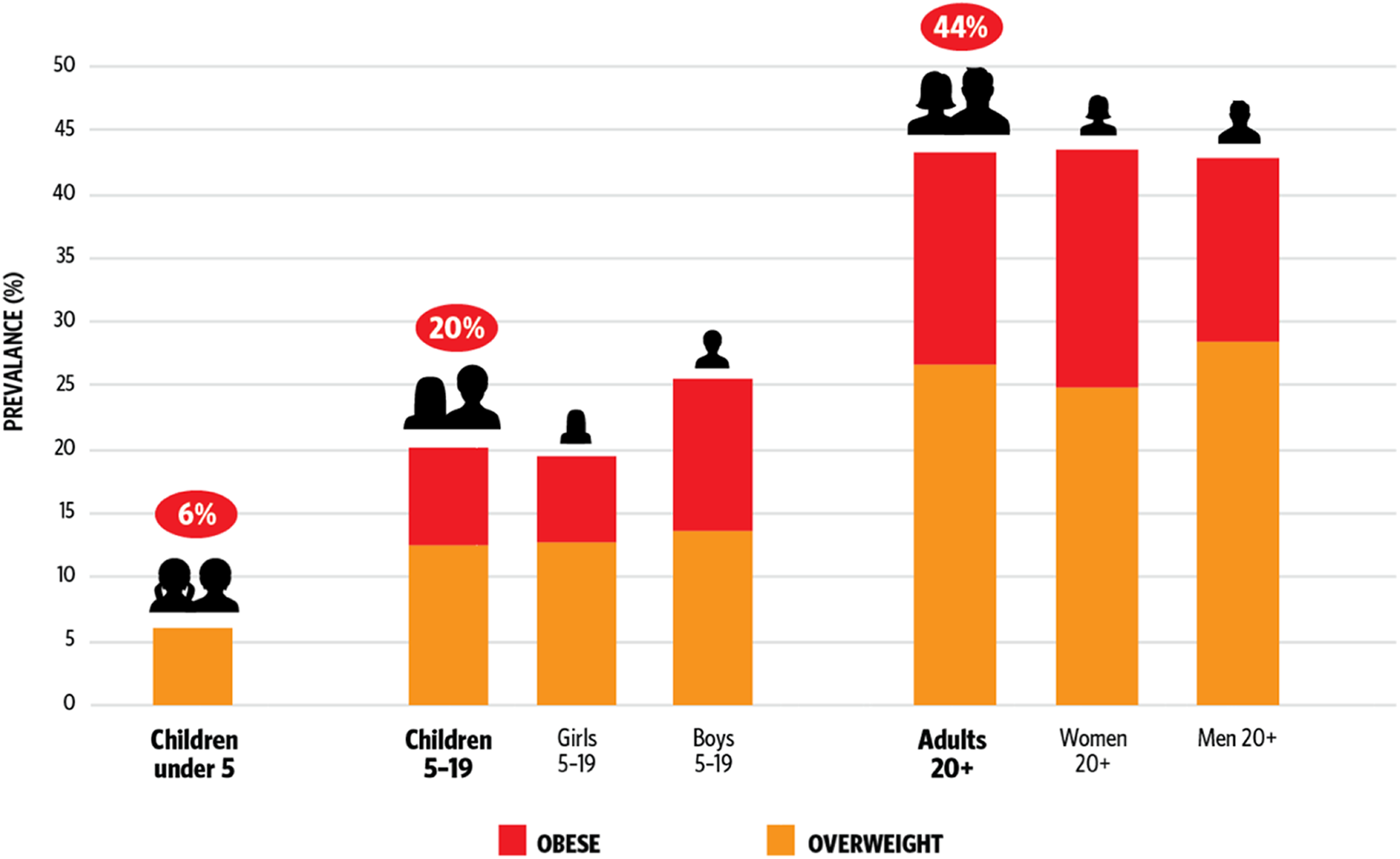
Global prevalence of obese and overweight data sources: Data for children younger than 5 years are from UNICEF, WHO, and World Bank 2016; data for adults are from NCD-RisC data for 2016, http://ncdrisc.org/data-downloads.html. UNICEF indicates United Nations Children’s Fund; WHO, World Health Organization.
Furthermore, in all age-groups, the majority of overweight/obese individuals reside in middle-income or low-income countries, dispelling the myth that overweight/obesity is a problem only in high-income countries. Similarly, the rise of obesity is not limited to urban areas, and the growth in rural obesity has been notable. In all countries with high adult overweight/obesity levels that began in the 1990s, there was a lag of about 7 years or more before child and adolescent overweight/obesity also accelerated. Latin America, North Africa, and South East and East Asia, among other regions, are beginning to show higher prevalence of child/adolescent overweight, and the rates of change are accelerating, even as the stunting burden recedes ever so slowly, leading to the phenomenon of the “double-burden of malnutrition.”
Guatemala is undergoing rapid nutrition, epidemiological, and economic transitions and is one of the countries in the world with the highest burden of both undernutrition (child stunting) and overweight/obesity among women. The study cohort had high rates of chronic childhood undernutrition followed by high exposure to an obesogenic environment in adulthood. The INCAP Longitudinal Study has and will continue to provide unique contributions to understanding the role of early childhood nutrition on adult body composition and cardiometabolic health. Kroker et al present both positive and adverse effects from the longitudinal study cohort, showing that this is a complex issue that needs follow-up and careful study. 8 Adiposity and weight in adulthood are strongly predicted by weight gain after the first 1000 days of life. One of the most recent follow-up studies (2015-2017) found that exposure to atole in early life reduced diabetes risk by approximately 50% but on the other hand increased the risk of overweight and obesity. Future research will aid in clarifying the underlying mechanisms that drive these 2 associations.
A key finding of the Human Capital Study (2002-2004) was that linear growth in the first 3 years of life was associated with higher fat-free mass in adulthood and weakly associated with fat mass and abdominal circumference, while an increase in body mass index (BMI) between 3 and 7 years of age was strongly associated with higher fat mass and abdominal fat. This result highlights the importance of monitoring changes in BMI in preschool age to prevent excessive adiposity in adult life. The data from this follow-up were used in a joint analysis with 4 other low- to middle-income country cohorts (Brazil, India, the Philippines, and South Africa) and consistently demonstrated that faster linear growth and relative weight gain after early childhood were associated with greater overweight in adulthood. 18
Program Evaluations—A Key Tool for Evidence-Based Policy-Making
While the global nutrition community has raised a call for “More money for Nutrition,” based on careful analyses on what it will cost to scale-up high impact interventions to achieve the SDG nutrition targets, 19 at the same time there is a call for “more nutrition for the money that is being spent.” This call will be further articulated at the forthcoming “Nutrition-for-Growth” summit to be hosted by the Government of Japan in Tokyo in 2020. This will entail better data on nutrition, both coverage data on key interventions and data on tracking expenditures on nutrition through public expenditure reviews and evaluations of large-scale programs to measure if results were achieved. While there is significant evidence on “what to do,” there is much less information on how to do it at scale, and more understanding is needed of the contextual factors that affect program effectiveness and the levers that can be adjusted to improve program quality.
As noted by Martorell, in the initial INCAP study, both control and treatment groups received strengthened primary health-care services, including innovative protocols for assessment, treatment, referral, and follow-up of sick and malnourished women and children. 3 Accelerating progress in nutrition (both undernutrition and overnutrition) will require increased contributions from other sectors, including health; social protection; water, sanitation, and hygiene; agriculture; and education to improve the delivery of “nutrition sensitive” interventions 20 to address the underlying determinants of malnutrition and to improve synergies with the nutrition-specific interventions. More rigorous evaluations of large-scale programs are needed to build the evidence base for the effectiveness and efficiency of large-scale programs that deliver packages of core high-impact nutrition interventions with nutrition-sensitive interventions through national systems (either jointly or through improving coordination and geographical convergence). In this time of unprecedented commitment to building human capital, high-quality long-term impact evaluations and cohort studies are needed to improve our knowledge base on the sustained effects of these multisectoral nutrition interventions.
The initial INCAP study would be largely forgotten today without the many follow-up studies. In this supplement, Behrman et al 10 argue that convincing analysis requires a coherent conceptual model, using longitudinal studies that follow individuals over long periods of their life course, and a plausible means of distinctly identifying the effects of improving early life nutrition from other factors—all of which was embodied in the INCAP Longitudinal Study that provides a template for future evaluations.
Conclusion
The INCAP study cohort has provided, and will provide in the future, unique data on the role of early life nutrition on many outcomes of interest to the development community—from physical and cognitive growth to body composition and cardiometabolic health. The results from these studies have gone on to inform new development paradigms and strengthen narratives such as human capital and will hopefully remain one of the unique data bases that will continue to inform researchers, development professionals, and country leaders on designing programs to improve the futures of humankind in the generations to come.
Footnotes
Declaration of Conflicting Interests
The author(s) declared no potential conflicts of interest with respect to the research, authorship, and/or publication of this article.
Funding
The author(s) received no financial support for the research, authorship, and/or publication of this article.
