




Abstract
Background:
Although the issue of nutrition was long underrepresented in the global health agenda, it regained international attention with the introduction of the Scaling Up Nutrition (SUN) framework. A historical review of global nutrition policies over 4 decades illustrates the evolution of nutrition policy themes and the challenges confronted by SUN.
Objective:
This study reviews major events in global nutrition policy from the 1970s to the SUN movement around 2010 to illustrate the dynamics of global agenda setting for nutrition policy along with implications for the government of Japan.
Methods:
The events are categorized according to each decade’s nutrition paradigm: nutrition and its socioeconomic features in the 1970s, nutrition and community programs in the 1980s, nutrition as a political issue in the 1990s, and nutrition and evidence in the 2000s.
Results:
This study identified 2 findings: First, the arguments that led to a global consensus on nutrition policy generated paradigm shifts in core ideas, and second, in response to these paradigm shifts, global nutrition policies have changed significantly over time. With regard to Japan, this analysis concludes that the government of Japan can take a greater initiative in the global health community as supporter of SUN by strategically developing a combination of financial, political, and practical approaches to improve global nutrition policy through the concepts of Universal Health Coverage and Human Security.
Keywords
Introduction
From a global health perspective, adequate and appropriate nutrition for child survival and development is an urgent matter. In communities, infants and mothers are the primary victims of undernutrition, which impairs cognitive development and physical growth—conditions that may recur in future generations and have significant effects on the future education and productivity of children. 1 In 2011, an estimated 99 million children worldwide younger than 5 years of age were considered undernourished, 2 and an estimated 45% of deaths of children in this age-group were attributed to undernutrition. 3
On a policy level, nutrition has long been underrepresented as an issue on the global health agenda. It is still the case that, unlike other global health issues, “nutrition is institutionally homeless in government” and the “nutrition system is fragmented and uncoordinated.” 4 In 2010, the Scaling Up Nutrition (SUN) framework was established based on the principles and global visibility of the Lancet Nutrition Series of 2008. The SUN finally placed high priority on nutrition, which gained visibility on the global health agenda after years of dedicated effort. 5 On the other hand, it is important to recognize that even before SUN many countries, including Japan, provided substantial amounts of resources directly or indirectly through various channels to improve nutrition in communities. For example, the World Bank and the government of Japan jointly established the Policy and Human Resources Development Fund 6 and started new projects for nutrition.
A historical review of global nutrition policies over the past 4 decades illustrates the evolution of nutrition policy themes and the challenges confronted by SUN. Different paradigm shifts in the international development agenda have shaped many health policies in the past, and nutrition policy has likewise been influenced by these changes over time. 7 However, prior reviews of global nutrition policy have been limited in scope and data and did not address broader aspects of nutrition.
Consequently, this study reviews the major events in the evolution of global nutrition policy by decade, from the 1970s to the SUN movement around 2010, focusing mainly on undernutrition. This review uses a broader view of global nutrition policy than previous analyses to illustrate the evolving dynamics of global agenda setting for nutrition policy and to provide some implications for further cooperation by the government of Japan.
Methods
Between November 2014 and January 2015, we conducted a review using printed sources, including major papers and relevant available policy reports regarding major global nutrition events from the 1970s to the 2010s. We also conducted an electronic search of English-language articles using a variety of key words (nutrition policy, paradigm shift, global nutrition, international nutrition, bibliography, and chronology) and the Google Advanced Search tool. The research team then identified major events in the history of global nutrition policy from the 1970s to the 2010s by reviewing key reports issued by the United Nations and the World Bank, putting these events in chronological order, and identifying and examining the dominant theme or paradigm for each decade.
Results
The 1970s: Nutrition and its Socioeconomic Features
In the 1970s, discussions regarding nutrition focused mainly on socioeconomics. Recognition of wide disparities in the global economic growth of the 1960s led to criticism of economic growth strategies. In 1973, the United States Agency for International Development (USAID) announced its New Direction policy, later referred to as the Basic Human Needs mandate, to help fulfill the basic needs of people living in poverty. At this time, there was also an ongoing debate about the significance of undernutrition in the context of economic development. Animated discussions took place to determine whether nutrition was a positive investment for economic growth or merely a consumer behavior. 8
The focus of these arguments was undernutrition as a lack of protein. Harper and others criticized this assertion, pointing out the need for a broader socioeconomic perspective. 9 In addition, McLaren asserted that undernutrition was a lack of energy as well as a lack of protein. 10 It was also claimed that securing enough food for groups in poverty solely via the means of economic growth took a substantial amount of time. 11 In light of this argument, with the global food shortage caused by the oil crisis of the 1970s and the sharp upswing of prices that followed, the need for further discussion on nutrition policy with an emphasis on poverty reduction gained more attention. The USAID and the World Bank recognized the importance of nutrition intervention and began to increase their investments toward that end. Global attention turned to the importance of a multidimensional approach to nutrition that would consider social, economic, political, and cultural factors. Eventually, following the Food and Agriculture Organization (FAO) report in 1977 on the world food situation, the global nutrition community recognized that the problem was not only in the quantity of food but also in the distribution of or access to food for the poor. 12 In 1978, the Alma-Ata Declaration adopted the Primary Health Care (PHC) approach. One of the eight essential components of the PHC approach was the improvement in nutrition, which was addressed through community-based nutrition activities. 13
The 1980s: Nutrition and Community Programs
In the 1980s, there was a greater focus on community-based nutrition. In some countries during the 1980s, the budget for social development programs (such as health care) was significantly reduced, while the health conditions of poor populations worsened and the number of malnourished people increased. 14 This occurred in countries whose domestic economy had deteriorated because of debt caused by the economic recession brought on by the oil crisis of the 1970s. The call in 1979 for a cost-effective and target-oriented “selective PHC” was initiated against this global economic background. 15 In 1983, the United Nations Children’s Fund (UNICEF) proposed its Child Survival and Development Revolution for children and started the GOBI program (that combined Growth monitoring, Oral rehydration therapy, Breastfeeding, and Immunization). 16
In the 1980s, 2 landmark community programs were implemented that became the basis for later community-based nutrition programs. 17 In Thailand, PHC became an important element of health care planning in 1976, and in Iringa, Tanzania, the Joint World Health Organization (WHO)/UNICEF Nutrition Support Program was active from 1982 to 1989. The Nutrition Support Program emphasized social mobilization in addition to the assessment of and action plans for nutrition and food security. 18 In Thailand, notable actions carried out as part of the sixth national development plan (1987-1991), which featured social mobilization and community participation, achieved major results in the 1980s and the 1990s. Throughout Thailand, village health volunteers were trained to build capacity through community mobilization. These health workers acted as facilitators to generate interaction among key players at the community level. 19
The 1990s: Nutrition as a Political Issue
During the decade of the 1990s, arguments about nutrition were discussed as a political issue in global conferences. The “Strategy for Improved Nutrition of Children and Women in Developing Countries” asserted that nutrition was the right of every child in the world. 20 In addition, the UNICEF Conceptual Framework, announced in the same year, described the basic concept of nutrition and other relevant factors, based on the experiences of Tanzania’s Iringa nutrition project. 20
As a result of these discussions, nutrition projects were carried out based on scientific research and practice. The focus of nutrition policy shifted from Protein-Energy Malnutrition to programs to combat micronutrient deficiency, which quickly produced many benefits. After this, significant successes were consistently realized with the eradication of each micronutrient deficiency. 17
This decade also saw an emphasis on the right of every individual to have access to adequate nutrition and food security. The United Nations World Summit for Children in 1990, the Ending Hidden Hunger Conference in 1991, and the World Summit for Children in 1991 took place during this decade. In addition, the FAO/WHO Joint Nutrition Conference adopted a World Declaration on Nutrition in 1992, stating that “access to nutritionally adequate and safe food is a right of each individual.” 21
In the same year, the World Food Summit in Rome reached an agreement on global food security and the eradication of hunger and malnutrition and adopted the Rome Declaration on World Food Security, with the aim of halving the number of malnourished people around the world to 800 million by 2015. After reaching an international agreement that access to proper nutrition and food was a basic human right according to this definition, countries and their representatives came to discuss the implementation of programs in a series of high-level meetings. At the same time, the basis for the global governance system for food security was established.
This decade also saw the rise in the concept of “nutrition transition,” which was introduced in 1994. Popkin pointed out that a double burden of under- and overnutrition was emerging in developing countries, in addition to the 1-way phenomenon of under- to overnutrition that occurs in conditions of socioeconomic growth. 22
The 2000s: Nutrition and Evidence
In the 2000s, evidence-based approaches to nutrition were emphasized in global policy discussions. UNICEF announced its “Lifecycle Approach” in 2000. A gender-based viewpoint was adopted, and the concept of discussing nutrition within women’s life cycles, including reproductive health, was proposed. The Lifecycle Approach became a comprehensive way of thinking about child health and protection as well as current child nutrition. 23 In September of the same year, 189 world leaders agreed to the Millennium Development Goals (MDGs). The target statement for Goal 1 was to halve, between 1990 and 2015, the proportion of people who suffer from hunger in order to move toward “Goal 1: Eradicate extreme poverty and hunger,” and being underweight and stunted growth were used as nutrition indicators. As nutrition is a factor related to all of the MDGs, it became clear that accomplishing the MDGs necessitated overcoming the problems of nutrition. 24
During this decade, the World Bank conducted a study of the economic effectiveness of investing in nutrition and published a full report, “Repositioning Nutrition as Central to Development,” in 2006. This report emphasized the high returns of nutrition intervention and systematically evaluated different nutritional services according to the mainstream results-oriented health strategy 1 developed by the World Bank in the 1990s. In 2007, WHO Director General Margaret Chan emphasized the need to recognize PHC to achieve “health system strengthening.” 25 In this way, the importance of community-based activity, which is a central component of global nutrition strategies, was again under consideration, reflecting a return to the trends of the 1990s.
Most programs that treated children with severe acute malnutrition (SAM) did so in a series of treatments in facilities; however, they began to use “Ready-to-Use Therapeutic Food” within communities. 26 This was provided to children who were affected by SAM without any complications in “Integrated Management of Childhood Illness.” 27 The “World Growth Standard” was developed in 2006, and it considered the differences in race, socioeconomics, and culture based on a statistical survey conducted in 6 different regions of the world. 28 The changes in the growth charts were related to breast-feeding: The earlier growth charts were based on epidemiological data of bottle-fed children, mainly in the United States, whereas the new growth charts are based on data of breast-fed children from a variety of countries and thus are much more representative. For this reason, the assessment of undernutrition in developing countries was usually overestimated previously, and setting numerical targets according to regional patterns using the new survey allowed for a more accurate assessment of nutrition problems among children in developing countries.
The Lancet Nutrition Series and the SUN Program
In January 2008, The Lancet published a feature article on “Maternal and Child Undernutrition.” This article was written by prominent global health academics who provided a detailed discussion of maternal and child undernutrition and analyzed the current global situation, the points of debate, the importance of the issue, and the evidence presented. This article included statements such as “The international nutrition system is broken. Leadership is absent, resources are too few, capacity is fragile, and emergency response systems are fragmentary.” 29 This critical assessment made a strong impression on many researchers, policy makers, and practitioners in the global nutrition community.
A number of international conferences pertaining to nutrition were held in 2008, including the fourth Tokyo International Conference on African Development (TICAD IV) in May and the Rome Food Summit and the Pacific Health Summit in June, and the G8 Hokkaido Toyako Summit in July. In these meetings, participants discussed topics such as global climate change and the food crisis, and how these problems influenced malnutrition. In addition, the “Toyako Framework for Action on Global Health,” announced at the G8 Hokkaido Toyako Summit by the government of Japan, highlighted the need for countermeasures to address the malnutrition of vulnerable groups and rapidly rising food prices. 30 In the 2008 Copenhagen Consensus global conference, economists gathered to discuss cost-effective countermeasures to solve global problems. At this conference, 5 nutrition-related countermeasures were among the 28 services discussed. 31 Yet the global community invested less in nutrition problems than in health and communicable diseases such as HIV/AIDS, as stated in the World Bank’s 2010 report, “Scaling Up Nutrition: What Will it Cost?” 32
Scaling Up Nutrition was launched in September 2010. Many donor countries, international organizations, and associations working on nutrition have since joined this initiative. 33 The SUN framework focuses on “taking intensive care of expectant mothers (nine months prior to delivery) and infants under 24 months of age who live in 36 high-burden countries.” This period is regarded as the “window of opportunity” (1000 days) to implement 13 existing and preferred evidence-based and cost-effective nutrition services. Because of the high impact of preventive nutrition programs, it has been estimated that approximately 1 million child deaths could be prevented yearly.
The second Lancet series on nutrition, “Maternal and Child Nutrition,” was published in 2013. The first series focused on the undernutrition of mothers and children, proposing evidence-based and cost-effective services. The second series addressed overnuitrition as well as undernutrition affecting not only mothers and children in both developing and developed countries but pregnant women and adolescents as well. The second series also highlighted the importance of “nutrition-sensitive interventions,” such as the multisectoral approach. The second series thus targeted maternal and child nutrition (as done in the first series) while promoting the importance of comprehensive nutrition services (see Figure 1). 34 -37
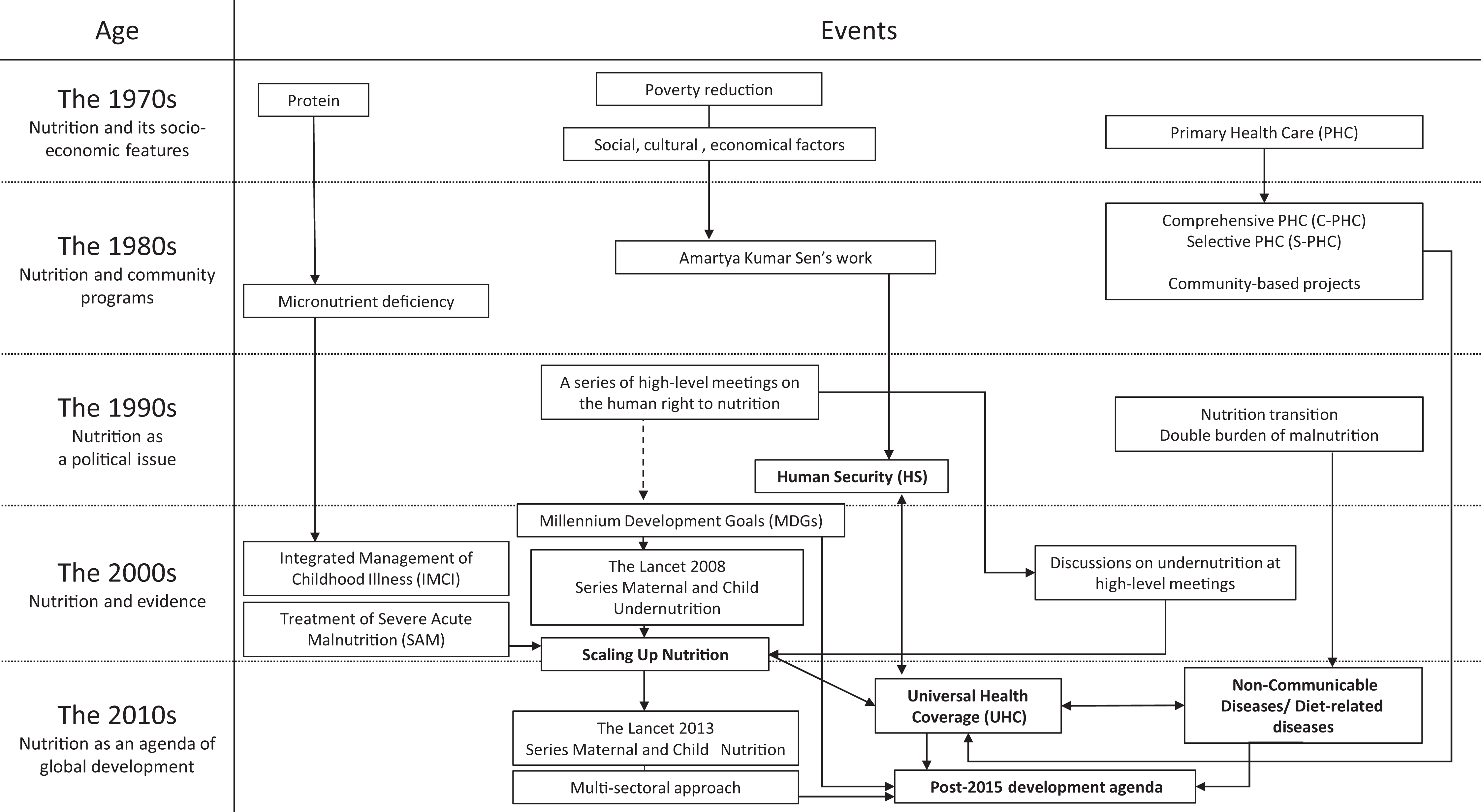
Trends in global nutrition policy.
Scaling Up Nutrition and the Government of Japan
The recent global priority given to nutrition was assisted by the financial cooperation of the government of Japan. The government of Japan and the World Bank agreed to establish a multidonor fund, called the “ New Multi-donor Trust Fund for Malnutrition,” for 36 countries, where malnutrition was a severe problem in the “GOJ-WBG Cooperation Framework towards a Vibrant Africa 2008–2013.” This fund was finalized at the TICAD IV in May 2008. 38 This event led to the establishment of the “Scaling-Up Nutrition Trust Fund” in July 2009. With this fund, which was first suggested during the meeting of the World Bank-IMF Combination Development Committee in April 2010, the SUN Framework was established as an international action program for malnutrition.
The government of Japan thus took on an important role in the global community as one of the main supporters of SUN. Japan can now turn this investment into an opportunity to pursue additional actions. However, it must be noted that global nutrition has long been “invisible” in Japan. In his article, Rikimaru stated that “global nutrition has never quite taken root in education, research, and practice enough in Japan, and resources on global nutrition in Japan are insufficient”. 39 For example, Japan’s advanced education system curricula offer few opportunities to learn about global nutrition. Even within the university nutrition departments that educate future dieticians, only a few include global nutrition as a subcomponent of public health or public nutrition. In addition, in academia and research, clinical nutrition (encompassing diet-related diseases, elderly undernutrition, and healthy eating) tends to be regarded as more important than global nutrition, along with the development of scientific health technology. As a result, there are insufficient resources to train and develop specialists in global nutrition in Japan.
Perspectives on Japan’s Contribution
Recent changes in perceptions of global nutrition have had a huge impact not only on academic experts in Japan but also on the government of Japan itself. The importance of nutrition activities was mentioned in “Japan’s Global Health Policy 2011–2015,” issued by the Ministry of Foreign Affairs in 2010. 40 This policy included the statement that “approximately one-third of child deaths are attributable to undernutrition, which suggests that efforts to bolster nutrition are critical in improving maternal and child health.”
In addition, because nutrition is a primary issue in most African countries, Japan must confront the problem of nutrition as the host country for the TICAD. 41 The TICAD is an international conference held every 4 years in Japan to promote high-level policy dialogues between African leaders and development partners. As mentioned earlier, SUN was founded with the World Bank in 2008 during TICAD IV. During TICAD V, progress in implementing health and nutrition interventions in 51 African countries was confirmed. At this conference, the government of Japan and the World Food Programme (WFP) agreed to strengthen their partnership to improve the nutrition situation in Africa and to maximize the impact of the experience and the successful examples of the Japanese private sector engagement. Ajinomoto Co, Inc and the WFP arranged a project for maternal and child nutrition improvement in Ghana as a follow-up to TICAD V. 42 It is worth noting that the government of Japan has been a leading force in African development throughout these conferences, allowing Japan to maintain strengthened partnerships with African countries to work on nutrition issues.
The concept of Universal Health Coverage (UHC) provides a good opportunity to tackle the issue of global nutrition. UHC can ensure that an entire population receives basic health services when necessary, regardless of an individual’s economic or financial situation. Furthermore, UHC aims to ensure the provision of health services for all, which allows a shift from disease-oriented to human-oriented services. The other goal is to enable countries to handle their own problems using their own health policies and limited budgets. 43 Nutrition is paramount in achieving the right to health for all, and could therefore be an important driving force behind the acceleration of forthcoming human-oriented discussions on UHC as part of the post-MDGs agenda.
In recent years, the government of Japan has also promoted human security (HS) in its international development policy. 44 The concept of HS is to protect the vital core of all human life in ways that enhance human freedom and human fulfillment. This is accomplished through 2 approaches: protection (top-down) and empowerment (bottom-up). Protection by the state shields people from hunger, chronic undernutrition, and even obesity while empowering the community enables people to develop the capacity to cope with nutritional difficulties in their daily lives with appropriate and adequate decision making. Because nutrition has strong multisectoral characteristics, it may not be recognized as important as other health issues, such as infectious disease or maternal health. However, Human Security strategies, such as protection by strengthening the sustainable health system and comprehensive community empowerment, can motivate effective efforts to improve nutrition.
For the reasons mentioned earlier, there are unresolved issues in global nutrition policy that still need to be addressed proactively at the practical level as well as financially and politically. Urban Jonsson proposed two approaches to nutrition paradigms: a “human rights-based approach” and an “investment approach.” 17 The former describes an intervention using the bottom-up approach through empowerment, while the latter is a combination of the results-oriented and top-down approaches. Japan’s technical cooperation uses capacity development, which corresponds to the “human rights-based approach.” However, the amount of financial or technical resources available is usually discussed in the context of SUN. Issues of nutrition cannot be solved using either approach alone, so the government of Japan is expected to continue developing innovations such as the results-based SUN with capacity development. In this way, the government of Japan could continue to contribute financially, politically, and technically to nutrition as a supporter of SUN.
This study is subject to a particular limitation: It did not use a systematic review method but a combination of several search methods. A fuller account of the events and policy developments for global nutrition is beyond the scope of this article, as it would require a deeper exploration of the political economy of global nutrition policy 45 along with direct interviews with the relevant actors involved. However, the study did review and analyze a large number of reports issued by international organizations or international conferences, as well as academic articles on global nutrition policy, and the recent SUN movement (as the product of a long history of efforts) as well as Japanese financial contributions.
Conclusion
This analysis of the evolution of global nutrition policies from the 1970s to the 2010s has 3 important implications for Japan. First, the weakness of resources devoted to global nutrition in Japan must be addressed. In Japan, this field of study could be strengthened by fostering human resources, supporting research and teaching, and advocating the importance of global nutrition. Second, in terms of politics, because of Japan’s leading role in African development as the host country for TICAD, it has been able to commit to driving nutritional improvement, a major health concern in African countries. In the post-MDG period, Universal Health Coverage and Human Security will be potentially important policies in addressing nutrition issues. Global nutrition can be one of the core global health policy issues for the next G7 Summit, which will be held in Japan in 2016. The government of Japan can take a more substantive role on global nutrition in this upcoming Summit. Third, Japan can make fuller use of its capacity development measures and offer further technical contributions to continue the initiative in the global health community as supporter of the SUN movement.
In conclusion, the government of Japan can utilize its contribution to global nutrition policy more actively, not only for international health cooperation but also as an important facet of diplomatic strategy. The strategic combination of financial, political, and practical approaches could be one of the most powerful ways in which Japan could demonstrate its involvement in global nutrition issues.
Footnotes
Acknowledgments
The authors would like to thank Senator Keizo Takemi and Dr Etsuko Kita for providing useful information and suggestions from the perspective of Japan’s global health policy. The authors would also like to thank Dr Toru Rikimaru for providing insightful advice from the perspective of global nutrition.
Authors’ Note
Marika Nomura and Kenzo Takahashi made significant contributions to the writing of the manuscript. Michael R. Reich supervised all parts of the manuscript.
Declaration of Conflicting Interests
The author(s) declared the following potential conflicts of interest with respect to the research, authorship, and/or publication of this article Marika Nomura was a Takemi Fellow in International Health at Harvard T.H. Chan School of Public Health, with support from the Japan Medical Association, during 2013 to 2014 when this research was conducted.
Funding
The author(s) received no financial support for the research, authorship, and/or publication of this article.