




Abstract
Background:
The Institute of Nutrition of Central America and Panama (INCAP) Longitudinal Study provides a unique opportunity to examine the role of nutrition in cognitive functioning over time, controlling for other sociocultural factors.
Objective:
This article describes results of analyses carried out in the INCAP Longitudinal Study on relationships between early childhood nutritional status and supplementation with concurrent and subsequent cognitive development in childhood and adolescence/young adulthood.
Methods:
Articles were chosen for review that addressed this topic from the original and 1988 follow-up studies; 41 articles were reviewed and key results summarized for relationships between early nutrition and cognition in infancy, early childhood, and adolescence/young adulthood.
Results:
Overall, results suggest strong relationships between indicators of a child’s early nutritional status and motor and cognitive development in infancy and through the preschool years, continuing into adolescence/young adulthood, particularly for males. Nutritional supplementation during gestation through 2 years of age was associated with improvements in motor development and small, but consistent improvements in cognitive development during infancy and preschool years, with similar results of greater magnitude found with cognitive functioning in adolescence and young adulthood. Findings remain strong after controlling for various sociocultural factors (eg, socioeconomic status [SES]) and schooling. Among adolescents, significant interactions were found with SES and years of school attained; differences in performance favored Atole over Fresco children, with greatest differences for participants of low SES and those with higher levels of schooling.
Conclusions:
Results support the need for programs to address unmet nutritional requirements among at-risk mothers and children and potential beneficial effects for human cognitive development.
Introduction
The Institute of Nutrition of Central America and Panama (INCAP) Longitudinal Study has greatly contributed to the body of research indicating a relationship between poor nutrition early in life and deficits in cognitive development and educational achievement during childhood and adolescence/young adulthood. Research suggests poor nutrition and growth early in life are associated with poorer performance on tests of motor development and cognitive functioning, as well as deficits in social skills, attention, learning, and educational achievement. 1,2 However, what is often difficult to discern is the role of nutrition versus the role of an impoverished environment or various sociocultural factors which may coexist. 3 The INCAP Longitudinal Study allowed researchers to look at these relationships in a population of low-income, nutritionally at-risk children from both cross-sectional (eg, length and cognitive performance at 6 months) and longitudinal perspectives (eg, nutritional status at 3 years and intellectual performance in adolescence); to examine consistency of relationships between child size and development across 2 generations; and to examine the impact of nutritional supplementation on cognition and schooling, controlling for potential influence of sociocultural factors. Effects of supplementation on variation in nutritional status, a potential pathway to cognition, are described elsewhere.
The original 1969 to 1977 study randomized 4 villages in eastern Guatemala, with 2 randomly assigned to the treatment group to receive protein supplementation (Atole) and 2 assigned to the control group to receive a supplement with calories only (Fresco). Measures of child nutritional status and cognitive functioning were collected from birth through preschool. A follow-up study (1988-1989) examined outcomes among adolescents and young adults from the original cohort. A 1991 to 1999 study examined similar outcomes and relationships among the next generation of Guatemalan children living in the original study villages. The current article summarizes results from these studies in the following areas: relationships between maternal supplementation and cognition in infancy and early childhood; relationships between early nutritional status and growth with cognition in infancy and childhood; relationships between nutritional supplementation and cognition in infancy and childhood, with potential implications for schooling; and relationships between early childhood nutrition, cognition, and schooling in adolescence and young adulthood.
Methods
A compendium of articles related to the INCAP Longitudinal Study was examined and articles were selected for review that addressed early childhood nutrition and cognition from the original and 1988 follow-up studies; a total of 41 articles were reviewed and key results summarized for relationships between early nutrition and cognition in infancy, early childhood, and adolescence/young adulthood.
Results
Maternal Supplementation and Cognitive Functioning in Infancy and Childhood
Maternal supplementation during pregnancy and lactation was positively associated with child birth weight and growth. 4,5 Despite associations between supplementation and child nutrition indicators often associated with development, no association was found between maternal supplementation and performance on the Brazelton Neonatal Behavioral Assessment Scale among newborns. 4,5 Assessments at 6 months with the Composite Infant Scale (CIS), an instrument derived from items on several widely used instruments (eg, Bayley, Gesell), demonstrated a positive association between supplementation and mental, but not motor development; results were similar for both boys and girls. 4,5 At 15, 24, and 36 months, maternal supplementation was positively associated with mental and motor performance on the CIS and with improved performance on a preschool battery of tests. Authors discerned that supplementation during pregnancy, rather than later supplementation, is critical for effects on cognitive and motor functioning. 5 Socioeconomic status (SES) interacted with supplementation; at 36 months, children from low-SES families were more affected by maternal supplementation on measures of cognitive development (ie, low supplementation associated with higher risk of exhibiting poor cognitive outcomes) than children from high-SES families (ie, level of supplementation not associated with cognitive outcomes). 5 At 15 months, children receiving Atole during pregnancy and lactation were at lower risk for low psychological test performance than those receiving Fresco. 6
Early Nutritional Status and Cognition in Infancy and Childhood
The INCAP Longitudinal Study examined relationships between indicators of early child nutritional status and cognitive functioning during childhood. During infancy, both mental and motor performance were assessed; this is in line with subsequent studies, noting that both aspects of development may be impacted by nutritional status and associated with later cognitive functioning. 7 In the initial intervention study (1969-1977), low birth weight (≤2.5 kg) was associated with poorer psychomotor performance on the Brazelton (habituation, motor fitness, and tremors/startles) during the first 2 weeks of life. 8 Birth weight was positively associated with motor, but not mental performance on the CIS at 6 months (r = 0.16, P < .01). 8 This relationship was stronger for infants with low birth weight (≤2.5 kg), but persisted among infants weighing more than 2.5 kg, remaining significant after controlling for maternal head circumference, parity, birth interval, lactation, and nutrition during pregnancy. 8 In addition, severe malnutrition during the first year of life was associated with reduced levels of attention to novel stimuli. 9
Subsequent analyses revealed that length and weight were most strongly associated with mental and motor performance on the CIS at 6, 15, and 24 months when compared to other nutrition indicators (eg, head circumference, skin fold), with strongest relationships at older ages. 10 Current size (length, weight) accounted for a significant proportion of variability in CIS scores, after controlling for length and weight at an earlier age. When controlling for current length or weight, early nutritional status was not significantly correlated with CIS performance; authors note this suggests little evidence to support a sensitive period hypothesis in infancy, but further research should look beyond 2 years. 10 Changes in body size correlated with changes in CIS scores during the first 2 years; periods of rapid behavioral and physical growth seemed to positively co-vary. Relationships were not explained by gestational age, nutrient intake, disease, or household characteristics. 10 Children with intrauterine growth retardation scored lower on the CIS at 3 years compared to children with normal birth weight. 11 Researchers suggest including infant–caretaker interactions and family SES in nutrition and cognition analyses, examining the role these variables may play in psychological test performance, particularly with increasing age. 12
Studies (1991-1999) with the subsequent generation of Guatemalan children living in the original villages examined relationships between physical growth and neurodevelopment during the first 3 years of life. 13,14 Small size at birth (height for age z-score [HAZ]; weight for age z-score) and poor physical growth during the first 24 months were related to neurodevelopmental delays on the Mental Development Index (MDI) and Psychomotor Development Index (PDI) of an adapted Spanish version of the Bayley Scales of Infant Development (BSID). Birth size was significantly associated with child development at 6 and 24 months. Gains in length and weight during the first 24 months were positively associated with child development, whereas growth from 24 to 36 months was not. Motor development was more strongly and consistently related to child growth than mental development. 14 Severely stunted infants (HAZ < −3 standard deviation [SD]) scored significantly lower on both BSID scales at 24 months compared to moderately (HAZ < −2 SD) and nonstunted infants. Differences between severely stunted and nonstunted groups at 24 months were 9 and 14 points for the MDI and PDI, respectively, with differences of smaller magnitude at 36 months. 14 These differences can be considered clinically significant. Findings confirm results from previous research demonstrating consistency of associations between child size and development across 2 generations of children in Guatemala.
Several studies with the initial cohort examined relationships between nutrition and cognition during the preschool years (ages 3-7). A large battery of tests assessed children’s cognitive performance, including language, short-term memory, and perceptual analysis. Preschool psychological test performance was strongly associated with attained size (height, head circumference) and with estimates of family SES. 12,15 Data suggest nutritional status is related to psychological test performance beyond any confounding effects of sociocultural factors, although these factors do overlap. 9 Height and head circumference contributed most to perceptual functioning and less to language; contributions were equal for memory. Physical growth was a better predictor of vocabulary and short-term memory for girls than boys. 9,15 In addition, malnourished preschool children performed poorly on tasks involving high attentional demands, suggesting attention may mediate associations between optimal nutrition and cognitive performance. 9 Authors recommend using a battery of psychological tests varying in type, range, and focus when studying malnutrition and cognition to capture cognitive processes most sensitive to effects of malnutrition. 16 This is in line with current research that suggests moving beyond global, standardized instruments of neurocognitive development (eg, BSID) to include more specific assessments of neurodevelopment such as attention, memory, and executive functioning. 17 Assessing associations between nutrition and cognition during the preschool years is important as both preschool health/nutrition and cognitive ability are significant determinants of eventual educational attainment. 18
Early Nutritional Supplementation and Cognition in Infancy and Childhood
To more rigorously assess the role of early childhood nutrition in cognitive functioning, studies examined effects of nutritional supplementation prenatally and in early childhood on cognitive and motor development in infancy through age 7 years. Effects of supplementation on nutritional status (a potential pathway) are reported elsewhere. Studies assessed effects of supplementation overall and differences between Atole and Fresco groups. As noted previously, in infancy, no effects of maternal supplementation on neonatal performance were found on the Brazelton; 19,20 results examining effects of maternal plus child supplementation (up until testing with CIS) demonstrated small, significant differences in mental development scores and significant differences for motor development across groups of consumption (high, medium, low) up to 24 months of age, with greater consumption associated with higher scores. 20,5
For preschool children (ages 3-7 years), analyses varied in measurement of supplement and cognitive development, sample, and design of analysis. 20 Several studies examined effects of overall supplement consumption as the treatment variable, pooling participants, and focusing on a few measures of cognitive functioning or a composite score. Positive associations were found between supplement consumption and performance on tests of language, memory, and perception and on composite scores from 3 to 7 years. 21 -24 Some studies suggested the first 3 years of life as the critical period for the influence of nutrition on preschool cognitive development, 3 while others noted the gestational period up until 24 months as most important. 23 Socioeconomic status interacted with supplementation for mental development; children of low SES who received little supplement were at higher risk of poor test performance than those of high SES who received little supplement from 0 to 36 months. 3 High levels of both maternal and child supplementation were associated with higher levels of social involvement and affect, whereas low levels of supplementation were associated with passivity, dependency, and anxious behavior, 25 variables that may impact cognitive development and test performance. Assessing effects of overall supplement consumption by pooling samples suggests positive associations between improved nutrition and cognition; however, absence of a between group design does not rule out possibility of self-selection bias, which may influence results; mothers and infants with the highest level of consumption may be the most socially engaged, which may influence cognitive development. 20
Several studies assessed effects of Atole versus Fresco using the original study design, controlling for potential confounding effects of SES and attendance to supplementation centers. Results from these studies suggest the effect of Atole on mental development was consistent but minor 20,26 -28 ; comparisons of test scores on the preschool battery favored children from Atole villages. 27 In analyses restricted to children receiving supplementation from conception through age 2 years (maximum exposure), children in the Atole group had significantly higher motor scores at 24 months and higher factor scores for items related to perceptual-organizational skills when compared to the Fresco group. 20,26 A summary article by Engle and Fernandez 26 nicely lays out published analyses of longitudinal data testing effects of nutritional supplementation on mental development (Table 1), along with descriptions of potential pathways of influence such as direct effects of nutrition on inhibition of brain growth and myelination during the critical period of brain growth (“neural hypothesis”); potential indirect effects on a child’s energy and receptivity to learning (“developmental hypothesis”); and the more complex interaction between environmental stimuli and nutritional deficiency, affecting both child and caregiver behavior, suggested by study results. 20,26
Published Analyses of Longitudinal Data Testing Effects of Nutritional Supplementation on Mental Development.a
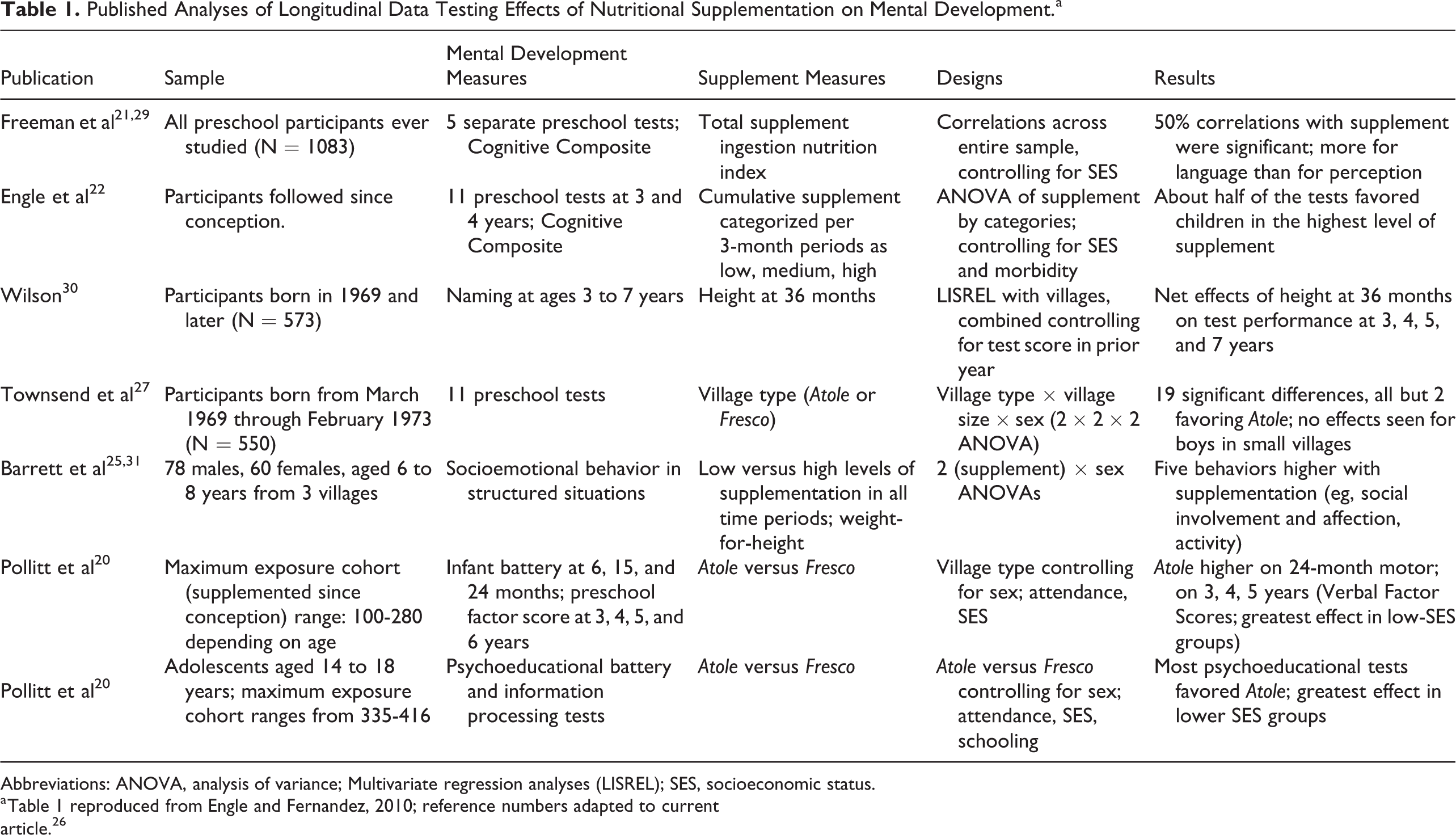
Abbreviations: ANOVA, analysis of variance; Multivariate regression analyses (LISREL); SES, socioeconomic status.
a Table 1 reproduced from Engle and Fernandez, 2010; reference numbers adapted to current
article. 26
These results are important as they relate to schooling for children in these villages. Some suggest that preschool health, nutritional status, and cognitive ability are significant determinants of schooling and educational attainment. 18,32 Townsend and colleagues 3 note that children who performed well on tests at ages 3, 4, and 5 years entered school earlier than peers who did not perform well, stayed in school longer, and received higher grades from their teachers. These children were perceived by adults in the villages as more “listo” (smart, good verbal skills and memory, high activity level) than their peers. 3 Others have found preschool cognitive scores predictive of age at entry to school, with SES also predicting age of entry and success in school. 33,34
Early Childhood Nutrition and Cognition in Adolescence and Young Adulthood
The 1988 to 1989 INCAP Longitudinal follow-up studies examined impact of early childhood nutrition and supplementation on adolescent and young adult cognitive functioning in original participants (ages 11-26 years). 20,35 -39 Studies confirmed earlier results observing an association between poor nutritional status and cognitive functioning. Controlling for maternal schooling and family SES, HAZ scores at age 3 were related to intellectual performance measures in adolescents and young adults, with strongest results found for males. In males, growth failure (stunting) at 3 years was associated with late entry into school, fewer years of schooling, and poorer performance on tests of general knowledge, numeracy, reading, and vocabulary; in females, significant relationships were found with age at school entry and reading. 40 Exposure to increasing numbers of risk factors during early childhood, including malnutrition, was associated with lowered school attainment and test performance in adolescence/young adulthood; schooling may buffer effects of early risk on learning and test performance. 41
The 1988 study hypothesized that nutritional improvements provided during gestation and the first several years of life would ultimately produce adolescents and young adults with greater potential for leading healthy and productive lives. The longitudinal follow-up provided an excellent, novel opportunity to examine impact of an early childhood nutritional intervention on abilities in adolescents and young adults not yet evident in young children. 35 Analyses focused on adolescents/young adults (13-19 years) exposed to the nutrition intervention during the prenatal period and first 2 years of life (maximum exposure). The maximum exposure period was identified as the time when the brain is developing quickly and may be most sensitive to effects of nutrition. 35,36 Performance was assessed with a battery of psychoeducational and information processing tests (eg, literacy, numeracy, general knowledge, standardized achievement tests, Raven Progressive Matrices). Analyses controlled for schooling variables as villages differed in patterns of school attendance since before the study began. Atole was associated with better performance on tests of knowledge, numeracy, reading, and vocabulary, along with faster reaction times on information processing tasks when compared with Fresco; analyses controlled for age at testing, gender, attendance to Fresco or Atole centers, SES, and schooling history (age child started school; maximum grade attained in primary school). Significant interactions were found with SES and years of school attained; differences in performance favored Atole over Fresco children, with differences greatest for participants of low SES and among those who had higher levels of schooling. 36,37 By controlling for SES and schooling, authors concluded the strongest explanation for test performance differences observed between groups could be attributed to dietary changes produced by early supplementation. Authors also noted that Atole may have increased children’s ability to take advantage of the schooling experiences to which they were exposed. 36
Additional analyses examined the role of timing of the intervention, looking at effects for children receiving supplement only after 24 months compared to during gestation and the first 2 years of life. Controlling for potential confounders, Atole participants performed significantly better on tests of numeracy and knowledge than Fresco participants. The pattern of findings was similar to that of participants with maximum exposure, but the number and magnitude of significant findings were greatly reduced; results strongly indicated effects in adolescents/young adults occurred more in cohorts exposed to supplementation earlier, but insufficient evidence existed to fully specify the role of timing in the intervention. 20,39
Comparing effects of nutritional supplementation on cognition in childhood versus adolescence/young adulthood, studies noted that though positive, the effects in childhood were much smaller in magnitude than those found in adolescence/young adulthood. The Atole–Fresco differences found in children aged 3 to 7 years were less than 0.2 of a standard deviation (small effects) compared to differences of around 0.6 of SD (medium to large effects) found in adolescence/young adulthood using a summary variable of intellectual functioning. 20,38,39 Authors note the positive effects of Atole supplementation in childhood appear to become more pronounced as children get older.
Conclusions
The INCAP Longitudinal Study is an excellent, controlled field nutrition intervention, with a longitudinal design allowing for repeated measurement of child nutritional status, social environment, and cognition over time. Overall, results suggest that indicators of early childhood nutritional status and nutritional supplementation provided prenatally through 2 years are positively associated with motor development and cognitive functioning in infancy through the preschool years; similar results of greater magnitude were found with cognitive functioning in adolescence/young adulthood. Findings remain strong even after controlling for various sociocultural factors such as SES, attendance to supplementation centers, and schooling. These studies provide strong support for a nutritional effect of supplementation on cognitive development during childhood and adolescence/young adulthood, although specific nutrients responsible for the positive changes on cognition were not identified. Results provide strong evidence for the importance of providing low-income, at-risk mothers, infants, and children with programs to address unmet nutritional requirements and potential beneficial effects for human cognitive development. Studies also support more complex interactions between environmental stimuli and nutritional deficiency, which can be further explored in future research.
Footnotes
Acknowledgements
The authors acknowledge the support of the Bill and Melinda Gates Foundation (OPP 1164115) in the preparation of this article.
Declaration of Conflicting Interests
The author(s) declared no potential conflicts of interest with respect to the research, authorship, and/or publication of this article.
Funding
The author(s) received no financial support for the research, authorship, and/or publication of this article.
