



Abstract
The development of a superior treatment option for severe acute malnutrition (SAM) which allowed for home-based therapy put in place constraints that are crucial for ensuring the feasibility and nutritional integrity of the treatment. Soon after the initial success of ready-to-use therapeutic food (RUTF), there were attempts to modify the formulation for cost and other areas of acceptability. While alternative formulations have been taken on in clinical trials, they have been inferior to the standard RUTF recipe. Linear programming (LP) technology, however, has streamlined the formulation process allowing the user to account for the crucial constraints required to maintain the feasibility and nutritional integrity of standard RUTF. With the aid of an LP tool and other functional tools for assessing nutrient quality, nutrition researchers can use innovative approaches in food development that could potentially revolutionize food aid products.
Keywords
Background
Standard ready-to-use therapeutic food (RUTF) contains peanuts, nonfat dry milk, vegetable oil, sugar, and a vitamin and mineral premix. 1 This is produced as a lipid-based paste that is used for the treatment of severe acute malnutrition (SAM). 2 The advent of home-based therapy with RUTF and its proven efficacy for treatment of SAM has led to exploring ways the recipe can be altered and optimized for enhancements in areas of cost and acceptability as well as for different populations such as malnourished pregnant women, children, and adults with human immunodefiency virus, and children with moderate acute malnutrition (MAM). 3 –7 Several alternative formulas have been developed and tested by leading researchers and nutrition experts; however, most of these products were not successful in terms of achieving comparable effectiveness to the current milk- and peanut-based recipe. 6,8,9
Linear Programming Technology: Moving Beyond Proof of Concept
In 2013, Washington University in St Louis with support from the Children’s Investment Fund Foundation initiated a multiphase alternative RUTF formulation project. What started as a proof of concept, “can linear programming (LP) technology be used to develop low-cost RUTF formulations with the introduction of local ingredients without compromising the nutrient integrity of standard RUTF?,” has evolved into, “in what ways can this LP tool be used to optimize RUTF or other food aid products?” 3,10 The LP tool is a formulaic computer database program listing all potential ingredients, nutritional composition, prices, and country-specific availability to create different therapeutic or supplemental foods for the treatment of nutrition ailments. 4 Essentially, the tool depends on the programmed inputs, which include ingredient cost data, nutritional composition of potential ingredients, country-specific availability, and other optimization constraints such as specifications for certain types of therapeutic foods; it then runs an algorithm to create an output. 3,4
The process of food formulation and development is more complex than setting constraints in an excel-based program; however, this tool has undeniably streamlined the process by eliminating some of the trial and error typically required in food formulation. 3 The process starts with a candidate ingredient list which is refined from a master ingredient list, containing ingredients available within the designated country, which allows the user to restrict the potential ingredients available for the program to pull from to achieve physical and nutritional attributes advantageous for use in RUTF. Acceptable attributes include, but are not limited to, low-moisture, nutrient-dense ingredients. 1 The candidate ingredients’ usage rates may also be altered to fit a product profile or utilize locally available resources. 4,10 Figure 1 shows the default nutrient constraints for RUTF, which can be changed to formulate products with different nutrient requirements such as ready-to-use supplementary foods (RUSF). After customizing ingredient usage and nutrient profile, the LP tool employs an algorithm to generate a formula. The prices of ingredients are considered in the algorithm to provide the lowest-cost formula while maintaining the desired inputs. After running the program, the selected formulation is assessed for feasibility and made at a bench-top level. Additional constraints can then be input to account for ingredient and nutrient restrictions necessary for formulation optimization. 3 This is important, because many factors, in addition to cost, go into formulation optimization such as palatability, availability, bioavailability, and so on, which cannot be accounted for with the program’s algorithm. 4
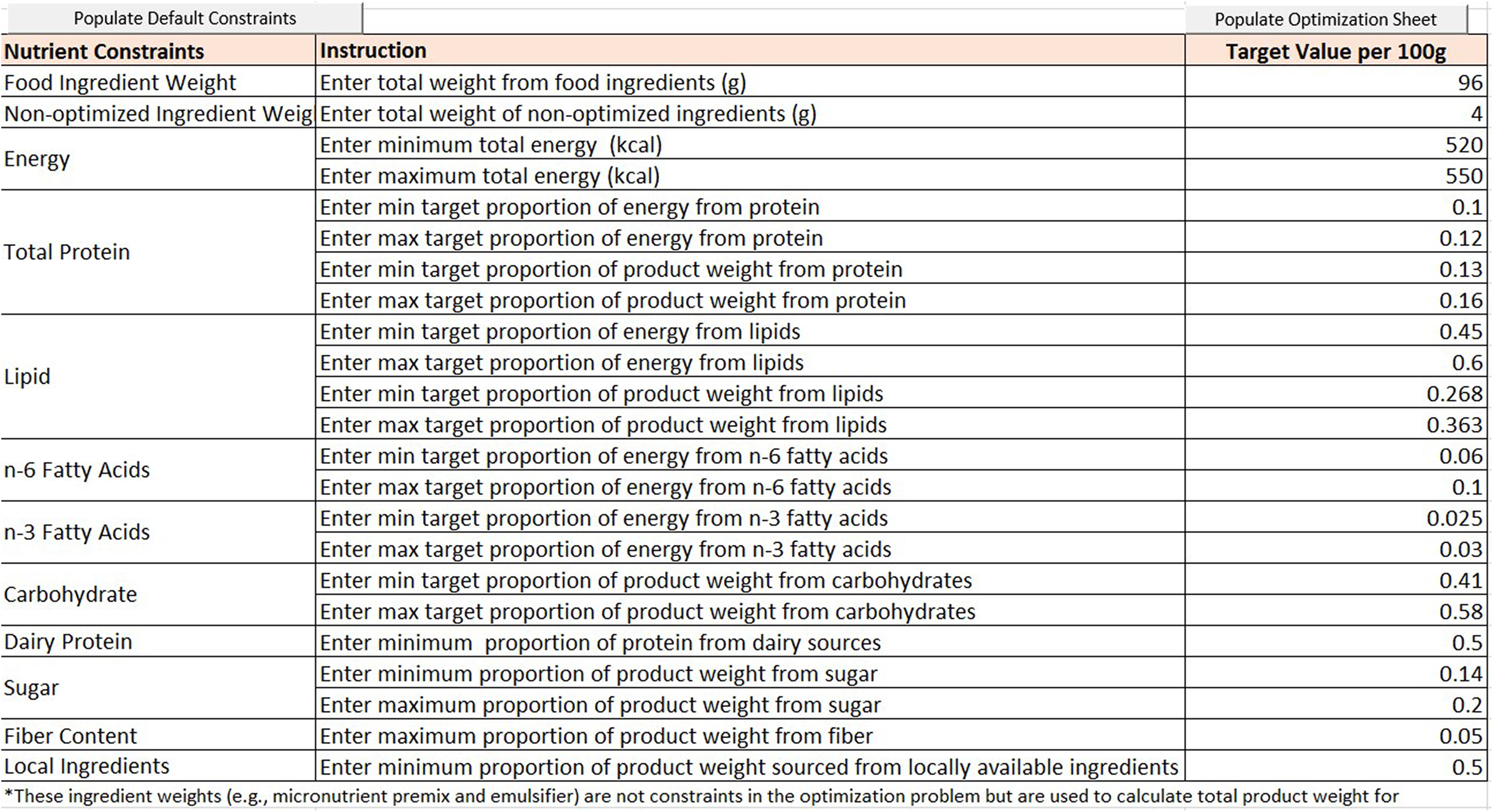
Screenshot of nutrient constraints for ready-to-use therapeutic food (RUTF) in linear programming (LP) tool.
Versatility: Application for Diverse Populations, Locations, and Nutrient Composition Improvement
The LP tool’s current ingredient catalog is customizable in that additional ingredients, nutrient profiles, and their cost may be introduced to the LP tool’s existing database. This is advantageous if utilizing the tool in a new country where previously absent ingredient profiles may be added to allow for their capitalization for local ingredient inclusion. 4 The LP tool also allows for the diverse application for target locations and populations. For example, reaching all nutritional requirements during pregnancy is often unfeasible for many women in low-income settings; however, with the tool, a product aimed specifically for pregnant and lactating women could be developed. To provide for the needs of that population, the ingredient inputs, nutrient profile, and constraints in the tool may be expanded and changed. A similar application is also possible if the goal is to implement a school-feeding program. The same tool could then be altered to formulate an appropriate food for school-aged children.
Innovative applications of the LP tool also include utilization in optimizing formulas for certain nutritional profiles that may be superior to the current formulation or in exploration to understand why certain ingredients may lead to inferior formulations. These formulas can then be tested in clinical trials for effectiveness and aid in the understanding of the role of specific nutrients by providing empirical evidence. For example, in endeavors to lower the cost of RUTF, there have been attempts to remove or to decrease the proportion of dried skimmed milk, the most expensive ingredient in RUTF. 6,9 While these formulations had some success in recovery, they all had an apparent inferiority to the standard RUTF in treating children with SAM. 6,9 It is likely that the replacement of milk proteins with proteins from other sources had an impact on protein quality. 11 With this in consideration, the customizable aspect of ingredient inclusion or elimination plays a role when utilizing the LP tool in incorporating optimal nutrient ingredients in a formula. A better understanding of the role of protein quality is needed to help improve efficacy of the current formulation, provide a benchmark for attempts at cost savings as well as to provide guidance in the development of treatment for children with MAM. 12 -14
Utilizing the LP Tool: Protein Quality–Optimized RUSF for MAM Treatment
A typical protocol for treating MAM during emergencies is supplemental food distribution, often providing a fortified blended flour (FBF) with added oil and sugar that requires cooking, posing a microbial risk as there is variability of the food safety of the additional ingredients used as well as the cleanliness of the preparation. 15 Ready-to-use supplementary foods are not conducive to the growth of bacteria because of their low moisture content, they do not require cooking, are ready to eat, and have led to greater recovery rates than FBFs like corn-soy blend in direct comparisons. 16 Ready-to-use supplementary foods, however, still require some nutrient composition guidance. 17 A recent study comparing the effectiveness of a peanut-based RUSF with soy protein and novel dairy RUSF with whey permeate and whey protein concentrate showed that the proportion of children that recovered from MAM was significantly higher in the group that received whey RUSF than the soy RUSF, 83.9% and 80.5%, respectively (P < .04). 18 One assumption from this evidence is that dairy proteins have higher protein quality, providing generous quantities of essential amino acids (AA), which have been associated with better growth. 19 There is still a vague understanding about the effect of protein quality in treating children with MAM. 20 To gain a better understanding of the role of protein quality, 2 isonitrogenous peanut/dairy RUSFs were developed utilizing the LP tool and will be used in a clinical effectiveness trial in Malawi to treat children with MAM, comparing an RUSF optimized for protein quality with a control RUSF with standard protein quality.
The method for developing the 2 isonitrogenous RUSFs for clinical effectiveness was by supplementing the food formulation process utilizing the LP tool with the creation of a separate, less sophisticated excel calculator that calculates protein quality using the Digestible Indispensable Amino Acid Score (DIAAS) 14 This calculator complements the optimization process of developing novel therapeutic foods with the LP tool by allowing the users to assess the formulations from the LP tool for protein quality and examine which essential AAs are most limited. For example, in Figure 2, the screenshot shows lysine as the limited AA in the DIAAS of standard RUTF. In optimization with LP tool, the user might limit peanut and add in a legume with more bioavailable lysine, such as soybeans. This change is processed in the LP tool as it accounts for the constraint of an ingredient by ensuring that whichever nutrient is in deficit is compensated with nutrient equivalents to ensure it meets the desired nutrient specifications. Figure 3 demonstrates how restricting peanut to 18% and adding in 4% soy flour can boost the protein quality. This demonstrates a synchronized process of optimization using the LP tool and assessing protein quality with the excel calculator.
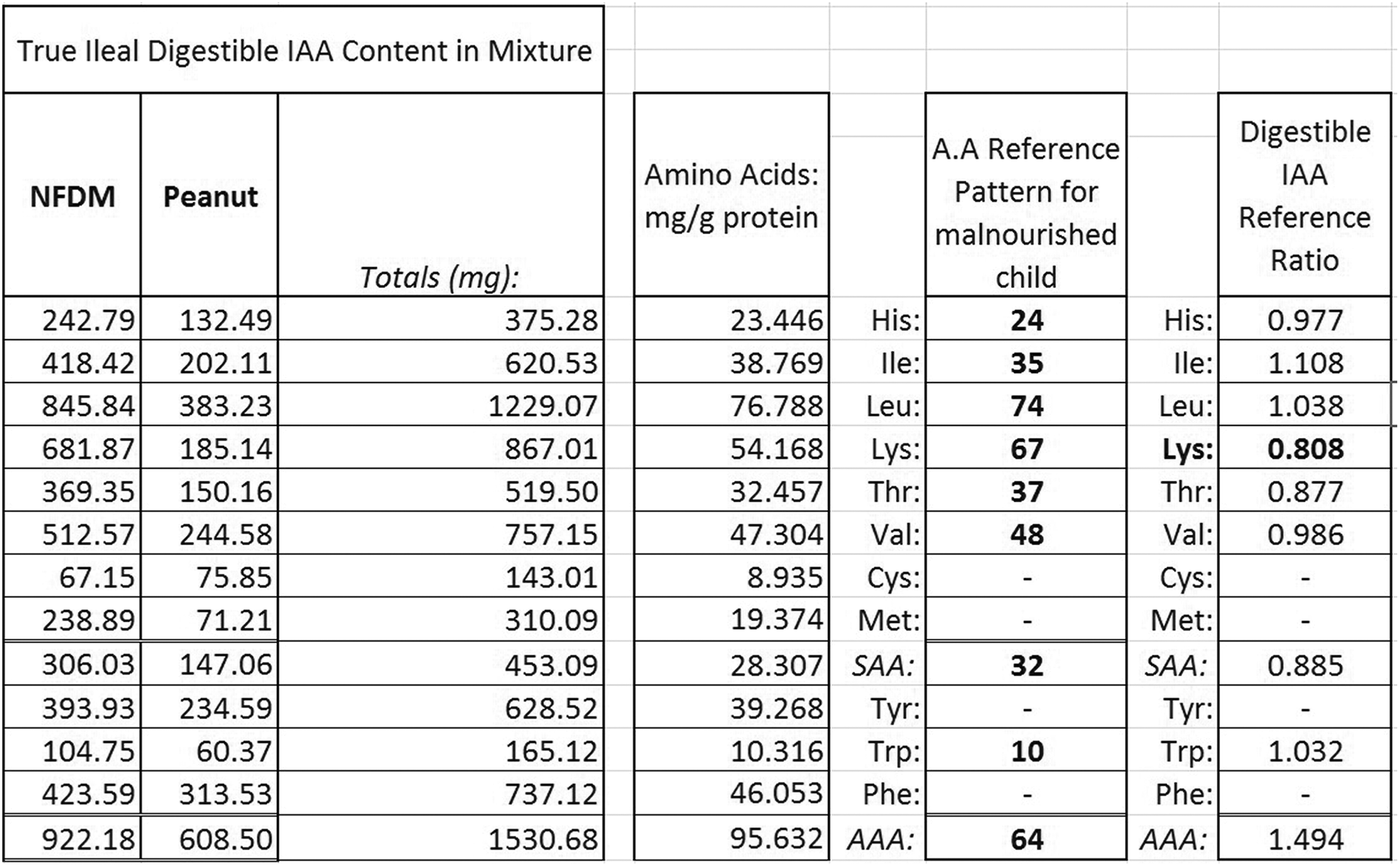
Screenshot of Digestible Ileal Amino Acid Score (DIAAS) excel calculator for standard ready-to-use therapeutic food (RUTF) recipe.
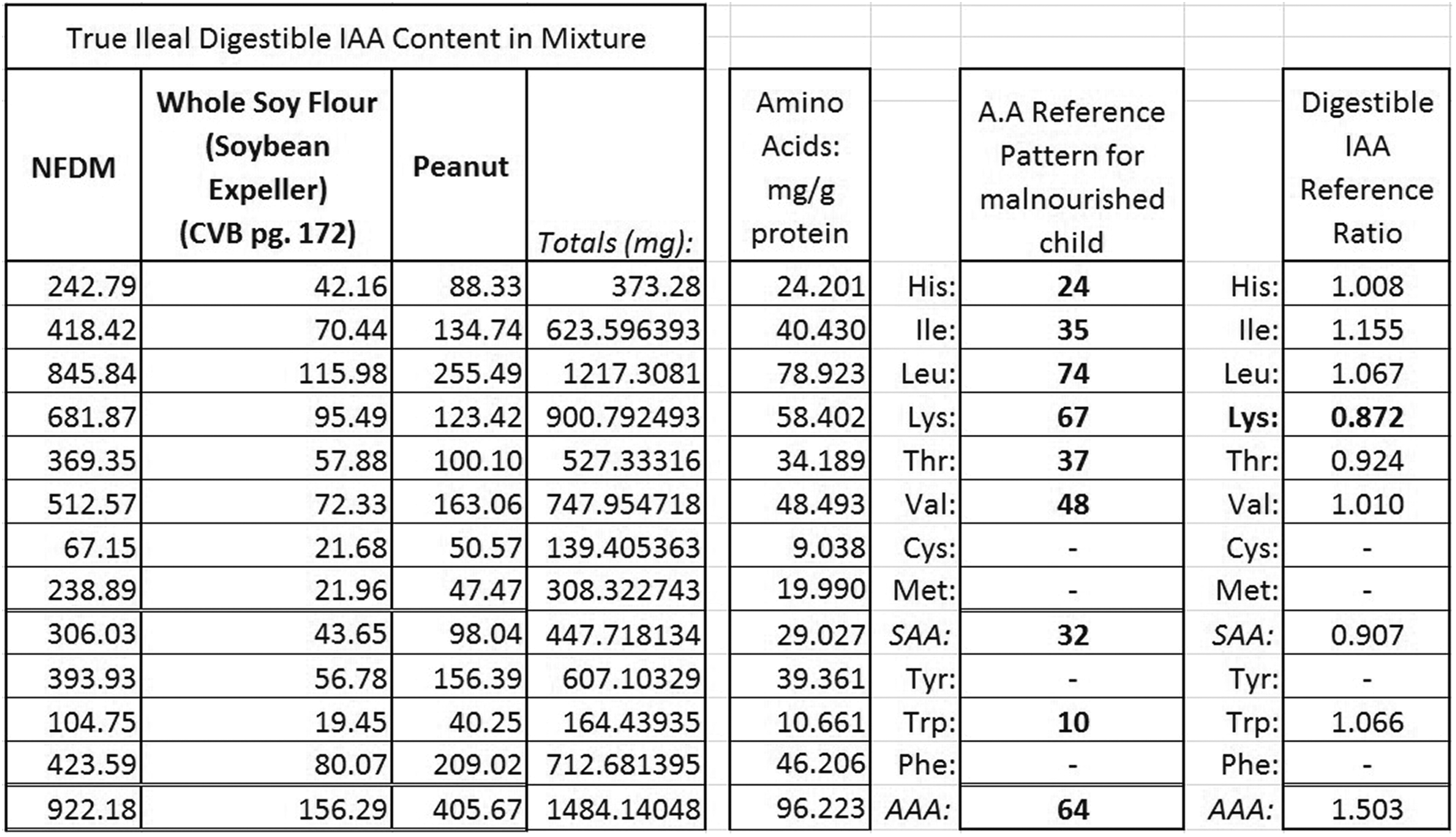
Screenshot of Digestible Ileal Amino Acid Score (DIAAS) excel calculator for standard ready-to-use therapeutic food (RUTF) with the addition and restriction of protein ingredients.
Conclusion
Nutrition is not only a continually evolving field that demands useful tools for modifying food aid formulations, but nutritional needs such as protein and AA requirements vary through the life cycle and by physiologic state. A diet that might be adequate in protein quality for healthy adults may instead be very inadequate for pregnant or lactating women, especially those living in limited resource settings.13,14 Therefore, the calculation and awareness of protein quality when creating formulations with the LP tool is vital, but likewise is the versatility of the LP tool to allow for the streamlined development of supplemental foods made with high-quality protein tailored to target populations. Although ideally the LP tool algorithm would include the calculation of the DIAAS, the parallel use of both the LP tool and DIAAS calculator have proven sufficient in allowing users to evaluate the formulas generated by the LP tool to ensure that ingredients used are not significantly impacting protein quality. The LP tool has already aided in optimization for target populations, feasibility, scale-up, local production, and so on, but with supplemental nutritional tools such as the DIAAS calculator and the customizable features the LP tool offers, its utility in food aid product development can continue to offer novel opportunities.
Footnotes
Declaration of Conflicting Interests
The author(s) declared no potential conflicts of interest with respect to the research, authorship, and/or publication of this article.
Funding
The author(s) received no financial support for the research, authorship, and/or publication of this article.