



Abstract
The U.S. trucking industry has the potential to be an early adopter of autonomous vehicles. The trucking industry hauls the majority of U.S. freight by weight and has a vast infrastructure network. Numerous business cases and routes may be able to utilize autonomous trucks. The trucking industry consumes more fuel and has more crashes than other modes of freight transportation. Trucking companies may be able to reduce costs through labor savings and increased utilization of trucks. All the dynamics of market size, infrastructure, fuel consumption, safety, and cost savings make the trucking industry a potential early adopter of autonomous vehicles. For autonomous technology to be applied to trucks in the United States there needs to be interest from technology developers, truck manufacturers, and trucking companies; government support to allow the testing and deployment of autonomous trucks on public roads; and acceptance from the public who will share the road with autonomous trucks. Given that autonomous truck deployments are in the beginning stages of being tested on public roads, there needs to be a comprehensive review of the market potential of autonomous trucks from the perspective of all involved stakeholders. To provide this comprehensive overview, this paper reviews the current dynamics of autonomous truck deployments in the United States, including deployment markets, business cases, adoption timelines, and logistics-, manufacturing-, operations-, technology-, and government partnerships. The paper concludes with the possible benefits of and barriers to autonomous trucks to illustrate what may drive or impede their U.S. deployment and market potential.
Keywords
The trucking industry moved 65% of all goods by weight in the United States in 2017 ( 1 ). It contributed $389.3 billion to the U.S. gross domestic product (GDP) in 2021 with the for-hire sector responsible for generating $185.1 billion and the in-house sector $204.2 billion ( 2 ). The truck transportation sector employs 1.56 million people and 897,370 of those are heavy tractor-trailer truck drivers ( 3 ). Across all industries, heavy tractor-trailer truck drivers total 1.98 million ( 4 ). The U.S. trucking industry has prospered owing to the vast roadway system in the United States: with a total of 4.2 million roadway miles it has more miles of roadway infrastructure than other freight modes ( 5 ). The vast U.S. roadway system increases accessibility and allows for fast and reliable service. However, truck transportation also has higher fuel consumption and more crashes than other modes of freight transportation. In 2020, trucks consumed 44.8 billion gallons of fuel with combination trucks consuming 28.4 billion of those gallons ( 6 ). In relation to freight safety, 146,934 injuries and 4,965 fatalities occurred in 2020 from large-truck-related crashes ( 7 ). The trucking industry has experienced the second highest increase in average revenue per ton-mile since 1990. Pipeline transportation revenue increased 181% and truck transportation increased 134% (Table 1, Column 4). This translates into higher costs for shippers and consumers. The freight transportation statistics of the trucking industry compared with other U.S. transportation modes are given in Table 1. This table shows truck transportation to be the largest mode of U.S. freight transportation for weight moved, GDP, employment, and infrastructure. The data also indicate the need for improvements in relation to fatalities, injuries, and energy use. The market size and infrastructure in place in the United States makes trucking a potential early adopter of automation. Automation also holds promise for reducing crashes and improving fuel efficiency. Although the trucking industry appears to be a good market for autonomous vehicles (AVs), for autonomous trucks (ATs) to be deployed on public roads there will need to be shared interest and a recognition of the mutual benefits among the trucking industry, the government, and the general public.
U.S. Modes of Freight Transportation Statistics
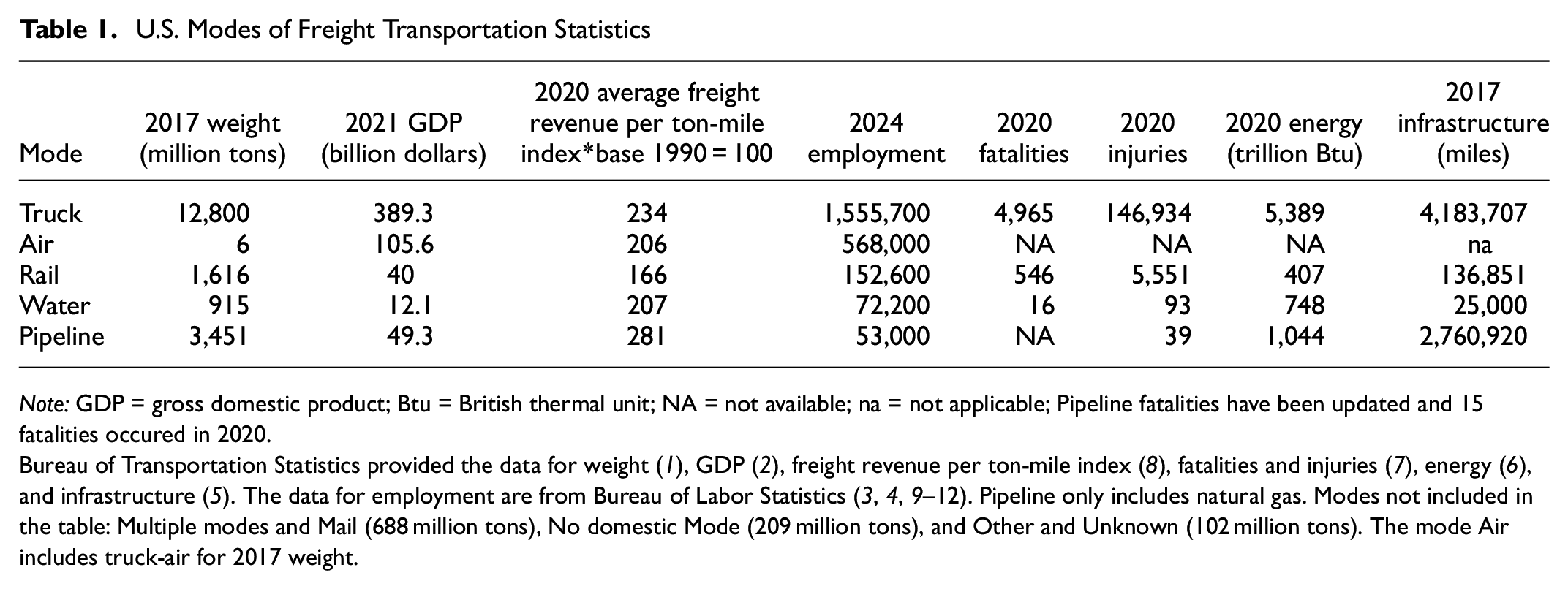
Note: GDP = gross domestic product; Btu = British thermal unit; NA = not available; na = not applicable; Pipeline fatalities have been updated and 15 fatalities occured in 2020.
Bureau of Transportation Statistics provided the data for weight ( 1 ), GDP ( 2 ), freight revenue per ton-mile index ( 8 ), fatalities and injuries ( 7 ), energy ( 6 ), and infrastructure ( 5 ). The data for employment are from Bureau of Labor Statistics ( 3 , 4 , 9 –12). Pipeline only includes natural gas. Modes not included in the table: Multiple modes and Mail (688 million tons), No domestic Mode (209 million tons), and Other and Unknown (102 million tons). The mode Air includes truck-air for 2017 weight.
Background
Trucking Industry
The trucking industry will help determine the initial use cases of ATs and their economic viability. For instance, certain truck carriers, routes, and types of freight may be better suited for initial deployments. These initial deployment scenarios are currently being tested by several logistics companies. The AT pilots currently taking place are on high-volume freight routes in the Southwestern United States. Whereas this is the predominant testing area for ATs, testing of platoons in North Dakota and autonomous box trucks in Arkansas and Toronto can also be found. ATs might be used on routes where it is difficult to hire enough drivers to meet the demand for truck transportation; they might be deployed to help offset peak demand for holidays or harvest or other seasonal truck moves; and could be used on routes that are less desirable for drivers. ATs could also be used to move goods to remote areas or on long-distance routes that require drivers to be away from home for long periods of time. How and where ATs are ultimately deployed will determine their market potential.
Interest in ATs is relatively new. Daimler Truck announced their vision for the future of automation in heavy-duty trucks in 2014 with Mercedes-Benz Future Truck 2025 ( 13 ). Since then, Daimler and several other companies have focused on developing Level 4 ATs. Level 4 ATs can operate in specific operating domains without a driver in the truck. The different levels of automation are described in detail in the next section. There has been rapid acceleration in testing, partnerships, and investor interest, with projected timelines for U.S. deployment before 2030. Daimler Truck is planning to deploy ATs in the United States in 2027 ( 13 ). Since the AT ecosystem is in the beginning stages of development, it is unclear what the relationship will be between AT companies, original equipment manufacturers (OEMs), trucking companies, and third-party logistics (3PL) companies. AT companies, OEMs, and 3PL companies could start building their own AT capacity. Even though it is unclear how these relationships will evolve, it is clear that companies within the trucking industry are interested. There are many benefits for trucking companies that adopt ATs, including labor savings, reduced fuel consumption, and higher truck utilization. At the same time, there are also barriers like job losses and concerns about the safety of other roads users. This balance will play out over time as more pilots and tests are performed with ATs. Given the industry’s nascent stage of development, the AT ecosystem of partnerships and commercial applications are provided in detail in this paper to provide clarity on the market potential for ATs.
Government
The U.S. government will play a major role in the adoption of ATs by providing the infrastructure, maintaining roads, and regulating the operation of ATs. Roads in the United States are owned and managed by either the local (77.4%), state (19.6%), or federal (3.0%) government ( 14 ). The funds used to build and maintain the roads also come from local, state, and federal sources. Funding sources include fuel taxes, tolls, license fees, heavy-truck tire sales, truck and trailer sales, and weight-based heavy-vehicle taxes. The amount that each of these sources contributes varies by state ( 15 , 16 ). ATs may require upgrades to current roads to improve pavement condition, signs, and lane markings. In addition to traditional road improvements, new technologies may need to be added to roads to facilitate the deployment of ATs. These new technologies might include sensors that will enable connectivity among roads, vehicles, infrastructures, traffic signals, and other road users. It is also possible that new road systems will need to be built with dedicated lanes for ATs. All of these changes will require the government to be involved in the adoption of ATs. Regulation will also play a critical role in the adoption of ATs, determining where they can be deployed, what roads they can use, what conditions they can operate in, what hours they can operate, how they will handle edge cases (i.e., driving situations that ATs have not yet been trained to handle), and ethical situations that arise on the road—for instance, who will be liable when a crash occurs—and many other situations that could arise. Regulation of ATs in the United States is currently supported by the federal government, though regulation is being created at the state level. The U.S. Department of Transportation (U.S. DOT) published its first recommendations for automated vehicle policies in 2016 ( 17 ). U.S. DOT’s most recent publication, Automated Vehicles: Comprehensive Plan, was published in 2021 and focused on three goals: promoting collaboration and transparency, modernizing the regulatory environment, and preparing the transportation system ( 17 ). The U.S. government recognizes the need to allow innovation while ensuring safety. Presently, federal regulators believe individual states are best suited to maintaining this balance and to enact laws for ATs. As the AT industry matures and business cases are evaluated and tested, laws can be crafted to help safely introduce ATs.
Several federal agencies will be involved in the adoption of ATs including the Federal Motor Carrier Safety Administration (FMCSA), the National Highway Traffic Safety Administration (NHTSA), the Federal Highway Administration (FHWA), and the Commercial Vehicle Safety Alliance (CVSA). FMCSA regulates commercial trucking in the United States to improve safety on the roads ( 18 ). That agency will determine whether ATs have to obey driver hours-of-service (HOS) requirements and many other trucking regulations. In 2019, FMCSA issued an advanced notice of proposed rulemaking for the safe integration of automated driving systems for commercial vehicles ( 19 ). NHTSA sets standards for manufacturing vehicles known as Federal Motor Vehicle Safety Standards to help improve road safety ( 20 ). These standards include the corporate average fuel economy standards that regulate fuel efficiency for vehicles ( 21 ). NHTSA will play a role in determining how manufacturing and safety standards may change for ATs. In 2021, NHTSA issued a standing general order that requires the reporting of crashes that occur with advanced driver assistance systems ( 22 ). FHWA manages the building and maintenance of the U.S. highway system ( 23 ), and will play an important role in designing highways that are safe for the adoption of ATs. FHWA has many research and outreach programs to help deploy AVs, including a project to examine how a truck platoon approach to using technology would function in commercial applications ( 24 ). CVSA created inspection standards known as the North American Standard Inspection Program for commercial vehicles to help improve consistency in inspection and safety on the roads ( 25 ). Its inspection process will determine when ATs are in compliance and safe to operate on the roads. CVSA set guidelines for AT inspections in 2022 ( 26 ).
Significant preparations for ATs at the state level are also taking place. Texas Department of Transportation (TxDOT) recognized the need to prepare for AVs and created the Connected and Automated Vehicles Task Force in 2019 ( 27 ). The task force has several divisions to help handle the introduction of connected and automated vehicles including, Data, connectivity, cyber security, and privacy; Education, communication, and user needs; Freight and delivery; Licensing and registration; Safety, liability, and responsibility; and Workforce and economic opportunities ( 28 ). The committee directly related to ATs, Freight and delivery, may evaluate operational challenges, trials and deployments, delivery modes, infrastructure, maintenance, networks, and workforce development ( 28 ). With Texas being the current location of planned AT deployments, it makes sense that TxDOT is preparing for their introduction. The description of the AT ecosystem of partnerships and commercial applications in this paper will help to provide clarity on the geographical scope of ATs and the governments that will need to be prepared for their adoption.
General Public
The people of the United States have a vested interest in how ATs are deployed because they may be sharing the road with them in the future. How people perceive ATs will determine whether they are adopted and what their market potential will be. How people perceive ATs will be determined by the information they receive about them. It will be important for people to have access to unbiased information to make informed decisions about ATs. Several of the benefits and concerns related to deployment of ATs can be viewed from either side. For instance, ATs might improve safety for all road users by eliminating human error, but they might equally introduce new types of errors that humans do not make, which could cause crashes. Such errors are most likely to occur during edge cases. The same logic applies to emissions and congestion: ATs may decrease emissions by operating more efficiently, but equally could increase emissions through increased vehicle utilization. Likewise, congestion might decrease because of the utilization of ATs during nonpeak operating hours, but increase as a result of the increased use of ATs. Therefore, public perceptions are likely to be formed by particular use cases of ATs and the testing of ATs in these use cases. The AV industry is beginning to focus on more-specific use cases. Presently, companies are focused on two main applications, robotaxis and freight delivery, rather than automation of passenger vehicles. Because this paper focuses on the market potential of ATs, the partnerships and business cases are provided in detail for ATs to help provide clarity on concerns that need to be addressed and, ultimately, how ATs will be perceived by the public.
Although the trucking industry, the government, and the general public will all need to reach a consensus on the deployment of ATs, the majority of the activity currently taking place is within the trucking industry. Partnerships are being formed and ATs pilots are taking place on public roads. Governments have begun to enact regulations that will adequately address the challenges of deploying ATs, though this is mainly within the states where the industry is currently testing ATs. Most people have had minimal exposure to ATs and it is unknown what their perception will be until ATs are tested in their area. Industry partnerships are the main focus of this paper because they provide the most comprehensive information on the market potential of ATs. This paper begins by discussing the historical roots of automation to provide context on how automation in vehicles has evolved. The current levels of automation, as defined by NHTSA, are then explained. The technology that facilitates the automation of vehicles is described in detail to outline the strategy for the deployment of Level 4 ATs. The AT ecosystem and the partnerships being formed are then elaborated, which includes the deployment markets, business cases, adoption times, and industry partnerships being formed. Finally, the benefits of ATs and potential challenges to their deployment are described to illustrate why ATs may be adopted and what might prevent their adoption. Concluding remarks are provided on the market potential of ATs in the United States, and on future directions of research.
History and Current State of Autonomous Vehicle Technology
Historical Roots of Automation in Vehicles
Kröger provides a historical account of automation in vehicles ( 29 ). AVs have been on the minds of Americans for over 100 years. The idea of AVs was first conceptualized with the mass commercialization of the automobile in the 1920s, and was seen as a way to remedy the crashes associated with the increased road traffic ( 29 ). The development of remote-controlled vehicles in the 1920s and 1930s further suggested the concept of AVs was feasible. The remotely controlled car would be followed by another car with a driver who would control it ( 29 ). The idea of a car being remotely controlled caught the attention of the public and demonstrations were given in 37 U.S. states, though the impetus of the demonstration was safety and not autonomous driving ( 30 ). In a further development, it was proposed that vehicles would be controlled by wires built into the highway. A test was performed on a highway in Nebraska in 1957 using this method ( 31 ). Researchers and innovators continued to explore this idea from 1930 until 1970.
Safety and convenience features such as cruise control began to emerge in vehicles in the late 1950s. In the United States, the cruise control mechanism created by Ralph Teetor first appeared in vehicles in 1958 ( 32 ). The conceptual move from using infrastructure to using vision through cameras on vehicles to make vehicles autonomous came about in the 1970s. Additional safety features also started to emerge during this decade with antilock braking systems (ABS) being fitted in vehicles. Interestingly, ABS technology was first tested in airplanes and trains: it began to be integrated into airplanes in the 1950s because of the safety and economic benefits ( 33 ). When ABS was initially introduced in the United States, it was an expensive technology that cost about 6% of the base price of the vehicle ( 33 ). In 1977, Tsukuba Mechanical Engineering made an AV that could recognize street markings using cameras ( 34 ). During the 1980s, in-depth research into AVs commenced, and in 1986 Ernst Dickmanns and his team at Bundeswehr University Munich equipped a van with computers, sensors, and cameras that was able to drive autonomously ( 35 , 36 ). This test prompted interest in the automotive industry about the possibility of AVs. Ernst Dickmanns and his team joined the European Eureka PROMETHEUS Project, which culminated with demonstrations in 1994 and 1995. In 1994, Dickmanns’ team created an AV that drove in Paris traffic, though a driver had his hands on the wheel, ready to take over if needed ( 36 ). In 1995, another autonomous demonstration was conducted from Munich, Germany to Copenhagen, Denmark under driver supervision ( 37 ).
Other AV projects started to emerge in the United States and Italy in the 1990s ( 35 ). Carnegie Mellon started working on AVs in 1986 ( 38 ). In 1995, students at Carnegie Mellon University created an autonomous system using cameras, GPS, and computers that controlled the steering of a van ( 38 ). They rode in the van from Pennsylvania to California and controlled the braking and accelerating. In 1991, the U.S. Congress passed the Intermodal Surface Transportation Efficiency Act (ISTEA), which initiated the development of AVs by U.S. DOT ( 39 ). As part of this Act, a demonstration was conducted in 1997 on Interstate 15 near San Diego to test various deployment scenarios for AVs. U.S. DOT created the National Automated Highway System Consortium to help engage public and private sectors for the demonstration. Four scenarios were tested during the demonstration: 1) a multiplatform scenario with buses and passenger cars that used sensors, 2) a platooning scenario with passenger cars that used sensors and magnets in the highway, 3) an alternative technology scenario that used radar-reflective tape, radars, and cameras, and 4) an evolutionary scenario that used advanced driver assistance technologies. After the demonstration, the U.S. DOT decided to focus on partially automated driving features.
Another driver assist feature, the Electronic Stability Program (ESC), became available in the 1990s. ESC is an extension of ABS that uses additional sensors to help correct the path of a vehicle by activating brakes on one or more wheels or activating the throttle. This helps to counteract driver overreactions to a situation that might result in a rollover. Even though this feature offers the potential to help reduce crashes, it was slow to be adopted by the auto industry ( 40 ). AVs started to gain traction in the United States with the first U.S. Defense Advanced Research Projects Agency (DARPA) Grand Challenge in 2004 ( 41 ). The DARPA Grand Challenge was created to stimulate AV research within the United States for military applications, but it ended up stimulating the race for AV deployment in commercial applications. No teams completed the first competition, but in 2005, five teams completed the 132-mi course over dessert terrain in the Southwest United States ( 41 ). In 2007, DARPA held an urban challenge in which AVs had to be able to handle on-road driving conditions such as merging, passing, and parking ( 42 ). Six teams completed the course at George Air Force Base in California, indicating that AVs could handle these typical driving maneuvers. One of the first U.S. AV companies, Waymo, was cofounded by Sebastian Thrun, who was on the winning team for the 2005 DARPA Grand Challenge ( 36 ). AV technology has advanced rapidly since 2005, and numerous companies are now competing in AV development and deployment.
Automation Levels in Vehicles
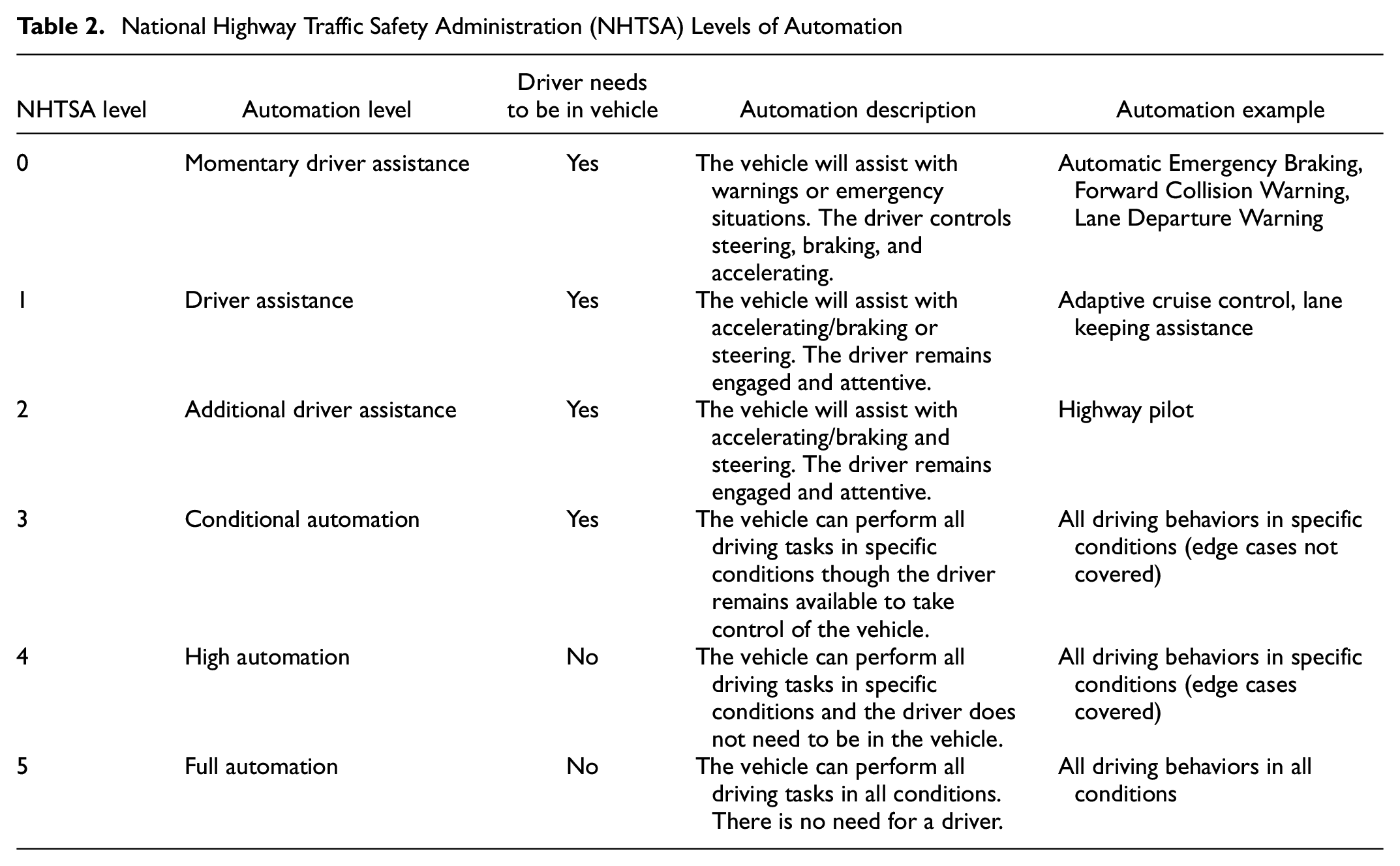
NHTSA has defined “Five Eras of Safety” for vehicles that have taken place since 1950 ( 22 ). The first era was between 1950 and 2000 and includes safety features like cruise control, seat belts, and antilock brakes. The second era, 2000 to 2010, has more advanced safety features like electronic stability control, blind-spot detection, forward collision warning, and lane departure warning. The third era, 2010 to 2016, includes advanced driver assistance features like rearview video systems, automatic emergency breaking, and lane centering assist. The fourth era, from 2016 to 2025, includes partially automated safety features like lane keeping assist, adaptive cruise control, and traffic jam assist. The final era, from 2025 onward, will include fully automated safety features. As vehicle technology has progressed, NHTSA has required vehicle manufacturers to adopt features that improve safety. For instance, in 2014, NHTSA announced that new vehicles under 10,000 lb must have rear visibility technology by 2018 ( 43 ). In 2023 they proposed a rule that would require automatic emergency breaking on passenger cars and light trucks ( 44 ). To help provide clarity on the automation of a vehicle, levels of automation have been defined. NHTSA provides six different levels of automation to define the relationship between the driver and the vehicle ( 22 ). For Levels 0, 1, and 2, the driver is in control of the vehicle while the system provides momentary assistance with braking, accelerating, and/or steering. For Levels 3, 4, and 5, the system drives, and the driver has varying roles of responsibility. For Level 3, the driver must be ready to take control of the vehicle if needed. For Level 4, the driver is not needed if the vehicle is operating within a specific operating domain. For Level 5, the driver is not needed and the vehicle can operate in all operating conditions. Table 2 describes the six levels of automation and the driving features that correspond to each level.
National Highway Traffic Safety Administration (NHTSA) Levels of Automation
Technology Used in Autonomous Vehicles
The technology used in AVs includes two main components, sensors and machine learning algorithms. The sensors include perception devices in the vehicle such as radar, lidar, and cameras that enable the vehicle to perceive the surrounding environment. Machine learning algorithms help the vehicle to make sense of all these data and to detect or predict what action the vehicle should take. The industry is currently pursuing the approach that automation technology should be within the vehicle and not the infrastructure. This approach allows the market dynamics of the technology to play out instead of relying on government-funded infrastructure updates. A hybrid approach might be used in the future that would employ sensors in the vehicles, in infrastructure, and on nearby pedestrians. This approach, known as vehicle-to-everything (V2X), crucially includes communication between the sensors on vehicles, infrastructure, and even other road users such as pedestrians. This is an area that is currently being researched and tested by U.S. DOT, although the industry is not relying on it vehicle communication technology for initial deployments ( 45 ). The additional information from infrastructure and nearby vehicle sensors could be combined with the perception technology in vehicles. This should increase the prediction accuracy of machine learning algorithms because all of the information could be used to determine the best next action. Because companies are currently pursuing the deployment of AVs using just perception devices, some additional detail is provided on these technologies.
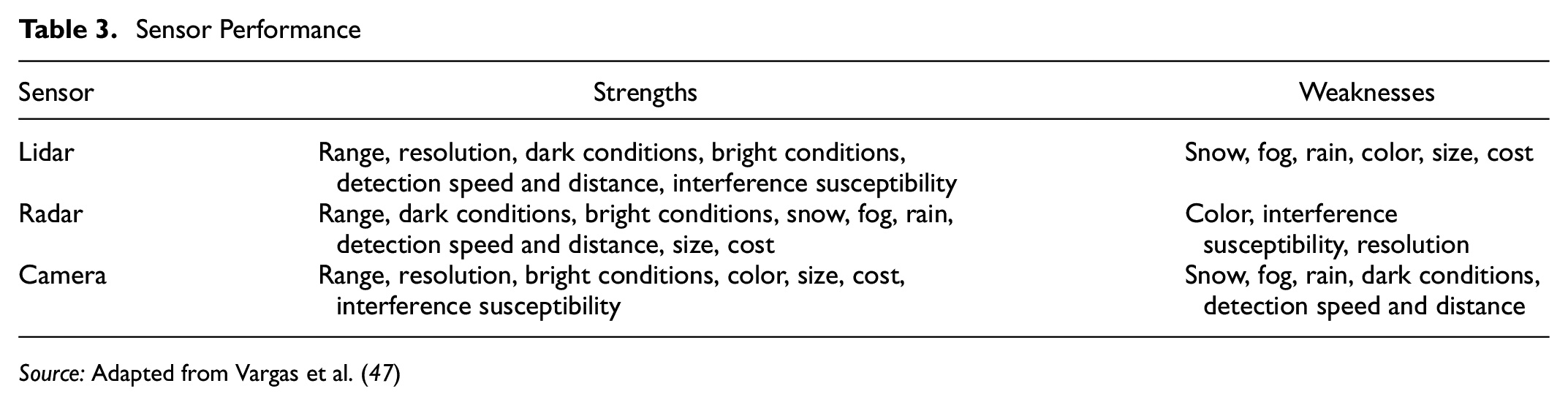
Yeong et al. undertook a review of sensors used in AVs ( 46 ). Radar (radio detection and ranging) uses radio waves to detect objects, lidar (light detection and ranging) uses light waves to detect images, and a camera uses a lens to pick up light emitted from the surfaces of objects. Each device has benefits and drawbacks. Radar uses electromagnetic waves to determine the speed and position of objects and is therefore not affected by environmental lighting or weather conditions. This makes radar useful for detecting objects at night and in adverse weather conditions. However, radar only provides a coarse image of the objects detected so it needs to be combined with cameras and lidar for improved object detection. There are three types of radar used in vehicles: short-, medium-, and long-range radar. Short-range radar is useful in parking assistance and collision proximity warning. Medium-range radar is useful for side-/rear-collision avoidance and blind-spot detection. Long-range radar is useful for adaptive cruise control and early detection applications ( 46 ). Lidar uses ultraviolet, visible, or near-infrared light to determine the distance to an object. The points received from lidar (known as a point cloud) can be used to generate three-dimensional (3D) representations of objects. Lidar has a large range, is accurate, and is able to quickly scan the environment, but performance declines in adverse weather conditions ( 46 ). Lidar, like radar, does not provide color information of the surrounding environment. Cameras use light from the surrounding environment to create high-resolution images. In AVs they are used to detect road signs, traffic lights, road lane markings, and barriers ( 46 ). However, the quality of camera images declines in adverse weather conditions and at night. Further, camera images may have an optical distortion that could result in an incorrect identification or location of an object. Analyzing camera images also requires a lot of computational power. Vargas et al. compared lidar, radar, and cameras across several categories including range, resolution, lighting conditions, weather conditions, detection speed and distance, size, and interference susceptibility ( 47 ). Each sensor has its strengths and weaknesses, which are summarized in Table 3 ( 47 ). By combining the data from all of the sensors some of the areas of weakness can be mitigated.
Sensor Performance
Source: Adapted from Vargas et al. ( 47 )
Sensors can be categorized as passive or active based on whether the sensor has their own source of light or illumination. Cameras are passive sensors that receive energy emitted from the environment to generate an output. Lidar and radar are active sensors that generate energy and then receive the reaction of that energy from the environment to generate an output. Given the different functionality of the sensors, their arrangement on vehicles is an important consideration. Where the sensors are placed will affect the type of information received and ultimately the accuracy of their perception of the surrounding environment ( 46 ). The placement of sensors on a Class 8 semitruck will be different than on a passenger car, and the perceived environment from the sensor will also be different. Class 8 semitrucks are heavy-duty trucks that have a weight limit greater than 33,000 lb. The size of semitrucks allows for greater visibility of the roadway, though it also presents challenges for turns, stopping distance, and maneuvering in traffic. Another data input for AVs is their location, which is obtained from a combination of sensors including GPS and inertial navigation sensing. AVs can also use the perception sensors to help locate where it is if a GPS signal is not available. Making the vehicle as independent as possible from outside data input makes it more akin to human driving, in which we rely on our eyes to make the best driving decisions.
Machine learning algorithms process and make sense of the data obtained from the passive and active sensors. Machine learning is a subset of artificial intelligence (AI). AI is the ability of machines or systems to mimic human behaviors, and machine learning refers to the algorithms used to train the machines or systems to learn from past experience ( 48 ). Machine learning is a type of software development in which the system is trained using data and algorithms so that it learns how to operate or perform a specific task without being explicitly programmed ( 49 ). This makes the system dynamic, so it is continually evolving and improving as it encounters new data or scenarios. The multitude of scenarios that the system must be able to handle is also why it is so difficult to train a vehicle to drive. A subset of machine learning is deep learning, which uses neural networks that are inspired from how the human brain processes information. Deep learning has improved object detection, and has exceeded human performance for image classification ( 50 ). Deep learning algorithms help AVs turn the data from the sensors into actionable information. However, deep learning is not the only type of machine learning algorithm used for AVs. Machine learning algorithms can be classified into five general types: 1) supervised learning, 2) unsupervised learning, 3) semisupervised learning, 4) reinforcement learning, and 5) deep learning ( 48 ). The algorithms that are used depend on the autonomous driving task. For instance, perception, motion planning, pedestrian detection, traffic sign detection, road marking detection, self-localization, automated parking, motion control, vehicle cybersecurity, and fault diagnosis all use different algorithms ( 51 ). Autonomous driving can be described under five main tasks: 1) sensing the environment, 2) perceiving the environment, 3) localizing the vehicle, 4) planning the next action, and 5) implementing the driving decision ( 49 ). Sensors gather information about the environment, and machine learning algorithms facilitate use of these data to understand, plan, and act on the information.
Commercial Application of ATs in the Trucking Industry
Deployment Market
Several companies believe that the hardware sensors and the machine learning algorithms have advanced to the point where AVs could be deployed on public roads. The main deployment markets for AVs currently being pursued by companies are commercial applications in the movement of freight and passengers. Companies pursing the automation of trucks for freight started to take place in the United States around 2015. There are currently more than a dozen companies focused on developing autonomous driving systems for trucking applications. Three AT companies went public in the United States in 2021: Aurora, TuSimple, and Embark ( 52 – 54 ). The race to deploy ATs on public roads is taking place globally with tests being performed in China, Japan, South Korea, Sweden, Germany, Australia, Canada, and the United States. Whereas testing of ATs is taking place globally, there is a high concentration of AT companies with headquarters in the United States. Considering all of the companies that have pursued the AT market, even the companies no longer operating, 73% have headquarters in the United States, as shown in Figure 1. Some of the companies with U.S. headquarters are pursuing markets outside of the United States. Because of the economic and national advantages of improving logistics operations, several countries are moving to safely deploy ATs. Although in the future AT companies will most likely operate on a global scale, initial deployments may be more nationally focused because of security concerns, regulatory uncertainty, and market size. To better understand the possible deployment markets for ATs, the companies currently involved in development are categorized based on the location of their headquarters. Additional deployment markets are also covered by reviewing potential AT market entrants and AT companies that are no longer in business. As Figure 2 shows, nine companies are based in the United States, eight companies are outside, seven companies may enter the AT market, and six companies have gone out of business.
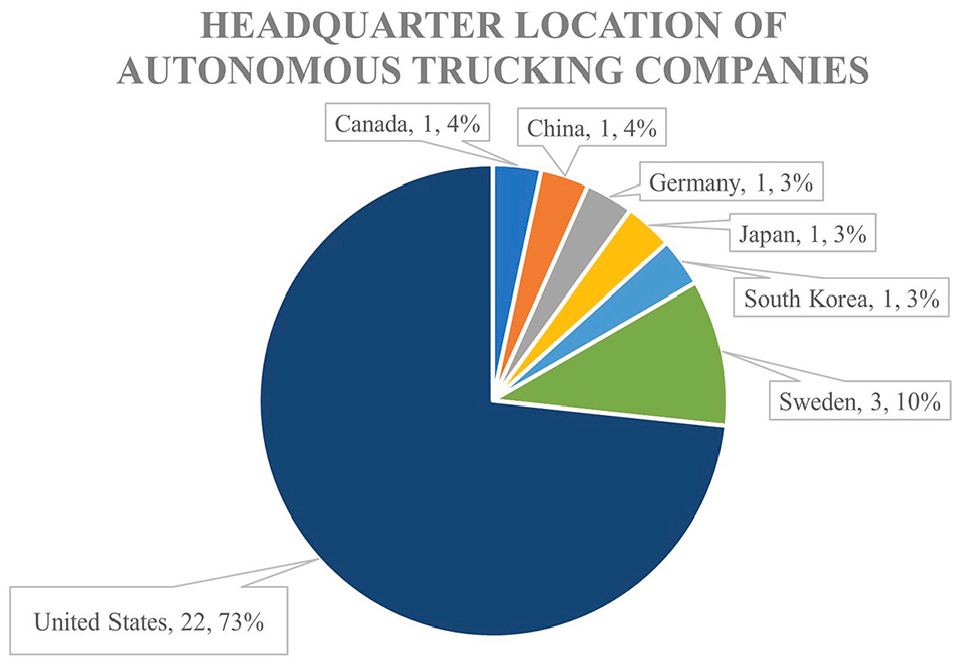
Location of autonomous truck headquarters (includes potential market entrants and companies no longer operating).
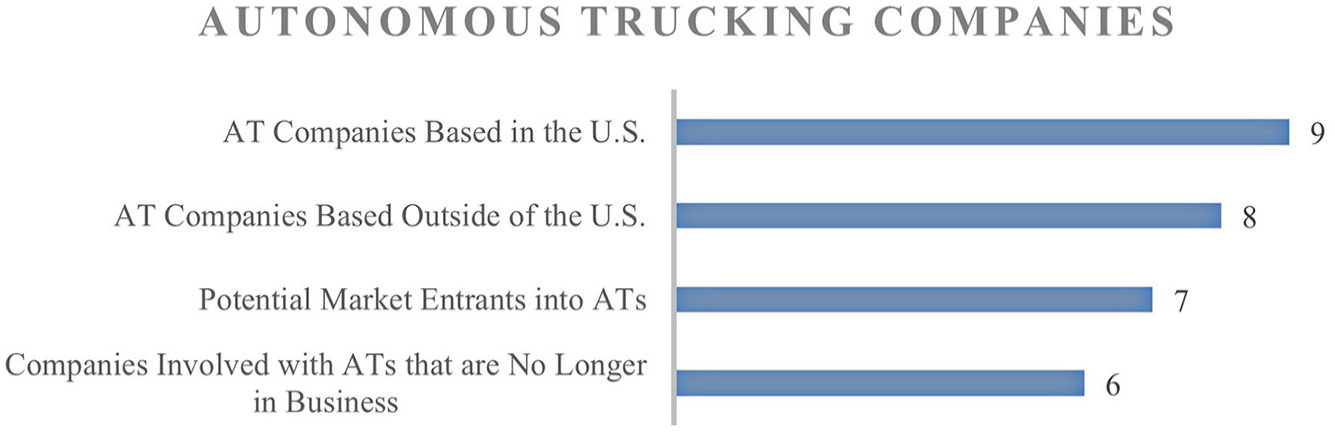
Deployment market of autonomous truck companies.
AT Companies Based Outside of the United States
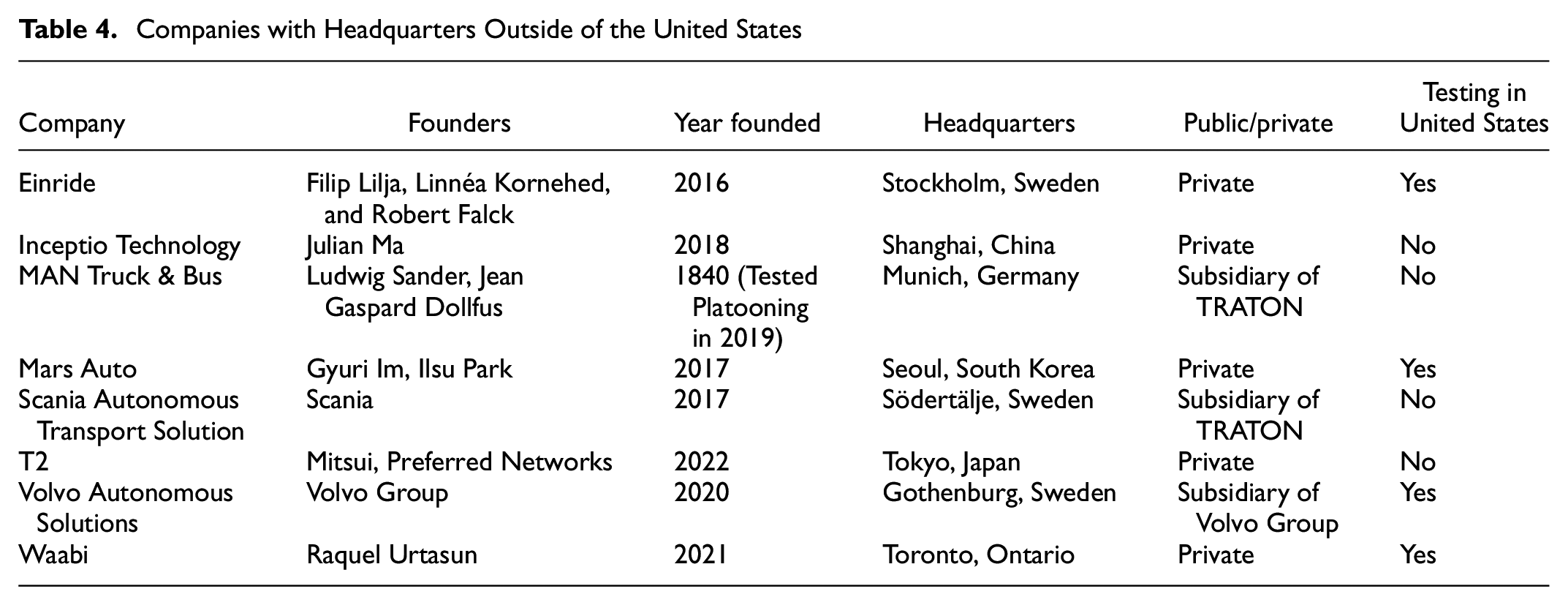
Companies headquartered outside of the United States are listed in Table 4 and include Einride, Inceptio Technology, Scania Autonomous Solutions, Volvo Autonomous Solutions, Waabi, MAN Truck & Bus, Mars Auto, and T2. Four of the companies are in Europe and the rest are based in China, Japan, South Korea, and Canada. Three of the companies are large truck manufacturers large-truck and five are new entrants into the trucking industry. All of the companies recently became involved in ATs, with Einride being the earliest, entering the market in 2016. MAN Truck & Bus, a well-established large vehicle manufacturer, tested platooning in 2019 in Germany ( 55 ). Three of the companies are based in Sweden, and two of them, Einride and Volvo, are planning to utilize ATs in the United States. Einride has performed AT tests in the United States with GE Appliances and Volvo has been working with several logistics companies testing ATs in Texas ( 56 , 57 ). Scania Autonomous Solutions, another AT company based in Sweden, is primarily focusing on the European market. However, Scania did perform a truck platoon test in Singapore on public roads, hauling containers between ports ( 58 ). Scania and Navistar are both subsidiaries of TRATON and TuSimple had a partnership formed with both companies ( 59 , 60 ). The partnership Navistar had with TuSimple has ended, but TRATON is partnering with Plus to commercialize Level 4 ATs in the United States and Europe ( 61 ). With this partnership Plus will work with Navistar, Scania, and MAN Truck & Bus. MAN Truck & Bus is another subsidiary of TRATON that is working on Level 4 ATs in Europe. MAN Truck & Bus is focused on deploying ATs initially in Germany and then expanding operations to the rest of Europe. Companies in the Asia-Pacific region include Mars Auto, T2, and Inceptio Technology. Inceptio Technology is based in China and is focusing solely on the Chinese market. Other AT companies with China ties based in the United States include Plus, Pony.ai, and TuSimple. Mars Auto is currently focusing on the South Korean market, though it is planning to expand to the United States ( 62 , 63 ). T2 was created from investments from logistics company Mitsui and technology company Preferred Networks among other investors ( 64 ). They are focusing on deploying Level 4 ATs in Japan. Waabi is based in Canada but is also focusing on deploying ATs in the United States.
Companies with Headquarters Outside of the United States
AT Companies Based in the United States
Companies that are headquartered in the United States are mainly focused on deploying ATs there, though some are also focusing on international markets. Table 5 lists all AT companies with headquarters in the United States. Like the internationally based AT companies, the U.S.-based companies became involved with ATs relatively recently, with TuSimple being the earliest in 2015. Kratos Defense is one of the most recent companies to become involved. Kratos began testing platoons in North Dakota in 2022 ( 65 ). The companies that are also focusing on international markets are Plus, Pony.ai, and TuSimple. Plus is working on deploying its technology in the United States, Europe, and China. Plus split their business into two companies in 2023, so the China operation is now a separate company ( 66 ). Pony.ai is working on deploying robotaxis in the United States, though it has recently performed AT tests in China. Pony.ai began forming logistics partnerships in 2022 to deploy ATs in China and has not formed any U.S.-based logistics partnerships ( 67 , 68 ). TuSimple was initially focused on the U.S. market and performed many over-the-road tests in the Southwestern United States with logistics companies. TuSimple has shifted to the Asian Pacific market, closed its U.S. operations, and delisted its stock from NASDAQ ( 69 , 70 ). TuSimple started testing ATs in Japan in 2023 with a local Japanese OEM ( 71 ). Japan revised its Road Traffic Act in April of 2023 so that Level 4 ATs can now operate under certain conditions ( 72 ).
Companies with Headquarter in the United States
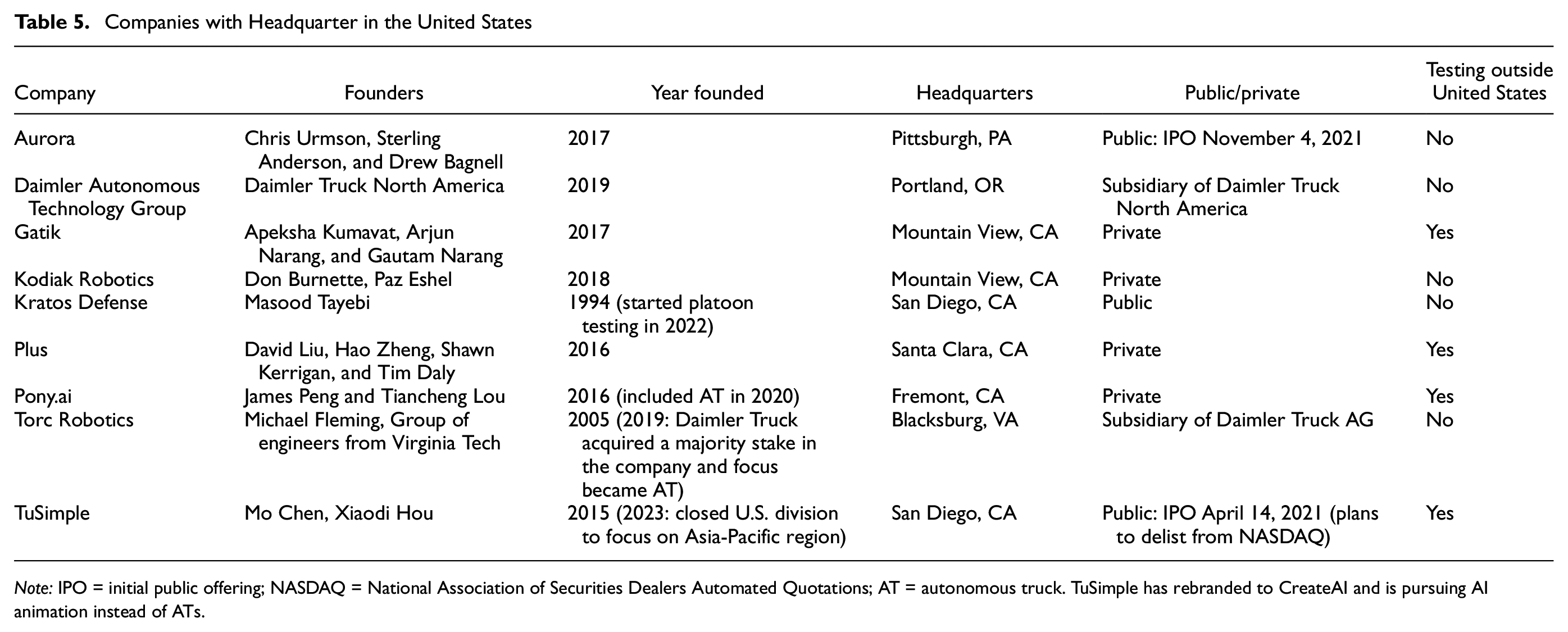
Note: IPO = initial public offering; NASDAQ = National Association of Securities Dealers Automated Quotations; AT = autonomous truck. TuSimple has rebranded to CreateAI and is pursuing AI animation instead of ATs.
Companies headquartered in the United States that are mainly focused on deploying ATs there are Aurora, Gatik, Kodiak Robotics, Kratos Defense, and Torc Robotics. Aurora has been performing over-the-road AT tests in the Southwestern United States. The company plans to expand to other commercial deployments like delivery of local goods and robotaxis. Aurora also plans to expand to other markets outside of the United States, though its initial focus is on ATs in the United States. Gatik is working on automating box truck deliveries in the United States and Canada and has been performing autonomous runs with no drivers in the vehicles. Kodiak Robotics has also been performing tests in the Southwestern United States. Kodiak did form a partnership to test ATs in South Korea to expand into the Asian market, though currently, it appears its main focus remains the United States. Torc Robotics is another company undertaking tests in the Southwestern United States. Daimler, which is based in Germany, acquired a majority stake in Torc Robotics in 2019. Freightliner, which is owned by Daimler, is based in Portland, OR ( 73 ). Kratos has traditionally focused on military applications of AVs, though it has entered the commercial market with its platoons and autonomous truck-mounted attenuators in work zones.
Potential Entrants into the AT Market
Potential entrants into the AT market are presented in Table 6 and include Ike, Pronto, Forterra (Robotic Research), Stack AV, Tesla, and Waymo Via, and Hydron. Ike was initially focused on ATs before being acquired by Nuro ( 74 ). Nuro is mainly focused on local deliveries though its autonomous driving system has been used on semitrucks ( 75 ). Pronto is now focused on off-road applications of ATs, though they were initially focused on on-road applications. It made the switch from on-road Class 8 truck automation to autonomous haulage units in closed sites in 2020 ( 76 ). Pronto is working with the Virginian Tech Transportation Institute on a project to showcase the deployment of ATs ( 77 ). Forterra has focused on off-road applications for AVs including military applications, though it began moving into commercial applications in 2021 ( 78 ). Stack AV is focused on using automation with Class 8 semitrucks, though its exact focus is not yet clear. Founders Bryan Salesky and Peter Rander previously started an AV company that Ford purchased and shut down in 2022 ( 79 ). Tesla is working on creating autonomous electric vehicles and recently released an electric semitruck to PepsiCo in 2022 ( 80 ). The semitrucks may be able to use Tesla’s autonomous driving system in the future. Waymo Via was the AT division of Waymo until it was closed in 2023 so the company could focus on robotaxis ( 81 ). Waymo created a partnership with Daimler, which it plans to keep in place. Waymo could shift back into ATs in the future. Hydron is planning to build autonomous-ready semitrucks. The founder, Mo Chen, cofounded TuSimple, and TuSimple is now focused on the Asian market.
Potential Entrants into Autonomous Truck (AT) Market
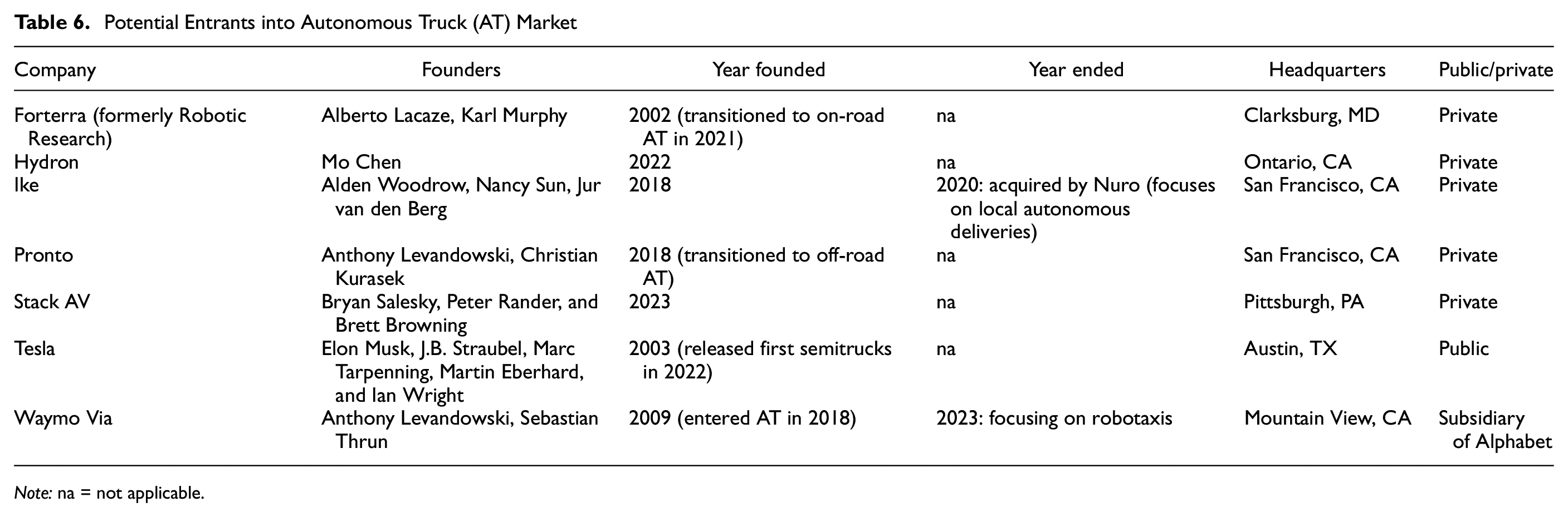
Note: na = not applicable.
Companies Involved with ATs that are No Longer in Business
Companies that were involved with ATs but are no longer in business are presented in Table 7 and include Embark, Locomation, Otto (Uber Advanced Technologies Group), Starsky Robotics, and Peloton Technology. Most of these closures have taken place recently with five of the six companies closing since 2020. All of these companies were focused on deploying ATs in the United States. Embark, founded in 2016, was performing on-road tests of ATs in the Southwestern United States. It ceased operations in 2023 and was acquired by Applied Intuition, a software company that is helping companies to deploy AVs ( 82 ). Locomation, founded in 2018, was planning on deploying ATs using a two-truck convoy. It also closed in 2023 ( 83 ). Otto, founded in 2016, was focused on ATs and then was acquired by Uber ( 84 ). Uber kept the AT division open for a while and then decided to close it ( 85 ). Otto is well known for the autonomous test run it performed in Colorado, hauling Budweiser beer between Fort Collins and Colorado Springs in 2016 ( 86 ). Uber Advanced Technologies Group was later acquired by Aurora, which is now focused on ATs ( 87 ). Starsky Robotics, founded in 2016, was focused on ATs that would be monitored by a remote operator. It performed a fully driverless test in Florida in 2019 and closed in 2020 ( 88 ). Peloton was founded in 2011 and was focused on truck platooning. Peloton was testing its technology with customers and was planning on moving to Level 4 autonomous trucking where the driver could be removed from the following truck ( 89 ). Peloton ceased operations in 2021 ( 90 ).
Companies Involved with ATs That Are No Longer Operating
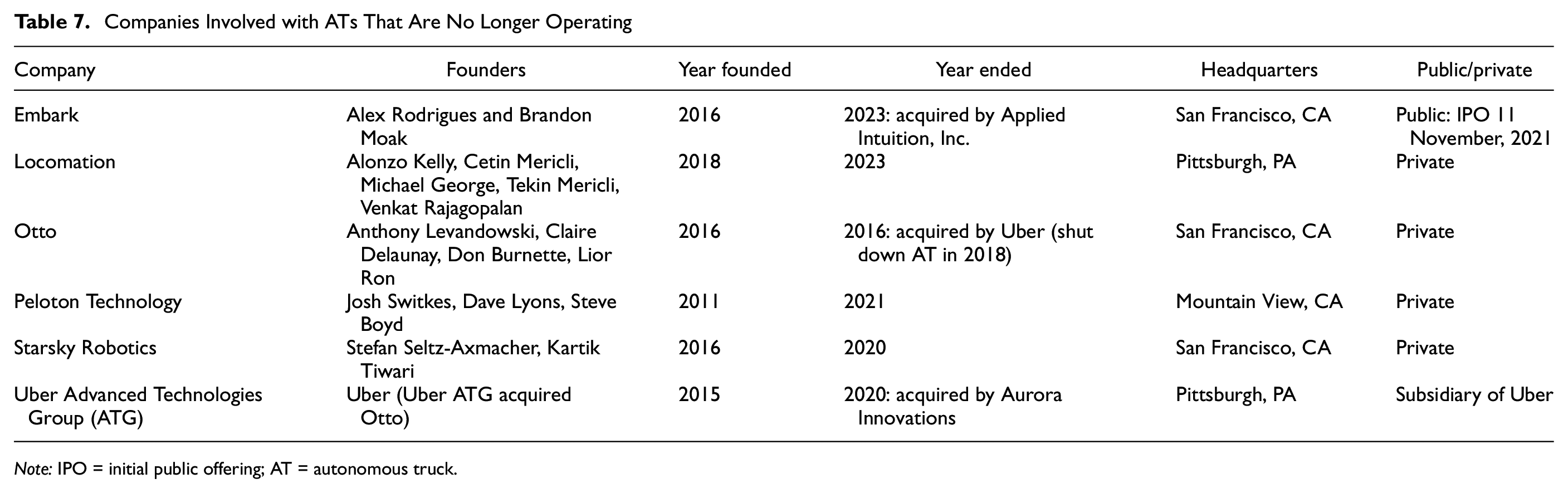
Note: IPO = initial public offering; AT = autonomous truck.
Business Cases Being Pursued by AT Companies
Whereas most AT companies started to emerge in 2015, the use of AVs in commercial applications has been common since the 2000s in closed environment like mines, ports, and distribution centers where tasks are controllable and very repetitive. Rio Tinto began using ATs in mines in Australia in 2008 ( 91 ). It reported in 2018 that ATs operated about 700 h more than conventional trucks, cut costs by about 15%, and no AT-related injuries had occurred ( 91 ). Utilization and cost savings along with improved safety make ATs a compelling investment for companies. Because of the many benefits ATs offer, U.S. logistics companies have started partnering with AT companies to test possible use cases. The move from closed environments such as mines to public infrastructure that is shared with noncommercial traffic represents a significant shift that will open several new business opportunities for companies. The business cases being pursued by AT companies are shown in Figure 3. A few things should be noted about Figure 3. Some companies are pursuing multiple business cases, so AT companies are included in multiple business cases. Figure 3 includes just the companies involved with ATs. There are many companies pursuing industrial applications in closed environments that are not included, since they are not pursuing ATs. Some companies in the figure are listed as Level 4 AT, because it is not clear what particular application they are going to pursue. Only one AT manufacturer is shown in Figure 3, though most major manufacturers are involved with ATs through partnerships or investing in AT companies. The one manufacturer included is a new company that is planning to manufacture ATs. Figure 3 also includes AT companies that are no longer in business, and potential market entrants. The predominant business case, as shown in Figure 3, is a hub-to-hub application of ATs.
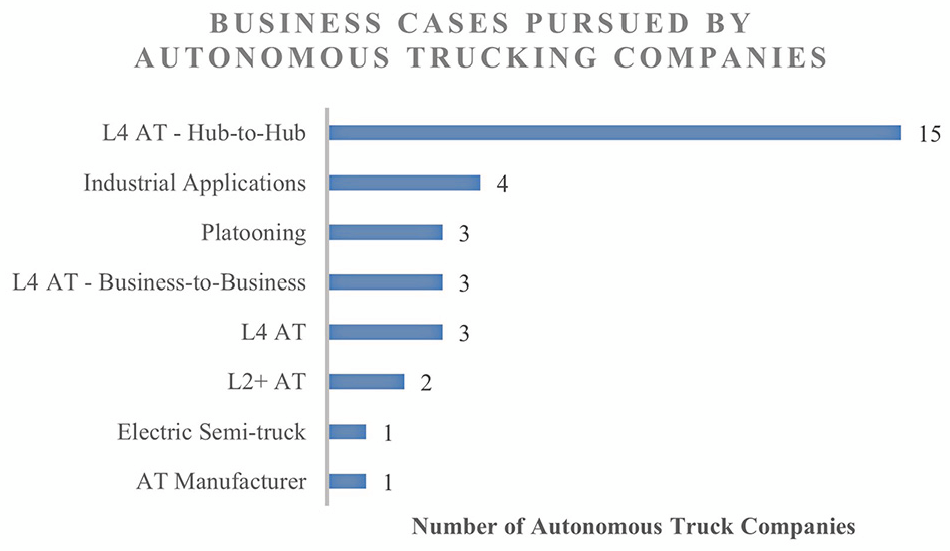
AT business cases being pursued (Includes potential market entrants and companies no longer operating).
Hub-to-Hub Model
Table 8 presents the current business cases being pursued for ATs. One of the predominant business cases being pursued is Level 4 ATs that will operate in a hub-to-hub model. Aurora, Kodiak, MAN Truck & Bus, Scania, Torc Robotics, Volvo, Waabi, and T2 are planning to initially deploy ATs using this method. A hub-to-hub model is set up so that terminals are located outside of major cities. The AT would then operate between the hubs over interstate highways leaving the last mile for manually driven trucks. There are several reasons why this is the predominant approach to initially deploy ATs. This strategy may be easier to automate than deployments in urban areas because of a less complex operating environment. This will result in fewer stops, which will increase the utilization of the truck and help decrease the payback period of the initial investment. It will enable drivers to stay closer to home, which may improve driver morale and retention, and reduce lodging expenses. Another challenge and possible benefit of automating highway driving is reducing the number of high-speed collisions. Higher driving speeds on highways increase the risk of deploying ATs, although the potential benefits are increased if this can be achieved safely. The goal would be for trucks to operate at Level 5, meaning they could operate from dock to dock under any traffic conditions. This level of deployment may be several years into the future; for now, companies are focusing on finding repetitive operating conditions that have a compelling business case and can utilize Level 4 ATs in a hub-to-hub model.
Companies Pursuing AT Business Cases
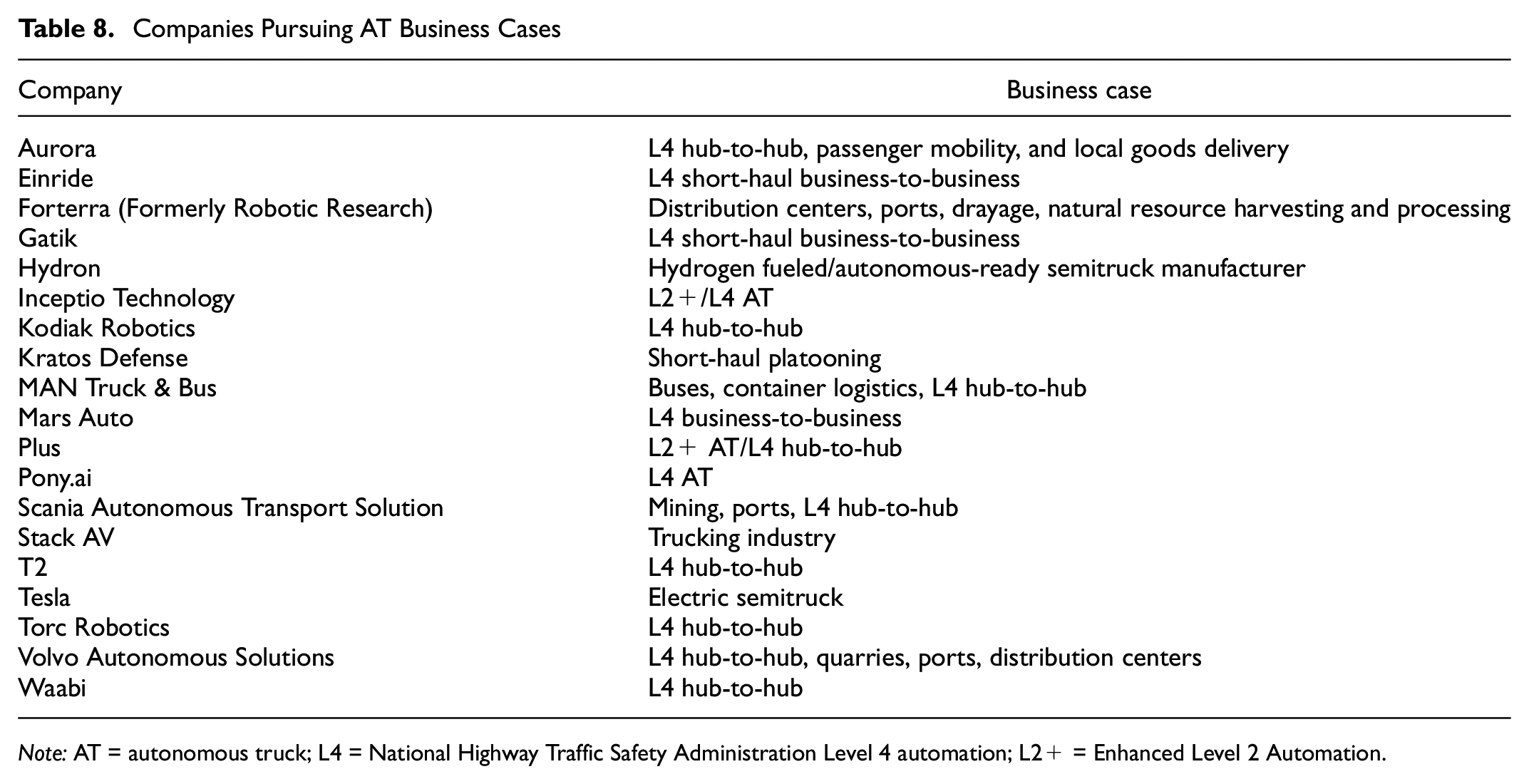
Note: AT = autonomous truck; L4 = National Highway Traffic Safety Administration Level 4 automation; L2+ = Enhanced Level 2 Automation.
Level 4 Versus Level 2+ Automation
Level 4 is being pursued by most companies because a driver does not need to be in the vehicle, which removes the complication of driver handoffs necessary in Level 3 automation. In 2012, Waymo explored the possibility of using Level 3 automation; they found that drivers overrelied on the technology and the transition from passenger to driver in complex situations was challenging ( 92 ). The handoff problem, combined with the cost savings of removing the driver makes Level 4 more compelling for logistics companies. Even though Level 4 is the goal for most AT companies, some are pursuing Level 2+ ATs because the technology is commercially available. Plus and Inceptio Technology are companies that decided to take this approach. Plus is retrofitting semitrucks with Level 2+ technology that includes advanced lane centering, merge handling, collision avoidance, blind-spot detection, an integrated event data recorder, driver attentiveness system, and predictive fuel optimization ( 93 ). Its plan is to commercialize this technology while developing and testing a Level 4 system. For its Level 4 system, Plus is planning to use a hub-to-hub model. Inceptio Technology is following a similar approach to Plus where it is currently deploying Level 2+ trucks to customers in China ( 94 ). It plans to deploy Level 4 ATs in the future. Platooning is another automation strategy. The approach involves tethering two trucks together using wireless communications so they can travel close to each other. Platooning may use driver assistance features, although the system does not have to be autonomous. Kratos Defense and Security Solutions has partnered with Minn-Dak Farmers Cooperative to test truck platoons to haul sugar beets in North Dakota and Minnesota ( 65 ). Kratos is also testing platoons in Northern Minnesota to haul biodiesel between refining plants. It also has plans to test platoons in Ohio and Indiana for a 3PL company ( 95 ).
Short-Haul Business-to-Business Market
Another segment of the trucking market that is being pursued is the short-haul, middle-mile market. This consists of routes between manufacturing facilities and warehouses or warehouses and retail stores. Gatik, Einride, and Mars Auto are pursuing this market, which offers the possibility of earlier deployment times because of shorter routes and the use of smaller trucks. Gatik uses Classes 3 to 7 box trucks that have a gross vehicle weight rating (GVWR) of 10,000 to 33,000 lb, compared with Class 8 trucks with a GVWR exceeding 33,000 lb ( 96 ). Because of the lower weight and slower speed, the severity of crashes is reduced. Owing to the lower barriers to entry of this market, Gatik has started to deploy autonomous box trucks with no driver. There is also the possibility that automated box trucks may move some of the freight that is typically hauled with Class 8 semitrucks. This is being seen in a partnership between Gatik and Georgia-Pacific where the companies are testing automated box trucks to make deliveries to Sam’s Club locations instead of using Class 8 semitrucks ( 97 ). The move toward using automated smaller vehicles that make more deliveries instead of manually driven larger vehicles is also being tested in the mining industry. Volvo Autonomous Solutions is building a smaller autonomous haul truck for mines, which it believes will increase efficiency and allow for electrification ( 98 ). Einride has designed a cabless electric truck that they are planning to deploy in ports and between warehouses. Mars Auto is similarly pursuing AT applications between warehouses, though on longer routes.
There has been a lot of movement in the AT market with companies entering and exiting. Table 9 lists all companies that were at one point involved with ATs in the United States. Embark, Ike, Otto (Uber ATG), Starsky Robotics, TuSimple, and Waymo Via all planned to deploy Level 4 ATs in a hub-to-hub model in the United States. Embark had several partnerships with logistics companies to test its deployment method, however, the company ran out of funding to stay in business. Waymo Via decided to shift their focus back to robotaxis. Ike was acquired by Nuro and is now focusing on automating local deliveries. Otto was acquired by Uber and eventually shifted from ATs to self-driving cars. Starsky was unable to commercialize their product to stay in business, and TuSimple left the United States to focus on the Asian market. There have also been shifts between off- and on-road applications for ATs. Pronto was initially focused on on-road applications of ATs but is now working on off-road applications in mines. Forterra (Robotic Research) has mainly focused on off-road applications of AVs though it is now entering on-road applications. Kratos is making the same shift from off-road AVs for military vehicles to on-road applications. Other companies that focused on platooning are no longer in business. Peloton Technology and Locomation were planning on deploying platoons of trucks. Locomation had a three-phase approach to get to Level 4 ATs. The first phase was to be a two-truck convoy with a driver in the lead vehicle and a driver sleeping in the second vehicle. The second phase was to remove the driver resting in the second vehicle. The third phase would have been Level 4 automation of a single truck and no driver. Kratos is the only company that is still pursuing platooning as a viable commercial deployment option.
Companies No Longer Involved with ATs in the United States
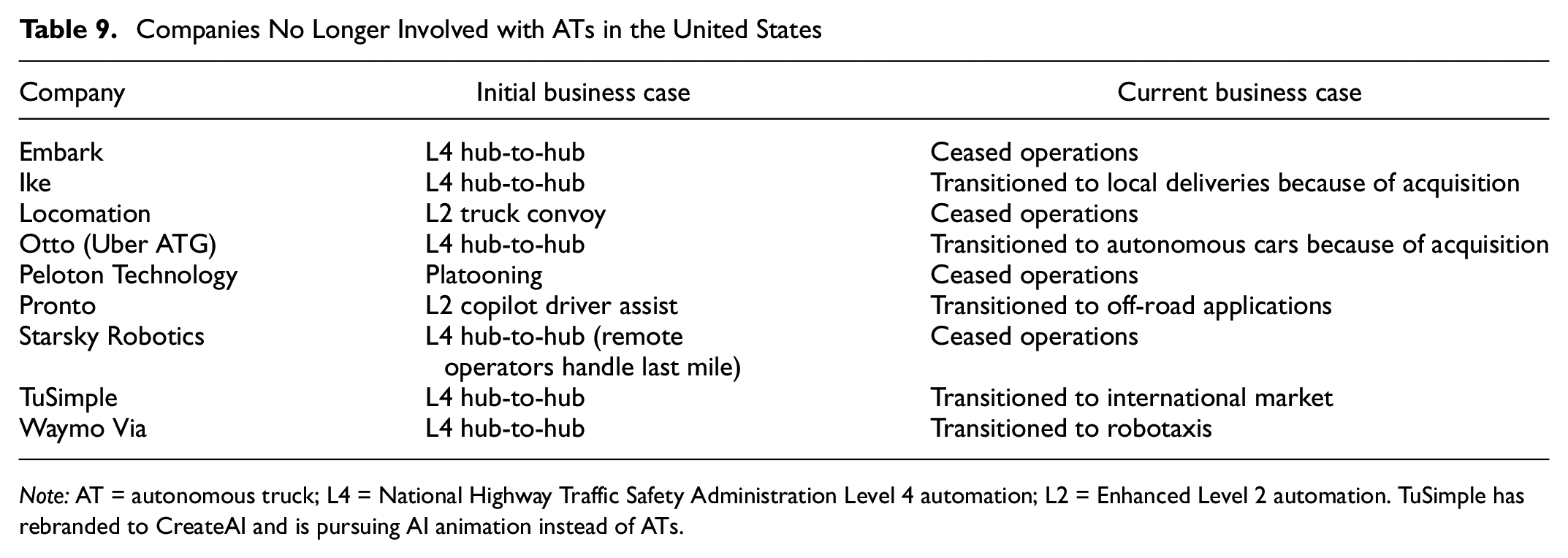
Note: AT = autonomous truck; L4 = National Highway Traffic Safety Administration Level 4 automation; L2 = Enhanced Level 2 automation. TuSimple has rebranded to CreateAI and is pursuing AI animation instead of ATs.
Commercial Adoption Timelines and Deployments
Commercial deployment of Level 4 ATs is planned to take place by the end of the decade, as shown in Figure 4. AT commercial deployments started in 2021 with Gatik making deliveries for Walmart in Arkansas using their autonomous box trucks. In 2021 and 2022, Level 2 autonomous systems became available in the United States and China. In 2023, Einride started making daily deliveries using their cabless AT for GE Appliance on a private road that is open to the public ( 99 ). Aurora, Kodiak, Torc Robotics, MAN, and Scania all plan on deploying Level 4 ATs by 2030.
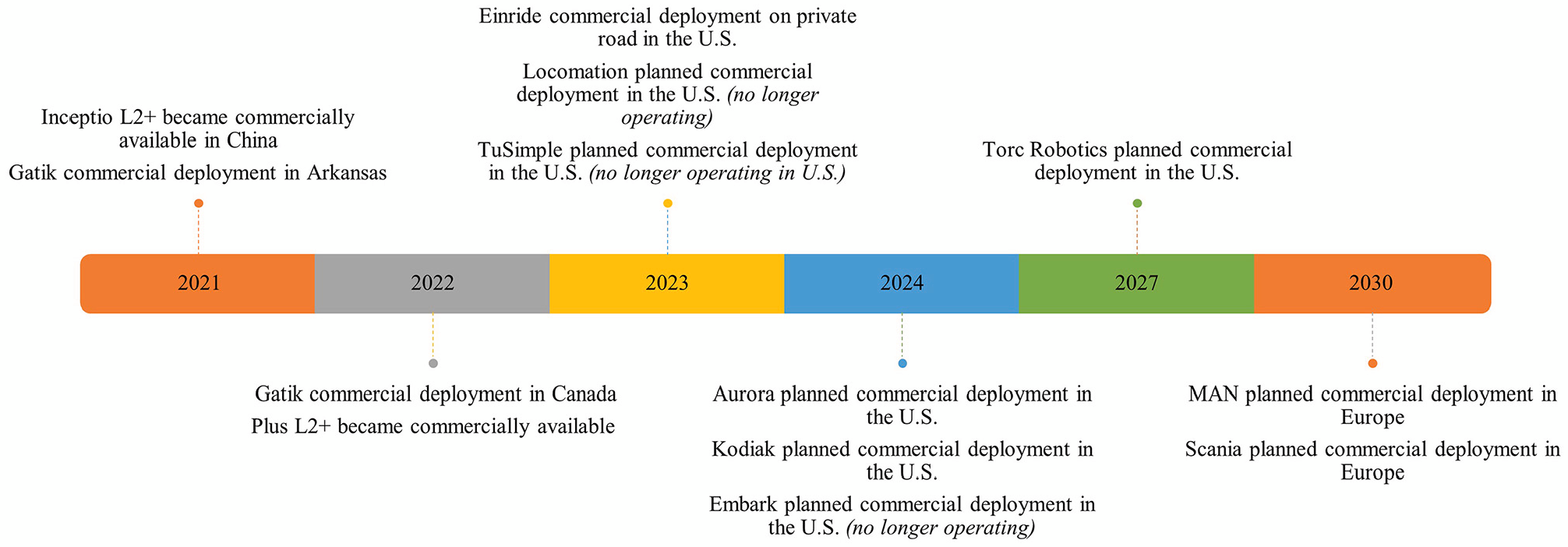
Timeline of commercial deployment of autonomous trucks.
Companies that are Still Operating
Companies pursuing Level 4 automation are still in the testing phase, though many are planning to deploy Level 4 ATs within the decade. The deployment timeline and locations are listed in Table 10. Aurora, a publicly traded company, planned on deploying ATs between Dallas and Houston, TX, in 2024 though their timeline has been pushed back to 2025 ( 100 ). Kodiak, a private company, has recently announced that it has an autonomous-ready truck that will also be deployed between Dallas and Houston in 2024 ( 101 ). Torc Robotics has announced that its target for deployment of ATs is 2027, initially in Texas between Dallas and Laredo ( 102 ). Volvo has not set a timeline for when it plans to deploy ATs, but has indicated that its first freight corridors will be Dallas–Fort Worth to El Paso and Dallas to Houston, TX ( 57 ). This is similar to Waabi, which plans to offer its AT service first in Texas between Dallas and Houston in partnership with Uber Freight ( 103 ). Although all of these companies are initially targeting Texas as their deployment location, many are planning on expanding throughout the Sunbelt region (i.e., xxx) and then throughout the entire United States. All of these companies are pursuing the hub-to-hub model, so the deployments are planned to take place on major interstate routes. We can see where expansion is planned for ATs with Torc Robotics’ adoption plan. After deploying between Dallas and Laredo, TX, Torc plans to expand along Interstate 40 between Phoenix, Albuquerque, Oklahoma City, St. Louis, Memphis, and Atlanta ( 102 , 104 ). The company then plans to return to Texas and add routes to El Paso, Houston, and Shreveport, LA. The two companies pursuing ATs in Europe, Scania and MAN, are planning to have a Level 4 AT commercially available by 2030 ( 105 , 106 ). Plus and Inceptio Technology have Level 2+ automation that is commercially available for installation in trucks. PlusDrive became commercially available in 2022 and will be installed in Nikola electric trucks in 2024 ( 107 ). Plus SuperDrive, their Level 4 technology, is currently being tested in the United States and Europe ( 61 ). Inceptio Technology has been using its Level 2+ automation in China since 2021 ( 108 ). The other commercially available product is Gatik’s autonomous box truck. Gatik has partnered with companies like Walmart to use Level 4 autonomous box trucks for routes between warehouses and retail stores. It removed the safety driver in Arkansas in 2021 for the Walmart routes and in Toronto, Canada, in 2022 for the Loblaw routes ( 109 , 110 ). In 2024, Gatik is planning to remove the safety driver for routes in Texas ( 111 ).
Deployment Timelines of AT Companies
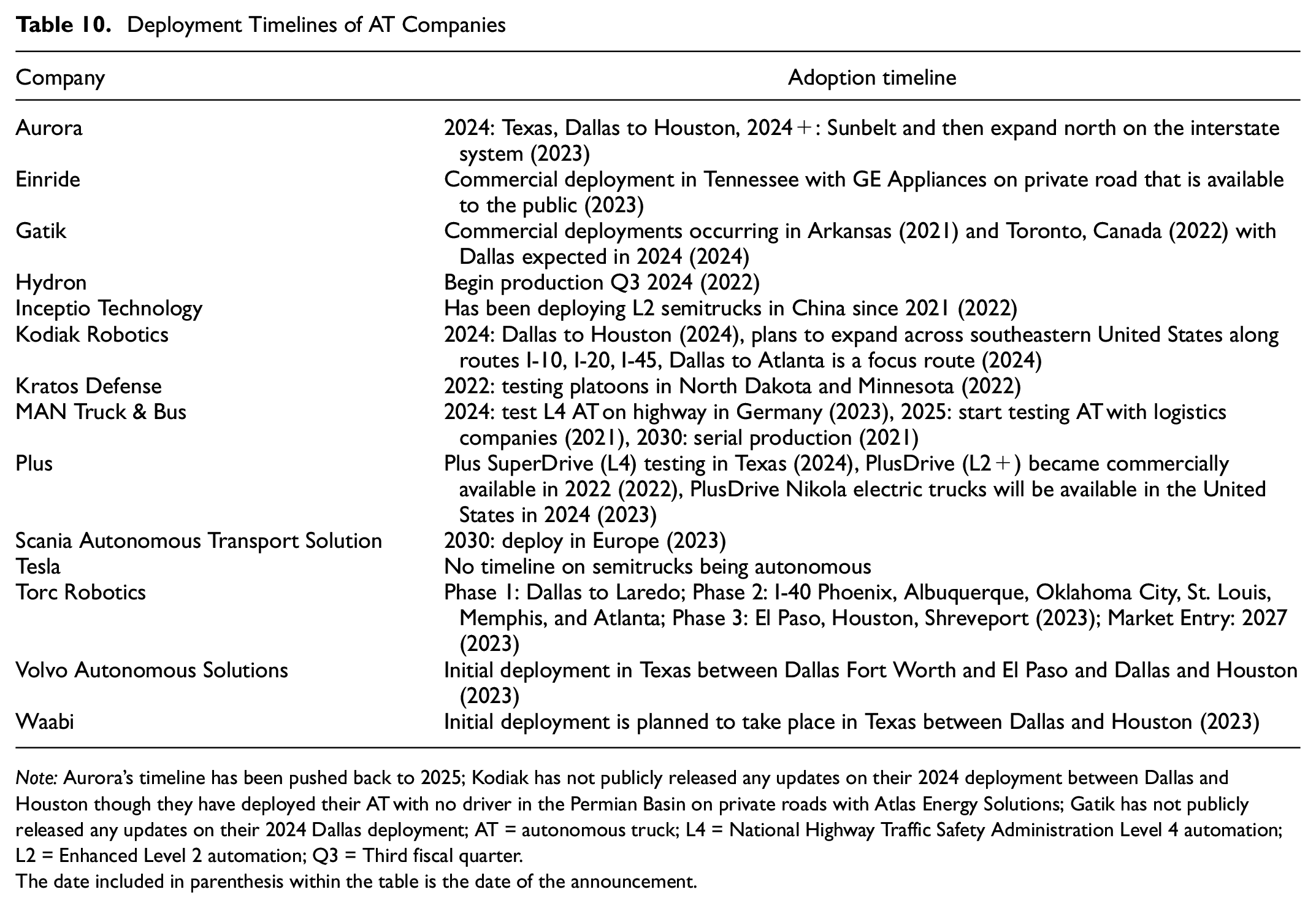
Note: Aurora’s timeline has been pushed back to 2025; Kodiak has not publicly released any updates on their 2024 deployment between Dallas and Houston though they have deployed their AT with no driver in the Permian Basin on private roads with Atlas Energy Solutions; Gatik has not publicly released any updates on their 2024 Dallas deployment; AT = autonomous truck; L4 = National Highway Traffic Safety Administration Level 4 automation; L2 = Enhanced Level 2 automation; Q3 = Third fiscal quarter.
The date included in parenthesis within the table is the date of the announcement.
Companies that have Ceased Operating
For companies that are no longer pursuing ATs in the United States, we see a similar trend in the deployment timelines and locations in their original plan (see Table 11). Embark was working on building a network of transfer points that ATs would have operated between including, Oakland, Los Angeles, Phoenix, El Paso, Dallas, San Antonio, Houston, Atlanta, and Jacksonville. This would have allowed AT coverage across the Sunbelt region. Its initial timeline was to begin deploying ATs across this network in 2024 and then expand to the rest of the United States ( 112 ). TuSimple had a similar vision. It planned to use ATs in Arizona between 2023 and 2026, the Texas Triangle (the area outlined by the major urban areas of Austin, Dallas–Fort Worth, Houston, and San Antonio) between 2027 and 2029, and the Sunbelt region after 2030 ( 113 ). The company saw this progression beginning slowly with about 10 ATs between 2023 and 2026 and then growing to 100 and then to thousands of trucks between 2027 and 2029, and finally to 10,000 trucks after 2030 ( 113 ). The ATs were to be initially be operated, maintained, and monitored by TuSimple with the goal of the logistics company taking it over in the future.
Deployment Timelines of Companies no Longer Pursuing ATs in the United States
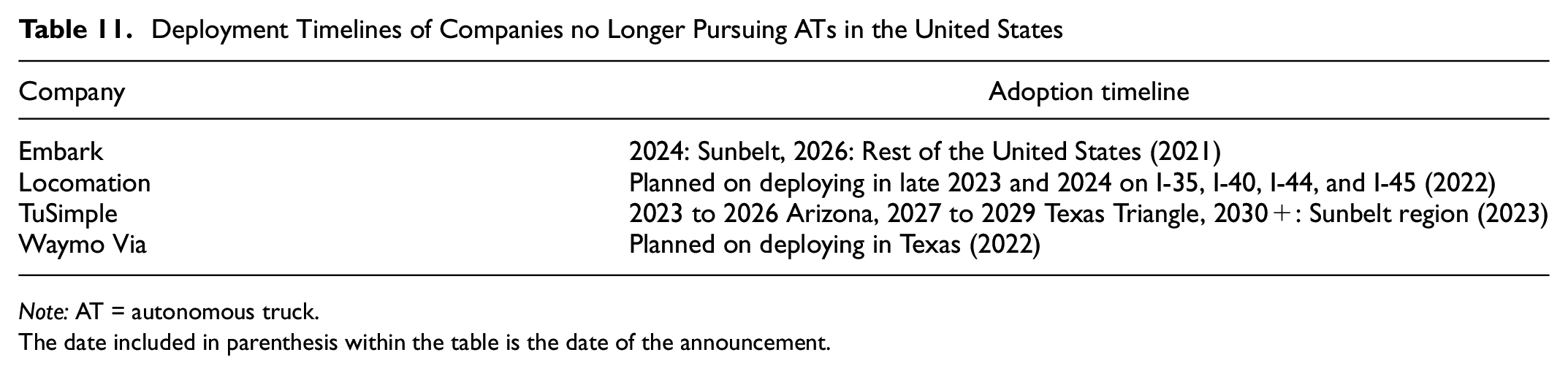
Note: AT = autonomous truck.
The date included in parenthesis within the table is the date of the announcement.
The adoption timeline of ATs will depend on when the technology can operate successfully under all the necessary driving conditions, and when they are proven safe to operate on public roads. Several companies are adopting a safety case to validate that their autonomous driving system is ready to operate on public roads. For example, Aurora’s safety case consists of five main categories: proficient, fail-safe, continuously improving, resilient, and trustworthy ( 114 ). The AT is proficient if it can operate safely during normal operations. It is fail-safe if it can handle faults and failures. It is continuously improving if all potential risks are evaluated and resolved. It is resilient if it can handle unavoidable events, and it is trustworthy if all conditions of the safety case have been met. Kodiak is using simulation and real-world data to validate that its AT system is safer than a human under diverse operating conditions ( 115 ). Many AT companies are performing voluntary safety self-assessments to demonstrate the processes they have in place to safely deploy ATs. Companies send their safety assessments to NHTSA: these are publicly available. Aurora, Ike, Kodiak, Mars Auto, Nuro, Plus, Pony.ai, Stack AV, Torc Robotics, TuSimple, Waabi, and Waymo Via all completed voluntary safety self-assessments ( 116 ). Locomation, Starsky Robotics, and Uber also completed voluntary safety self-assessments, but these are no longer available because the companies ceased operating.
Industry Partnerships
To deploy ATs on public roads, many stakeholders need to be involved. This ecosystem of stakeholders is developing within the United States so that ATs can be deployed at scale. AT companies are partnering with logistics companies, truck manufacturers, and other companies to assist with the operations of AT deployments; with technology companies for equipment; with research and academic institutions to conduct tests; and government agencies to deploy ATs on public roads. The majority of these partnerships were formed in 2020, 2021, and 2022. The logistics partnerships are being formed to see how ATs will work within the operations of a trucking company and to test real-world operating conditions. The manufacturing partnerships facilitate integration of the autonomous driving system into the systems of established truck manufacturers. In the United States, AT companies are not planning on manufacturing their own trucks. Truck manufacturers have well-established relationships with trucking companies which will bridge the gap for newer AT companies. Operations partnerships include all of the extra details needed to deploy ATs at scale: companies to help with maintenance, AT hub facility allocation, insurance, charging facilities, manufacturing for the mass production of sensors, telecommunication providers for 5G service, and companies building smart infrastructure. Technology partnerships assist with the equipment, data, and testing of ATs. Such partnerships include sensor companies, Tier 1 suppliers of auto parts, cloud service providers, and simulation providers. Government and academic partnerships are needed to safely deploy ATs on public roads and include state Departments of Transportation (DOTs) and highway patrol offices, universities, and research agencies. Many other partnerships will form as the industry evolves and matures.
Logistics Partnerships
AT companies have formed logistics partnerships with at least 71 companies in the transportation industry. These include for-hire, private carriers and public carriers, logistics companies, and shippers. For-hire companies account for 32% of the companies, and private carriers, 3PL companies, and shippers make up 25%, 25%, and 15%, respectively, as shown in Figure 5. Figure 6 illustrates the deployment locations for logistics partnerships. The United States is the predominant location where companies are planning to deploy ATs. Table 12 presents the logistics partnerships for the leading AT companies and the year the partnership was announced. Some of the partnerships may be extensions of former partnerships, so the year may not be reflective of the start of the partnership. For the partnerships included in the table, most developed relatively recently with 19, 40, and 20 partnerships formed in 2021, 2022, and 2023, respectively. This accounts for 86% of the partnerships. This list does not include partnerships that were formed by companies that were no longer involved with ATs in 2023: Ike, Otto, Peloton, Pronto, and Starsky Robotics. Whereas most of the logistics partnerships being formed are to test ATs on public roads, this is not the case for all of the partnerships. Some are to explore the integration of ATs into the operations of logistics companies, to identify the needs of the industry, and to explore how ATs can help solve problem areas. Other partnerships were formed to explore deployment strategies and to identify the best routes on which to deploy ATs. Finally, some of the partnerships are reservations to utilize ATs once they are ready for commercial use. Although there are varying degrees of involvement in the logistics partnerships listed, all the partners have an interest in adopting ATs. To show the interest in ATs from the industry, companies that have ceased operations are included in Table 12. The gray highlighting in the table represents AT companies that have ceased operations (dark gray) or transitioned to a new market (light gray). None of the companies highlighted in light gray are now involved with ATs, except TuSimple, which shifted focus from the United States to international markets.
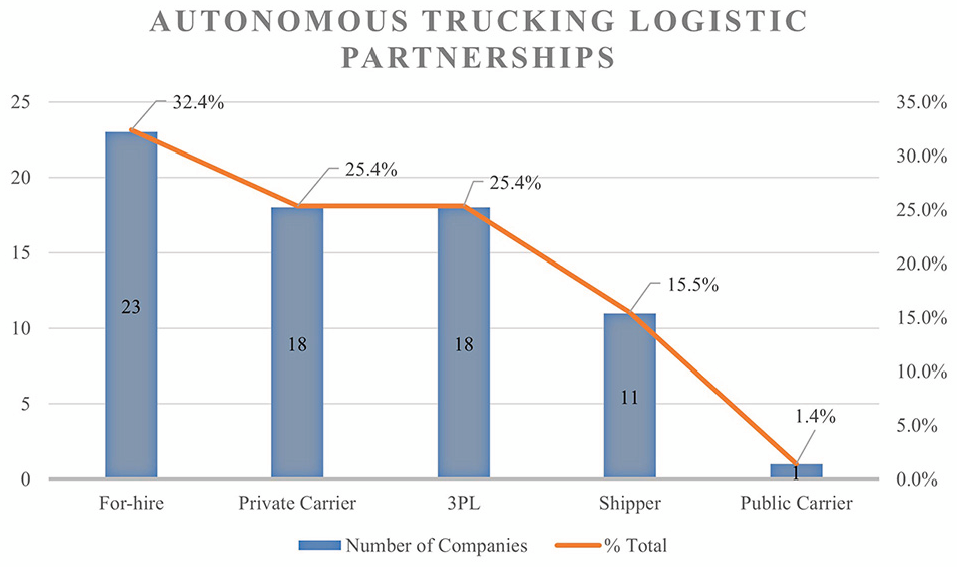
Autonomous truck (AT) logistics partnerships by type of company.
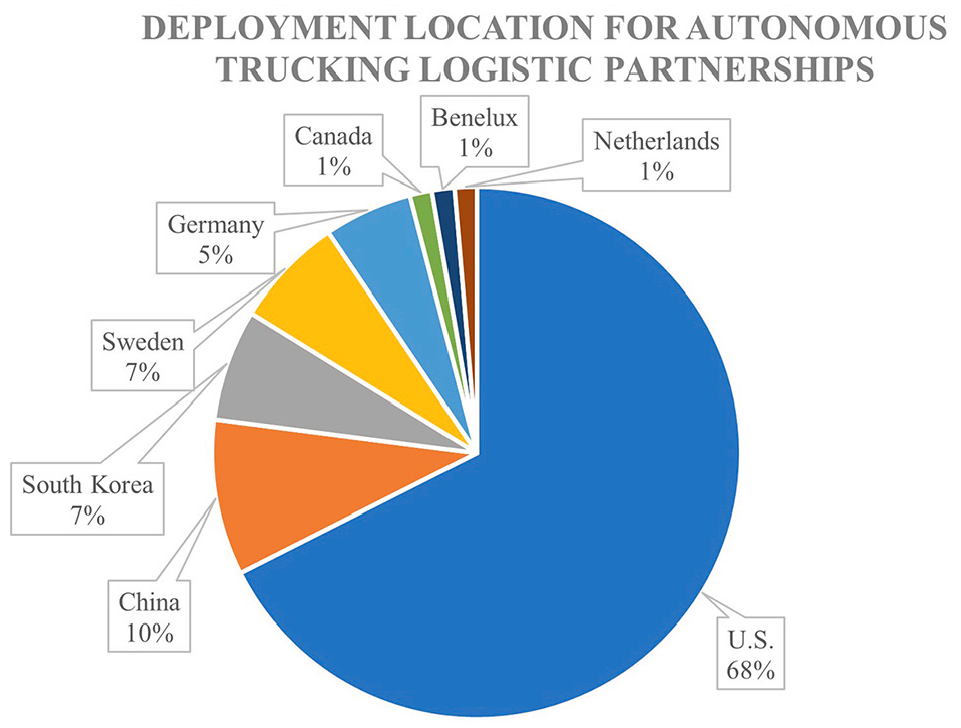
Deployment location for autonomous trucking logistics partnerships.
Logistics Partnerships
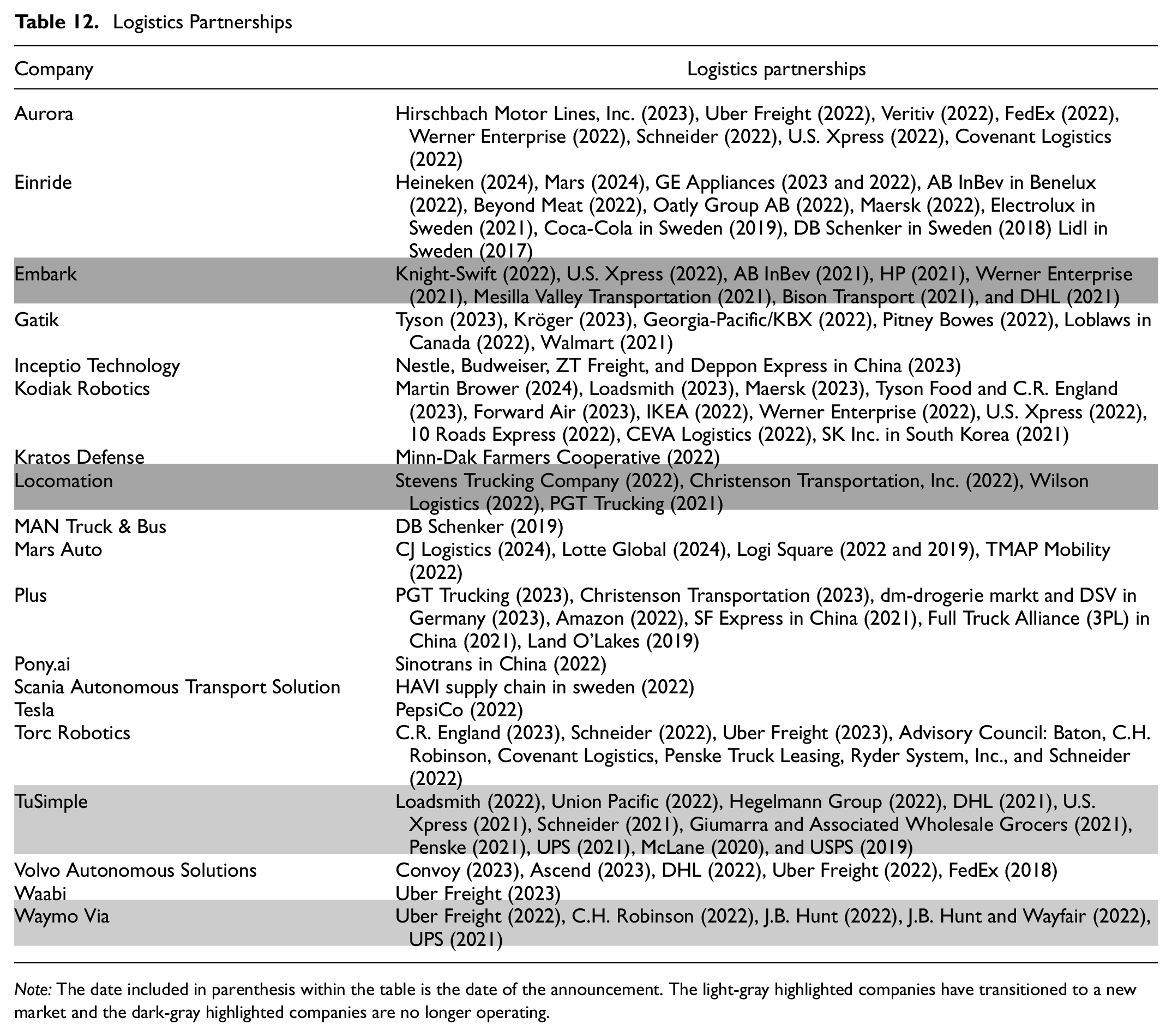
Note: The date included in parenthesis within the table is the date of the announcement. The light-gray highlighted companies have transitioned to a new market and the dark-gray highlighted companies are no longer operating.
Third-Party Logistics Companies
AT companies have partnered with 18 different 3PL companies. These partnerships are planned to take place in the United States, China, Sweden, South Korea, and Germany. The United States is the main deployment location with 39% of the companies planning on deploying ATs there, 22% are in China and South Korea, and the remaining 17% are in Europe. The logistics companies involved have services for freight brokerage, dry-storage warehousing, ocean freight, airfreight, and dedicated services. According to Transport Topics 2023 rankings, the logistics companies are some of the largest in the industry including the largest freight brokerage company, C.H. Robinson, and the largest dry-storage warehouse provider, DHL ( 117 ). Newer 3PL companies, Uber Freight, Convoy, and Loadsmith, are also testing ATs. In Loadsmith’s case, the company plans to build a freight network to utilize ATs ( 118 ). ATs may offer an easier access point for traditional 3PL companies that just connect shippers and carriers, to begin to offer their own AT capacity. This is seen in the partnerships that C.H. Robinson and Uber Freight have been forming with AT companies. C.H. Robinson and Uber Freight are traditional 3PL companies that do not own trucks but instead offer a service to help connect carriers and shippers. C.H. Robinson is exploring the possibility of how ATs could be utilized on its network, and Uber Freight is working with AT companies to evaluate deployment strategies ( 119 , 120 ). In both cases, 3PL networks could turn into AT networks that are set up for the deployment of ATs. Table 13 contains all of the 3PL partnerships formed and their Transport Topics 2023 ranking.
Third-Party Logistics Companies Partnerships with AT Companies
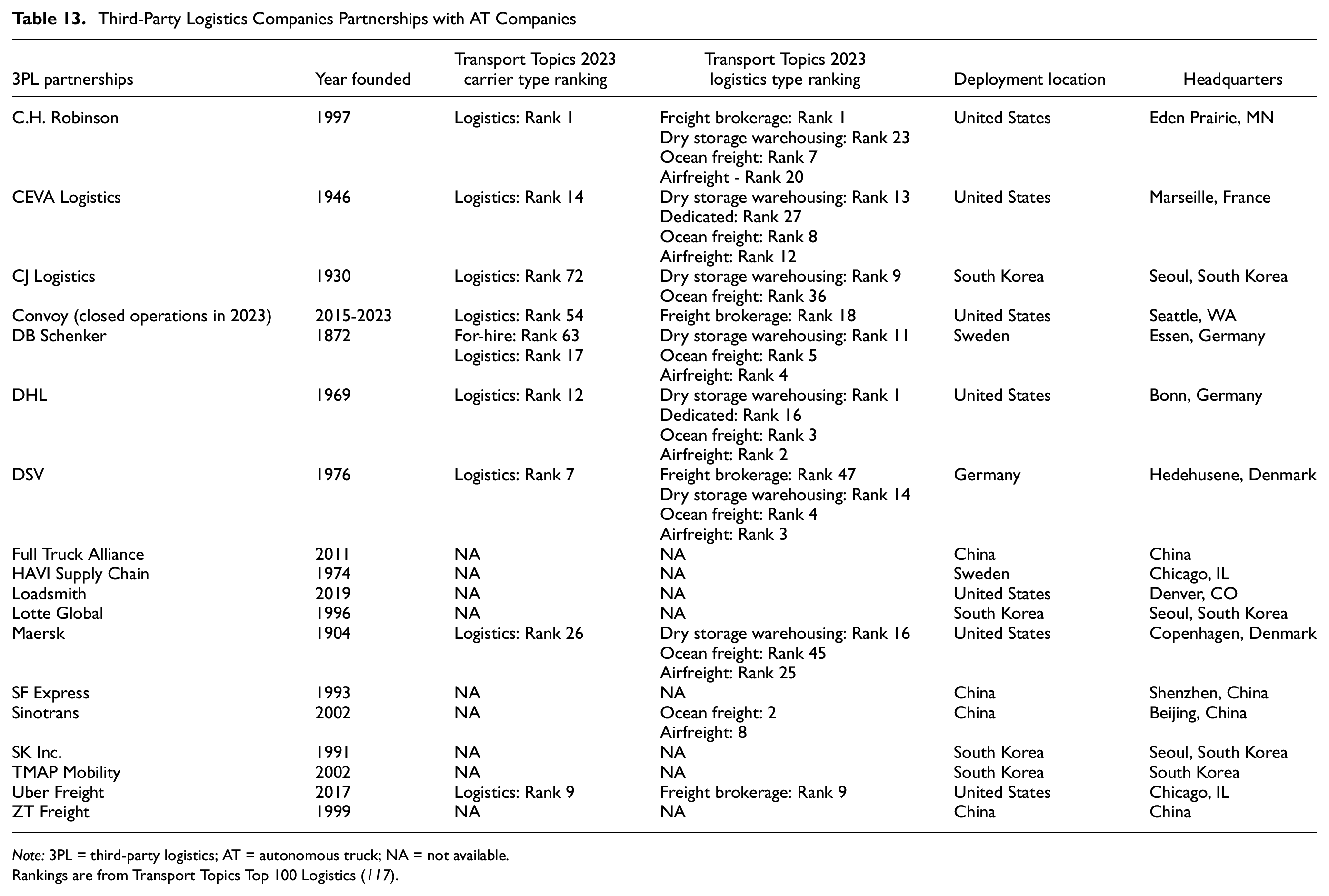
Note: 3PL = third-party logistics; AT = autonomous truck; NA = not available.
Rankings are from Transport Topics Top 100 Logistics ( 117 ).
Uber Freight, Maersk, DHL, C.H. Robinson, and CEVA Logistics have all announced they plan to pilot ATs on public roads in the United States. Uber Freight is hauling freight in Texas between Fort Worth and El Paso with Aurora, and between Dallas and Houston with Waabi ( 103 , 121 ). With Aurora, Uber Freight’s customer Veritiv was chosen for the pilot to test ATs during the peak holiday season for shipping. The other partnerships are with Torc Robotics, Volvo Autonomous Solutions, and Waymo Via. Torc Robotics is using Uber Freight’s data and insights to analyze shipper volumes, and their network to plan deployment strategies for routes and hubs for ATs ( 122 ). The Volvo and Waymo partnerships were formed to integrate their autonomous driving system with Uber Freight’s network ( 120 , 123 ). Waymo plans to own the ATs initially and then eventually the customer would purchase the ATs, pay a driver-as-a-service fee, and then have the option to deploy them on the Uber Freight network. Maersk formed a partnership with Kodiak to test ATs between Houston, TX, and Oklahoma City, OK ( 124 ). Maersk views ATs as a competitive advantage that will create a sustainable solution for their customers. They joined Kodiak’s partner development program to explore other routes that may be a good fit for ATs. Another partnership with Kodiak is CEVA Logistics, who are testing ATs between Dallas–Fort Worth and Austin, TX, and Dallas–Fort Worth and Oklahoma City, OK ( 125 ). CEVA Logistics is searching for ways to improve their customers’ supply chain operations and considers ATs to be a possible solution. DHL formed partnerships with Embark, TuSimple, and Volvo. Embark had a partnerships development program like Kodiak to help facilitate the adoption of ATs. The goal of the program was to operationalize ATs by seeing how they would fit within commercial operations, finding the routes that would be best suited to ATs, and planning deployment strategies for hub locations. DHL joined the partnerships development program with Embark and piloted ATs from Southern California, CA, to Phoenix, AZ ( 126 , 127 ). The partnership with TuSimple was to haul freight between San Antonio and Dallas, and with Volvo the focus was to test out the hub-to-hub model ( 128 ). C.H. Robinson had a partnership with Waymo Via to explore the possibilities of utilizing ATs in supply chains ( 119 ). This involved initially piloting ATs between Dallas and Houston. Waymo Via was planning on using C.H. Robinson’s size, scale, platform, and customer relationships to facilitate pilot opportunities and to scale up the deployment of ATs.
For-Hire Carriers
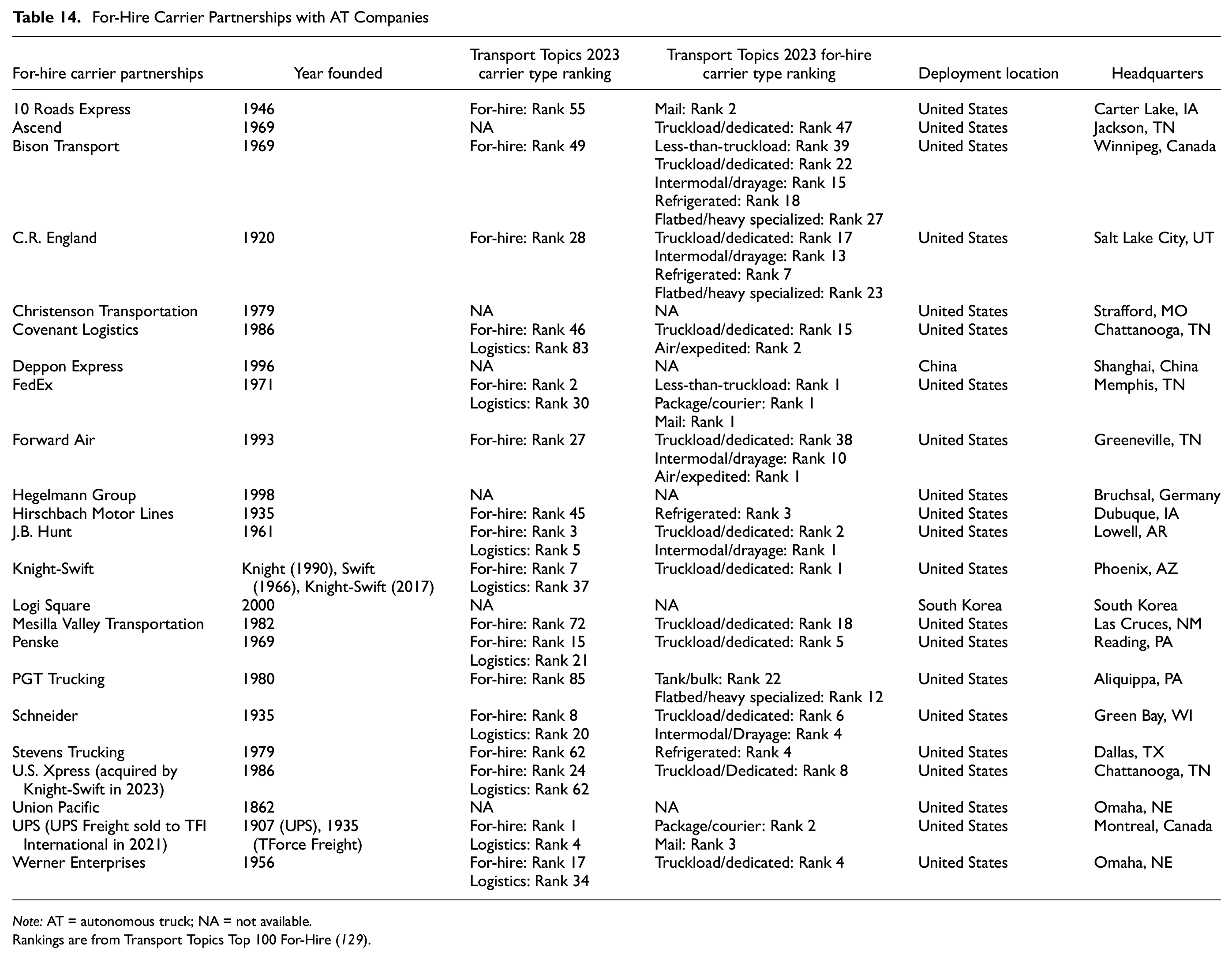
For-hire carriers represent the largest segment of companies that are testing ATs. There are 23 for-hire companies that have an interest in utilizing ATs and 21 of the companies are planning to deploy ATs in the United States. Two of the companies, Deppon Express and Logi Square, are based in China and South Korea, respectively. The for-hire carriers include mail, less-than-truckload, truckload, dedicated, intermodal/drayage, refrigerated, flatbed/heavy specialized, package/courier, air/expedited, and tank/bulk carriers. Some of the for-hire companies offer logistic services to customers although they also own their own trucks. For instance, J.B. Hunt and UPS are the fifth- and fourth-largest logistic providers in the United States. Although there are several types of trucking companies testing ATs, truckload is the predominant type, accounting for 35% of the for-hire carriers. According to Transport Topics 2023 rankings, the top three for-hire carriers, UPS, FedEx, and J.B. Hunt, have been involved with AT tests ( 129 ). Three companies not included in the top 100 for-hire carriers, Ascend, Christenson Transportation, and Hegelmann Group, are also interested in using ATs or platoons. Hegelmann has mainly focused on the European market and only recently started expanding into North America. Although Ascend is not in the top 100 for-hire carriers, they are the 47th largest truckload/dedicated carrier. The other smaller for-hire carriers that are interested in using ATs or platoons are Mesilla Valley Transportation and PGT Trucking. Also, one Class I railroad, Union Pacific (UP), has been involved with ATs. UP was planning on using TuSimple’s ATs to help move freight in Arizona from Tucson to Phoenix. TuSimple is now focusing on the Asia market, so this deployment route is no longer being pursued. ATs still offer the opportunity to help improve the last-mile over-the-road movement of rail freight and will likely be implemented in the future. Table 14 contains all of the for-hire carrier partnerships formed and their Transport Topic 2023 ranking.
For-Hire Carrier Partnerships with AT Companies
Note: AT = autonomous truck; NA = not available.
Rankings are from Transport Topics Top 100 For-Hire ( 129 ).
Hirschbach Motor Lines, FedEx, Werner Enterprise, Schneider, C.R. England, Forward Air, U.S. Xpress, 10 Roads Express, UP, UPS, and J.B. Hunt have all announced plans to pilot ATs on public roads in the United States. Most of these pilots are planned to take place in Texas between Dallas and Houston, Fort Worth and El Paso, and Dallas and San Antonio. Other pilots are taking place between Dallas and Atlanta, Tucson and Phoenix, Dallas and Lake City, Florida, and a roundtrip between San Antonio, San Francisco, and Jacksonville. Hirschbach Motor Lines, FedEx, Werner, and Schneider are partnering with Aurora to test ATs in Texas ( 130 – 133 ). Werner views ATs as a source of supplemental capacity to help meet the rising demand for truck freight movement. The company is piloting ATs on a subset route of their busiest route between Atlanta and Los Angeles. This is a common theme seen across multiple for-hire carriers. They view ATs as a scalable solution on certain routes that will help them balance their network. This hybrid model allows them to utilize drivers in a more structured way on routes that may be more desirable to drivers. C.R. England, Forward Air, Werner Enterprise, U.S. Xpress, and 10 Roads Express are partnering with Kodiak to test ATs in Texas and between Texas and Georgia ( 134 – 138 ). U.S. Xpress is piloting the Dallas to Atlanta route, which they see as a good route for ATs because it is too long for a same day return trip and not economical for a sleeper team. 10 Roads Xpress piloted Kodiak’s ATs on a roundtrip route between San Antonio, San Francisco, and Jacksonville. A route that is this extensive and that covers a wide geographical span is less common. Most companies are piloting specific routes that are within the same state or that span states in the same geographical area. C.R. England and Schneider have partnered with Torc Robotics to see how ATs can fit within their operations and to pilot ATs ( 139 , 140 ). Torc Robotics also has an advisory council of companies in the industry to help guide the development of their AT system. The advisory council includes Baton, C.H. Robinson, Covenant Logistics, Penske Truck Leasing, Ryder System, Inc., and Schneider ( 141 ). Kodiak and Aurora have also formed an industry advisory council to help scale ATs. Kodiak has members from logistics companies, Werner, UPS, Walmart, and Loadsmith, and Kodiak has former executives from Swift and Paper Transport ( 142 , 143 ). UPS has partnered with TuSimple and Waymo Via to test ATs for their air freight division ( 144 , 145 ). Waymo Via also partnered with J.B. Hunt to test ATs in Texas. One of the pilots hauled freight for a customer of J.B. Hunt, Wayfair ( 146 ). TuSimple performed a fully driverless test between Tucson and Phoenix with UP ( 147 ). All of the other pilots with logistics companies have been performed with a safety driver in the AT.
Private Carriers
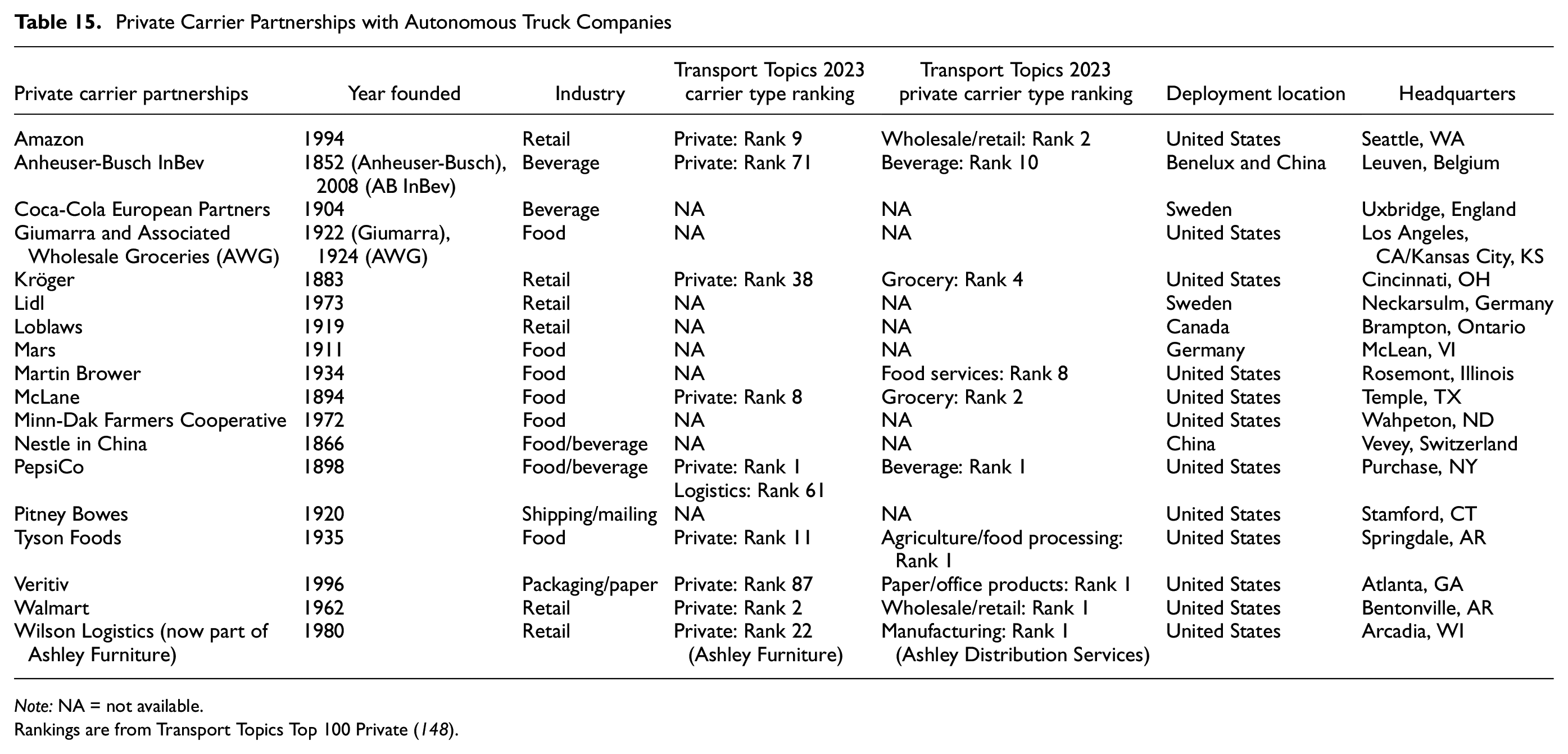
Eighteen different private carriers are interested in utilizing ATs. Deployment locations include Benelux (i.e., Belgium, Netherlands, Luxemburg), China, Canada, Germany, Sweden, and the United States. Retail, food, and beverage companies are the most common, accounting for 89% of the private carriers. The only two companies not included in these industries are Veritiv and Pitney Bowes. The private carriers are some of the largest in their industry according to Transport Topics 2023 rankings ( 148 ). Walmart is the largest retailer. PepsiCo is the largest beverage company. Tyson is the largest food processing company. Veritiv is the largest paper/office provider and Ashely is the largest manufacturing company. Note that PepsiCo is listed because it ordered Tesla’s electric semitruck ( 80 ). Tesla’s electric semitrucks are not autonomous, although they could be if Tesla achieves Level 4 automation with its autopilot. This is also the case with some of the partnerships that Einride has formed. For instance, Lidl is planning to use Einride’s manually driven electric trucks ( 149 ). Other companies partnering with Einride, like Coca-Cola, are planning on using Einride electric ATs ( 150 ). Table 15 contains all of the private carrier partnerships formed and the Transport Topic 2023 ranking.
Private Carrier Partnerships with Autonomous Truck Companies
Note: NA = not available.Rankings are from Transport Topics Top 100 Private ( 148 ).
Kröger, Pitney Bowes, Loblaws, Martin Brower, Walmart, and Giumarra have announced plans to pilot ATs, and Minn-Dak Farmers Cooperative is piloting platoons on public roads in the United States. Most of the pilots are taking place with Gatik utilizing box trucks for regional deliveries. Kröger and Pitney Bowes are piloting ATs in Dallas, which is the next location Gatik plans to deploy fully autonomous box trucks ( 151 , 152 ). Loblaws and Walmart are already utilizing fully autonomous box trucks in Toronto and Bentonville, AR ( 109 , 110 ). Another food service company, Martin Bower, has partnered with Kodiak to test ATs between Dallas and Oklahoma City ( 153 ). Minn-Dak Farmers Cooperative is testing two-truck platoons in North Dakota. Minn-Dak sees platoons as a way to help meet demand during peak harvest season when demand exceeds driver availability ( 65 ). Giumarra performed an AT pilot from Nogales, AZ, to Oklahoma City hauling products for Associated Wholesale Grocers ( 154 ). Giumarra believes ATs may help supply food to rural communities and food deserts in the United States.
Shippers
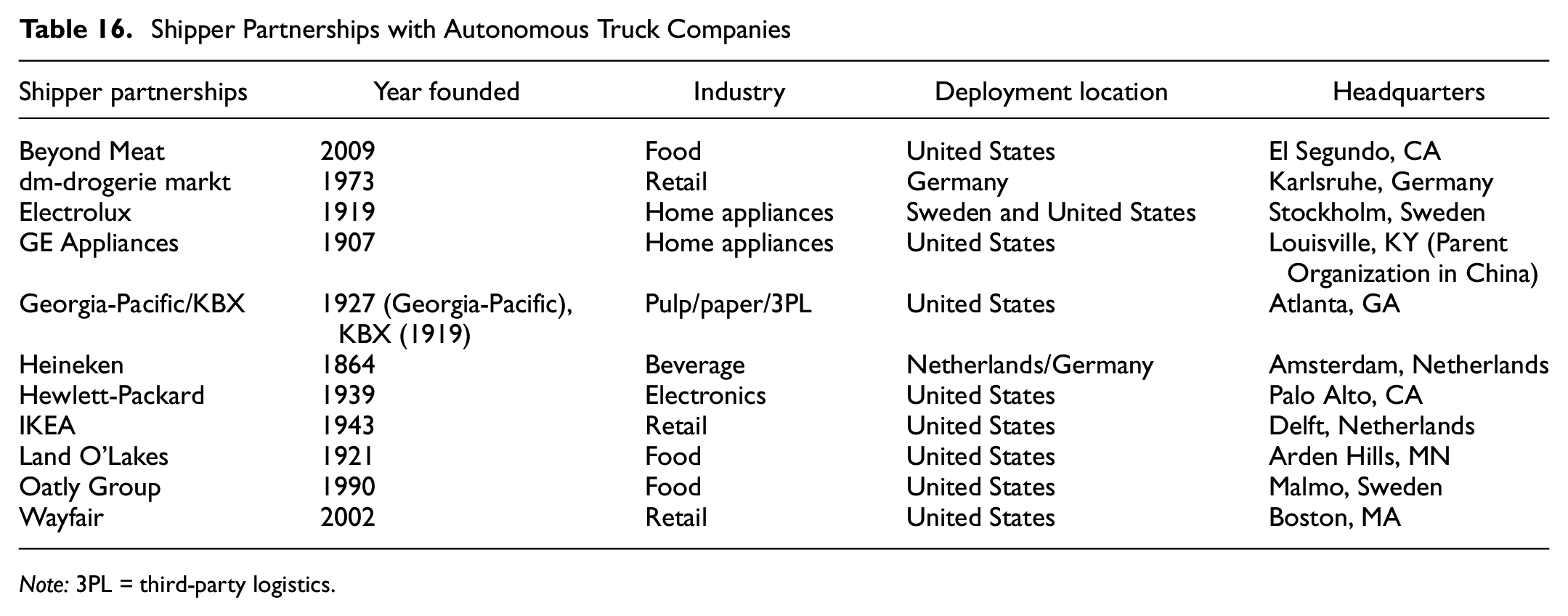
The companies listed as shippers do not have their own network of trucks, but rely on other carriers to move their freight. The shippers that have expressed interest in ATs include food companies, appliance and home goods companies, electronic companies, and retail companies. Partnerships are taking place in the United States, Germany, Sweden, and the Netherlands. Some of the partnerships are focused on electrification. Beyond Meat, Oatly Group, and Heineken are planning to utilize Einride’s manual electric trucks. Einride is working on developing a Level 4 autonomous electric truck and electric trucks that are manually driven. The rest of the partnerships are focused on Level 4 ATs except dm-drogerie markt who is working with Plus on a highly automated system at Level 2+ automation. Table 16 contains all of the shipper partnerships formed and their Transport Topic 2023 ranking.
Shipper Partnerships with Autonomous Truck Companies
Note: 3PL = third-party logistics.
HP, Tyson, Georgia-Pacific, and IKEA have announced plans to pilot ATs and Land O’Lakes has piloted advanced driver assistance systems on public roads in the United States. HP partnered with Embark to haul printers between Los Angeles and Phoenix utilizing Embark’s ATs ( 155 ). Tyson and Georgia-Pacific partnered with Gatik to utilize autonomous box trucks in Springdale, AR, and Dallas–Fort Worth ( 156 , 157 ). Tyson is testing the use of box trucks to make more frequent trips instead of using Class 8 semitrucks. Georgia-Pacific is working with KBX, a sister company, to use autonomous box trucks to make deliveries from its locations to Sam’s Club locations. IKEA has partnered with Kodiak to test ATs between Dallas and Houston. IKEA is looking for ways to improve safety and working conditions for drivers on long trips ( 158 ). Land O’Lakes performed a pilot with Plus using its Level 2+ advanced driver assistance system from Tulare, CA, to Quakertown, PA ( 159 ). Land O’Lakes see autonomous systems as a way to help meet peak demand in the future.
Manufacturing Partnerships
All major U.S. truck manufacturers have been involved with ATs. The partnerships that AT companies have formed with truck manufacturers are presented in Table 17. The current market of U.S. truck manufacturers is as follows: 37.5% for Freightliner, 15% for Peterbilt, 14.5% for International, 14.3% for Kenworth, 9.4% for Volvo, 7.0% for Mack, and 2.3% for Western Star ( 160 ). Daimler owns Freightliner and Western Star; Volvo Group owns Volvo and Mack; PACCAR owns Peterbilt and Kenworth; and TRATON owns Navistar, which owns International. Aurora has formed a partnership with PACCAR and Volvo ( 161 , 162 ). Daimler has purchased a majority stake in Torc Robotics and has partnered with Waymo Via to make a Class 8 semitruck that will work with an autonomous driving system ( 163 ). Although the partnership is now ended, Navistar worked with TuSimple to utilize its self-driving technology on their International Class 8 semitrucks ( 164 ). TRATON has partnered with Plus to utilize its Level 4 AT technology with Navistar, MAN, and Scania ( 61 ). Plus has also partnered with IVECO in Europe, Nikola in the United States, and FAW in China for its L2+ AT technology ( 107 , 165 , 166 ). Plus is working with Nikola to incorporate its system into Nikola’s Class 8 electric semitruck. The Plus-enabled vehicles are planned to be commercially available in late 2024 and PGT Trucking and Christenson Transportation will pilot them in late 2023 ( 107 ). In China, Inceptio Technology is working with DFCV and Sinotruk, and Pony.ai is working with SANY ( 68 , 167 ). In South Korea, Hyundai performed a Level 3 AT pilot in 2018 ( 168 ). It is clear that truck manufacturers are very interested in playing a major role in the adoption of ATs. Partnerships with truck manufacturers are essential for developing an autonomous-ready truck that has redundant systems in place to handle failures that may occur. In 2021, Daimler announced they had created an AT platform with backup systems for steering, braking, a low-voltage power network, and a communication network ( 169 ). However, not all AT companies have formed partnerships with truck manufacturers: Embark decided not to form any such partnership. Instead, Embark created a universal interface that would allow its self-driving system to be compatible with any truck manufacturer. They saw the self-driving system as an add-on option that the customer could choose once they had bought the truck. Kodiak is another AT company that has not formed a partnership with a truck manufacturer.
Manufacturing Partnerships with Autonomous Truck Companies
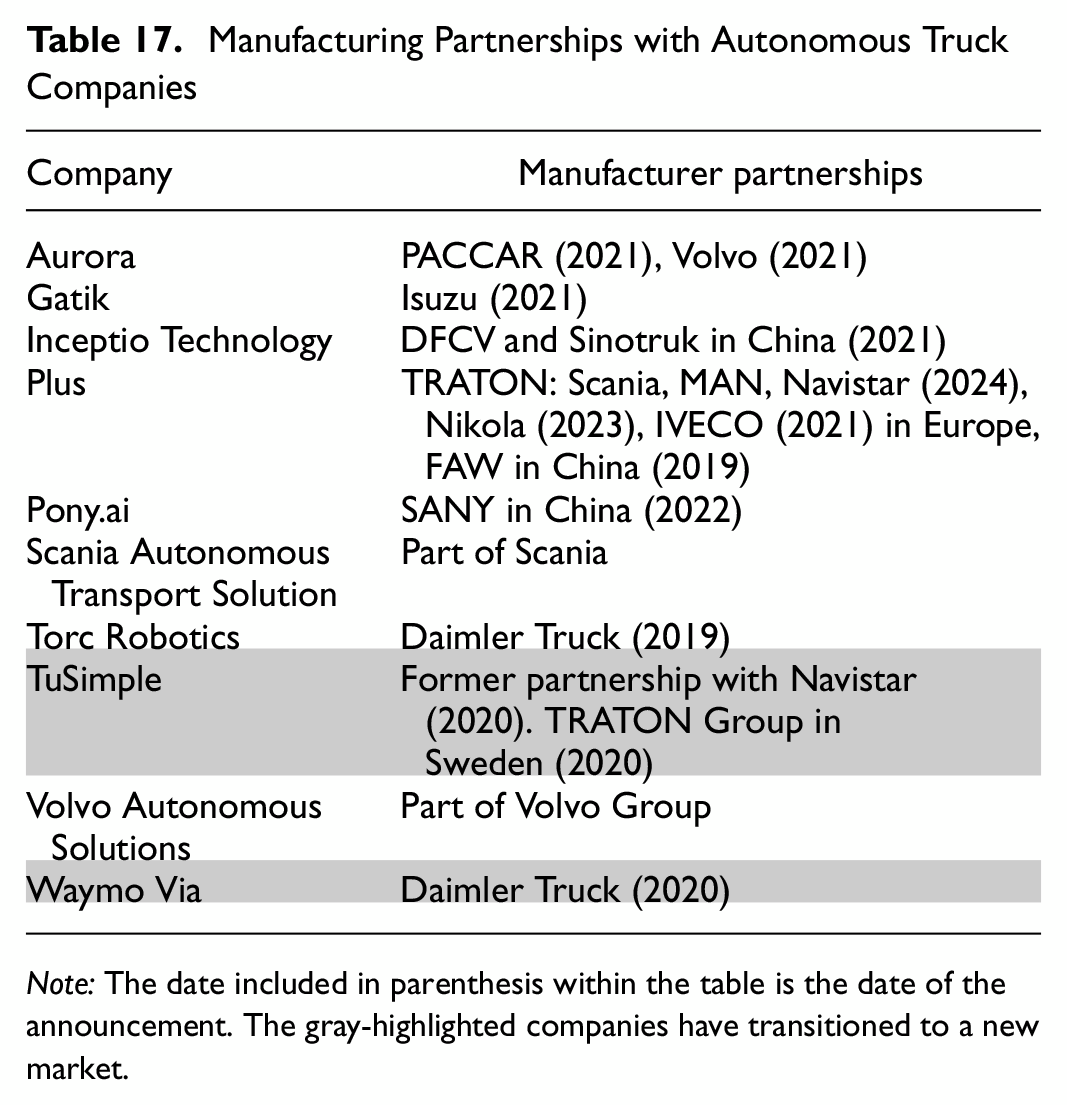
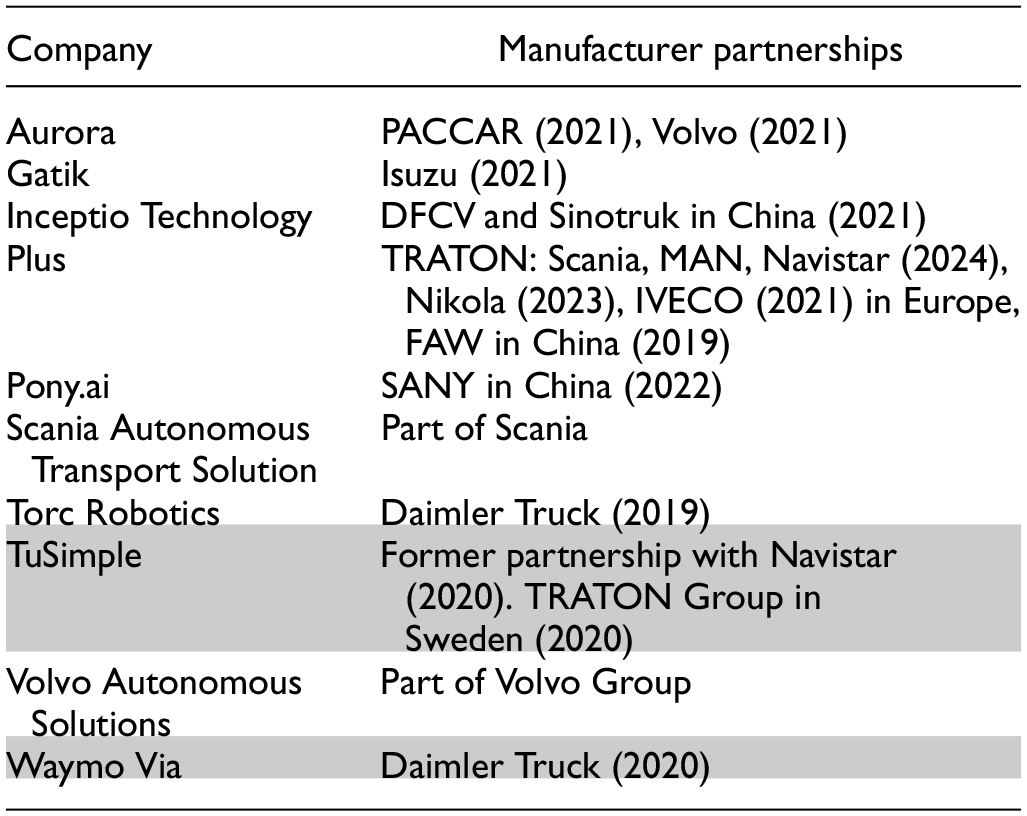
Note: The date included in parenthesis within the table is the date of the announcement. The gray-highlighted companies have transitioned to a new market.
Operations Partnerships
An ecosystem of companies has started to emerge as the industry prepares to deploy ATs in the United States. For instance, ATs may require more maintenance and more frequent inspections because of their increased utilization. They will also need roadside assistance if there is an equipment malfunction. AT companies have partnered with Ryder, Penske, Rush Enterprises, and Werner to help provide the maintenance and roadside assistance for ATs. Site selection for hub locations is another area that is rapidly evolving. Property groups such as Alterra and Hillwood are helping AT companies establish hub locations for ATs. Existing facilities may also be used for hub locations. Pilot, in partnership with Kodiak, opened an autonomous-ready truck terminal in Villa Rica, GA, just west of Atlanta ( 170 ). This terminal is set up to handle light maintenance and inspections. Kodiak also worked with Ryder to set up a terminal in Houston at an existing Ryder fleet maintenance facility ( 171 ). Although existing facilities can be used, they do need to be updated to be able to handle ATs. For instance, Aurora has developed an autonomous-ready terminal in Palmer, TX, just south of Dallas. This terminal is set up to handle the maintenance and inspection of ATs, offload data, and provide launching and landing zones as well as fuel and weight stations ( 172 ). Waymo Via built a new AT-ready facility in Lancaster, TX, just south of Dallas ( 173 ). This facility included diesel fuel bays, electric charging bays, and maintenance shops. TuSimple and Hillwood were planning to build an autonomous-ready hub in the AllianceTexas, Mobility Innovation Zone, which is north of Fort Worth ( 174 ). With TuSimple ceasing U.S. operations, this facility may be developed with another company.
In addition to maintenance and hub locations, many more partnerships are being formed to deploy ATs. These include partnerships for insurance, 5G service, charging facilities, smart infrastructure, and remote monitoring. For insurance, Locomation partnered with Aon, and TuSimple partnered with Liberty Mutual Insurance ( 175 , 176 ). During the beginning stages of AT deployment there is a higher risk given the uncertainty of an accident occurring. There will likely be new insurance policies created to manage the risks and safety benefits of ATs as they become more widely adopted. Plus partnered with Velocity to help retrofit current semitrucks with their Level 2+ driving system and to provide maintenance ( 177 ). For 5G service, Einride in Sweden is working with Ericsson and Telia to install 5G connectivity for AT pilots ( 178 ). For charging facilities for electric trucks, Gatik is working with ChargePoint to help build a charging infrastructure for its autonomous box trucks ( 179 ). The electrification and automation of trucks are two separate challenges and companies are generally pursuing automation first and then electrification. All of the major manufacturers have commercially available Class 8 electric semitrucks except Navistar, which plans to introduce one in the near future ( 180 ). Kodiak plans on incorporating a Peterbilt electric truck with its autonomous driving technology in 2024 ( 181 ). For smart infrastructure, Plus is partnering with Transurban to test ATs on smart road infrastructure in Australia ( 182 ). Transurban has also worked with Virginia Department of Transportation and the Virginia Tech Transportation Institute to test connected AVs and road infrastructure ( 183 ). Several AT companies are working to provide a solution that will easily integrate into truck carriers’ current operations. One aspect of this is creating a dispatching, remote monitoring, and management system that controls the AT. Many AT companies are working on building their own software solution that manages ATs. For instance, Torc Robotics has a product they call Mission Control and Aurora has Aurora Beacon to handle the management of ATs in a network ( 184 , 185 ). MAN Truck & Bus is working with Fernride to provide a solution to remotely monitor ATs ( 186 ). This remote monitor qualifies as a technical supervisor, which meets the qualifications to deploy Level 4 ATs in Germany according to that country’s most recent law on ATs ( 187 ). All operations partnerships that AT companies have formed are listed Table 18.
Operations Partnerships with Autonomous Truck Companies
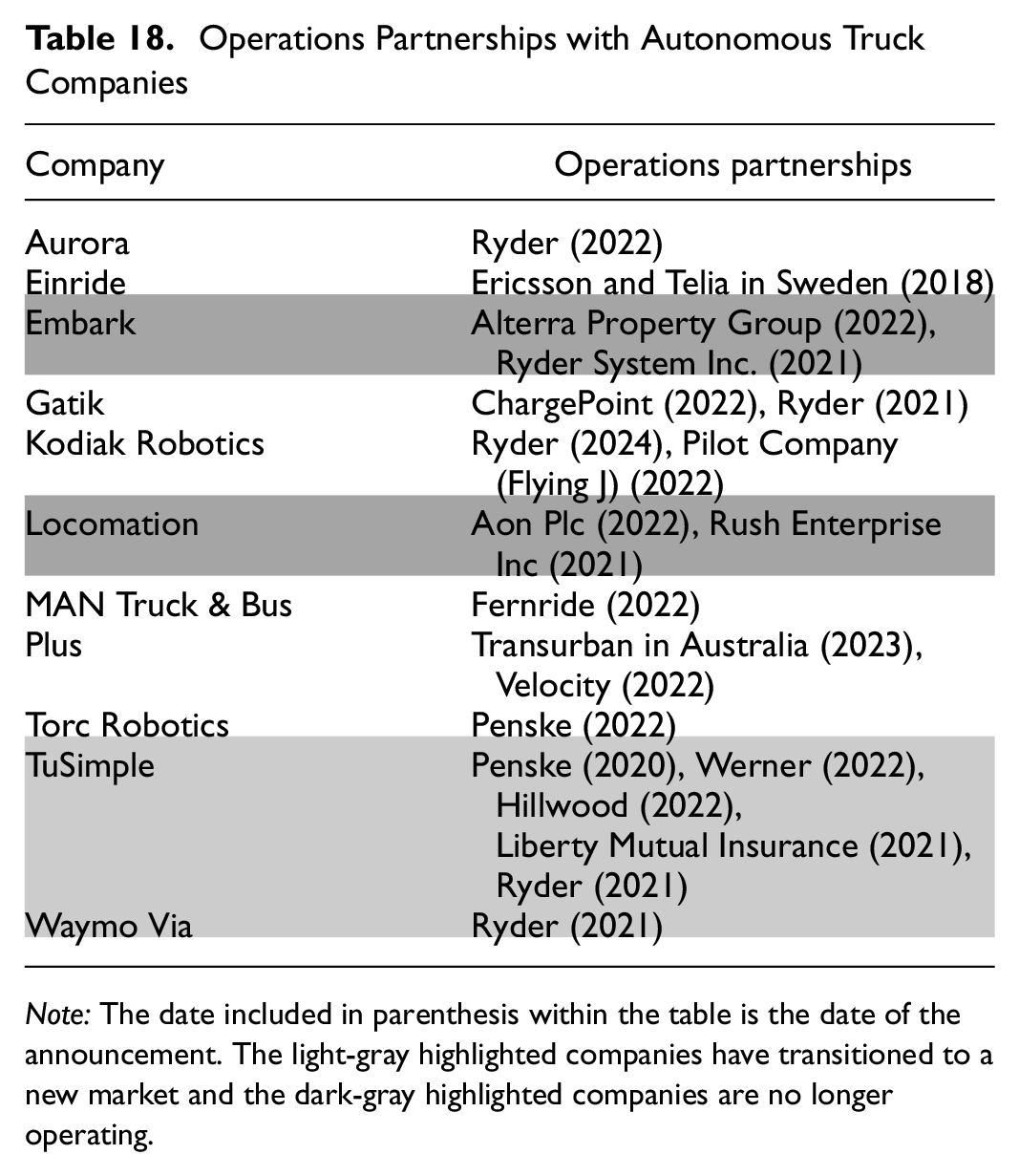
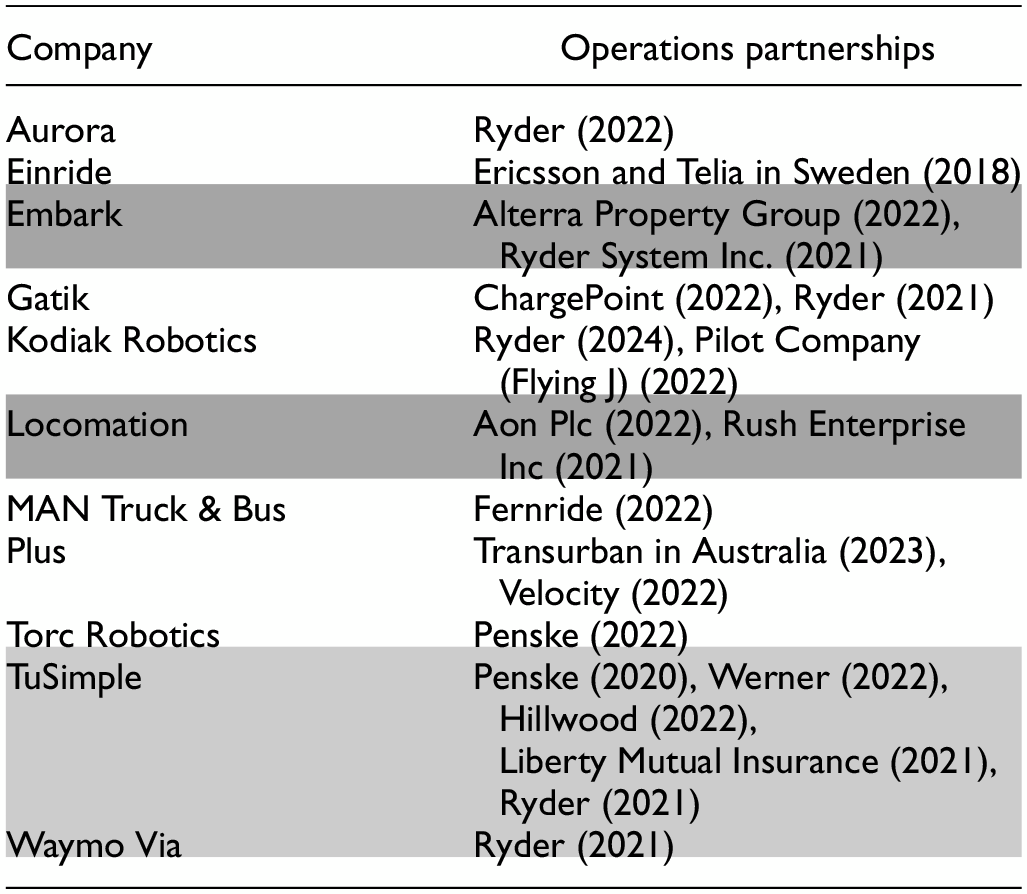
Note: The date included in parenthesis within the table is the date of the announcement. The light-gray highlighted companies have transitioned to a new market and the dark-gray highlighted companies are no longer operating.
Technology Partnerships
AT companies are taking different approaches in relation to hardware sensors. For instance, Aurora is developing all of its hardware including cameras, lidar, radar, and computing systems ( 188 ). Kodiak is taking a different approach by partnering with ZF for radar, Hesai and Luminar for Lidar, Ambarella for camera data processing, NVIDIA Drive Orin for chips for data processing, and Applied Intuition for simulation testing ( 115 , 189 , 190 ). Mars Auto is building ATs just using cameras to decrease the cost of adoption ( 191 ). They are working with SK Telecom to improve the machine learning algorithms that process the data ( 192 ). AT companies are developing other partnerships with Continental, Goodyear, Cummins, ZF, Bosch, Aeva, Ouster, TeleDyne FLIR, AWS, One Stop Systems, Algolux, Blackberry QNX, and SK Telecom. Aurora has partnered with Continental for the mass production of their autonomous driving system ( 193 ). Continental is going to manufacture and assemble the pods that contain the sensors and hardware components necessary for autonomous systems, and will supply them to Aurora’s truck manufacturer partners. Continental is going to handle the full lifecycle of the pods from production to service to decommission. Other part manufacturing companies involved with ATs include Goodyear, Cummins, Bosch, and ZF, which are helping to integrate autonomous driving systems with truck components. Goodyear is providing its smart tires to AT companies to help provide extra data input. Cummins is working with AT companies to see how autonomous systems integrate with powertrain systems. ZF and Bosch are also partnering with AT companies to test steering systems with autonomous driving systems. Aeva, Ouster, and TeleDyne FLIR are helping provide additional hardware sensors. Aeva has four-dimensional lidar technology that provides continuous instead of pulsed lasers to detect objects. Ouster provides 3D lidar sensors and TeleDyne provides thermal cameras. Thermal cameras can be used as an extra data input that may help with low visibility conditions. AWS, One Stop Systems, Blackberry QNX, and Algolux are helping provide software and data computing solutions. AWS is being used for its cloud data service to handle all of the data needed for autonomous driving systems. One Stop System provides edge computing modules to help process data onsite. Blackberry QNX is an operating system that can be used for autonomous driving systems. Algolux is a machine learning and computer visions company that was acquired by Torc Robotics. All technology partnerships that AT companies have formed are listed in Table 19.
Technology Partnerships with Autonomous Truck Companies
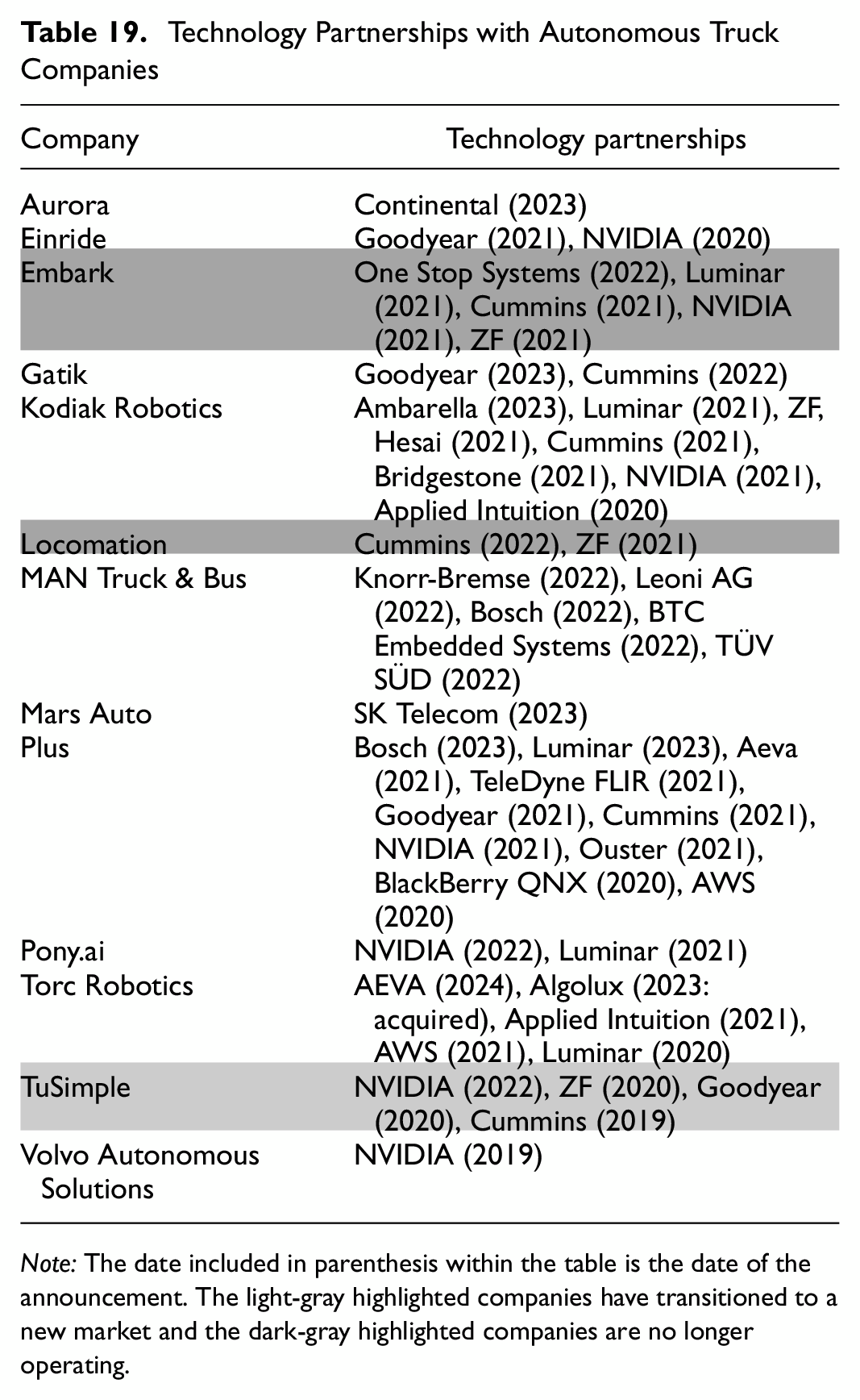
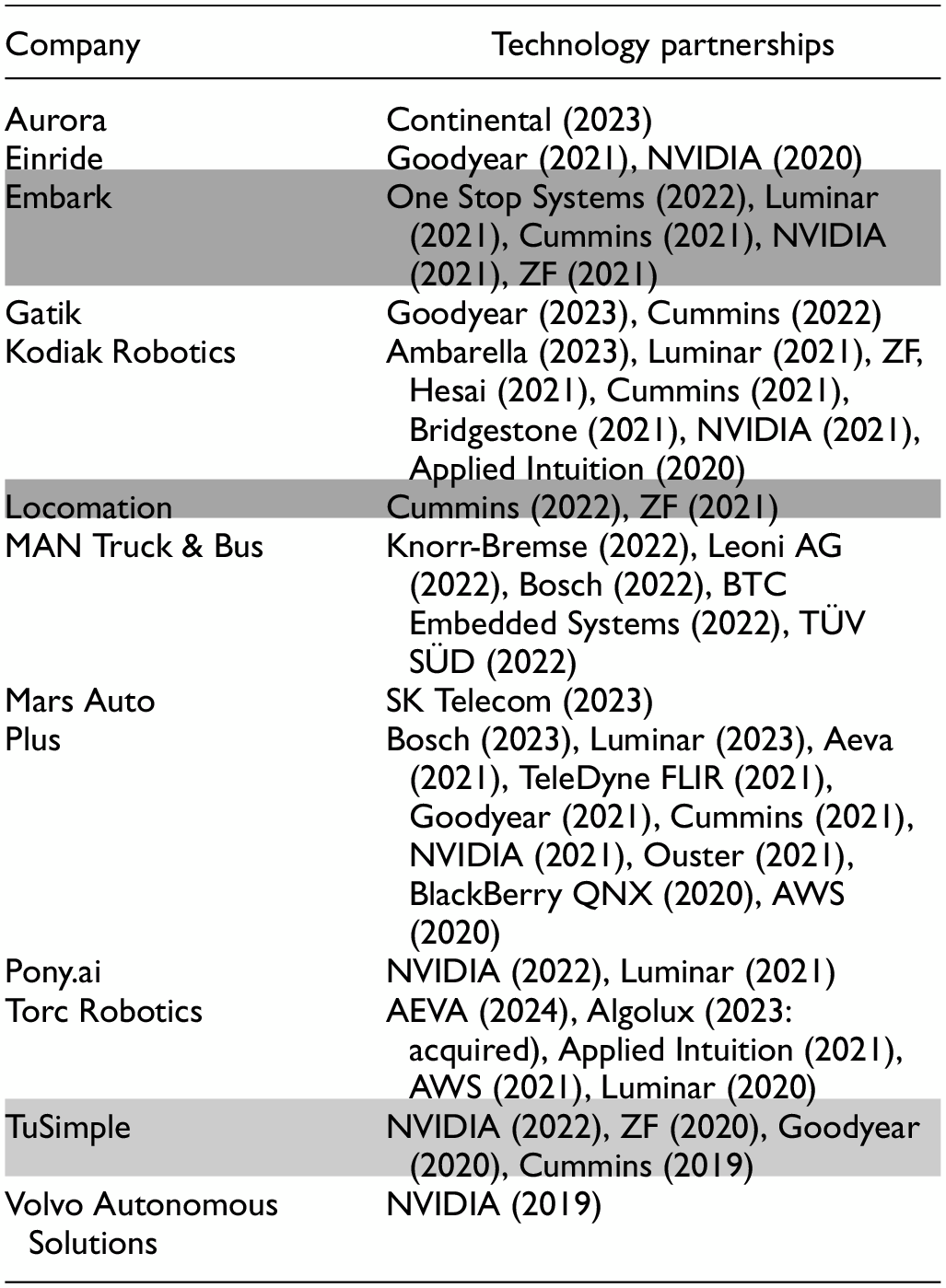
Note: The date included in parenthesis within the table is the date of the announcement. The light-gray highlighted companies have transitioned to a new market and the dark-gray highlighted companies are no longer operating.
Government Partnerships
Government and academic partnerships are being formed with AT companies to determine how to safely deploy ATs. These partnerships are listed in Table 20. Embark was working with the Texas Department of Public Safety and Travis County Sheriff’s Office to test emergency vehicle interactions with ATs, and they were working with the Arizona Department of Transportation on testing ATs in work zones ( 194 , 195 ). Embark worked with Texas A&M Engineering Experiment Station and the Center for Autonomous Vehicles and Sensor Systems to perform research and testing of its autonomous driving system when the company began testing ATs in Texas ( 196 ). Partnerships have been formed with state governments to test ATs in adverse weather conditions. Plus worked with the Minnesota Department of Transportation to test systems in adverse weather conditions and Gatik was awarded funds by the Government of Ontario (Canada) to help prepare its equipment for cold weather conditions ( 197 ). Because each state has unique operating conditions, it is likely that more partnerships will be formed at the state level to test ATs. To prepare for the safe deployment of ATs in the United States, Virginia Tech Transportation Institute was awarded a grant through FMCSA. This grant is geared toward helping the trucking industry utilize ATs and the institute is working with Pronto to test ATs in commercial operations ( 77 ). Another potential collaboration between the U.S. government and AT companies that may emerge in the future is for the deployment of ATs in rural areas. U.S. DOT announced a new Rural Autonomous Vehicle Research Program that will focus on utilizing autonomous mobility and freight solutions to serve people in rural and tribal communities ( 198 ). MAN Truck & Bus has formed several partnerships with research and government organizations to test Level 4 ATs in Germany by the end of 2024. Kodiak is working with the U.S. Army to apply its technology to unmanned vehicles ( 199 ).
Government and Academic Partnerships with Autonomous Truck Companies
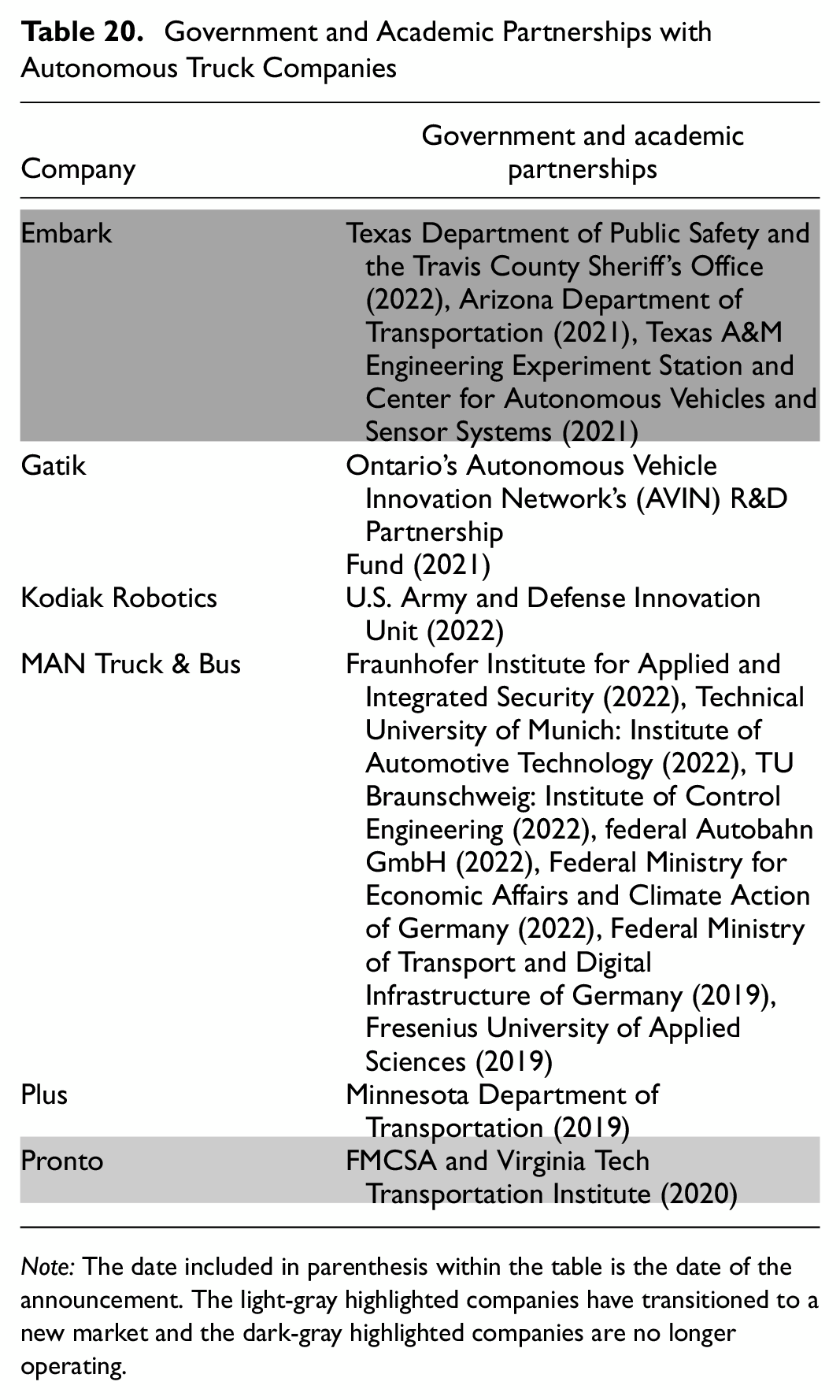
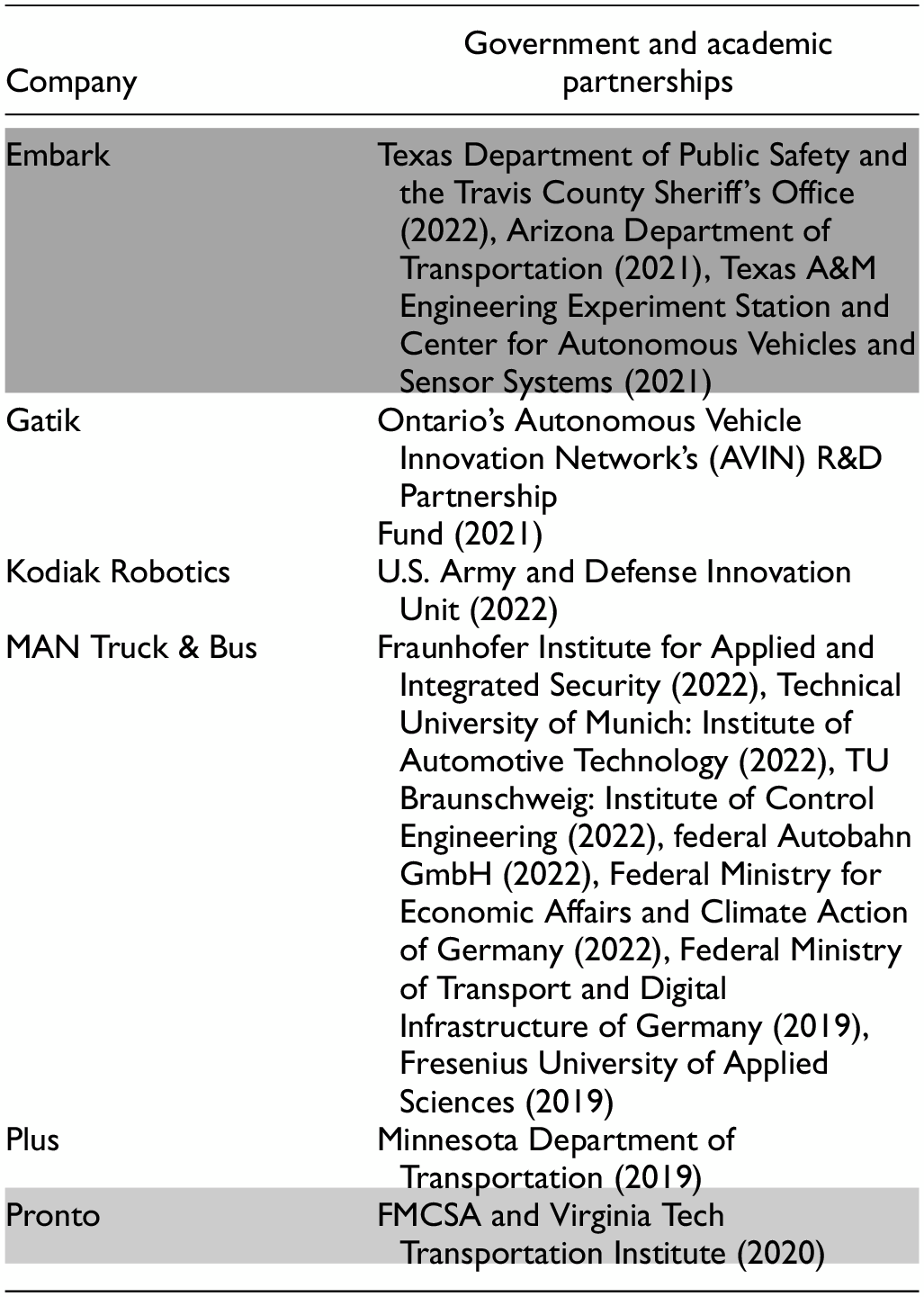
Note: The date included in parenthesis within the table is the date of the announcement. The light-gray highlighted companies have transitioned to a new market and the dark-gray highlighted companies are no longer operating.
AT Deployment Scenarios
How ATs may be deployed in the future may be indicated by the partnerships that are being formed. For-hire trucking companies, private carriers, shippers, 3PL companies, and truck manufacturers are all working with AT companies to deploy ATs. Aurora is an interesting example in which to see the dynamics at play in the deployment of ATs. Aurora is working with Uber Freight to deploy ATs using Uber Freight’s 3PL platform ( 121 ). This allows smaller companies early access to ATs. Veritiv is one company that is using Aurora’s ATs as a customer of Uber Freight. Aurora has also formed partnerships with trucking carriers, Hirschbach, FedEx, Werner Enterprise, Schneider, and U.S. Express, to deploy ATs in their fleets. They are working with truck manufacturers PACCAR and Volvo. Volvo is working on creating its own Transportation-as-a-Service platform utilizing the Aurora self-driving system. The partnerships Aurora is forming suggest four different pathways for the deployment of ATs. First, trucking companies could utilize ATs by buying the semitruck and then paying a service fee for utilizing the self-driving technology. Second, 3PL companies could build their own fleet of AT semitrucks; another option would be for them to build a network for the deployment of ATs. Third, AT companies could build a fleet of AT trucks that they offer as a service to companies. Fourth, truck manufacturers could build a fleet of AT trucks by either partnering or investing in AT companies.
Benefits and Barriers to the Adoption of ATs
ATs may be deployed commercially with no safety driver on public roads in the near future. The industry is maturing with partnerships being formed across the transportation ecosystem including major trucking companies and manufacturers. The interest in deploying ATs makes sense because the cost savings that can be realized by removing the driver from the truck and increasing utilization beyond HOS regulations is a major incentive for trucking companies to adopt ATs. There is also the potential for the general public and the government to benefit from the adoption of ATs. If ATs can be deployed safely on public roads with passenger traffic, safety may be improved and the cost reduction in transportation might be passed on to consumers through lower-priced goods. ATs might help ignite economic development in regions where they are deployed through reduced costs, increased accessibility of goods, and the new jobs that will be required to assist with the maintenance and operations of ATs. Although the benefits of ATs are compelling, many barriers and questions still need to be addressed. From the trucking industry perspective, a primary question is, will ATs reduce costs, or will the service fees, operational and maintenance costs, and other costs associated with using ATs outweigh the savings? Business cases that provide safe deployment options for the public and economical returns for industry will need to be identified. The general public will want to know how they can be certain they can trust ATs. This will likely be dependent on the geographical and operating conditions of ATs, which will have to be tested over time for trust to be developed. The government will need to create regulations that allow for AT innovations to be tested while also ensuring safety. For governments to create regulations for ATs they need to know how they will be used, and in what regions and operating conditions they will be deployed. Many of the benefits and barriers of ATs will have to be determined through the testing and analysis of specific business cases. To provide a comprehensive (although not exhaustive) overview of the benefits and barriers of AT adoption, the potential impacts on the general public, the government, and the trucking industry are summarized. The benefits and barriers will determine the market potential of ATs. For successful adoption, there will have to be mutual benefits that are shared by the general public, the government, and the trucking industry.
General Public
The possible benefits and barriers of adopting ATs with regard to how it may affect the general public is presented in Table 21. The general public may benefit from the introduction of ATs on public roads because transportation plays a vital role in the strength and vitality of an economy ( 200 ). A more robust transportation system will have an impact on every company that has goods to transport and therefore will affect the entire U.S. economy. Because ATs could reduce costs for trucking companies, these cost savings might be passed on to consumers via a reduction in the price of goods. Another major component of a robust transportation system is accessibility and flexibility. ATs may increase accessibility by extending service to remote and rural areas. Flexibility may be improved through the extra capacity on demand offered by ATs. Having the option to operate ATs during nonpeak traffic hours and optimized routing of ATs may help reduce congestion. Furthermore, ATs can be optimized to operate in a fuel-efficient manner by smoothing acceleration, braking, and maintaining fuel-efficient speeds, which should reduce fuel consumption and emissions.
Benefits and Barriers to Society
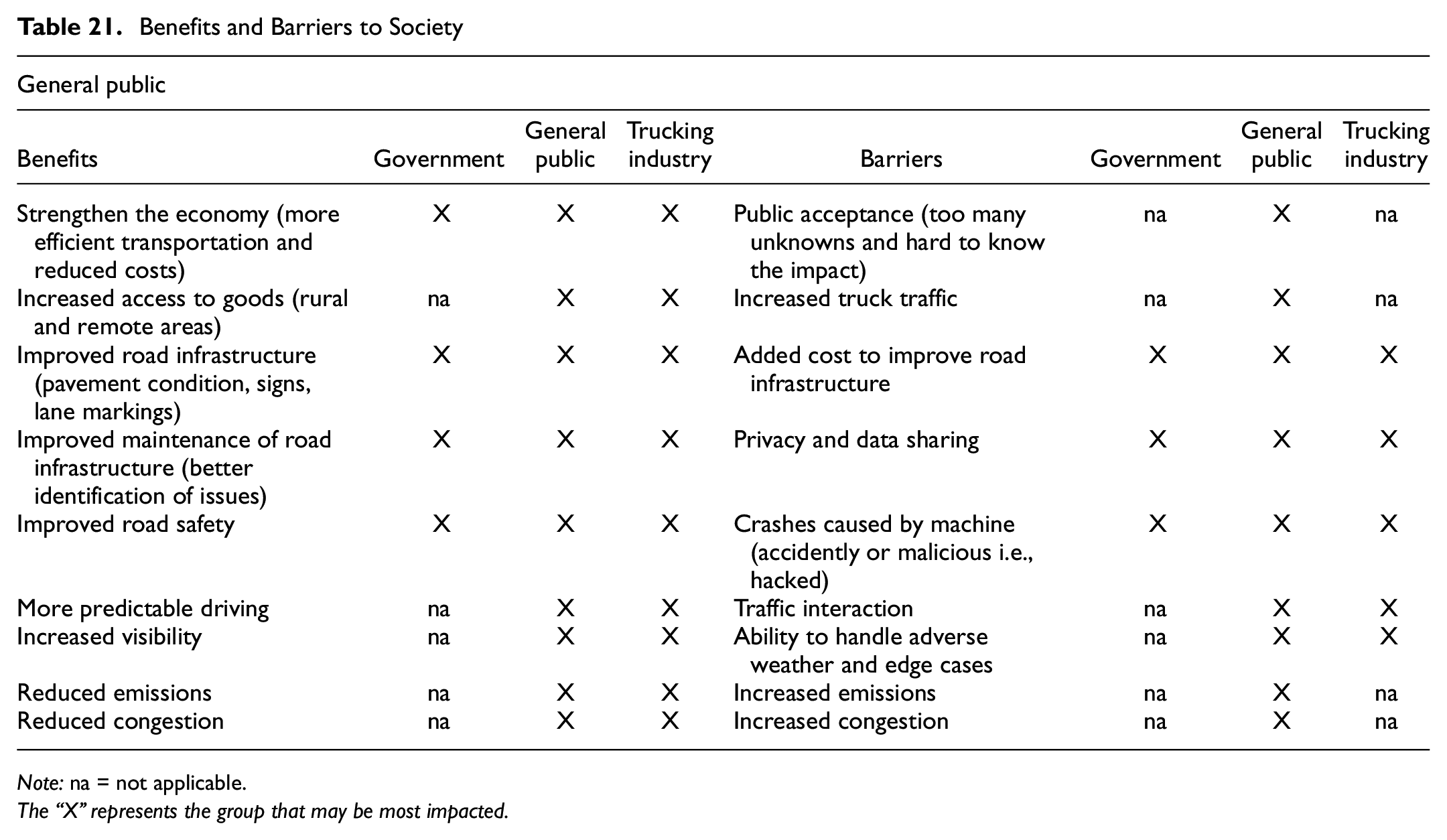
Note: na = not applicable.
The “X” represents the group that may be most impacted.
ATs may help improve roadway infrastructure. ATs will require infrastructure that is in good condition, has proper signs, and lane markings ( 201 ). ATs may also require smart infrastructure that is able to communicate wirelessly with trucks using additional sensors embedded in the road. All of these updates will benefit passenger traffic and may be partially funded through the trucking industry. Road maintenance may be improved through better identification of areas that need repairing via vehicle sensor data. The market potential of adopting AV technology in the trucking industry may be the catalyst for the widespread adoption of this technology by the general public. AV technology will be fully verified by the high utilization of semitrucks in specific operating conditions. Once the more-specific operating conditions are proven safe, the technology can be expanded to more widespread operating conditions. The trucking industry will also have the funds to adopt the best technology available because of the potential savings that can be realized. As the technology matures, the initial purchase price will decrease, and the technology may become more affordable for the general public. In this way, the trucking industry has the potential to usher in the use of AV technology for the general public.
A reduction in crashes is one of the main benefits mentioned by companies involved with ATs and by advocates for the adoption of ATs. The rationale for this argument is that ATs may facilitate this reduction by removing driver errors like distraction, fatigue, blind spots, and overreaction. In a survey from 2005 to 2007, NHTSA found that 94% of the time, one of the critical reasons for crashes was driver error ( 202 ). Although driver error may not have been the cause of the crash in each of the instances, the drivers’ behaviors did play a critical role. In addition to reducing driver errors, ATs may have improved visibility of the surrounding environment and the ability to react quicker to issues that arise while driving. ATs should be more consistent in their driving because they are programmed to follow specific rules. This may make it easier for other traffic to navigate around them. Although it is unknown how much ATs will have an impact on crashes, there is significant room for improvement with regard to road crashes in the United States. In 2020 there were 40,851 fatalities and 4,965 of those were from large-truck crashes ( 7 ). Although the exact amount is unknown, ATs have the potential to help reduce the number of crashes and fatalities.
From a societal perspective, several of the barriers identified could prevent the adoption of ATs. Each benefit of the technology has an associated barrier. Whereas ATs have the potential to strengthen the U.S. economy, they may have other unintended impacts that are currently unknown. This may make the general public hesitant to accept the adoption of ATs. ATs represent a revolutionary change within the transportation industry, and it will likely have unknown impacts. The ripple effects of these impacts are likely to affect many industries tied to the trucking industry. The increased access to goods that ATs could offer may also result in increased truck traffic. The increase in truck traffic might increase congestion, emissions, and have other unintended consequences. ATs might also take freight away from more fuel-efficient modes of transport such as rail. Although ATs have the possibility to reduce crashes, they may cause crashes in ways not initially anticipated. ATs will operate in a predictable way, but it is unknown how this will affect the driving behavior of other road users. Crashes involving ATs could prompt regulatory or societal pressure to discontinue their use on public roads. We do not know how ATs will operate in all possible cases, as there will always be some edge cases that have not been tested. The specific operating domains of Level 4 ATs, limit the possible edge cases, but they do not eliminate them all. ATs are currently set to operate in environments that do not have harsh winters with a lot of snow or ice. It is still uncertain how ATs will handle all weather conditions. In addition, how ATs operate in rural settings remains underresearched. The possible improvements in infrastructure to allow the adoption of ATs may increase costs that will have to be funded by U.S. taxpayers. If ATs are deployed on public roads, they may be able to identify issues with the roads that need to be addressed. Whereas these issues can be identified through the data collected with the sensors, these data may contain personal information of other road users. How those personal data of other road users are handled will need to be addressed. Before privacy issues are clearly addressed, obstacles from other road users could be a huge barrier to the adoption of ATs
Government
The possible benefits and barriers of adopting ATs with regard to how they may affect the government are presented in Table 22. The Center for Transportation Research at the University of Texas at Austin conducted a study in 2016 to help prepare Texas for connected and autonomous transport systems ( 203 ). In this report they provide guidance to TxDOT on possible areas that will need to be addressed. Kockelman et al. acknowledge that Texas would not have to make many changes to their current regulation to allow the deployment of ATs ( 203 ), however, this is not the recommended approach. If states start preparing for the potential barriers of adopting ATs, they can be the recipient of the many potential benefits of ATs. Some of the areas recommended to TxDOT to help prepare for AVs include testing and deployment, vehicle registration, operator requirements, license plates, rules for truck platoons, crash claims and liability, privacy and data sharing, and hacking (see Table 22).
Benefits and Barriers to the Government
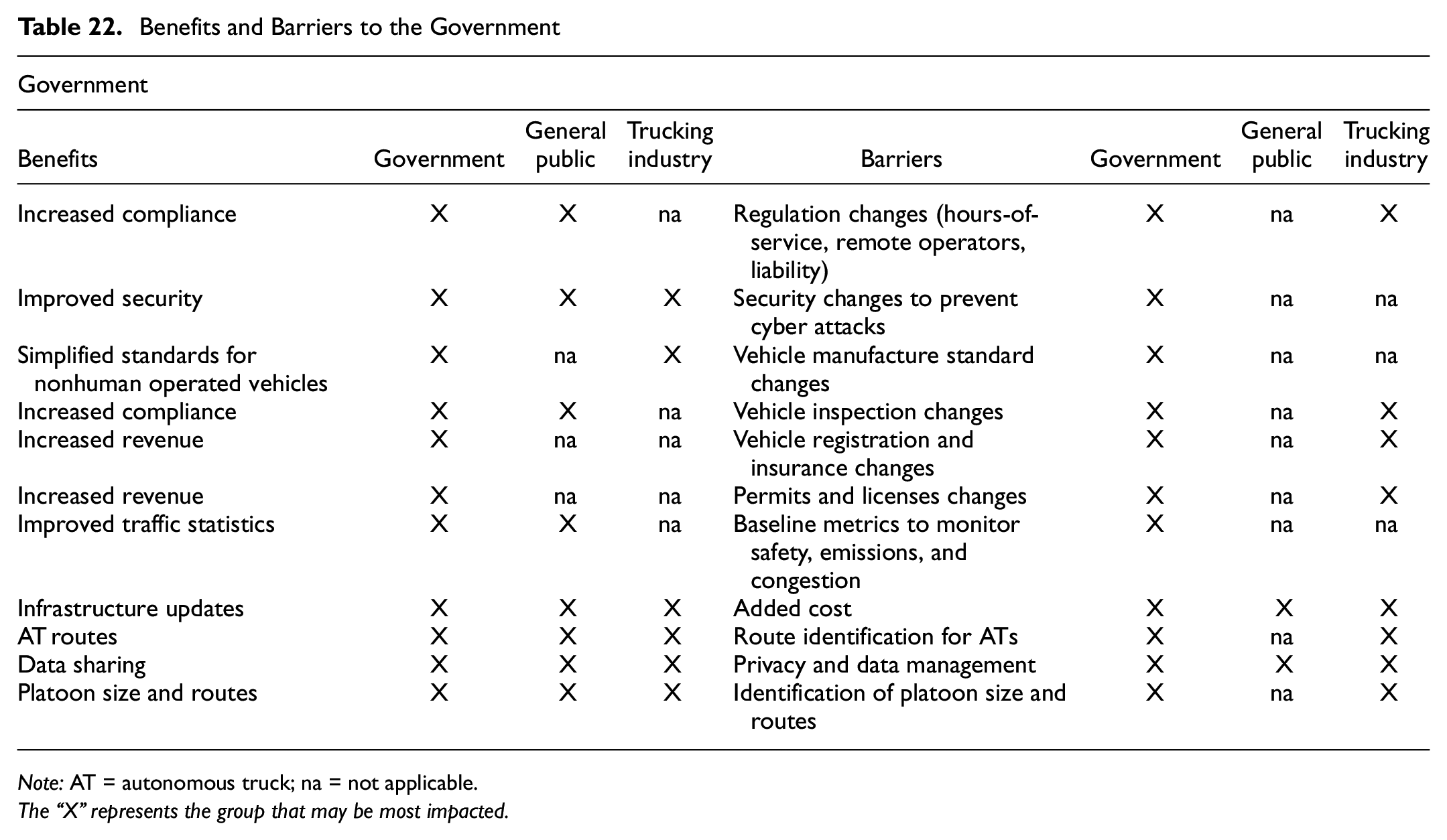
Note: AT = autonomous truck; na = not applicable.
The “X” represents the group that may be most impacted.
For ATs to be fully utilized there will need to be regulation changes at state and federal levels. The first barrier would be the removal of HOS for ATs, which are set by FMCSA. Another potential barrier would be determining the role of remote operators for ATs. This would include establishing whether a remote operator is necessary, how many trucks they could monitor, and their qualifications. Germany passed an act in 2021 that requires Level 4 AVs to have a technical supervisor that can deactivate and perform driving maneuvers for the AV. Liability will need to be established to provide clarity on who is at fault when crashes occur with AVs. Additional regulation may be needed to define the operating environments for ATs and platoons. In 2019, Minnesota passed legislation for how platoons can operate in the state ( 204 ). They have identified preapproved routes for platoons, and companies must submit a platoon plan to Minnesota Department of Transportation before they can use them on the routes. Although testing and deploying platoons and ATs will be necessary to assess their benefits, states may need to develop plans for how companies can go about testing in their state. States will also need to decide how registration, insurance, permits, licenses, and inspections may change for ATs. Kockelman et al. suggest that when ATs are registered they could include additional safety requirements ( 203 ). This could include requiring ATs to have a device to disengage the system, a device to indicate whether it is in autonomous mode, and a system that indicates whether a failure has occurred ( 203 ). In addition to this information, it will also be beneficial for states to know how many ATs are operating on their highways and in what locations. States could start to establish data-sharing agreements with AT companies so they can utilize the information obtained from the sensors to improve traffic and road maintenance in the state. This will require states to develop privacy standards for ATs and how the data will be managed. To evaluate the benefit of ATs, states will need to determine baseline metrics that they can compare ATs against and have the AT data available to analyze. Some additional barriers that may need to be considered are security changes and vehicle manufacturer changes. ATs will be vulnerable to malicious hackers and safeguards will therefore need to be in place for compromised ATs. Most ATs are currently being deployed in traditional trucks with a cab, though in the future they may be cabless. Einride is one company that is working on deploying cabless ATs. How manufacturing and safety standards might change for cabless ATs will need to be specified by NHTSA.
Although the changes that may need to be made at state and national levels could pose barriers to the adoption of ATs, if they are addressed the many benefits of ATs could be realized. ATs may improve compliance, security, funding (revenue), traffic data, and road infrastructure. Compliance could be improved through the inspection information obtained from ATs. Security could be enhanced through updated cybersecurity protocols. Revenue might increase through registration, permits, licenses, and increased truck utilization. Traffic data obtained from AT sensors could be used in a variety of ways by state DOTs to improve operations. Road infrastructure updates needed for ATs will benefit all users who share the road with ATs.
Trucking Industry
ATs will have an impact on many companies in the trucking industry and people employed in the industry. This section focuses on the benefits and barriers to three areas of the trucking industry: 1) truck carrier companies, 2) truck carrier employees, and 3) truck carrier customers (shippers). For truck carriers, ATs will affect private and for-hire truck carriers. For employees in the trucking industry, it will affect drivers, diesel technicians, and new operations jobs created, such as remote operators and inspectors. For customers, it will have an impact on shippers that haul freight with the carriers utilizing ATs. The benefits and barriers are first described for truck carrier companies followed by truck carrier employees, and finally, the customers.
Truck Carrier Companies
The possible benefits and barriers of adopting ATs in relation to how this may affect truck carriers is presented in Table 23. Many of the benefits of ATs have the potential to address the top issues facing the trucking industry. The American Transportation Research Institute (ATRI) has identified critical issues facing the trucking industry and in 2022 these included, fuel prices, driver shortages, truck parking, driver compensation, economy, detention/delay at customer facilities, driver retention, compliance/safety/accountability, speed limiters, and lawsuit abuse reform ( 205 ). Three of the top 10, fuel prices, driver compensation, and the economy, are related to increases in costs. ATs offer the possibility to reduce costs for trucking companies. They may do this through an increase in productivity, through the ability to operate a truck nearly 24/7. Current HOS regulations specify a maximum of 11 h of driving for a truck driver ( 206 ). If HOS regulations are removed for ATs, they could operate nearly 24/7, only needing to stop for maintenance, fueling, and inspection. With this ability, trucks could operate during nonpeak hours, which could reduce traffic congestion and decrease delivery times. The increased utilization of trucks could lead to more reliable service times for shippers and increased business opportunities for carriers. ATRI estimates that congestion costs the trucking industry billions of dollars every year ( 207 ). The removal of HOS regulations may also reduce empty loads, truck parking, and detention/delay at customer facilities. Eliminating the need to comply with HOS rules would allow loads to be hauled when they are full instead of matching them with drivers’ hours. Truck parking could be eliminated and replaced with designated hub locations. Loads at customer facilities could be better managed by deploying ATs based on when loads are ready to move instead of matching the drivers’ hours with the customers’ loads. These changes should help reduce delay and detention.
Benefits and Barriers to the Trucking Industry: Truck Carriers
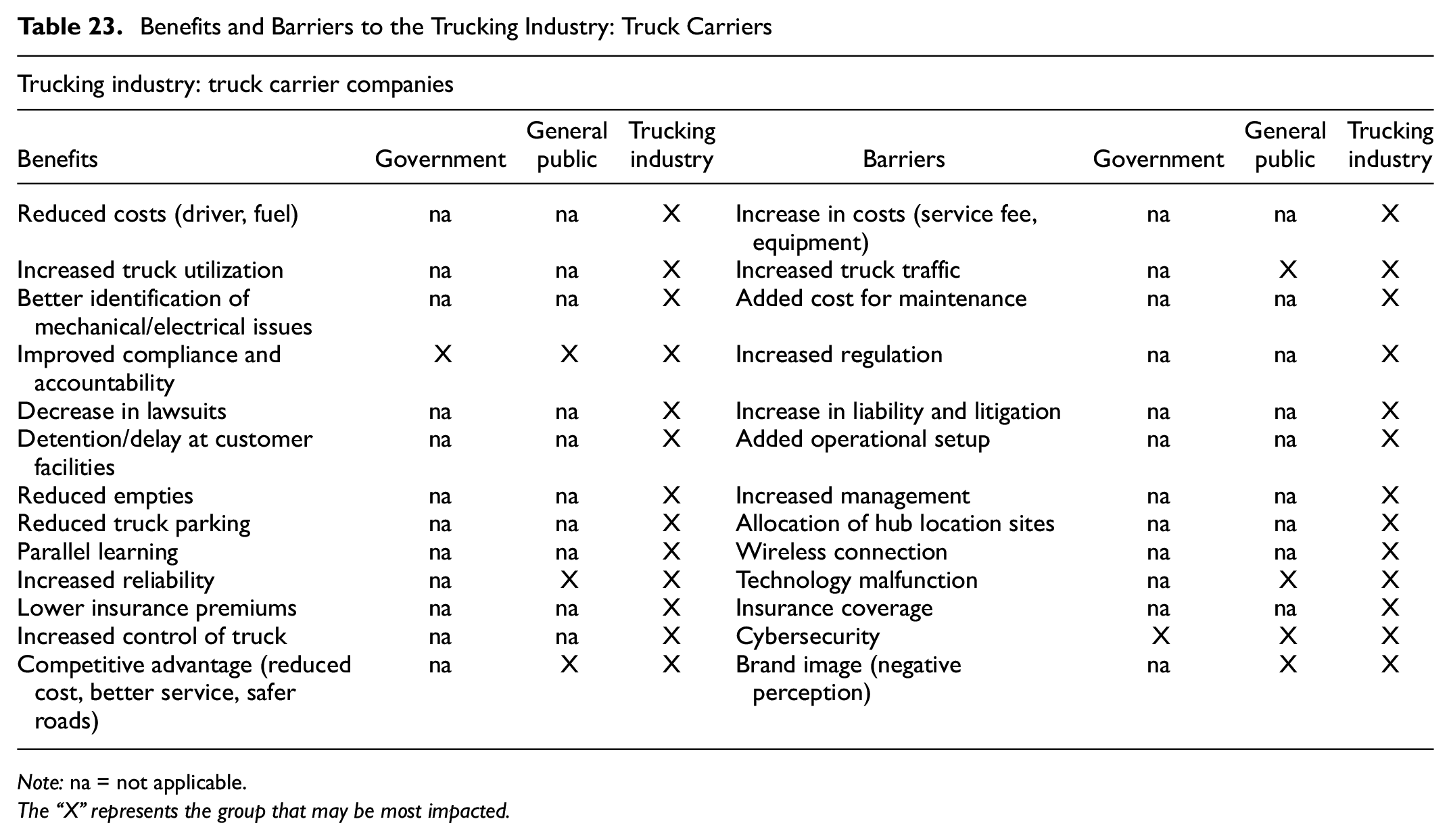
Note: na = not applicable.
The “X” represents the group that may be most impacted.
ATs also have the potential to reduce other operating costs for trucking companies. Savings could be realized from reduced driver wages, -driver benefits, -driver training, -fuel costs, -truck insurance and litigation, -crash expenses, -repair and maintenance costs, -downtime, and -tire costs. Fuel and driver wages are the two largest expenses for trucking companies, which contributed to about 66% of operating costs in 2021 ( 208 ). Removing the driver and operating in a more fuel-efficient manner should help reduce these costs. The trucking industry has also been facing rising insurance premiums and cases of litigation-related verdicts amounting to more than $1 million ( 209 , 210 ). Over time, if ATs reduce crashes, insurance premiums should decrease, and companies will save costs associated with crashes. Such verdicts of more than $1 million dollars and other litigation costs may be avoided by utilizing the extra information obtained from the sensors on the truck. Repair and maintenance expenses, tire costs, and downtime may all be reduced by the lower levels of wear and tear on the truck as a result of optimized driving.
Another critical issue that may be addressed is compliance, safety, and accountability. The trucking industry must remain compliant with HOS regulations, drivers’ fitness, vehicle maintenance, hazardous materials, and government mandates like electronic logging devices ( 211 ). All of these measures are in place to help reduce the number and the severity of crashes. ATs could potentially improve all of these measures for trucking companies. HOS and driver fitness requirements will not be relevant for ATs. Level 4 ATs would remove the driver, so driver fitness would be replaced with maintaining the condition of the AT driving system. The AT system will go through an inspection that verifies it is safe to operate in specific operating conditions. CVSA has already defined the inspection procedures for ATs and how these will be communicated to state officials ( 26 ). With the enhanced CVSA inspections for ATs, it is less likely that they will fail to be compliant with maintenance or hazmat regulations. ATs will also be able to detect any mechanical or electrical malfunction while driving and will be required to pull off to the side of the road as soon as possible. Like HOS, other regulations, such as those related to electronic logging devices, will no longer be necessary. However, ATs will probably initiate other regulatory measures. One possible regulation that could be added is speed limiters: talked about by regulating agencies, though no rule has yet been applied ( 212 ). Although ATs will probably have additional regulations on how they operate, those regulations may simplify the current compliance and accountability processes for companies and at the same time improve safety.
ATs offer the possibility for companies to achieve a competitive advantage by reducing costs, improving service, and creating safer roads. The benefits of ATs may also grow over time as fleets slowly convert their trucks. Multiple ATs in a fleet might be able to communicate with each other and learn in parallel. Road conditions, congestion, and operating conditions can be broadcast to the network of ATs. However, for the benefits of ATs to be realized, several barriers will need to be addressed. It is still unknown what the return on investment will be for ATs. Additional costs associated with implementing ATs will offset some of the savings. Some of those additional expenses include the increase in purchase price of the truck, a per-mile service fee, personnel for maintenance and inspection, and facility updates. ATs may need additional supervisors to manage the trucks in the fleet. Although there is the potential for enough savings that AT adoption is being pursued by the trucking industry, it will take time to fully identify the cost–benefit ratio. There is also great uncertainty about regulation and liability related to ATs. The federal government has issued guidance on the development of ATs through the Automated Vehicles: Comprehensive Plan ( 17 ), however, ATs are currently regulated by state governments. A comprehensive federal policy may be needed in the future to allow ATs to operate throughout the nation. Liability in relation to ATs in the case of a crash is still unknown. It will likely be dependent on determining who was at fault and identifying whether the crash resulted from an error in the technology, or from maintenance, the manufacturer, or something else. Another major concern is with cybersecurity and the ability to hack an AT. Moving the control of the vehicle from a person to a machine opens up the vulnerability that someone may be able to compromise the truck and take control of it. Safeguards will be needed to ensure that if a truck does become compromised, it will go into safe mode and pull safely to the side of the road. ATs are still in the testing phase for many of the operating conditions, and it remains uncertain in what conditions they will operate reliably. ATs have the potential to give a company a competitive advantage while, at the same time, it could have a negative impact on its brand image if they do not operate as intended. One way this dilemma can be negated is by partnering with trusted third parties to test ATs to verify their operation.
Truck Carrier Employees
The possible benefits and barriers of adopting ATs in relation to how it may affect people employed in the trucking industry are presented in Table 24. ATs have the possibility of making truck driving a more enjoyable career. The trucking industry has experienced a tight labor market for drivers since 2013 and the American Trucking Association suggests there is a driver shortage in the industry ( 213 ). In particular there appears to be a high turnover rate for long-distance truck drivers ( 213 ). The industry is also facing an aging population of truck drivers. ATRI has shown that the proportion of truck drivers between the ages of 25 and 34 declined from about 30% to 15% from 1994 to 2013 ( 214 ). The driver shortage and turnover point to a dissatisfaction among drivers in the trucking industry. ATs may help to fill the demand for trucks drivers, make truck driving more enjoyable, and help companies retain their drivers. Drivers may be more likely to stay with a company because of the health and wellness benefits resulting from running shorter routes that are closer to home. The adoption of ATs may increase morale among drivers who see their company as a leader in using innovative technology that helps to reduce crashes and improves the wellbeing of others. ATs will create new types of jobs that may attract younger workers. These include jobs at companies that are developing the software, at manufacturers that are working on integrating the autonomous technology, as technicians to handle the maintenance, as inspectors to verify that they are safe to operate, as operations managers at trucking companies to handle the integration and monitoring of ATs, and many other jobs needed to safely deploy ATs. However, although ATs will create new jobs, they will eliminate some existing roles and cause drivers to transition to a different position. It may be difficult for drivers to transition into a new position and some may decide to leave their occupation. U.S. DOT conducted a study on the workforce impacts of driving automation for long-haul trucking and bus transit ( 215 ). They found that drivers may struggle in transitioning to a new occupation owing to their age and education level. U.S. DOT reviewed the demographics of trucks drivers and found the trucking industry has a higher concentration of workers between the ages 35 and 75 compared with other blue-collar jobs. They also found that most heavy-duty truck driver jobs do not require a degree, and truck drivers have higher wages given their education level compared with other blue-collar jobs. Certain areas of the United States may be affected more because of a high concentration of heavy tractor-trailer truck drivers. Arkansas, Nebraska, North Dakota, Iowa, and Wyoming have the highest concentration of tractor-trailer truck drivers ( 215 ). The magnitude of the truck drivers that will be affected by ATs is uncertain since ATs may meet the unmet demand for drivers or they may remove drivers from their current jobs. There is also the possibility that the new positions for drivers may pay less than their current roles. Long-haul driving, which is currently being pursued for Level 4 ATs, often pays more than shorter local routes ( 216 ). However, there is the possibility that ATs may create a middle-mile market for truck drivers that pays well and results in the drivers making it home each night.
Benefits and Barriers to the Trucking Industry: Truck Carrier Drivers
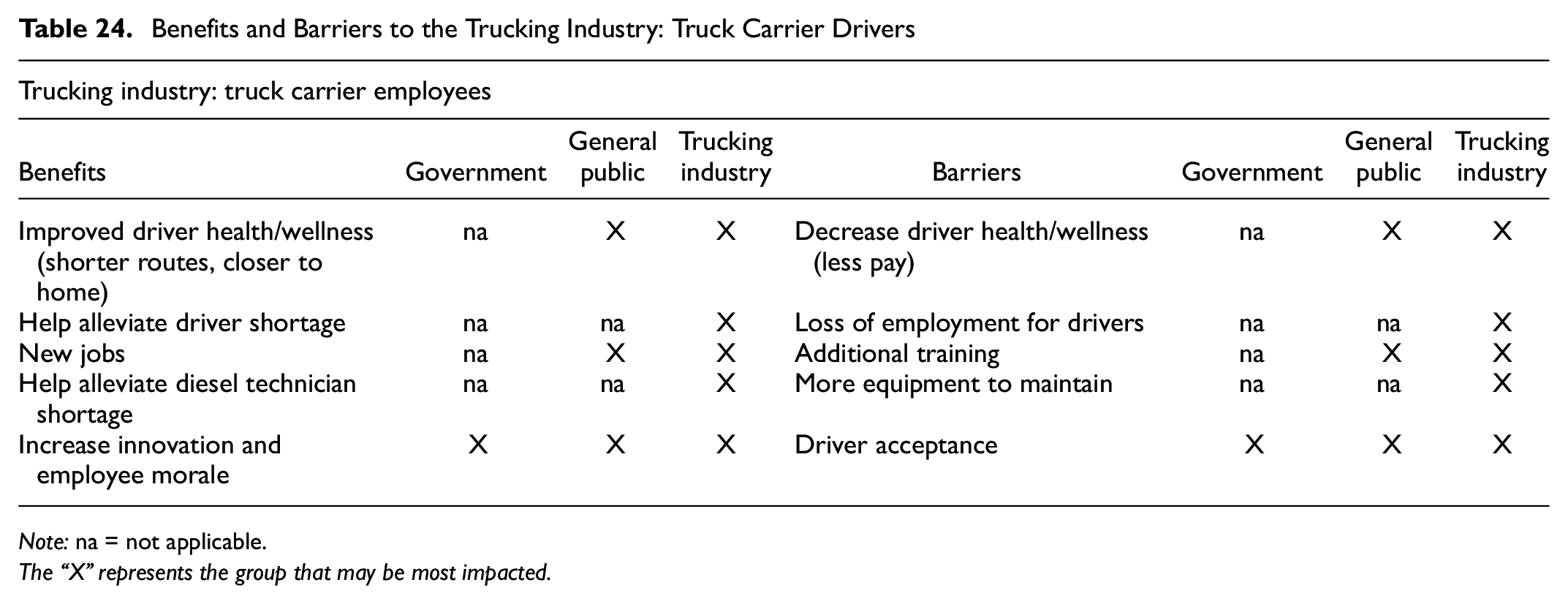
Note: na = not applicable.
The “X” represents the group that may be most impacted.
Truck Carrier Customers (Shippers)
The possible benefits and barriers of adopting ATs with regard to how they may affect shippers is presented in Table 25. ATs offer the possibility of reducing costs and lead times for shippers while also improving the predictability, flexibility, and accessibility of their freight deliveries. Although the adoption of ATs will be driven by truck carriers operating ATs, shippers also play a role in the adoption of ATs. Shippers rely on truck transportation for the timely delivery of their goods. Having consistent deliveries made with ATs could enable companies to have less inventory. ATs are like a new mode of transportation that shippers can utilize to make their supply chain more resilient to transportation disruptions. Whereas ATs should reduce transportation costs in the long-term, it may initially cost shippers more if they decide to utilize AT capacity. Shippers may also have to change their yard layouts to accommodate ATs, or they may have to provide the first-/last-mile transportation to an AT hub. For instance, with the hub-to-hub model for Level 4 ATs, a trucking carrier may provide the AT capacity between the hubs, and the shipper may be responsible for picking up and delivering their freight to the hub. This first-/last-mile could also be provided by 3PL companies or the carrier itself. The operational change needed by the shipper to fully utilize ATs would need to be tested. There may also be disruptions to shippers’ operations from unforeseen issues that may arise from using a new technology. These disruptions can be mitigated by testing ATs in commercial applications.
Benefits and Barriers to the Trucking Industry: Truck Carrier Customers (Shippers)
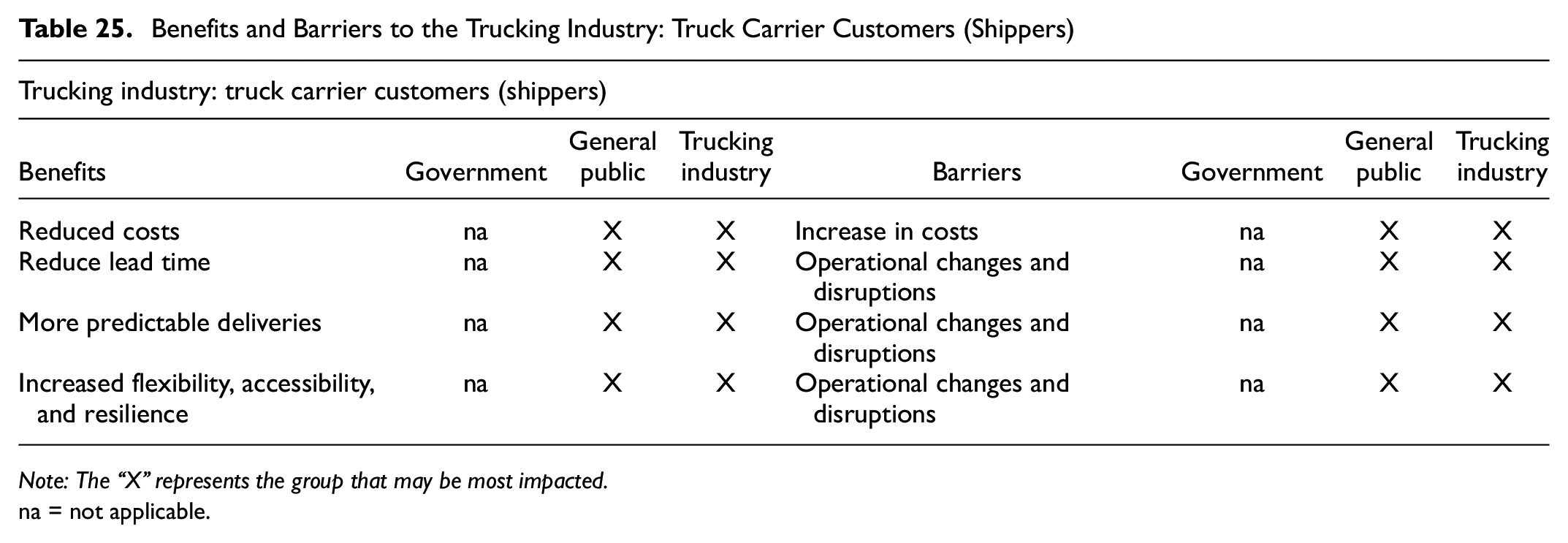
Note: The “X” represents the group that may be most impacted.
na = not applicable.
Conclusion and Future Direction
The trucking industry—the nation’s largest freight market—has the potential to be an early adopter of AV technology in the United States. Trucks haul the majority of the U.S. freight. There are millions of miles of infrastructure for different deployment options and business cases. ATs may help reduce the thousands of fatalities and injuries that occur every year on U.S. highways, and they may facilitate a reduction in fuel consumption and emissions. The compelling case to use AVs in the U.S. trucking industry is illustrated in Figure 7.
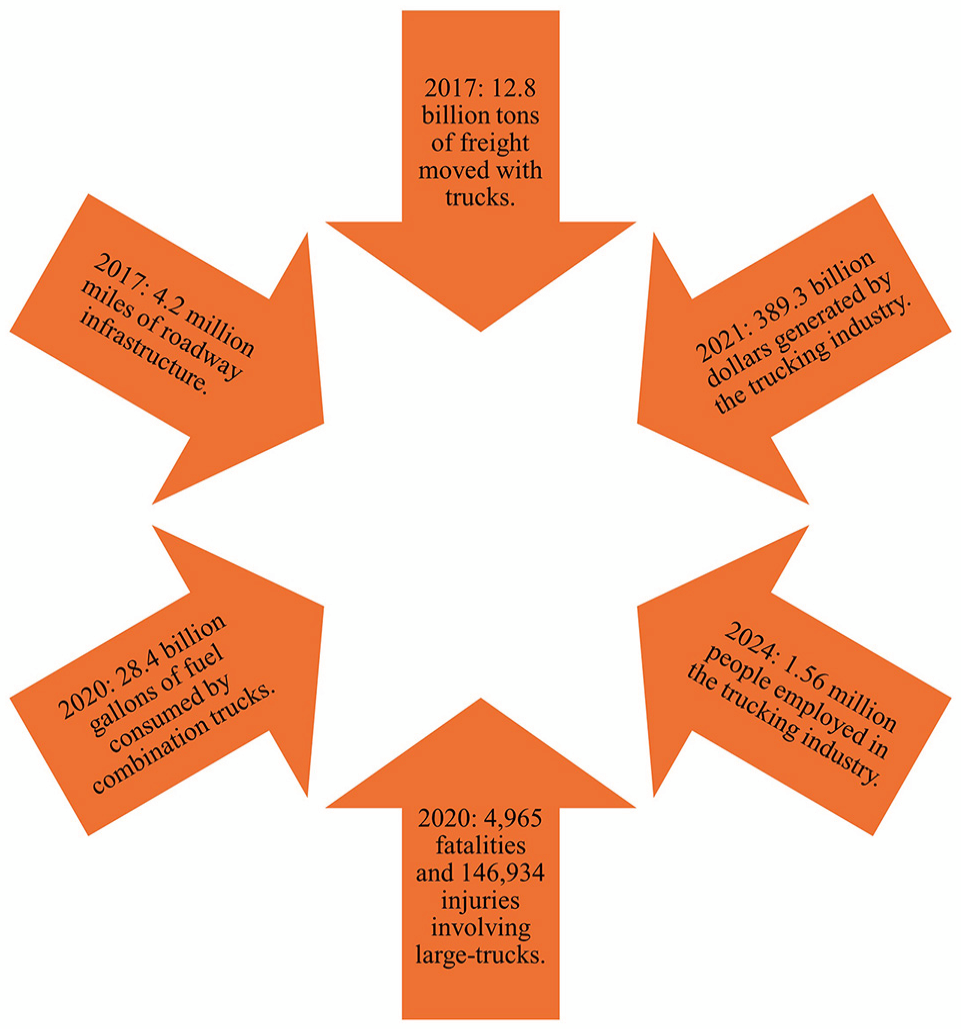
Factors that contribute to the market opportunity for autonomous trucks in the United States.
For ATs to be deployed in commercial application in the U.S. there will need to be interest from the trucking industry, the government, and the general public. The trucking industry will help to determine the initial use cases of ATs and their economic viability. This will involve evaluating the best routes, types of freight, and carriers for the initial deployment of ATs. The U.S. government will play a major role in the adoption of ATs by creating regulation that allows for the safe adoption of ATs. The people of the United States have a vested interest in how ATs are deployed because they may be sharing the road with them in the future. We can see from the partnerships being formed in the trucking industry with AT companies that there is widespread interest in utilizing ATs. Trucking companies are performing AT pilots on public roads. The U.S. government is preparing for the adoption of ATs at the federal level by issuing guidance through U.S. DOT’s Automated Vehicles: Comprehensive Plan ( 17 ) and the federal agencies, FMCSA, NHTSA, FHWA, and CVSA, are evaluating the changes that will need to be made to regulations, vehicle standards, infrastructure, and inspections. Although the perceptions of the general public toward ATs are, as yet, not apparent, this is likely to be determined over time as ATs are deployed in particular use cases.
Whereas AVs have caught the attention of the general public, the government, and the trucking industry, the idea of automating vehicles has been in the minds of Americans since the mass production of automobiles in the 1920s ( 29 ). It was first thought that the automation of vehicles would require installing wires within the infrastructure to control the vehicles. Then, in the 1950s, automation features started appearing in vehicles such as cruise control ( 171 ). There was a shift in the mindset in the 1970s that automation features should originate from the vehicle instead of the infrastructure. During this time, vision through cameras began to be used to automate vehicles that could recognize street markings. Automation features such as ABS also started to emerge. In 1994 an AV was created that was able to drive in traffic in Paris, and in 1994 Carnegie Mellon students created an autonomous system using cameras, GPS, and computers that controlled the steering of the vehicle ( 21 , 57 ). In 1991, the U.S. Congress passed the ISTEA, which initiated the development of AVs by U.S. DOT ( 142 ). Another automation feature, ESC, became available in the 1990s ( 169 ). AVs started to gain traction in the United States with the first U.S. DARPA challenge in 2004 ( 56 ). This challenge was followed by another in 2005 in desert terrain and in 2007 in an urban environment on an air force base ( 56 , 55 ). NHTSA has defined “Five Eras of Safety” that correspond to the evolution of automation in vehicles, as shown in Figure 8 ( 144 ).
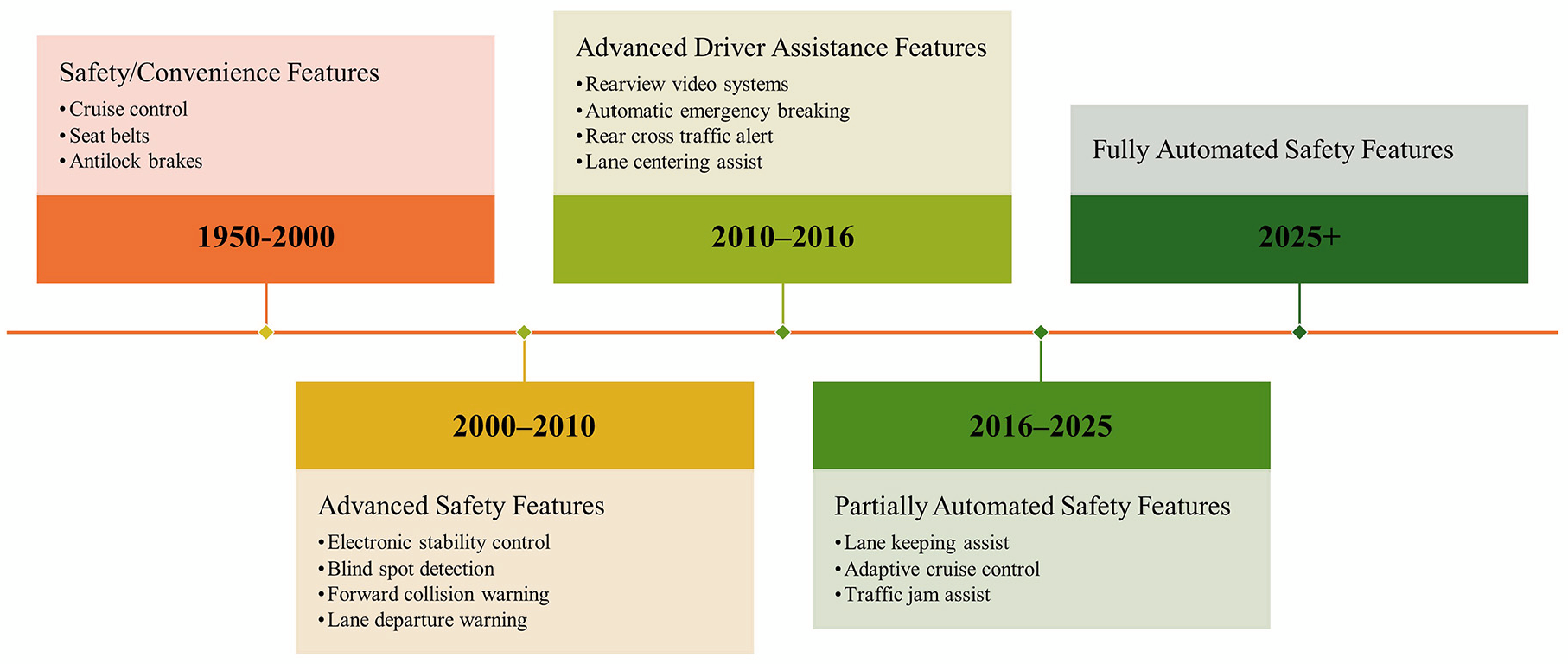
Evolution of safety features in vehicles
To categorize the automation of vehicles a numerical scale from 0 to 5 has been created. For Levels 0, 1, and 2, the driver is in control of the vehicle while the system provides momentary assistance with braking, accelerating, and/or steering. For Levels 3, 4, and 5, the system drives and the driver has varying roles of responsibility. The most common automation level being pursued for ATs is Level 4, in which the truck can operate in specific operating domains without a driver in the truck. The AT companies pursuing Level 4 ATs are consistent with the 1970s mindset that automation will occur as a result of the technology in the vehicle, not the infrastructure. The current technology uses sensors such as radar, lidar, and cameras to perceive the environment, and machine learning algorithms are employed to interpret these data and decide the best direction forward.
Several companies believe that the hardware sensors and the machine learning algorithms have advanced to the point where AVs could be deployed on public roads. The main deployment markets for AVs being pursued by companies are commercial applications in the movement of freight and passengers. ATs are being tested on public roads in China, Japan, South Korea, Sweden, Germany, Australia, Canada, and the United States. The deployment markets and timelines, AT headquarter locations, and business cases are shown in Figure 9. Whereas most of the companies with U.S headquarters are planning on deploying ATs in the United States, four of the companies are pursuing international markets. These include Gatik, Plus, Pony.ai, and TuSimple. Pony.ai and TuSimple are exclusively pursuing international markets for ATs even though they have headquarters in the United States. Daimler Autonomous Technology Group purchased a majority stake in Torc Robotics, so they are working together on ATs. Although Daimler Truck North America is based in Oregon, Daimler Truck AG is based in Germany. There are many potential U.S.-based entrants who could get involved with ATs. These include, Forterra, Hydron, Ike (now Nuro), Pronto, Stack AV, Tesla, Waymo Via, and Bot Auto. Bot Auto is a company that has recently formed and is therefore not included in the industry analysis portion of this paper. There are also several companies based in the United States that pursued ATs but are no longer in business. These include Embark, Locomation, Otto, Peloton Technology, Starsky Robotics, and Uber Advanced Technology Group.
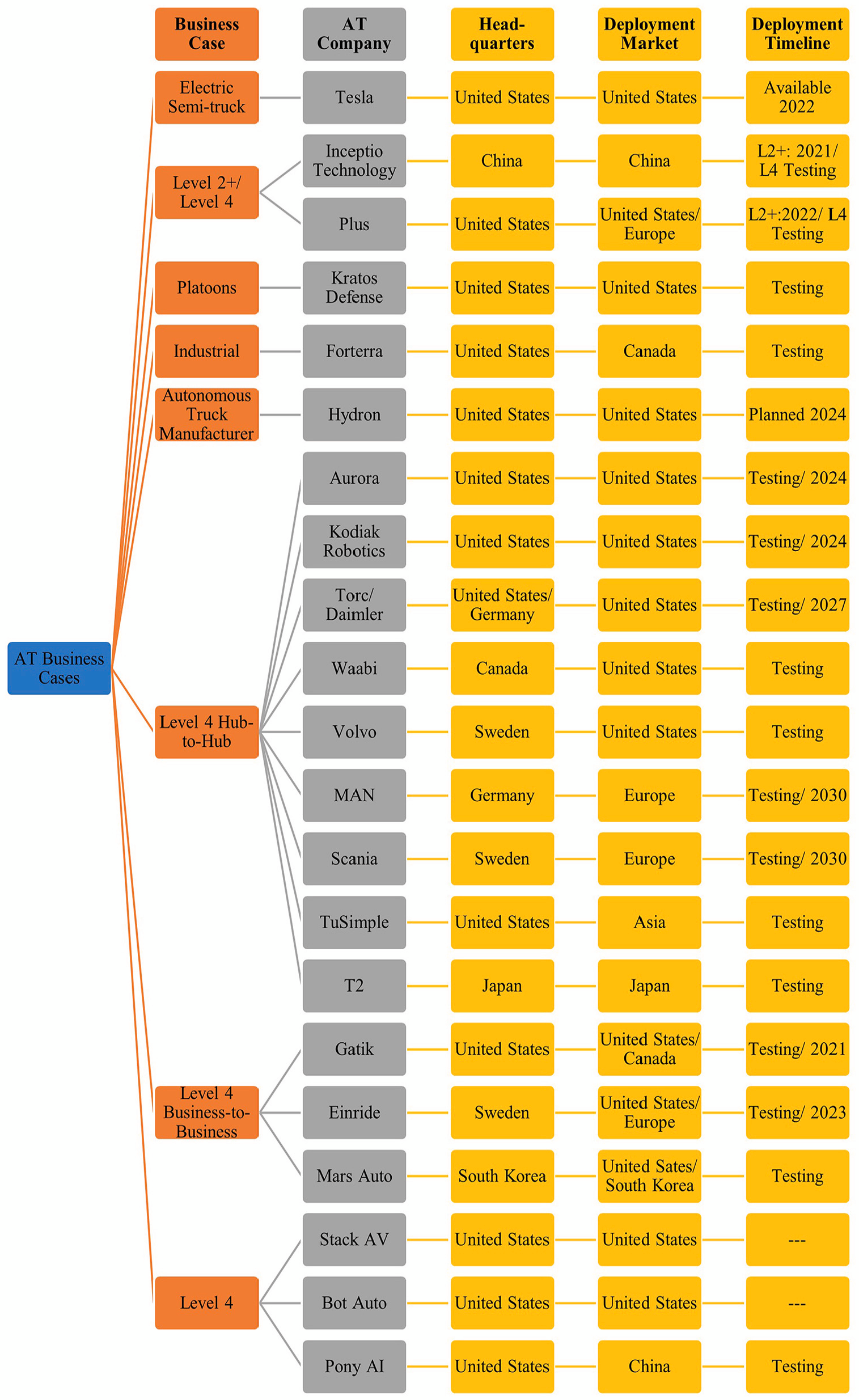
Autonomous truck business cases by company, headquarters, deployment market, and deployment timeline.
The predominant business case being pursued by AT companies is Level 4 ATs that will operate in a hub-to-hub model on interstate routes, as seen in Table 9. Some of the companies in Table 9 are pursuing multiple business cases, though they are only listed for one of their applications. For instance, Plus has a Level 2+ technology that is commercially available, though they are also pursuing Level 4 hub-to-hub. The hub-to-hub setup where the terminals are located outside of major cities is seen as a good entry point for AVs owing to the less complex operating environment. It also allows for high utilization of AVs, which would improve the profitability of ATs. There is another business case being pursued for Level 4 ATs in the short-haul market. This involves utilizing Level 4 trucks between manufacturing facilities and warehouses or warehouses and retail stores. The general consensus among all AT companies is to find business cases that have repetitive operating conditions, high volume, and can utilize Level 4 ATs. Whereas most companies are pursuing Level 4 ATs since the driver can be removed from the vehicle, some companies are pursuing Level 2+ automation, in which the driver remains in the truck, though it has advanced driving features that might improve safety and fuel efficiency. Another similar strategy being pursued is platooning, in which multiple trucks are tethered together using wireless technology.
Other business cases being pursued include utilizing ATs in remote areas for hauling commodities and automating trucks that remain within ports and distribution centers. Forterra, MAN Truck & Bus, Scania, and Volvo are pursuing this market. Several of the AT companies that went out of business were pursuing similar business strategies of Level 4 hub-to-hub, Level 2 automation, and platooning. These companies either transitioned to a new market, were acquired, or did not have the financing to continue operating. The timing of when the general public, the government, and the trucking industry will be ready to adopt this technology, along with the ability of the technology to work reliably, will determine when ATs are deployed commercially. Several AT companies are saying that ATs will start commercial deployments by the end of 2030, with some taking place in 2024. Most companies still have a safety drive onboard the truck, although Gatik and Einride have removed the safety driver for some of their routes. There are many more AT companies that are currently testing, though they have not announced when they will be ready for commercial deployments.
AT companies have been forming partnerships with logistics companies, truck manufacturers, and other companies to assist with the operations of AT deployments; with technology companies for equipment; research and academic institutions to conduct tests; and with government agencies to deploy ATs on public roads. The AT ecosystem of companies is rapidly expanding. The type of logistics companies that have formed partnerships with AT companies is shown in Figure 10. There is a diverse group of logistics companies preparing for ATs in their network.
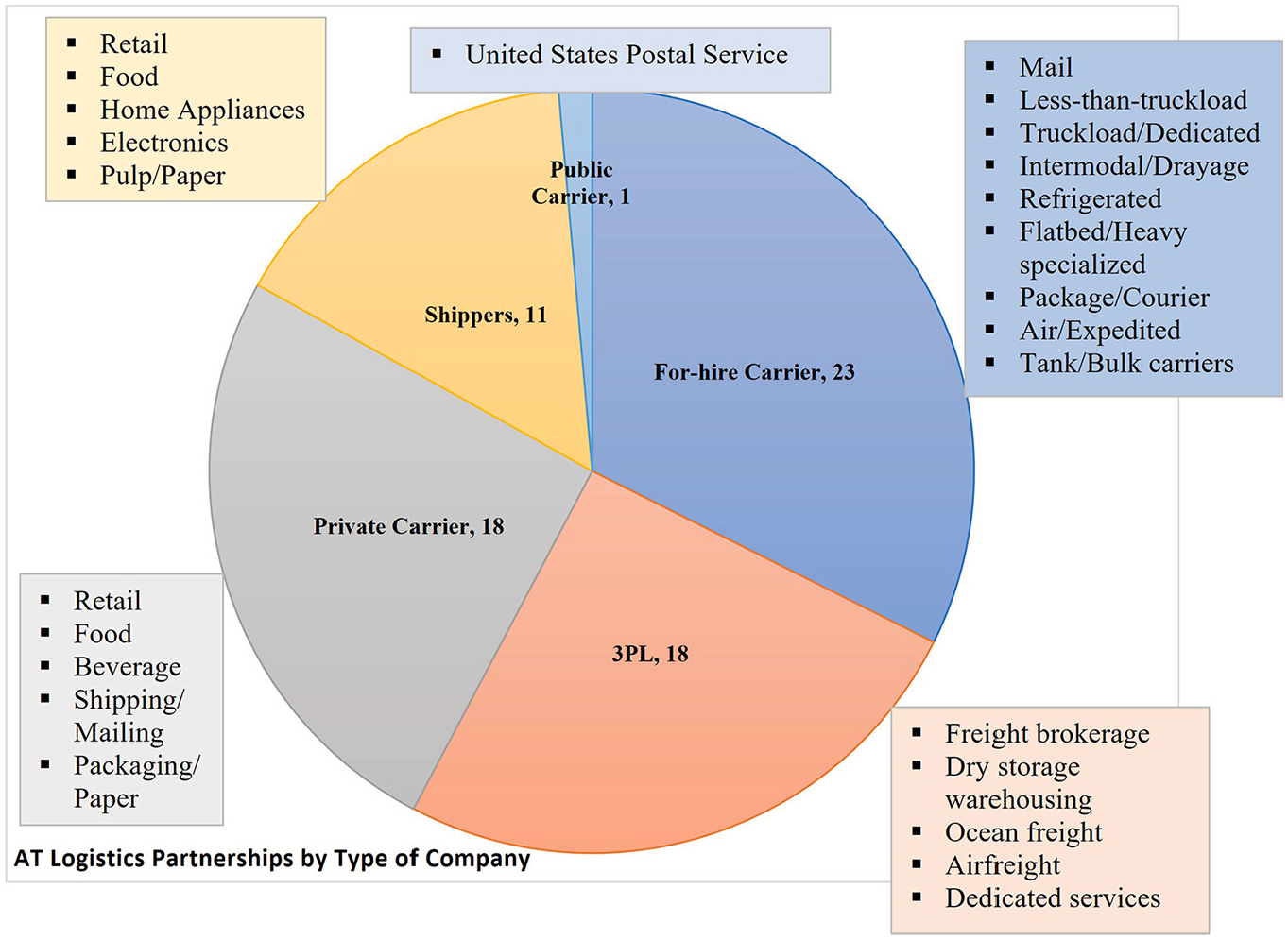
AT logistics partnerships type of company.
Not all logistics partnerships have been formed to pilot ATs on public roads, some are to explore how ATs can be integrated into the operations of a carrier. Figure 11 shows the companies that have formed partnerships to pilot Level 4 ATs, Level 2+, and platoons.
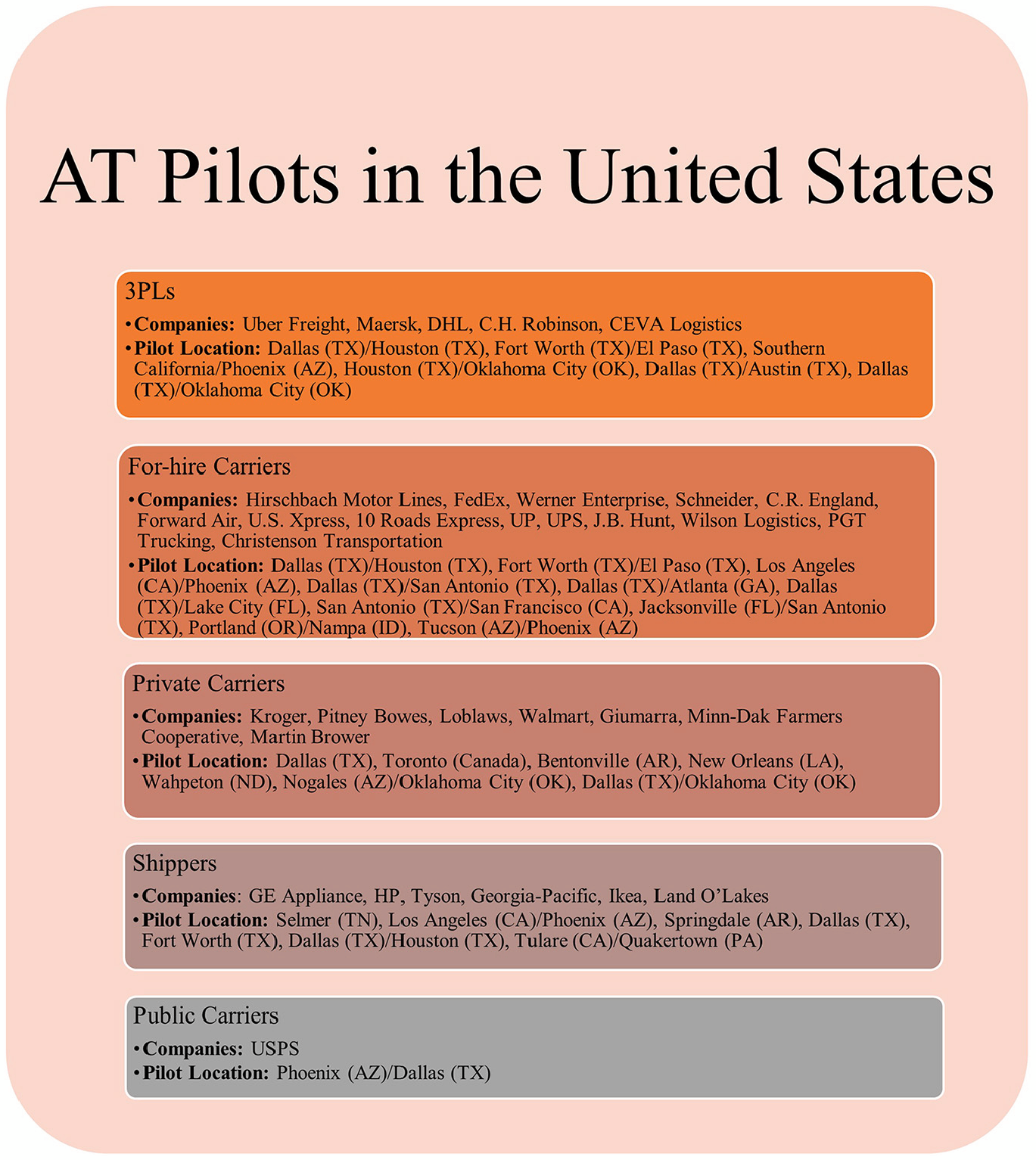
Autonomous trucking (AT) pilots in the United States (includes Level 2+, platoon, and Level 4 pilots).
In addition to the logistics partnerships, manufacturing partnerships are being formed to help integrate the autonomous driving system into the systems of established truck manufacturers. Operations partnerships to assist with all the extra details needed to deploy ATs at scale include companies for maintenance, AT hub facility allocation, insurance, charging facilities, manufacturing for mass production of sensors, telecommunication providers for 5G service, and companies building smart infrastructure. Technology partnerships to provide support with the equipment, data, and testing of ATs include sensor companies, Tier 1 suppliers of auto parts, cloud service providers, and simulation providers. Government and academic partnerships are needed to deploy ATs on public roads safely and include state DOTs and highway patrol offices, universities, and research agencies. Many other partnerships will form as the industry evolves and matures.
Even though the AT industry is maturing with the partnerships being formed across the transportation ecosystem including major trucking companies and manufacturers, there are still some barriers that will need to be addressed for ATs to be deployed in commercial applications. Not all barriers can be known, although potential barriers can be anticipated and better addressed if they are thought through before the adoption of AT takes place in commercial applications. Potential barriers from the perspective of the general public and government are shown in Figure 12.
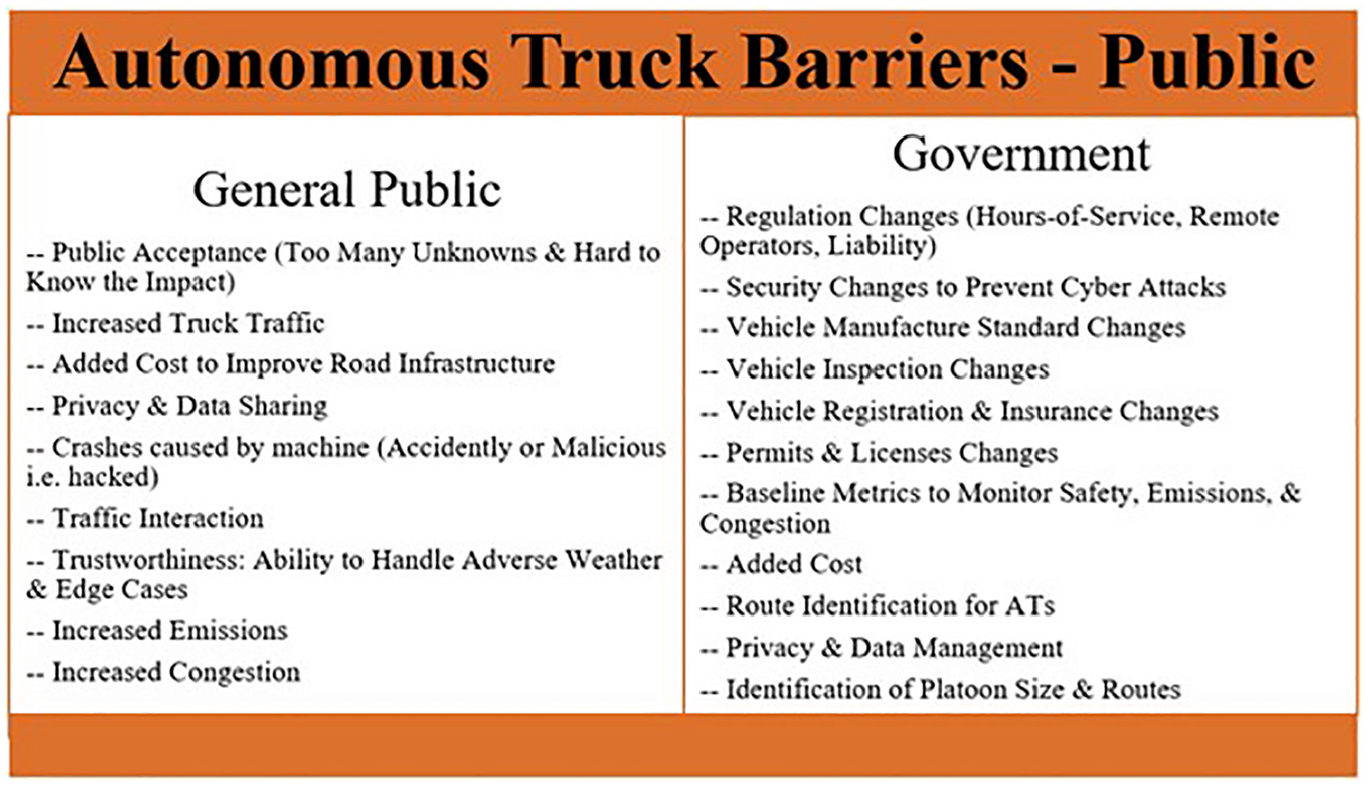
Autonomous truck barriers for the general public and the government.
A major barrier for the general public is trustworthiness and understanding that the technology will be used for the benefit of all road users and not just the companies utilizing the technology. This will likely be dependent on the geographical and operating conditions of ATs and will have to be tested over time for trust to be developed. A major barrier for governments is to determine how to create regulations that allow for AT innovations to be tested while also ensuring safety. Like the general public, for governments to create regulations for ATs they need to know how they will be used, and in what regions and operating conditions they will be deployed.
Lastly, there are barriers that will need to be addressed by the trucking industry. These barriers are divided into three areas: truck carrier companies, truck carrier employees, and truck carrier customers (shippers) and are shown in Figure 13. AT companies are developing the ecosystem of partnerships with logistics companies, truck manufacturers, operations and technology companies, and government and academic institutions to address the barriers for truck carriers. They are also being addressed and tested through the pilots being performed with logistics companies. For truck drivers, the most talked about barrier, loss of employment, may not be realized owing to driver shortages in certain markets and routes. Regardless of this, AT will cause workforce impacts that will need to be effectively communicated and discussed with drivers. Finally, there are barriers that may be faced by shippers. Shippers may need to pay an extra charges to take advantage of the benefits that ATs offer, such as faster and more reliable service. They may also need to change the operation setup for how they go about staging trailers, picking them up, or dispatching them to hub locations. With any new technology there is also the chance for disruptions to take place. With all of the barriers for the general public, the government, and the trucking industry, if they are addressed there are many benefits that can be realized through ATs.
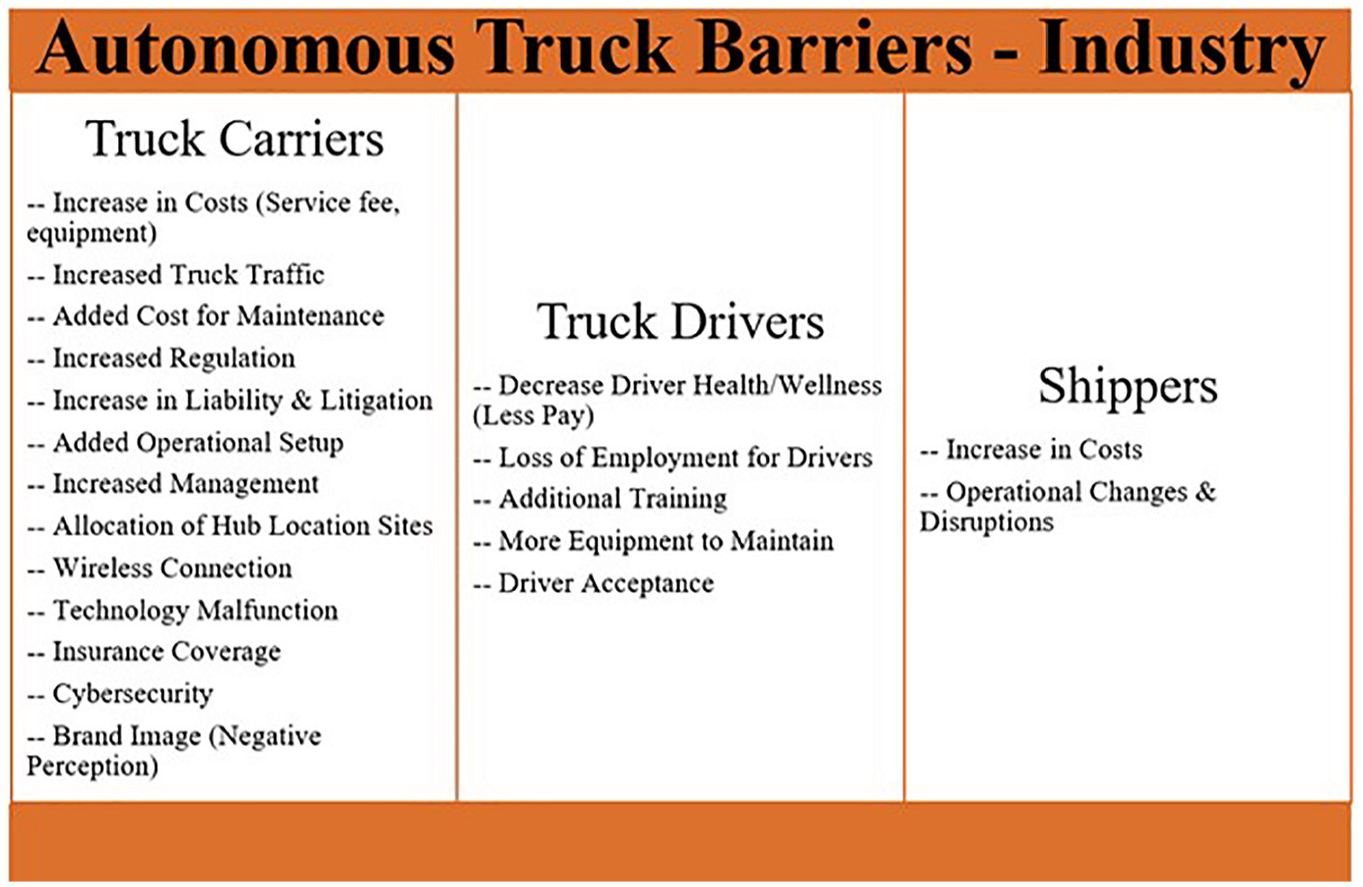
Autonomous truck barriers for the trucking industry.
It is clear from the AT partnerships being formed, the pilots be conducted on U.S. public roads, and the commercial adoption timelines by AT companies that the U.S. trucking market has the potential to be an early adopter of AV technology. Most of the AT companies are planning on deploying AT on specific routes in the Southwestern United States, though there are some companies that are testing ATs in North Dakota, Toronto, Arkansas, and New Orleans. All business cases involve finding repetitive routes that have a high volume of traffic. Identifying the possible business cases for ATs so that the general public, the government, and the trucking industry can start preparing for the adoption of ATs is therefore necessary. It is likely that most business cases will be state- or region-specific, as this setup is most amenable to Level 4 automation. Identifying where ATs will be used could help the general public better grasp the impact of ATs, help government draft appropriate regulation, and allow the trucking industry to realize the benefits of ATs. To determine the appropriate business cases for ATs, the trucking industry will need to be involved. Understanding the trucking industry’s current knowledge and perceptions of ATs, their willingness to use ATs, what routes, freight, and business cases they believe would work best with ATs, and what concerns and barriers they see in adopting ATs, will help determine what business cases are most feasible for ATs. In addition to the trucking industry, the general public and the government will need to be involved in determining where and how ATs are deployed on public roads. If the mutual benefits of ATs can be realized for all stakeholders, the full market potential for ATs can be realized in the United States.
Footnotes
Acknowledgements
The authors thank Tom Jirik for providing assistance in writing this article.
Authorship Contributions
The authors confirm contribution to the paper as follows: study conception and design: R. Jones, P. Lu, D. Tolliver; data collection: R. Jones; analysis and interpretation of results: R. Jones; draft manuscript preparation: R. Jones, P. Lu, D. Tolliver. All authors reviewed the results and approved the final version of the manuscript.
Declaration of Conflicting Interests
The authors declared no potential conflicts of interest with respect to the research, authorship, and/or publication of this article.
Funding
The authors disclosed receipt of the following financial support for the research, authorship, and/or publication of this article: This work was partly supported by the United States Department of Transportation, Federal Motor Carrier Safety Administration, grant number FM-MHP-23-001.
