




Abstract
In spot markets for truckload transportation services, centralized collaboration among carriers is often regarded as an ideal way to determine which load (a.k.a. shipment) is delivered by each carrier. The challenge of getting all competing carriers to collaborate under a centralized system (instead of being rivals for loads) has prompted interest in collaboration modes that are on a smaller scale than complete centralization. In this research vein, this paper answers the following question: for the small-scale collaboration of decentralized load exchange among small alliances of willing carriers, how close do the performance results (profits, etc.) come to the purported ideal results under centralization? Our core finding from extensive computational experiments is that, by collaborating with the right load exchange partners, a carrier in a small and easier-to-manage alliance can achieve financial savings that closely match and sometimes even surpass the per carrier savings from a fully centralized system. This, and some closely related insights, comprise this paper’s main contributions to the literature. The practical relevance of the contributions is in facilitating decisions about how much effort is worth expending on having every carrier within geographic network participate in a centralized system.
Keywords
Rightly so, many of the freight transportation community’s scholars and practitioners remain focused on the objective of gaining logistical efficiencies through collaboration: see for example, scholarly works such as Aloui et al. ( 1 ); Gansterer et al. ( 2 ); Vargas et al. ( 3 ); as well as practitioner reports such as Cassidy ( 4 ) and White ( 5 ). That focus is invariably on savings forfeited owing to the lack of such collaboration among carriers. For truckload transportation services, this holds true in the two major market types: spot and contract. Spot markets focus on one-off arrangements to meet immediate and known delivery needs within the next few days while contract markets are for longer term service contracts (e.g., over the next 12 months) to handle estimated delivery volumes aggregated at the level of transportation lanes (paths linking delivery origins and destinations). In spot markets, which is the market type of interest here, the auction-based process toward finalizing which transportation service provider (i.e., carrier) will deliver each load (a.k.a. shipment) normally proceeds in three main stages: First, carriers bid on loads advertised by shippers (or by freight transportation brokers representing shippers). Next, after solving their winner determination problems WDPs) for each load that was bid on by multiple carriers, the shipper offers it to the winning carrier. Finally, carriers receiving multiple offers beyond their transportation capacity, solve their winner determination problem to select the most profitable offer(s).
As a self-interested market participant in this three-stage auction process of bid→offer→accept decisions, a carrier views other carriers, not as parties to possibly collaborate with, but only as rivals to outbid in price competition for desirable loads. As such, the outcome of which load(s) a carrier will handle depends solely on the carrier’s success (or failure) in the bidding competition and not on any joint action or decision with any other carrier. A carrier could choose to view other carriers as potential collaborators. At the highest inter-carrier collaboration level, referred to here as full centralization, a single coalition of all carriers would decide the systemwide carrier–load pairings that are optimal for the coalition: that is, carrier–load pairing decisions are centralized under the coalition. There is a critical dilemma in this contrast between full centralization) and no inter-carrier collaboration (a.k.a. pure decentralization, in which each carrier independently seeks its own best load assignments and does not collaborate with others). The dilemma is that for carriers to transition from no collaboration to full collaboration to maximize logistical savings would mean incurring the expense of the centralized coalition’s organizational setup and operational governance: see, for example, Karam et al. (
6
). This paper provides some insight on this dilemma by addressing the following core question:
We consider this question in what is typically described in, for example, Lafkihi et al. ( 7 ), as the many-to-many market participation context: that is, multiple participants (shippers and carriers) and thus multiple concurrent bid→offer→accept interactions. A key motivation for addressing this question is rooted in the unexplored considerations in studies that focus on small-scale inter-carrier collaboration (as an alternative to the larger scale collaboration of full centralization); for example, Lafkihi et al. ( 7 , 8 ) and Özener et al. ( 9 ). In addition, Hvolby et al. ( 10 ) note the practical relevance of such collaborations from a field project involving European carriers. The small-scale collaboration of interest here is post-competition load exchange among carriers: that is, after being awarded loads through the decentralized process outlined above, a temporary alliance of two or more carriers conducts one-off load trading if such trading makes them better off than having each alliance member deliver only the load(s) it won through competitive bidding. As such, we will model the aforementioned patterns as functions of the alliance size (the number of members). As is evident in past works on load exchange—for example, Özener et al. ( 9 )—price competition largely explains why post-competition load exchange can yield improvement (i.e., why loads are misallocated in the first place). For example, by submitting a low (but still profitable) bid price, one carrier’s success in getting its best outcome (i.e., best load assignments) can result in a neighboring carrier (who also wanted one of those prized assignments) having to take a severely inferior assignment. In such cases, the joint interest of both carriers might be best met with load reallocation (a.k.a. load exchange) package in which one of the prized assignments goes to the less successful carrier. That is, the less successful carrier might have been the more cost-effective carrier for the prized assignments and the more successful carrier is more cost-effective carrier for the less prized assignment.
Therefore, unless the market functions according to an ideal in which bid prices across all rival carriers in a network are perfectly correlated with costs, post-competition load exchange will provide opportunity for beneficial load exchange. That ideal is likely to be thwarted by random price impacting differences across carriers on matters such as desired profit margin above operating costs and risk tolerance in the face of uncertainty about bid amounts from rival carriers. The next five sections of the paper describe the nature, logic, and outcomes of our work to explore post-competition load exchange. The second section reviews the extant literature and identifies its gaps that this work will address. The third section details the methodology of the experiments conducted, including the related mathematical programming models and algorithms. The fourth presents and discusses the findings and insights. The final section highlights the key conclusions and potential future research directions.
Literature Review
Within the domain of reverse auctions for freight transportation services (i.e., carriers as vendors bid the prices they wish to receive for their services), the scholarly literature of most direct relevance here is at the intersection of two research streams: (1) freight transportation spot markets in the truckload sector and (2) collaboration among carriers. To delineate how our work fits into those two research streams, we organize the review into two subsections. To spotlight our work’s possible theoretical implications, we close the review with reference to the literature’s apparent prevailing view of centralization as the standard of optimal benefit for collaborators and thus the ideal against which to measure the benefit produced by alternative modes of collaboration. Our review benefits since a rich compendium of articles at that intersection can be drawn from the combined reference list in literature surveys by Lafkihi et al. ( 7 ), Basu et al. ( 11 ), and Pan et al. ( 12 ).
Truckload Transportation in Spot Markets
From recent studies such as Hammani et al. ( 13 ) back through to more pioneering studies such as Figliozzi et al. ( 14 ), the literature denotes the central business problem in truckload spot markets transportation as freight transportation service procurement. This is to decide which carrier will handle each delivery and it has two key component decision problems: One relates to the auction procedure’s initiating stage bid submission: the carrier’s decision of what price to bid for each load of interest (i.e., the bid price generation problem a.k.a. the bid construction problem—BCP). The other is the WDP, which is invariably presented in the literature from the perspective of the shipper (or broker acting on the shipper’s behalf) who must decide which carrier to transact with.
As regards the pricing problem, works that emphasize prescriptive modeling (determining optimal prices to bid/quote) include Olcaytu and Kuyzu ( 15 ), Triki ( 16 ), Kuyzu et al. ( 17 ), and Triki et al. ( 18 ). Inputs to the literature’s prescriptive models include price estimates based on historical data. Those price estimates can come from the sort of sort of insights in works on predictive price modeling. Prominent price estimation/prediction works include Skinner et al. ( 19 ), Özkaya et al. ( 20 ), Lindsey et al. ( 21 , 22 ), and Lindsey and Mahmassani ( 23 ). Related works that can be leveraged for price prediction include Scott ( 24 ) who used longitudinal data to understand market participants’ pricing behavior and Miller et al. ( 25 ) who studied how the relationship between spot prices and contract prices changed since the advent of the electronic logging device (ELD) mandate. For the experiments in our study, we lean more toward using prices based on empirical studies of the pricing logic used by North American trucking companies: we elaborate on this in the section ‘Bid price data inputs for the computational experiments’ of the methodology discussion.
Like the bidding stage (which follows from either BCP solutions or a carrier’s chosen pricing logic or heuristic), the literature presents the next auction stage as the outcome of an optimization procedure: that is, the load offer stage results from shippers solving their WDPs. See, for example, already cited works on prescriptive price modeling as well as Hammani et al. ( 13 ) and Xu and Huang ( 26 ). The scope of published works on the WDP extends beyond the truckload’s spot market setting we are focused on and includes contract market setting: for example, Ma et al. ( 27 ), Remli and Rekik ( 28 ), and Zhang et al. ( 29 , 30 ). For the culminating post-offer stage of carrier load acceptance of load offers, studies cited so far portray carriers as obligated to accept what they are offered. That is, those studies do not consider the possibility rejection (as the outcome of rational analysis by a carrier) because it is either implied or explicit that acceptance is an automatic response carrier action, not the outcome of solving a decision problem.
Meaningful discussions of load rejection are limited to contract markets: see, for example., Acocella and Caplice ( 31 ). Such discussions are for cases in which the contracted carrier for a lane, rejects the shipper’s tender for delivering a specific load on that lane (thus prompting the shipper’s use of the spot market). Beyond those discussions, Triki et al. ( 18 ), which is on freight transportation spot markets, acknowledge that a carrier (perhaps to “hedge its bets”) might bid on a bundle containing time-incompatible loads: that is, two loads with delivery dates that limit the carrier to accepting no more than one of those loads, even if the carrier is the lowest bidder for both loads (which means that one of them must be rejected). The authors address the issue with a constraint adjustment to their bid generation model instead of treating the inevitable rejection as a genuine post-offer decision by a bet-hedging carrier. In the reverse action domain, Zhou et al. (32) (but outside of trucking) handle post-offer rejection explicitly as a supplier decision based on reasons such as subsequent discovery that accepting the offer would yield negative profit. In truckload transportation, this subsequent discovery is possible because there is no guarantee of equality between a carrier’s expected and realized costs to handle downstream loads (i.e., those picked up after delivery of the first pick-up). Specifically, carriers’ bid prices typically use expected cost inputs based on expected auction outcomes for loads to be picked up earlier. However, realized auction outcomes (which could require the carrier’s truck to travel longer than expected/hoped to pick-up a downstream load) can turn an expected profit into a realized loss. With this insight that post-offer rejection is a reverse auction phenomenon and the Triki et al. ( 18 ) observation that carriers can bid for (and thus be offered) load bundles that they cannot wholly accept, we treat the WDP as a decision problem that is not just for service buyers (shippers) but also for service vendors (carriers). That is, unlike the literature’s usual three-stage process (bid→offer→accept), in which the reverse auction’s third stage is essentially pre-determined carrier acceptance of offers, we account for the possibility of offer rejection.
Carrier Collaboration
The carrier collaboration research stream spans truckload as less-than-truckload (LTL) and vehicle routing operations. This is evidenced in literature survey papers by Pan et al. ( 12 ) and by Gansterer and Hartl ( 33 ), whose review was directly targeted at LTL and vehicle routing problem (VRP) settings. Within this literature’s truckload-focused segment, a point of emphasis, particularly in more recent works, is the contrast between centralized and decentralized collaboration. One of the stylized descriptions of centralized collaboration is as follows: a single entity (e.g., the administrator of a load-board announcing a transportation network’s shipments requiring delivery) gathers all the carriers’ bids (or expressions of interest), then, with the benefit of full visibility of the transportation network’s relevant data, solves the network-wide carrier-to-load assignment problem to produce the optimal set of carrier–load pairings. Authors such as Lafkihi et al. ( 34 ) use the term price of anarchy to portray the difference between this globally optimized solution’s statistics (e.g., aggregate network-wide carrier profits from delivery operations) and inferior statistics from situations in which no collaboration occurs. Özener et al., ( 9 ), though not the first to examine centralized carrier collaboration, provide much of the foundation for the ample body of research about centralization’s benefits.
Examples of such research (i.e., focused on measuring centralization’s benefits) in truckload contexts include Hezarkhani et al. ( 35 ), Li et al. ( 36 ), and Haughton et al. ( 37 ). For LTL and VRP contexts, recent benefit measurement examples are Vaziri et al. ( 38 ), Padmanabhan et al. ( 39 ), and Karels et al. ( 40 ), whereas earlier examples include Berger and Bierwirth ( 41 ) and Hernández et al. ( 42 – 45 ). Still, along with the definitive acknowledgment of centralization’s benefits, the literature highlights concerns about the practical feasibility of fully centralized collaboration. As noted by authors such as Vargas et al. ( 3 ), Karam et al. ( 6 ), Lafkihi et al. ( 34 ), Pan et al. ( 12 ), Lyu et al. ( 46 ), and Özener et al. ( 9 ), some of the frequently cited concerns are carrier’s loss of autonomy and flexibility, considerable organizational set-up, and complex operational governance (especially in regard to gainsharing and information sharing). Those concerns have motivated published works on non-centralized collaboration mechanisms that can produce worthwhile savings at desirable levels of carrier autonomy and tolerable levels of organizational and administrative effort.
These alternative mechanisms involve carriers exercising the option to have ad hoc (one-off) alliances with one or more rival carriers on occasions when such cooperation benefits the alliance partners. A typical form of cooperation is post-market/competition load exchange, that is, alliance members exchange shipment requests they won through competitive spot market bidding: see, for example, Özener et al. ( 9 ). These mechanisms go by names such as decentralized coordination in Vargas et al. ( 3 ); decentralized collaborative transportation networks (CTN) in Lafkihi et al. ( 8 ); carrier alliance in Pan et al. ( 12 ); and distributed control in Li et al. ( 38 ). Although decentralized collaboration is not new to the research literature (note, for example, the date of the Özener et al. [ 9 ] study), multiple authors have observed the need for further research involving comparative analysis of decentralized mechanisms versus centralized optimization. In making and preliminarily responding to the call for further research, Lafkihi et al. ( 34 ) simulate a four-carrier problem to study an intermediate scenario between pure centralization and pure decentralization.
Based on those simulations, Lafkihi et al. ( 34 ) presented several intriguing tentative insights about their intermediate scenario (in which carriers know the overall average margin across all carriers under pure decentralization). However, they noted that such scenarios must be explored more fully before definitive conclusions can be given. To the best of our knowledge, no published paper provides such conclusions. More specifically, none has answered the question of how the number of partners in a decentralized load exchange carrier alliance influences the alliance’s performance statistics (alliance partners’ profits, customer service, and eco-efficiency) vis-à-vis centralization’s performance statistics. Although it may seem intuitively obvious that more alliance partners should result in better performance statistics, several important matters are not at all obvious. These include (i) the functional form of the relationship between alliance membership size and each performance metric and (ii) the amount of stochasticity in estimating the performance statistics. Systematically addressing those matters through extensive and carefully designed experiments is the essence of this paper’s novel contributions to the research literature.
Beyond their practical relevance, which we detail later in the paper, these contributions also have theoretical relevance. The relevance relates to the literature’s prevailing wisdom that, in any non-centralized collaboration, there is a non-negative price of anarchy (since only centralized collaboration is free from the anarchy of independent decisions by individual carriers). This view is incontestable if the price of anarchy is measured with reference to carriers’ aggregate operating profits forfeited from not participating in a centralized system. That is because of the inherent sub-optimality in any non-centralized collaboration mechanism: for example, load exchanges yield local optima (i.e., only for exchange partners) instead of a networkwide optimum. However, if the price of anarchy is measured with reference to profit per carrier, we will show that non-centralized collaborations can, in some circumstances, outperform centralization. To that end, our work provides a basis for conceptualizing and measuring the price of anarchy more broadly.
Models and Methods
This section addresses four key elements of the study’s methodology. The first element is about the transportation network context for the experiments and the design of those experiments: parameters, replication, and so on. The second element comprises the mathematical models we use to represent (a) pure decentralization (loads awarded through competitive bidding in a reverse auction); (b) pure centralization; and (c) and post-award load exchange among alliance partners. The third element clarifies how bid price data were gathered from empirical sources. The fourth element is about how we measured and analyzed the performance of post-competition load exchange. In the appendix, we present a small numerical example that readers may find useful for visualizing the processes in these methodological elements and for having preview of how load exchange opportunities can arise and helps to illustrate the contrast between centralization and small-scale load exchange collaboration.
Network Context and Experimental Design
The transportation network context for the experiments is a hypothetical square region of size 1 million kilometers (km) squared with side length = 1,000 km. We study situations involving different numbers of competing long haul truckload carriers (V = 9, 12, and 16) and the daily number of loads equal to the number of carriers (e.g., 16 × 2 = 32 loads for V = 16). To keep the computational work manageable, we started with V = 9, then tried 12, followed by 16 to see if and how the results are affected. The results indicated that there is no need to go beyond V = 16. Carriers’ pricing account for opportunities to achieve economies of scope, which portrays the circumstance of carriers having two-day visibility of the 2V loads, so that they can detect such opportunities (from among the (V + 1) 2 − 1 possible two-day tours). Given the long-haul truckload context, each carrier’s capacity is one load per day. Replication to produce different test cases in this context involved generating random starting positions for each of the V trucks and random pick-up and drop-off locations for each of the 2V loads. Those locations (specified as x and y coordinates in the 1,000 × 1,000 grid) were random draws from a uniform distribution with [a; b] = [0; 1,000] for both coordinates. There were 10 such draws for each value of V. For each of those 16 different spatial juxtapositions of loads and carriers, we generated four random sets of 2V prices for each of the V carriers (using a simulated price generation procedure described in ‘Load exchange performance measurement’ below).
For each of the resulting 40 test cases for each value of V, we first simulated the previously described iterative three-stage auction process to ascertain the load-to-truck assignments. We then solved 8 × (V− 1) load exchange problems (formulation in ‘Bid price data inputs for the computational experiments’). The (V− 1) is for the different numbers of load exchange alliance partners (K = 2, 3, …, V) and the 8 is for the number of randomly selected K-partner alliances from among the V carriers. For an alliance size of, say approximately 30% of the V carriers (i.e., K≃ 3, 4, 5 for V = 9, 12, 16, respectively), our design yields 960 observations (40 test cases × three [3] levels of V× 8 random partner selections). This ample number of observations facilitated robust confidence intervals and estimates such as the probability of finding a profitable K-member alliance from among a region’s V carriers. Note that for K = V, there is only one set of partners, which is the set of all V carriers. This represents centralized load exchange, which is one of the two forms of centralization we study. The other form (described in ‘Bid price data inputs for the computational experiments’ below) is for the coalition of V carriers to submit a single bid for each load after solving the coalition’s profit maximization problem.
Mathematical Models
Modeling Pure/Complete Centralization
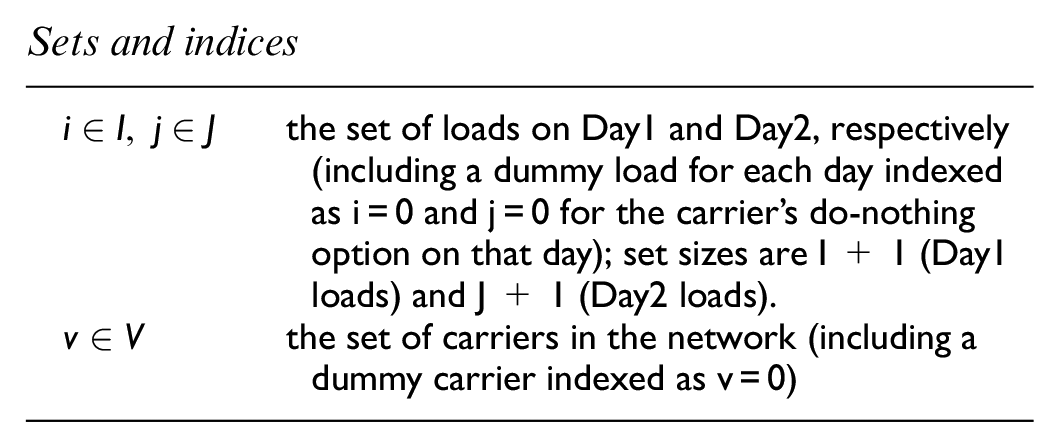
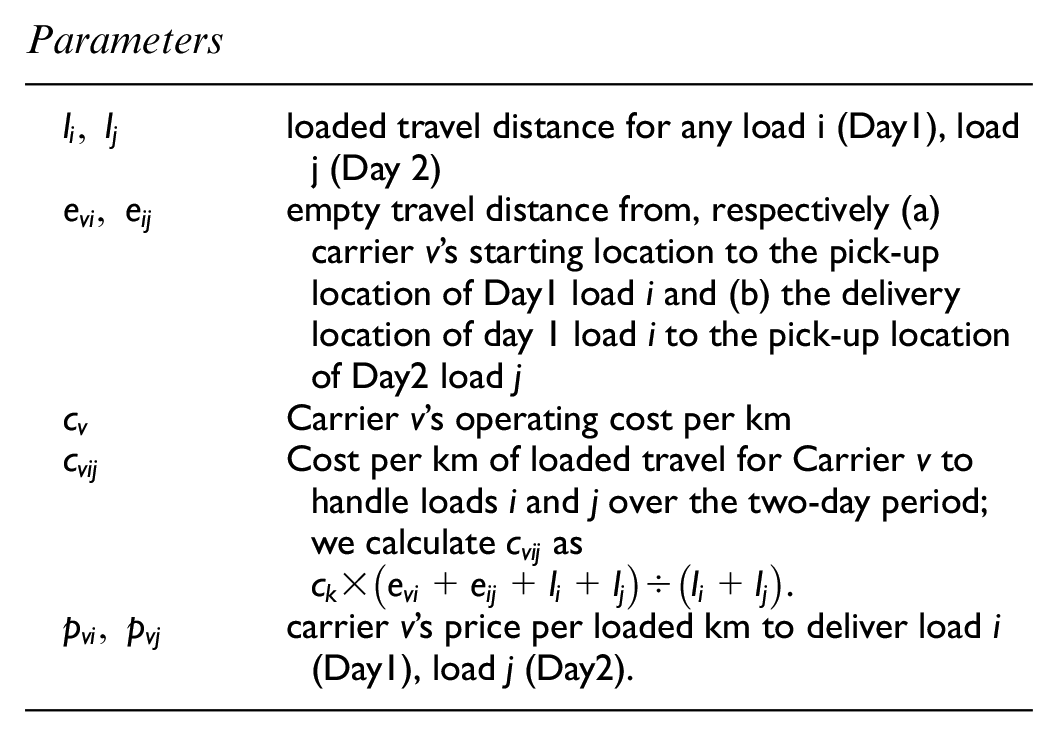
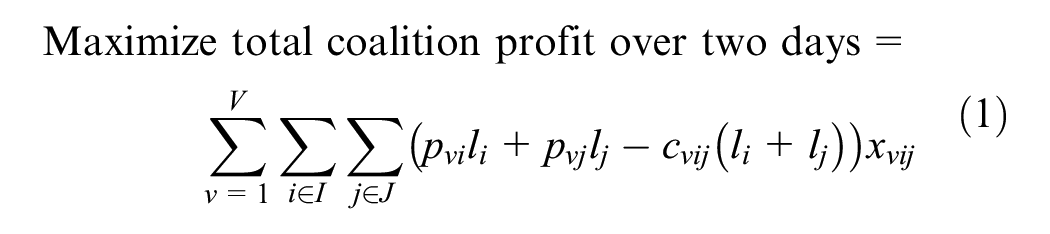
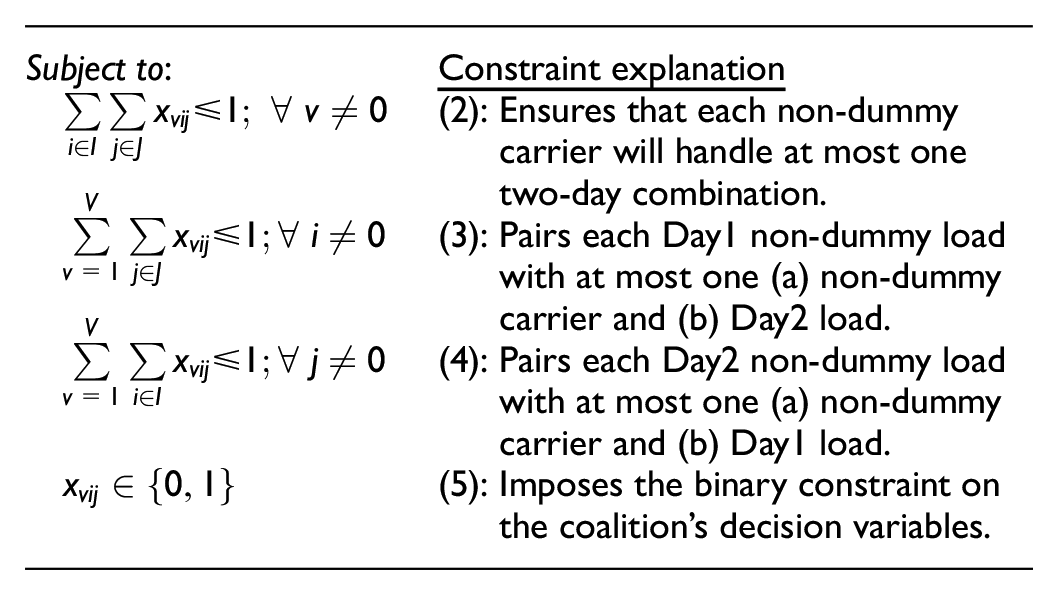
There are at least two conceptions of centralization. One conception we consider is for the number of alliance members to be equal to the number of carriers operating in the network: that is, the special case of a load exchange alliance with 100% carrier participation. As indicated in the numerical example above, the other conception we will consider is to view the set of all carriers in the network as a single mega carrier that determines its globally optimal set of truck-to-load assignments, then makes just one bid on each load. The bid for each load is the bid price of the carrier to which the load is assigned under global optimization. Along the lines of the subtle alliance versus coalition distinction noted in Pan et al. ( 12 ), this way of representing centralization is akin to a coalition. The coalition’s profit per carrier, customer service, and eco-efficiency will provide the benchmarks against which we will gauge the performance by alliances of different sizes. The definitions and formulation of the coalition’s load-to-carrier assignment problem are as follows:
Sets and indices
Parameters
The decision variable
Incorporating the definitions above into the V-carrier coalition’s objective function yields:
Modeling Pure Decentralization (Competitive Bidding Reverse Auction)
As outlined in this paper’s introduction, the spot market’s three-stage operation under decentralization starts with carriers bidding on advertised loads in the reverse auction. In our research context, there is a set of loads to be picked up on one day, and another set to be picked up the following day. On the first day, the carriers know of all loads over the two consecutive days (i.e., visibility into tomorrow’s shipment requests). This visibility allows carriers to detect opportunities for what studies such as Özener et al. (9) define as economies of scope: financially attractive multi-day/multi-load tours through cost-effective repositioning of empty vehicles over multiple days. With carriers’ bid prices as inputs, we execute the second process stage (where shippers determine their optimal decisions of which load[s] to offer to each carrier) by solving their WDPs. For the third stage, carriers who receive multiple offers beyond their transportation capacity, solve their own WDP to select the most profitable shipper offer(s). The process returns to the second stage for loads that are still available to be offered and terminates when, for every carrier, taking on another load is either unprofitable or infeasible (because taking on the load would violate the constraint that a carrier can handle at most one truckload delivery per day). Following are the definitions and formulations for the individual shipper’s WDP and the individual carrier’s WDP, respectively. After those definitions and formulations, we present Figure 1 for clearer visualization of the three-stage auction process, which we programmed in MATLAB. The framework in Figure 1 can be flexibly generalized to some typical other auction processes for freight transportation procurement. For example, if carriers are price takers (i.e., the load board displays a shipper-specified price to signal the shipper’s maximum acceptable price [a.k.a. reserve price] to deliver the load), the model would remain intact since the effect would merely be fewer bids for shippers to consider. That is because carriers for whom the load’s reserve price would result in a loss would not bid on the load. As well, for multi-item multi-round auctions—see, for example, Berger and Bierwirth ( 41 )—which would involve each carrier bidding on just one time-compatible load bundle in each round, only a few straightforward tweaks would be required: remove the carriers’ WDP step (no longer needed for time-compatible offers) and add a step that involves applying any of the literature’s established bundle generation models to determine which time-compatible bundle (from the round-specific population of all possible bundles) the carrier should bid on in the round under consideration.
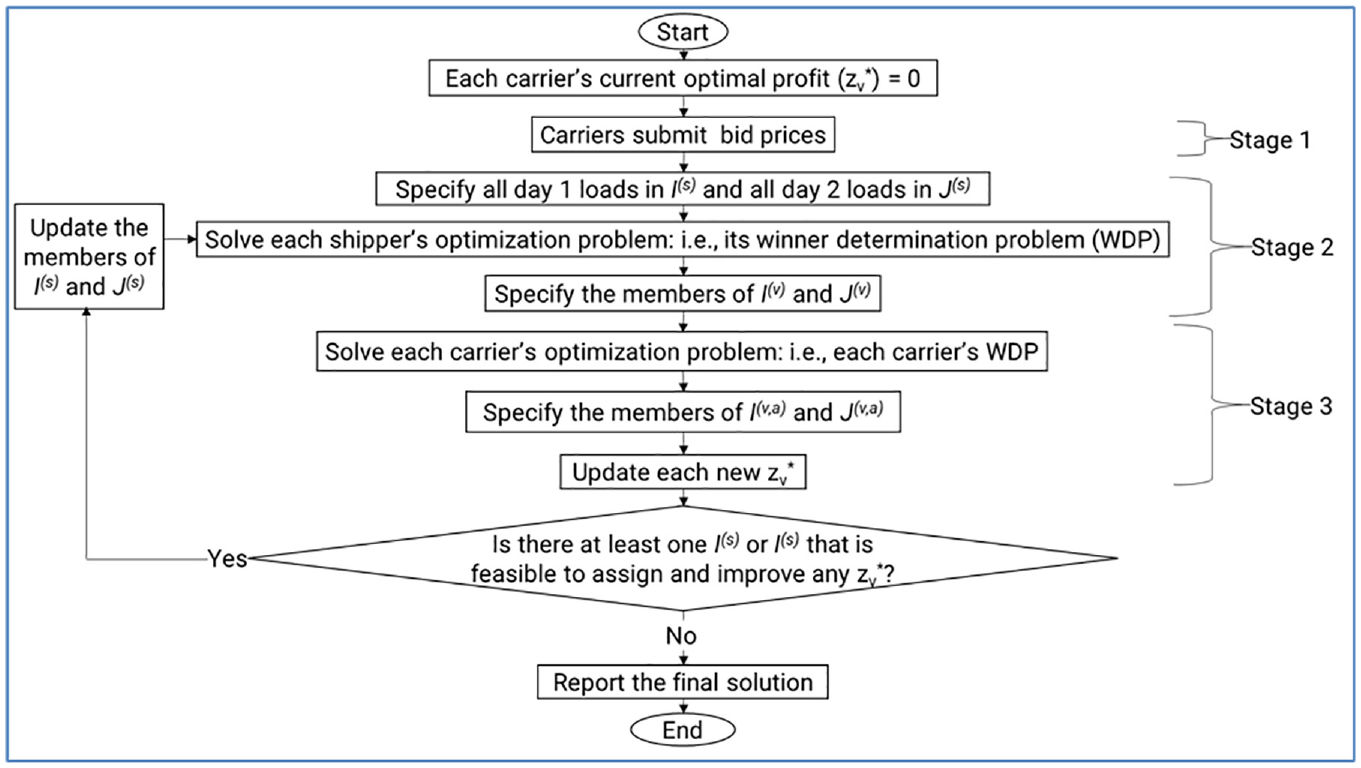
Flowchart to model the three-stage auction process under decentralization.
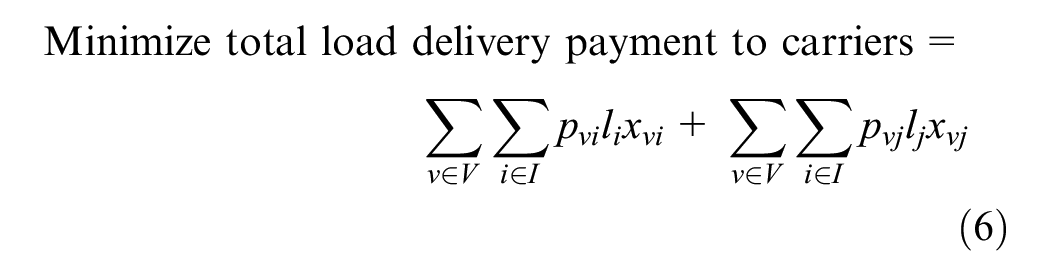
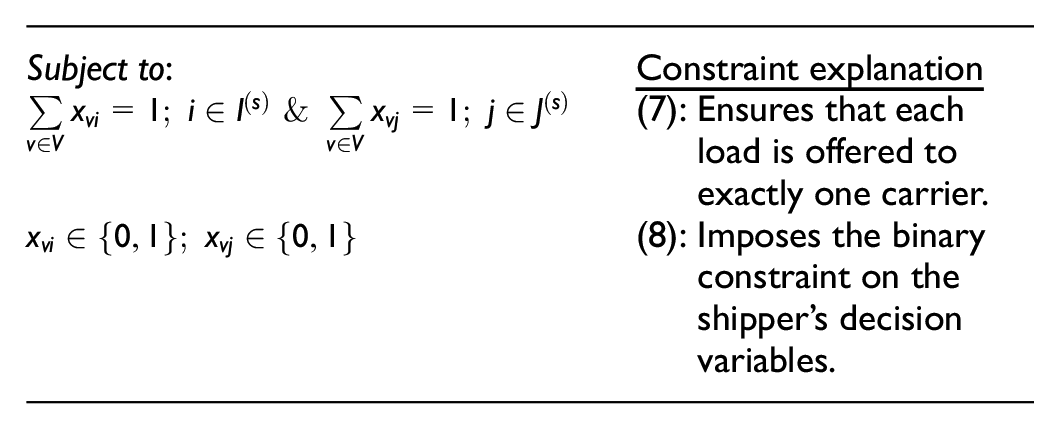
For each shipper (denoted s) with set I(s) of Day1 loads and set J(s) of Day2 loads that are yet to be assigned any carrier, we define x vi and xvj as binary decision variables. Respectively, these specify whether Day1 load i from set I(s) is offered to carrier v and whether Day2 load j from set J(s) is offered to carrier v. Further, we set the price for the dummy carrier (that can accept an unlimited number of loads on any day) as a very large number M (i.e., p0i = p0j = M). This logic behind the artificially high price of M is that it is just one way to account for the shipper’s loads that all non-dummy carriers rejected in the auction (while ensuring that the dummy carrier is the shipper’s last resort). Loads that go to dummy carriers are, in effect, unassigned loads, so the amount paid to dummy carriers is an artificial payment to be subtracted post-optimization to determine the shipper’s true total payment. In each iteration of the auction, that shipper’s optimization problem (minimize total spent for load delivery) is:
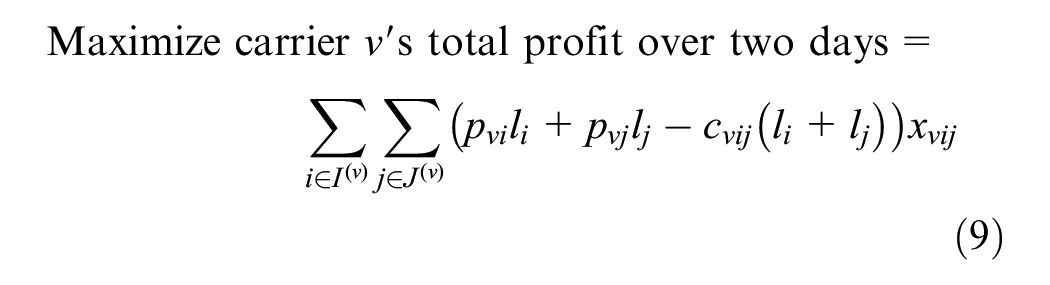
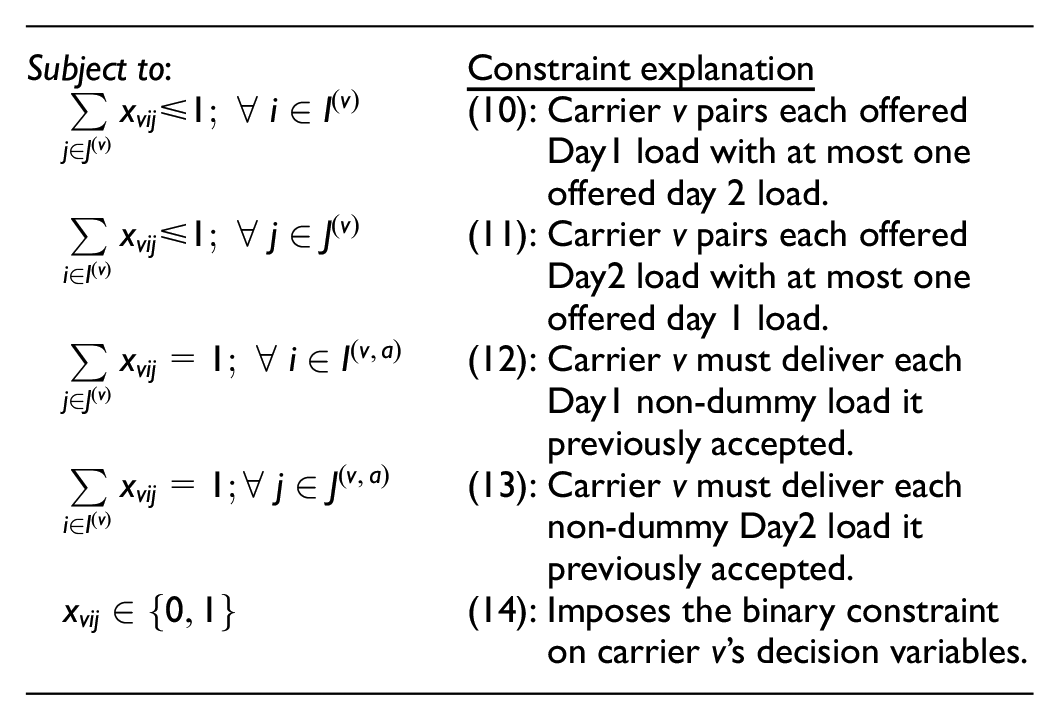
For each carrier (v = 1, 2, …, V), we specify the model in a way that is general for any number of trucks a carrier possesses: that is, a model that readily captures our context of single-truck carriers but is not limited to that context. Consider carrier v who has received two sets of load offers (sets denoted I(v) and J(v) for Day1 and Day2, respectively) and, from previous iterations, already accepted two sets of non-dummy load offers (sets denoted I(v,a) and J(v,a) for Day1 and Day2, respectively). Based on these sets and on sets, indices, parameters, and decision variables, specified earlier, the objective function for carrier v’s WDP is as shown in (9), with constraints in (10) through (14).
Modeling The Mechanism of Load Exchange Among Alliance Members
From the decentralization results specifying the load(s) accepted by each member of the carrier alliance, we then model the problem to find optimum load exchanges among alliance partners. For a given K-carrier load exchange alliance, we now define an additional set K (the set of carriers in the alliance) and two binary parameters (Ai and Aj) that will be given a value =1 for any load accepted by a load exchange alliance partner in the decentralized solution or =0 for any load that remained unassigned during the auction and thus open for reconsideration in the post-auction load exchange. The alliance has some pricing freedom on unassigned loads but loads that an alliance member accepted must be delivered at the agreed auction price (a.k.a. the strike price): pi for the ith Day1 load and pj for the jth Day2 load. The alliance’s objective function in (15) and the constraints reflect those considerations.
Maximize total alliance profit over two days

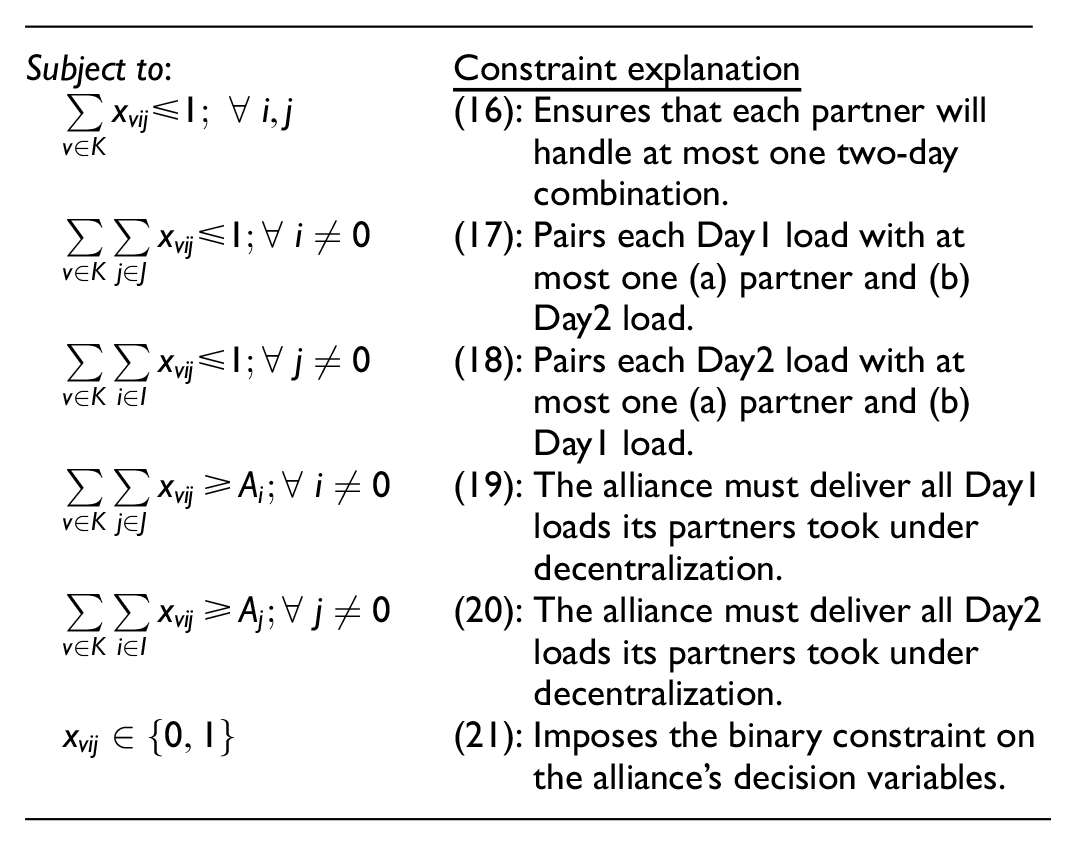
We note here that the basic post-auction load exchange activity represented in the above formulation in (15) to (20) is not the only non-centralization collaboration mechanism to benchmark against centralization. For example, as discussed in the literature survey paper by Pan et al. ( 12 ), exchange alliances can incorporate more intricate elements such as an additional pricing decision problem (which exchange partners solve to determine the prices for exchanged loads). Given this paper’s focus on a research purpose that the literature has not heretofore addressed—to gauge the impact of alliance size on outcomes such as profits—we chose to provide baseline findings from working with a tractable form of load exchange that is free of such intricacies.
Bid Price Data Inputs for The Computational Experiments
The pricing inputs in our experiments reflect realities in North America’s trucking sector. Those realities and how we utilized them in the experiments were as follows:
□ Carrier operating margin (operating profit as a ratio or percentage of cost). Multiple sources of trucking industry statistics (the American Transportation Research Institute: https://truckingresearch.org/; Freightwaves: www.freightwaves.com; etc.) present average ratios (in percentage terms) of between mid-to-low single digits and the mid-teens. Based on those sources, we set each carrier’s bid price for any specified load to be a random value between 5% and 17% above the carrier’s cost per loaded km to handle the load. Because those industry sources also indicate that most carriers operate with very thin margins, we used a triangular distribution with mode (and minimum) = 5% and maximum = 17%.
□ Carrier operating cost. To determine ck) for carrier k (as input for calculating cost per loaded km and subsequently the bid price as indicated in the preceding bullet point), we referred to Zolfagharinia and Haughton (47). The authors indicated that an average carrier’s operating cost is approximately $ 0.70 per km. There is variation around the average (e.g., some carriers are better at deploying efficiency-enhancing practices). So, for any carrier v, our experiments randomly assigned c v as a random draw from a triangular probability distribution with parameters (minimum; mode; maximum) = ($ 0.60; $ 0.70; $ 0.80) per km.
□ Carrier cost per loaded km for Day1 loads. To decide its bid price a Day1 load, the carrier has cost certainty (because its initial location is known); that is, Carrier v’s cost to handle any Day1 load i is c vi = cv× (e vi + li) ÷ li, which means that if Carrier v’s randomly assigned operating margin for that load is m vi , then the resulting simulated bid price is straightforwardly calculated as (1 + m vi ) × c vi .
□ Carrier cost per loaded km for Day2 loads. To decide its bid price a Day1 load, the carrier faces cost uncertainty because its location at the start of Day2 is unknown: that depends on which, if any, load it wins in the auction. If N (= V in this study) is the number of Day1 loads, then after Day1 loads are assigned Carrier v will be at one (yet unknown) of N + 1 possible locations in preparation for Day2 (i.e., the N delivery locations of the Day1 loads plus the initial location if it does not win a Day1 load). As inputs to inform our computational study reported here, we conducted extensive auction simulations (using N = 9, 12, 16 and focused solely on Day1 loads) and found that while carriers will have better chances of getting their more desired Day1 outcomes, the presence of inter-carrier price competition means that no carrier is assured of getting any of those outcomes. So, using the metric of surplus of revenue travel over empty travel to rank the carrier’s possible Day1 outcomes from best to worst (ranking rom 1 for the largest surplus to N + 1 for the smallest surplus), we modeled the carrier’s
Load Exchange Performance Measurement
To gauge the relative performance of post-competition load exchange among alliance members, we measure its performance in against the benchmark performance under pure centralization’s performance. The metrics to be compared relative to centralization are collaboration driven profit gained per carrier, customer service, and ecological efficiency. These metrics are calculated as follows:
■
■
■
Results, Discussion, and Business Implications
This section comprises four subsections to address the alliance member profit performance; customer service performance; eco-efficiency; and the comparison of alliances and coalitions.
Alliance Member Profit Performance
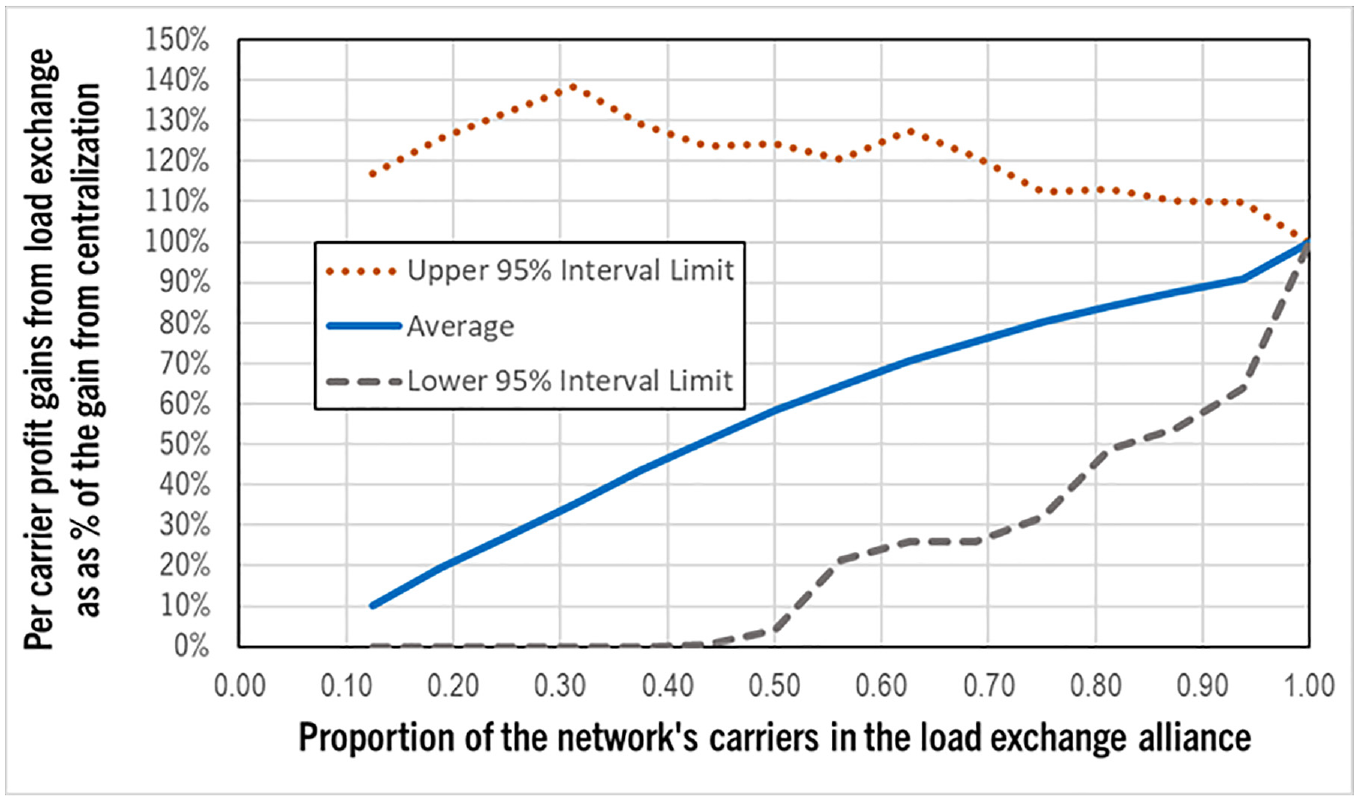
Figure 2 concisely summarizes the full experimental results on per carrier profit gained by exchanging load exchange (measured as a percentage of the corresponding gain via centralization). The y-axis shows the mean and the range within which 95% of the observations fell for each alliance size (measured in percentage terms as K/V, where K and V are as previously defined: K = number of load exchange partners and V = number of carriers in the network). Figure 3 portrays three major findings:
(1) As indicated by the 95% intervals’ upper limits (upper dashed line in Figure 2), small alliances (≈ 10%–20% of the network’s carriers) can attain profit per carrier gains that exceed the profit per carrier gained from centralizing: upper limits exceed 100%. This shows that, concerning profit per carrier, the partial anarchy of carriers collaborating independently of a centralized system can have a price of anarchy that is zero (a value of 100% on the graph’s vertical axis) and sometimes negative (values above 100% on the vertical axis).
(2) Using the upper 95% limits as indicators of alliance outcomes that are very beneficial (i.e., high gain-producing), such outcomes can be better for small alliances: observe that the upper 95% limit for profit gained per carrier rises as the alliance size grows up to around 30% of the network’s carriers, then gradually tapers off for larger alliance sizes. This finding can be characterized as gainsharing’s general numerator/denominator phenomenon: aggregate gains grow with alliance size but eventually, the number of alliance members that the gains must be shared among makes it unwise to continue increasing the alliance size.
(3) Using the lower 95% limits (lower dashed line) as indicators of allowance outcomes in which the gains are relatively low or non-existent, such outcomes are evidently more pervasive for small alliances: observe that the lower 95% limits for per carrier profit from load exchange just barely exceed 0 for alliances up to around 50% of the network’s carriers, then rises noticeably after that; viewed another way: profitable small alliances are rare.
An important managerial insight to be drawn from the combination of findings (1) through (3) concerns the large gaps between the 95% upper and lower limits for small alliances. Those findings raise the question of why some small alliances can be so beneficial (notice the existence of per partner profit gains being higher than under complete centralization: >100%) and others yield dismally little to no gain. That is a question of who the right load exchange partners for a small alliance are. Our study confirmed the intuition and expected insight that the more beneficial alliances are among partners that are or will be spatially close to each other over the two-day period. We used the following logic to operationalize spatially close: in a network of V competing carriers, spatially close carriers in a K-partner alliance would occupy approximately a K÷V share of the 106 km2 network, so that the two most distant alliance partners from each other are no further than a rectilinear trip of length
Average and 95% interval bounds on profit gained per carrier as functions of alliance size.
Average and 95% interval bounds on relative % of loads accepted for delivery as functions of alliance size.
Customer Service Effect of Load Exchange Alliances
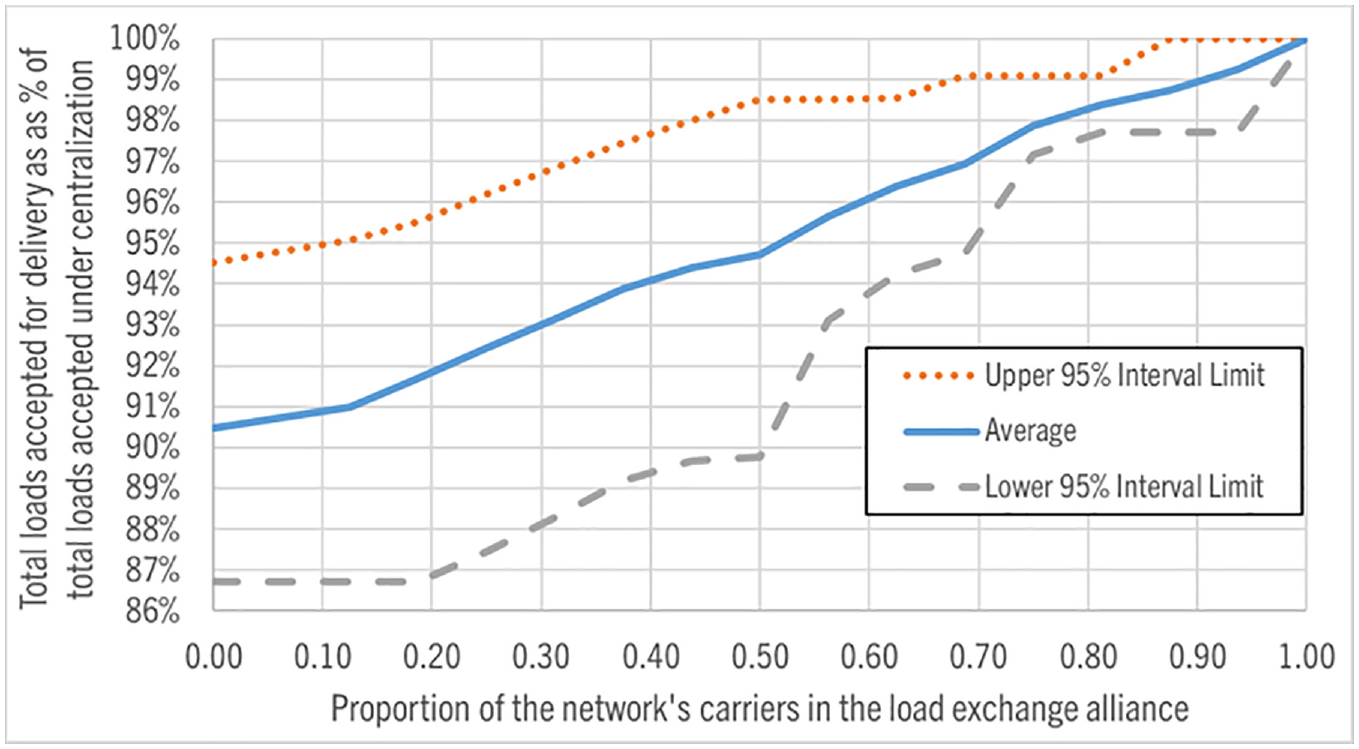
Figure 3 shows the overall results for customer service metric (its mean and 95% interval limits), measured as networkwide number of loads accepted for delivery (as a percentage of the number accepted under centralization). Three notable results from Figure 3 are:
(1) Based on the lower interval 95% limits, it is possible that unless the load exchange alliances comprise at least 20% of the network’s carriers, then 97.5% of the time, the number of loads shipped could be as low as 87% of what is shipped under complete centralization. That 87% is essentially the same 95% lower limit with no alliance, meaning that it is possible for very small alliances to have no impact on customer service.
(2) Conversely, the upper 95% interval limits show that small load exchange alliances can yield customer service performance that is competitive with centralized optimization: nearly 96% of centralized optimization’s delivered shipments with just 20% of the network’s carriers engaged in load exchanges.
(3) Unlike the gain in profit per load exchange partner, customer service metric for alliances never exceeds the corresponding metric for complete centralization. That is, as anticipated, the best networkwide customer service performance is achieved with complete centralization.
As with the plots of interval limits for gain in profit per alliance partner showing a conspicuous gap between high and low gains for small alliances, the corresponding gap between strong and weak poor customer service performance in Figure 3 points to the same business implication: the impact of load exchange alliance depends on having the right set of partners come together. The proximity criterion cited earlier for higher profit gains (i.e., the two most distant K-member alliance partners from each other being within a rectilinear trip of length
Environmental Sustainability Effect of Alliances
Figure 4 plots the mean and 95% interval limits for the eco-efficiency metric for different alliance sizes. The plotted eco-efficiency values are relative to the eco-efficiency for complete centralization: that is, ratio of loaded travel distance to total travel distance under post-competition load exchange as a percentage of the corresponding ratio under centralization. The key findings on eco-efficiency are:
(1) Similar stories to what we observed for profit and customer service emerged in (a) the trajectory of the Figure 4 plot lines (highlighting the possibility of little impact from small alliances) and (b) noticeably wider gaps between the 95% interval limits for small alliances (highlighting that the impact depends on finding the right alliance partners).
(2) From trying a second-order polynomial regression between the average profit gain per alliance member and the eco-efficiency metric, we found that just under 98% of the variation in per member profit gain can be explained by eco-efficiency. That high R 2 indicates that the dominant source of profit gain from load exchange is the reallocation of loads to increase the chances of (a) Day1 loads being allocated to the most advantageously positioned carrier and (b) Day2 loads being allocated to maximize economies of scope defined earlier (i.e., allocation to carriers whose updated positions after Day1 yield minimum empty travel for the Day2 load). This observation returns the spotlight to the issue we raised in this paper’s introduction: the issue of why loads are misallocated during competitive auctions. Our experiments showed that even with seemingly rational bid pricing by carriers (the pricing model of 5%–17% above cost), there is no guarantee that the carrier who is offered and accepts a given load assignment is the most advantageously positioned carrier for that load.
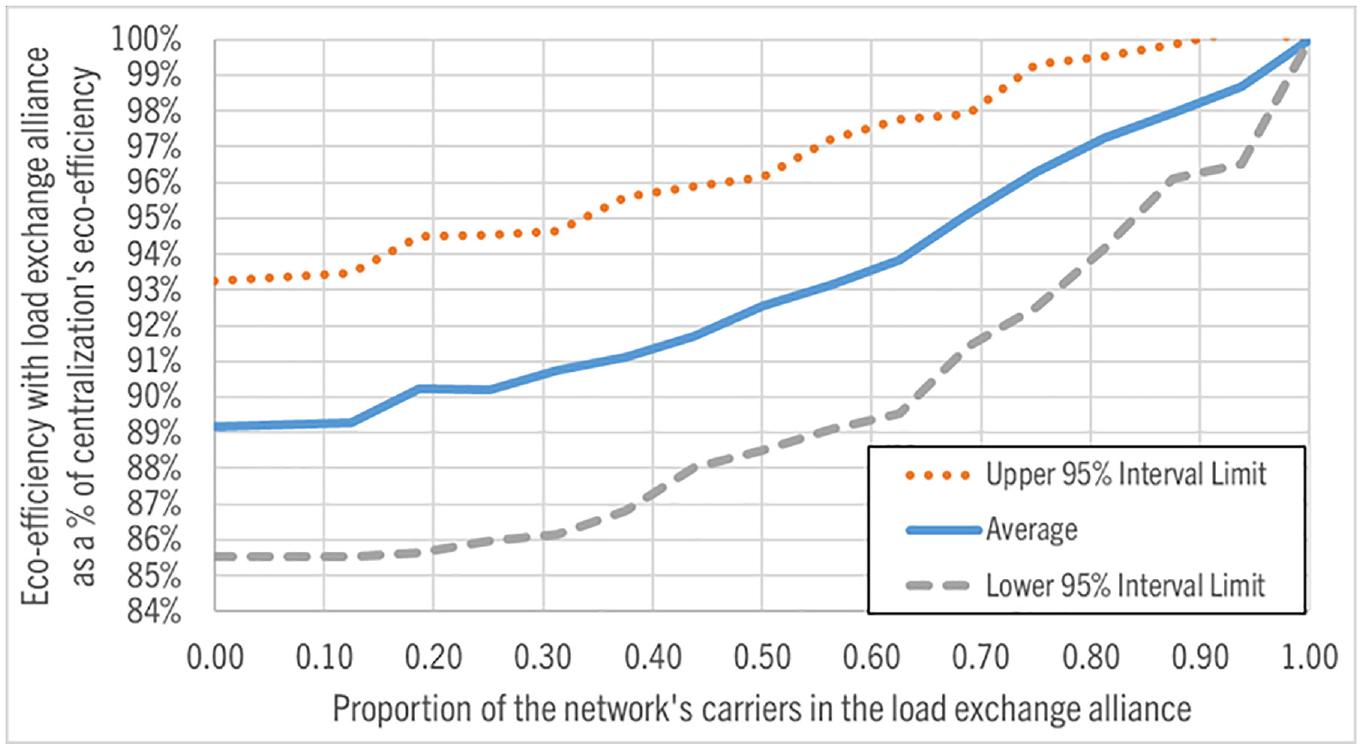
Average and 95% interval bounds on relative eco-efficiency as functions of alliance size.
Bidding as a Coalition Versus Exchanging Loads Through an Alliance
On the question of whether to collaborate as a coalition or as a load exchange alliance, we compared both forms of collaboration for the case of K = V. While a load exchange alliance is constrained by the predetermined agreed rates (i.e., strike prices) that resulted from decentralized bid price competition, a coalition would involve all K carriers acting as a monopolistic mega carrier that has more pricing flexibility. Therefore, we already know that the coalition’s profit cannot be smaller. The unknown we sought to uncover is the amount by which the coalition’s profit exceeds the load exchange alliance’s profits. Our experiments across the 120 cases (40 for each value of V) yielded a mean of 1.08% (within a range of 0.52% to 1.98%). Because a coalition involves an arguably bigger administrative challenge than post-competition load exchange, this average of 1.08% can be viewed as the expected reward from undertaking that extra challenge. Logic suggests that this reward will probably be smaller for comparisons of coalition versus load exchange alliance when K < V. That is because the coalition’s bid price for a load is not guaranteed to beat the lowest from among the V−K non-coalition members. This would necessitate the coalition either lowering its bid price for that load or accepting an inferior load. As such, the projected profit from the coalition’s desired optimal set of loads it would compete for is likely to be lower than its realized profit.
Conclusions
Research Contributions
The essence of this paper’s contributions can be distilled into three practical implications for carriers in spot markets for truckload transportation services. First, we found that, on average, the gain in profit per carrier increases with the size of the carriers’ load exchange alliance. Second, and crucially, we found that, despite the larger expected profit gain owing to larger alliances, the alliances need not be large for carriers to achieve impressive financial gains of cooperating with competing carriers. For example, we show that within a network served by 16 carriers, even just two carriers in a load exchange alliance can attain a higher profit gain per carrier than a centralized coalition of all 16 carriers. Thus, large alliances and the concomitant heavy organizational and coordination burden, are not pre-requisites for successful carrier collaboration. Third, because not many small alliances will consistently reap those impressive gains (i.e., for most small alliances, load exchange will yield very little financial gain), a key task for carriers is finding the few partners (among many potential partners) with which load exchange will make the partners better off. We found that spatial proximity is a key criterion for determining the right load exchange partners.
These three practical implications also apply to two important freight transportation stakeholders other than carriers: receivers of freight and governments. Specifically, as regards the performance criteria of customer service (measured by the proportion of shipment requests delivered on the day requested) and eco-efficiency (measured as ratio of loaded travel distance to total travel distance), we found the following: like carriers’ profit gains, customer service and eco-efficiency are, on average, better with larger alliances. Yet, with wise partner selection, small alliances can produce strong customer service and eco-efficiency outcomes. As such, these other stakeholders should have a genuine interest in how the performance criteria that matter to them can be impacted by carrier collaboration decisions.
Embedded in these practical implications are theoretical implications concerning a taken-for-granted tenet that centralization is the collaboration mechanism that maximizes carriers’ delivery operations profits: our observation of multiple instances in which small alliances yield more average profit gains per carrier than centralized coalitions signal that carriers’ non-participation in centralized systems does not always have a non-negative price of anarchy. This suggest that there is knowledge value in revisiting how the price of anarchy is conceptualized in the freight transportation procurement domain. That revisit could be a catalyst for ongoing work that is expressly undertaken to test, advance, and propose theories and concepts of relevance to the domain. Such work could focus on issues such as alliance formation and coordination. Those issues include what could be learned from using transaction cost theory to assess whether the profits gained from basic load exchange are large enough to leave little or no incentive for carriers to pursue alliances that involve deeper levels of inter-carrier integration: that is, the integration levels articulated in studies seeking to develop taxonomies of co-opetition—for example, Chiambaretto and Dumez ( 48 ).
Research Limitations and Extensions
Along with the further theoretical explorations suggested above, we see five very promising opportunities for further contributions (both methodological and business application) to the line of research inquiry addressed here. The first of these concerns our work’s limitation in not being able to model the possible delivery delays that might result from adding the post-auction process of load exchanges. This limitation could be addressed in future studies that (i) account for additional customer service considerations such as tight delivery time windows and (ii) can access empirical data on delays resulting from load exchanges. Second, while we (a) underscore that finding the right load exchange alliance partners is an imperative for small alliances and (b) found that spatial proximity is a criterion for deciding the best partner(s), we acknowledge that there are practical limitations. Specifically, although post-competition load exchange is meant to achieve the benefits of inter-carrier collaboration without the heavy coordination burden of complete centralization, it is not entirely free of analogous burdens. As discussed in Hvolby et al. ( 10 ), load exchange requires an information exchange platform. Of course, this could be as informal and as simple as a few carriers deciding to regularly exchange text messages about the loads they have. At present, there is no published scholarly work on inter-carrier communication, and in the practitioner literature, discussions about communication platforms are dominated by the larger ones (e.g., digital load boards), that are not for inter-carrier communication. As such, future empirical research could explore potential configurations that the platform model in Hvolby et al. ( 10 ) could take and whether they can be simple (and consequently) cost-effective enough to not eat away at the kind of load exchange gains we report here.
A third possible research stream is more on the modeling side: to investigate whether closed form analytical expressions can be used to also pursue this paper’s primary research goal of quantifying the impact of alliance size on profit, customer service, and eco-efficiency. Such research could explore whether solutions for WDPs have inherent structural properties that would cause an alliance with x% of a network’s carriers to have a 95% chance of yielding profit-per-carrier gain equal to y% more than if there is no collaboration. A fourth extension is also related to modeling and would involve using more sophisticated collaboration mechanisms: for example, alliances that can incorporate more intricate elements such as an additional pricing decision problem (which exchange partners would have to solve to determine the prices for exchanged loads). A fifth path for extending the research relates to what opportunities the carriers have for economies of scope. Our work considered cases in which carriers see two days of shipment requests, that is, they can see opportunities to string together two-day tours. How the statistical findings we report would be affected by carriers having shipment request visibility beyond two days is an open research question. Although the computational burden would be significantly higher for experiments with longer visibility horizons, this may still be a high payoff area of research. For example, such research could help to answer the question of whether longer visibility horizons attenuate or amplify the gains from carrier collaboration.
Supplemental Material
sj-pdf-1-trr-10.1177_03611981241255028 – Supplemental material for What is the Right Size for Truckload Carrier Alliances?
Supplemental material, sj-pdf-1-trr-10.1177_03611981241255028 for What is the Right Size for Truckload Carrier Alliances? by Michael Haughton and Alireza Amini in Transportation Research Record
Footnotes
Author Contributions
The authors confirm contribution to the paper as follows: study conception and design: Dr. Michael Haughton; data collection: Dr. Alireza Amini; analysis and interpretation of results: Dr. Michael Haughton and Dr. Alireza Amini; draft manuscript preparation: Dr. Michael Haughton. All authors reviewed the results and approved the final version of the manuscript.
Declaration of Conflicting Interests
The authors declared no potential conflicts of interest with respect to the research, authorship, and/or publication of this article.
Funding
The authors disclosed receipt of the following financial support for the research, authorship, and/or publication of this article: The authors gratefully acknowledge that funding for this work was provided by the Social Sciences and Humanities Research Council of Canada (SSHRC): Insight Grant #0483.

Supplemental Material
Supplemental material for this article is available online.
References
Supplementary Material
Please find the following supplemental material available below.
For Open Access articles published under a Creative Commons License, all supplemental material carries the same license as the article it is associated with.
For non-Open Access articles published, all supplemental material carries a non-exclusive license, and permission requests for re-use of supplemental material or any part of supplemental material shall be sent directly to the copyright owner as specified in the copyright notice associated with the article.
