




Abstract
Buses, bus stops, trains, and train platforms represent sites of shelter for many of the over 500,000 Americans who are unhoused every night. This study seeks to understand how transit agencies are responding to them. Based on interviews with staff members and partners at 10 different transit agencies and on program performance data, where available, we provide detailed case studies of four sets of strategies taken in response to homelessness on transit systems: hub of services, mobile outreach, discounted fares, and transportation to shelters. We analyze each strategy’s scope, implementation, impact, challenges, and lessons learned. Reviewing these strategies, we note that they may differ depending on the context, need, and available resources. We find value in transit agencies fostering external partnerships with social service organizations and other municipal departments and keeping law enforcement distinct from routine homeless outreach. We also underline the key need for funding from other levels of government to allow transit operators to adopt, expand, and refine homelessness response programs.
Keywords
More than 500,000 people in the U.S. lack a stable roof over their heads on any given night ( 1 ). With few other places for unhoused individuals to turn, transit settings such as buses, train cars, bus stops, and train stations often represent sites of visible homelessness. Many transit agencies must address the impact of homelessness on their service, while at the same time upholding their social responsibility to serve all their riders, housed and unhoused.
Homelessness as a societal problem is beyond the control of transit agencies. Most lack external funding and other resources to effectively respond to it ( 2 ). This, combined with negative reactions toward unhoused riders from other riders and a general lack of knowledge about best practices, often leaves transit agencies—and their unhoused riders—in a helpless position.
In this article, we present case studies of response strategies adopted by several agencies to address homelessness on their systems. We selected these strategies based on a nationwide survey of transit agencies we conducted in 2020 ( 2 ). The identified programs vary in scope, impact, resource burden, and organizational complexity. We interviewed relevant staff from agencies implementing these programs and other partnering organizations to learn how each strategy was initiated and carried out, its impacts, challenges encountered, and lessons from implementation and operation. Where possible, we also gathered program performance data on these strategies.
In what follows, we first present a literature review on transit agencies’ responses to homelessness on their systems. We then discuss our research methodology, followed by a presentation of the case study strategies. We present each as a synthesis of two or three similar programs adopted by different agencies across the country, noting similarities and differences among them. We conclude with a discussion and reflection of key lessons learned.
Literature Review
Scope and Responses
Homelessness has been a documented phenomenon on U.S. transit systems at least since the early 1990s ( 3 ), but the relevant literature is sparse ( 4 ). Not only transit, but other parts of the transportation system are sites where unhoused Americans find shelter. A parallel literature examining how state departments of transportation have dealt with unhoused individuals near highways and on their rights of way is even sparser ( 5 , 6 ). Looking at transit in particular, a 2018 American Public Transportation Association (APTA) survey found that 68% of agencies professed a responsibility to addressing homelessness on their systems, but just 5% reported dedicating resources to the task ( 7 ). In a recent survey of 115 transit agencies in the U.S. and Canada, we found that staff, especially at large transit agencies, consider responding to homelessness as an important (albeit not their most important) priority ( 2 ). Nevertheless, only a small share of transit agencies has developed formal policies to respond to homelessness (29% in Boyle [8]; 19% in our 2020 survey, which included more small operators [ 2 ]). Many such policies attempt to address specific behaviors often associated with unhoused individuals, rather than a specific group of riders ( 8 ).
Whether under written protocols or as ad hoc efforts, transit agencies often employ enforcement and outreach strategies to address homelessness on their systems ( 2 ). While the former mostly remove people experiencing homelessness from transit environments, the latter aim to connect them with social services and opportunities for shelter and housing.
Over the past 30 years, policymakers have increasingly criminalized homelessness in urban spaces ( 9 ), including on transit. These efforts entail bans on camping, panhandling, staying on vehicles at the end of lines, or carrying large items, as well as so-called sweeps (forced removals of unhoused people and disposal of their belongings) (2, 9). In both a 2016 survey by Boyle and the 2020 survey by the authors, around four in 10 transit operators reported conducting sweeps of places where unsheltered people congregate ( 2 , 8 ). Sweeps around highways and underpasses also represent a common practice of state departments of transportation ( 5 ). More than half of the surveyed operators enforce anti-loitering laws ( 8 ), and around half of those surveyed in 2020 also use “hostile architecture” ( 2 )—design that prevents or impairs lying or sitting, such as middle armrests on benches ( 10 – 12 ). Scholars have criticized such practices for punishing people merely for being visible in public spaces ( 13 , 14 ) and for displacing homelessness instead of reducing it ( 15 , 16 ). Studies beyond transit have also questioned the effectiveness of enforcement strategies which simply shuffle around unhoused people or sweep encampments, as the latter tend to reappear at later times ( 5 , 15 , 16 ). During the coronavirus disease 2019 (COVID-19) pandemic, the Centers for Disease Control and Prevention (CDC) issued guidance to “allow people who are living unsheltered or in encampments to remain where they are” ( 17 ), which led some localities and departments of transportation to pause sweeps of transit and freeway environments ( 18 – 20 ).
Meanwhile, some transit operators also employ outreach and engagement strategies in an effort to offer critical help to their unhoused riders. Studies on responses to homelessness in environments other than transit generally find outreach more effective at addressing homelessness than punitive strategies ( 21 – 24 ). Though little research has been conducted on outreach on transit in particular, common strategies include training of front-line staff and offering discounted or free fares for unhoused riders ( 2 , 8 ). During the pandemic, many operators removed fares or suspended fare enforcement for all riders ( 2 ), though with noted concern about the effect of these policies on homelessness on their systems ( 25 ). Often, operators partner with external service providers to administer outreach programs, as such providers can connect unhoused individuals to the larger social service network and provide expertise transit agencies themselves lack. Compared with Boyle’s 2016 survey, we noted a slight trend toward outreach strategies in 2020, but the pandemic complicates this comparison ( 2 , 8 ).
Goals and Measuring Success
Scholars and agencies rarely evaluate the effectiveness of transit homelessness efforts. Maybe this is because such evaluation faces the same thorny questions that policymakers both implicitly and explicitly grapple with when designing such programs: what goal(s) and whom do they serve, and by what metrics should they be evaluated? Giuliano has described transit’s two main policy goals as (1) providing mobility for the transportation-disadvantaged (“transit-dependent” riders) and (2) serving broader environmental aims by reducing car use and increasing the numbers of “choice” riders ( 26 ). The first goal represents the “social service” role of transit ( 7 ), which may come into conflict with the second goal. More recently, scholars have noted that transit’s social role is often ignored. Taylor and Morris find that transit operators often state multiple goals (from mobility and reliability to economic development and environmental impact), which are sometimes contradictory and hard to operationalize into quantifiable metrics ( 27 ). Surveying 50 transit agencies, they found that only four agencies had explicitly identified social service as a goal ( 27 ). Unhoused individuals certainly fall into the group of mobility-disadvantaged, low-income riders, as transit is a primary travel mode for them ( 28 ).
The literature includes very few studies evaluating the effectiveness of transit homelessness efforts. And it is true that such efforts may be evaluated along many potentially contradictory axes (from removing or reducing the numbers of unhoused riders from transit systems to providing them with free fares, offering outreach services, or connecting them to health or housing services). Some scholars have argued that homelessness programs with goals centered on the welfare of the unhoused represent more effective interventions than those designed around the complaints and preferences of others, as Herring demonstrates ( 14 , 29 ). A 2006 study reported fewer complaints and more people connected to services after a targeted outreach effort among mental health clinicians, transit staff, and law enforcement in Orange County, California ( 30 ). However, audits of New York City’s transit homelessness programs found that they missed their targets of reducing system homelessness (as measured by annual counts) and often had unreliable data and inconsistent staffing ( 31 – 33 ). An evaluation of Los Angeles (LA) Metro’s homeless programs determined that civilian outreach teams placed more people in housing and with services, more cost-effectively, than police teams doing similar work ( 34 ). We refer to these last two examples in our case studies below.
Methodology
Between November 2020 and April 2021, we conducted interviews with 26 individuals representing 10 different transit agencies and their partners (Table 1). We identified these individuals based on responses that they or their colleagues had given to our prior survey of U.S. and Canadian transit operators about homelessness in transit environments (administered in late summer 2020, with 142 respondents at 115 agencies) ( 2 ). Questions on this survey asked respondents to identify strategies or programs that their agency had used over the last few years to respond to unhoused riders on their systems; another question asked respondents to name any peer agencies that had implemented interventions the respondent considered to be a best practice. From these survey results and a complementary search of recent academic and professional literature, we followed up and requested interviews with relevant staff from those agencies and their partners who had identified (or been identified as having) especially significant, well-developed, effective, or novel programs. Our interviewees represented a wide spectrum of professionals from operations, police, community outreach, and in some cases, nonprofits or other public entities that have partnered with a transit agency. They were particularly knowledgeable about these programs, as supervisors or employees responsible for their operation.
Statistics of Case Study Transit Operators, Report Year 2019
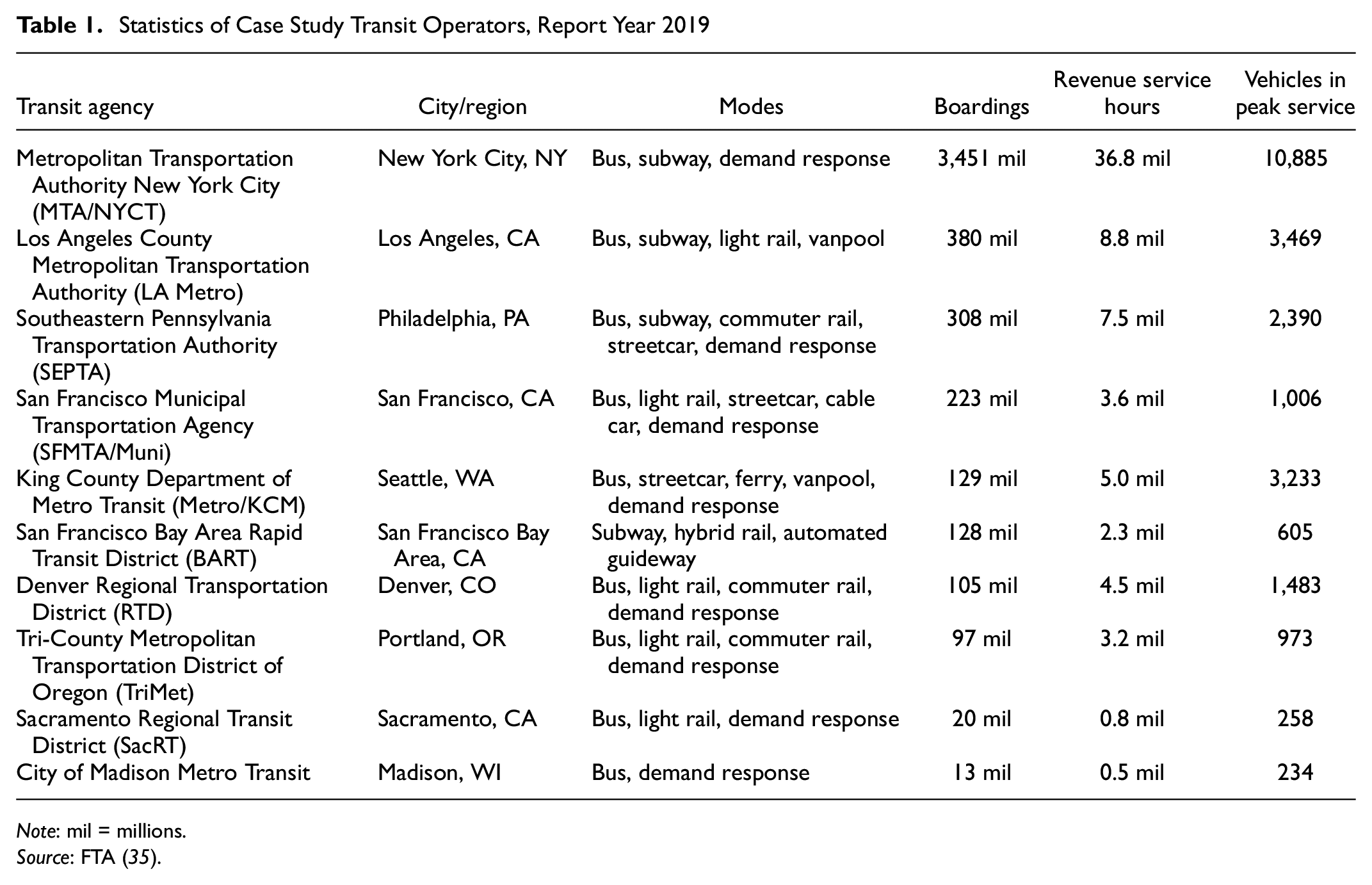
Note: mil = millions.
Source: FTA ( 35 ).
Each interview lasted 45 to 60 min and followed a semi-structured format. We asked respondents to discuss each program’s focus and scope, history, effects of the pandemic on program operations, partnerships with other entities, resources (budget and staff), program impacts, challenges encountered, and lessons learned from implementation. For some programs, interviewees sent us additional documentation (e.g., program expenditures, unhoused individuals reached, etc.). We transcribed all interviews verbatim using appropriate software and then open-coded the complete interview transcripts, following the themes/topics listed in the previous paragraph. We then clustered codes expressing similar meanings to form categories of responses. Finally, we reread the original transcripts to make sure that we had identified all pertinent themes.
We note that one important limitation of our study is that we did not interview unhoused riders. As this study took place during the early days of the COVID-19 pandemic, fieldwork was extremely difficult. Future research should include their voices, understand their perspectives, and identify their perceptions about various programs. This is particularly important because unhoused individuals do not represent a homogenous group. Thus, without such interviews, we cannot fully identify which programs may work better for different sub-groups of unhoused riders (e.g., chronically versus temporarily unhoused people, those with mental health problems, those of different ages, etc.).
In what follows, we discuss our findings relating to four distinct homelessness response strategies: hub of services, mobile outreach, discounted fares, and transportation to shelters. While we find much to be learned and potentially replicated from these broad strategies, we do not necessarily characterize each specific program below as a “best practice” per se and we identify several challenges and drawbacks. We analyze the performance data we were able to obtain and synthesize the interviewees’ responses to provide a guide for policymakers exploring humane approaches to homelessness on transit.
Two of the presented strategies enhance the mobility of unhoused riders, and the other two seek to connect them to services and put them on a path to stable shelter off the transit system. The former represent an application of transit’s important role as mobility provider for those who most need it. As for the latter, though directly housing the unhoused is not in transit operators’ remit, they help unhoused riders find supportive services, thus reducing the use of transit as a shelter. Such programs also broadly complement transit’s social service role, provided they can be done without impairing service provision. An interviewee at every profiled agency mentioned at least one of these two goals as an aim of the program or the basis of a tracked metric. We discuss this further in the conclusion.
Results
Hub of Services
This strategy concentrates a variety of outreach resources and services for unhoused riders in one or more central points in the city, at or near a major transit facility. The most successful and comprehensive example is the Hub of Hope in Philadelphia, a partnership between the Southeastern Pennsylvania Transportation Authority (SEPTA), the City of Philadelphia, and Project HOME, a local nonprofit. Initiated in 2011 as a small walk-in outreach center and relocated in 2018 to a much larger facility, the Hub of Hope has as its objective to offer services to people experiencing homelessness, including case management (initial referrals to shelter, substance abuse treatment, and other public services), hospitality services (showers, laundry, snacks, and meals), primary medical care, and behavioral and dental health care. It also provides transportation to shelters and outreach teams in surrounding areas through its many partners.
The Hub relies heavily on partnerships. The City provided the space and pays for the operating costs, while SEPTA paid for its initial renovations. Both SEPTA’s transit police and City police refer or bring people experiencing homelessness to the Hub, while “Ambassadors of Hope,” a program run by Project HOME and a business association, refers people there from throughout the Center City district. Other nonprofits provide meals at the Hub, as well as transportation from the Hub to shelters.
The program’s annual budget is about 1 million dollars, excluding the cost of medical, behavioral health, and dental services, which are funded through Project HOME’s federally qualified Health Center. The Hub has nine social service staff members and six medical care staff members. Funding comes from SEPTA, Project HOME, and the City. SEPTA and Project HOME hold an annual fundraising breakfast, which raises about $3.5 million per year for renovations, equipment, and other expenses.
It is clear that SEPTA has invested heavily in the success of the Hub of Hope. According to SEPTA’s transit police chief:
SEPTA knows we have to be a partner, not just a consumer of [Project HOME’s] effort[s]. I’ve had a lot of challenging conversations about this. Some folks within SEPTA told me: “We are a transit agency, not a social service agency.” But the social service issues have a direct impact on transportation. And if you can’t address the social service problems that surround…the transportation realm, then your business isn’t going to flourish.
Interviewees characterized the Hub as a safe place, which helps reduce the numbers of unsheltered individuals on the transit system. According to the chief:
It is about developing…relationships, and that’s what the Hub does….They have that daily contact with the folks, so they develop trust. And then once you develop trust, then you are able to channel people to the assistance that they have.
According to Hub of Hope staff interviewed, the numbers of people experiencing homelessness on the transit system are lower when the Hub is open and rise when it is closed. They have tracked that the Hub served about 4,000 different individuals in year 2019 and received about 100,000 visits. The Hub made around 3,000 combined referrals into shelters, respites, and treatment programs that year (though multiple placements may have been for the same individual) ( 36 ). Our interviewees mentioned that it is difficult to track individuals after they receive their referral or to know how many of them have been ultimately able to get out of homelessness. They noted the need for additional resources to redesign the space according to trauma-informed care and design principles, for unhoused individuals to feel physically and psychologically safe. While the numbers of unhoused individuals have declined since the Hub started operation, Hub of Hope senior leadership mentioned that some commuters and businesses in the train station blame the Hub for bringing them to the station. In response to observed drug sales, SEPTA’s transit police has increased its presence and surveillance in and around the Hub.
One key theme that emerged was the importance of relationship-building. Unhoused people are vulnerable, and it takes time and effort to build trusting relationships that lead to lasting service provision. What the Hub has done is “to meet people where they are” by offering coffee, food, and hospitality to make unhoused people feel safe and welcome. Indeed, the Hub provides what a Project HOME staffer calls “things…that are so basic that…someone might not even think of [them]: the shower, the laundry, having clean underwear to put on after you[r] shower, toothbrush, toothpaste.” The program strives to link unhoused individuals with needed, critical help and achieves this through its comprehensive, one-stop approach. Additionally, the location of the space in a central, accessible area is vital to its successful outcomes. The Hub offers a lesson on the importance of compassion among staff to address the specific emotional and psychological needs of those experiencing homelessness. This requires staff to have relevant training, knowledge, skills, and experience. Finally, interviewees emphasized the importance of sustained, trusted partnerships among different agencies and organizations.
Mobile Outreach
While the Hub concentrates outreach services for unsheltered riders in one place, some transit agencies have adopted mobile outreach strategies with staff moving throughout the transit system to provide services or referrals to services. The objective of these programs is to provide services or referrals to unhoused individuals encountered on transit systems, through the deployment of clinicians/social workers or specially trained law-enforcement agents, or both. An additional objective of these programs is to reduce instances of interactions on transit between unhoused individuals and police officers that could otherwise escalate, become disruptive or aggressive, or result in punitive fines or avoidable arrests. Below, we first describe two smaller programs at the Sacramento Regional Transit District (SacRT) and Denver Regional Transportation District (RTD). Then we turn to discuss two larger, slightly older programs, with at least some outreach teams deployed independently of law enforcement.
Clinician/Social Worker Programs
The SacRT program started in the summer of 2020, after the killing of George Floyd by a police officer in Minnesota. The transit agency coordinates with law-enforcement agencies in Sacramento County to identify a list of “top ten” chronic offenders on transit. SacRT has found that these predominantly unsheltered individuals account for a large portion of incidents in which the police have been called to intervene. The second part of SacRT’s response involves outreach to these individuals and other unhoused riders by an intern from a local Master of Social Work program. The intern rides with transit police officers when there is a call for assistance, speaks with the individuals, offers them services, and connects them with their case manager, if possible.
Denver RTD employs a full-time mental health professional to ride along with security staff to de-escalate confrontations and link people with shelter services and counseling. The clinician is equipped with a police radio and listens to calls that she may be needed for. When such a call comes in, she responds and goes to the person in need along with a transit police officer. Other times, she walks around the various transit facilities making contacts with people who she feels might need help, connecting them with resources or transportation, and, in extreme circumstances, putting them on a mental health hold (a mandatory hold of up to 72 h and examination at a mental health hospital). After the onset of the pandemic, the clinician began responding to calls without accompanying police officers.
In Sacramento, the program is the outcome of partnerships between SacRT and several regional entities, including law-enforcement agencies, Sacramento’s community prosecutor, Sacramento’s mental health hospital, and the City’s newly created Office of Community Response. The program in Denver is a partnership between Denver RTD and Mental Health Services of Denver (MHCD). Additionally, MHCD runs a pilot program, which transports those experiencing behavioral health crises to resources elsewhere, refers them to services, and even connects them to a case manager, who can help them in their search for services and housing. Denver RTD has also started a Homeless Task Force that meets monthly with many homeless organizations in Denver to identify challenges and solutions.
While SacRT does not pay for the intern, who is completing required fieldwork for her degree, at Denver RTD, the costs run somewhat higher. The budget for one clinician is approximately $110,000, including salary and overhead. Half of this is paid from Denver RTD’s $26 million police budget, while the other half is covered by MHCD through Medicaid funding.
In Sacramento, the program is only a few months old, and SacRT is looking to collect more data to determine its success. But our interviewees were quite specific about the positive impact of Denver RTD’s program on the lives of unhoused people. RTD and MHCD measure success by the number of people receiving services, even though they often cannot track outcomes beyond referrals to services. As the deputy chief of RTD’s transit police noted:
From December 27, 2019 to October 21, 2020, [the program clinician]…made 182 contacts. That’s great! But the real measure is [that], for a lot of these individuals that have been contacted, enforcement [is] way out of this issue. [Otherwise, we] would either have to write [them] a citation or suspend them from transportation use.
A representative from MHCD also noted that the program is successful as it results in “much more supportive, non-judgmental interaction[s]” with a clinician who knows and has built rapport with the unsheltered population and can “listen to their stories and…do problem solving in a different way than a transit officer would be able to [do].”
Staff at SacRT and Denver RTD identified two sets of challenges: (1) disconnect between law-enforcement agencies and social service organizations working to assist people experiencing homelessness and (2) lack of dedicated resources that limits what outreach staff can offer.
Comprehensive Mobile Outreach Programs
In California, the state with the highest concentration of unsheltered people experiencing homelessness ( 1 ), three large operators employ comprehensive mobile outreach programs: Los Angeles County Metropolitan Transportation Authority (LA Metro), the San Francisco Bay Area Rapid Transit District (BART), and the San Francisco Municipal Transportation Agency (SFMTA). These programs broadly operate on the same model as those of SacRT and Denver RTD but are larger in scale and resources, have existed longer, and have more sub-initiatives.
LA Metro’s program, which was started in 2017, has four mobile outreach teams; three of these teams are composed of police officers from different departments, while one team consists of civilian outreach staff from the social service agency People Assisting the Homeless (PATH). Staff are trained for interactions with people experiencing homelessness and tasked with referring them to services, placing them into housing, and de-escalating situations on the system. In April 2020, LA Metro also initiated “Operation Shelter the Unsheltered,” in which outreach teams visit key end-of-line stations to ask unsheltered riders to disembark from trains during closing hours and provide resources to those seeking shelter. Through its contract with PATH, LA Metro provides temporary shelter in motels for the most vulnerable riders (women with children, veterans, older adults, and disabled individuals). The outreach teams transport them to motels and follow up to connect them with services. About 25 to 40 people every month are given shelter in a motel.
The Bay Area’s transit regional homeless outreach program began in November 2017 as a partnership between BART, SFMTA, and the San Francisco Department of Homelessness and Supportive Housing. A major element of the program is Homeless Outreach Teams (HOT), each consisting of two civilian outreach workers who respond to dispatch calls and assist and connect people experiencing homelessness in the BART system to shelters and other services. Begun in downtown San Francisco, the HOT model was expanded to other parts of the system in 2019. However, the original partnership with SFMTA was suspended in November 2020, when the Salvation Army became the primary organization covering downtown stations. BART and SFMTA also have long-standing “transit ambassador” programs, with unarmed staff or community members trained in conflict resolution riding buses and trains. BART has also deployed crisis intervention training for officers, elevator attendants (further civilian staff who monitor, ride, and keep clean the system’s elevators) and, in combination with San Francisco’s Department of Public Works, “Pit Stop” restrooms near certain stations (street-level restroom units staffed by attendants and cleaned between uses).
LA Metro, BART, and SFMTA interviewees touted the importance of diverse partnerships for outreach because people experiencing homelessness are heterogeneous and have different needs. LA Metro partners with law-enforcement agencies; PATH; a City Attorney’s office program that assists people dealing with mental health issues, drug addiction, and past incarceration; and other nonprofits. BART likewise has relied on collaborations with the homelessness and health departments of the various jurisdictions it serves and external groups like the Salvation Army. These are primarily cost-sharing partnerships, but partners also coordinate to review monthly reported data and decide on improvements and changes to the program.
The monthly cost of LA Metro’s four outreach team programs ranges from $45,000 for the Long Beach Police Department team, which only employs two officers, to $408,333 for the PATH program, which employs 25 staff members and plans to grow to 35. Despite its higher total cost, the civilian PATH program has the lowest cost (including overhead) per staff member among LA Metro’s four sets of outreach teams. In Northern California, each HOT team of two outreach workers costs around $250,000 per year. Unlike LA Metro’s costs, these costs are shared between BART and its municipal/county partners.
LA Metro’s teams track the number of contacts made, referrals to services, housing placements, involuntary mental health holds, and other actions. These performance data afford a unique opportunity to compare law-enforcement and civilian outreach efforts; the programs were all in operation at the same time and on the same system, eliminating the need to control for such differences (Table 2). We note that data in Table 2 are from two distinct periods, one pre-pandemic and one during the pandemic, which entailed different conditions that affected outreach (e.g., lower shelter capacity, some new availability of hotel rooms for temporary housing, etc.). But comparing apples-to-apples within each period and confirming the findings of Dembo ( 34 ) over a longer stretch of time, we find the civilian PATH partnership to be the most cost-effective, and also the most effective at placing unsheltered individuals in housing, especially since the start of the pandemic. The share of individuals placed in housing by PATH was higher than those of the law-enforcement programs, likely because PATH is also a developer and operator of low-income housing. On the other hand, the share of individuals referred to services was comparable. While before the pandemic, the police teams made more contacts and referrals to services per staffer, the post-pandemic police data, with a narrower definition of “engaged contact,” show lower contacts per staffer than the PATH teams during the same period (potentially because of the many effects of the pandemic on law-enforcement operations and deployment). The police teams do tend, however, to make a higher volume of initial contacts, but at a higher cost. We urge some caution in interpreting these performance data—for instance, sometimes referrals and housing placements may not also get counted as contacts, especially if they occurred in separate months, and the way law-enforcement teams classified interactions with unhoused riders changed in 2020 to separate contacts from “engaged contacts” (those for which information was provided and the person’s name obtained).
Monthly Statistics for Los Angeles Metro Mobile Homeless Outreach Programs
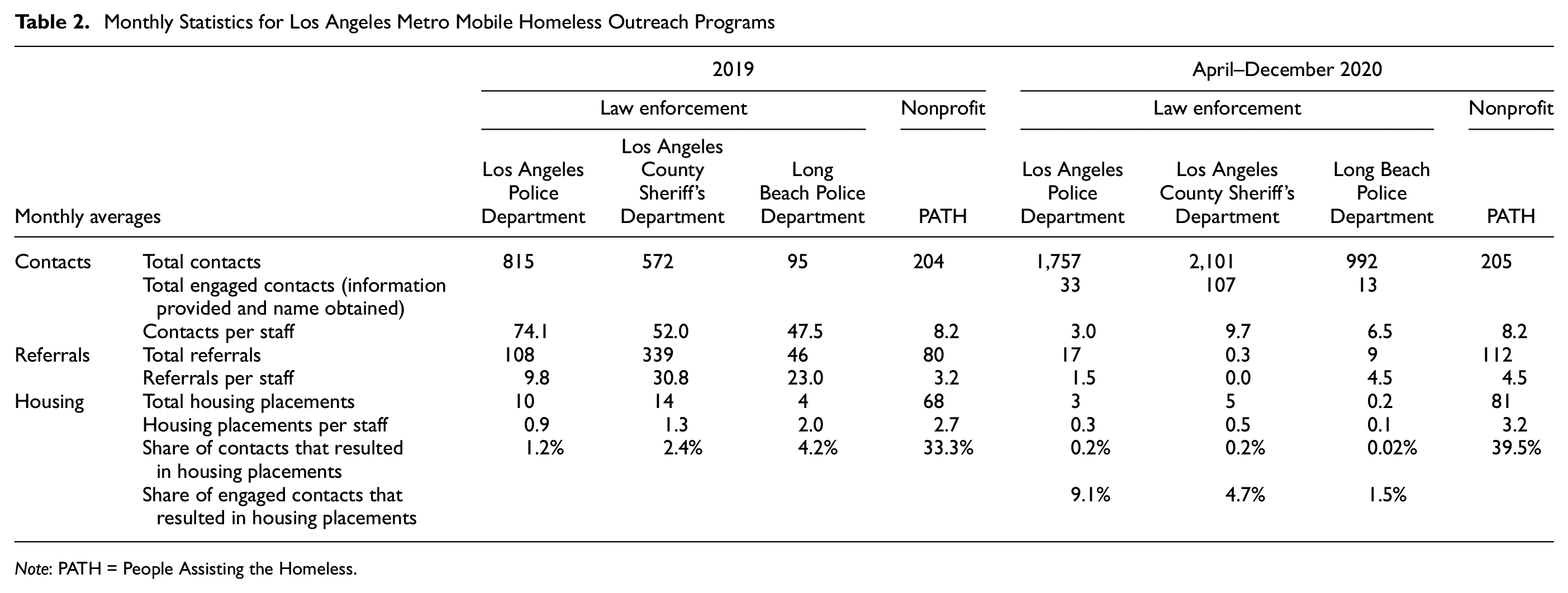
Note: PATH = People Assisting the Homeless.
The San Francisco HOT program has also had a high share of successful referrals and a comparable share of housing placements to those of LA Metro’s civilian outreach teams (Table 3). Monthly contacts grew from an average of 58.6 during the period of November 2017 to October 2018 to over 500 during March, April, and May 2020. Again, we note that the data in Table 3 include pre-pandemic and pandemic periods, entailing different circumstances.
Monthly Statistics for the San Francisco HOT Program
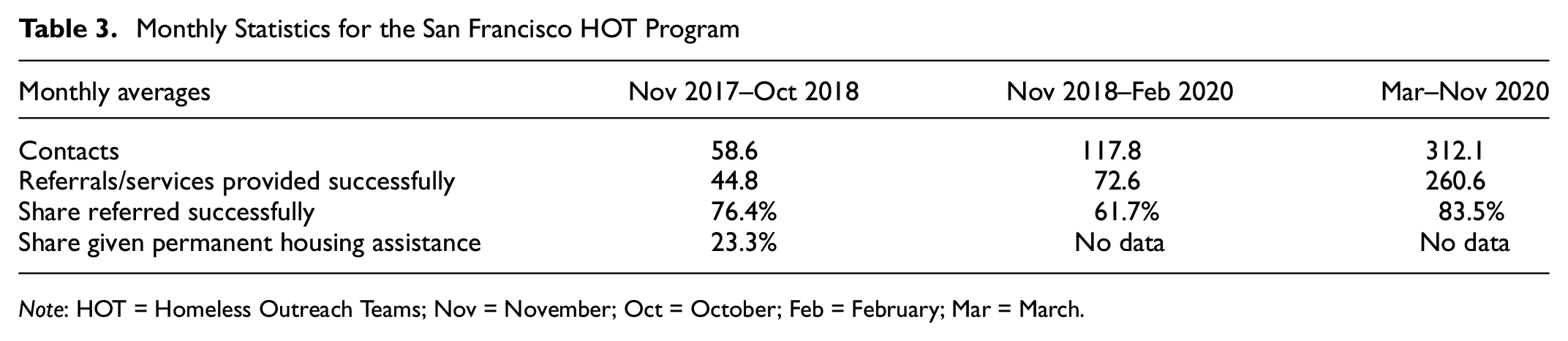
Note: HOT = Homeless Outreach Teams; Nov = November; Oct = October; Feb = February; Mar = March.
The main challenge these California agencies face is a severe lack of affordable housing and shelter space in their regions, which has increased the numbers of unhoused riders. This was aggravated by the pandemic, as many shelters have lowered their capacities to meet physical distancing requirements. Interviewees also noted a lack of adequate funding and support from state and federal governments, exacerbated by declines in transit revenues since the start of the pandemic. This budget crunch led BART and its partners to concentrate outreach resources only in a selected number of stations. BART interviewees also spoke of the challenge of their agency spanning multiple counties with differing resources and priorities in addressing homelessness. Finally, staff described as a “major pressure point” receiving complaints from riders who mostly want to see people experiencing homelessness removed from the transit system and may not understand the nuances of outreach programs that seek to help them.
Staff at both smaller and larger mobile outreach programs discussed similar lessons learned from implementation. Echoing many of the findings from the other strategies profiled in this article, they highlighted the importance of partnerships for outreach because, as one staffer explained, “Partnership means you have skin in the game. And partnership means funding.” Communicating and coordinating with other partners on outreach efforts is critical, especially since some have built relationships of trust with unhoused individuals. Indeed, LA Metro, Denver RTD, and SacRT interviewees observed that people experiencing homelessness are more likely to accept help from non-law-enforcement employees, and the first two programs plan to expand their unarmed outreach efforts. In conjunction, some interviewees observed the importance of educating the public about a transit agency’s outreach efforts. Finally, interviewees advocated for starting with small, pilot programs first, developing metrics to measure and evaluate their effectiveness, and using a pilot’s positive impact to persuade policymakers to fund larger programs.
Discounted Fares
While the prior strategies aim at the housing and health needs of unhoused riders, the objective of this strategy is to enhance the mobility of unhoused riders. For this purpose, some transit agencies provide reduced or free fares to assist people experiencing homelessness and enable them to travel on their systems.
Begun in 1992, the King County Department of Metro Transit’s Human Services Bus Ticket Program sells tickets at a 90% discount to local social service agencies addressing homelessness. These agencies give the tickets for free to their clients to assist them with their mobility needs. The Tri-County Metropolitan Transportation District (TriMet) in Portland more recently began several fare programs which benefit people experiencing homelessness, though having broader eligibility. One program allows residents with incomes under 200% of the poverty line to qualify for discounts of up to 72% off regular fares; qualifying residents can register with one of about 50 partner agencies across three counties. Another program provides free or reduced-cost transit tickets to over 90 organizations to cover emergency transportation costs for people in crisis or with immediate need. Finally, the SFMTA Access Pass, initiated in October 2020, offers people experiencing homelessness a free transit pass for 2 years on city vehicles. Eligible individuals must be registered with the City’s Department of Homelessness and Supportive Housing. In addition to providing the free transit pass, enrollment also automatically waives all previous fare evasion citations.
All three agencies have partnerships—two with social service agencies and one with another public agency—which help them distribute the discounted tickets. TriMet’s partners, for instance, verify and enroll low-income people in the program. Other San Francisco city departments conduct outreach to people who qualify for the Access Pass, and SFMTA works with shelters and other service providers to distribute information about the program.
Our interviewees at King County Metro and SFMTA could not pinpoint a specific budgetary figure for the cost of program implementation. Broadly though, while such programs involve forgoing some fare revenue, revenue losses are likely slight, given that a significant share of unhoused people are unable to pay fares and ride or attempt to ride without paying (
37
). As an SFMTA staffer noted:
I think everyone acknowledges this is not an issue of lost revenue here. These are folks that are unable to pay their fares and get on the vehicles. Many are in fear of getting the humiliation of the interaction of getting a fare evasion citation. So, I think this program is an acknowledgment of the support that we need to provide for people experiencing homelessness to get to those critical appointments…and other things. So, both from staffing and revenue loss, its [cost] is negligible.
TriMet staff indicated that they expect to ultimately devote $12 million annually to their Reduced Fare Program, though in 2020, because of reduced demand, the agency spent only $5 million on the program. The administrative costs to run it are $150,000 to $175,000 per year, funded from a portion of Oregon’s statewide transit payroll tax.
None of the three agencies gave us specific numbers of unhoused individuals who benefit from their discounted fares programs. Our interviewees indicated that they await new smart card data, which can help them better understand the travel patterns of low-income and unsheltered riders and the extent to which they are using the free fares.
While all respondents outlined that discounted or free fare programs do not diminish the number of people experiencing homelessness on transit, they nevertheless offer an important service: increasing their mobility by allowing them to travel without fear of being caught without payment. Additionally, SFMTA staff mentioned that, by asking unhoused riders to go through municipal “access point” service centers to get their passes, they hope to connect them with other resources and social services. However, this method involves additional verification steps and limits the reach of the program.
One of the biggest challenges that interviewees mentioned is communicating to eligible individuals that such programs exist. They also cited a lack of coordination with other local transit agencies, which may or may not have discounted fare programs themselves. As a result, there are different fare rules and prices on different transit modes and systems, creating a confusing environment for people experiencing homelessness. TriMet interviewees indicated that the main challenge for their reduced fares program is financial, as the program competes with other transit programs for scarce funding.
As with the strategies above, interviewees agreed on the significance of partnerships to operating discounted fare programs. As explained, it is important to secure agreements with state agencies and partner organizations at the outset to avoid delays. If partners can enroll eligible riders directly, the process is more efficient, because service providers can give the reduced fare cards when they also enroll people in other homelessness programs and can assist those who lack requisite identification. Such partnerships also lessen the burden on the transit agency.
Another lesson underlined is the importance of finding ways to communicate with unhoused individuals about the existence of these programs. Additionally, enrollment processes should be streamlined so that they are as easy as possible. As one SFMTA staff member emphasized, the partnership and collaboration of a transit agency with a city or county homelessness or public health department are key for communication, outreach, and eligibility verification.
Transportation to Shelters
The prior strategy increases the mobility of those experiencing homelessness to destinations already served by transit. However, some operators also seek to expand the access of unhoused individuals to particular destinations. Programs with the objective of offering free transportation to and from homeless shelters represent one of the most direct ways that transit operators can aid those experiencing homelessness.
Here, we profile two systems which provide transportation to shelters or work with other agencies to do so: the U.S.’s largest operator, New York City’s Metropolitan Transportation Authority (MTA), and a smaller agency, Madison, Wisconsin’s Metro Transit. The City of New York’s Department of Social Services (DSS) transports unhoused MTA subway riders to shelters in partnership with a local nonprofit, the Bowery Residents’ Committee (BRC). At around 25 stations at the end of subway lines, trained outreach workers from BRC and DSS conduct outreach to people experiencing homelessness, engaging with them, referring them to shelters, and offering free transport. The program deploys 22 to 28 vans for these rides on a given night, with more on colder nights and with at least 10 additional vans for moving staff and as contingency. MTA operates a parallel outreach and transport program at Penn, Grand Central, and other commuter rail stations in New York City.
At a smaller scale, Madison Metro Transit also established a program to provide transportation between daytime and nighttime shelters for people experiencing homelessness. This emergency operation during the pandemic lasted from March 2020 to September 2020, after which a contracted private bus company provided the service for Metro Transit. During the months that Metro Transit operated the program, the agency utilized two full-size buses twice a day, during both a.m. and p.m. hours, to transport people between a daytime shelter in downtown Madison and a nighttime shelter on the north side of the city, which was not easily accessible through public transit, especially for people carrying their belongings.
In New York, the programs rely on the partnership with the local nonprofit BRC for outreach staff and services. As part of its broader homeless outreach efforts, MTA has initiated partnerships with other stakeholders, including Amtrak, the New York Police Department, other law-enforcement partners, and outreach personnel. These stakeholders come together in monthly borough-wide meetings to identify target areas that need a response, discuss mitigation strategies, and coordinate how best to share resources and disseminate information to people experiencing homelessness. The primary partners for Madison Metro Transit’s transportation-to-shelter program were the two shelters, who worked together with Metro Transit staff to organize pick-up locations and coordinate operations.
MTA’s annual budget for its responses to homelessness on its commuter rail system is $1.86 million, and New York City spends $23 million annually in its contract with BRC for its subway efforts. Both of these figures include the whole scope of each agency’s transit homelessness outreach, such as outreach workers and engagement services, not just transport to shelters. The City’s subway program has deployed up to 40 BRC and 60 DSS staff members each night since May 2020. In Madison, since the program was provided through an emergency operations request, it was funded by the city’s general fund. Program costs were modest, involving only drivers’ pay and the cost of operating the two buses on their fixed route between the shelters daily.
Transportation-to-shelter programs not only enhance the mobility of unsheltered individuals, but may also build relationships with them. This creates the trust necessary to get them not just to go to a shelter but to remain there, where they can continue to receive stabilizing services, instead of potentially returning to transit. Through the outreach program on the New York subway system, 7,595 people accepted at least a referral and transport to shelter placements between May 6, 2020 and April 4, 2021, of which 2,435 (32%) accepted shelter placement after transport. According to our interviewees, the ability to match people directly at the subway station to open shelter beds, instead of taking them to an intake center, helps build the trust behind this acceptance. The DSS commissioner emphasized that, as of April 6, 2021, 792 unhoused people, previously spending the night on the subway system, were still in shelter. Madison Metro Transit’s staff underlined that the continued contact between bus drivers and people experiencing homelessness during the period of the service enabled the development of more trusting relationships. Such relationships can make it easier for both parties, and drivers do not have to always rely on law enforcement.
On the other hand, as mentioned above, pre-pandemic audits of New York’s programs identified several issues, including missing performance targets (as counts of unhoused individuals on the system have increased in recent years), short-staffing, and poor coordination with partners ( 31 , 32 ). A report released in June 2020 by MTA’s Inspector General characterized the transit agency’s homeless outreach efforts as expensive and minimally effective ( 33 ). In response, the DSS commissioner noted both that New York City staff now work directly with contracted staff to increase accountability and that significant operational changes since the pandemic have resulted in the outcomes described above. Madison Metro Transit staff reported merely some initial timing and coordination issues with the shelters, which were quickly resolved.
As with the other programs profiled in this article, coordination with partners and close communication between the transit agency and local homelessness agency are necessary for success. Likewise, the interviewees noted that outreach personnel should build trust with people experiencing homelessness for shelter transport and housing efforts to work. As noted by a staff member at Metro Transit:
My advice for any agency that…may have requests…from either their municipalities or shelters [for such a program] is to do it. It was beneficial for [us]….I would highly recommend building that type of relationship with shelter organizations and…helping your staff familiarize themselves with a population that can be easily looked down upon or forgotten about.
In respect of operations, New York MTA staff cited the benefits of having outreach staff remain in place in the transit station their whole shift, while separate staff drive unhoused people to open shelters. That way, the station has a continuous outreach presence. Additionally, the interviewee suggested the use of smaller, wheelchair-accessible paratransit vans, as opposed to more unwieldy full buses that MTA once used for such efforts.
Finally and importantly, New York DSS staff emphasized that their program was greatly aided by being in one of few places with a “right to shelter”—defined by the New York State courts in 1979—which mandates the City of New York to provide an open shelter bed for everyone who needs it and allocates necessary funding to do so ( 38 , 39 ). Compared with programs in other states, their effort was made far easier by almost always having a place to refer unhoused riders.
Discussion: Lessons Learned
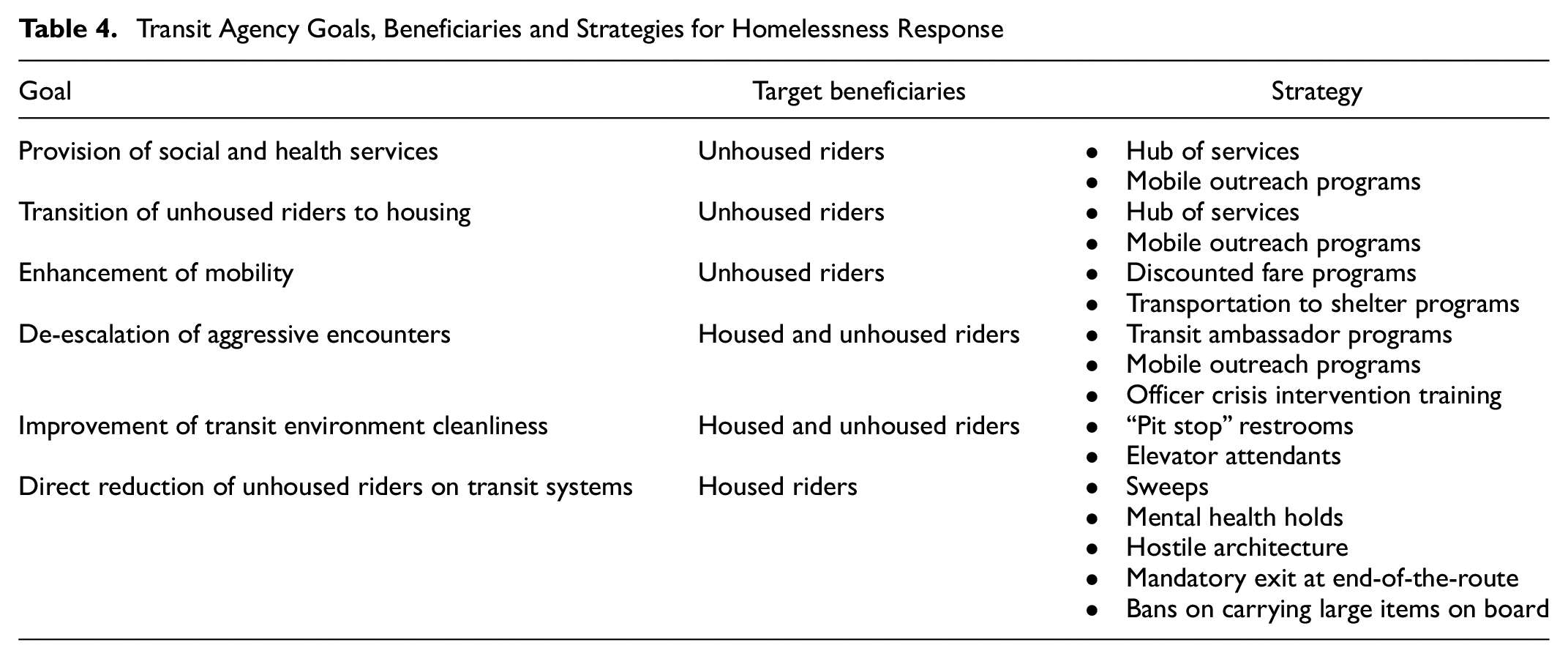
Many U.S. transit operators around the country encounter unhoused individuals who use transit systems for mobility or shelter, or both. The plight of these individuals is a social challenge that operators have not created themselves but one to which they must respond. Their varied responses reflect the tension between the transit industry’s dual goal of providing services to the most disadvantaged, while at the same time providing service that riders of all types use and find acceptable. As a result, strategies vary in their aims and may range from policing, sweeps, and hostile architecture to outreach, service provision, and mobility for the unhoused (Table 4). In this article, we highlighted programs initiated by transit agencies that intend to aid their most disadvantaged riders. While benefiting primarily unhoused individuals, these programs also serve both ridership and society at large. By offering positive alternative spaces and concentrated services, programs such as the Hub of Hope can, in the long run, reduce the numbers of unhoused individuals on the transit systems ( 8 ).
Transit Agency Goals, Beneficiaries and Strategies for Homelessness Response
While U.S. transit operators large and small are increasingly confronting homelessness, their responses will likely differ. Strategies should be tailored to the specific physical and social contexts and to each agency’s available budget and human resources. For example, it makes sense for operators in cities or regions where homelessness is concentrated in central districts to opt toward providing a centrally located hub for outreach and services, as SEPTA did in Philadelphia. On the other hand, mobile outreach services may be more appropriate for areas experiencing a dispersion of homelessness throughout the metropolitan landscape. The extent of homelessness and availability of shelter and housing should also inform the size of the response program. Nonetheless, as different as agencies like New York’s MTA and Madison’s Metro Transit are, both implemented the same type of strategy, albeit on very different scales. Thus, across all strategies, we summarize below key lessons learned from the case studies that can apply across the country.
Many interviewees emphasized that the coordination and collaboration between law-enforcement and outreach staff is critical. The programs in Philadelphia, Sacramento, and Denver pair outreach workers with officers, with the police chief in Philadelphia citing this as a key element of program success. BART staff also praised crisis intervention training for officers to de-escalate potentially violent situations (
8
). Yet interviewees in our case studies, which took place after the killing of George Floyd at the hands of police officers, also voiced the value of keeping law enforcement in the background or distinct from routine homeless outreach. Additionally, the data shown in Table 2, comparing the performance of programs operating during the same time and on the same system, indicate a greater effectiveness of civilian outreach efforts as compared with law-enforcement efforts, at least in this case study. Thus, separating homeless outreach from law enforcement, keeping law enforcement focused on other, more pertinent tasks, and asking for their involvement only in cases involving public safety may increase the rate of successful outcomes and help build trust between unhoused riders and outreach staff. For instance, during the admittedly extraordinary pandemic period, Denver RTD’s clinician worked without an accompanying officer. She observed, “Now that I’ve been by myself, I’m getting a lot more calls because I feel like people only want the clinician, not the cop, there.” As the Alliance for Community Transit-Los Angeles (ACT-LA) notes (
40
), Deep differences in organizational identities, lack of information sharing, and divergent approaches to problem-solving can all hinder cooperation between law enforcement and social services providers [(
40
)]. Moreover, the very presence of law enforcement can be threatening and even re-traumatizing to unhoused people, undermining successful outreach [(41, 42)].
Interestingly, three transit police officials we interviewed also discussed the benefits of separating law enforcement from homeless outreach. SacRT’s Regional Transit Police chief described their “big push…to not necessarily have law-enforcement officers respond to nuisance-type individuals, people experiencing homelessness, [and] mentally ill people,” arguing that “the higher success rate is to have trained individuals making these contacts on their own.” Transit agency staff in King County and Madison also cited reducing police interactions with unhoused riders not just as a positive side effect of their programs but as a goal itself, and in New York City, police “pulled back” from homelessness work during the summer 2020 protests and thereafter, according to the DSS commissioner.
In line with transit’s social service role, transit agencies are asked to provide their core transportation services to both housed and unhoused riders. However, some unhoused individuals do not even possess the means to purchase a transit fare. Since these unhoused people already skirt around fare collection because of their inability to pay, agencies are not forfeiting much revenue by providing them free fares. Additionally, as one interviewee noted, doing so would make it easier for bus drivers, who often find themselves having to resolve altercations over this issue. Free fares allow unhoused people to use transit with less threat of an unnecessary run-in with station staff, bus drivers, fare enforcement officers, or police. While this strategy enhances the mobility of unhoused people, it may result in more unhoused riders in transit systems. Thus, matching this strategy with outreach and referrals to health and housing services is important. Partnering with relevant municipal agencies and social service nonprofits to actively engage with unhoused individuals on their systems provides transit agencies an opportunity to direct them to services at the end of the line or with mobile outreach teams.
Finally, any strategy must embed in its organizational structure and external partner contracts provisions for robust, open data collection; performance benchmarks; and adaptability. As described above and evidenced in audits, a failure to do so can undermine programs.
Conclusion
Homelessness represents a failure of our society to take care of and respond to the plight faced by its most unfortunate members. Transit is a public service, and enhancing the mobility of unhoused riders represents part of its social role (
5
). However, as one interviewee from the transit industry noted:
Transit agencies have historically not undertaken very much of a role in response to homelessness. And that’s why we’re all struggling so much right now, because it’s in our face….And now [we] can’t ignore the problem….It’s our problem!
While transit agencies can no longer ignore the unhoused individuals on their systems, they also hear the concerns of their housed riders, some of whom view the unhoused population with trepidation (according to transit agency staff we surveyed and interviewed who receive such complaints often) ( 2 ). Operators often face complaints and pressure to simply sweep unsheltered individuals away from their system. However, experience has shown that this is not an effective strategy. As one interviewee put it, “If ‘lock them up’ worked, we would [have] wrapped this up years ago.” Thus, transit operators have to navigate the balance of the concerns and fears of housed riders and their efforts to serve unhoused riders.
In doing so, they should recognize that certain strategies, such as transport to open shelters, alone may not suffice for subsets of the unhoused population. For people simultaneously experiencing homelessness and mental health crises who require additional aid, trained mental health case workers, as deployed in cities like Denver, serve an important role, both for their unhoused rider clients and for other users of the transit system.
Additionally, transit agencies should identify the monetary and human resources and the appropriate know-how to address the challenge. The transit industry cannot do it alone when it comes to responding to homelessness. Partnership and coordination with other entities are crucial. Successful partnerships are behind all case studies presented and are key in almost any agency effort to respond to homelessness. External partners not only can fill knowledge and skill gaps and bring in additional resources for transit agencies but can also help make a powerful case to policymakers for the importance of the issue and the need for greater funding. Indeed, funding from other levels of government is key to allowing agencies across the country to adopt, expand, or refine homelessness response programs.
In this article, we reviewed four different types of programs initiated by transit agencies which targeted resources, identified partnerships, and have ultimately been able to provide outreach and help to some of the most disadvantaged members of our society. We certainly need more research on the effectiveness of the various strategies undertaken by agencies to respond to homelessness in transit environments—on what works where and how. Such research should also draw from the perspectives of the unhoused riders themselves (and those people and organizations that work on their behalf) as to which of the strategies are genuinely helpful.
Footnotes
Acknowledgements
The authors would like to thank the State of California for its support of university-based research and especially for the funding received for this project. The authors would also like to thank all of our interviewees and all those who gave their time to share information, data, and insight on transit agency responses to homelessness.
Author Contributions
The authors confirm contribution to the paper as follows: study conception and design: A. Loukaitou-Sideris and J. Wasserman; data collection: A. Loukaitou-Sideris, R. Caro, and J. Wasserman; analysis and interpretation of results: A. Loukaitou-Sideris, J. Wasserman, R. Caro, and H. Ding; draft manuscript preparation: A. Loukaitou-Sideris, J. Wasserman. All authors reviewed the results and approved the final version of the manuscript.
Declaration of Conflicting Interests
The author(s) declared no potential conflicts of interest with respect to the research, authorship, and/or publication of this article.
Funding
The author(s) disclosed receipt of the following financial support for the research, authorship, and/or publication of this article: This research was made possible through funding received by the University of California Institute of Transportation Studies from the State of California through the Public Transportation Account and the Road Repair and Accountability Act of 2017 (Senate Bill 1), as part of the California Statewide Transportation Research Program (grant number 446466-A1-18125).

The authors are responsible for any errors or omissions.