



Abstract
Using the Bi-Digital O-Ring Test, a simple examination of any handwritten material, regardless of any line or character, often allows for the detection of abnormal medical conditions that existed at the time of writing. Our study indicated that medical conditions in the right side of the chest, neck or brain, and abdomen are often represented in the handwriting of the right hand, including lung cancer, breast cancer, cancer of the head and neck, cancer of the GI. system, and various infections, but a problem in left side may not show up significantly, unless a very significant abnormality exists in the left side of the body. Therefore, in order to get more usefill medical information, it is important to Observe the following 3 sets of writing:
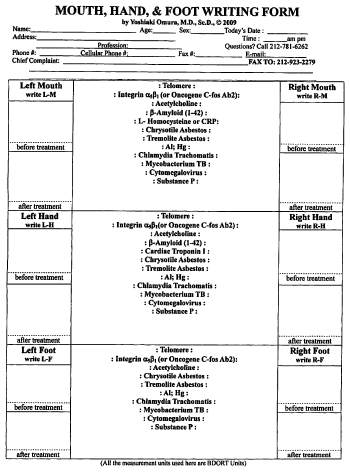
1) Mouth writings of the right side of the mouth and left side of the mouth to detect medical problems of neck, oral cavity, & head of same side, 2) Hand writings of right hand and left hand, 3) Foot writings of right foot and left foot. Mouth writing is performed by having the patient hold a ball pen with the back teeth in one side of the mouth and write RM for right mouth writing and LM for left mouth writing without the help of the patient’s hand or another person. It is not necessary to write legible letters or words. Foot writing is done by holding a pencil or ball pen between the big toe and the 2nd toe and the individual simply write RF for right foot writing & LF for left foot writing. In order to detect abnormality, first examine these writings using the Bi-Digital O-Ring Test by applying the tip of a metal electrode held by an intermediary’s hand to the one of any part of the writing; the examiner administers the Bi-Digital O-Ring Test on each of 6 writings and observes the response of the hand of the intermediary. When the test result is a strong negative, many O-Rings will open when the electrode is touched to the writing; the O-Ring Test information is given as the following numerical values: 0 to (−)2 is considered within normal range, (−)3 is considered to be borderline, (−)4 is considered to be abnormal, (−)5 is further abnormal, and (−)6 is more abnormal. When the value is (−)4 or a larger negative value, malignant tumors should be ruled out using a cancer screening kit consisting of 50 of the most common cancers, a process that can be completed in less than 5 min. The second item to rule out is cardiovascular disease: cardiac disease can be ruled out using Cardiac Troponin 1. C-reactive protein or L-homocysteine is used for general cardiovascular problems. The third item to rule out is Alzheimer’s disease in adults and Autism in children by measuring β-Amyloid (1-42) and A1. The fourth item to rule out is bacteria and viruses. The most common cause is a mixed viral and bacterial infection. Viruses can be tested with a mixture of EPA (180mg) and DHA (120mg) as a safe and effective antiviral agent. Bacterial infection can be tested by having the intermediary hold broad-spectrum antibiotics such as Amoxicillin (500mg). If it becomes a strong positive when one is examining the O-Ring Test with 500mg Amoxicillin, the O-Ring will no longer open and then the presence of Amoxicillin-sensitive bacteria is indicated. If there is Chlamydia Trachomatis, Doxycyclin (100mg) or a tablet of Substance Z makes the O-Ring Test a very strong positive and no O-Rings will open. Type & amount of bacterial or viral infection can be identified using known amount of microorganism or its monoclonal antibody by examining if there is resonance between writings and Reference Control Substances (RCS). To test the presence or absence of cancer or any malignant tumor when a cancer screening kit is not available, Integrin α5β1 (60ng) is used to find if there is any resonance. If it produces a strong resonance ((−)4, if 4 O-Rings can be opened, to (−)6, if 6 O-Rings can be opened), one has to presume there is a possibility of malignancy. When Integrin α5β1 or Oncogene C-fos Ab2 is over 5~10ng, one must suspect presence of malignant cells. When these values are less than 80 ng BDORT units, usually standard laboratory tests fail to detect any malignancy. If the malignancy is ignored, however, the tumor often can be detected several months or a few years later by standard laboratory tests. If Integrin α5β1 or Oncogene C-fos Ab2 are 100 ng BDORT units or higher, the malignancy requires immediate medical attention regardless of the laboratory test results. Once malignancy is suspected, depending on the location, the most likely cause of the cancer can be estimated by the location of die abnormal writing. For example, if the location is the right hand of a man, the most possible causes of the malignancy will be adenocarcinoma of the right lung, small cell carcinoma of the right lung, squamous cell carcinoma of the right lung, a malignant tumor of the head or neck, or metastatic tumor of the right side of the brain, metastatic cancer in the right lung from adenocarcinoma of the colon or brain tumor in the right side of the brain, or in rare cases right male breast cancer of the right nipple area. If it is a woman’s right handwriting being examined, she may have the same 3 types of lung cancer of the right chest as the man, as well as adenocarcinoma of the right breast, or metastasis to the right brain. If Integrin α5β1 is high for the right foot writing in a man, the potential problems include adenocarcinoma of the ascending colon, adenocarcinoma of the right side of the urinary bladder, and adenocarcinoma of the right prostate gland. If the right foot writing of the woman showed increased Integrin α5β1 or Oncogene C-fosAb2 levels, the possible causes include adenocarcinoma of the ascending colon, uterus cancer, right ovarian cancer, or adenocarcinoma of the urinary bladder. Similarly, depending upon the location of the body used, one can easily estimate possible cancers. To identify which of the suspected malignant tumors exist, using microscope cancer slides of specific organs, if the Bi-Digital O-Ring Test produces strong resonance while testing with the specific organ’s microscopic slides of the cancer tissues, one can non-invasively identify which cell type of the malignant tumor exists. Once microscope slide of the specific cancer tissue or specific internal organ produces strong O-Ring weakening resonance, then standard laboratory tests should be performed by blood testing to detect the presence or absence of most sensitive cancer marker for the suspected cancer, as well as the imaging analysis by X-ray, CT scan, MR1, or Ultrasonic imaging. When all 6 writings show exactly same abnormal high values of Integrin α5β1 or Oncogene C-fosAb2, immediately one must suspect the presence of one of the leukemia. One can often detect very early stage of acute myelocytic leukemia without detectable CBC changes but often with the disappearance of X-Chromosomes and this may be due to advanced age or associated with pre-acute leukemia. Same of the examples of clinical applications of hand writings, where various cancers were discovered, are shown with actual documents before & after treatment. Also the therapeutic effect should be evaluated by the quantum estimation of RCSs and the resonance of microscopic slides of the cancer tissues.
Get full access to this article
View all access options for this article.