




Abstract
The first objective for this study was to measure the spontaneous energy emitted from a commercially available mixed para and ferromagnetic mineral blend (Aulterra International, Coeur D’Alene, ID) in terms of its biological effects. Because this mineral has paramagnetic as well as ferromagnetic properties, it is expected to spontaneously emit an ultra-weak electromagnetic (EM) field. It has been previously shown that DNA, particularly its conformation, is highly sensitive to weak EM fields (1). The conformation of DNA can be accurately measured in real time using a spectrophotometer (2). Previous studies demonstrate the extreme sensitivity of DNA rewinding kinetics to ultra-weak electromagnetic (EM) energy, when the DNA is pre-exposed to heat to denature its secondary structure (3).
In the present study this DNA rewinding assay was used as an in-vitro bioassay to measure the energetic effects of the mixed mineral powder. A test tube containing human placental DNA (lOμg/ml water) was physically placed on top of a small pile of mineral powder on a laboratory bench. In this way, any observable biological effects can not be attributed to a chemical interaction, but rather to an ultra-weak EM energy being radiated from the mineral powder itself. Similar experiments have been previously reported for ultra-weak EM radiation from powdered tourmaline (4). DNA rewinding kinetics was measured as previously described (3). After one day, there was no change in the DNA rewinding pattern. However, after 3 days of exposure, the rewinding curve became highly irregular, instead of the typical smooth curve (see Figure).
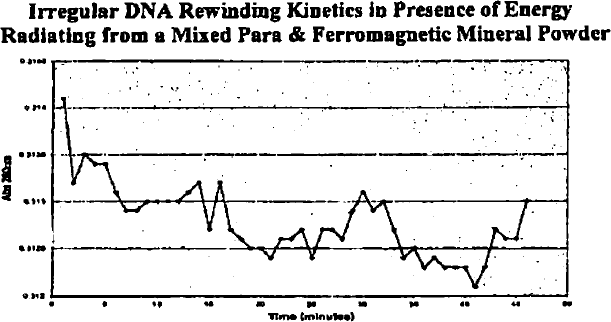
The effect of the radiated energy from the mixed mineral powder was also assessed quantitatively in 12 separate experiments. In the presence of ambient EM energy the average slope for the control samples was -0.11 ± 0.025. DNA samples surrounded by the mineral powder showed a five-fold increase in DNA rewinding with an average value of -0.52 ±0.18. Statistical analysis revealed a highly significant difference (p=0.01) between treated and untreated samples. These studies demonstrate that the energy radiating from the mixed mineral alters the conformation of human DNA in-vitro.
The second objective for these experiments was to determine whether the radiated energy field from the mineral blend has a beneficial effect on the body. It was predicted that the energy might have a protective effect on the body. Therefore protection from heavy metal toxicity was chosen as the biological endpoint for these experiments, since it is known that these effects are mediated by DNA. Copper (Cu(II)) was chosen as a representative heavy metal because it is known that its toxic effects (5) are due to its direct binding to DNA resulting in a conformational change in the secondary structure of DNA (6). Therefore, a series of experiments were done to determine the appropriate concentration of copper. It was expected that the ability of the energy from mineral powder to neutralize the toxic effect of copper would be minimal at higher concentrations of copper where the system is saturated. Initial studies determined an appropriate sub-optimal dose of copper which minimally effected DNA conformation. In the absence of heavy metals the control rewinding rate was determined in six separate experiments where the average value for the slope was determined to be -0.813 ± 0.06. The rewinding rate was then measured in four separate experiments when DNA was exposed to ImM copper at 4°C for 2 days. The average slope was dramatically reduced to -0.023 ± 0.015.
Preliminary experiments were conducted to determine whether this large effect of copper on DNA rewinding rates could be neutralized if the DNA was placed on top of the mineral powder while being exposed to the copper. After two days the average slope was -0.011, which is not much different than -0.023 (ie. 97% inhibition) indicated that the energy from the mineral powder did not neutralize the damaging effect of the copper. However, after three days the slope was -0.28 (66% inhibition) and after four days the slope was -0.36 (55% inhibition), rapidly approaching the -0.81 value for the slope in the absence of copper. These results demonstrate that the energy from the mineral powder does in fact neutralize the toxic effect of relatively high concentrations of copper by reducing the 97% inhibition (with no energy) to 55% in the presence of energy. The effect appears to be linear with time indicating that the longer the DNA was exposed to the energy, the larger its neutralizing ability.
It is possible that only partial protection occurred because the concentration of the toxin was too high. Therefore, these experiments were repeated using half the concentration of copper, 0.5mM. Based on the previous experiments, it was predicted that a neutralizing effect of the lower concentration of copper would be seen after only two days. Therefore, twelve separate experiments were done with DNA exposed to 0.5mM copper in the presence and absence of energy from the mineral powder. 0.5mM copper alone caused an 86% inhibition of DNA rewinding, giving an average slope value of -0.11 ± 0.025. In the presence of the energy from the mineral powder, this effect was reduced to only 36%, giving an average slope of -0.52 ±0.18. Statistical comparison of the last two numbers reveals a highly significant difference (p=0.01).
These results, taken together with the previous results using higher concentrations of copper clearly demonstrate that the spontaneous energy radiating from the mixed mineral has the ability to neutralize the toxic effect of copper. Taking into account that the DNA sample was only millimeters away from the mineral powder, the intensity of the radiated energy is expected to be very weak. Biological systems are indeed sensitive to ultra-weak levels of EM energy (7). Since biochemical effects of ultra-weak EM fields can either be stimulatory or inhibitory, it is reasonable to believe that such fields generated from this mixed mineral blend could inhibit the chemical actions of copper.
Get full access to this article
View all access options for this article.