



Abstract
Purpose:
The clinical application of a newly developed automated apparatus (Bi-Digital 0- Ring Tester) for O-Ring Tests using air systems is described.
Methods and Materials:
The general experimental setup is shown in the schematic diagram below.
O-Ring Tester Block Diagram
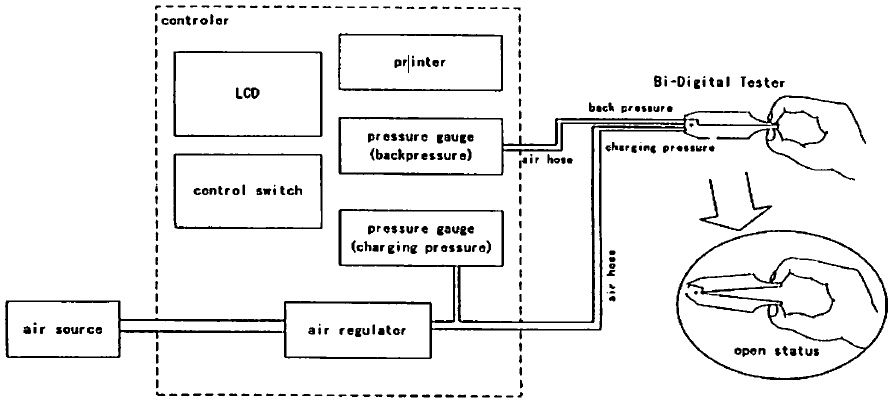
The following 7 subjects were used: 1) a healthy 46-year-old male; 2) a 25-year old male with upper abdominal pain 3) a 46-year-old female with lumbar pain; 4) a 62-year-old female with right radial nerve injury; 5) a 12-year-old girl with hyperventillation; 6) a 68-year-old male with Parkinson’s Syndrome; 7) a 68-year-old famale with adenocarcinoma of the colon with multiple metastases all over the body. Using the automated Bi-Digital O-Ring Tester, the following examinations were performed: with Subject 1, the subject’s sensitivity to electromagnetic field exposure was evaluated. Subjects 2-6 were used to evaluate the method of detection of abnormal parts of the body by direct O-Ring Testing as well as to evaluate drug compatibility tests. On Subject 7, using an indirect O-Ring Test, localization and mapping of Oncogene C-fos Ab2 was performed.
Results:
On Subject 1, who is a healthy 46-year-old male, the distance between the tip of the finger and a fluorescent light was varied from 0 cm to 200 cm. When the fluorescent light approached the tip of the finger, muscle strength was reduced, as shown below.
On subject 2, who is a 25-year-old male with upper abdominal pain, 5 measurements were taken at 5 different locations on the abdomen. When Subject 2 touched one painful area above the umbilicus, Bi-Digital O-Ring muscle strength was reduced to 80% compared to when the subject touched a control area of the abdomen where there was no pain. The same abnormal location above the umbilicus was tested while the subject touched a control area of the abdomen where there was no pain. The same abnormal location above the umbilicus was tested while the subject was holding a Zantac; muscle strength increased to 87%. When the subject held 1 dose of Maalox, muscle strength increased to 95%. When the subject held a Chinese and Japanese herb medicine, Anchusan, muscle strength increased to 112%. And when the subject held another herb medicine, Shoshikoto, muscle strength increased to 116%. These results indicate that these Chinese and Japanese herb medicines are more effective than commonly used Western medications for abdominal pain.
On Subject 3,who is a 46-year-old female with lower back pain, when the painful area was touched with a brass probe there was a striking decrease in the subject’s O-Ring muscle strength to less than 70% of normal. In Subject 4, who is a 62-year-old female with right radial nerve injury, no significant muscle strength reduction was observed. In Subject 5, who is a 12-year-old girl with hyperventillation, decreases in O-Ring muscle strength were observed when the subject touched the occipital area above the medulla oblongata. In Subject 6, who is a 68-year-old male with Parkinson’s Syndrome, there were striking decreases in muscle strength when the subject touched parts of the head corresponding to abnormal parts of the caudate nucleus. Subject 7, who is a 68-year-old female with multiple metastases of adenocarcinoma of the colon, was tested with the use of an intermediary whose muscle strength was tested as he touched various portions of subject’s body with a brass probe. The intermediary held a sample of Oncogene C-fos Ab2, one of the 6 coexisting factors for cancer and precancer originally discovered by Omura, Y, in the palm of one hand and the tip of a brass electrode between the thumb and index finger of the same hand. The automated BiDigital O-Ring Tester was used on the intermediary’s other hand which showed marked opening when intermediately touched the subject’s cancer-positive area, permitting localization and mapping of the cancer positive area. Subject had previously been tested and mapped using manual O-Ring testing, without use of the automated Bi-Digital O-Ring Tester, for Oncogene C-fos Ab2. However, some of the locations manual testing found to be positive were found to be negative when tested with the automated O-Ring Tester.
Discussion:
The Automated Bi-Digital O-Ring Tester was evaluated using 7 subjects. Results indicated that this can be useful for: 1) the detection of abnormalities in the body; 2) drug compatibility testing; 3) imaging of cancer positive areas using the resonance phenomenon; 4) general diagnostic purposes. However, discrepancies between the results obtained by the BiDigital O-Ring Test without an automated machine and the results obtained by the Bi-Digital O-Ring Tester need further study and evaluation.
Get full access to this article
View all access options for this article.