




Abstract
We read with great interest the article by Drummond and Finch on “Complex regional pain syndrome and migraine: Clinical relationships and possible common aetiology”, recently published in Cephalalgia (1). Drummond and Finch (1) provide compelling evidence that migraine frequently develops or worsens after the onset of complex regional pain syndrome (CRPS), in association with increased limb pain, wider pain distribution and lateralized cranial symptoms, supporting the existence of shared pathophysiological mechanisms such as central sensitization and impaired descending pain inhibition.
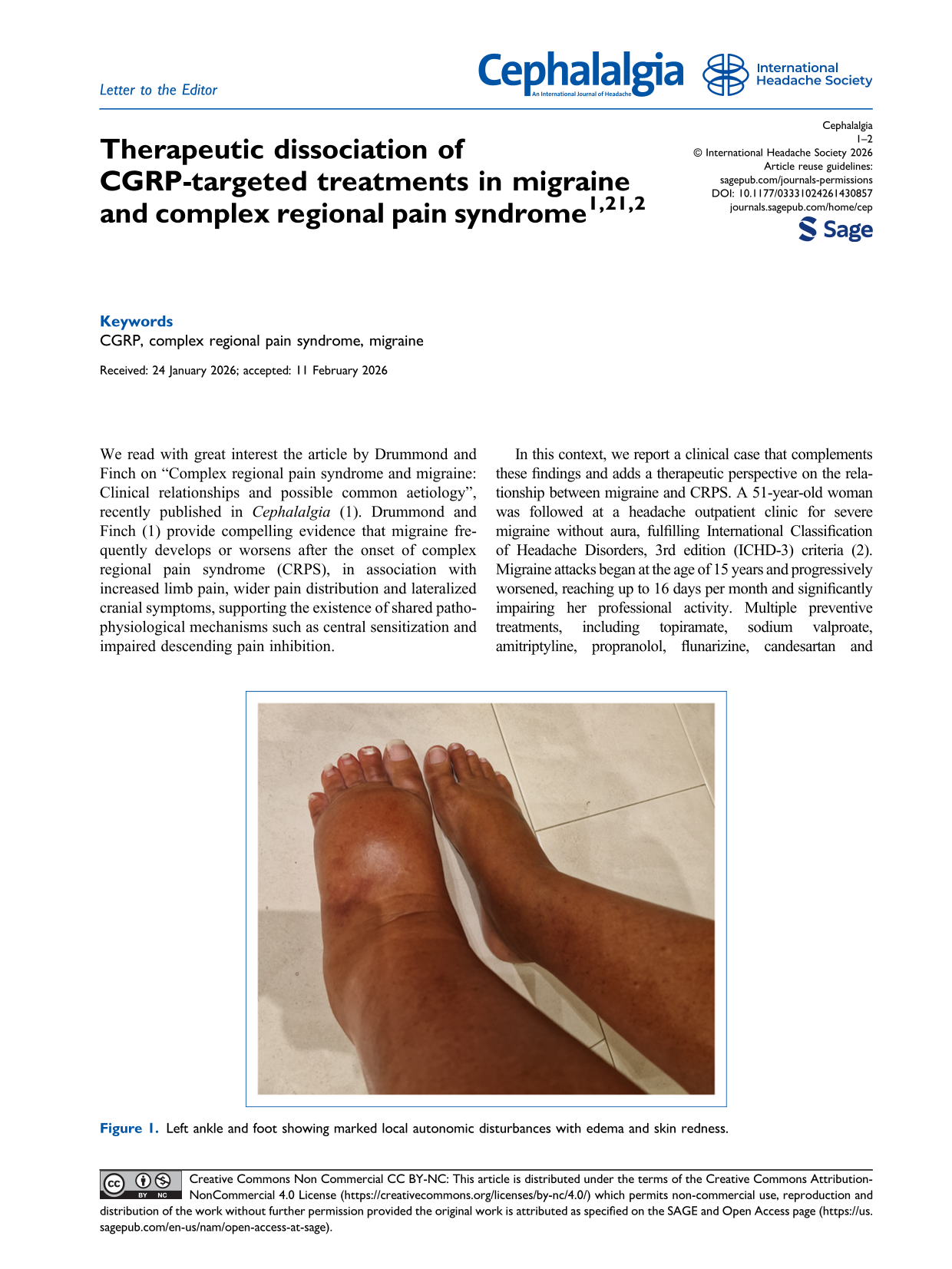
In this context, we report a clinical case that complements these findings and adds a therapeutic perspective on the relationship between migraine and CRPS. A 51-year-old woman was followed at a headache outpatient clinic for severe migraine without aura, fulfilling International Classification of Headache Disorders, 3rd edition (ICHD-3) criteria (2). Migraine attacks began at the age of 15 years and progressively worsened, reaching up to 16 days per month and significantly impairing her professional activity. Multiple preventive treatments, including topiramate, sodium valproate, amitriptyline, propranolol, flunarizine, candesartan and onabotulinumtoxinA, failed to provide meaningful benefit. Neurological examination and brain imaging were unremarkable. At the age of 49 years, she sustained a traumatic rupture of the left Achilles tendon, after which she developed persistent pain in the left ankle and foot associated with edema, skin color changes and temperature asymmetry (Figure 1.), consistent with CRPS. The diagnosis was confirmed clinically and supported by 99mTc-hydroxymethylene diphosphonate scintigraphy. Lumbar sympathetic block, lumbar sympathectomy and pharmacological treatments including duloxetine, gabapentin and tapentadol were ineffective.

Left ankle and foot showing marked local autonomic disturbances with edema and skin redness.
In July 2023, migraine prophylaxis with the calcitonin gene-related peptide
This case illustrates a clear therapeutic dissociation between migraine and CRPS under CGRP blockade. While both a CGRP monoclonal antibody and a CGRP receptor antagonist were highly effective for migraine prevention and acute treatment, neither intervention altered the severity of chronic CRPS. Although CGRP has been found to be increased in acute phase of CRPS (3), its role on the established CRPS remains unclear. The present case suggests that, despite overlapping clinical features and shared nociplastic mechanisms, CGRP-dependent pathways may play a more prominent role in chronic migraine than in established CRPS. Our case therefore complements the work of Drummond and Finch (1) by highlighting that, although migraine and CRPS may exacerbate one another clinically, they may remain at least partially dissociable at a therapeutic and mechanistic level. This distinction has important implications for clinical management and underscores the need for further research into mechanism-based treatments targeting shared versus condition-specific pathways.
Footnotes

Consent to participate
Permission release from patient.
Author contributions
FS was responsible for conceptualization; data curation; formal analysis; and writing the original draft. IPM was responsible for reviewing and editing. All authors have read and approved the final version of the manuscript submitted for publication.
Funding
The authors received no financial support for the research, authorship and/or publication of this article.
Declaration of conflicting interests
The authors declared the following potential conflicts of interest with respect to the research, authorship and/or publication of this article: Isabel Pavão Martins has received honoraria for lecturing, consultancy or participation in clinical trials from AbbVie, Allergan, Amgen, Eli Lilly, Lundbeck, Organon, Pfizer, Novartis, Teva, and Zambon. Filipa Dourado Sotero has received honoraria for lecturing, consultancy or participation in clinical trials from AbbVie, Allergan, and Lundbeck.