




Abstract

Konstantina Drellia, Lili Kokoti, Christina I Deligianni, et al. Anti-CGRP monoclonal antibodies for migraine prevention: A systematic review and likelihood to help or harm analysis. Cephalalgia 2021; 41(7): 851–864. DOI: 10.1177/0333102421989601
On page 857, Table 3, has been corrected and reproduced here; bold entries have been updated.
Efficacy, safety and benefit/risk outcomes in trials with anti-CGRP mAbs in the prophylaxis of chronic migraine.
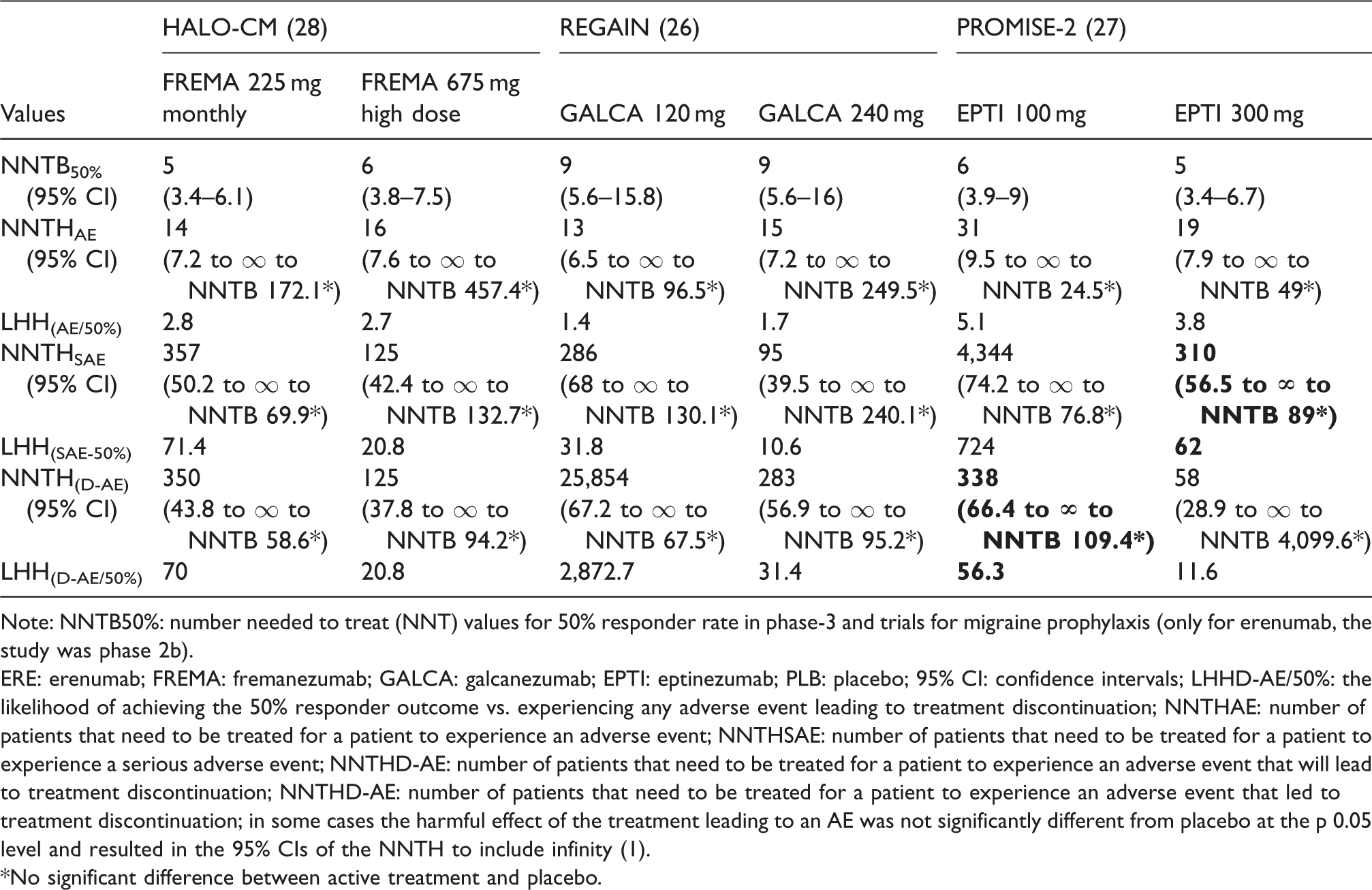
Note: NNTB50%: number needed to treat (NNT) values for 50% responder rate in phase-3 and trials for migraine prophylaxis (only for erenumab, the study was phase 2b).
ERE: erenumab; FREMA: fremanezumab; GALCA: galcanezumab; EPTI: eptinezumab; PLB: placebo; 95% CI: confidence intervals; LHHD-AE/50%: the likelihood of achieving the 50% responder outcome vs. experiencing any adverse event leading to treatment discontinuation; NNTHAE: number of patients that need to be treated for a patient to experience an adverse event; NNTHSAE: number of patients that need to be treated for a patient to experience a serious adverse event; NNTHD-AE: number of patients that need to be treated for a patient to experience an adverse event that will lead to treatment discontinuation; NNTHD-AE: number of patients that need to be treated for a patient to experience an adverse event that led to treatment discontinuation; in some cases the harmful effect of the treatment leading to an AE was not significantly different from placebo at the p 0.05 level and resulted in the 95% CIs of the NNTH to include infinity (1).
*No significant difference between active treatment and placebo.
Text in the Results section on page 856, right-hand column, second line should read (correction in bold):
In particular, the LHHD-AE/50% of fremanezumab, galcanezumab and eptinezumab varied from 20.8 to 70, 31.4 to 2872.7 and 11.6 to