




Abstract
Barré’s 1926 report “Sur un syndrome sympathique cervicale postérieure et sa cause fréquente: l’arthrite cervicale” is arguably the first description of what we now call cervicogenic headache. Barré’s contribution to the subject and significant insights, which have stood the test of time, are insufficiently recognised. This article is an English translation of Barré’s French original.
J-A Barré’s 1926 report “Sur un syndrome sympathique cervicale postérieure et sa cause fréquente: l’arthrite cervicale” (1), Figure 1, is arguably the first description of what we now call cervicogenic headache (2). Jean-Alexandre Barré (1880–1967), Figure 2, universally known by the eponymous Guillain-Barré polyneuritis, was Professor of Neurology at Strasbourg. In his early years, he worked with Babinski and Marie at the Salpêtrière in Paris. He received the Légion d’Honneur for his service during World War I. Barré had a particular interest in vestibular disorders, Figure 3, and was one the founders of the Revue d’Oto-Neuro-Ophtalmologie (3). His posterior cervical sympathetic syndrome acquired an eponymous name of Barré-Liéou syndrome, largely replaced by “cervical migraine” and later “cervicogenic headache”.

Barré article.
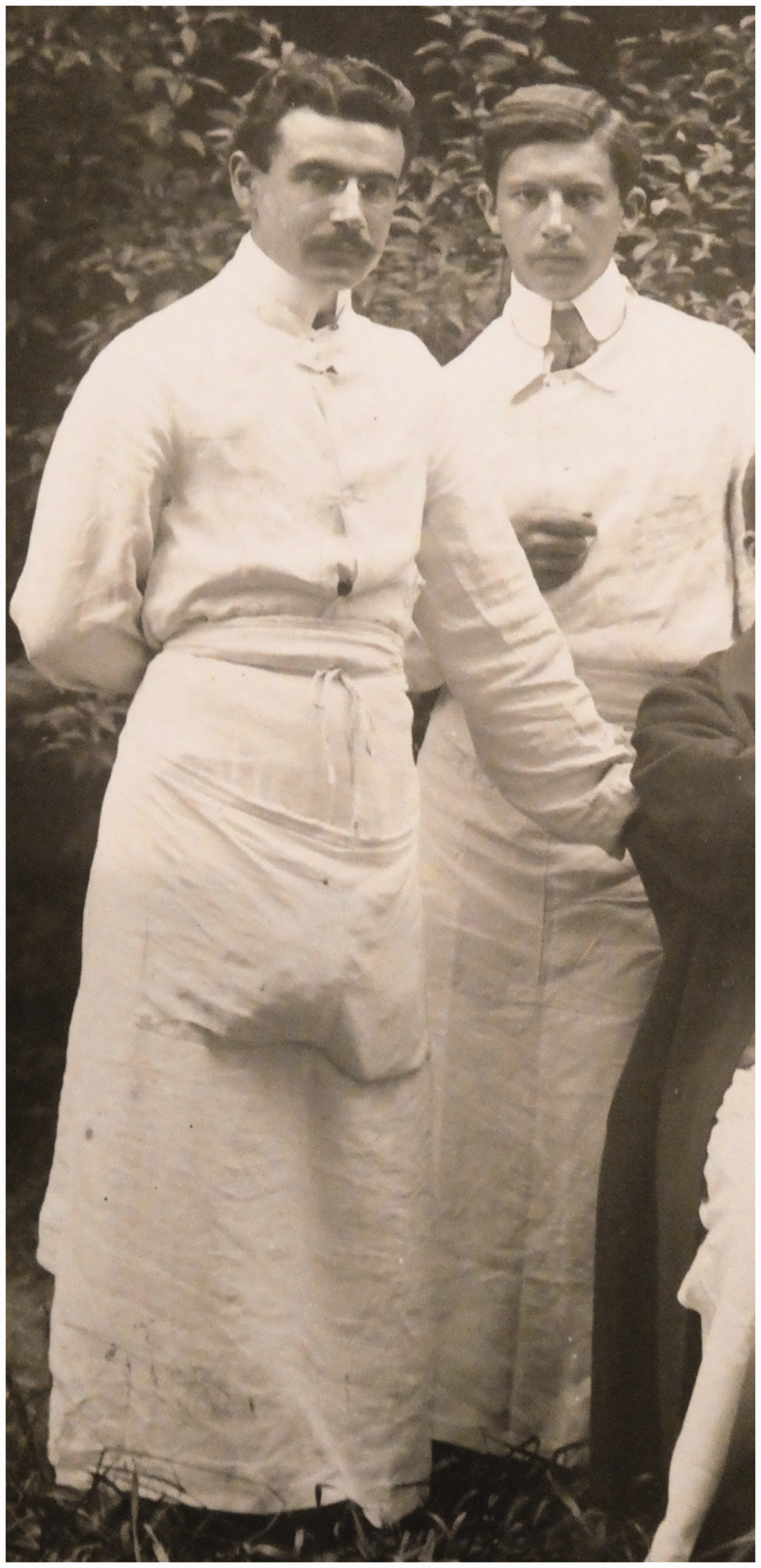
Dr. Jean-Alexandre Barré on the left with his colleague, Dr. Clovis Vincent, circa 1907.
Barré thought the newly described syndrome could have a sympathetic mechanism via “vertebral nerve’ as its anatomical agent. This idea was later rejected (4), giving his article a somewhat low reputation (5). With hindsight, however, and leaving the “sympathetic” theory aside, Barré’s short communication looks decidedly modern. He described a syndrome of headache, dizziness, tinnitus, visual disturbances and tiredness, and noted that the headache was its central complaint. He anticipated the concept of local anaesthetic blocks as invasive tests (6). He reported therapeutic effectiveness of local anaesthetics applied to a target in the cervical spine in the treatment of headache and suggested a possibility of surgical ablation of an offending nerve, predicting the modern use of radiofrequency neurotomy (7,8). He hypothesised, quite remarkably, that electrical nerve stimulation could have therapeutic use.

Caricature image. Photo provided with permission from Walusinski Library.
Barré was the first to link headache with degenerative arthritis of the cervical spine. In addition to head pain, most prominent in the occipital region, he mentioned pain in the face and eye, the distant receptive fields that do not receive sensory innervation from the cervical spinal nerves and are in the trigeminal distribution. This unlikely finding is, surprisingly, present in each case of the 1987 cervicogenic headache series by the Sjaastad’s group (2) – a phenomenon described in modern literature as trigeminocervical convergence (9,10). We see it as a common clinical feature in our own day-to-day practice (11).
Barré recognised that dizziness and tinnitus can have a cervical origin – findings that continue to be sporadically reported (12–14). To our unending surprise, these symptoms are often viewed as unexplained and recent educational texts appear to not recognise Barré’s musculoskeletal interpretation of facial pain (15), dizziness (16) and tinnitus (17). Cervicogenic headache is, in our experience, underdiagnosed. This is unfortunate since its treatment, as outlined by Bogduk and Govind (6), is simple and effective (18). We translated Barré’s original text from French in the hope of bringing his findings into a renewed focus.
————————Translation begins:
On posterior cervical sympathetic syndrome and its frequent cause: Cervical arthritis
By Mr. Barré
Summary. (Italics kept as in the original):
We have gradually come to realise that [this syndrome] deserves its own place and a precise extracranial cause; the syndrome whose different elements in the beginning seemed to have either intracranial origin or result from the disease of the sinuses of the base of the skull.
It seems justified to name it “posterior cervical sympathetic syndrome” since the deep cervical sympathetic, i.e. the vertebral nerve, appears to be its [true] agent, and to use such denomination in contrast with Claude Bernard-Horner’s [syndrome], the anterior cervical sympathetic syndrome, which is entirely different.
While the latter is [almost] purely objective, the posterior cervical sympathetic syndrome is almost exclusively subjective. It consists of more frequent cranial symptoms, less frequent cervical symptoms, [as may be judged by the cases observed so far], and, lastly, some systemic (inférieurs) sympathetic symptoms.
The cranial symptoms are as follows:
Headaches, at maximum occipital; Dizziness occurring every time that the patient turns his head, usually without distinct abnormalities in instrumental vestibular tests;
Tinnitus;
Visual complaints preventing patients from reading for long periods, causing them to blame their eyesight and visit an ophthalmologist who will not find [any] objective [visual] abnormalities – since the examination is conducted when the patient is not tired, whereas it is fatigue alone that is responsible for the complaint.
Among [more] local complaints we should mention frequent reduction in the pitch of the voice, [the veiled voice], a state of oscillatory aphonia that comes and goes [suddenly], and a particular hypersensitivity deep in the neck, with or without cracking and grinding of bones and joints.
Among the most frequent systemic (inférieurs) complaints is excessive tiredness – the signature of sympathetic involvement, especially in hypotensive persons in response to blood pressure changes.
In this constellation of symptoms, of which each element deserves to be considered at length in a more detailed article, the cranial complaints are by far the most important and characteristic.
[Search for] its cause has [long] intrigued us. First, we searched inside the skull, then in the infra-cranial sinuses, and undoubtedly some of the cases might be related to the sinus disease.
But in a good number of cases, where the sinus disease can be excluded or treated with temporary success, we need to look elsewhere.
Some cases, [which we are pleased to regard as lucky], led us to suspect the cervical spine, and we found in numerous subjects [exhibiting such symptoms] clear-cut signs of chronic cervical arthritis. In order to detect these signs, x-ray films should be taken in lateral view, and, whenever possible, of three kinds: One with the neck in neutral position, one with maximal head flexion and the third with maximal extension. We will publish on this with Dr Gunsett of Strasbourg.
Intermediary agent: It seems that cervical arthritis acts through irritation of the vertebral nerve, which runs almost in contact with the lateral parts of the cervical vertebral bodies (la partie latérale des corps vertébraux cervicaux), before it enters the skull to join different vessels of the base.
It is said that this nerve is formed mostly by the rami communicantes of the 4th, 5th and 6th cervical nerves. Indeed, in a large number of x-rays that we have so far observed, the most affected are precisely the 4th, 5th and 6th cervical vertebrae.
Some other facts, already known or recently published, correspond with our theory.
Often during sub-occipital or high cervical punctures one can trigger acute pain in the side of the face or in the eye; Interspinous cervical injections that we administered to alleviate the painful elements of the syndrome, occasionally caused all the phenomena to flare-up; Mr Leriche and Mr Fontaine, unaware of our research from the previous years, came to the same results from their neurosurgical observations; Finally, my registrar Dr Draganesco, of Bucharest, when directed by me to inject the base of the neck with scurocaine, at the level of the rami communicates that feed into the vertebral nerve, was able to trigger ipsilateral tinnitus, vertigo and nystagmus.
A positive and etiological diagnosis of this syndrome will often be a delicate task and it would be prudent first to think of sinus disease, on which there has recently been much emphasis, and also to think about eyesight-related occipital headaches, and the headaches that often accompany otosclerosis.
But one might also ask whether congestion of the sinuses was not partially or entirely caused by the state of the vertebral nerve, or whether otosclerosis did not develop as the result of vasodilatation from the same cause.
These clinical discussions are necessary and should draw more attention, and will eventually lead to a simple theory behind disorders still in part mysterious, and provide new treatments.
The high incidence of the posterior cervical sympathetic syndrome and of cervical arthritis can probably be explained by the anatomy of the region, where infection of the upper aerodigestive cavities in its neighbourhood commonly causes deep cellulitis and lymphangitis.
The treatment could address the sympathetic system as a whole or at a local level employ interspinous epidural injections (injections interépineuses sus-dure-mériennes). In some cases there could be a surgical way to free up the rami communicantes when they become trapped in the cellulo-osseous lesions, or even divide the vertebral nerve in its cervical portion.
One could also look to electricity: Some applications permitting, with certain precision, such vasomotor effects that will help relieve complaints related to intracranial circulation since it [intracranial circulation] is regulated via the vertebral nerve and its branches.
—————————Translations ends.
Article highlights
Barré’s 1926 report “Sur un syndrome sympathique cervicale postérieure et sa cause fréquente: l’arthrite cervicale” is arguably the first description of what we now call cervicogenic headache. Barré described a syndrome comprising headache, dizziness, tinnitus, visual disturbances and tiredness. Several of Barré’s insights stood the test of time: The concept of invasive tests, the effectiveness of spinal interventions in the treatment of headache, the anticipation of electrical stimulation as a therapeutic tool, the musculoskeletal origin of facial/orbital pain, dizziness, and tinnitus. Insufficient recognition of Barré’s findings is partly explained by the fact that the report was published in French.
Footnotes
Acknowledgement
I would like to thank Professor J-J Lehot, Professor of Anaesthesia and Intensive Care Medicine, Lyon, France, for the review of the manuscript and valuable comments.
Declaration of conflicting interests
The author declared no potential conflicts of interest with respect to the research, authorship, and/or publication of this article.
Funding
The author received no financial support for the research, authorship, and/or publication of this article.
