



Abstract
Positive predictive value (PPV) can easily be calculated with the following formula if sensitivity, specificity and prevalence are known (1):

It is important to take disease prevalence within the target population (pre-test probability) correctly into account. Authors, referees and editors should be aware of this to prevent the publication of erroneous results.
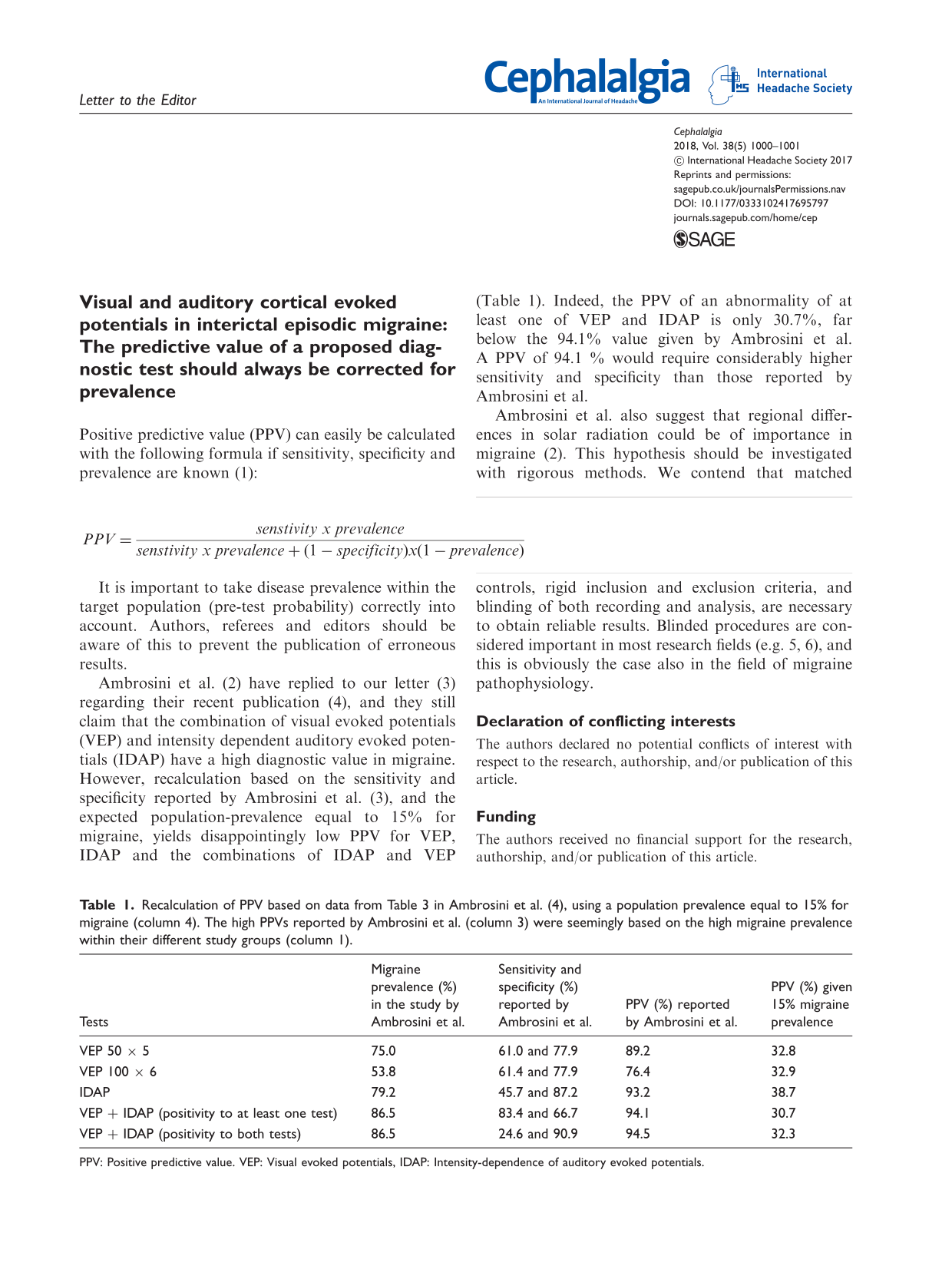
Recalculation of PPV based on data from Table 3 in Ambrosini et al. (4), using a population prevalence equal to 15% for migraine (column 4). The high PPVs reported by Ambrosini et al. (column 3) were seemingly based on the high migraine prevalence within their different study groups (column 1).

PPV: Positive predictive value. VEP: Visual evoked potentials, IDAP: Intensity-dependence of auditory evoked potentials.
Ambrosini et al. also suggest that regional differences in solar radiation could be of importance in migraine (2). This hypothesis should be investigated with rigorous methods. We contend that matched controls, rigid inclusion and exclusion criteria, and blinding of both recording and analysis, are necessary to obtain reliable results. Blinded procedures are considered important in most research fields (e.g. 5, 6), and this is obviously the case also in the field of migraine pathophysiology.
Footnotes
Declaration of conflicting interests
The authors declared no potential conflicts of interest with respect to the research, authorship, and/or publication of this article.
Funding
The authors received no financial support for the research, authorship, and/or publication of this article.