




Abstract
Background
The headache phenotype and neurological symptoms of the German composer Richard Wagner (1813–1883), whose music dramas count towards the most frequently performed operas across the world, are previously undocumented.
Methods
Richard Wagner’s own descriptions of his headache symptoms in his original writings and letters are investigated, as well as the complete diary records of his second wife, Cosima Wagner.
Results
There are manifold indications that Richard Wagner suffered from a severe headache disorder, which fulfils most likely the diagnostic criteria of migraine without aura and migraine with aura of ICHD-3 beta.
Conclusions
Richard Wagner’s life and opus can help to better understand the burden and suffering caused by migraine with its severe effects on the individual, familial and social life, the culture and community.
Introduction
The music dramas of German composer and poet Richard Wagner (22 May 1813–13 February 1883) form a milestone in music history and count towards the most frequently performed operas across the world. Arguably, no other composer has challenged musical conventions as much as Richard Wagner. His works integrate poetic, visual, musical and dramatic art to form a so-called Gesamtkunstwerk. Wagner’s pathography has been investigated in numerous accounts. It is divided into four categories: so-called functional disorders, skin disorders, acute infections and minor ailments as well as his heart disease (1,2). A detailed analysis of the neurological disorders of Richard Wagner has so far never been carried out. Wagner is described as a particularly sensitive person, who registered external stimuli immediately and reacted quickly (1). Franken (2004) calls this a ‘severe vegetative instability’, as part of which numerous ‘functional disorders’ were manifested, mainly in bodily complaints and sleep disorders (1). His so-called ‘functional headaches’, mentioned in a monograph about Wagner’s medical problems only as a side note (3), do not allow an exact headache phenotype classification. In an overview of Richard Wagner’s ill-health, Gould (1903) attributes these persistent symptoms to eye-strain, which could have been cured with glasses (4). Another extensive monograph about disorders of great musicians does not even mention headache as a complaint of Richard Wagner (2).
In a recent paper we showed how Richard Wagner interwove his headache suffering into his music and libretti, using the opera Siegfried as an example (5). However, a close diagnostic evaluation of his headache and neurological symptoms, described by him as the ‘main plague of his life’ (6), has never been carried out. In this study Richard Wagner’s headache disorders are analysed in detail for the first time using the diagnostic criteria of the International Classification of Headache Disorders (ICHD-3 beta) (7) on the basis of Richard Wagner’s own descriptions of his headache symptoms in his writings and letters (6,8,9). In addition, the headache phenotype is complemented for the first time by information about Richard Wagner’s headaches as specified in numerous diary records of his second wife, Cosima Wagner (10,11) from 1 January 1869 until 12 February 1883, the day before Richard Wagner died. In the following analysis we state, where possible, for each symptom described the corresponding letter-figure combination of the ICHD-3 beta criteria in square brackets.
Headache in the writings and letters of Richard Wagner
To capture the headache phenotype of Richard Wagner, we first analysed the memoirs (6), writings and letters (8,9) of Richard Wagner.
There was a family disposition towards headaches. Richard Wagner reported this about his mother, a baker’s daughter called Johanna Rosine Wagner, née Petz, (1774–1848) (6): ‘Even from the time when my reminiscence of her is quite distinct, she always had to wear a cap owing to some affection of the head, so that I have no recollection of her as a young and pretty mother.’ Cosima Wagner (née Liszt), Richard Wagner, Franz Liszt and Hans von Wolzogen at Villa Wahnfried, Bayreuth, Germany. Usually Richard Wagner wore a hat inside, which was a standard remedy against headaches at the time. Painting by Wilhelm Beckmann 1881. Source: Richard Wagner Museum Lucerne, with permission.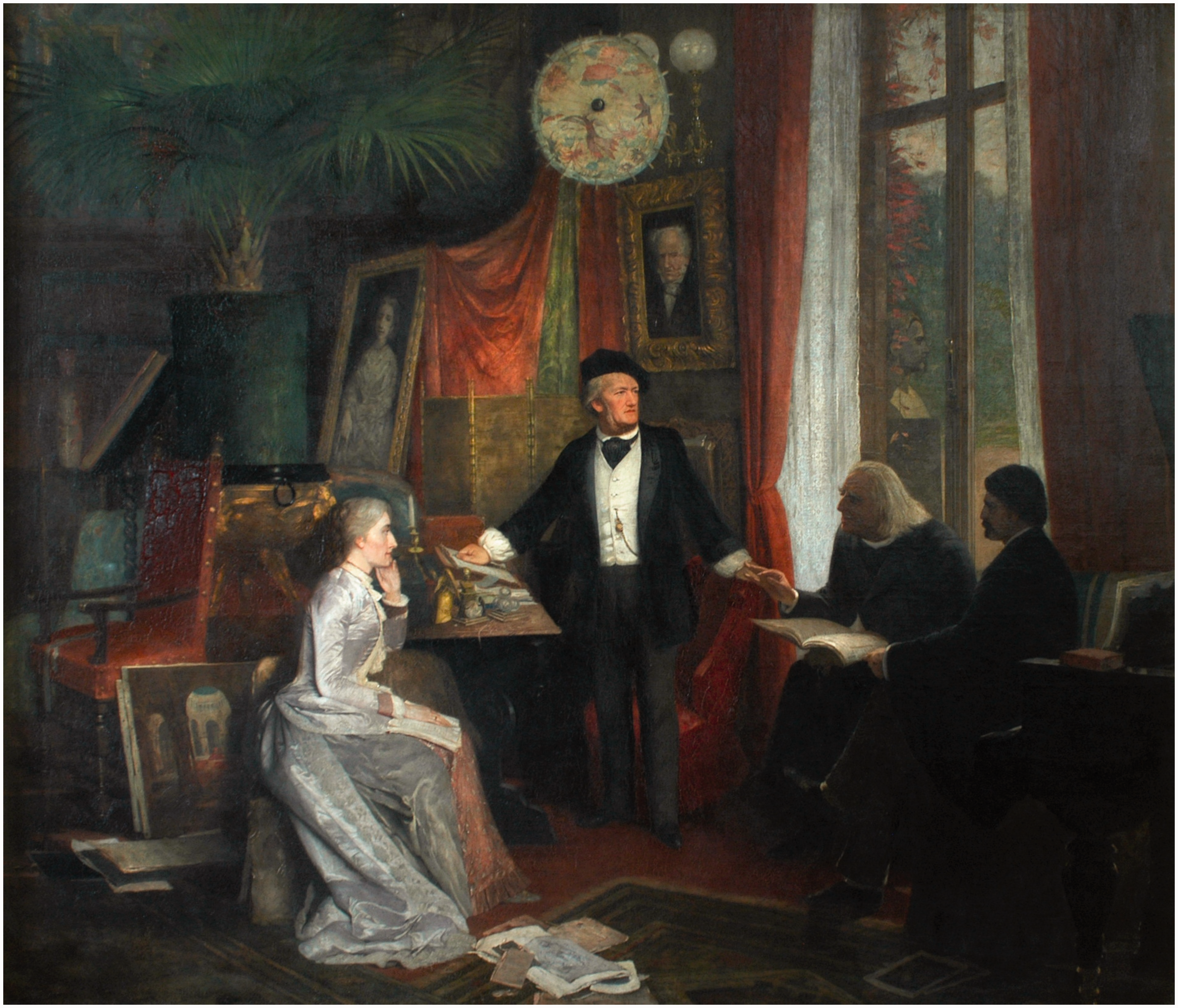
Richard Wagner describes suffering from long-lasting, almost never-ending, ‘nervous’ headaches (6): ‘I was not allowed to stop reading on the following days until Der Ring des Nibelungen was quite finished. Finally Paris claimed our attention, but while the ladies were visiting the museums I was unfortunately obliged to stay secluded in my room, tortured by never ending nervous headaches.’
Richard Wagner also repeatedly describes nausea related to pain, stress and fatigue (6) [1.1.D1]: ‘We had entered upon the year 1850; I had decided to go to Paris, if only for the sake of peace, but had to postpone my journey on account of ill-health. The reaction following upon the terrible excitement of recent times had not failed to have its effect on my overwrought nerves, and a state of complete exhaustion had followed.’ ‘That day I suffered from such terrible headaches and painful nerve twitches that I had to go home early and lie down in bed.’ ‘After dinner, when Liszt sat down at the piano, young Marie Wittgenstein noticed that I had withdrawn silently and rather sadly from the rest of the company; this was due partly to my headache, and partly to the feeling of isolation that came over me in these surroundings. I was touched by her sympathy and evident wish to divert me.’ ‘I went one day by appointment to see [Mr. E. Kossak], and found that his room had just been scrubbed with boiling water. The vapour from this operation was so unbearable that it had already given him a headache, and was not less disagreeable to me.’ ‘Your head is buzzing, you don’t know where you are, seem as if in a dream, and all is flickering before your eyes? Quite so: we know all about that from own experience.’
Wagner had a lifelong friendship with Dr Anton Pusinelli, physician in Dresden. In a letter to Dr Pusinelli from 1 August 1843 (9), Richard Wagner describes how longer lasting headache episodes were an impediment to his work [1.1.C3]: ‘My dear friend, I have headache and I am unproductive, yet I cannot resist replying to your kind letter.’ ‘Yesterday, I had headaches so severe that I had to leave theâtre français. It is better today; I slept four hours after all.’
In another letter to Minna Wagner from 26 June 1855, Wagner writes (9) [1.1.B; 1.1.C3]: ‘I have terrible headaches today.’ ‘The air is splendid; headache disappears on arriving.’ ‘Now I just finished a new score: if you knew what work was like for me! It is a fanaticism, which doesn’t let me see anything else. I never stop, only when the most painful headaches prevent me from working further: but then I am unable to do anything for the entire day.’ ‘I went to bed only at noon and couldn’t sleep well at all. I woke up with horrible nervous headache.’ ‘It is a true misery with me: but one thing is for sure, – I wasn’t born to make money, but to be creative; and the world should take care of me doing so. As we all know, one cannot force it, the world does what it wants. Just like I would like to. Thus we – the world and I – are two pig-headed fellows, banging each other’s head, and the weaker one must break, – which is probably why I have my nervous headaches so often. You, my dearest friend, have stepped in between us with the best of all intentions, without doubt to soften the bashes: take care not to also get injured!’ ‘I began to sketch the overture [of Siegfried] on September 22. That time one of the main plagues of my life arose, causing critical distress. A tinker had established himself opposite our house, and stunned my ears all day long with his incessant hammering. In my disgust at never being able to find a detached house protected from every kind of noise, I was on the point of deciding to give up composing altogether until the time when this indispensable condition should be fulfilled.’ ‘I have not yet got back into the mood for writing to [Carolyne and Marie von Sayn-Wittgenstein]. I am annoyed at being always in a state of lamentation, and must therefore wait for a favourable hour, for I do not like absolutely to deceive you. You yourself are used to my laments, and expect nothing else. My health, too, is once more so bad, that for ten days, after I had finished the sketch for the first act of Siegfried, I was literally not able to write a single bar without being driven away from my work by a most tremulous headache. Every morning I sit down, stare at the paper, and am glad enough when at least I get as far as reading Walter Scott. The fact is, I have once more over-taxed myself, and how am I to recover my strength? With Das Rheingold I got on well enough, considering my circumstances, but Die Walküre caused me much pain. At present my nervous system resembles a pianoforte very much out of tune, and on that instrument I am expected to produce Siegfried. Well, I fancy the strings will break at last, and then there will be an end. We cannot alter it; this is a life fit for a dog.’
Headaches of Richard Wagner in the diaries of Cosima Wagner
Cosima Wagner (24 December 1837–1 April 1930), daughter of the composer Franz Liszt, was the second wife of Richard Wagner. Primarily intended for her two children from the first marriage, she wrote down detailed diary entries, which she carefully maintained from 1 January 1869 until 12 February 1883 (10,11). The records ended 1 day before Richard Wagner’s death. She described in great detail the daily routine of family life, the family’s health as well as philosophical, musical and literary opinions. As a result of testation, the Bavarian State Bank in Munich kept the diaries under lock and key until 1972. Only in 1975 were the records made available to the public after lengthy legal disputes. Martin Gregor-Dellin completely transcribed the records and published them in two volumes (Volume I: 1869–1872 (10); Volume II: 1878–1883 (11)) with a total of 2596 pages.
Focal neurological disturbances and headaches of ‘“R”’ (Richard Wagner) in the diary records of Cosima Wagner.
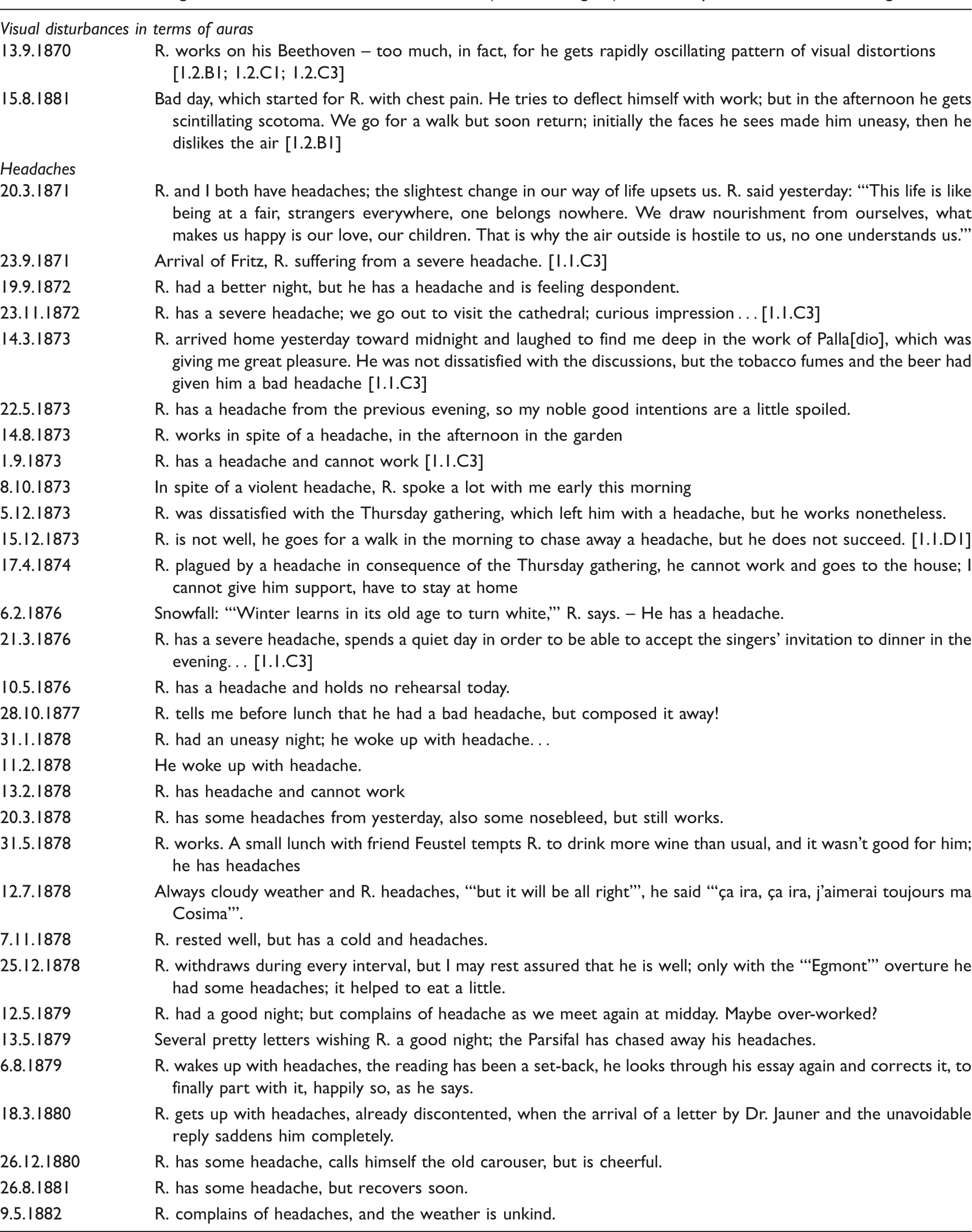
Notably in many parts of her diary, Cosima Wagner also complained of headaches making her bed-ridden for several days. Her elaborations support the assumption that she suffered from a migraine without aura and a migraine with aura with severe attacks. In a diary entry from 1 April 1869, Cosima Wagner even describes a marital conflict related to her headaches in great detail (10): ‘In the evening R. [Richard] speaks to me about the Odyssey and the Iliad, smoking and drinking beer. Since the joiners had been varnishing in the next room, all these various smells combine, and I gradually begin to feel dizzy and get headaches, which rob me entirely of my vision and finally of my hearing, too. When I told R. of my condition he became very angry, seeing a reproach in what was only an explanation. He then said many things it would have been better for him not to have said. I up to my room where, feeling upset, it made me cry. Now I am wondering what would be the best thing to do – whether I should leave his temper to cool down or go to him, quietly explain again what had happened, and soothe him. Hardly had I written this when R. came in to wish me good night. I then went downstairs to him and calmed his fantasies.’ ‘Fever, I must rest in bed until the doctor comes, having severe headaches. Without seeing the children and under the heavenly care of R. I spend the day in great pain. R. finishes his Beethoven.’
Cosima Wagner even documents undesired neurological side effects of Richard Wagner’s music on 23 May 1874 (10): ‘Frau v. M. leaves; all day with Marie Dönhoff, listening to her outpourings, my pain stays unexpressed. The painter Hoffmann arrives with his sketches, but unfortunately he has altered nothing. In the evening Marie Dönhoff plays very beautifully, she tells us the Crown Princess said R.’s music gave her a headache.’
Richard Wagner’s headache phenotype
Indications of diagnostic subcriteria of migraine without aura (code 1.1. ICHD-3 beta).
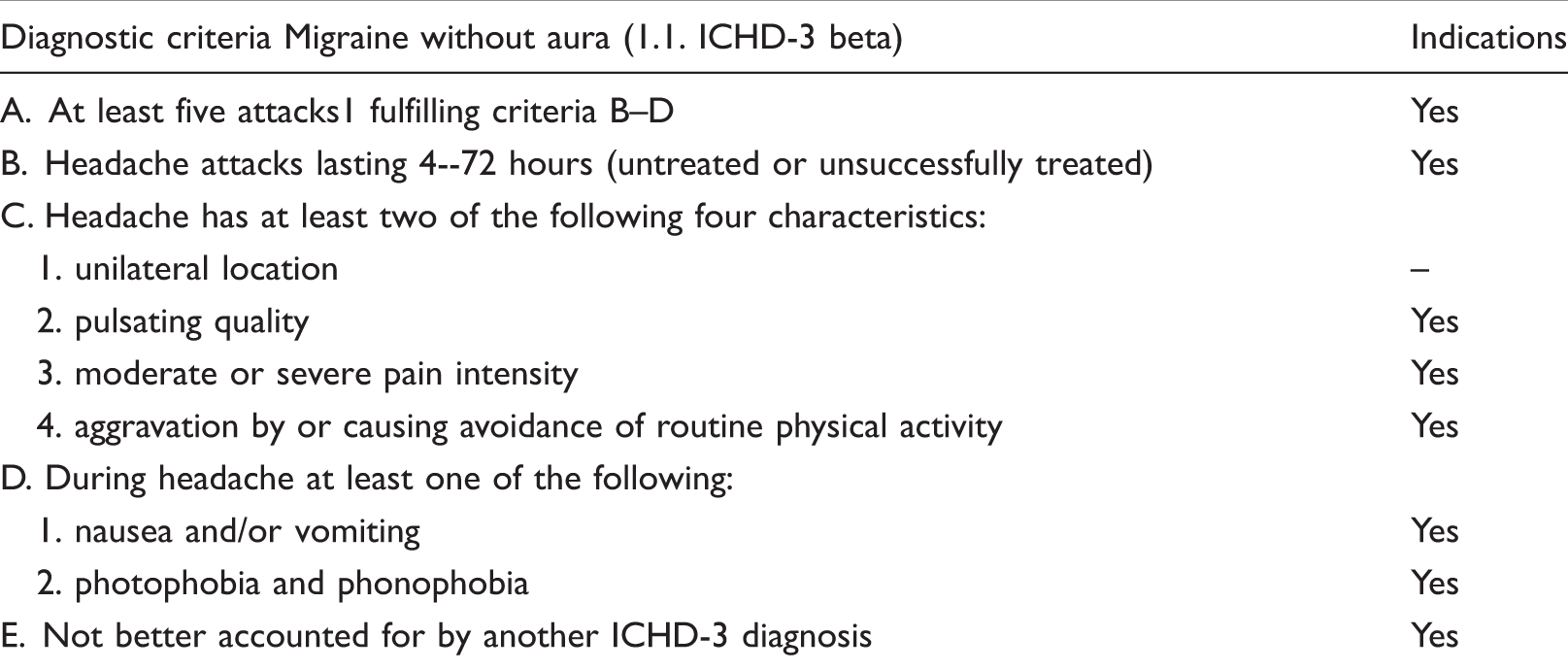
Indications of diagnostic subcriteria of migraine with aura (code 1.1. ICHD-3 beta).

Life-long migraine and especially migraine with aura carries an increased risk of the development of ischemic vascular disorders including angina, myocardial infarction, coronary revascularization, claudication and cardiovascular mortality (14,15). Until today, migraine has been associated with 12 known risk genes (16). Two of these are also known to be involved in the development of cardiovascular disorders: mutations in TGFBR2 can be implicated in the pathogenesis of abdominal aortic aneurysms, PHACTR1 increases the risk for a myocardial infarction at young age (16). Richard Wagner suffered from cardiovascular symptoms in the last years of his life and probably died from a myocardial infarction (1,2). Effective migraine therapy of present day standards (13,17) could have given him more creative ability and life span. The family and social life of the Wagner family would have also been less burdened. The question arises as to what effects an adequate diagnosis and sustainable migraine therapy might have had on his music. Richard Wagner’s life and opus can help us to better understand the burden and suffering caused by headache with its severe effects on the individual, familial and social life, the culture and community.
Clinical implications
Headaches and associated symptoms were a significant burden to Richard Wagner for decades and had central health implications. There is a clinically high probability that Richard Wagner suffered from a severe headache disorder fulfilling the phenotype of migraine without and migraine with aura of ICHD-3 beta. Effective migraine therapy of present day standards could have given Richard Wagner, whose music dramas count towards the most frequently performed operas across the world, more creative ability and life span.
Footnotes
Funding
This research received no specific grant from any funding agency in the public, commercial, or not-for-profit sectors.
Conflict of interest
None declared.