




Abstract
Background: Few descriptions of cluster and cluster-like headache made before the 19th century have been reported.
Case description: We present a previously unreported early description of a probable cluster headache case made by Francisco Suárez de Rivera (1686−c.1751), one of the main physicians of the Spanish Age of Enlightenment, writer of almost 40 textbooks about medicine, surgery, pharmacology, and therapeutics.
Discussion: The depiction here reported of a woman with probable cluster headache is possibly one of the earliest known and, to our knowledge, the first in Hispanic literature. We also review other descriptions of cluster and cluster-like headache from the same time period.
Keywords
Case description
In 1726, Francisco Suárez de Rivera published, in Spanish, Teatro de la Salud o Experimentos Médicos (Theatre of Health or Medical Experiments) (1; Figure 1). As a result of his medical experience, the book is structured in consecutive clinical profiles of his patients, with explanations of his diagnostic and therapeutic approach to them. Most of Suárez de Rivera’s works are written following this pattern. The work is divided into six books (main chapters) which are subdivided into chapters (minor chapters). The third book is entitled De los experimentos que conducen a vencer los morbos, que comunmente suelen ofender a la cabeza (About the experiments that may solve the diseases commonly affecting the head) and the first chapter of this book is entitled En donde se descubren los experimentos contra el dolor de cabeza (Where experiments against headache are described). This chapter contains the following account of a nun with headache, which could be considered to be an early description of episodic cluster headache written in Spanish and one of the first in universal medical literature:
Portrait of Francisco Suárez de Rivera at the age of 52 (left), from one of his textbooks, and cover of Suárez de Rivera’s Teatro de la Salud (1726) (right).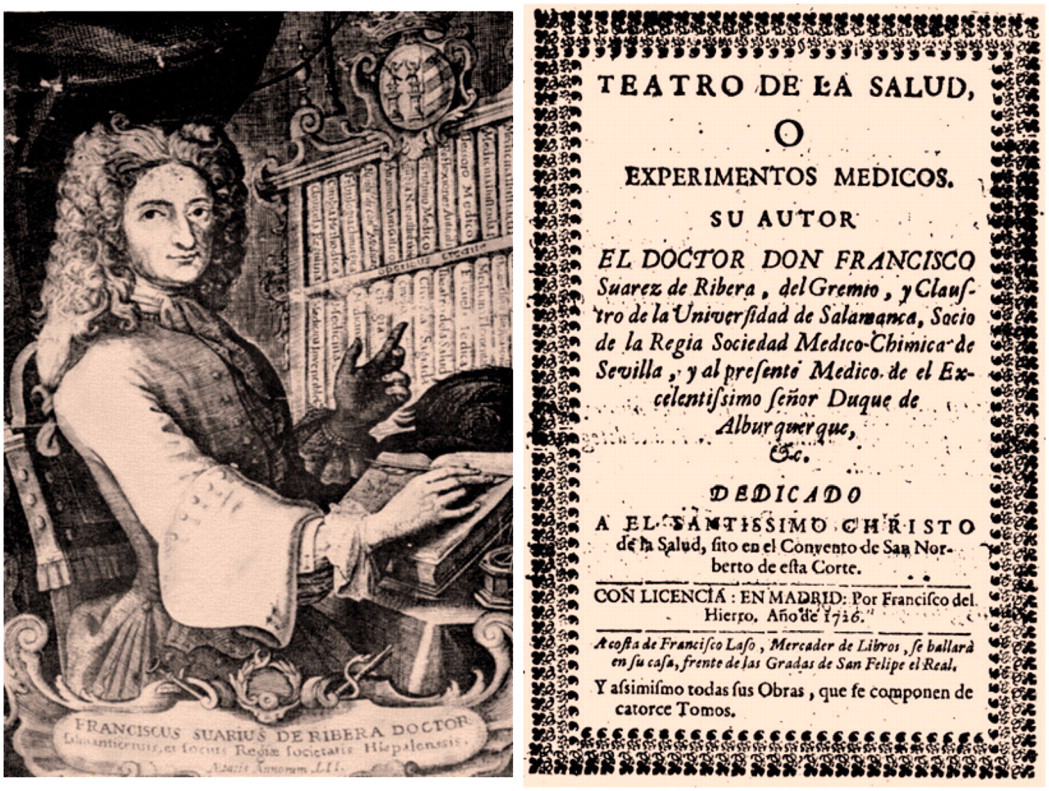
‘Es, pues, el morbo que aflige a esta Religiosa, un dolor, que solo ocupa la media cabeza, el qual empieza en el huesso de la mexilla izquierda y por encima del ojo, y se va estendiendo por la parte superior, y anterior, de la cabeza, no llegando a tocar la nuca, el ombro, ni garganta, sí solo molesta con grandisima fuerza […] la parte superior de la cabeza, de tal fuerte, que le parece a la enferma que los circunstantes oyen los golpes que dize le causan el dolor; la enferma llora por el ojo izquierdo y [quiere] abrise la cabeza; obligala a no poder para en la cama, sino es, como si fuera dementada, hablar desatinos con grandes gritos, no siendo capazes à sujetarla seis Religiosas, en estando con la fuerza del dolor […].’
‘The disease affecting this Sister is a pain that lies only in the half side of the head, which begins in the left cheek bone and above the eye, and spreads to the upper and anterior sides of the head, never in the neck, shoulder, or throat; it only severely affects the head; she believes that the throbs causing her pain can be heard among those present; the tears begin to flow from the left eye and the Nun cries and [wants] to open her own head; [the pain] forces her to be restless in bed, as if she had become mad, and to shout loudly, and six other Nuns cannot hold her, due to her strength during the pain episodes.’
Further on, Suárez de Rivera identifies the seasonal periodicity of the headache:
‘La primera vez que la acometiò este dolor, fue quatro años ha por este tiempo, continuandola siempre por principio de Verano, y hasta que empieza el Otoño no cessa de molestarla, yà mas, yà menos; y en tiempo de Invierno, si alguna vez la repite, dura muy poco, y no con fuerça; con la advertencia, que por la noche se exacerva, y por el dia se mitiga.’.
‘The first time this pain happened was four years ago in this season, beginning always at the opening of summer, annoying her, more or less, until the beginning of fall; and, in winter, it lasts a little or nothing; with the warning that it increases at night and disappears during the day.’
Suárez de Rivera puts forward how this headache can be termed ‘clavus hystericus’ as the origin of the pain can be attributed to ‘the inflammation of the fibres of the brain membranes whose origin is the blood modified by the hysterical ferment’.
Further on in the text, Suárez de Rivera points to the failed treatments that have been applied to the nun (including bloodletting, leechs behind her ears, and cupping glass therapy) and explains that, according to his experience, this headache can improve following a treatment with mercurial pills (made of water, rhubarb, saffron, mercury, and ammonia) to absorb the stomach acid and lupine pills (made of wolf penis, cinnabar, daisy, laudanuma, and gold leaf) to destroy the hysterical ferments.
Francisco Suárez de Rivera
Little is known about the biographical data of Francisco Suárez de Rivera (2). He was born in Salamanca in 1686, where he studied medicine. In 1733 he was appointed physician to King Philip V, and later to his son, King Ferdinand VI. He was member of the Royal Society of Physicians of Seville (Regia Sociedad Médica de Sevilla) and also of the Royal Medical Academy of Oporto (Portugal). He was a renowned and talented physician, and, during his life, he enjoyed great prestige in academic and social circles. This reputation can be confirmed by all the positions he held during his lifetime and also in the forewords of his works, in most cases laudatory reviews of the texts, written by other contemporary physicians. The number of textbooks and works written by Suárez de Rivera is astonishing. Between his first work (Clavicula Regulina) dating from 1718 and his last known work (Canones particulares de Cirugia) published in 1751, Suárez de Rivera wrote almost 40 books. The date of his death is unknown, though he may have died not long after his last publication, in 1751. Several of Suárez de Rivera’s textbooks display a special interest in neurological conditions. Apoplexy, palsy, epilepsy, catalepsy, and headache are described by Suárez de Rivera not only in Teatro de la Salud but also in other works, such as Tesoro Médico (1724), in the first volume of Remedios de deplorados (1724), in Secretos Médicos Extraordinarios (1733), and in some chapters of Manifestación de Cien Secretos del Doctor Juan Curvo Semmedo (1736).
Suárez de Rivera practised medicine during the early 18th-century, a time of confrontation between tradition and modernity. During this period, the new scientific and philosophical concepts of the Age of Enlightenment emerged against the traditional theories of Aristotelianism and Galenism. In this regard, although Suárez de Rivera’s convictions were deeply attached to the Old School, he was interested in new concepts about iatrochemistry, anatomy, and botany, which arose in the late 17th and early 18th centuries, using them in some of his publications.
Discussion
Reports of the rather unique clinical features of cluster headache do not appear in the medical literature until the late 17th century (3). In 1672, the English physician Thomas Willis (acclaimed anatomist and founder member of the Royal Society), published De Anima Brutorum, where he described a recurrent headache with a seasonal periodicity, although other clinical data suggesting a cluster headache are absent (4). Abraham de la Pryme, an English antiquary, published a report in 1708 about ‘A remarkable case of hydrophobia’ in the Royal Society’s Philosophical Transactions where he described a cluster headache case initially attributed to rabies (5). The Dutch physician Nicolaes Pieterzoon, known as Tulp (the main character of Rembrandt’s famous painting The Anatomy Lesson), exemplified some of the features of cluster headache in his work Observationes Medicae, published in Amsterdam in 1641 (6). Although it is unclear whether the case fulfilled today’s criteria for episodic cluster headache of the International Classification of Headache Disorders (ICHD), his description is highly valuable. Approximately a century later, in 1745, Gerard van Swieten, another Dutch physician (pupil of Herman Boerhaave in Leiden and professor at the Vienna School of Medicine) published his Commentaria, in which he offers a detailed description of a man with cluster headache, fulfilling all the ICHD current criteria for this condition (7,8). Some other cases of hemicranial headaches suggestive of cluster headache in mid-18th century texts have been reported, including the descriptions of a clockwise headache by Johann C. U. Oppermann in 1747 (9), Robert Whytt in 1764 and Giovanni Morgagni in 1779 (10). Possible additional 19th-century cases and descriptions of seasonal headaches suggestive of cluster headache were published by Johann V. Müller (1813), Marshall Hall (1836), Moritz H. Romberg (1840), Albert Eulenburg (1871), and Robert F. Kilvert (1840⊟18 7 9) (5).
The depiction made by Suárez de Rivera and here reported comprises, to our knowledge, the first description of a cluster-like headache in Spanish literature. In contrast to other contemporary descriptions, it describes the pain in a woman and not in a man. Although cluster headache is not absent in women, it is more frequent in men, with a ratio of (3:1) (11). The description stresses three main characteristics of the pain: it is strictly unilateral, it is accompanied by agitation and restlessness during the pain crises, and it has a noteworthy circadian and circannual periodicity. All these features, in addition to the lacrimation of the ipsilateral eye, suggest that the pain suffered by the nun was actually a cluster headache rather than a paroxysmal hemicrania (11). However, Suárez de Rivera does not include the duration of the pain or the frequency, thus not fulfilling all the current ICHD criteria for episodic or chronic cluster headache.
The case described by Suárez de Rivera highlights that the medical observations of historical physicians should be critically reviewed for descriptions of neurological conditions such as headache. Moreover, many Spanish physicians from the 16th, 17th, and 18th centuries are nowadays unknown, despite the fact that they were well known and acclaimed during their time. Today, their works are relegated to the bottom of the archives, waiting to be found and to recover the place they deserve in history.
Footnotes
Funding
This research received no specific grant from any funding agency in the public, commercial, or not-for-profit sectors.