



Abstract
This review examines how Western business schools have included and excluded Indigenous people and knowledge in management education through a decolonisation lens. A growing but disparate body of scholarly work reveals how business schools have largely ignored colonisation. Our systematic literature review of 59 articles published from 1996 to 2024 centred on Indigenous wisdom and communities in management education identifies gaps and explores opportunities. We conclude that management educators need to build upon concepts of self-determination; truth-telling and trust-building; appreciation and transformative reconciliation. We argue a relational ontology based on shared, critically reflective and co-created practices is critical to decolonising management education.
Keywords
1. Introduction
Indigenous people account for 6.2% of the world population (476 million) with over 5000 communities (Amnesty International, 2025), yet their inclusion in business education is still systematically limited (Bastien et al., 2023). The effects of colonisation, although acknowledged and partially addressed at a political level in some countries, continue through institutionalised discrimination. Despite some pressure to redress this, systemic discrimination against Indigenous peoples continues predominantly because contemporary organisations perpetuate social inequality (Amis et al., 2020), while anti-racism practices tackling structural and institutional racism remain an ongoing challenge (Elias et al., 2024).
In recent years, business schools have faced mounting pressure to address these complex issues primarily through the interplay between Indigenising 1 and decolonising management education (Shapiro Beigh, 2025). The challenge facing business schools mirrors broader societal struggles with reconciliation, representation and the dismantling of colonial structures deeply embedded in institutions. Many business schools acknowledge the need for change and have adopted an Indigenising approach to inclusion. The concepts of Indigenisation and decolonisation, while interrelated, are distinct in their approaches and outcomes. Indigenisation refers to the process of embedding Indigenous knowledge, perspectives and practices into educational curricula and institutional structures (Woods et al., 2022). Decolonisation, on the other hand, involves the critical examination and dismantling of colonial power structures, ideologies and practices that have historically marginalised Indigenous peoples and their knowledge systems (Shahjahan et al., 2022).
How business schools and management education attempt to systematically address this has received limited attention in management education research. In a related review examining the inclusion of Indigenous knowledge and peoples in management studies research (not education), Salmon et al. (2023) summarised 776 articles and highlighted important research themes. This review is relevant to our study because three themes inform directions for management education: Indigenous ways of knowing and being (Martin and Mirraboopa, 2003); Indigenous self-organising principles; and adopting an Indigenous relational approach ensuring that Indigenous voices and perspectives are central to education.
Although Salmon et al. (2023) provide a synthesis of the literature on progress being made on Indigenous matters in management practice, and Hrenyk and Salmon (2024) extend this by critically examining the silencing of Indigenous voices in case study pedagogy, there is limited systematic research on how management education can include Indigenous peoples and their knowledge to educate students as future business leaders in appreciating Indigenous wisdom and building cultural competence (e.g. Bastien et al., 2023; Woods et al., 2022). Research in management education has identified imbalances in power; knowledge hierarchies and the underlying foundation of colonisation as still present in business education (Evans et al., 2024; Jack et al., 2011). Joy and Poonamallee (2013) argue that Western business schools tend to not prioritise the different knowledge arising from minorities and women and that universities have ‘marginalised, ignored, erased, segregated and minimised Indigenous peoples, worldviews, and pedagogies’ (Sasakamoose and Pete, 2015: 3). Woods et al. (2022) caution about ‘intellectual colonisation’ and the need for an understanding of a world that is distinctly different from the dominant Western worldview based on rationalisation, to which we add exploitation of, and racism towards certain peoples, and exploitation of nature to that worldview.
However, the recognition of interrelationships and the unique insights that Indigenous peoples bring to management education has been steadily increasing (e.g. Alang et al., 2020; Salmon et al., 2023). Simultaneous with the realisation of the value of Indigenous knowledge to management scholarship, there have been calls for business schools to incorporate this wisdom into their education (Bastien et al., 2023; Pio and Waddock, 2021). But, despite the growing recognition of the value of Indigenous knowledge in management scholarship and calls to embed this wisdom, there remains a significant gap in how management education includes Indigenous perspectives. This gap underscores the urgent need to apply decolonisation theory to critically examine and address the systemic exclusion of Indigenous voices in management education (see Banerjee, 2022). To address the need for further research in this area of management education, our study examines two research questions:
RQ1. How have Indigenous knowledge and Indigenous peoples been included and excluded in management education?
RQ2. What are the key concepts, frameworks and approaches that management educators need to build upon to decolonise management education to have a positive shared impact on Indigenous peoples and communities?
To answer these questions, our study adopted a systematic literature review (SLR) of management education research. After reducing the total number of papers to those that specifically related to the research questions, we reviewed 53 articles published in academic journals, two conference proceedings and four book chapters ranging from the years 1996 to 2024. The review of the literature provides insights into current practices and also identifies gaps for future research. Based on this review and the gaps revealed, we provide a model for understanding future priorities in Indigenous management education practice and research.
2. Methodology
2.1. Identifying literature for review
The purpose of this study was to identify and synthesise Indigenous research within business school education, and therefore, an SLR was appropriate. We followed the three-stage (nine phase) process explained by Tranfield et al. (2003), which is the accepted practice within the field of management (Salmon et al., 2023). The review commenced with a planning stage of three phases: identification of a review need, followed by the preparation of a review proposal, and formulation of a review protocol. The second stage of conducting a review consisted of five phases: identifying research, selecting studies, assessing study quality, extracting data and monitoring progress and synthesising data. The reporting and dissemination stage with two phases encompassed the presentation of findings and recommendations, with an emphasis on the practical integration of the evidence. This approach ensures that the review is comprehensive and relevant.
First, the necessity and relevance for conducting an SLR on Indigenous research within business and management education was established (planning stage). The catalyst for this research was a session on Indigenous Voice and Appreciating First Nations Wisdom in Business and Management Education at the United Nations Principles for Responsible Management Education (PRME) Global Forum that took place in New York City, during June 2023. Three members of the research team (Bodle, Young-Ferris, and Hales) with expertise in including Indigenous knowledge in Australian management education convened and presented at the PRME Global Forum and concluded that there was a gap that this SLR intends to fill. The inclusion of an accomplished Indigenous academic, Professor Bodle, as a key author and collaborator was crucial to ensure the research is representative of an authentic Indigenous voice. Her lived experience, cultural authority and Indigenous knowledge systems are central to the conceptual framing, interpretation and critical voice within this review. Her involvement ensures that this work is conducted with respect for Indigenous sovereignty and avoids extractive or tokenistic research practices.
In developing a review protocol, a significant study was identified that addresses Indigenous management studies (Salmon et al., 2023). It underscored the deficiencies in the current understanding of various themes, particularly the embedding of Indigenous knowledge within management practices. It pointed to a critical gap regarding the lack of acknowledgement of the colonial histories that shape Indigenous experiences alongside Western knowledge paradigms (Salmon et al., 2023) and how Western management education needs ‘decolonising’.
Next, in conducting a review, we undertook a comprehensive search strategy aimed at collating scholarly articles pertaining to Indigenous perspectives in business and management education (see Figure 1). Keywords such as ‘Indigenous’, ‘Indigen* 2 ’, ‘Aboriginal’, ‘First Nations’, ‘First Peoples’, ‘Native American’, ‘American Indian’, ‘Adivasi’ and ‘Scheduled Tribes’ were paired with terms related to business education, such as ‘management education’, ‘business school’, ‘learning’, ‘pedagogy’ and ‘curriculum’ to filter the relevant literature. The search was limited to materials published in English to ensure the feasibility of the analysis and to cater to the primary audience of the review. The selection of keywords for the search strings was refined through an iterative process involving several discussions with the co-authors and expert academics in the field and evaluation of initial search outcomes, grounded in existing literature on Indigenous research. This collaborative approach ensured a comprehensive and relevant set of terms capable of capturing the breadth of pertinent literature.
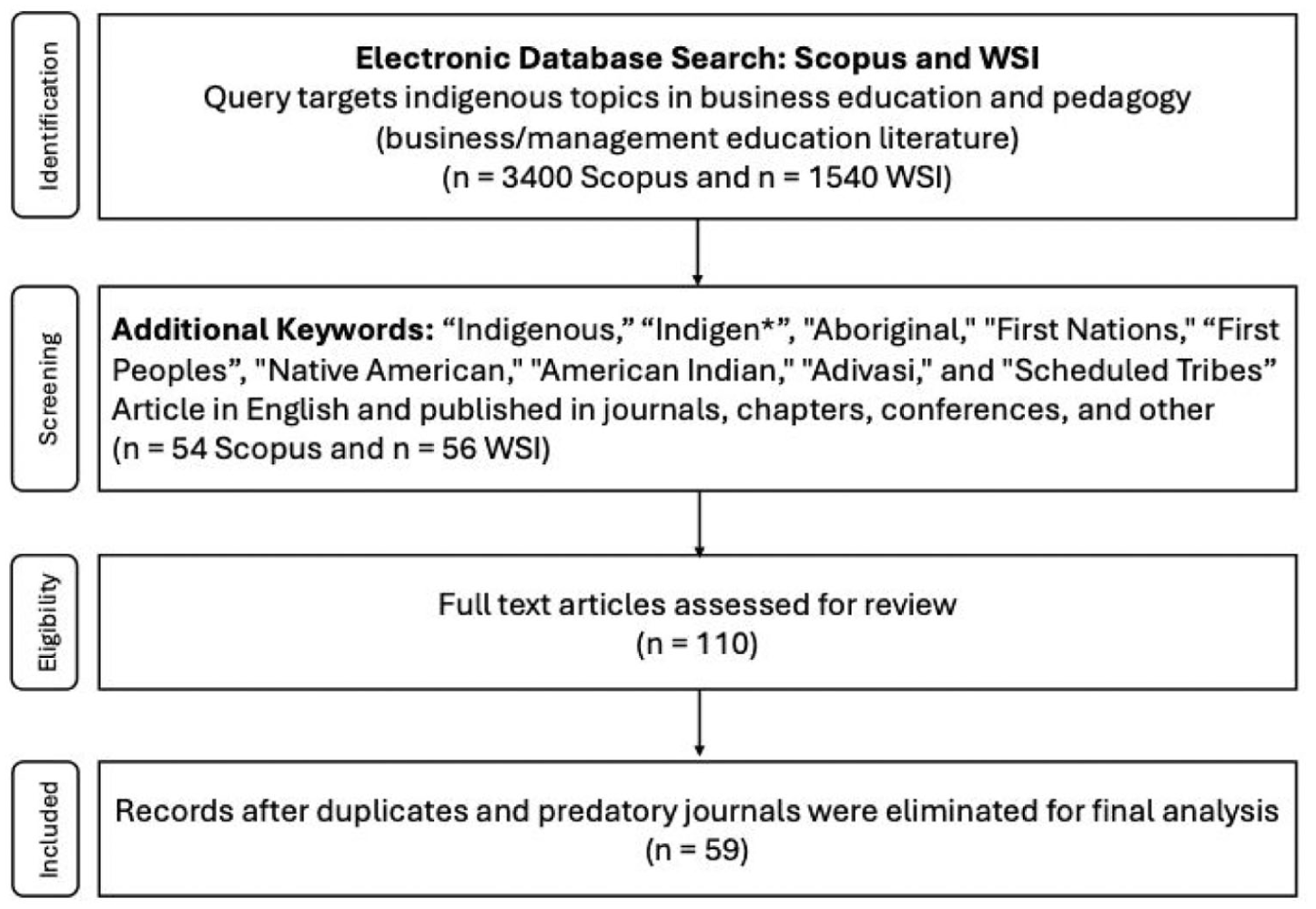
PRISMA flow diagram.
Our review concentrated on examining literature from two principal databases: Scopus and Web of Science (Joseph et al., 2023; Zaman et al., 2022) as these are renowned for their extensive repositories of peer-reviewed articles, as well as books, book chapters and conference proceedings. Finally, the specific search strings described above were run, resulting in 110 articles, and after omitting repeated studies and predatory journals, we retrieved 59 studies. Once the final sample was identified, we reviewed all papers and coded them based on their contextual, content and research design characteristics. For context, we coded each work based on its contribution, theoretical framework, geographic location, Indigenous authorship, Indigenous community, sample size and faculty. Content code categories were based on the explicit text of the article including pedagogy (e.g. learning outcomes, assessments, Indigenous faculty involvement) and teaching about or including Indigenous wisdom within curricula (e.g. ways of knowing and being, intergenerational equity, role of elders, cultural competence, challenges, drivers of curriculum change). Research design characteristics were coded in terms of the methodology (qualitative, quantitative or mixed methods) and the specific method(s) used. This data allowed for a descriptive analysis, elaborated below.
2.2. Descriptive results
Our SLR covers 28 years of publications, from 1996 to 2024. Figure 2 analyses the year of publications and illustrates the increasing interest through the volume of scholarly publications on Indigenous topics within the management education field, particularly in recent years. These variations suggest a growing academic interest and evolving discourse in Indigenous business education, as evidenced by the publication patterns. There are noticeable spikes in 2010–2014 and 2020–2024, but it is difficult to pinpoint a specific catalyst for these spikes, given the inherently global nature of our study. However, one might surmise that growing attention on climate change and the degradation of our planet, as well as awareness of the intergenerational trauma experienced by Indigenous communities has led to increased concern. Concern by society and government, and now business and academic scholars about how, on the one hand, we can acknowledge harm and work towards reconciliation, and on the other, how we can learn from thousands of years of Indigenous wisdom about how to care for the planet.
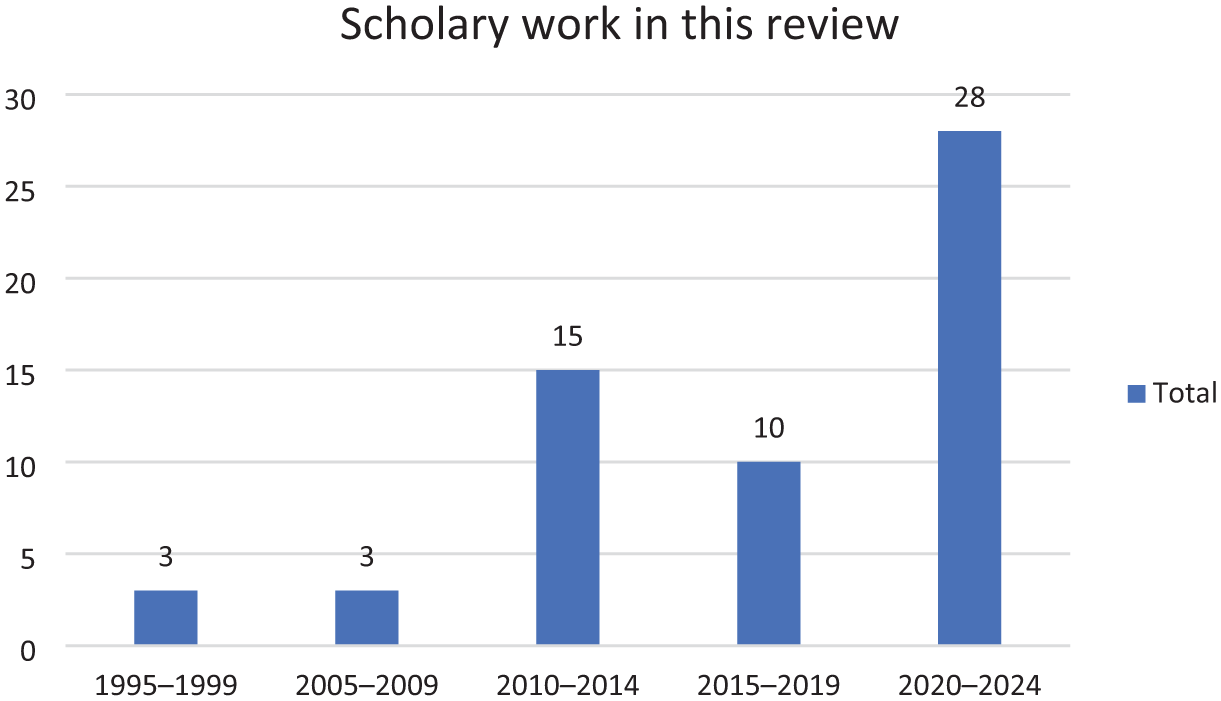
Scholarly work on Indigenous topics within management education.
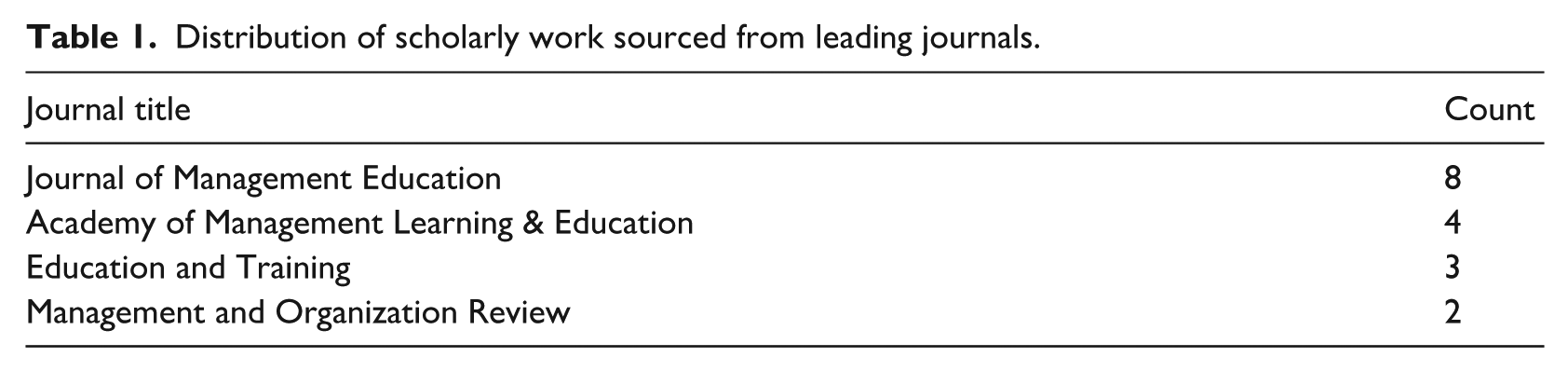
Table 1 reflects the distribution of papers sourced from leading journals in the field, with the Journal of Management Education contributing the most articles, eight. Other significant journals include the Academy of Management Learning and Education, Management and Organization Review and Education and Training.
Distribution of scholarly work sourced from leading journals.
The review examines a diverse range of Indigenous communities, across various regions, from the Arctic (e.g. Berge, 2020), American Indian (e.g. Stewart and Pepper, 2011; Verbos and Humphries, 2015b), South American (e.g. Blevins et al., 2020), Canadian (e.g. Doucette et al., 2021; Hrenyk and Salmon, 2024), Australian Aboriginal (e.g. Kennedy et al., 2022) and African and Egyptian (e.g. Ganiyu, 2018; Ogunyemi and Ogunyemi, 2022) to the Mamanwa ethnic minority in the Philippines (Rabasso and Rabasso, 2014). Studies also include insights from specific educational settings highlighting different cultural contexts such as Chinese (Fey, 2022) business schools and Māori knowledge systems (Ruth, 2020; Woods, 2011).
Specifically, one Māori study examines the underlying values clash between Indigenous perspectives and key elements of capitalism, colonisation and technological advances (Ruth, 2020). In the Australian context, the experiences of Aboriginal and Torres Strait Islander peoples have been the focus of studies (Dang et al., 2016; Keane et al., 2017; McPhail et al., 2024; Nursey-Bray and Haugstetter, 2011), with recent national-level research highlighting the perspectives of business educators on First Nations inclusion in curriculum and the systemic barriers they face. In the North American context, multiple studies explore various aspects of Native American communities, shedding light on their cultural heritage and societal dynamics. Stotz et al. (2021) and Lucero and Roubideaux (2022) examine American Indian and Alaska Native populations. Berge (2020) contributes by studying communities in Old Crow, Yukon Territory; Naujaat, Nunavut; and Ulukhaktok, Northwest Territory. In addition, Stewart and Pepper (2011) explore the context of American Indian communities, while Verbos et al. (2011) focus on Native American teaching and learning methods. Blevins et al., 2020 explore the pedagogy of short-term study trips to Mayan Indigenous tribes in Guatemala. In Canada, Jolly et al. (2011) focus on the James Bay Cree communities.
Only 14 papers include 13 authors who explicitly identify as Indigenous and certain scholars (see Table 2), notably Verbos (Verbos et al., 2011; Verbos and Humphries, 2014, 2015a, 2015b), have made significant contributions to the body of Indigenous business scholarship (based on five articles retrieved in this study). Indigenous scholars’ work is vital in this context as it provides an authentic voice, often underrepresented in academic discourse. The centring of Indigenous voice ensures a richer understanding of Indigenous paradigms in business education, allowing for cultural sensitivity and how Indigenous knowledge and people can co-design management education. While we recognise that Indigenous knowledge is often communicated through oral traditions, community reports and other non-traditional sources, our SLR was intentionally limited to academic journals, books and conference proceedings to ensure methodological rigour and comparability with established practices in management education research. However, we acknowledge that this approach may inadvertently exclude important Indigenous voices and perspectives, and we note this as a limitation and an area for future research that should incorporate broader sources and Indigenous-led methodologies. Further limitations are outlined in Section 4.
Scholarly work that includes an Indigenous author.
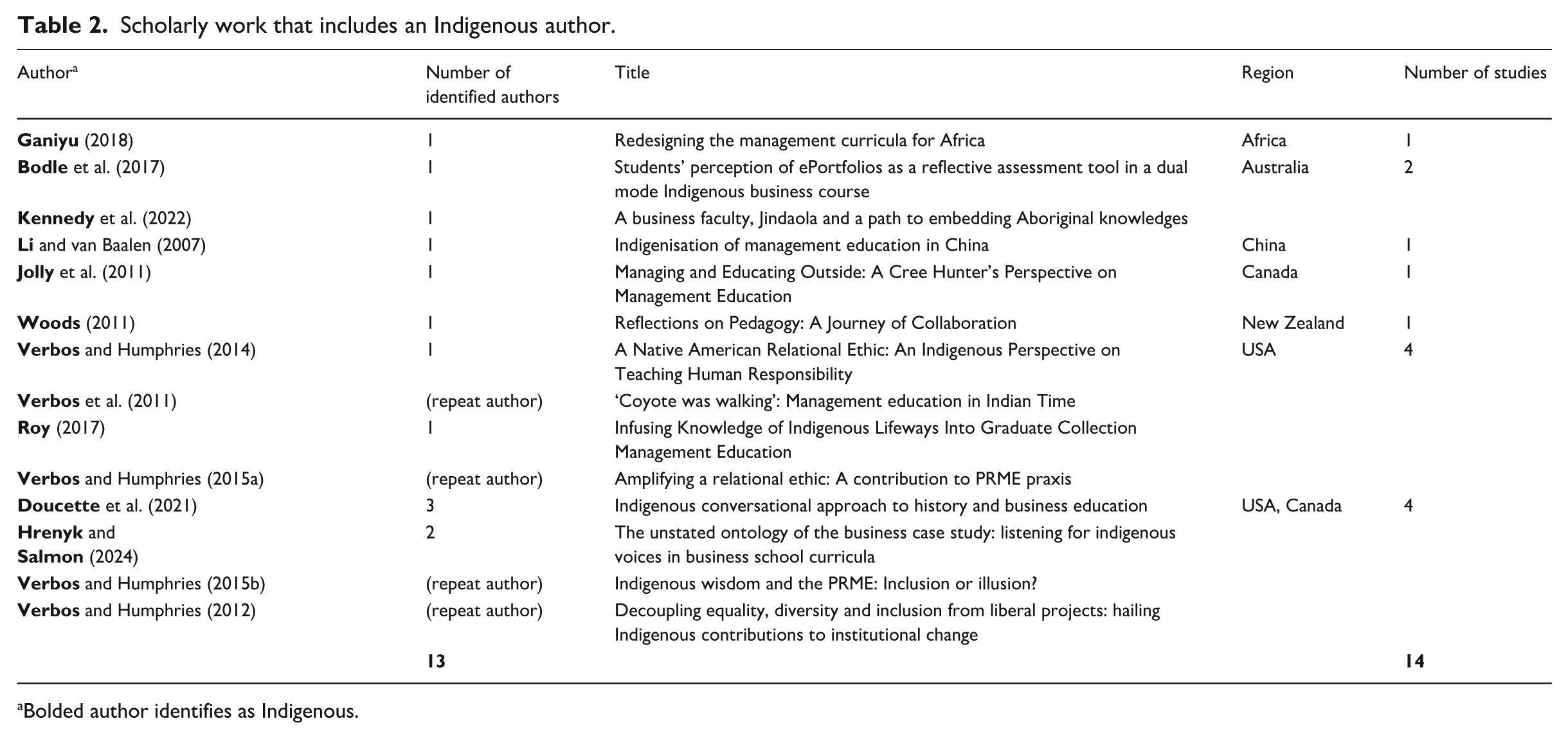
Bolded author identifies as Indigenous.
3. Thematic analysis
3.1. Why a decolonising framework?
We have organised the thematic analysis based on an inductive-deductive iterative approach as an author group, through individual literature review and analysis, complemented by multiple author meetings (n = 23). This involved first, each author analysing a sample set of papers and discussing the emerging categories searching for commonalities and omissions. After broadly agreeing on an initial set of categories, we each undertook further review and analysis of a different set of papers from our initial assignment. Decolonisation began to emerge as a framework to guide our discussion and analysis, and we applied this decolonising lens to make holistic sense of the themes that began to emerge. This decolonising lens led to discussing the themes again and in some circumstances revising these themes and refining the underlying categories. Decolonisation provides a core framework for understanding the challenges and opportunities relating to Indigenous inclusion in management education.
Decolonisation is a process by which ideologies based on colonial tradition including related power mechanisms are deconstructed, allowing room to discuss, engage with and implement Indigenous ways of being, knowing and doing (Fellner, 2018). A decolonisation lens challenges the notion that Western knowledge is universal and there is no need for alternative organising to make sense of the world or to engage with global challenges (Pimblott, 2020). Essentially, broad calls for decolonising business school education argue for including different approaches to learning, applying different epistemologies and proactively including Indigenous perspectives in the curriculum as one way of achieving decolonisation of management education (Woods et al., 2022).
3.2. Our Conceptual Model
Figure 3 provides our conceptual model based on our systematic and inductive analysis as outlined in Section 2 and provides the basis for our thematic analysis presented in this section. Part of the literature encompassed how Indigenous wisdom is being included in management education (Bodle and Blue, 2020) – depicted by the large, curved arrow on the right labelled ‘Ways of Decolonising’. Here, distinctive themes emerged about how Indigenous wisdom impacts management education in terms of: ‘relational and interconnected ontology’, ‘authentic inclusion’, ‘cultural competence and critical self-reflection’ and ‘specific inclusive and reflective pedagogy’ and the learnings from embracing Indigenous ways of knowing and being (Martin and Mirraboopa, 2003). We came to understand these as ways of decolonising management education – depicted by the four straight arrows feeding into the large, curved arrow on the right hand side of our conceptual model. These themes can be considered as a way of operationalising decolonisation as part of an authentic embedding of Indigenous wisdom into management education, where there is critical and reflective listening between expert Indigenous and non-Indigenous scholars in the co-design of curriculum.
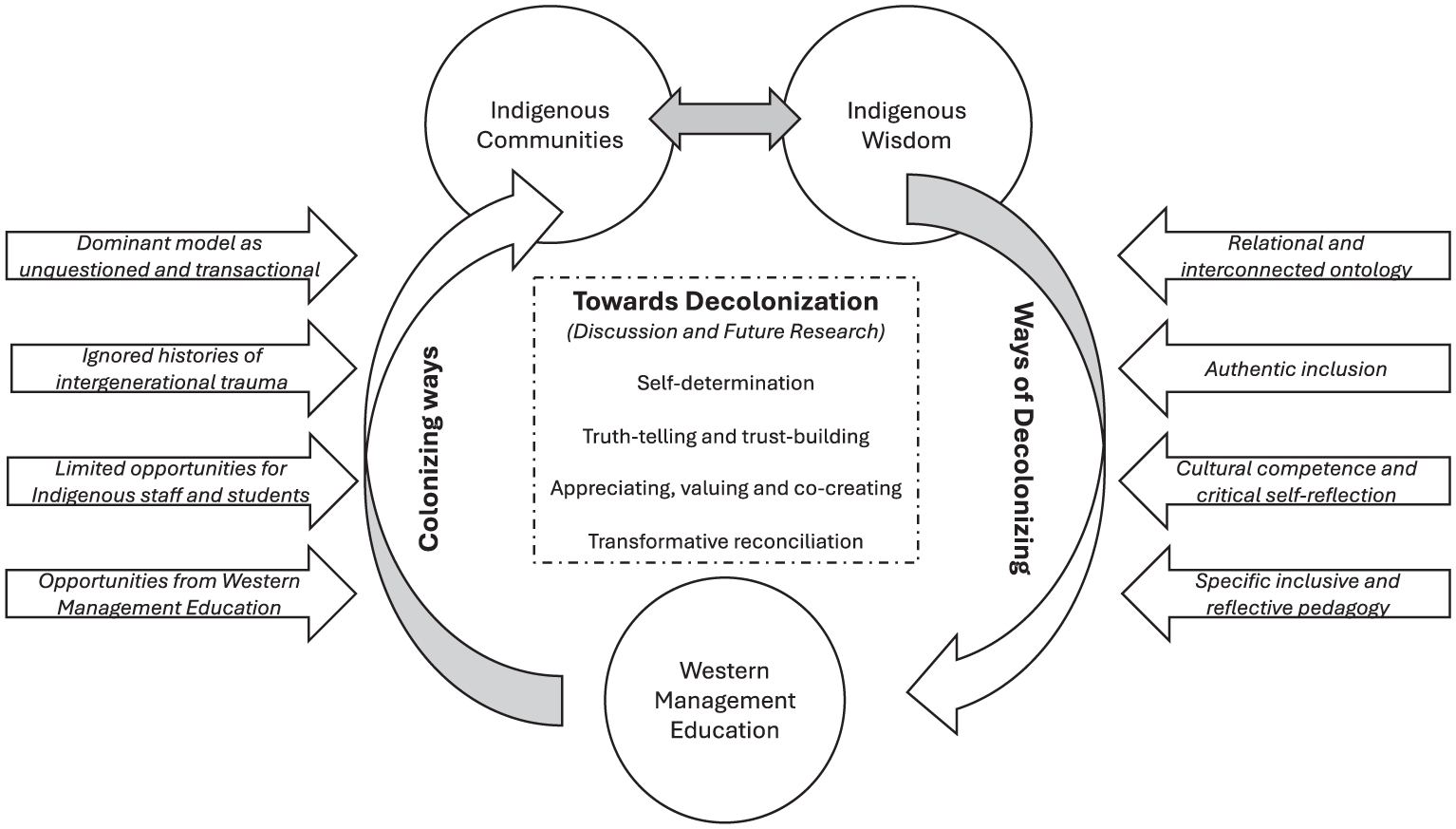
Our conceptual model.
However, and not unsurprisingly, equally a segment of literature emphasises how management education has devastating impacts on Indigenous communities – as depicted by the large, curved arrow on the left that we label ‘Colonising Ways’. Here, again distinctive themes emerged about how Western management education impacts Indigenous communities including: ‘Dominant model as unquestioned and transactional’, ‘Ignored histories of intergenerational trauma’, ‘Limited opportunities for Indigenous staff and students’ but also some possible ‘Opportunities from Management Education’ in providing Indigenous communities with technical skills and alternative ways of organising. These four themes are depicted by the four straight arrows feeding into the large, curved arrow on the left-hand side of the model. These themes can be considered the colonising ways within Western management education that scholars need to awaken to, to reduce negative and racist impacts on and restore relationships with Indigenous communities. We define and analyse both sides of our model below, commencing with ‘Colonising Ways’.
Finally, and drawing all of this together, in our conceptual model, a set of discussion themes and opportunities for future research that advocate for a movement ‘Towards Decolonisation’ emerge – depicted in the central square of our model in Figure 3 that we analyse in Section 4. Themes include: ‘Self-determination’, ‘Truth-telling and trust-building’ and the need for the ‘Appreciating, valuing and co-creating’ and ‘Transformative reconciliation’ of Indigenous wisdom and communities within management education.
3.3. Colonising ways
Western business schools have long been dominated by white, Anglo-American ideologies that fail to account for the experiences and knowledge of Indigenous peoples (Allen and Girei, 2023). The predominance of white, Anglo-American ideologies embedded within the foundations of business education has had considerable (and continues to have) impacts on Indigenous communities, often perpetuating colonial power structures and marginalising their ways of knowing and being (Bastien et al., 2023). Despite calls from critical scholars to decolonise management curricula, racist underpinnings of mainstream business schools have persisted, continuing to undermine the self-determination and economic sovereignty of Indigenous populations (Dar et al., 2021). Significant impacts on Indigenous communities are perpetuated by a largely unquestioned and transactional dominant model, ignoring the histories of harm inflicted on these communities and Indigenous staff and students themselves.
3.3.1 Dominant model as unquestioned and transactional
The dominant model of management education, rooted in Western capitalist traditions, has been unquestioningly adopted and taught, without regard for its incompatibility with Indigenous worldviews and ways of being (nor, other minority groups). For example, Mika and O’Sullivan (2014) argue that contemporary management practices in Aotearoa New Zealand are largely based on Western, individualistic and capitalist models that are ‘mismatched’ with Māori cultural values and practices. This dominant model is characterised by a transactional, extractive and exploitative approach, grounded in shareholder primacy, where the sole focus is to maximise returns for shareholders (Smith and Rönnegard, 2016). This disadvantages Indigenous ‘stakeholders’ as ‘dispossession from their land and knowledge is taken for granted as the norm’ (Doucette et al., 2021: 480).
The rise of stakeholder capitalism, in opposition to the shareholder approach, offers avenues for Indigenous voice but is not without the problem of colonisation of Indigenous stakeholders (Banerjee, 2003). The unquestioned nature of the dominant traditional Western model fails to acknowledge historical and ongoing harms inflicted on Indigenous peoples through colonial and capitalist expansion (Colbourne et al., 2024). This lack of critical self-reflection about the colonial legacy embedded within management education perpetuates the oppression of Indigenous communities.
3.3.2 Ignored histories of intergenerational trauma
Closely related to the unquestioned nature of the dominant model is how the histories of harm, intergenerational trauma, racism and oppression experienced by Indigenous communities (Elias et al., 2024) have been largely overlooked within management education curricula (Doucette et al., 2021). The erasure of Indigenous histories and experiences not only perpetuates the marginalisation of these communities but also deprives management students of the opportunity to develop a more honest and critical understanding of the complex social, political and environmental contexts in which businesses operate. As Verbos and Humphries (2014) argue, the inclusion of Indigenous knowledge and perspectives within management education can help us appreciate the deep relationship, interconnection and interdependency of business with the communities and natural environment within which it operates (we explore this further in Section 3.4).
Another important blind spot in management education is the dominance of colonial mindsets and practices in business, which have exploited and dispossessed Indigenous communities, particularly around issues of land, resources and economic development. Limited management education literature exists on land rights, and the work that has been done needs a more expansive view of land rights (Myllylä, 2017). For example, the destruction of a sacred site in the Juukan Gorge by the mining company, Rio Tinto, in Australia (Young-Ferris and Yu, 2022). Here, the business had an active corporate self-regulation process which included Indigenous engagement but separated this from the regulatory domain of the company’s governance. This led to the destruction of the sacred site as it was deemed lawful to do so (Holey, 2022).
3.3.3 Limited opportunities for Indigenous staff and students
Furthermore, the lack of Indigenous representation and leadership of Indigenous staff and students in business schools has meant that Indigenous staff and students often feel isolated and disconnected from the curriculum and campus culture. This has limited their ability to succeed and thrive in these environments (Blanchard, 2014). Broader higher education literature in the field of decolonisation suggests that more support and engagement programmes for Indigenous staff and students focused on diversity and inclusion, as well as anti-racism campaigns and movement-based decolonisation is critical (Hayes et al., 2021; Jones et al., 2024; Le Grange, 2020).
Harm can also be done through quasi-Indigenising efforts which appear progressive. Four Arrows (2019) has identified the potential problem of using the term ‘Indigenising’. This problem stems from its use as a verb which can be removed or distant from the context of the speaker. In other words, Indigenising becomes an action done to Indigenous peoples by non-Indigenous people (or even Indigenous people from other locations), rather than a change driven by Indigenous communities themselves. This could lead to the misappropriation and misuse of Indigenous knowledge. Four Arrows (2019) concludes that Indigenising education is important for all students, not just Indigenous students, because Indigenous knowledge can benefit everyone. However, of critical importance is that the process must be done carefully to avoid further colonisation, by ‘co-design’ and the inclusion of traditional custodians, Elders and Indigenous staff. The literature cautions that the inclusion of Indigenous perspectives must go beyond simply ‘adding’ these elements to an otherwise unchanged curriculum.
3.3.4 Opportunities from Western Management Education
While the review overwhelmingly highlights the negative impacts of Western management education on Indigenous communities, it suggests some potential opportunities. Specifically, the technical and organisational skills taught within management education programmes can be valuable for Indigenous entrepreneurs and leaders seeking to navigate the complexities of the modern business landscape. Berge (2020) notes that management education can offer Indigenous communities’ opportunities in the form of technical skills and alternative ways of organising. However, the opportunities presented by Western management education can only be realised if they are accompanied by a genuine commitment to addressing the histories of harm, and a willingness to embrace alternative, Indigenous-informed models of business through a process of co-creation.
3.4. Ways of decolonising
We now turn to the literature that appreciates the ways that Indigenous wisdom has been included in management education, which we argue can be seen as ways of decolonising our curricula and engendering deeper understanding and respect. The literature here acknowledges and appreciates broad insights from Indigenous wisdom and culture that are new and novel to the Western business model. As Doucette et al. (2021) argue, the business academy has been complicit in the ongoing colonisation of Indigenous peoples and must engage in a more fundamental decolonisation of its practices and pedagogies.
3.4.1 Relational and interconnected ontology
This theme celebrates how Indigenous understanding and wisdom is of a different ontology than our typical Western lens that is more transactional, instrumental and exploitative in its ontology. Indigenous wisdom acknowledges a scared holism and symbiosis in that everything is in relationship with and interconnected to everything else, across time, past, present and future (Berge, 2020; Doucette et al., 2021; Gainsford and Evans, 2021; Jolly et al., 2011; McGowan, 2018; Martin and Mirraboopa, 2003). Young-Ferris and Voola (2023) cite ‘interdependence and interconnection’ as one of their central tenets of a broad rendition of Indigenous stewardship that is a recognition of humanity’s close, interconnected and interdependent relationship with nature and her eco-systems (Martin and Mirraboopa, 2003). Thus, nature and her resources must be protected, preserved and cared for, while being conscious of the rights of future generations to those natural resources (Beckford et al., 2010).
Verbos and Humphries (2014) highlight Native American people’s gratitude for the Earth as a living organism and their understanding of the interconnection of all things. This deep gratitude is expressed ‘metaphysically’ and ‘spiritually’ and effectuated through traditional ceremonies that have sustained Indigenous communities throughout the ages, and even in the face of colonisation and significant oppression (Verbos and Humphries, 2014). Ruth (2020) examines Māori Indigenous wisdom and how humans are understood to be born into a relational and dynamically connected world as ‘interlocking parts of a whole system of knowledge and are inseparable from the ongoing context of life itself. The environment itself is a stakeholder’. (p. 411). Similarly, Tangihaere and Twiname (2011) speak of how Māori culture links ‘holistic relationships between humans and the natural world (forests, plant life, sea and marine life, rivers, and water sources)’ (p. 113).
The emphasis is not only on nature–human relationships but also on human–human relationships (Martin and Mirraboopa, 2003). Ganiyu (2018) explores the African context and the lasting management principle of Ubuntu/Botho, which is about what it means to be human, as in humanism and humaneness (p. 255). Ubuntu is connected to Indigenous ways of knowing, being and ways of expressing concern for others’ pain, discomfort and misfortune (Ganiyu, 2018: 256). Working in partnership with Aboriginal knowledge holders in the ‘Jindaolo Way’ programme to embed Indigenous knowledge within business school curricula, Kennedy et al. (2022: 1942) found that relationships are central and relationships between Aboriginal and non-Aboriginal team members need to be meaningful and built upon ‘principles of respect, responsibility and reciprocity’. In other words, Australian Aboriginal lore claims Indigenous spirituality and Dreamtime relates to land, rivers and sky as being ‘human’ too. This drives decision-making in business decisions they have been making for over 65,000 years when to burn; when and how much to kill in feeding their people and catching fish in nets; and trading. It comes out in art, songs and dance which is also business for them too.
Such a relational ontology and interconnected understanding within management education stand in stark contrast to the traditional management education focused on linear extraction of resources and exploitation of humans in the relentless pursuit of profit 3 . Mainstream management education teaches that shareholders are the only stakeholder of concern to business, which has had disastrous consequences for Indigenous communities and humanity, vis-à-vis destruction of nature, culture and identity. The articles in this theme exemplify the possibility of a new ontology for business as ‘stewards’ not ‘owners’ where ‘business is understood to be in close relationship with humanity, and interdependent on nature’ and where ‘ideas of environmental sustainability, caretaking, collectivism and intergenerational equity’ are at the fore (Beckford et al., 2010; Young-Ferris and Voola, 2023: 147).
Further, Verbos and Humphries (2015a) argue for ‘relational ethics’ and that the ‘fundamental wisdom of marginalised and excluded people, can and should occur through our call for the greater inclusion of Indigenous knowledge in management education and practice’ (p. 43). We, too, encourage this relational and interconnected ontology for business education, ‘one that can help us appreciate the deep relationship, interconnection and interdependency of business with the communities and natural environment within which it operates’ as a critical way of decolonising our curricula (Young-Ferris and Voola, 2023: 137). Ausubel (2008) suggests that Indigenous wisdom is ‘precisely what humanity most needs now to slip through this epochal keyhole of history where the stakes are the very survival of our species and countless other beings in the web of life’ (p. xxi) (in Verbos and Humphries, 2014: 2).
3.4.2 Authentic inclusion
It is alarming how so few articles about the inclusion of Indigenous wisdom in business curricula feature authors who identify as Indigenous (i.e. 13 authors in 14 studies out of 59). On the one hand, this leads to speculation that such work might be considered superficial or ‘surface level’ (Doucette et al., 2021: 481) or ‘tokenistic’ (Elias et al., 2024: 18), but on the other hand, such work has led to critical reflection of the need to include Indigenous voice (Young-Ferris and Voola, 2023) and more importantly to collaboration, co-creation and mutual empowerment between Indigenous and non-Indigenous scholars (the present article is an example).
Regardless, the authentic inclusion of Indigenous voices and empowering Indigenous communities is central and required. Doucette et al. (2021) capture this need strikingly and the way that addressing this need should be taken further to benefit Indigenous communities: . . . an example of that deep engagement, which includes the voices of Indigenous business scholars and the use of Indigenous methodologies. We write for the benefit of other Indigenous scholars, and for the benefit of the business academy at large, but there is also much room to write and do research that can benefit Indigenous communities as well . . . We want to dialogue with the rest of the Academy and we want to dialogue with Indigenous communities, so that all can benefit (p. 482).
Jolly et al. (2015: 27) provide a thought-provoking example of honouring and centring Indigenous voices with an ‘inspiring template for integrating a deep sense-of-place within management education’. Situated in James Bay, Canada, FJ, the lead author and a 54-year-old Cree tallyman (a senior hunter and leader of his family’s hunting territory), shares his approach to environmental sustainability and its implications for management education (Jolly et al., 2011: 28). Here, the Cree (and other Indigenous) cultures’ emphasis on ‘place-based’ value systems has direct significance for environmental sustainability education (Jolly et al., 2011: 31). FJ’s experiential approach that takes students outdoors is firmly influenced by his Cree culture and his relationship with nature and can serve as inspiration for non-Indigenous educators to not only empower and give voice to Indigenous educators but also take learning outside. Whiteside et al. (2011) provides an exquisite explanation of empowerment and that it ‘comes through the growth in awareness and the enabling of local [Indigenous] people to take action on their own behalf’. Alongside the inclusion of Indigenous voice, empowerment is not about nongovernment aid organisations postulating a solution from a Western capitalist perspective, ‘but rather mak[ing] Indigenous people the critical force for change in their situations’ (Whiteseide et al., 2011).
3.4.3 Cultural competence and critical self-reflection
The development of cultural competence in staff and students seems to complement an approach where critical self-reflection improves. This is a universal theme in, for example, the African (e.g. Ganiyu, 2018), Australian Aboriginal and Torres Strait Islander (e.g. Kennedy et al., 2022), Native American Indian (e.g. Doucette et al., 2021; Verbos and Humphries, 2014) and Māori (e.g. Woods, 2011) contexts. Notwithstanding, sometimes educators knew they were lacking in cultural competence but did not always know how to embed it within their curricula and their teaching teams and students (Stewart and Pepper, 2011).
Kopnina (2016) argues strongly for critical reflection as part of the development of cultural competence in both staff and students, in her environmental education courses involving Indigenous perspectives. Interestingly, she does not argue for rejecting the dominant and unquestioned Western model per se, but rather examines how educators can use it as a catalyst to lead to critical self-reflection and develop ethical awareness and empowerment (Kopnina, 2016: 80). As a result of their critical self-reflection, Young-Ferris and Voola (2023) were also compelled to bring more culturally competent teaching and learning into their jumbo unit of ~2000 students and ~50 staff per semester and acknowledge it is a delicate space to navigate.
3.4.4 Specific inclusive and reflective pedagogy
A review of the pedagogical approaches indicates a diverse and innovative educational landscape where a set of specific inclusive and reflective pedagogy draws on Indigenous ways that deeply engage students in active learning and critical thinking within global and intercultural contexts. We break these into three overarching categories. First, are the oral-led pedagogy such as storytelling, yarning, talking circles and auto-ethnographical methods (not that Indigenous people use this label) that feature in most Indigenous cultures. Such oral and conversational approaches have proved a specific and successful pedagogical style to engage learners and overcome the limitations of Western linear styles (e.g. Doucette et al., 2021; Nursey-Bray and Haugstetter, 2011; Sambrook, 2021; Verbos et al., 2011). Doucette et al. (2021; 414), deliberately write their article in a conversational style citing that Indigenous knowledges are ‘transferred and developed orally in conversations, in relationships, and often via storytelling and visiting’. Verbos et al. (2011) use a Native American Coyote story to explain a different perception of time to students, free from the temporal constraints of the Western linear construct of time, arguing it promotes more effective and creative learning.
Second, is place-based and co-created pedagogy, where the learning is closely connected to nature and educators take the learning outside the traditional classroom into natural environments, with Indigenous locals (Blevins et al., 2020). Recall, FJ, the Indigenous Cree tallyman and educator who took his classroom outside; ‘out of doors on (and with) the land’ (Jolly et al., 2015: 27). FJ wants to challenge educators to relocate and relate their management education to specific local places, and to work in collaboration with local Indigenous people in a ‘participatory manner’ (Jolly et al., 2015; 28). Berge (2020) urges management educators to take a place-based approach to pedagogy, advocating for student exchange programmes because the dominant model focused on profit accumulation ignores the challenges and the opportunities from place-based economies where most Indigenous communities are situated (p. 3 and 14). For Woods (2011), the coming together of teacher and student to share knowledge and co-create new learning, with the guiding principles of collaboration and reciprocity is the most appropriate representation of her pedagogical approach (p. 163).
Third and finally, these pedagogical approaches are closely tied to ideas of eco-spirituality and the strongly held Indigenous relational ontology about ‘interrelationships among people, animals and nature’ and that ‘everything has a spirit, regardless of if it is animate such as a human or an animal, or inanimate, such as a rock’ (Verbos et al., 2011: 61). Drawing on Jolly et al. (2015: 37), ‘FJ has a deeply held spiritual belief that the earth is alive and a powerful teacher: “It comes from the land. The wisdom, it comes from the land”.’ A single tree has a strong spiritual connotation for a Cree hunter, for it can be their first meeting with the master spirit or perhaps, the supreme being. This serendipitously, and in keeping with our non-linear Indigenous ways of knowing and interconnectedness, brings us right back to our opening theme regarding the ‘relational and interconnected ontology’ of Indigenous wisdom in this section about ways of decolonising.
4. Discussion, limitations and future research
From the inductive thematic analysis of our key articles in this review, we found four overall streams worthy of consideration for future research. These insights emerged through noting the themes and calls for action in 59 articles in our SLR. We also determined the gaps in research through a collective reflexive process undertaken by the authors of this article, including our Indigenous author who provides a particularly strong voice for this part of our review. The central square of our model in Figure 3 identifies what is needed in management education for authentic Indigenous inclusion. We discuss each in turn and inspire future research questions.
Before we discuss these, some limitations should be noted. One limitation of this review is that our specific Western (colonised) SLR methodology may have overlooked important Indigenous works. We acknowledge that by relying on highly ranked, peer-reviewed journals, books and book chapters indexed in Scopus and Web of Science, our review is inherently shaped by Western academic paradigms, which can limit the inclusion and representation of Indigenous knowledges and methodologies. Indigenous wisdom is often transmitted through oral traditions, storytelling, community practices and other forms of knowledge sharing that are not always captured in conventional academic publishing or subject to Western peer review processes. This presents a significant limitation, as these journals may not be the most effective avenues for capturing the full richness of Indigenous ways of being, knowing and doing. We recognise that expanding the scope of future reviews to include non-traditional academic literature, grey literature and community-authored work, alongside engagement with Indigenous research methodologies, would provide a more holistic and authentic representation of Indigenous knowledge systems. Our current focus was to examine literature that directly informs business school curricula and management education, but we strongly recommend that subsequent research broaden its scope to better honour and include a broader scope of Indigenous epistemologies and voices.
Another potential limitation is that the review focus is on works in the management education field, at the exclusion of relevant works in organisation theory related to education. We also acknowledge our focus in this review has been to examine journals that contribute directly to the business school body of knowledge and thus business schools.
This review was also limited by its focus on English-language academic publications and may exclude important Indigenous knowledges expressed through oral traditions, community reports, or non-traditional sources. Future research should incorporate diverse knowledge forms to strengthen inclusion and epistemic diversity. In addition, introducing counterarguments and engaging with overlapping or conflicting themes such as tensions between institutional policy goals and Indigenous sovereignty would provide a more critical and nuanced interpretation of the findings.
While this review draws primarily on decolonisation theory, future research could strengthen and extend the framework by engaging with intersecting lenses such as critical race theory and anti-colonial educational theories. Space limitations have precluded further examination of these theories. These perspectives may add further analytical depth to understanding structural inequalities in management education and offer further insights into power, race and knowledge hierarchies.
Finally, given the breadth of cross-cultural literature included in our review, our analysis and the emergent principles are intended to have broad applicability across management education, including an array of diverse First Nations contexts. However, we acknowledge that specific cultural and country-specific recommendations are essential for meaningful and contextually relevant practice. The scope of this initial review did not allow for an in-depth exploration of individual country or cultural contexts. We recommend that future research adopt a more nuanced approach, engaging directly with specific Indigenous communities and national contexts to develop tailored recommendations that respect and reflect local knowledge, values and priorities. With these limitations in mind, we propose the following future research questions (Table 3) and discuss the framework principles below.
Future research questions for discussion.
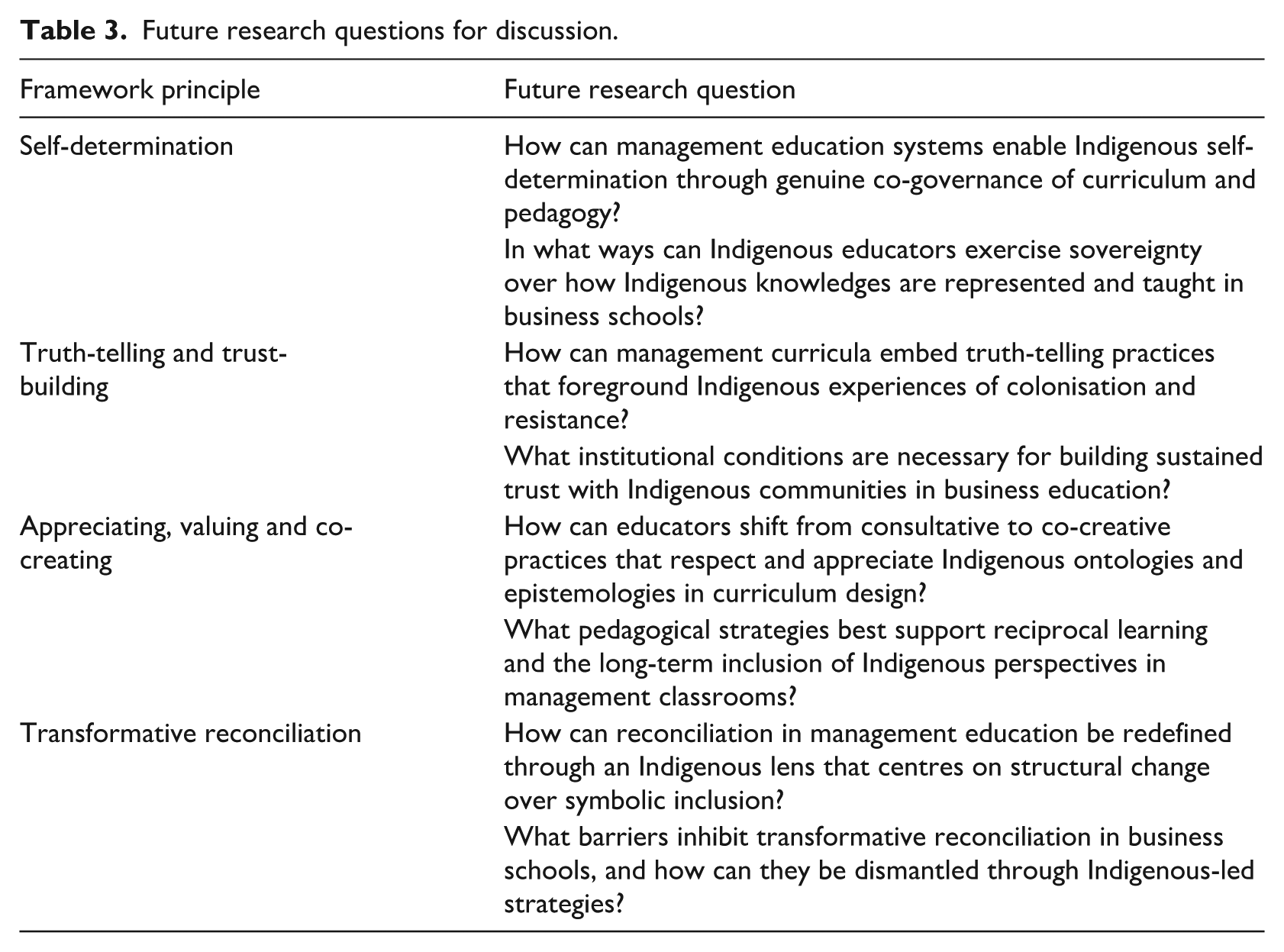
However, these practices may remain superficial if not supported by institutional structures that enable co-governance and sustained leadership. Furthermore, much of the existing literature on Indigenisation has been criticised for its superficiality and neocolonial orientation (Banerjee and Linstead, 2004), often conceptualised by non-Indigenous scholars in ways that may perpetuate outdated or extractive views. Kennedy et al. (2022) illustrate a more embedded approach through the Jindaola Way, using ethnographic methods and cultural capability training to ensure that Aboriginal knowledge is respectfully integrated. These examples highlight the need for more future research focused on how institutions and non-Indigenous educators can support Indigenous sovereignty in curriculum design, while avoiding appropriation or tokenism.
This is further compounded by ‘colonial-loading’, whereby Indigenous staff are burdened with the responsibility of Indigenising curricula under conditions that lack power-sharing. Motta and Allen (2022) similarly critique the dominance of ‘employment-ready’ logics, which diminish space for Indigenous perspectives on knowledge, community and identity. Trust-building cannot occur in such settings without first addressing these structural barriers. The works of Dani and Dasgupta (2021), Verbos et al. (2011) and Young and Karme (2015) show that sustained relationships with Indigenous communities and service learning are foundational to trust. Future inquiry should investigate the epistemological awareness of non-Indigenous educators, the institutional conditions needed for authentic truth-telling, and how Indigenous relational ethics – rooted in humility, respect and reciprocity – can inform pedagogical change.
The third principle,
One lively and practical example can be found in the creation and dissemination of the Indigenous Leadership in Business Video Series (Young-Ferris et al., 2024), created by two of the authors of this article and other scholars now integrated into a foundation Master of Commerce unit taken by ~2000 students per semester at a leading Business School. The series features six Indigenous leaders who exemplify collective leadership, stewardship, reciprocity and deep relationality with Country principles that are foundational to Indigenous pedagogy and offer valuable guidance for management education. For non-Indigenous educators, the series provides concrete models for embedding Indigenous perspectives, such as privileging community benefit over individual achievement and practicing active, open listening to build trust and credibility with Indigenous learners and colleagues. The creators of the video series also created an accompanying Education Guide to ensure educators have ‘hands-on’ guidance for respectfully amplifying Indigenous voice in their teaching practices (McHugh et al., 2024). Policy makers are encouraged to support curriculum frameworks that prioritise Indigenous knowledge systems and foster environments where Indigenous and non-Indigenous educators collaborate on equal footing. Practical examples from the series, such as the use of storytelling and case studies grounded in lived experience, demonstrate how Indigenous pedagogical principles can be operationalised in business education, ensuring that teaching and leadership practices are culturally responsive and inclusive, truly emblematic of the principle of appreciating, valuing and co-creating.
The final principle,
5. Conclusion and implications
The review highlighted the growing scholarly interest in embedding Indigenous perspectives into business education, as evidenced by the increasing number of publications. However, the review also reveals that only a small proportion of the studies (14 out of 59) includes 13 authors who identify as Indigenous, suggesting a need for greater representation of Indigenous voices in the co-design process. The review was used to develop a framework that questions the fundamental assumptions of traditional management education and incorporates an Indigenous self-determined and decolonisation lens for matters that impact Indigenous communities. At the same time, the review has highlighted that critical ways that Indigenous wisdom must be understood in terms of its relational ontology, and in the spirit of critical reflection if it is to be embedded into management education in an inclusive and authentic way. The two mutually reinforcing sides of our conceptual model (see Figure 3) produced opportunities for discussion and future research in terms of self-determination; truth-telling and trust-building; appreciating, valuing and co-creating; and transformative reconciliation as ways of addressing colonisation towards decolonising the education of our future business leaders.
Implications of the shift towards self-determination and decolonisation in management education relates to stakeholders, non-Indigenous educators, policy makers, universities and business schools, curriculum designers, and scholars and researchers. We conclude there is much work to be done if management education is to play an authentic role towards decolonisation. The intergenerational trauma that is embedded in traditional Western business school models and the impact colonisation has had on Indigenous communities at large must be acknowledged and dismantled if a transformative reconciliation that addresses our other principles of self-determination; truth-telling and trust-building; appreciating, valuing and co-creating are to be realised.
Key Research and Practical Implications
This article addresses the persistent exclusion of Indigenous voices and perspectives in business education, highlighting how many programmes continue to reflect colonial perspectives and rarely incorporate Indigenous knowledge in meaningful ways. Our review demonstrates that integrating Indigenous wisdom—centred on relationships, sustainability and collective well-being – can profoundly enrich business curricula and pedagogy. For instance, we present case studies of Indigenous business leaders who exemplify these principles, offering students tangible insights into the value of Indigenous approaches to business.
Decolonising business education requires more than simply adding Indigenous content; it involves fundamentally rethinking how knowledge is defined, how power operates within educational settings and how learning can be co-created with Indigenous communities. We identify four guiding principles for this transformation:
This article provides actionable guidance for educators, researchers and institutions seeking to move beyond tokenism. By forming meaningful partnerships with Indigenous peoples, business schools can reshape their programmes to foster justice, equity and more sustainable futures for all.
Footnotes
Appendix

| Authors | Year | Title | Source title | |
|---|---|---|---|---|
| 1 | Bajada C and Trayler R | 2014 | A fresh approach to indigenous business education | Education and Training |
| 2 | Banerjee SB | 2011 | Embedding sustainability across the organization: a critical perspective | Academy of Management Learning & Education |
| 3 | Bátiz-Lazo B | 2013 | The adoption of US-style business education in Mexico, 1945–2005 | America Latina en la Historia Economica |
| 4 | Beamish PW | 2020 | The transferability of Western business education to the east | Journal of Management Studies |
| 5 | Berge ST | 2020 | Pedagogical pathways for Indigenous business education: learning from current Indigenous business practices | International Indigenous Policy Journal |
| 6 | Bhada Ron K, Ghassemi A and Morgan JD | 1996 | Enhancing environmental education a multi-dimensional, total environmental education programme | Proceedings of the Air and Waste Management Association’s Annual Meeting and Exhibition |
| 7 | Blevins B, Ramírez GC and Wight JB | 2020 | Short-term study trips in the Americas: pedagogy and logistical best practices | Journal of Teaching in International Business |
| 8 | Bodle K, Malin M and Wynhoven A | 2017 | Students’ experience toward ePortfolios as a reflective assessment tool in a dual mode indigenous business course | Accounting Research Journal |
| 9 | Brower HH | 2011 | Sustainable development through service learning: a pedagogical framework and case example in a third world context | Academy of Management Learning & Education |
| 10 | Clark DN, Reboud S, Toutain O, Ballereau V and Mazzarol T | 2021 | Entrepreneurial education: an entrepreneurial ecosystem approach | Journal of Management & Organisation |
| 11 | Czinkota MR | 1997 | Russia’s transition to a market economy: Learning about business | Journal of International Marketing |
| 12 | D’Mello B | 1999 | Management education: a critical appraisal | Economic and Political Weekly |
| 13 | Dang TKA, Vitartas P, Ambrose K and Millar H | 2016 | Improving the participation and engagement of Aboriginal and Torres Strait Islander students in business education | Journal of Higher Education Policy and Management |
| 14 | Dani VV and Dasgupta M | 2021 | GoBhaarati – contributing to the ‘Journey of Healthy Living’ | Emerald Emerging Markets Case Studies |
| 15 | Doucette MB, Gladstone JS and Carter T | 2021 | Indigenous conversational approach to history and business education | Academy of Management Learning & Education |
| 16 | Feekery AJ, Chisholm K, Jeffrey C and Diesch F | 2021 | Enhancing students’ professional information literacy: collaboratively designing an online learning module and reflective assessments | Journal of Information Literacy |
| 17 | Fey CF | 2022 | A perspective on the potential of Chinese business schools: a call for greater attention to context, differentiation and developing an indigenous model | Management and Organization Review |
| 18 | Gainsford A and Evans M | 2021 | Integrating andragogical philosophy with Indigenous teaching and learning | Management Learning |
| 19 | Ganiyu RA | 2018 | Redesigning the management curricula for Africa | Advanced Series in Management |
| 20 | Hearns N, Devine F and Baum T | 2007 | The implications of contemporary cultural diversity for the hospitality curriculum | Education and Training |
| 21 | Henry E and Sayers H | 2017 | Environmental crisis in New Zealand Tribal, government, and business responses to the sinking of the MV Rena | Indigenous Aspirations and Rights: The Case for Responsible Business and Management |
| 22 | Hrenyk J and Salmon E | 2024 | The unstated ontology of the business case study: listening for Indigenous voices in business school curricula | Academy of Management Learning & Education |
| 23 | Ibeh K and Debrah YA | 2011 | Female talent development and African business schools | Journal of World Business |
| 24 | Jolly F, Whiteman G, Atkinson M and Radu I | 2011 | Managing and educating outside: a Cree hunter’s perspective on management education | Journal of Management Education |
| 25 | Karwowska E and Tomczak M | 2024 | Diversity, equality and inclusion maturity model: setting new standards in responsible business education – evidence fromPRME reports | Social Responsibility Journal |
| 26 | Kennedy J, Almeida S, Gibbons B, Clarke R, Bicego V and Phelan A | 2022 | A business faculty, Jindaola and a path to embedding Aboriginal knowledges | Higher Education Research and Development |
| 27 | Kopnina H | 2016 | Challenging economic development: the case study of teaching alternative cultural values in business education | Journal of Integrative Environmental Sciences |
| 28 | Li L and van Baalen P | 2007 | Indigenization of management education in China | Higher Education Policy |
| 29 | Lucero JE and Roubideaux Y | 2022 | Advancing diabetes prevention and control in American Indians and Alaska natives | Annual Review of Public Health |
| 30 | Martin L, Cottrell M and Colley VE | 2024 | Exploring ethical space as an innovative strategy to foster corporate social justice for Indigenous students in business schools | Organization, Purpose, and Values |
| 31 | McGowan K | 2018 | An innovative opportunity? social innovation, entrepreneurship and the pedagogical possibilities for Indigenous learners | Canadian Journal of Nonprofit and Social Economy Research |
| 32 | Nursey-Bray M and Haugstetter H | 2011 | More than a marriage of convenience: the convergence of management and Indigenous educational practice | Journal of Management Education |
| 33 | Ogunyemi K and Ogunyemi O | 2022 | Indigenous responsible management: the story of Egypt | Responsible Management in Africa, Volume 1: Traditions of Principled Entrepreneurship |
| 34 | Passant, AJG | 2022 | Educating Indigenous commercial executives. A business school in colonial context: The case of the Indochina Higher School of Commerce (1920–1932) | Business History |
| 35 | Patel DP | 2024 | Making Swadeshi managers: the antecedents of professional management education in India,1860s–1950s | Enterprise & Society |
| 36 | Rabasso C and Rabasso, J | 2014 | Responsible education and multiple learning identities by the Mamanwas in Surigao del Norte, Mindanao, Philippines | Journal of Global Responsibility |
| 37 | Rickard MKK, Sams D and Sams J | 2023 | High-impact practices (HIPs) benefits from study abroad country agent: a multi-method multi-perspective approach | Journal of International Education in Business |
| 38 | Roy L | 2017 | Infusing knowledge of Indigenous lifeways into graduate collection management education | Collection Management |
| 39 | Ruth D | 2020 | Indigenous wisdom, capital, technology and education | New Zealand Journal of Educational Studies |
| 40 | Sambrook S | 2021 | Management education through autoethnography | Human resource development international |
| 41 | Schwabenland C | 2011 | Surprise and awe: learning from Indigenous managers and implications for management education | Journal of Management Education |
| 42 | Stewart D and Pepper MB | 2011 | Close encounters: lessons from an Indigenous MBA programme | Journal of Management Education |
| 43 | Stotz SA, Brega AG, Gonzales K, Hebert LE and Moore KR | 2021 | Facilitators and barriers to healthy eating among American Indian and Alaska native adults with type 2 diabetes: stakeholder perspectives | Current Developments in Nutrition |
| 44 | Sudhakar GP | 2021 | An Indian MBA programme-context, content and confidence! | Purushartha |
| 45 | Timsal A, Shah UZ and Hodgson V | 2024 | Socio-digital disadvantage within management education: a study of MBA students’ experiences of digital technologies | Journal of Management Education |
| 46 | Turnbull S | 2011 | Worldly leadership: challenging the hegemony of Western business education | Journal of Global Responsibility |
| 47 | Verbos AK and Humphries MT | 2015 | Amplifying a relational ethic: a contribution to PRME praxis | Business and Society Review |
| 48 | Verbos AK and Humphries M | 2015 | Indigenous wisdom and the PRME: inclusion or illusion? | Journal of Management Development |
| 49 | Verbos AK, Kennedy DM and Gladstone JS | 2011 | ‘Coyote was walking’: management education in Indian time | Journal of Management Education |
| 50 | Verbos AK and Humphries M | 2014 | A native American relational ethic: an Indigenous perspective on teaching human responsibility | Journal of Business Ethics |
| 51 | Verbos AK and Humphries MT | 2012 | Decoupling equality, diversity and inclusion from liberal projects: hailing Indigenous contributions to institutional change | Equality, Diversity and Inclusion |
| 52 | Wei J and Zhang Z | 2022 | Introducing ‘business plus education ecosystem’ as a commentary to Fey (2022) | Management and Organization Review |
| 53 | Whittemore R, Vilar-Compte M, Burrola-Méndez S, Lozano-Marrufo A, Delvy R, Pardo-Carrillo M, De La Cerda S, Pena-Purcell N and Pérez-Escamilla R | 2020 | Development of a diabetes self-management plus mHealth programme: tailoring the intervention for a pilot study in a low-income setting in Mexico | Pilot and Feasibility Studies |
| 54 | Wihak C | 2005 | Culturally relevant management education: insights from experience in Nunavut | Alberta Journal of Educational Research |
| 55 | Wilson J, Thomson C, Sabo S, Edleman A and Kahn-John M | 2022 | Development of an American Indian diabetes education cultural supplement: a qualitative approach | Frontiers in Public Health |
| 56 | Woods C | 2011 | Reflections on pedagogy: a journey of collaboration | Journal of Management Education |
| 57 | Yen M and Anderson J | 2023 | Australian health services management courses: a discussion on syllabus | Asia Pacific Journal of Health Management |
| 58 | Young-Ferris A and Voola R | 2023 | Disrupting privilege as power and control: re-imagining business and the appreciation of Indigenous stewardship in management education curricula | Journal of Management Education |
| 59 | Young S and Karme T | 2015 | Service learning in an Indigenous not-for-profit organization | Education and Training |
Acknowledgements
We acknowledge with deep respect the Indigenous and First Nations peoples, scholars, and students whose knowledge, wisdom and leadership have informed and enriched this work on decolonising management education. We are grateful to those who continue to advance truth-telling, self-determination, and more just approaches to learning and scholarship.
Final transcript accepted 20 February 2026 by Melissa Wheeler (AE – Organisational Behaviour).
Funding
The authors received no financial support for the research, authorship and/or publication of this article.
