




Abstract
A paradox mindset indicates the extent to which individuals embrace and are energized by tensions. The adoption of a paradox mindset can help people leverage tensions and produce creative outputs. We propose a multilevel model based on self-determination theory that examines the effects of a paradox mindset on individuals’ innovative work behavior. We use data collected at two points in time from 369 employees in 90 teams; the multilevel data analysis shows that employees’ paradox mindset has a positive influence on their innovative behaviors via thriving at work. In addition, the cross-level moderated mediation results demonstrate that leaders’ paradox mindset strengthens the relationship between employees’ paradox mindset and thriving at work; also, it is positively associated with employees’ innovative work behavior. This study contributes to the literature on individuals’ approaches to paradoxes illustrating the psychological process from a paradox mindset to employees’ innovative work behavior.
Introduction
In today’s turbulent business and economic environment, organizations need to rely on employees’ innovative behavior to respond to technological developments, competing demands, and unstable markets. Whereas creativity only involves the generation of new ideas, individuals’ innovative behavior encompasses the generation, adoption, and implementation of novel and useful ideas, either developed by the individual or adopted from others (e.g., Anderson, Potočnik, & Zhou, 2014; Scott & Bruce, 1994). Innovative behavior is a core component of employees’ performance evaluation (Gong, Huang, & Farh, 2009; Ng & Lucianetti, 2016) and a crucial aspect of organizations’ effectiveness and sustained competitive advantage (e.g., Janssen, Van de Vliert, & West, 2004; Montani, Dagenais-Desmarais, Giorgi, & Grégoire, 2018).
Despite the potential benefits of innovative behaviors, individuals are not always motivated to engage in those behaviors in the workplace. Individual innovation is awash with tensions and paradoxes (DeFillippi, Grabher, & Jones, 2007), requiring employees to integrate contradictory demands (Smith & Lewis, 2011). It has been demonstrated that the adoption of a paradox mindset would facilitate the integration of conflicting agendas and produce creative benefits for organizations (Miron-Spektor, Gino, & Argote, 2011; Smith & Tushman, 2005). In addition, individuals endorsing a middle-ground approach, who rarely scrutinize conflicts and offer integrative solutions, are less likely to benefit from a paradox mindset (Leung et al., 2018). A paradox mindset is defined as “the extent to which one is accepting of and energized by tensions” (Miron-Spektor, Ingram, Keller, Smith, & Lewis, 2018, p. 26), indicating a cognitive ability to engage in paradoxes (Smith & Tushman, 2005). Some previous studies examined the mediating roles of sense of conflict and integrative complexity on the relationship between a paradox mindset and creativity (Leung et al., 2018; Miron-Spektor, Gino, & Argote, 2011). However, little is known about how and when a paradox mindset motivates employees to engage in innovative work behavior.
Miron-Spektor et al. (2018) emphasized that their definition of a paradox mindset included not only individuals’ cognitive responses to paradoxical tensions (Smith & Tushman, 2005) but also their affective reactions to them (Vince & Broussine, 1996). Individuals who have a paradox mindset feel comfortable with and are energized by tensions. Based on this assumption, we explore from a motivational perspective the psychological processes linking employees’ paradox mindset and innovative behavior. Drawing on self-determination theory (SDT; Deci & Ryan, 2000, 2012; Gagné & Deci, 2005), we propose that employees’ paradox mindset, intended as an individual difference, affects innovative behavior through thriving at work. Thriving is a self-adapted and psychological state in which individuals experience a sense of vitality and learning (Spreitzer, Sutcliffe, Dutton, Sonenshein, & Grant, 2005). Individuals with a paradox mindset are more likely to feel competent and autonomous to embrace and “work through” paradoxical tensions, which will promote employees’ thriving at work (Spreitzer et al., 2005) and intrinsically motivate them to engage in innovative behaviors.
Deci and Ryan (2012) argued that motivated individuals are influenced by many embedded social contexts, including both proximal interpersonal contexts and distal contexts (i.e., the cultural norms), which affect individuals’ autonomous motivations to engage in certain work behaviors. As a critical part of employees’ social context, leaders control job-related resources and play a crucial role in employees’ engagement in achieving their challenging objectives (Zhang, Wang, & Shi, 2012). We propose that the leader’s paradox mindset acts as a proximal context affecting employees’ psychological states; therefore, we explore the moderating role of leaders’ paradox mindset on the relationships between employees’ paradox mindset, thriving at work and innovative work behavior.
Theoretical Background and Research Hypotheses
Employees’ Paradox Mindset and Innovative Work Behavior
When coping with conflicting demands, individuals would regard tensions as paradoxes and respond to them in innovative ways (Smith & Lewis, 2011). A paradox mindset is a stable construct that offers a lens to allow individuals to interpret experiences (Dweck, 2008) and provides an important metatheoretical principle for individuals to deal with paradoxes (Schad, Lewis, Raisch, & Smith, 2016). It refers to mental templates in which the actors recognize and accept the persisting inconsistencies of contradictory forces (Smith & Tushman, 2005).
Innovative work behavior refers to the “intentional generation, promotion, and realization of new ideas with a work role, workgroup or organization” (Janssen & Van Yperen, 2004, p. 370). Scott and Bruce (1994) argue that complicated innovative behaviors consist of multiple activities pertaining to both idea generation and idea implementation. Individual innovation begins with the generation of new ideas or solutions. Idea generation requires exploration, out-of-the-box thinking, and tolerance of mistakes, whereas idea implementation requires seeking financial support and building alliances to promote an idea through the available channels given the organizational constraints (Scott & Bruce, 1994). The contradictory requirements are inherent in organizations and referred to as “the innovation paradox” (Miron-Spektor, Erez, & Naveh, 2011). Individual innovation is rife with paradoxical tensions that persist over time and can be impervious to resolution (Miron-Spektor & Erez, 2017).
We posit that employees who have a paradox mindset are more innovative compared with those who lack this mindset, in two ways (Leung et al., 2018; Miron-Spektor, Gino, & Argote, 2011). First, employees with a paradox mindset are more likely to confront rather than avoid contradictions (Miron-Spektor et al., 2018). Instead of “either/or” thinking, employees with a paradox mindset adopt a “both/and” thinking and perceive contradictions between multiple demands (Smith & Tushman, 2005). Thus, embracing conflicting propositions with a paradox mindset increases the number of ideas and solutions they consider. The more ideas employees generate, the more innovative solutions they produce for their organizations (Weisberg, 1999). Second, a paradox mindset encourages employees to juxtapose inconsistent elements cognitively, which broadens their attention scope and increases the accessibility of knowledge related to the conflicting elements (Miron-Spektor, Gino, & Argote, 2011). Accordingly, employees with a broader attentional span and knowledge are more likely to have greater flexibility and generate more new connections between activated elements. Hence, we propose the following hypothesis:
Employees’ Paradox Mindset and Thriving at Work
SDT is a motivational framework according to which people hold an innate desire for personal growth, a sense of choice, and personal initiative in their lives (Deci & Ryan, 2000). It includes two crucial meta-theoretical assumptions: (a) individuals are inherently proactive in engaging with their environments and (b) they have a developmental tendency to integrate and organize “psychic materials” (Deci & Ryan, 2012). Thus, SDT posits that autonomous motivation consists of both intrinsic motivation and well-internalized extrinsic motivation. The former is expressed by doing an activity because it is exciting and enjoyable. The latter refers to doing an activity because it is valued by the actors. When three basic psychological needs for autonomy, competence, and relatedness are satisfied, individuals are driven by autonomous motivation to engage in more agentic behaviors that ultimately promote greater psychological development and growth (Deci & Ryan, 2000). Also, autonomous motivation reflects the self-adaptation and motivation of thriving (Wallace, Butts, Johnson, Stevens, & Smith, 2016). Drawing on the tenets of SDT (Deci & Ryan, 2000, 2012; Gagné & Deci, 2005), we propose that a paradox mindset is an essential dispositional factor, which promotes employees’ thriving at work.
Thriving at work is defined as “the psychological state in which individuals experience the joint sense of vitality and learning at work” (Spreitzer et al., 2005, p. 538). Vitality consists of feeling energized and having a zest for work (Nix, Ryan, Manly, & Deci, 1999). Learning refers to the sense that one can acquire and apply skills or knowledge to develop capability and confidence (Edmondson, 1999; Elliott & Dweck, 1988). Vitality and learning represent the affective and cognitive components of thriving, respectively. Spreitzer et al. (2005) claimed that certain individual traits might predispose some individuals to thrive at work more than others. We propose that employees’ paradox mindset will predict their thriving at work. First, individuals who have a paradox mindset feel competent to work through the tensions caused by multiple contradictory elements. A paradox mindset elicits employees’ integrative complexity (Tadmor, Galinsky, & Maddux, 2012), increasing their willingness and capacity to tolerate and integrate different perspectives by generating new connections among them (Miron-Spektor, Gino, & Argote, 2011). Furthermore, the adoption of a paradox mindset favors the development of a general capacity to explore incompatible concepts and facilitates cognitive flexibility to learn or search for new strategies.
Second, employees with a paradox mindset feel autonomous. Whereas individuals who attempt to eliminate paradoxical tensions feel depleted emotionally (Vince & Broussine, 1996), those who embrace and value tensions are more likely to gain energy from them and enhance their overall available resources to engage in special work (Kanfer & Ackerman, 1989). As two nutriments of autonomous motivation, the satisfaction of individuals’ psychological needs for autonomy and competence can facilitate thriving at work (Spreitzer & Porath, 2014). Third, entertaining conflicting propositions with a paradox mindset enhances individuals’ intrinsic motivation to engage in more agentic work behaviors, such as learning activities and exploration, which are the engine of thriving (Spreitzer et al., 2005). Based on the above analysis, we propose the following hypothesis:
The Mediating Role of Thriving at Work
Thriving is generally considered a self-adaptive process in which employees can self-regulate themselves based on how they feel and gauge their development to improve both short-term individual functioning and long-term adaptability to their work environment (Spreitzer et al., 2005). The self-adaptive nature of thriving, which is in line with the autonomous motivation proposed in SDT, can help employees adjust to their work environment and promote personal development and growth (Wallace et al., 2016). When employees are thriving, their experience of energy and aliveness has a direct influence on organizational behaviors (Carmeli & Spreitzer, 2009). When individuals are thriving, they engage in a behavior because they enjoy it and for their personal achievement and recognition. Thriving at work closely aligns with the intrinsic motivation that drives individuals to engage in innovative behaviors (Anderson et al., 2014).
There are three possible reasons why thriving encourages employees to engage in innovation behaviors (Carmeli & Spreitzer, 2009). First, when learning and growing at work, individuals are in a favorable condition to recognize and apply new solutions to problems. Moreover, learning enables individuals to acquire new expertise, thus facilitating the generation of new ideas and boosting confidence to change the status quo. Second, when experiencing vitality at work, individuals have more energy and motivation to perform innovative behaviors (Kark & Carmeli, 2009). Carmeli and Spreitzer (2009) argued that vitality might be regarded as an indicator of the level of intrinsic motivation, which has been shown to be an essential antecedent for innovative behavior (Anderson et al., 2014). Third, when employees are thriving, the positive mood and emotions facilitate creative thinking and enhance the cognitive abilities or skills to solve problems (Hirt, Levine, McDonald, Melton, & Martin, 1997). Fredrickson (2001) argued that positive emotions help individuals broaden their thought–action repertoires, build psychological and social resources, and contribute to behavioral tendencies.
Therefore, we propose that employees’ paradox mindset affects their innovative behaviors through thriving at work. Employees adopting a paradox mindset are led to satisfying their fundamental psychological needs for competence and autonomy, which are the nutriments of thriving at work. This self-adaptive motivated psychological state, in turn, promotes individuals’ innovative work behavior. Thus, we propose the following hypothesis:
The Moderating Role of Leaders’ Paradox Mindset
Although individual traits have a significant influence on thriving at work, the latter is socially embedded and influenced by work-related contextual features and resources, including decision-making discretion, broad information sharing, and a climate of trust and respect (Spreitzer et al., 2005). Moreover, in an environment offering high-quality contextual features, employees engage in more agentic work behaviors, producing a set of resources (i.e., knowledge, positive meaning and affective resources, relational resources) and further promoting their thriving at work. Accordingly, the extent to which employees are autonomously motivated may also depend on whether leaders’ support satisfies their basic psychological needs for relatedness (Gagné & Deci, 2005).
Previous research demonstrates that leaders’ understanding of tensions has a positive influence on organizations when they embrace the contradictions and benefit from them (Lewis, 2000; Smith & Tushman, 2005). Leaders with a paradox mindset not only tend to make sense of paradoxical tensions but also provide enough support for their subordinates to respond to paradoxes. Employees perceive that they share similar views on how to approach paradoxes with their leaders and are more likely to endorse leaders’ values and beliefs. We argue that cognitive similarity is helpful to trigger positive interactions and feelings among individuals who share interests and common personality attributes (Allinson, Armstrong, & Hayes, 2001). Also, employees who perceive similarities with their supervisors tend to have positive perceptions about their leader–member exchange relationship (Engle & Lord, 1997), which increase attraction, harmony, and cooperation between them (Edwards & Cable, 2009). These high-quality connections between leaders and employees not only satisfy employees’ need for relatedness—another core aspect of SDT (Deci & Ryan, 2012)—but also serve as relational resources shaping employees’ engagement in agentic work behaviors (e.g., heedful relating), which promote their experience of thriving (Niessen, Sonnentag, & Sach, 2012; Spreitzer et al., 2005).
Based on this analysis, we propose that leaders who have a paradox mindset are more likely to support their employees and facilitate them in gaining more energy and resources to perform tasks. In contrast, leaders who lack a paradox mindset suppress their employees’ positive attitudes toward tensions and try to eliminate contradictory elements, which leads to a reduction of the resources available to the employees to engage in innovative behaviors. Hence, we propose the following hypothesis:
Based on the tenets of SDT, our hypotheses imply a moderated mediation process (Edwards & Lambert, 2007). In particular, individuals’ paradoxical cognition (i.e., a paradox mindset, cognitive and behavioral complexity) enables them to embrace and value paradoxical tensions by the tactic of “working it through” (Smith & Lewis, 2011); then, employees can have more energy and available resources to implement innovative tasks. Leaders with a high paradox mindset are more likely to support the employees with similar personal characteristics, which facilitates the establishment of trust and respect in the work groups. This supportive social factor motivates employees to experience more sense of vitality and learning, further engaging in innovative behaviors. Thus, we propose a first-stage moderated mediation model in which leaders’ paradox mindset moderates the indirect relationship between employees’ paradox mindset and innovative work behavior via thriving at work. The hypothesis is the following:
Method
Sample and Data Collection
The sample included supervisors and subordinates from 11 companies in China, involving IT, financial industry, machine manufacturing, and service industry. Five trained researchers sent the questionnaires to leaders and employees and received them back sealed in envelopes. At Time 1, we invited 461 employees to participate in our survey, which included questions on the demographic variables, paradox mindset, and thriving at work. After 3 weeks (at Time 2), the corresponding supervisors evaluated their own paradox mindset and employees’ innovative work behavior. We used numeric codes for the employees’ questionnaires to match them with their supervisors’ ratings. A total of 392 employees (85.03%) and 95 supervisors responded to our survey. Some responses were excluded because of missing data in the employee’s questionnaires or because the supervisor did not assess the employee’s innovative behavior. A few employees’ questionnaires were rejected because they could not be matched to a unique supervisor. Finally, we analyzed a sample of 369 employees (94.13%) paired with 90 supervisors (94.74%).
The employees in the final sample had a mean age of 21.37 years (SD = 6.29) and an average of 4.23 years’ organization tenure (SD = 4.02); 68% were females, and 55.60% obtained a bachelor’s degree. The supervisors were, on average, 37.57 years old (SD = 5.19), with an average of 9.04 years’ organization tenure (SD = 4.72) and an average of 12 subordinates; 48.50% were females, and 65.60% obtained a bachelor’s degree.
Measures
Unless otherwise indicated, all measures used a 5-point Likert-type scale ranging from 1 (strongly disagree) to 5 (strongly agree).
Leaders’ and Employees’ Paradox Mindset
We used the nine-item scale from Miron-Spektor et al. (2018) to measure leaders’ and followers’ paradox mindset. A sample item was “When I consider conflicting perspectives, I gain a better understanding of an issue.” Cronbach’s α for the leader-rated and employee-rated scales were .83 and .88, respectively.
Thriving at Work
Employees rated their thriving at work using 10 items from Porath, Spreitzer, Gibson, and Garnett’s (2012) thriving scale (α = .73). Sample items were “At work, I see myself continually improving” and “I do not feel very energetic” (reverse coded).
Innovative Work Behavior
Supervisors evaluated their subordinates’ innovative work behavior using six items from Scott and Bruce’s (1994) innovative behavior scale (α = .73). A sample item was “Please rate your subordinate on the extent to which he or she searches out new technologies, processes, techniques, and/or product ideas.”
Control Variables
We controlled for employees’ demographic characteristics, including gender, age, education, and organizational tenure. In addition, we also controlled for employees’ proactive personalities. Proactive personality is defined as an individual’s disposition toward initiating and taking actions to influence one’s surrounding environment (Bateman & Crant, 1993). Previous studies showed that dispositional proactivity was positively related to employees’ thriving at work (Porath et al., 2012; Jiang, 2017) and innovative work behavior (e.g., Giebels, de Reuver, Rispens, & Ufkes, 2016). We used 10 items from Seibert, Crant, and Kraimer’s (1999) proactive personality scale (α = .86) to measure proactive personality. A sample item was “Wherever I have been, I have been a powerful force for constructive change.”
Analytical Strategy
The managers rated innovative work behaviors for several employees (4.10 on average) and their own paradox mindset. Hence, our measurements potentially violated the independence assumption. First, we estimated a fully unconditional, intercept-only model for employees’ innovative work behavior within and between groups to examine the data for nesting effects (Bliese, 2000). We found significant between-group variance in employees’ innovative behaviors, σ2 = .12, χ2(89) = 215.59, p < .01. This between-group variance indicates the nested nature of the data; we used Mplus 7.0 to analyze the data by multilevel analyses (Muthén & Muthén, 2012). Second, we used the Monte Carlo simulation procedures by the open-source software R (http://quantpsy.org) to test conditional indirect effects. Monte Carlo is more accurate than the Sobel test that calculates confidence intervals (CIs) based on the data in a single sample (Preacher & Selig, 2012). Third, for testing the first-stage moderated mediation model, we ran the same model in two sets of analyses with leaders’ paradox mindset centered on minus or plus 1 standard deviation from its mean. Then, these analyses can produce parameters for calculating the conditional indirect effects at low and high leaders’ paradox mindset (Bauer, Preacher, & Gil, 2006).
Results
Preliminary Analyses
Confirmatory Factor Analysis
We conducted confirmatory factor analyses using Mplus 7.0 and examined the measurement model specifying five separate factors: employees’ proactivity, paradox mindset, thriving at work, innovative work behavior, and leaders’ paradox mindset. Given the small sample size relative to the measurement items, we adopted a parceling procedure (Aryee, Chen, Sun, & Debrah, 2007). We created two parcels based on the two dimensions of thriving at work. We reduced the number of items creating two parcels for the paradox mindset. As shown in Table 1, the hypothesized five-factors model was an acceptable fit: χ2(199) = 442.33, p < .01, comparative fit index = .92, Tucker–Lewis index = .90, root mean square error of approximation = .06, and standardized root mean square residual = .05. We then compared this model with alternative ones. The fit of other models was not better than the hypothesized five-factors model. This demonstrates that the study variables are five separate constructs.
Results of the Confirmatory Factor Analysis for the Study Variables.
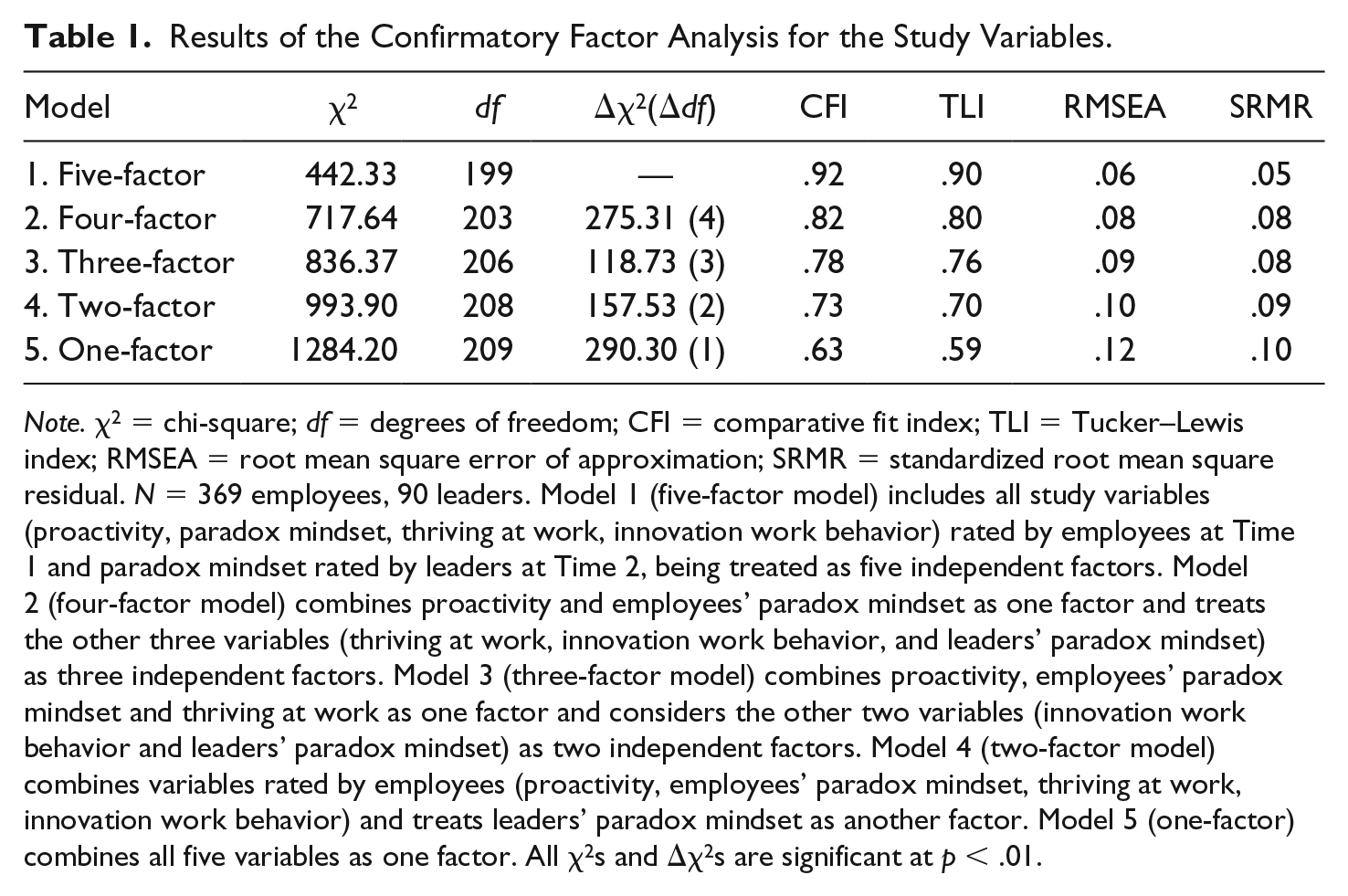
Note. χ2 = chi-square; df = degrees of freedom; CFI = comparative fit index; TLI = Tucker–Lewis index; RMSEA = root mean square error of approximation; SRMR = standardized root mean square residual. N = 369 employees, 90 leaders. Model 1 (five-factor model) includes all study variables (proactivity, paradox mindset, thriving at work, innovation work behavior) rated by employees at Time 1 and paradox mindset rated by leaders at Time 2, being treated as five independent factors. Model 2 (four-factor model) combines proactivity and employees’ paradox mindset as one factor and treats the other three variables (thriving at work, innovation work behavior, and leaders’ paradox mindset) as three independent factors. Model 3 (three-factor model) combines proactivity, employees’ paradox mindset and thriving at work as one factor and considers the other two variables (innovation work behavior and leaders’ paradox mindset) as two independent factors. Model 4 (two-factor model) combines variables rated by employees (proactivity, employees’ paradox mindset, thriving at work, innovation work behavior) and treats leaders’ paradox mindset as another factor. Model 5 (one-factor) combines all five variables as one factor. All χ2s and Δχ2s are significant at p < .01.
Descriptive Analysis
Table 2 presents the means, standard deviations, correlations among variables, and reliability coefficients for this study. Employees’ paradox mindset is positively related to leaders’ paradox mindset (r = .34, p < .01), thriving at work (r = .43, p < .01), and innovative work behavior (r = .68, p < .01). Employees’ thriving at work correlates positively with innovative work behavior (r = .48, p < .01).
Descriptive Statistics and Correlations Among the Study Variables.
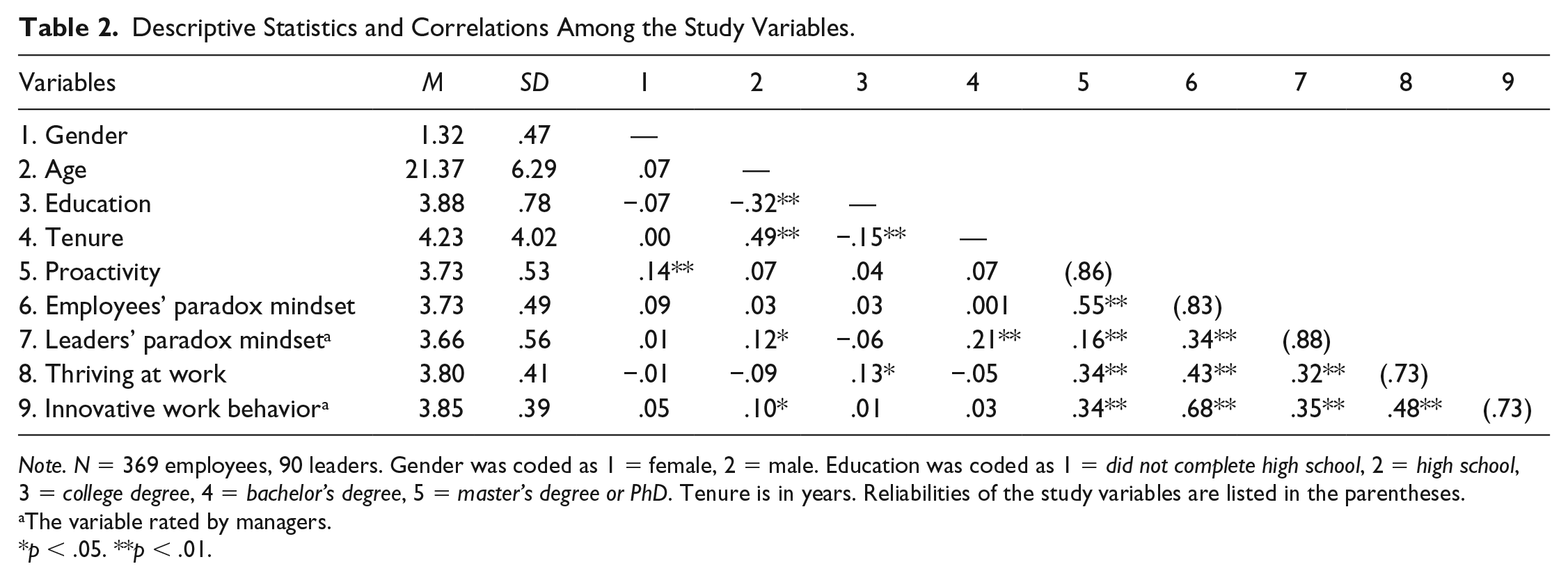
Note. N = 369 employees, 90 leaders. Gender was coded as 1 = female, 2 = male. Education was coded as 1 = did not complete high school, 2 = high school, 3 = college degree, 4 = bachelor’s degree, 5 = master’s degree or PhD. Tenure is in years. Reliabilities of the study variables are listed in the parentheses.
The variable rated by managers.
p < .05. **p < .01.
Hypothesis Tests
Table 3 and Figure 1 present the unstandardized coefficient estimates for the research model. At the individual level, employees’ paradox mindset is positively correlated to innovative work behavior (γ = .44, p < .01), and thriving at work (γ = .19, p < .01), providing support for the Hypotheses 1 and 2. Thriving at work is positively related to innovative work behavior (γ = .22, p < .01). These results indicate that when employees have a high paradox mindset, they are more likely to be thriving and innovative at work. With 20,000 Monte Carlo resamples, we found that the mediated effects of thriving at work between employees’ paradox mindset and innovative work behavior are .12 (95% CI = [.08, .17]). Because the CI excludes zero, Hypothesis 3 is supported, indicating that employees’ paradox mindset is positively and significantly correlated to innovative work behavior via thriving at work.
Unstandardized Coefficients and Standard Errors of the Multilevel Model.
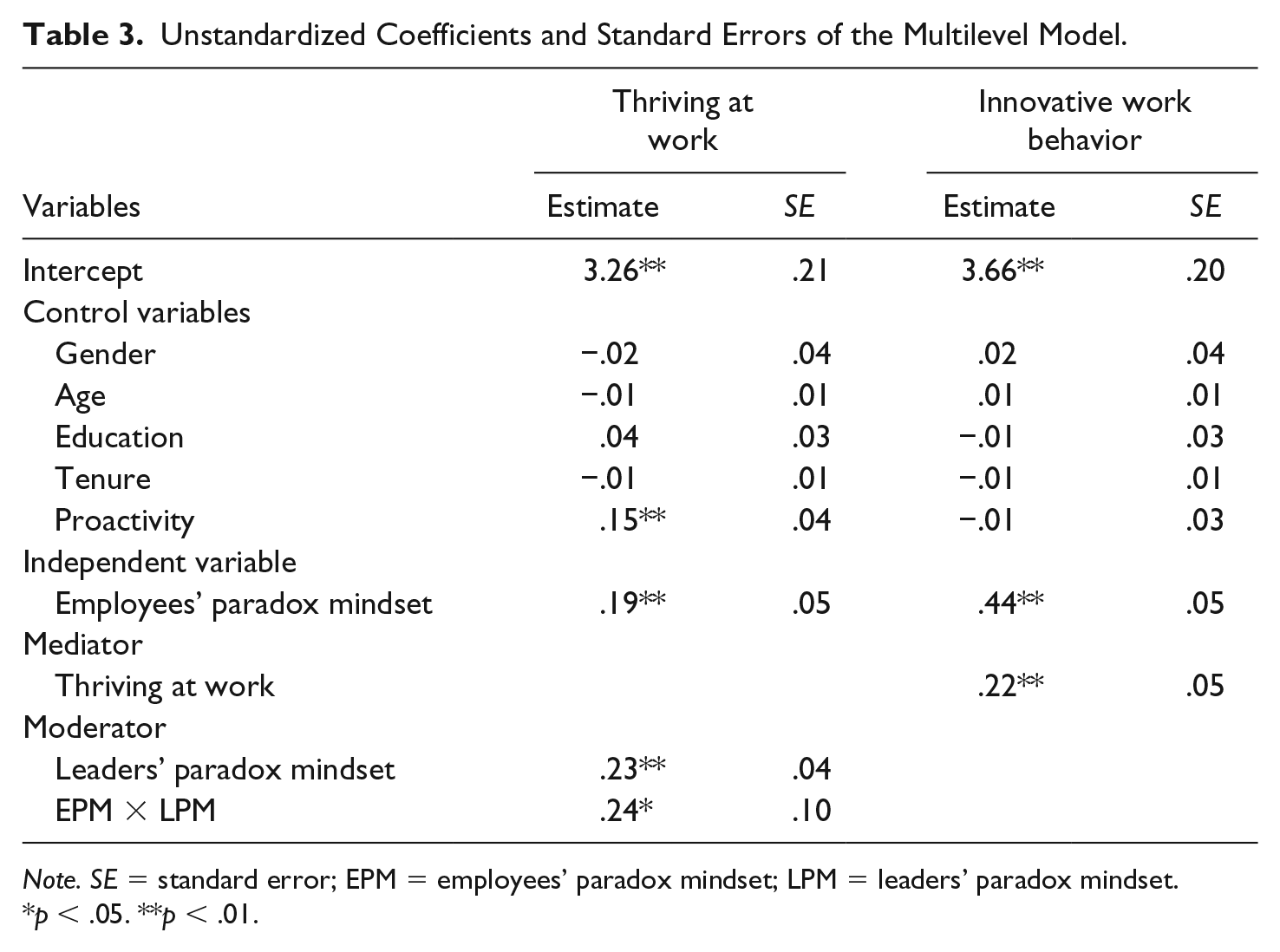
Note. SE = standard error; EPM = employees’ paradox mindset; LPM = leaders’ paradox mindset.
p < .05. **p < .01.
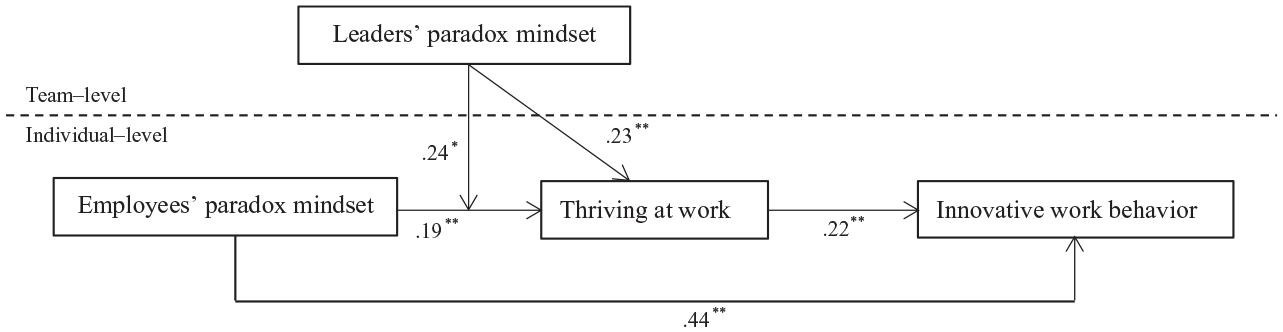
Unstandardized estimates of the path coefficients.
The crossing-level moderating effect of leaders’ paradox mindset on the relationship between employees’ paradox mindset and thriving at work is significant (γ = .24, p < .05). As shown in Figure 2, the relationship between employees’ paradox mindset and thriving at work is stronger when leaders’ paradox mindset is high (+1 SD, γ = .31, p < .01) than when it is low (−1SD, γ = .07, ns). This indicates that leaders’ paradox mindset strengthens the relationship between employees’ paradox mindset and thriving at work, supporting Hypothesis 4.
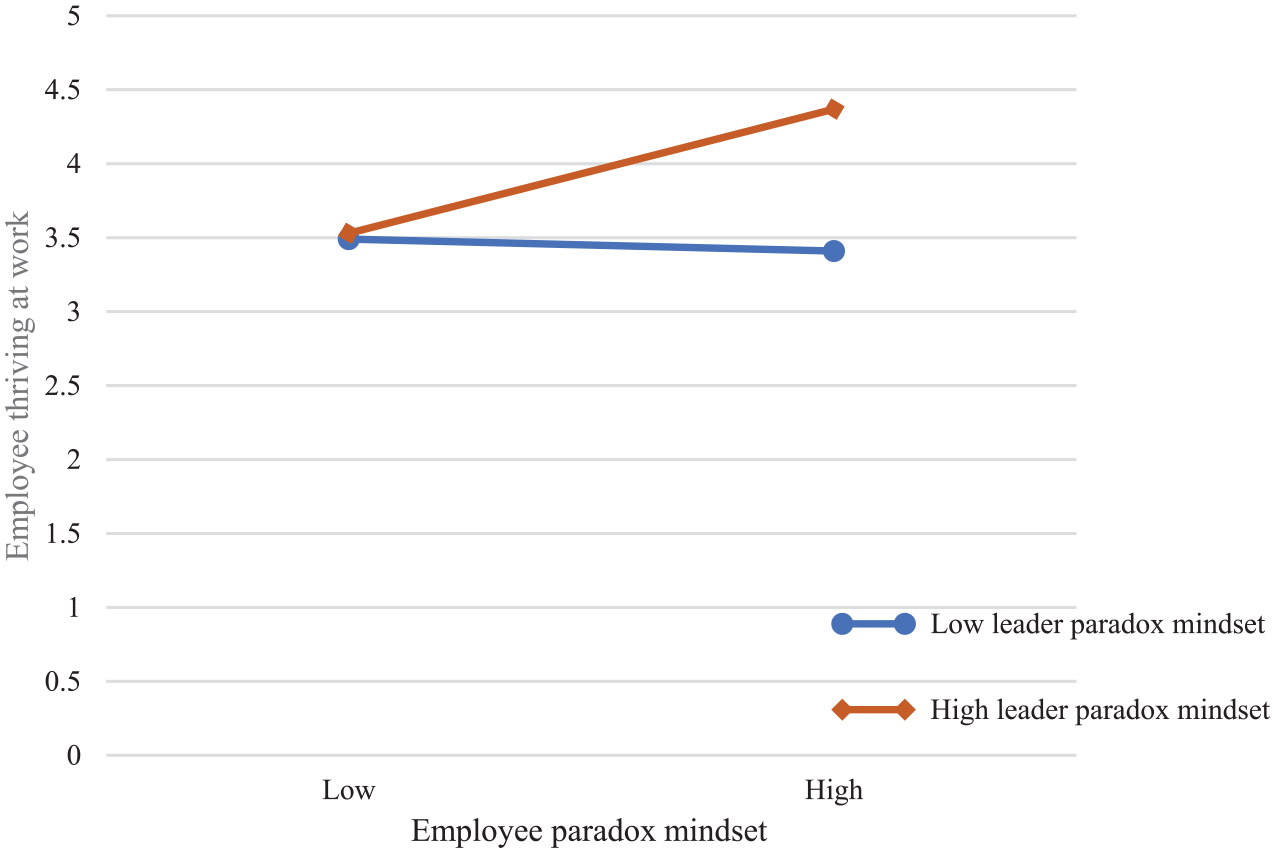
The moderating role of leaders’ paradox mindset on the relationship between employees’ paradox mindset and thriving at work.
Finally, we tested the moderated effect of leaders’ paradox mindset on the relationship between employees’ paradox mindset and innovative work behavior via thriving at work. The indirect effect is .07 (p < .01) for innovative work behavior when leaders’ paradox mindset is high, versus .02 (p > .05) when leaders’ paradox mindset is low. The effect of the difference between the two conditions is .05 (95% CI = [.01, .10]). Because the CI for the difference effect excludes zero, the strengthening effect of leaders’ paradox mindset on the indirect relationship between employees’ paradox mindset and innovative work behavior via thriving at work provides support for Hypothesis 5.
Discussion
This study examined how and when a paradox mindset promotes employees’ innovative behavior. Our findings indicate that employees’ paradox mindset is positively related to their innovative behavior through thriving at work. Furthermore, leaders’ paradox mindset strengthens the positive influence of employees’ paradox mindset on their innovative behavior.
Theoretical Contributions
The current research provides three main theoretical contributions. First, this study responds to the calls for examining individuals’ approaches to the experience of paradox in the future (Leung et al., 2018; Schad et al., 2016). Whereas previous research focused on the effect of leaders’ or employees’ paradox mindset separately, our study contributes to the literature exploring the effects of the interaction between different organizational actors’ paradox mindset. We argue that a paradox mindset serves as a dispositional factor producing creative benefits for organizations. This study not only confirms the positive relationship between employees’ paradox mindset and individual innovation (Miron-Spektor et al., 2018) but also reveals that leaders who embrace tensions are more likely to strengthen the positive effects of their subordinates’ paradox mindset.
Second, our findings contribute to both the literature on thriving at work and SDT, demonstrating how the adoption of a paradox mindset satisfies employees’ basic psychological needs, promoting their thriving and innovative behaviors. Previous research showed that a paradox mindset affected individuals’ innovative behavior from a cognitive perspective (Leung et al., 2018; Miron-Spektor, Gino, & Argote, 2011). Our contribution is to indicate that thriving at work might be the psychological mechanism mediating between the paradox mindset and innovative behavior from a motivational perspective. This study shows that energized internal states serve as potential gauges for self-regulating behaviors. Moreover, we provide empirical support to the claim that individuals’ approach to paradoxes involves affective responses to contradictions (Miron-Spektor et al., 2018).
Third, our findings regarding the creative benefits of a paradox mindset have theoretical implications for organizational innovation. The dispositional characteristics of individuals as a work team or group members may be amplified by their interactions and manifest as a higher level or collective phenomenon (Kozlowski & Klein, 2000). Based on this bottom-up emergent effect, team members can develop shared collective paradoxical frames via collective sense-making processes (Lüscher & Lewis, 2008; Miron-Spektor & Paletz, 2017). In addition, leaders with a paradox mindset, who may integrate the conflicting demands of the team members and balance among them, are more likely to promote the development of collective paradoxical frames in teams. Collective paradoxical frames can make team members recognize and embrace tensions, thus facilitating organizational learning and innovation at higher levels (Miron-Spektor & Paletz, 2017). It would be interesting to investigate how a collective paradox mindset (i.e., shared paradoxical frames) influences organization innovation with a multilevel and integrative approach.
Limitations and Research Directions
Future research may benefit from considering some limitations of the present study. First, we collected data from different sources (both supervisors and employees) at two time points; in the future, a combination between experimental and longitudinal designs may allow us to establish the causality between focal variables and reduce the potential common method bias (Podsakoff, MacKenzie, & Podsakoff, 2012). Second, the current study has only examined a single mediation mechanism for the relationship between employees’ paradox mindset and innovative work behavior. Future studies will need to explore more mediators to explain this relationship, such as ambivalence (Rothman, Pratt, Rees, & Vogus, 2017). Third, although leaders’ paradox mindset is considered a team-level variable, other behavioral, situational, and organizational factors should be examined in future research. Finally, Miron-Spektor et al. (2018) argued that merely experiencing tensions did not affect employees’ job performance and innovation; however, we did not measure participants’ experienced tensions; thus, we did not capture how participants’ experience of tensions affects their innovative behaviors.
Future research should also expand this study in several ways. Individuals from different cultural backgrounds may employ different mindsets to deal with paradoxical tensions. For example, Zhongyong is a typical Eastern value derived from the Confucian philosophy, which encourages individuals to take a harmonious and holistic perspective in their interactions with others (Yao, Yang, Dong, & Wang, 2010). In our data analysis, employees’ Zhongyong (M = 4.05, SD = .54) is positively related to a paradox mindset (r = .26, p < .01). Therefore, future research might examine the role of cross-cultural differences in shaping a paradox mindset. In addition, it is necessary for researchers to advance knowledge on both the positive and negative consequences of a paradox mindset before encouraging organizational actors to adopt it. Therefore, future research should shed light on the mixed outcomes of a paradox mindset, exploring its possible boundary conditions.
Future research should adopt a longitudinal design (e.g., experiencing sample method) to examine the dynamic effect over time of a paradox mindset on innovative behaviors via thriving. Schad et al. (2016) emphasized that studies on paradox dynamics provide a valuable perspective. Future research should examine how individuals’ paradox mindset shapes their psychological states and behaviors via interactions with dynamic experienced paradoxical tensions. Also, longitudinal studies would allow investigating the reciprocal influence of thriving and innovative behaviors to investigate whether innovative behaviors have an impact on thriving at work.
Another exciting research direction is to explore the role of leaders’ paradox mindset in the process of coping with tensions or contradictions. Zhang, Waldman, Han, and Li (2015) found that leaders’ holistic thinking and integrative complexity positively correlated with their paradoxical behaviors, such as maintaining decision control while allowing autonomy. Therefore, future research should examine how leaders with a strong paradox mindset manifest paradoxical behavior in different situations. In addition, women leaders may face tensions between agency and communion (Kark, Waismel-Manor, & Shamir, 2012; Koenig, Eagly, Mitchell, & Ristikari, 2011) because of the incongruence between their leader role and gender role demands (Eagly & Karau, 2002). Zheng, Kark, and Meister (2018) proposed a theoretical model to explain how women leaders differently experience and cope with agency–communion tensions; adopting a paradox mindset helps them build psychological resilience, identity coexistence, and leadership effectiveness. Future research should provide some empirical support on how women leaders leverage a paradox mindset to respond to the demands of both agency and communion, further benefiting from these tensions.
Practical Implications
This study also has important implications for managerial practice concerning how to promote employees’ innovative work behavior. First, given the contradictory demands inherent in the innovation process, organizational actors should use a paradox lens to look at innovation. When engaging in innovation, employees experience paradoxical perspectives, thoughts, processes, identities, and goals (Miron-Spektor & Erez, 2017). To achieve the creative benefits of paradox, employees should become comfortable with the feelings elicited by innovation paradox, rather than eliminating the contradictory forces. Thus, managers need to recruit employees who have a paradox mindset and allocate them to positions with innovative requirements. Moreover, Lomranz and Benyamini (2016) demonstrated that individuals could learn to tolerate tensions through challenging life experience. Organizations also can reinforce employees’ awareness of applying paradoxical frames through experiential learning activities.
Second, we find that thriving at work is crucial to understanding the relationship between employees’ paradox mindset and innovative behaviors. Although the employees who adopt a paradox mindset may increase their thriving, we claim that organizations should only rely on the effects of stable individual differences. Given employees’ three fundamental psychological needs for competence, autonomy, and relatedness, managers may provide more opportunities to increase employees’ state of thriving via job design and job rotation, in which they are more likely to experience positive meaning, increase self-efficacy, and acquire new knowledge from work (Niessen et al., 2012). Also, leaders can promote employees’ thriving by providing them with a high level of work autonomy. Managers can also provide helpful feedback to foster thriving, thus increasing employees’ innovative behaviors.
Third, leaders with a paradox mindset have a positive influence on organizational innovation (Ingram, Lewis, Barton, & Gartner, 2016; Smith & Tushman, 2005). We expect that organizations can develop leaders’ paradox mindset through training. Knight and Paroutis (2017) applied a paradoxical approach to management education. Organizations can transfer the pedagogy for teaching paradox into leadership training. In addition, organizations can create an atmosphere (e.g., ambidextrous organizational culture) facilitating leaders and employees to adopt paradoxical frames at work.
Supplemental Material
Appendix_supplementary_material_Yanjun_Liu_2019.10.4 – Supplemental material for Thriving at Work: How a Paradox Mindset Influences Innovative Work Behavior
Supplemental material, Appendix_supplementary_material_Yanjun_Liu_2019.10.4 for Thriving at Work: How a Paradox Mindset Influences Innovative Work Behavior by Yanjun Liu, Shiyong Xu and Bainan Zhang in The Journal of Applied Behavioral Science
Footnotes
Acknowledgements
We appreciate Amy Yi Ou’s comments on the earlier version of this article so much.
Declaration of Conflicting Interests
The author(s) declared no potential conflicts of interest with respect to the research, authorship, and/or publication of this article.
Funding
The author(s) disclosed receipt of the following financial support for the research, authorship, and/or publication of this article: This work was supported by the Outstanding Innovative Talents Cultivation Funded Programs 2017 of Renmin University of China.

Supplemental Material
Supplemental material for this article is available online.
References
Supplementary Material
Please find the following supplemental material available below.
For Open Access articles published under a Creative Commons License, all supplemental material carries the same license as the article it is associated with.
For non-Open Access articles published, all supplemental material carries a non-exclusive license, and permission requests for re-use of supplemental material or any part of supplemental material shall be sent directly to the copyright owner as specified in the copyright notice associated with the article.
