




Abstract
“Orchestration” describes activities of the lead firm in a Value Chain, where lead firm may not undertake any transformation of the tangible product. Limited research examines how goods-producing businesses make strategic organizational decisions on when and where to leverage digital technologies to operate globally, particularly smaller businesses We study 37 small to medium enterprises (SMEs) operating globally to understand strategic relationships in product Design, Create and Sale. We find quality of discovery capabilities now available with digital technologies enable SMEs greater identification and access to global resources in smaller discrete transactions, without upfront capital cost required to acquire those resources.
1. Introduction
Digital technologies and digital transformation are impacting all areas of business: from investment to customer engagement and business change (Keller et al., 2023; Monaghan et al., 2020; Sergei et al., 2023; Srivastava et al., 2023). New business models are being innovated as business leaders seek to optimise how technology is employed across their organisations (Gronum et al., 2016; Wiggins et al., 2020). A key enabler in business model innovation is the use of digital technologies for the orchestration of the extended enterprise, which we refer to as ‘digital orchestration’, that has evolved our earlier thinking on export myths and strategic realities (Keller et al., 2023; Yetton et al., 1991).
Digital orchestration has redefined economies of scale in business models (Garud et al., 2020; Guttentag, 2015; Stigler, 1958). Digital technologies have had a profound impact on access to both the supply and demand side of businesses of all sizes of businesses, and significantly, the change is for the first time impacting businesses simultaneously on both the demand and the supply side (Amit and Zott, 2001; Baldwin, 2019; Lasi et al., 2014; Nakano and Fleury, 2017; Pagani, 2013). The enabled changes include interactions between people, between things and between people and things (Hausberg et al., 2019). Information can be conveyed to all firms and all consumers, irrespective of their size and spatial geography, globally (Wu and Gereffi, 2018). New value-creation opportunities using two-sided digital platforms are discussed extensively in the literature, including the recent successes of information provider FaceBook, accommodation service provider AirBnB and transport service provider Uber (Cramer and Krueger, 2016; Facin et al., 2016; Garud et al., 2020; Guttentag, 2015; Lincoln and Robards, 2014). Similarly, efficiencies are being created by online retailers, small and large (Tolstoy et al., 2021; Wu and Gereffi, 2018). Widespread adoption of social media that has developed alongside commercial platforms provides a level of engagement and validation in the global community on product, leadership and corporate behaviour (Bunker, 2020; Chu et al., 2020; Heavey et al., 2020; Lincoln and Robards, 2014). However, much of the emphasis has been on ‘born digital’ services, buyer-led retail platforms and large businesses with the resources to invest in technologies, leaving a gap in the literature on the opportunities provided to tangible ‘product-making’ by small businesses (Gomes-Casseres, 2003; Monaghan et al., 2020; Tippmann et al., 2023; Tolstoy et al., 2021; Wu and Gereffi, 2018). The motivation for this study was therefore to specifically understand the opportunities provided by digital technologies to ‘product-making’ small businesses, which is an under-researched phenomenon and contributes to knowledge in the new world where small distant businesses can orchestrate value chains.
Small- to medium-sized enterprises (SMEs) make up 90% of businesses, employ half of all workers worldwide and contribute to just under half the world’s gross domestic product (Ardic et al., 2011; The World Bank, 2021). Furthermore, in 2021, over half the world’s population had access to the Internet, double that of 2011, and e-commerce valued at over US$2 trillion (Johnson, 2021; Statistica, 2020). Digital technologies have changed and are changing the transaction costs associated with going to market, such that the extent to which SMEs can operate globally will have significant global economic consequence to all (Davis and DeWitt, 2022; Lahiri et al., 2020). Small businesses are increasingly operating globally and the time taken for new businesses to reach unicorn valuations of $1 billion has decreased from decades to as little as one year (Kotha et al., 2022). Business models evolved over decades by corporations are being challenged (Chandler et al., 1990; Snihur and Eisenhardt, 2022; Zott and Amit, 2013). New efficiencies have enabled businesses to operate with fewer full-time employees, by leveraging outsourced resources, many of which are small businesses.
The implication of digital technologies and digital transformation for small-business ‘product makers’ is a step change in economies of scale provided by unlimited access to global expertise, global production facilities and global markets, not previously available locally, the dis-intermediation of sales and reduced transaction costs enabling smaller increments in resource consumption that previously limited small-firm growth (Anderson, 2012; Baldwin, 2019; Wallin, 2006). The literature is yet to comprehensively address specifically how digital technologies have enabled resource-limited SMEs to leverage global resources across the end-to-end value chain for the design, create 1 and sale of tangible products and the administration of their business (Brown, 2008; Eggers, 2020). Digital transformation research could be advanced with the enhanced development of theory, which better links the elements, processes and effects observed in practice (Gudergan and Mugge, 2017).
This field study seeks to contribute to filling the research gap on global small businesses making tangible products. Hence, our research question: how are small businesses effectively leveraging digital technologies across the full length of the value chain – specifically for the design, create and sale of tangible products and administrative functions of their business?
The novelty in this research is in focussing on the new capabilities provided by contemporary digital technologies available to SMEs to operate in a mode not previously possible with limited resources, and in delineating this operating mode as strategic choice. To the authors’ knowledge, the level of depth of SME value chain analysis at this breadth has not been undertaken previously in the literature.
Australian SMEs that have established their own value chain leveraging global resources for the design, create and sale of tangible goods are the unit of analysis for this research (Buckley, 2009; Gereffi et al., 2005; Koren, 2010). Australia provides the ideal context as the market is small, most geographically distant from global markets and open (AusTrade, 2019; Ghemawat, 2001; Liu et al., 2015; Organisation for Economic Co-Operation and Development, 2015). These firms, regardless of their position in the supply chain, do not have the benefit of a large home market to build scale nor have local access to globally scaled suppliers (Barney, 1991; Johanson and Vahlne, 1977). Thirty-seven Australian SMEs have been selected by purposeful sampling to provide extreme cases from a diverse range of industries, geographies and positions on the Hayes and Wheelwright (1979) product-process matrix. This assures sample diversity (George et al., 2005; Miles and Huberman, 1994; Patton, 2002; Voss, 2010). A qualitative method, using semi-structured interviews, has been used to understand the extent digital technologies have enabled SMEs to lead their own value chain. The scope of this work is limited to tangible goods and thereby excludes firms providing only services. Direct and indirect production activities within each firm are considered, including research and development and the acquisition and management of customers.
Distance matters, so the small businesses selected are distant from global sources of supply and global markets (Blainey, 1966; Dimitratos et al., 2014; Ghemawat, 2001). Hence, we draw on proximity theory to provide complete insights, framing of the solution and predictions about how digital technologies can provide for substitution of traditional spatial proximity with other dimensions of proximity in value chains that can potentially be global (these theories and their value and relevance to this study are reviewed in detail in the following section). We use orchestration theory as the lens through which to develop and interpret our data to understand the new capabilities made available to small ‘product-making’ businesses (Helfat, 2022; Pitelis and Teece, 2018). Both theoretical lenses are required to answer the research question of how changes in proximity dimensions enable orchestration with digital technologies across the full length of the value chain.
This work proposes a decision table drawing on a large qualitative sample from a wide range of SMEs businesses, each of which were examined holistically, using the Zahra (2007) process analysis and Langley (1999) sense making strategy. The article is presented in six sections. Section 2 provides the theoretical background to the work, section 3 provides the research method and section 4 details the findings, which are further discussed in section 5, followed by conclusions, contributions and limitations in section 6.
2. Literature review – theoretical background
Coase (1937) famously said that organisations are created voluntarily because markets are costly to use, hence, the most efficient production process takes place within a firm. Contemporary digital technologies and high-speed communications facilitate three principal changes in the way in which small businesses design, create and sell tangible products. First, the ‘tyranny of distance’ (Blainey, 1966; Ghemawat, 2001) that required spatial proximity for innovation as described by Marshall (1920) can be replaced with other dimensions of proximity. Second, Williamson (1973) transaction costs are lowered such that the Coasian (1937) boundary of the firm’s operations includes external market activities as well as internal activities, enabling both reduced firm size and a smaller transaction size. Third, resources can be orchestrated at a level of scale at reduced cost that was not previously possible prior to the advent of digital technologies and high-speed communications. In this section we propose and justify the relevance and value of both proximity theory and orchestration theory to the occurrence and nature of ‘SMEs that digitally orchestrate value chains, globally’ (Li et al., 2018; Vial, 2019).
Proximity theory was originally developed in the 1990s by the French School of Proximity Dynamics to study innovation and was summarised by Boschma (2005). Proximity theory expanded the early work on Marshallian industrial districts that focussed solely on spatial proximity (Boschma, 2005; Marshall, 1920). Ghemawat (2001) flagged that ‘distance still matters’ and identified four dimensions of distance: cultural, administrative and political, geographic and economic. Taken from the alternate perspective, the expansive body of work on proximity theory has been succinctly summarised by Boschma (2005), detailing proximity as consisting of five dimensions: social, spatial, organisational, cognitive and institutional. When spatial proximity is reduced or lost, other proximity dimensions can be substituted. Contemporary mobile computing technology in conjunction with high-speed Internet communications facilitate the substitution of spatial proximity for the institutional proximity of the Internet, organised in a single coherent manner globally, and is employed by users with the same shared cognitive experience with the benefit of instantaneous social interaction (Baldwin, 2019; Boschma, 2005). The question of changed proximity, away from spatial, is yet to be addressed in the considerable literature on digital transformation of existing businesses (Nambisan, 2017; Oliveira et al., 2021).
Although work continues on the substitutability of various dimensions of proximity, what is clear from our current context, and the recent global pandemic, is that digital technologies facilitated, and increasingly continue to facilitate, proximity between people that are not spatially connected (Baldwin, 2019; Boschma, 2005). Andal-Ancion et al. (2003) articulated the range of opportunities presented by digital technologies some time ago, yet it has not been until the global pandemic that human interactions with digital devices has been accelerated and spurned new perspectives, including remote working and smart phones to detect proximity digitally and provide digital footprints (Cencetti et al., 2021; Leonardi, 2020; Wang et al., 2021). Now, all businesses, irrespective of size, have the ability and proximity to access outsourced resources to provide small parcels of activity or expertise through fine-slicing, 2 irrespective of their onshore or offshore location. The Coase (1937) boundaries of the multinational enterprise (MNE) firm have changed – small firms now have low cost technologies that provide the opportunity to orchestrate their operations beyond their local Marshallian district – the constraints of spatial proximity are removed, and hence, the micro-multinational enterprise (mMNE) (Dimitratos et al., 2014).
Transaction costs have a direct impact on business decisions (Williamson, 1973). New business models have emerged from the opportunities provided by the use of digital technologies (Guckenbiehl and Corral de Zubielqui, 2022; Matarazzo et al., 2020). Digital transformation and the resultant business model innovation have altered consumer expectation and behaviours and disrupted numerous markets for many traditional firms (Golovko and Valentini, 2014; Verhoef et al., 2021). Research into digital transformation in SMEs is developing globally (Battistoni et al., 2023; Gao et al., 2023; Pfister and Lehmann, 2023; Sergei et al., 2023). However, cross-disciplinary research is yet to examine SMEs leveraging the latest digital technologies to create and shape the business models of their value chains for ‘product-making’ (Li et al., 2018; Sergei et al., 2023). Beyond the many models and conceptual frameworks that have been developed, we have not yet reached maturity in terms of a ‘theory’ explaining how digital transformation can be leveraged across the full length of the value chain of small ‘product-making’ businesses. Hence, deeper theoretical concepts are sought for this study that can provide rich insights, explanations and predictions of the phenomenon at hand (Verhoef et al., 2021).
Orchestration Theory presented by Pitelis and Teece (2018), and based on Teece and Pisano (1994) Dynamic Capabilities, distinguishes the way in which relationships between participants are created, shaped and broken by a lead firm to ensure competitors are unable to imitate their firm’s special capabilities (Helfat, 2022). Orchestration refers to management of resources that are outside of the focal firm’s boundaries and stands in contrast to management of resources within the focal firm’s boundary and the traditional Barney (1991) resource-based theory of the firm and approach to resource orchestration (within the firm) developed by Sirmon et al. (2011). Orchestration theory envelops Buckley and Casson (1976) Internalisation Theory by expanding the MNE theory. It includes the alternative of externalisation in addition to internalisation and emphases the opportunity of co-creating organisations, markets and business eco-systems to build and capture sustainable co-created value. Orchestration implicitly recognises the reduction in Williamson (1973) transaction costs and the consequential changes in the boundary of the firm, described by Coase (1937). However, Orchestration Theory is silent on firm size. Hence, given the potential opportunities presented by contemporary digital technologies and high-speed communications, recognised by World Economic Forum (2018), this work explicitly seeks to understand the extent to which resource-limited small firms have leveraged digital technologies to bring global resources proximate to their business and to orchestrate these resources across their value chains for the design, create and sale of tangible products. We combine concepts from proximity theory and orchestration theory to develop insights about how small businesses can leverage digital technologies to create value in a global supply network and market domain.
3. Research design
Detailed understanding of a business, the unit of analysis, using an engaged research approach, is required to understand how resources are orchestrated to effectively engage in design, create and sale of tangible goods and engage with their customer base in their purchase (Koren, 2010; Touboulic et al., 2020; Voss, 1995). We use Koren’s (2010) terms to classify and observe orchestrated activities across the value chains in our data set. To empirically establish the extent of value chain resources that are orchestrated leveraging digital technologies, with boundaries that are not clearly evident in advance, a level of in-depth investigation of the phenomenon is required, that is not available in public domain data (Bettis et al., 2015; Eisenhardt and Graebner, 2007; Langley, 1999). Hence, interpretive case study approach has been adopted.
Qualitative interpretivist case study approach at a single point in time was used to provide the required close-up insights and assess what happens and what matters within a business, focusing on individual meaning, the importance of the complexity of the situation and understanding of how the processes work (Brundin, 2007; Carroll and Swatman, 2000; Creswell, 2016; Denzin and Lincoln, 2008). Multiple atypical or extreme cases, rather than ordinary cases have been sought to reveal more information through theoretical replication (Bettis et al., 2015; Eisenhardt and Graebner, 2007; Flyvbjerg, 2006; Stake, 2005; Yin, 2009). The approach provides the opportunity to ‘illuminate a decision or set of decisions: why they were taken, how they were implemented, and with what result’ (Yin, 2009).
‘Small’, or SME, is an interesting unit of analysis because the overarching characteristic of SMEs is that they are resource-limited (Eggers, 2020). Australian-owned SMEs, which are most distant from global markets and sources of supply, have been deliberately chosen because of their low level of spatial proximity to major markets around the globe providing a high level of geographic homogeneity across the cases in the study. 3 As countries define SMEs differently, using number of employees, sales or loan size, we use the domestic Australian definition provided by the Australian Tax Office (A.T.O.) classification system – businesses with sales turnover of under AUD$250 million (Ardic et al., 2011). 4
To be considered, cases were screened against the global definition of having activities that span at least two continents (Sturgeon, 2001). Cases considered for the research demonstrated the operational construct 5 of having a level of innovation in developing new products or processes including outsourcing, offshoring and fine-slicing (Sharifi et al., 2013).
The contemporary Australian market is a small and open market economy, with minimal protection against global competition, providing the ideal market from which to test globally competitive SMEs (Liu et al., 2015; Luostarinen and Gabrielsson, 2006). These firms are anticipated to derive the most potential benefit from global orchestration, based on their distant geographic location from major markets and supply infrastructure (Baldwin, 2019; Blainey, 1966; Eggers, 2020; Sharifi et al., 2013). In selecting the case population in this way, key factors were controlled. Research focus was on the primary product(s) made by each of the SMEs.
Purposeful sampling approach, operational construct sampling assured maximum variation between cases, enabling common patterns to emerge, and offered value in terms of capturing the core experiences and shared aspects (Dubois and Araujo, 2007; Neergaard, 2007; Patton, 2002: 239, 230–246). Stratification used the SME’s production process on the Hayes and Wheelwright (1979) product-process matrix, 6 the Australian and New Zealand Industry Classification (ANZSIC), and geographic spread. The three stratification variables provided a diverse set of organisations to reflect differences experienced across the different sectors of private goods firms and assure quality of the research (Dubois and Araujo, 2007; Neergaard, 2007).
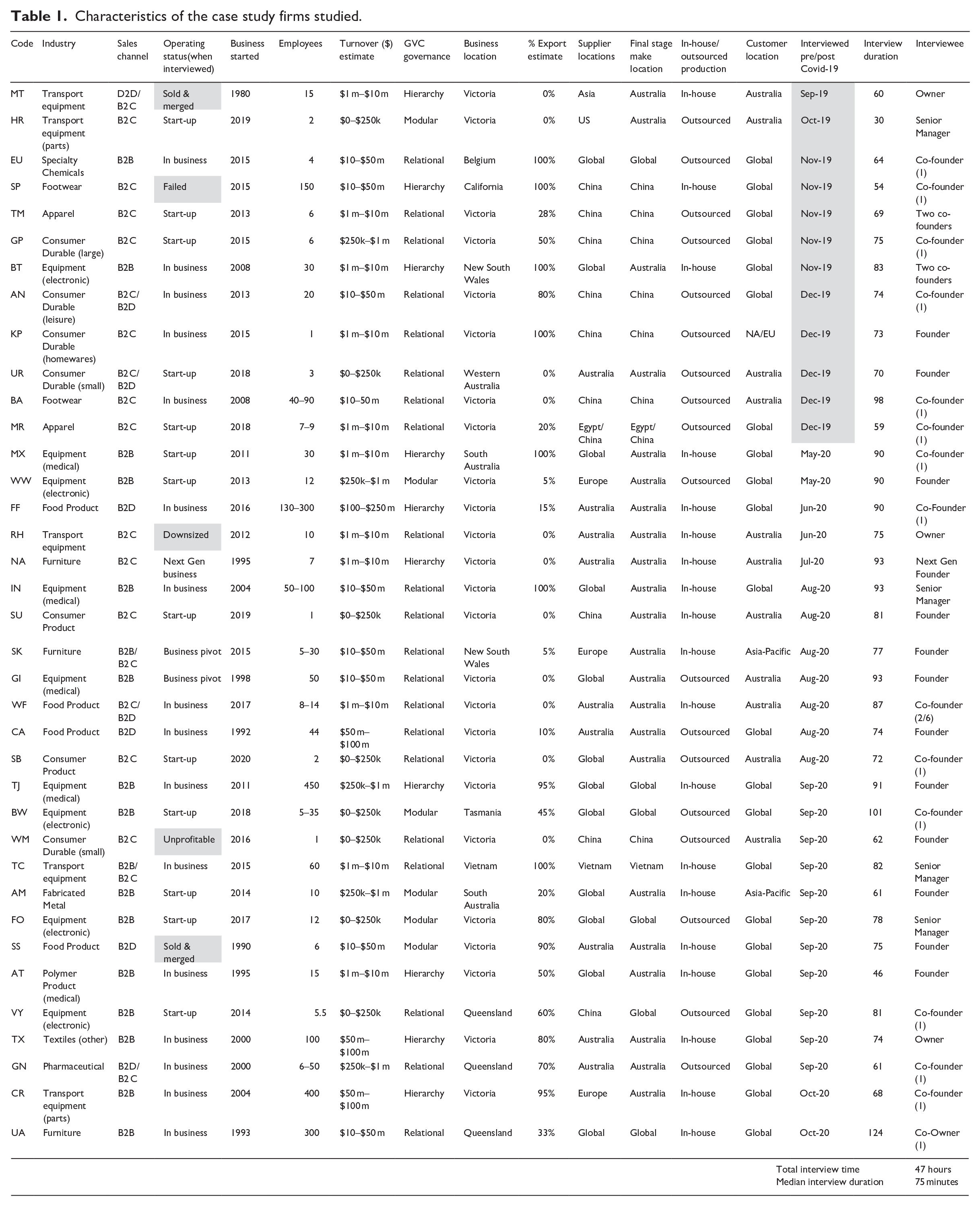
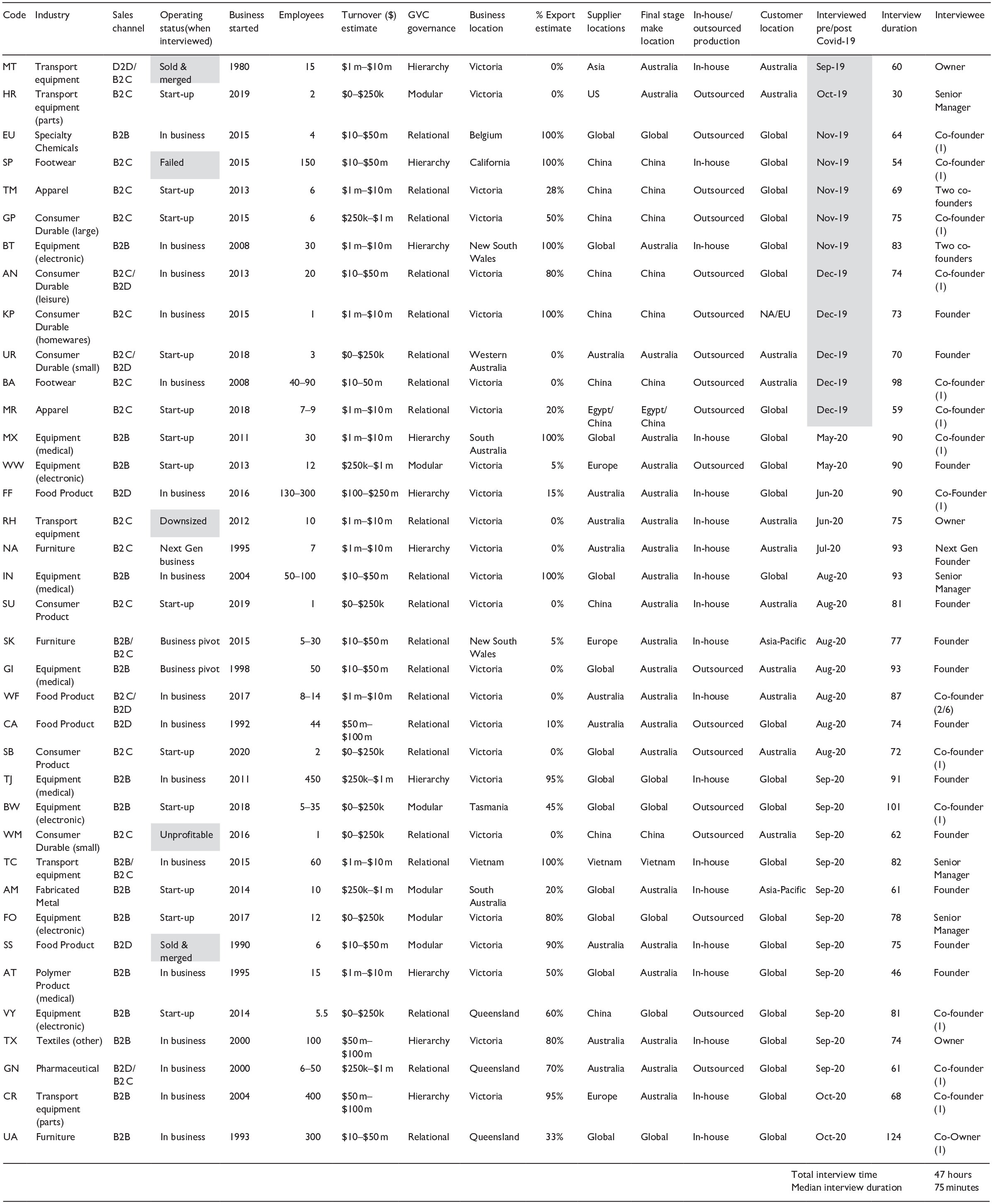
A total of 64 firms were approached for interview of which 27 cases were rejected. One or more knowledgeable executives in each firm were interviewed, using a semi-structured interview, over a 13-month period from September 2019 to October 2020. Research was halted upon theoretical saturation at 37 cases (described in Table 1), when incremental learning proved minimal (Eisenhardt, 1989; Glaser and Strauss, 2017). Characteristics of the case studies are shown in Table 1.
Characteristics of the case study firms studied.
Content analysis of the primary research data using template coding has been employed using the NVivo tool, with categories driven by predetermined tables to focus the analysis. By iteration, some emergent themes arose, and open coding was undertaken to code on these emerging themes in order to address the shortfall in the original coding (Blair, 2015; Larsson, 1993).
4. Findings: what can and cannot be orchestrated with digital technologies?
This section describes the strategic choices made by the cases studied for each of Koren (2010) three value chain process of design, create and sell, as well as the Brown (2008) administrative business support processes. We unpack the endogenous resource-allocation process across the full length of the value chain to understand how the types, quantities and combinations of non-financial resources (physical, technological, knowledge and human) are allocated and the conditions under which digital technologies reduce market transactions costs sufficiently for small firms to orchestrate globally – ‘we were global from day one’ [case AN].
4.1. Design process
This research found how digital tools have substantially improved the ability of SMEs to source and integrate the higher quality, non-financial resource of global best practice tacit knowledge into their design process and more quickly communicate design outputs at reduced cost. In doing so, this work extends the work of Nambisan et al. (2017) that ‘problem-solution matching (is) a micro-foundation of digital innovation orchestration’ by specifically examining SMEs making tangible products and deepens the recent survey work on co-innovation ambidexterity by Zahoor et al. (2023).
The discovery stage of the design process has been substantially aided by the development of simple and effective digital tools of Google searches ‘to get on and research . . . a million times a day’ [case GN] and online video conferencing ‘actually really makes a big difference to get a proper communication [its] really a step up in quality [and] makes a significant difference’ [case BT]. Low-cost, widely available online video conferencing is the simplest, most transformative, example identified in the research in better facilitating tacit knowledge capture. Contacting global experts, without having to physically travel to distant global locations, enabled substantially faster innovation ‘you can go from nothing to have solved a really significant commercial and technology barrier in such a quick time frame with – share information quickly and communicate quickly’ [case MX] – what Fine (1998) calls clock-speed – and at substantially reduced cost, in terms of both international travel costs and lost time away from the business. This has been complemented by platforms offering design services (99Designs) where designers respond to design briefs and tendering their responses, and ‘They could be anywhere in the world’ [case WF].
The development stage of the design process has been enabled by the increased capabilities of the Internet and use by consumers. ‘the Internet has made a big difference [for problem definition]. You can send big files over the Internet. That’s made a huge difference. Otherwise we used to send tapes and CDs around’ [case AT]. For the customer-facing businesses in this study, the business’s Internet website is their primary means of contact with their customer base. Unlike traditional bricks and mortar retail, online businesses can evaluate customer buyer behaviour towards their products and services at more micro detail and rapidly innovate at clock-speed by changing the programming code on their website (Fine, 1998), independently of customer geography to more closely meet customers’ needs and at lower cost (Von Hippel, 1994, 2006). ‘Early communication with end-users in the process . . . actually involving them in the process and the design process between prototypes’ [case TM]. The detail 7 stage of providing the design outputs from the design process has supported the aforementioned changes in the design process. ‘To launch a product, just to get the drawing pack done could take nine months, now it takes two weeks. It’s a significant advancement in the speed and flexibility . . . to deliver products’. [case MX]
The design process in the study was observed mostly as internal to the firm. Improved innovation through design iteration with customers was noted to depend on the agility that comes from internal team members dedicated to the firm’s objective, as noted by cases AN, SP, VY and TM. However, as the design process moves from discovery through define, develop and detail, the level of external resource use increased in the cases studied.
Overall, orchestration using digital technologies in the design process has provided SMEs with much greater access to the non-financial resource of higher quality, globally competitive tacit knowledge sources, more quickly and at reduced cost and with the ability to rapidly iterate their product offering, leveraging what Eggers (2020) call ‘SME agility’.
All the images that you see on our website are actually computer generated. . . . [which] enables us to tweak designs really easily and . . . see how much interest it generates so we don’t actually have to make the product before we get orders [case NA].
A finding that builds on the work by Bouncken et al. (2023), this capability is most suited to the context of more complex products, in fast-changing markets compared to basic materials requiring human senses to differentiate more subtle differences. ‘I need to go so I can see what’s possible . . . I can’t take a photo of something and get a good look at it . . . the light mightn’t be right or . . . the texture might not be good’ [case BA].
4.2. Create process
This research has found how digital tools have had a mixed impact on the ability of SMEs to digitally orchestrate the create process. Key constraints on how SME’s create globally have been identified. In doing so, we identify key strategic choices made by SMEs in their allocation of managerial attention that influences the allocation of resources and the management of risk in the use of advanced technologies.
Planning was observed to be undertaken internal to the business for all cases studied; however, the technology used varied considerably. Low awareness and adoption of planning technology were observed. Smaller businesses planned manually. ‘The single best improvement we made is our inventory management and logistics coordination (using software)’ [case VY].
Amazing, you look at it how much it could do it, how easy it is to use compared to some of the older accounting packages, is quite amazing [and] . . . the guys got it up and running in about 2 weeks [case GI].
Sourcing has developed considerably with the advent of digital platforms, attracting both providers and buyers of products and services (Facin et al., 2016). Similar to the discovery stage in the design process, all cases in the study were engaged to some extent in sourcing at a global domain level. Notably, the technology used was mixed, with different digital marketplaces specialised in specific supplies and services, in addition to simple Google searches for discovery of supplies and suppliers. In the past, it took ‘15 people on a plane . . . sent . . . all around Australia and all around the world for 10 weeks, to come back with the information that I can now do on the Internet in an evening’ [case HR].
Make was undertaken very differently across the cases studied. Half of components were made offshore and a third of final assembly undertaken offshore. Although two-thirds of cases in the study orchestrated the outsourced make of constituent parts in their products, less than a half outsourced final assembly, retaining control of the final process before the customer received the product. The most novel approach was to outsource final assembly to the end customer, to use their own technical team to install the kit of components provided by the business (case WW). Two key types of technologies were identified in support of automated machine-to-machine orchestration of the make stage: 3D printing (3DP), which ‘should be close to the end user to reduce the logistics and transport, but the design is basically in the cloud and can be done anywhere’ [case AN]; and Manufacturing Execution Systems (MES), which enabled ‘all operational processes [to] be controlled and maintained distant from the production facility . . . facility was able to run 24/7 without onsite staff during COVID19’ [case TX].
Delivery has changed substantially with the advent of online direct sales between the product firms and their customers. ‘We just shifted the trust from analogue, in person, to digital and the way we did that is through videos, and we proliferated our brand and our people through those videos’ [case RH]. The ability for the business to manage the customer relationship has effectively commoditised the delivery process creating new online only business models. ‘We actually don’t go buy stock, hold it, sell it’ [case MR]. ‘The whole idea with D2 C brands is that you can bypass traditional retailers, wholesalers and distributors and basically give people the goods for a cheaper price point because no-ones taking a clip’ [case SU]. HoloLens technology was observed supporting remote industrial equipment commissioning previously done in person (case IN), so ‘instead of having to fly across the world, you know, disrupt all my other things, just to be present, now I can observe remotely’ [case IN]. Outsourcing was observed to full-service providers like Amazon to undertake all the delivery execution work (cases KP, GP, MX). The ability for the product maker to orchestrate the delivery process as an extension of their business provides significant value uplift – in one case, the business nearly doubled sales after removing distributors that had previously accounted for nearly half of their sales (case RH).
The limitation in using digital orchestration in the create process relates to the operational structure and number of business partners used by the businesses studied. ‘Let’s say you got a 100 grand, . . . that might pay back in three years on our project. Whereas if you put the 100 grand on the front-end, you might get payback in three months’ [case BA]. The small size of the businesses studied required strong supply relationships with a small number of make stage partners important to the business. ‘Everything to do with operations you can’t do digitally unless you have volume’ [case RH] and ‘trying to get a good deal – very, very hard to do over the phone via email online’ [case SB]. Hence, economies of scale in the number of create process relationships were not present across the businesses studied. The significance of the capability of each relationship led most businesses to validate their make stage partners in person –
‘Some of them were Phantom manufacturers who may be borrowed a factory for a day and made it look like an operating concern . . . it took a number of visits and a number of good and bad experiences to eventually identify the real people’ [case MT].
Overall, orchestration using digital technologies in the create process has provided SMEs with access to global sources of supply and global partners to make components and assemble the final product. However, the greatest benefit of orchestration has been in allocating resources towards new sources of value capture, leveraging the ability to manage a codified delivery process while retaining the relationship with the end consumer, and capturing the financial value previously paid to intermediaries (distributors, agents, retailers) between the product maker and the customer.
4.3. Sell process
This research found how digital tools enabled SMEs to reach and target their potential customer base with a considerably larger reach at lower cost and complete the sale at reduced transaction cost. The
‘sharing of Amazon data between Amazon itself, us and the third-party services . . . helps us to have a clear vision of how our business is performing and where we are heading, what needs to adjust, what needs to be improved, what costs need to come down, whether we need to sell more with particular product and cut down on others’ [case KP].
Customer-need recognition has been supported by the widespread use of the Internet, and associated online applications like social media, by consumers.
‘If you go to our website . . . there are all these reviews of people holding up their [product] . . . or using their [product] . . . it gives us credibility and authority as a brand because it makes it look like we’re very much in the real world’ [case SU].
Businesses evaluate consumer information search using ‘Google Analytics historical data to determine what search terms people are searching that we can try and optimize’ [case GP]. Businesses have leveraged the reach of influencers, as social media platforms has enabled social media influencers to create large audiences in short periods of time (Enke and Borchers, 2019; Freberg et al., 2011). Influencers ‘register a cookie on their website for all their social contacts and if any of their followers chose to buy a products then they receive a payment’ [case UR].
Social media is important for two reasons: it gives your brand authenticity and credibility . . . the first place I go is Instagram, not the brands website. . . . If they don’t have a presence on Instagram, I’ll be this brand seems like it’s not legit [case SU].
The trend for consumers to be part of something bigger than themselves has led some to make financial contributions to businesses over and above the cost of individual products (Paschen, 2017). Consumer decisions to invest in the businesses studied leveraged digital technologies – ‘we launched our products on Kickstarter, a crowdfunding website. . . . we were global from day one . . . we were getting customers from around the world’ [case AN]. Contributions to innovation, such as helping a firm test their technology and contributing feedback on firm’s product and website was mentioned in the previous section on the design process. The implication is that the value chain needs to be considered more as a continuous engagement process between the business and customers than a linear delivery process that simply delivers product (Von Hippel, 2006).
Post-purchase and service has been addressed quite differently across the cases studied. Fully automated use of artificial intelligence, where customers ‘first talk to a robot, a Facebook chatbot, capable of answering basic questions . . . [and] . . . once question is more specific, then it directs you to talk to a human at the backend’ [case KP]. Personalised email solutions ‘send out in a rich format, HTML emails that are all well branded . . . to personalize offers to customers, rather than a blanket email to everyone’ [case TM]. And conventional post-sales follow up phone calls used by case UR. Most cases adopted Customer Relationship (CRM) software to track customer activity and communications, with the more advanced using ZenDesk (cases TM, AN, FO, GP), providing ‘a pretty detailed data capture system so that we can report issues with products and track them down to specific dates and quantities’ [case AN].
The Sell process by businesses in the study was orchestrated using a range of different software solutions. Consumer engagement using Internet, social media and email-enabled businesses to cost-effectively manage codified knowledge associated with their product and engage and manage direct relationships with customers directly. However, two areas were identified where digitally orchestrating customers was constrained: expensive luxury items, where ‘They gotta touch it. See it. Feel it. Smell it’ [case TC]; and for the design of customised products, where ‘you’re designing it straight in front of them, live, is a really impressive process for the customer . . . and it feels as though everything is still getting designed’. [case NA]. In both cases, the buying experience was an integral part of the purchase outcome, and transactional efficiency was not observed to enhance the buying experience.
Overall, orchestration using digital technologies in the Sell process has provided SMEs with the ability to engage directly with customers at low cost and high transactional efficiency and to capture margin, previously paid to intermediaries in wholesale, distribution and retail, almost regardless of their spatial proximity. The source of greatest benefit to SMEs in the orchestration of the Sell process has been from customers, who have elected to codify knowledge that businesses can cost-effectively harvest, knowledge that was previously only available as tacit knowledge to retailers, who met customers in person.
4.4. Administrative business support processes
The opportunities to start businesses now are just unbelievable (case SU). ‘You can now run an office from a laptop, with a simple and secure internet connection that would have taken weeks years ago’ (case UR). ‘There’s lots of little areas where we can make incremental improvements. If you add up quite a lot of those, it’ll have a fairly substantial improvement in the processes that we have’ (case AN).
This research has found how digital tools have enabled SMEs to quickly and easily adopt low-cost proven technology and process to run their business with low transactional costs, engage expert human resources at low marginal costs, more aligned to needs, and to manage their business as a small entity (Coase, 1937).
General management and firm infrastructure are enhanced by the speed and efficacy of digital technologies. ‘We exist digitally, we are born digital, everything about the model is digital, so without digital, we would not exist’ [case MR]. Human resource management is enhanced by the capabilities of digital technologies to more precisely support the resource constrained needs of SMEs to reach and engage best available resources at reduced cost.
‘Access to a global workforce of people that you can easily communicate with, whether it’s leverage and sharing information or whether it’s just being able to have a face-to-face conversation with someone who is overseas, that isn’t purely based on written communication’ [case BW].
The businesses in this study were not limited by recruitment of local staff to support their businesses, nor did they limit their resource acquisition to full-time permanent staff members. One full-time employee of an Australian business was based in Iceland, about as far away from Australia as is possible (case BT) and another business draws upon individual part-time and casual staff from all across Australia and India (case BW). The use of the labour spot market platforms facilitate businesses to draw upon people skills for codified individual tasks as and when these tasks are required by the business, especially for marketing collateral and technology tasks (cases GP, KP, TM, WF). ‘Our marketing guys are in the Ukraine . . . They manage marketing; social media marketing or online advertising, search engine marketing (SEO)’ [case MR].
Cloud-based software, used by most of the cases in this study, has also facilitated a number of cloud providers to form integrated connections between cloud solutions, so that business users have a seamless technology solution. ‘Once the customer had ordered online, it drops straight into the appropriate 3PL and is processed in a very efficient manner’ [case AN]. ‘Everything with Shopify is integrated with the backend’ [case SU]. Orders placed on Shopify can be managed through CIN7 planning software and accounted for by XERO accounting software – three different software providers. As the vendors are managing both cloud software and cloud hardware, they control and can standardise (codify) their complete offering, whereas previously, each business had its own unique hardware infrastructure. Similarly, projects can be managed in the cloud with solutions like SLACK that instantly record all project task activities independent of time zone, transparent to all project team members and independent of geography and device (computer, tablet or phone) used to access the project information, which is ‘critical to communicate in different time zone and keep record of communication that is not just via email’ [case WF]. This real-time visibility and transparency has replaced batch modes of communication like email and reduced transaction costs and increased clock-speed in project management (Fine, 1998).
Orchestration of administrative business support processes with digital technologies was found to be constrained in managing human relationships. ‘I’m pretty confident that on average you’re going to have a better relationship at least periodically meeting face to face . . . technology has made it easy to maintain relationships’ [case GI]. Managers communicated the need to periodically meet with their key business partners and managers cited employee need to socialise with colleagues to reduce stress levels as part of their human resource management. ‘We were very good at exercising the big muscles through digital, I book an hour to talk to someone about something, but missed the little water cooler conversations that are the glue that hold things together’ [case IN].
Overall, orchestration using digital technologies in the administrative business support processes has provided SMEs with reduced transaction costs for codified knowledge transfers in both general management and the inter-operability of technology solutions. Fewer resources need be allocated for physical, technological, knowledge and human resource types, as each resource type can be consumed by the firm in a quantity and combination aligned to the actual needs of the firm. ‘Outsourced external providers provides a tap you can turn on and off’ [case VY]. The administrative business support processes were the only part of the business’s value chain where the same common software technology solution (XERO) was employed by the majority of small businesses studied.
5. Discussion
The use of digital technologies to orchestrate is shown to be changing the boundaries of the firm, and the impact of different aspects of proximity, enabling SME business leaders to access global resources at scale (Baldwin, 2019; Coase, 1937). Using the open Australian market context, where SMEs are most challenged by their geographical distance from global markets, and a purposefully selected diverse group of SMEs, conditions under which digital technologies reduce market transaction costs sufficiently for small firms to orchestrate globally has been evaluated. We have observed in the cases studied that proven digital technologies can be acquired at low or no cost, how they provide greater reach to higher-quality business relationships (inputs and customers) and with lower transaction costs, lowering the barrier to entry to global business for use by small firms. Our findings from the cases are summarised in Figure 1 and show that across the cases studied, digital technology is used to a varying degree for the orchestration of all business activities involved in design, create and sale of tangible products, and Administration of their business. Furthermore, the cases studied show the use of orchestration is not limited by industry type nor position on the Hayes and Wheelwright (1979) product-process matrix. Most notably, given the spread of SME business size within the study, it is the smaller, and not the medium-sized, businesses that are leveraging technology for orchestration at global scale. Given the resource limitations of SMEs and increased cost associated with accessing resources more distant, the observed leverage by SMEs of global resources requires an accompanying reduction in the transaction costs of resource search and acquisition (De Marchi et al., 2014; Eggers, 2020; Williamson, 1973).
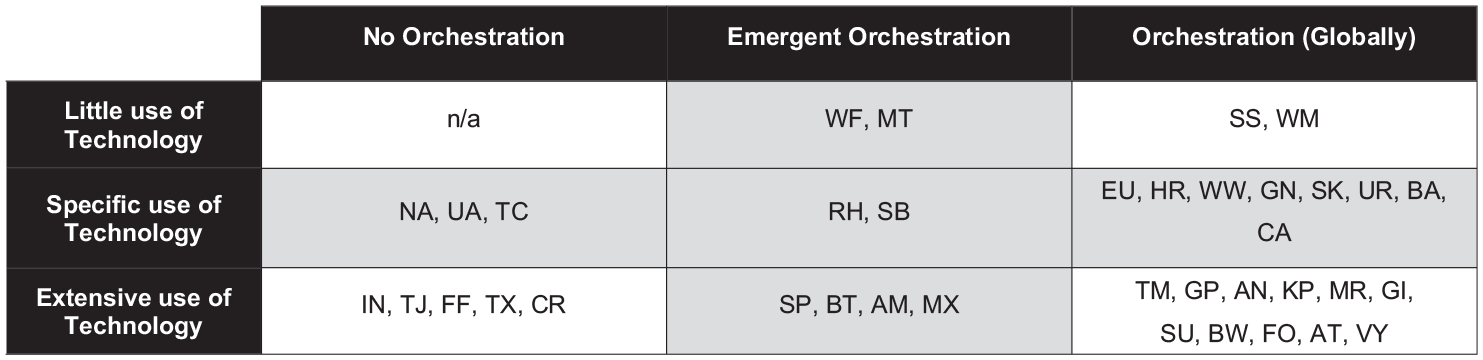
Qualitative assessment of the cases studied.
The answer to the research question in this study is that there are two possible strategic processes ‘how’ firms can externally orchestrate (right side column of Figure 2) with or without technology, extending the internal orchestration – only approach (left side column of Figure 2) provided by Sirmon et al. (2011). One of the unique contributions of this article is that we have empirically observed these approaches to strategy through our deep interpretative case study analysis. Our findings in Figure 1 provide insights into the strategy adopted by different businesses, independent of industry, and has been summarised into a simple management two-by-two strategy matrix in Figure 2. The upper left corner can be described as simple create-focussed ‘craft’ product businesses, such as the local cake shop, as a value chain (non-global) producers that does not require orchestration nor sophisticated digital technologies to deliver a product sensitive to taste, smell and touch that cannot presently be conveyed using digital technologies. SMEs purposefully selected for this study have progressed beyond the upper left corner to the adjacent three squares, having adopted a level of technology (cases NA, TC & UA) or orchestration (cases MT & WF), or orchestration with technology (cases RH & SB). In the upper right corner, where the product is simple and the market is largely unsophisticated, orchestration may take place at scale without sophisticated digital technology by simply using a telephone (cases EU, SS & WM). This is the realm of outsourced ‘services’ that has long been used to assist in the Sell of tangible products. The lower left corner is where product makers have developed an in-house ‘scale’ and capability in create and design, requiring significant intellectual property to protect, and is where digital orchestration presents a risk (cases CR, FF, IN, TJ & TX). Treatment of such risks results in the allocation of resource away from digital orchestration external to the firm and technology investment is observed internal to the firm. The lower right corner represents the space occupied by MNE operating at scale that have leveraged their accumulated resources to invest and orchestrate globally as GVCs (De Marchi et al., 2014; Gereffi et al., 2005; Johanson and Vahlne, 1977). However, in this study, the lower right corner represents the new opportunity for SMEs provided by the lower transaction costs of Digital orchestration, which offers sizable discovery and sourcing benefit to businesses which are sub-scale, and in markets that are engaged digitally. Businesses in this space have invested in digital technologies (Administration) to orchestrate resources, rather than invest in resources for the design, create or sell of their tangible product. The businesses in this study are not large MNE GVCs but small SMEs that have used digital technologies to leverage the scale of others to build scale in their own business value chain across all three areas of design, create and sell, by investing in (Administration) technology.
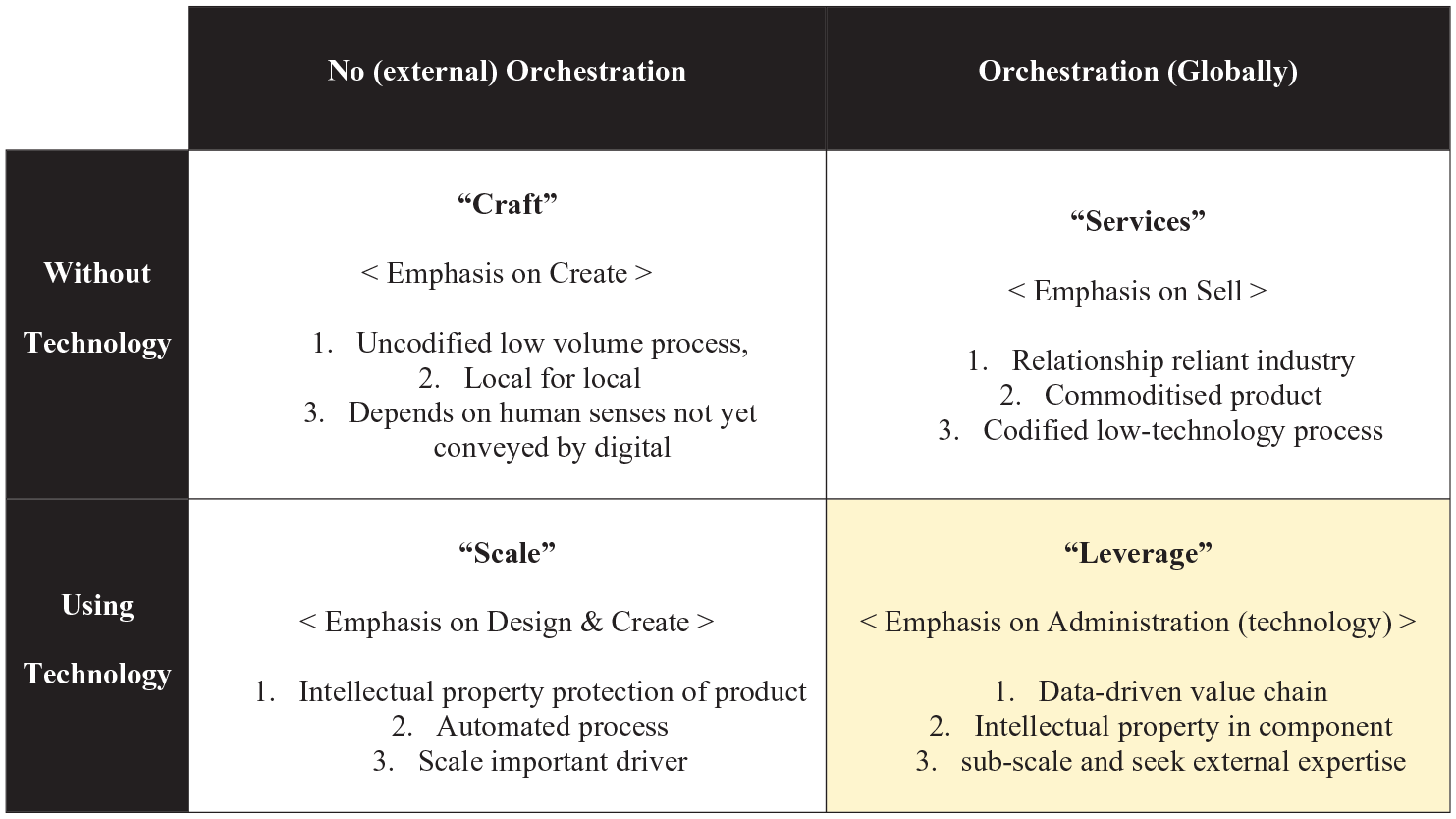
Digital orchestration guidelines – whether and how to orchestrate with digital technologies.
The strategy of digital orchestration benefits most the digitally astute producer, that is sub-scale, having created a new business model seeking global best practice inputs and selling to, and responsive to, global niche markets, found through online opportunity discovery. This is perhaps best captured by case SU: ‘It’s never been easier to start a business’. The conditions under which digital technologies reduce market transactions costs sufficiently for small firms to orchestrate globally are three-fold, as shown in Figure 2. First, the business is sub-scale and actively seeking external expertise. Discovery of new opportunities and orchestrating specialist pockets of expertise at scale is the opportunity ahead. Second, the value chain is data-driven and digitally connected. The blend of technology, process and material science is creating new opportunities, with new business models for micro business start-ups and SMEs assembling complex products at scale (Pitelis and Teece, 2018; Wernerfelt, 1984, 2022). Third, intellectual property is most likely to be contained within discrete modules within the product that are difficult to replicate. Furthermore, as SMEs have fewer internal business resources reduces the demands on business resources to adapt, such that SME businesses can do more with less resources, more quickly and compete globally at scale in their chosen niche with large MNEs (Baldwin, 2019; Wernerfelt, 2022).
6. Conclusions, limitations and contributions
The contribution of this empirical research work is that digital orchestration provides small-business ‘product makers’ with a step-change benefit in economies of scale to operate as an mMNE: unlimited access to global expertise, global production facilities and global markets, and enabling smaller increments in resource consumption that previously limited small-firm growth. The conditions under which digital technologies reduce market transactions costs sufficiently for small firms to orchestrate globally has been presented and summarised as a strategic choice in the proposed matrix. This empirical study is novel in sampling a diverse range of Australian firms, most distant from global markets, to understand how digital technologies can mitigate geographical distance and enable global resources to be orchestrated at scale to make products for global markets. The research has five key implications that respond to the study’s research question. First, the study has provided an indication of the types of activities that were outsourced, offshored and fine-sliced in the global SME value chain business model. Second, the wide range of digital technologies currently available to SMEs provide opportunities for SMEs to orchestrate components of their value chain, more quickly and independent of distance from global markets, often replacing spatial proximity. Third, benefits of digital orchestration fall to firms requiring incremental resources and knowledge when the business is sub-scale in their value chain. Fourth, as firms grow, the need for agility drives firms to bring selected resources in-house, providing a limiting factor for benefits of digital orchestration. Fifth, firms in competitive markets that have developed high levels of in-house intellectual property are least likely to adopt a digitally orchestrated global outsourced value chain approach.
6.1. Managerial relevance
Business practitioners, particularly early-stage entrepreneurs, may be able to orchestrate their sub-scale businesses with fewer resources and less external funding requirements than those prior to the digital age. This will likely lead to a larger number of SME value chains operating globally and a self-sustaining ecosystem over time, which will in turn provide a dynamic economy and thriving small-business sector, more sensitive to changes in global markets.
The social implication is that businesses will implicitly become smaller, with less people working and engaged within the organisational structures of businesses as we know them today. The change in physical, technological, knowledge and human resource allocation will transform organisational design. This makes planning difficult for forward focussed, research-initiated, institutional infrastructure to support growth in global SME value chains. In the absence of institutional infrastructure for growth in global SME value chains, the opportunity for national growth may be stunted.
6.2. Limitations and applicability
The method, number of cases and range of businesses under study have been deliberately narrow to understand each global SME value chain at greater depth. The sample size is small for each industry, so not all process findings may be transferable within industry or across industry and country. Our qualitative field study of the processes used to make resource-allocation choices has been undertaken at one point in time, based on one extensive interview with the business leader or manager, triangulated with information available publicly at the time. The approach provides limitations on the external validity, or transferability, of the results.
6.3. Theoretical contribution
Our data show how digitalisation allows for small firms which traditionally would have been low in power can exert orchestrated influence including over large firms that reduces distance (Ghemawat, 2001) and improves overall proximity including global contexts. In particular, the influence beyond the Coasian (1937) boundaries of the firm have changed for small businesses such that the size in the step changes in resources required to scale a business have reduced enabling greater possible reach for small sized businesses.
This work extends three areas of literature. First, the orchestration theory by Pitelis and Teece (2018) has been extended to show that orchestration is biased towards areas of business where there are multiple relationships: customers and sourcing, and least in the area of supply where there is a single or small number of singularly important relationships. Orchestration theory is further extended by defining the benefit as being derived from the incremental allocation of knowledge and specialist resources, when business is sub-scale, avoiding step-change investment costs. Second, Gereffi et al. (2005) literature on GVCs has been extended to show that, with digital technologies, the lead firm can be small and can efficiently orchestrate value chain relationships globally in design, create and especially the sell process to customers. Third, entrepreneurship literature is extended to show that digital skills are integral skills required by contemporary entrepreneurs, providing significant benefit in the development of mMNEs. In more broadly upskilling entrepreneurs in business activities and increasing their awareness of the breadth of technologies available, they may better allocate their limited resources to create novel end-to-end business models, using digital technologies for all value chain stages and lead their own value chain globally for providing tangible goods direct to customers.
6.4. Opportunities for further research
Extension of traditional firm resource-allocation process to include value chain orchestration globally begs further exploration of ‘when the underdog wins?’ (Wernerfelt, 2022). In the past, small firms have been swallowed and/or controlled by large firms; however, more evidence could be collected on how agile firms can swallow the slow-moving firms through leveraging digital orchestration.
Further research is warranted on how learning over time strengthens the effectiveness of technological capabilities, including platforms, which could measure the impact of variations in legal frameworks across countries on platform use and effectiveness. Furthermore, drilling down into the mechanisms of the sub-activities under design/create/sell/administrate would extend the findings in this study. Given the change in the Coasian (1937) boundaries of the firm identified in this work, further research should also investigate the circumstances and particularness of specific digital technologies such as sourcing platforms, blockchain and other inter-firm technologies.
The findings that SMEs use technology to digitally orchestrate customers at the expense of digitally orchestrating their value chain globally do not suggest that this is the only way forward. Instead, this finding presents opportunities for more digitally astute firms who can leverage digital orchestration on both the demand and the supply side of their business to compete even more effectively. Furthermore, quantification of global market size and growth of commoditized manufactures subject to digital orchestration would build on the qualitative insights provided by this research.
Key theoretical and practical implications
Footnotes
Acknowledgements
The authors acknowledge very generous support of Professor Beth Webster in guiding this research, which was supported by the Commonwealth of Australia, through an Australian Government Research Training Programme Scholarship.
Final transcript accepted 1 March 2025 by Catherine Collins (Deputy Editor).
Funding
The author(s) disclosed receipt of the following financial support for the research, authorship, and/or publication of this article: Supported by the Commonwealth of Australia, through an Australian Government Research Training Program Scholarship.
