




Abstract
Racism in the workplace occurs at both the interpersonal and institutional level in terms of prejudiced attitudes and behaviours and avoidable and unfair differences in hiring, retention and opportunities for training and promotion. Many organisations have stated commitments to workforce diversity; however, work-related racism remains the most common forms of reported discrimination. Rather, efforts to increase workforce diversity will fail in the absence of measures to address discriminatory attitudes, behaviours, practices and cultures. Current approaches also lack strategic development, including knowledge of how to implement workforce diversity and anti-racism strategies at multiple organisational levels. Specifically, there is less understanding of measures to support structural level change. This article aims to advance both theoretical and empirical understanding of racism and anti-discrimination in the workplace. We do this by presenting a multi-level framework for understanding and addressing workplace racism. We also study the implementation of a meso-level workplace diversity and anti-discrimination assessment within two local government organisations in Australia. Findings revealed the importance of implementing strategies across multiple organisational levels and establishing accountability for commitments to diversity and anti-racism practice. Despite its structural and universal drives, we argue that racism can be disrupted through the presence of diversity in the workplace and anti-racism intervention.
1. Introduction
Recent global developments, such as the Black Lives Matter movement and protests in the United States, have heightened attention to issues of racism, including structural forms of discrimination in the workplace. In response, there has been increasing momentum for organisations to increase workforce diversity and address racism through hiring practices and other measures such as dedicated diversity roles and training. At the same time, progress remains slow or non-existent in many settings, with work-related racism continuing to be one of the most consistent forms of reported discrimination (Lee et al., 2019; Pew Research Center, 2016).
Racial discrimination or racism is defined as a system of practices, attitudes and beliefs based on assumptions of superiority/inferiority, which sustain an unequal and avoidable distribution of resources based on racial/ethnic group membership (Paradies, 2006). Alongside racism, individuals may experience multiple discriminations, including on the basis of gender, age, class and sexual orientation (Crenshaw, 1989; Nash, 2008). Workplace racism can be linked to several negative outcomes, including poorer mental health and well-being, lower job quality and higher occupational stress (De Castro et al., 2010; Hughes and Dodge, 1997; Rospenda et al., 2009; Shannon et al., 2009) and can also result in substantial economic costs, where companies may suffer litigation costs due to substantiated cases of racial discrimination (Blank et al., 2004; Buttner et al., 2010; Elias and Paradies, 2016).
Despite its prevalence and harmful effects, issues of workplace racism have been neglected within management studies. Rather, research has focused mainly on managing diversity, which involves the process of recruiting, retaining, rewarding and promoting individuals from diverse backgrounds (Cox, 1991; Ivancevich and Gilbert, 2000). While such a focus is important, efforts to increase workforce diversity can backfire in the absence of clear strategies to address prejudiced attitudes and behaviours and exclusive workplace practices and cultures (Ely et al., 2012). For example, organisations may fail to attract diverse candidates who anticipate a lower sense of belonging and/or organisational commitment to diversity and non-discriminatory cultural norms (Avery and McKay, 2006; Chatman and O’Reilly, 2016).
There are also important conceptual differences between diversity management and ensuring workforce equity and anti-discrimination. The former is a voluntarist agenda, which is controlled and managed internally, while the latter is usually addressed by external regulatory controls, such as equal opportunity and anti-discrimination legislation (Noon, 2007). While it is claimed that the voluntarist nature of diversity management allows managers to assume greater responsibility for diversity issues, this can conceal underlying issues of bias and discrimination, where managers might, for instance, deny that racism exists (Nelson, 2013) and face less scrutiny when implementing diversity plans.
Diversity management has also been positioned as a more ‘inclusive’ language and philosophy which can be applied to the ‘whole’ organisation (Thomas, 1990), thus avoiding some of the backlash effects of affirmative action and anti-racism agendas (Lorbiecki and Jack, 2000; Wrench, 2005). However, as Noon (2007) argues, it is ‘misguided to believe that diversity will deliver in ways that equal opportunities could not’ (p. 775), where the seemingly neutral language and ideology of diversity management can conceal racism and unequal power relationships (Lorbiecki and Jack, 2000). Nonetheless, finding the right language is a key dilemma in diversity work, where, for instance, Ahmed (2006) proposes that the term can be used strategically: Diversity work is strategic, even if it has certain political principles behind it. So diversity is used by some precisely because it is a comfortable term that allows people to engage more easily with this kind of work. As a result, practitioners are positive about the term ‘diversity’ for the very reasons some are critical of them. (p. 122)
In this sense, diversity practitioners articulate the usefulness of diversity terminology in establishing buy-in, while being critical of the term at the same time. Similarly, we use both diversity and anti-racism terminology in this article, including the terms ‘diversity practitioner’ and ‘diversity work’ to refer to individuals and work practices that support both workforce diversity and anti-racism goals. Like Ahmed (2006), we recognise that diversity terminology has practical value while also being critical of managerial focus on workforce diversity alone. Diversity work must include an explicit focus on anti-racism – as an active process of identifying and eliminating racism through addressing attitudes, behaviours, structures and systems (Jones et al., 2015; Paradies, 2005). However, these two goals are not mutually exclusive, where anti-racism can be re-oriented within diversity practice (Berman and Paradies, 2010).
While there is extensive research and theory on the causes of workplace inequalities, studies of effective ‘remedies’ are rare (Dobbin et al., 2015: 1014). Rather, despite growing interest in the efficacy of diversity and anti-racism best practices, understanding remains relatively limited, particularly outside of well-studied areas like training (Nishii et al., 2018; Paluck and Green, 2009). In addition, few studies have tested the effects of interventions with adults outside of laboratory settings (Paluck et al., 2021; Pedersen et al., 2005). This gap may be due to difficulties in gaining access to institutions to study implementation processes and sensitive issues, such as racism, despite a critical need for such work (Cox and Nkomo, 1990; Fine, 1996).
Current approaches also lack strategic development, including knowledge of how to implement workforce diversity and anti-racism practices at multiple organisational levels (Ben et al., 2020; Bourke et al., 2019; Bowser, 2017; Ferdinand et al., 2017; Griffith et al., 2007b). The resultant lack of clarity can obstruct analysis and confuse managers. Overall, there is evidence that individual-level strategies, such as training to reduce managerial bias, are largely ineffective if not accompanied by other structural measures such as increased organisational accountability, affirmative action plans, committees and dedicated diversity staff and resources to support implementation processes (Kalev et al., 2006; Nishii et al., 2018).
Alongside the implementation of multi-level strategies, there is a need to establish accountability for workforce diversity and anti-racism initiatives. This is because organisational commitments to workforce diversity and anti-racism, even when inscribed into institutional mission statements, documents and speech acts, are often ‘non-performative’ in that they ‘do not do what they say: they do not, as it were, commit a person, organization, or state to an action’ (Ahmed, 2012: 104). Rather, there is consistent evidence of gaps between statements of commitment and practice. For example, the Stephen Lawrence enquiry into institutional racism in the United Kingdom (Macpherson, 1999) led to mandatory requirements for public bodies to develop race equality plans. However, while public authorities readily shifted language, this ‘quickly got translated into being good at race equality’ (Ahmed, 2006; Gillborn, 2006: 16). Rather, while many local councils established training programmes, some evaluations showed that workforce compositions remained largely the same, with no clear policies and processes for dealing with racism at work (Creegan et al., 2003; Hussain and Ishaq, 2008).
2. Research aims
Given the persistence of workplace racism, a key task for scholars is to advance understanding of how racism manifests in diverse organisational contexts and to provide further evidence to guide practitioners in conducting more effective diversity and anti-racism practice. Therefore, the aims of this article were twofold: to provide a fresh theoretical framework for understanding and addressing racism in the workplace and to further empirical understanding of anti-racism intervention. Integrating academic literature and theoretical insights from multiple disciplines, we seek to shed light on the interplay of factors that contribute to racism at multiple organisational levels. We then review key strategies to support diversity and address racism and tie together these themes in an overarching framework. The empirical focus of this article involves the implementation of a meso-level workforce diversity and anti-racism strategy within two local government workforces in Australia. By observing the implementation process, we demonstrate supporting factors and barriers when implementing workforce diversity and anti-racism strategies in practice.
3. Theoretical framework
3.1. Understanding and addressing racism in the workplace
Racism occurs at multiple levels, including individual and/or interpersonal racism (i.e. interactions between individuals) and institutional or systemic racism (i.e. production, control and access to labour, materials and resources within society) (Jones, 1997; Paradies, 2005; Watego et al., 2021). Psychological theory focuses on individual- and group-level prejudice, which includes attitudes or beliefs based on a sense of racial/ethnic superiority or distinctiveness (e.g. negative, and inaccurate stereotypes) and/or negative emotions (e.g. anxiety, fear, or hatred), alongside biased behaviours that result in unfair treatment (Allport, 1954; Blumer, 1958).
Institutional or systemic racism is defined as a set of established laws, patterns, procedures and practices that consistently penalise and reproduce systems of inequality (Carmichael and Hamilton, 1968; Griffith et al., 2010; Jones, 1997), although there are important overlaps between individual/interpersonal and systemic/institutional racism. Watego et al. (2021: 6) note the existence of ‘conceptual slippage’ between different terms such as systemic, institutional and systemic racism. Systemic racism can be understood as a set of institutions and practises (e.g. the education or health system) and deeper political, economic and sociological systems. Due to its breadth of use, referring to a ‘system’ may not invoke the accountability mechanisms of institutional governance and other hierarchies (Watego et al., 2021). In this article, which examines workplace racism, we use the term institutional racism due to its focus on accountability, norms and practices within institutions, while recognising that these practices are intertwined with broader structural and systemic factors.
According to sociological theory, racism is a combination of structure and agency, where its structural forms are actively produced and reproduced by human actors or agents (Essed, 1991; Giddens, 1984). Essed (1991) defines racism as a combination of ideology, structure and process in which dominance is produced and perpetuated by systems that establish norms, laws, regulations and the allocation of resources and control. Therefore, while racism is often viewed as an individual-level problem, its everyday nature in the attitudes, behaviours and practices that make up social systems highlights its systemic nature (Essed, 1991). Similarly, other scholars have criticised conceptions of institutional racism that downplay the role of human agency, where it is the ‘attitudes, beliefs, objectives, and concerns’ of people who make up institutions, especially decision makers, who make it feasible for institutions to be seen as racist (Berard, 2008: 740).
Racism is also underpinned by power relations, whereby dominant group members have relatively more power and privilege (e.g. access and allocation of resources) and can dominate without necessarily being aware of how systems are structured according to their interests (Arendt, 1953; Essed, 1991). However, the privileging effects of racism are also commonly neglected, where existing power imbalances have a relative, privileging/anti-privileging effect for members of dominant/subordinate groups (Collins, 1991; hooks, 1990; Paradies, 2006). Racism’s privileging effects are tied to responsibility, where not acting, or passive tolerance of racism, also involves an exercise of power (Essed, 1991).
In the workplace, racism can be both overt and/or subtle, interpersonal and/or systemic (Deitch et al., 2003; Jones et al., 2016). Overt forms of interpersonal racism include bullying, harassment, rudeness, name-calling, exclusion, excessive surveillance, verbal/physical abuse and unfair performance appraisal and firing, while subtle racism can include avoidance, unfriendliness and a failure to help with work responsibilities, as well as seemingly positive and well-intentioned behaviour, such as unrealistically favourable feedback or tokenistic inclusion (Deitch et al., 2003; Dovidio et al., 2010). While such acts may arise out of unconscious psychological processes and not come from a desire to hurt, subtle forms of prejudice and racism can be just as harmful as overt racism (Dovidio and Hebl, 2005; Jones et al., 2016; King et al., 2023). As a result, interpersonal racism can lead to unrealistic expectations, scrutiny and criticism, which in turn causes experiences of isolation and exclusion (Smith and Calasanti, 2005) alongside reduced access to training, mentoring opportunities and promotion (Fiske, 1998). Conversely, due to privileging effects, dominant groups may gain more opportunities to perform and demonstrate their competence, and ‘believed to be more competent, are preferred for job assignments, may garner more rewards, and often are better liked’ as well as having better access to developmental opportunities at work (DiTomaso et al., 2007: 490).
At both the institutional and systemic level, racism commonly manifests in disparities in labour market search and labour supply (Biddle et al., 2013; Habtegiorgis and Paradies, 2013), alongside job application and selection processes (Berman et al., 2008; Dovidio and Hebl, 2005; Gelfand et al., 2005) and interviews themselves (Hughes and Davidson, 2011). For example, recruitment practices can exclude applicants who lack experience in navigating complex application processes, including an understanding of ‘bureaucratic lingo’ and relevant ‘cultural know-how’ (Bertone et al., 2005). Racism can also manifest in recruitment practices as a form of cultural ‘cloning’ (Colic-Peisker and Tilbury, 2007; Essed, 2005) and ‘the reproduction of likeness’ (Ahmed, 2012: 38), such as a tendency for managers to consciously or unconsciously recruit and mould people like themselves (Essed, 2005). A preference for sameness can also mean a reliance on applicants by word-of-mouth referrals and networks (Brief et al., 2005; Rangarajan and Black, 2007). While some of these practices and processes are structural in nature (e.g. job application and selection processes), human agency (e.g. managerial bias, networks) also plays an important role.
More subtly, institutional racism can be embedded in organisational processes, practices, cultures and norms (Agocs and Graham, 2015; Ahmed, 2012; Bourke et al., 2019). For example, diversity comes to represent the inclusion of those who ‘look different’ and is ‘added on’ to existing organisational norms and practices, thereby confirming ‘the whiteness of what is already in place’ (Ahmed, 2012: 33; Rabelo et al., 2021). Also termed ‘institutional whiteness’, this can manifest in the physical environment, in the form of symbols and surroundings (e.g. statutes and buildings representing dominant groups) that are often taken for granted and unnoticed but influence organisational culture at visible and subtle layers (Ahmed, 2012; Schein, 2004).
Institutional racism is also contextual and is likely to manifest differently according to various institutional and organisational settings, such as education (Ahmed, 2012; Gillborn, 2006; Moreton-Robinson et al., 2011), health (Bourke et al., 2019; Came, 2014; Flemington et al., 2022; Watego et al., 2021), the criminal justice system and policing (Bennetto, 2009; Cunneen, 2001; Holdaway and O’Neill, 2007), among others. In addition, the nature of racism and racist attitudes vary in relation to place (Kobayashi and Peake, 2000), thereby necessitating the importance of targeting of anti-racism strategies to local contexts (Dunn et al., 2004).
3.2. A need for remedies: supporting workforce diversity and addressing racism at multiple organisational levels
Strategies to support diversity and address workplace racism can also be conceptualised and implemented at different organisational levels (Cox, 1993; Trenerry et al., 2012). Drawing on Syed and Ozbilgin’s (2009) relational framework, we propose three levels of analysis for supporting workplace diversity and anti-racism intervention. Micro-level strategies are targeted at the interpersonal/group level and aim to address individual attitudes and behaviours (e.g. training), while meso-level factors assess organisational structures, cultures, policies and practices (e.g. human resource (HR) policies and practices such as recruitment/hiring, anti-discrimination complaints and grievance policies) and organisational development strategies (e.g. organisational assessments, diversity plans). Interpersonal and meso-level strategies overlap and are situated within macro-structural contexts, such as equal opportunity and anti-discrimination laws and regulations (Syed and Pio, 2009).
At the micro/interpersonal level, training is one of the most commonly practised and studied interventions and ranges from cultural awareness or cultural competency training to implicit/unconscious bias or anti-racism training (Ben et al., 2020; Paluck and Green, 2009). In general, training has a positive impact on participants (Beach et al., 2006; Paluck, 2006), although evidence is more mixed on other outcomes such as behaviour change, team and organisational effects (Bezrukova et al., 2016; Kalinoski et al., 2013; Maloney et al., 2016). Diversity training has also been critiqued as focusing overly on cultural awareness and difference over more complex and confronting issues of race, racism and privilege (Fredericks and Bargallie, 2016; Truong et al., 2014). Anti-racism training can cause negative emotions such as discomfort, guilt, anxiety, sadness and shame (Kowal et al., 2013). A failure to address these reactions can, in turn, lead to resistance and create ‘backlash’ effects, including increased prejudice and racism and disengagement from anti-racism practice (Bhui et al., 2012; Dovidio et al., 2010; Utsey et al., 2008). However, such discomfort and resistance can be worked through in a process of individual and organisational transformation (Fredericks and Bargallie, 2016).
Alongside general training for employees, studies support the effectiveness of targeted training, such as for leaders, managers and service delivery staff (Greene, 2007; Johnstone and Kanitsaki, 2008; Mack Burch et al., 2005). For example, a recent evaluation of an Aboriginal Cultural Awareness training programme found higher participant awareness in understanding race and racism alongside greater support for organisational policies to improve Aboriginal recruitment and retention (Kelaher et al., 2018). Targeted training is therefore likely to have a flow-on effect by highlighting structural barriers and supporting policy and practice improvements (Kelaher et al., 2018).
Meso-level strategies target organisational structures, policies, practices and cultures. Organisational assessments, also called diversity audits, provide a framework for examining structures, policies and practises (Cox, 1993; Dreachslin et al., 2004). Organisational assessment guides strategic change across different domains by involving representatives across different roles and seniority levels (Mathews, 1998; Trenerry and Paradies, 2012). This includes assessment of workplace environments and cultures, strategic plans, human resource policies and practices such as recruitment, anti-discrimination complaints and grievance policies and other organisational development and culture change initiatives. For example, visible support for diversity and anti-racism can be demonstrated in the physical environment, such as through signs and symbols that provide a sense of welcome for employees from diverse cultural backgrounds, alongside organisational values, plans and policies (Ahmed, 2006; Schein, 2004; Truong et al., 2014). By reviewing organisational structures, policies and practices, organisational assessments help to establish accountability and allocate resources to diversity and anti-racism efforts by leveraging real organisational data to convince leaders and managers that problems exist (Mathews, 1998; Paradies et al., 2009).
Hiring practices can range from interpersonal strategies, such as training to reduce managerial bias in recruitment and ensuring diverse representation on interview panels, to structural level interventions such as de-identifying job applications, also known as blind recruitment (Åslund and Skans, 2012; Banerjee et al., 2018; Krause et al., 2012). Other organisational development practices include affirmative action, also termed positive discrimination, which aims to redress inequalities in the workforce by increasing the representation of under-represented groups (Amano-Patino et al., 2021). Affirmative action or positive discrimination is often commonly misunderstood in relation to quotas and undermining principles of merit-based recruitment, including beliefs that ‘an unqualified (or less qualified) person from an under-represented social group will be given preferential treatment over a more qualified person from a dominant social group’ (Noon, 2010: 370). However, such misconceptions neglect new and more moderate forms of positive discrimination, such as the tie-break and threshold systems, which seek to maintain principles of ‘merit-based’ recruitment. Other human resource initiatives include establishing clear policies and procedures for addressing racial discrimination (Griffith et al., 2010; Hussain and Ishaq, 2008; Kelaher et al., 2018).
Alongside the importance of implementing strategies at multiple organisational levels, there is a need to establish accountability across different institutional levels to enable system-level change (Griffith et al., 2007a; Paradies et al., 2009). Establishing accountability is critical in racial equality work in holding organisations to account for statements of commitment to workforce diversity and anti-racism. Accountability can be established through external measures, such as equal opportunity and anti-discrimination legislation and policies, as well as increased public transparency around workforce data. Internally, the importance of establishing leadership and management support for workforce diversity and anti-discrimination has been well established (Dreachslin et al., 2004; Fernandez and Rainey, 2006; Metz and Kulik, 2008). In traditional change models, leaders play a key role in leading strategic change and allocating resources, while managers are commonly responsible for implementing change and countering resistance (Kotter, 1996; Narine and Persaud, 2003). The role of bottom-up actors is also critical in initiating change and maintaining momentum. Diversity champions and change agents help to keep initiatives alive and establish coalitions for change, often through informal channels and networks (Greenhalgh et al., 2004; Rogers, 1995). Overall, changing institutional structures, policies, practices and cultures, require ongoing commitment from multiple organisational actors.
Based on literature summarised above, we present a multi-level framework for understanding and addressing racism in the workplace (see Figure 1), including the interplay between interpersonal (i.e. human agency) and institutional (i.e. structural) barriers and enablers across multiple organisational levels.
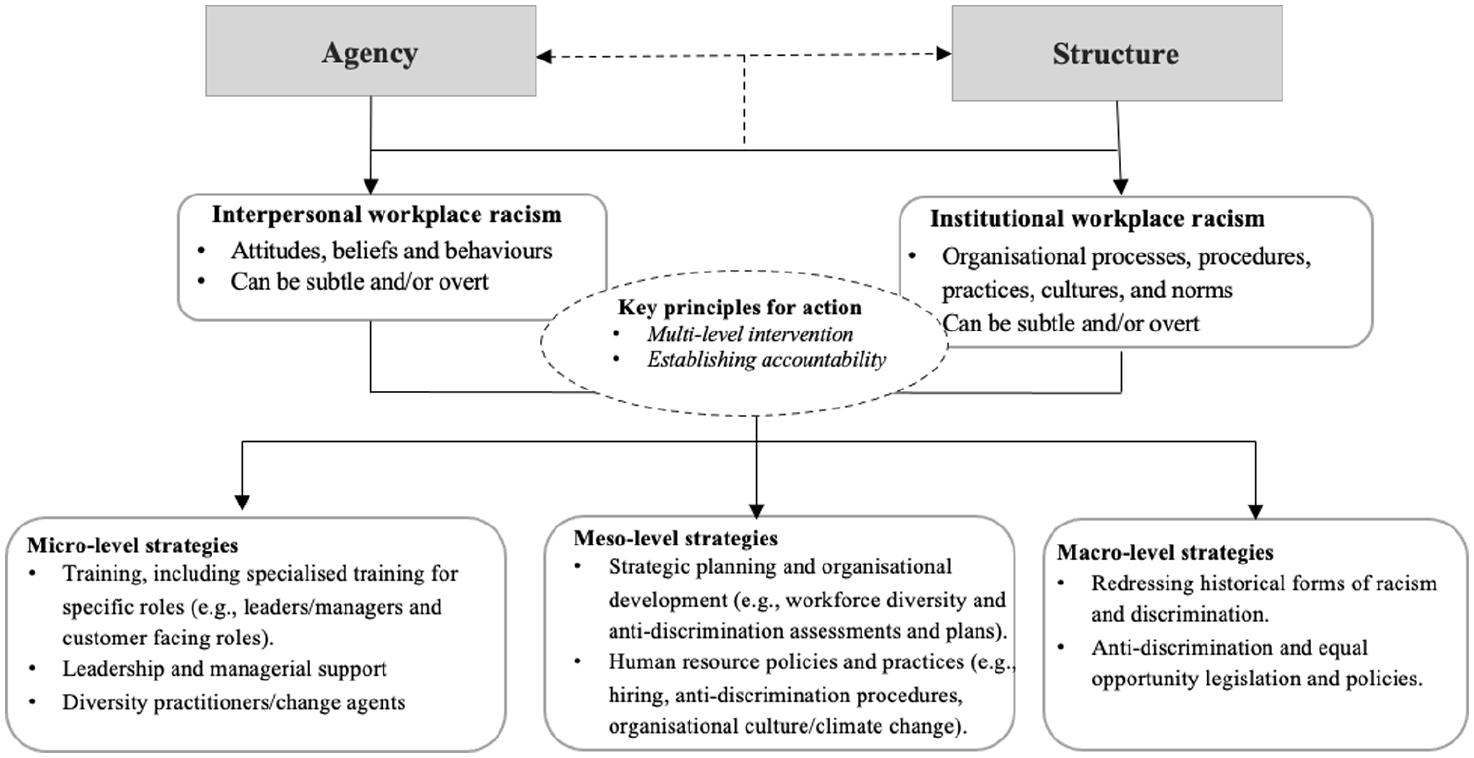
A multi-level framework for supporting diversity and anti-racism in the workplace.
4. Methods
4.1. Study background: supporting workforce diversity and anti-racism in Australia
This study is set in the macro-context of Australia, which has a settler-colonial history, including the dispossession of Indigenous/First Nations’ land and peoples and successive discriminatory policies of forced assimilation, alongside restrictions placed on immigrants from predominately non-White and/or non-English-speaking backgrounds (Ferdinand et al., 2012; Langton, 2000). These origins can be linked to present-day inequalities and discrimination across a range of settings, including education, employment, the criminal justice system and healthcare, among others (Biddle et al., 2013; Cunneen, 2001; Paradies, 2006). Moreover, despite nearly half (48%) of Australia’s population being born overseas or having at least one overseas-born parent (Australian Bureau of Statistics, 2021a), this diversity is not adequately represented in the workforce, especially in more senior roles (Soutphommasane, 2017).
Australia has several measures to challenge racial discrimination at the national, state and local levels. This includes ratifying the International Convention on the Elimination of Racial Discrimination and enacting the Racial Discrimination Act 1995. Each Australian state and territory also have anti-discrimination laws allowing individuals to report discrimination, harassment and bullying. Under the Equal Opportunity Act 2010, companies, schools and goods and service providers in Victoria have a positive duty to eliminate discrimination, sexual harassment and victimisation, including local government organisations (local councils). The Local Government Act 2020 also requires local councils to develop merit-based, transparent recruitment and advertising practices.
In addition to legislative measures, the Australian Government recently established a National Anti-Racism Strategy to promote public awareness of racism and develop educational resources to identify and prevent racism in key settings where it occurs. Other initiatives include structured partnerships and plans to address long-standing structural inequalities and racism, including in the workplace (e.g. Lowitja Institute, 2022; Polity Research, 2020). Despite these initiatives, however, there is widespread evidence that current measures are inadequate in dealing with issues of workplace racism, including complaints of workplace discrimination (Behrendt and Coombes, 2021; Gaze, 2005; Paradies, 2005).
4.2. Local governments as implementation partners in a wider public health programme
This study was situated within a wider 4-year public health programme and evaluation aimed at supporting diversity and reducing racial discrimination across different settings (e.g. workplaces, retail, education and the broader community) within two local government municipalities in Victoria, Australia. The two local councils were selected as implementation partners in the broader programme due to having an existing track record in supporting community-level diversity (e.g. local implementation of multicultural and settlement policies) (Mansouri et al., 2007). The programme trailed multiple strategies (e.g. anti-racism training, workplace assessments, social media campaigns) and was rigorously evaluated to build evidence of effectiveness in supporting diversity and countering racism at different levels of society, including the workplace. This study is focused on a workplace assessment implemented with the council organisations, to examine policies, practices and procedures to support workplace diversity and anti-racism.
4.3. The local council workplace sites
Participating organisations included City Council (a pseudonym) which is located in the northern outskirts of metropolitan Melbourne, with a population of 231,799 residents, of which 1% identify as Aboriginal and/or Torres Strait Islander, while around 37.6% of residents are born overseas (Australian Bureau of Statistics, 2021b). Regional Council (a pseudonym) resides in a regional area of Victoria, with a population of 68,522 residents. Aboriginal and/or Torres Strait Islander people make up around 3.9% of the total population. The large majority (82.6%) of residents are born in Australia, while 17.4% of residents are born overseas (Australian Bureau of Statistics, 2021b).
4.4. Development and implementation of a workplace diversity and anti-racism assessment tool
This study focused on the implementation of a Workplace Diversity and Anti-Discrimination Tool (the Workplace Assessment Tool hereon in), developed after a global literature review (see Trenerry and Paradies, 2012). The review found few publicly available tools within the diversity management literature, particularly those with an explicit focus on addressing racism, although some have since become available (e.g. Bourke et al., 2019; Marrie and Marrie, 2014). Cultural competency literature provided greater insights for assessing processes and practices across multiple organisational domains (Cross et al., 1989; Siegel et al., 2004), although many tools reviewed still focused on the individual-level, rather than organisational-level, processes and practices (Gozu et al., 2007; Olavarria et al., 2009).
Based on these gaps, the authors developed a tool integrating management and cultural competency and focused on the organisational level (Bowen, 2008; Cox, 1993; Olavarria et al., 2009). The tool was piloted with council employees and contextualised to the Australian context (see Merri Community Health Services et al., 2014; Mungabareena Aboriginal Corporation and Women’s Health Goulburn North East, 2008).
As shown in Table 1, the tool was structured to assess five domains of organisational planning, policy and practice (see VicHealth (2015) for a final version of the tool). During implementation, an assessment committee was formed with representatives from human resources, communications, policy and planning, administration and finance, as well as individuals whose job roles supported diverse communities or roles directly related to workforce diversity and inclusion (i.e. diversity practitioners).
Workplace diversity and anti-discrimination assessment tool. a
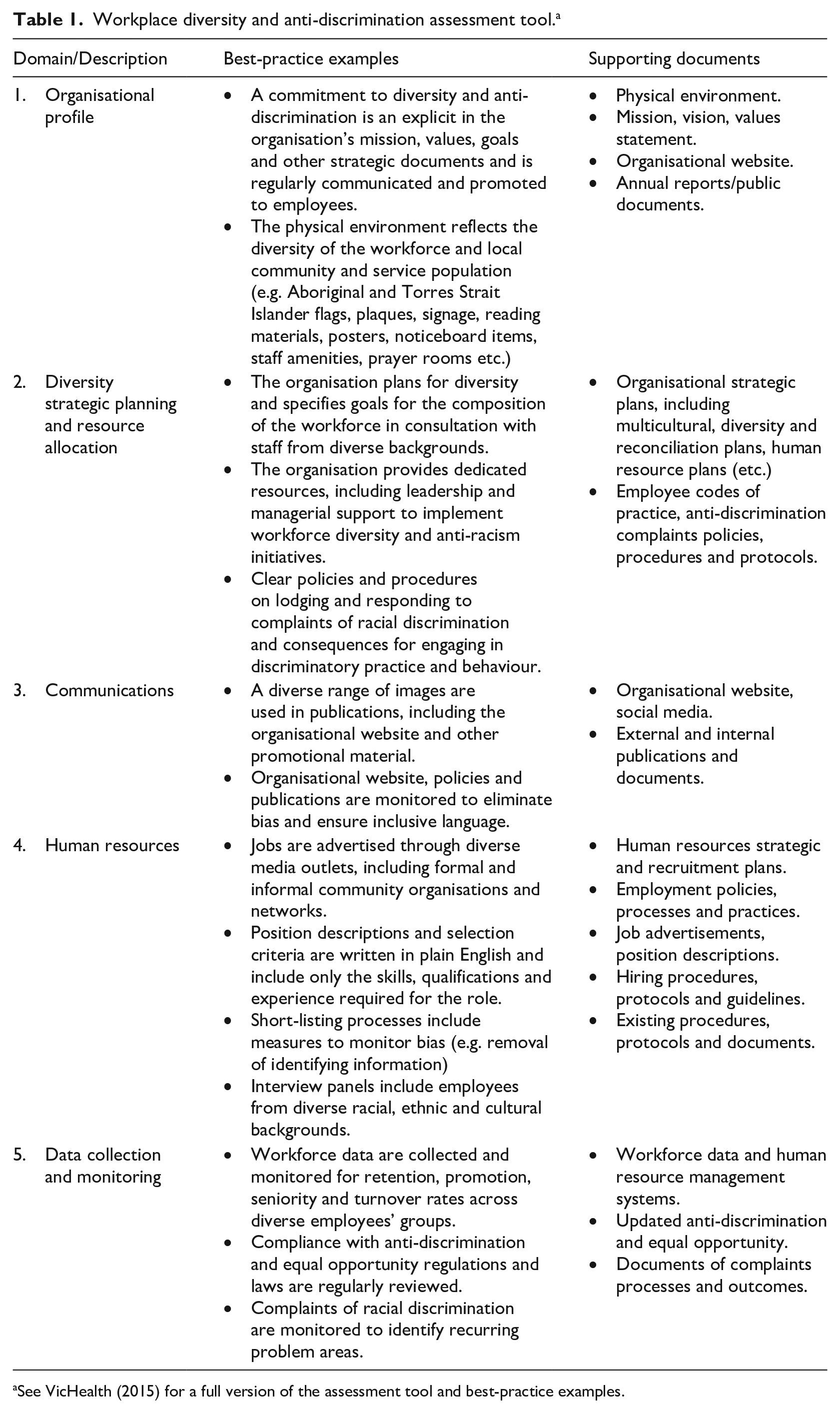
See VicHealth (2015) for a full version of the assessment tool and best-practice examples.
4.5. Participant observation and key informant interviews
This study examined the implementation of the Workplace Assessment Tool within the two local council workplaces above. Key methods included participant observation of meetings and workplace dynamics with 25 council employees across the two council sites and 16 follow-up interviews. During fieldwork, the first author spent 1 day each week in each council for 12–18 months and conducted more than 500 hours of observation, with 100,000 fieldnotes written. During meetings, the researcher observed discussion and exchanges throughout the implementation process, including group dynamics, body language and subtle exchanges (e.g. speaking under one’s breath, the use of humour). Key informant interviews provided an opportunity to follow up on issues observed during the implementation process (Patton, 2002).
Interviews were audio-recorded, transcribed and shared with participants in a process of member checking (Lincoln and Guba, 1986). Data were analysed in two stages. First, field notes were analysed to inform interview questions. In the second stage, all data were analysed together using the NVivo qualitative data-coding tool, employing ‘inductive’ or open coding followed by ‘closed’ coding (Emerson et al., 1995). Observational and interview data were triangulated with organisational documents (see Table 1 above for examples).
5. Findings
This section presents selected findings of observations of the workplace diversity and anti-discrimination assessment and follow-up interviews with council employees at the two local council workplaces. Findings are structured according to three domains of practice in the assessment tool. First, we examine Councils’ organisational profile, with a focus on commitments to diversity and anti-racism in mission statements, values and goals. Specifically, we consider how organisational commitments translated into practice, including the role of leaders and diversity practitioners in the implementation process. We also examine the importance of the physical environment and the role of managers in countering resistance. Second, we explore strategic plans and policies to increase workforce diversity. Finally, we analyse human resource policies and practices, with a focus on selection and hiring. Across all domains, we examine the role of structure (i.e. organisational documents, policies and practices) versus agency (i.e. managerial attitudes and behaviours) when implementing workforce diversity and anti-racism organisational assessment and strategic change.
5.1. Organisational profile
5.1.1. Commitments to diversity in mission statements, values and goals
At both councils, the assessment committee discussed how commitments to diversity and anti-racism were reflected in organisational documents, such as Council’s mission and value statements as well as publicly available documents and plans, including the website. At City Council, valuing diversity was strongly reflected in council values, where ‘valuing diversity’ was one of six key values expected of staff. As Sonia and Kon said during a meeting, Valuing cultural diversity is strongly reflected in our values . . . The statement also mentions workforce diversity ‘in strengthening and enriching the organisation’. (Sonia, Diversity Practitioner, City Council) The values do help to promote discussion about diversity. For my department, we use a simplified version of the performance review process. Managers break it down and provide some concrete examples of what kinds of behaviour are acceptable and not acceptable in the workplace. (Kon, Senior Manager, City Council)
As Sonia explained, valuing cultural diversity also included a reference to workforce diversity, where diversity was positioned as a resource that strengthened and enriched the organisation (Ely and Thomas, 2001). The inclusion of council values also helped to promote discussion about diversity, such as in the performance review process. For Kon’s team, this included concrete examples of what kinds of behaviour were acceptable and not acceptable in the workplace. Importantly, embedding council diversity values into the performance review process helped to translate commitments into action (Ahmed, 2006). Nonetheless, it was less clear whether all managers took an active role in discussing diversity and reinforcing council values as part of the performance review process.
At Regional Council, references to diversity were included in the organisation’s vision statement and other publicly available documents such as council plans and annual reports. As Andrea said, [Council publications] are quite good. It has some really good images on the front of people from multicultural backgrounds as well as a statement about recognising diversity. Although this relates more to the community than the workplace. (Andrea, Senior Manager, Regional Council).
In contrast to City Council, there was less reference to valuing workforce diversity in strategic documents at Regional Council. Assessment committee members also mentioned constraints on integrating commitments to workforce diversity and anti-racism into council values where changing council values was seen as a long-term process, which raised ‘bigger questions’ for the organisation.
In translating statements of commitment to diversity and anti-racism into practice, assessment committee members acknowledged the importance of top-level support from the chief executive officer (CEO) and other senior leaders. As Liz and Andrea, both senior managers at City Council, said, I think one of the things from [the program] is that we’ve had [the CEO’s] support right from the beginning; he’s been our biggest champion. That means a lot. So in some ways, the organisation can’t question our commitment to it . . . It’s on the agenda and that makes it easier for us. . .it’s already now accepted that this is a setting that we’re working in. (Liz, Senior Manager, City Council) I think they’ve [senior management] been really good with it. Because we’ve had a CEO change it could really railroad it. Like if you’ve got the wrong CEO coming in afterwards, after a CEO who had been so embracing of this, that if you got someone in after that just went, ‘oh no, we don’t need to do that’? (Andrea, Senior Manager, 3 years at council)
According to Liz, the CEO’s personal commitment translated into organisational commitment (‘the organisation cannot question our engagement’). This commitment also led to the allocation of resources for ongoing diversity work and therefore helped to embed commitments into practice. Like Liz, Andrea found senior management to be supportive (‘they’ve been really good with it’). However, she suggested that a change in leadership could potentially ‘railroad’ these efforts, where a new CEO might not value or prioritise diversity goals. This speaks to the tenuous nature of diversity commitments, even when ‘institutionalised’ into organisational mission and value statements and documents.
In fact, despite council having plans and policies in place, the implementation of diversity initiatives often fell to diversity practitioners. As Brian explained, But the thing is it’s assumed that we know everything about all Aboriginal issues regardless if they’re health, social justice or whatever it’s like yeah, you can come to an Aboriginal officer and they’ll know . . . Because you can’t claim ignorance anymore . . . we’ve got reconciliation on the agenda and it’s about everyone being a part of that journey . . . (Brian, Diversity Practitioner, City Council)
Due to his role in working with the Aboriginal community, Brian said that staff commonly assumed that he could advise on ‘all Aboriginal issues’. This was even though City Council had stated commitments to supporting reconciliation (‘we’ve got reconciliation on the agenda’) alongside substantial expertise and resources (‘we’re a very clever organisation’). This meant that the organisation could no longer ‘claim ignorance’. Brian’s comments also reflect the educative burden that commonly falls on under-represented groups (Land, 2015).
Similarly, Sonia described the process of trying to engage with another department to support multicultural communities.
[Another external organisation] came to me to have a conversation around engaging the multicultural communities in playing tennis, but [another department] are the ones that run the tennis club . . . All they had to do was write a letter to say ‘yes we can participate, no we can’t’, and we left it with [the other department] to do that body of work, but in the end I don’t think anything happened. (Sonia, Diversity Practitioner, City Council)
Even though another department was responsible for managing the tennis clubs, it was assumed that it was Sonia’s role. Despite being a relatively simple task (‘all they had to do was write a letter’), the department failed to follow up. This reflects a common phenomenon in diversity work, where institutional responsibilities are often shifted onto employees with an obvious diversity role in the organisation (Ahmed, 2012). As a result, it is left to diversity practitioners to maintain momentum for diversity initiatives.
As champions and change agents, diversity practitioners also played a key role in advocating for diverse communities and challenging dominant cultural norms in the workplace. As Brian and Sonia both explained,
Brian: I suppose for me I’ve done front line work and worked at the coal face for a long time so I think I’ve served my community so I want to serve them in a different way . . . But yeah it’s a culture shock of moving away from that kind of work into working in a big organisation like this . . . Because I tell you, look I have to change the way I speak sometimes . . . (Diversity Practitioner, 3 years at council)
Sonia: Local government is still an organisation, it’s still a bureaucracy in itself, it’s still very much based on the system . . . But that’s part of what it means to work in an organisation, is that you are part of something . . . At the same time, my role is one that is a change agent . . . and so of course we’re going to have conflicts with the system, but I actually see that as my role, that’s what I’m here to do, to rock the boat. (Diversity Practitioner, 7 years at council)
Brian spoke about working in ‘front line’ community roles before joining local government, which he described as serving his community in ‘a different way’. Sonia also described tensions between working within a government bureaucracy while trying to create change. She recognised that part of working in an organisation included learning to fit into that structure, while also describing herself as a ‘change agent’, whose role is to ‘rock the boat’. She acknowledged that this might cause conflict, but believed it was necessary to disrupt the status quo and challenge ‘what’s seen as normal’. Together, due to their proximity to diverse communities and commitments to create institutional change, Brian and Sonia ‘held’ organisational commitments to diversity and anti-racism in place.
5.1.2. Supporting diversity and anti-racism in the physical environment
In Australian local government, support for diversity is commonly made visible through signage, flags and ceremonies that acknowledge Aboriginal and Torres Strait Islander people as First Peoples and traditional landowners. At City Council, the assessment committee discussed the importance of flying the Aboriginal and Torres Strait Islander flags at the council buildings. As Brian and Kon said, Flying both flags is seen as a positive step from council to the community. (Brian, Diversity Practitioner, City Council) Only the Australian flag is flown at the council depot as there are no other flag poles, although it would be easy enough to get another pole. (Kon, Senior Manager, City Council)
As Brian pointed out, flying the flags was seen as a positive step from City Council in providing a sense of welcome to both the local community and council employees, a point he reiterated in a later interview: It is wonderful to see that we have both flags out the front, you know. Well, what I explain to the community is [that] council supports and works with Aboriginal and Torres Strait Islander people. So that’s their way of showing that. So, the environment, the workplace environment’s right. (Brian, Diversity Practitioner, City Council)
During the meeting, Kon acknowledged that at the council depot, where outdoor operations are managed, including storage of City Council’s garbage trucks and other vehicles, only the Australian flag was flown. At a follow-up interview, Kon indicated that he had already set aside funding to instal another flagpole at the depot site: I mean, just because I was on [the assessment committee] when we put our budgets together, I got the money for an extra flagpole . . . So doing that sort of stuff you know, flying the Koori flag, it will be a change, people will come in here and say ‘this is political correctness gone mad’ . . . But I mean as a manager staying true to the cause, you know being firm in and resolute in a view when these actions occur, helps bed that down through the masses so they’ll say, ‘ok no this is serious stuff, he hasn’t blinked an eye lid’. (Kon, Senior Manager, City Council)
Following his involvement in the workplace assessment, Kon recognised the importance of the physical environment in supporting workforce diversity. However, Kon also anticipated that installing an Aboriginal flag would be met with resistance (‘this is political correctness gone mad’). However, he conceded that managers could address such tensions through clear leadership and communication and linked this to action, through embodiment such as mannerisms and body language (‘they’ll say: ok no this is serious stuff, he hasn’t blinked an eyelid’). As discussed further below, Kon’s leadership style worked to counter resistance and bridge gaps between articulated commitments to diversity and practice.
5.2. Strategic plans and policies to increase workforce diversity
The assessment committees at both councils discussed specific plans for workforce diversity, including goals to increase diversity in the workplace and dedicated roles and resources to support workforce diversity. As Victoria said during a meeting at City Council, Council has a multicultural plan . . . but no, we don’t have a specific diversity plan for the internal workforce. (Victoria, Diversity Practitioner, City Council) This role would be very much about the workforce, more core and integrated into HR . . . is this something we would recommend for future action? (Josh, Diversity Practitioner, City Council) [Motioning to HR], I’m sensing your silence means that you approve! (David, Senior Manager, City Council)
Victoria explained that City Council had a multicultural plan and several community-facing job roles, but no internal diversity plan or position. Josh said the role must be a core HR function. David, a senior manager, interjected, using humour to encourage consensus. Following the assessment process, City Council committed to hiring an HR practitioner focusing on internal workforce diversity recruitment, acknowledging the importance of allocating resources to support diversity work.
Highlighting important contextual differences between the council sites, at Regional Council, the assessment committee acknowledged that the largely Anglo-Australian demographic of council was not currently representative of the diversity in the community. However, this was something that Regional Council desired to change. As Craig said, I’ve been in the ear of [the CEO] . . . to get the diversity of the workforce at a level of one per cent [compared to community demographics] . . . (Craig, Senior Manager, Regional Council)
In a later interview, Craig restated his desire to develop a workforce diversity plan: [Policies would] definitely need the structural support all the way from the top, from the councillors. That’s the only way the union will agree with me. The union said, if you put in a council policy that says you can [positively] discriminate against one per cent, he said then I’ll back off . . . And I just haven’t got time, it’s not my area to be out there fighting policies like that. That’s where it’s up to [the program coordinator]. (Craig, Senior Manager, Regional Council)
Craig demonstrated his commitment to establishing a policy which would allow Regional Council to positively discriminate in favour of diverse candidates and had taken initial steps in engaging with the CEO and union representatives. He claimed the union representative would be more supportive if policy was supported ‘from the top’. Despite his enthusiasm and seniority, Craig implied that developing the policy was not part of his role and that the programme coordinator was better placed to progress the work.
Similarly, other senior leaders at Regional Shire admitted that the predominately Anglo-Australian council workforce was not representative of community demographics. For example, Paul said, I think it’s a realisation that local government, for its survival, needs to become more reflective of its community . . . I’m not advocating quotas, but what I do think is that we need to be far more inclusive of that, because that will then enable us to then hopefully provide services in a much more reflective way . . . (Paul, Senior HR Manager, Regional Council)
Paul suggested that local councils should reflect the community’s diversity, even linking this to their ‘survival’. However, Paul indicated that he was not ‘advocating quotas’, followed by an aspiration that ‘being inclusive’ would ‘hopefully’ lead to enhanced service delivery. Ahmed (2012) has critiqued the role of ‘hope’ in diversity practice, where commitments to diversity ‘as a speech act might be understood as generating its own promise’ (p. 67). Paul’s statement was ‘non-performative’, where statements of his support did not lead to action (Ahmed, 2012).
5.3. Human resources
5.3.1. Selection and hiring processes and practices
Recruitment involves the process of attracting, selecting and hiring and is a key point of entry into the labour market. In this study, applicants from under-represented racial/ethnic groups faced barriers in the hiring processes at both interpersonal and structural levels. For example, at City Council, committee members discussed the job application process: We have already started the process of moving job applications online . . . This is the preferred way, although there is an alternative application process for some council roles. (Andrew, Senior HR Manager, City Council) The online application system is not working well for diverse communities. (Victoria, Diversity Practitioner, City Council). I understand the barriers, but we have already invested in streamlining the application process. We have limited resources to deal with the overwhelming number of applications. (Frank, Manager, City Council).
Due to resource constraints and a higher volume of applications, City Council had already switched to an online application system. Victoria said that the online application systems created barriers for job seekers from under-represented groups, who lacked experience navigating complex application processes. However, alternative recruitment processes were also used for selected council roles, like school crossing supervisors, such as information nights and on-the-spot application processes. Due to the community-facing nature of such roles, applications from people who spoke a language other than English were often well regarded.
At a subsequent meeting at City Council, Frank elaborated on how the online application might inadvertently impact under-represented groups: The process for shortlisting applications . . . it could be improved. Recently we advertised for a permanent part-time customer service role, which is particularly popular for women. But due to the high volume of applications, those that were not well presented, such as not adequately addressing the selection criteria would have been eliminated during the short-listing process. (Frank, HR Manager, City Council)
Frank recognised the role of bias in the selection process, where due to ‘the high volume of applications’ for a permanent part-time role that was particularly popular among female candidates with caregiving responsibilities, poorly presented applications, including those that did not sufficiently address selection criteria, were excluded. This seemed to confirm fears that even small errors or inconsistencies in applications would be rejected in the short-listing process. During follow-up interviews, council employees said that bias also occurred in interviews. For example, Victoria said, I think it happens, it definitely happens, yeah, it happened. I was part of a process where it did happen, whether it was because of racism I don’t know, I can’t actually say that, but there was a situation whereby . . . we didn’t have that many [applicants] shortlisted but I was on the interview panel . . . in the end there were three of us saying ‘this person’ and one of us, who was the boss, saying ‘no I don’t want that person, I want this person, and in the end [the other applicant] was employed. (Victoria, Diversity Practitioner, City Council)
Victoria explained that despite having a diverse interview panel, with a majority favouring a particular candidate, decisions could be overridden by a senior manager. Sonia also spoke about her own experience as a woman, and felt that she had been treated unfairly when applying for a more senior role after returning to work after having a baby: Like I really have this thing about gender, in that I think [this council] has an issue with gender more than they have an issue with cultural diversity and racism, although they could probably both exist on the same plane. It’s kind of old-fashioned or something. (Sonia, Diversity Practitioner, City Council)
Sonia felt that gender discrimination was more of an issue in council, saying that many of the organisational structures were ‘run by males’, thus highlighting the intersection of multiple forms of discrimination (Crenshaw, 1991), which included a tendency for ‘old-fashioned’ values and hierarchical power structures (Kalev, 2009; Metz and Kulik, 2008).
At Regional Council, the assessment committee also discussed barriers to recruitment. Despite legislative requirements in relation to equal opportunity in employment, managers discussed that recruitment practices had become ingrained within bureaucratic processes. As Paul and Simone said, Recruitment has to be on the basis of transparency, merit . . . We are still very much mono-culture, mono-stuck, it’s ingrained, recruitment for example in responding to [key selection criteria] . . . now that’s a gatekeeping thing really, that’s not about securing and recruiting the very best person for the role. That’s about can you comply, and you know, conform to our requirements . . . (Paul, Senior HR Manager, Regional Council) If someone leaves [a team leader or manager] will say we need another person just like that. Well, do we? Do we really need the exact same demographic, age, gender, nationality? . . . There might be a way to look at the key selection criteria, that there might be some minimum requirements . . . we need to think outside of the box. (Simone, HR Manager, City Council).
Paul began by stating legislative requirements for merit and transparency in hiring but suggested that such practices had become ingrained and relatively unquestioned. It was clear from Paul’s choice of words (i.e. ‘mono-culture’ and ‘mono-stuck’) that there was a tendency towards homogeneity in hiring practices. In addition, Paul said that hiring practices had taken on a ‘gatekeeping’ role, where passing the initial ‘first test’ (i.e. the interview stage) was critical to long-term success within the public sector. Similarly, Simone discussed the tendency for managers to hire people from similar backgrounds to those already employed within Council. As Craig, a senior manager at Regional Council, said, I’ve been pushing very, very hard to be able to be allowed to use Congolese, Afghans, whoever that come here to put them on as full-time employees. Our systems don’t allow that to be done very easily . . . I’ve got a guy who’ll be sitting at this table next Monday for an interview . . . Like he should get the job, but he won’t . . . Because his interview technique will be terrible, because of his English and so forth . . . But he’s a magnificent worker. (Craig, Senior Manager, Reginal Council)
Craig spoke about difficulties in moving casual employees from non-English-speaking backgrounds to secure permanent and/or full-time employment within the council. This included evidence that some hardworking employees (e.g. outdoor workers) were unlikely to gain permanent employment due to a lack of English proficiency, despite such proficiency not being a requirement for the role. As Craig pointed out, high levels of English proficiency were often expected even when such skills were not required for the role. Similarly, Manika, a highly skilled diversity practitioner at Regional Council, who had recently immigrated to Australia, explained in an interview, [The application process] puts off people applying because it’s so cumbersome looking . . . The terminology used [in responding to key selection criteria] is so, I think they must keep it by the job. But I don’t think there has ever been a review of these things, it’s just dished out from the past centuries I think and it’s still going on . . . I’m not doing one per cent of what [the job description] wanted me to [do] . . . (Manika, Diversity Practitioner, Regional Council)
Manika described the job application process, including responding to lengthy selection criteria, as unnecessarily complex and a key barrier for applicants from racially/ethnically diverse backgrounds, who were less familiar with navigating such processes. Rather, job selection processes were outdated and often did not match the requirements for the role.
Similarly, at City Council, the assessment committee discussed other practices such as removing demographic information (such as names, age and gender) from job applications prior to the short-listing process (i.e. blind recruitment). However, despite a push to trial blind recruitment, this was met with resistance, as demonstrated by the following conversation at City Council: But surely ‘discrimination based on surnames’ does not happens at [this council]. (David, Senior Manager, City Council) Could we at least trial it, give the goal of this process is to trial innovate approaches? (Josh, Diversity Practitioner, City Council)
Despite evidence that racism exists in recruitment practices (Booth et al., 2009), some assessment committee members questioned the need to remove identifying material from job applications. Rather, there was a perception that discrimination on the basis of race/ethnicity did not happen within the council. More subtly, following the meeting, HR had written emphatically ‘no, not possible’ against the proposed action item of trailing blind recruitment on the draft action plan. Rather, the assessment committed opted to focus on addressing implicit bias within hiring processes.
6. Discussion
This article was structured in two parts. First, we established a multi-level framework for understanding and addressing racism in the workplace, tying together theoretical insights from multiple disciplines, including sociology, psychology and organisation/management studies. This includes analysis of how workplace racism manifests at both the interpersonal and institutional level, where attitudes, beliefs and behaviours at the interpersonal level influence organisational structures, policies, practices and cultures (Brief et al., 2005; Essed, 1991). Key strategies to support diversity and address racism were also reviewed. Drawing on Syed and Ozbilgin’s (2009) relational framework, three levels of practice were proposed: micro-level strategies targeted at the interpersonal/group level; meso-level strategies aiming to assess and alter organisational structures, policies, practises and cultures; and overarching macro-structural factors that influence micro/macro practices and processes. Key principles for enabling system-level change and establishing accountability were also emphasised (Griffith et al., 2007a; Paradies et al., 2009).
6.1. Summary of empirical findings and implications
The empirical focus of this article presented selected findings based on observations of a meso-level workplace diversity and anti-racism assessment implemented within two local government organisations in Australia. Findings were presented thematically with a focus on three domains of policy and practice as summarised below.
First, this included assessment of commitments to diversity in organisational documents, such as mission statements, values and plans and in the physical environment. Findings revealed contextual differences between the two council workplaces. City Council’s mission and values explicitly valued workforce diversity, while Regional Council only focused on community diversity. City Council had made some steps towards embedding diversity values into the performance review process, which helped to establish accountability. Organisational leaders who championed diversity and anti-discrimination also helped to establish accountability by allocating resources and leading change. However, there was recognition that such support was contingent on the appointment of leaders who were personally committed to diversity issues.
As Ahmed et al. (2006) propose, this is one of the ‘loops’ and difficulties in diversity work where ‘achieving commitment depends on commitment’. Even when ‘institutionalised’ into organisational documents, it usually takes more ‘commitment’ by individuals to turn commitments into action (Ahmed et al., 2006). Such circularity highlights the tenuous nature of diversity commitments and the interplay between structure and agency. Indeed, despite having institutional statements and plans in place, the ‘doing’ of diversity work was often left to employees with an obvious diversity role, where diversity practitioners spoke about challenges in gaining broader organisational support for diversity work.
Support for diversity was also made visible in the physical environment (e.g. flags acknowledging Aboriginal and Torres Strait Islander peoples), where involvement in the assessment process led managers to allocate additional resources for installing flagpoles at other council sites. While managers acknowledged that such measures could be met with resistance, the presence of strong leadership helped to counter resistance and bridge gaps between articulated commitments and practice.
Strategic plans and policies, including goals to increase workforce diversity and allocating dedicated roles and resources to support diversity work, were assessed in the second domain. This process, combined with other workforce planning initiatives, led to City Council committing to hire a HR practitioner with an explicit focusing on diversity recruitment. Commitment from other senior leaders, such as the CEO, translated into the allocation of resources for ongoing diversity work, thereby helping to embed commitments into institutional practice. At Regional Council, it was openly acknowledged that the workforce was not representative of the diversity in the community. Although some managers expressed sincere commitments to establish plans to increase the diversity of the workforce, including positive discrimination, there was a lack of ownership over who would drive and implement these initiatives. In this way, commitments to workforce diversity were ‘non-performative’ in that they did not lead to action (Ahmed, 2012).
Finally, the assessment involved a review of human resource policies and practices, with a key focus on recruitment. Several barriers to hiring were identified. In particular, standardised recruitment practices, such as shifting to online application systems and requiring applicants to respond to lengthy selection criteria, disadvantaged applicants from under-represented groups, who lacked experience navigating complex application processes. Despite requirements for merit-based recruitment, selection procedures appeared to function as a form of organisational gatekeeping, with applicants expected to fit into predefined cultural norms. Other forms of bias in recruitment practices included a preference for homogeneity, such as hiring individuals with a similar profile and background. Even when interview panels were diverse, senior managers could override consensus decisions.
While alternative recruitment processes were adopted for selected council roles (e.g. school crossing supervisors), these were focused narrowly on community-facing roles, limiting opportunities for upwards mobility (Avery and McKay, 2006; Kalev, 2009). Women also faced barriers in promotion, due to outdated values and hierarchical power structures, indicating the intersection of multiple forms of discrimination in the workplace (Crenshaw, 1991; Metz and Kulik, 2008). Furthermore, even though some roles (such as those for outdoor workers) did not require a high level of English proficiency, such workers were unlikely to obtain permanent positions despite holding casual jobs at Council. In addition, despite other studies indicating bias and discrimination in recruitment (e.g. Booth et al., 2009), there was denial that such practices occurred within the council organisations. Rather, suggestions to trial blind recruitment were met with resistance. There was a preference for ‘softer’ strategies targeted at removing individual biases (e.g. managerial training) over testing ‘harder’ interventions focused at the institutional level.
Based on these findings, there are several implications for policy and practice. While managerial bias plays a role in hiring practices and is often remedied by training, other strategies targeted at the structural level are needed. Strategies can include changes to hiring practices, such as alternative recruitment methods and greater flexibility in hiring to meet diversity targets. Organisations could also do away with the need for candidates to respond to lengthy selection criteria, given that such practices commonly disadvantage under-represented groups. Given the persistence of workforce inequities, there is a strong case for establishing special measures such as positive discrimination. In contrast to popular assumptions, such measures do not undermine principles of merit-based recruitment, but if part of strategic planning processes demonstrate that organisations are serious about their commitments.
Organisational commitments, as expressed in mission statements, values, plans and the physical environment at the most visible level of organisational culture (Schein, 2004) provide an important starting point for diversity and anti-racism work. However, even when ‘institutionalised’ into organisational documents and even physical structures, such commitments will fail in the absence of sustained action by institutional agents. This highlights the importance of establishing accountability in racial equality work. We need to ‘follow’ organisational commitments to diversity and anti-racism ‘around’ to ensure that such commitments ‘do’ what they say (Ahmed, 2006: 105).
Due to power and status differentials that exist within organisations, leaders and managers play a crucial role in establishing buy-in for diversity and anti-racism work and countering resistance (DiTomaso et al., 2007). This is particularly important in addressing racism where power imbalances have a privileging/anti-privileging effect for members of dominant/subordinate groups and passive tolerance of racism is also an exercise of power (Essed, 1991; Paradies, 2006). Targeted training can be developed for leaders and managers to highlight structural barriers and the necessity of changing policies and practices (Kelaher et al., 2018). Moreover, as shown in this article, it is commonly bottom-up actors, such as diversity practitioners and other change agents, who maintain momentum for diversity work and hold organisations to account for stated commitments. Such actors can also be in leadership and management roles and are bottom-up in the sense that they are proximate to diverse communities and willing to disrupt dominant cultural norms (Ahmed et al., 2006). Hiring leaders and managers who are similarly committed to diversity and anti-racism goals is therefore essential in establishing multiple levels of accountability and building coalitions for change.
6.2. Study contributions, limitations and priorities for further research
This study makes several contributions to existing theory, research, policy and practice. We have sought to integrate and consolidate key literature across multiple disciplines and provide a fresh theoretical framework for understanding the nature of racism in the workplace. This includes the importance of implementing strategies across multiple organisational levels and the role of structure versus agency in workforce diversity and anti-racism intervention. We have also studied the implementation of a meso-level workplace diversity and anti-discrimination assessment as a tool through which to scrutinise organisational structures, policies and practices and processes. The intersecting role of structure (e.g. organisational values and mission statements, the physical environment, strategic plans, human resource policies and practices, etc.) versus human agency (i.e. establishing accountability and addressing attitudes, behaviours and norms) in supporting workforce diversity/anti-racism is less well studied and is thus a key theoretical contribution of this research (Ahmed, 2012; Berard, 2008; Essed, 1991).
This study also contributes to both empirical understanding of workforce diversity and anti-racism intervention. We have addressed a gap in studying implementation processes in real-life workplace settings (Cox and Nkomo, 1990). In addition, the use of multiple methods – including participant observations, interviews and assessment of organisational documents – helped to uncover deeper understanding of workplace dynamics and interactions. While organisations might be reluctant to allow researchers access to study these processes, doing so is crucial for understanding systemic issues like racism and where workforce diversity initiatives get stuck.
This study is limited to the Australian context, which has a specific macro-historical context for understanding and supporting workforce diversity/anti-racism, including in work-related settings. The findings of this research, including differences between the case study sites, underscore the importance of context and adopting workplace diversity and anti-racism strategies that are responsive to local and contextual factors. Nonetheless, the study has global relevance due to the paucity of empirical research on workplace racism and anti-racism, where relevant findings can be studied and generalised across countries and contexts.
Finally, this study examined the process of change rather than long-term outcomes. Longitudinal studies can measure changes in attitudes, behaviours, policies, practices and cultures over time and contribute to theory building. Other priorities for future research include understanding how racism manifests in different institutional settings and which strategies are more effective, given these varied contexts. This includes developing further knowledge of the intersection between structure and agency workforce diversity/anti-racism interventions, including the conditions and organisational contexts in which anti-racism interventions are more likely to succeed or fail.
7. Conclusion
Many countries and organisations around the world are dealing with a variety of workforce challenges, such as rapidly ageing populations and workforce shortages across a range of industries. More than ever, countries are reliant on migration to boost labour supply and increase productivity. Similarly, if companies are to remain competitive, attracting and retaining workers from a diversity of backgrounds and skill sets is essential. Despite increasing acknowledgement of the business case for diversity, many corporate diversity efforts have not led to significant changes in representation (Dobbin and Kalev, 2016).
Challenges in implementation can be due to multiple factors, including reliance on less effective strategies such as anti-bias training, and a lack of courage to acknowledge and challenge more confronting and deep-seated issues such as racism (Livingston, 2020). In particular, there is a need to hold institutions and decision makers to account for stated commitments to workforce diversity and anti-racism through implementing strategies at multiple organisational levels and establishing buy-in from a range of organisational actors. Nonetheless, despite its structural and universal drives, racism can be disrupted through the presence of diversity in the workplace and anti-racism intervention to challenge unacceptable attitudes and behaviours and exclusive institutional structures, cultures and norms.
Footnotes
Acknowledgements
The data collection and initial write-up for this article were completed while the first author was a PhD candidate at Western Sydney University, Australia. The authors would also like to thank the reviewers for their helpful comments in improving this article.
Final transcript accepted 18 April 2023 by Mariano Heyden (AE Special Issue).
Author contributions
B.T. conceptualised this article and undertook data collection, analysis and presentation of findings. K.D. and Y.P. helped to develop the results and edit the article. All authors contributed to and approved the final article.
Funding
The author(s) disclosed receipt of the following financial support for the research, authorship and/or publication of this article: B.T. was supported by an Australian Postgraduate Award in developing this study.
