



Abstract
An anonymous poem and a cartoon about etherisation were published in Bell’s Life in Sydney on 26 June 1847, less than 3 weeks after ether was first administered in Sydney, New South Wales. Almost a year later, an Adelaide newspaper, The South Australian Register, reproduced a poem about chloroform from the British satirical magazine Punch. This poem, ‘The Blessings of Chloroform’, has been attributed to Percival Leigh, a British medical practitioner who became a comic writer.
’T is thus that modern ‘sciences’ are made, By bold assumption, puffing and parade. Take three stale ‘truths’; a dozen ‘facts’, assumed; Two known ‘effects’, and fifty more, presumed; ‘Affinities’ a score, to sense unknown, And, just as ‘lucus, non lucendo’ shown, Add but a name of pompous Anglo-Greek, And only not impossible to speak, The work is done; a ‘science’ stands confest, And countless welcomes greet the queenly guest. Progress: A Satirical Poem (1846), by John Godfrey Saxe (1816–1887)
That Friday morning, William T.G. Morton (1819–1868), a 27-year-old Boston dentist and part-time medical student at the Massachusetts Medical College (now Harvard Medical School), would astound his instructors, fellow students and other spectators by administering an anodyne vapour to a surgical patient to enable the eminent surgeon John Collins Warren MD (1778–1856), to perform a painless operation. 4 This was not the first time a surgical operation had been performed under etherisation, but this public demonstration of insensibility in the surgical amphitheatre of the Massachusetts General Hospital, Boston, MA, USA, would become the catalyst for similar trials in Europe and eventually in other regions of the world. Today, 16 October is commemorated as Ether Day, a convenient foundation of the modern practice of anaesthesia – on this day, a new medical discipline and a new ‘science’ were created. Morton would have been too busy that morning to glance at the newspapers, nor could he have predicted, notwithstanding his apparent success in a minor operation at the hospital, how this new ‘science’ would develop.
From Boston, the news of etherisation was carried in Royal Mail ships (also known as packets or packet ships) across the Atlantic every 2 weeks, except during winter – the coal-powered steamers of the British and North American Royal Mail Steam Packet Company (founded in 1840; now known as the Cunard Line) usually crossing the Atlantic in about 2 weeks. In December 1846, surgical and dental operations were performed under etherisation in London, UK, and were reported in the medical and popular press in December 1846 and January 1847. 5 These accounts were carried by ships to the Australian colonies, then a 4-month voyage from the United Kingdom. Thus, it was only in early May 1847 that we find the first reports in Australian newspapers of operations under etherisation.6,7 These initial case reports were extracted from British newspapers; the earliest known surgical and dental operations under ether in Australia were performed on 7 June 1847. 8
This article draws attention to two poems that were published in Australian newspapers during the first year of anaesthesia in the Australian colonies. The first poem, which was about ether, was published in June 1847, along with a cartoon. The second poem, on the subject of chloroform, was published in April 1848.
The early poems about anaesthesia make use of wit and sardonic humour. Today, there is increasing recognition of the benefits of poetry and other forms of self-expression for patients and medical professionals. Poetry may engender empathy, facilitate introspection, bring clarity, provide solace, reduce anxiety and enhance resilience. The benefits of the arts for health and wellbeing were reviewed by Fancourt and Finn in a 2019 World Health Organization report. 9
Ether anaesthesia, June 1847
Operations under ether were performed in Sydney, NSW, and in Launceston, Van Diemen’s Land (Tasmania), in early June 1847. 8 By the end of the month, one Sydney newspaper, Bell’s Life in Sydney and Sporting Reviewer, 26 June 1847, carried two pieces of poetry and a cartoon on etherisation.10,11
Eight lines of untitled anonymous doggerel appeared on page 2 of Bell’s Life in Sydney:
10
At last M.D.s have found a way To ease all men of ailing; A tooth extracted is child’s play While ether they’re inhaling: But Grand-ma in her bosom deep The secret long did lock it; She sent each reader fast to sleep, Then coolly picked his pocket.
It is not clear whether this verse was written by a resident of Sydney, or whether it was taken from a British newspaper or magazine, but the poem on page 3 of the same issue of Bell’s Life in Sydney, and the accompanying cartoon (Figure 1), are ostensibly of Australian origin. The poem alludes to Sydney dentist John Belisario (1820–1900), who performed the first dental extraction under etherisation in the Colony of New South Wales on 7 June 1847.8,12,13 Belisario and Dr Charles Nathan (1816–1872) had collaborated in preparing an inhaling apparatus. 13 However, the extent of Nathan’s involvement on 7 June 1847 has not been fully ascertained. It is not clear whether this trial of etherisation had been suggested by Nathan. At the very least he may have superintended the first administration of ether by Belisario. That said, Nathan may perhaps have administered the ether to Belisario’s patients on this occasion. The dental extractions were performed in Belisario’s office in Spring Street, not far from Circular Quay. Today, Spring Street, one of the shortest streets in Sydney, extends for just about 100 m from the junction of Bent and Gresham Streets to Pitt Street. The location of Belisario’s rooms in Spring Street is not commemorated by a plaque, a memorial that is long overdue.
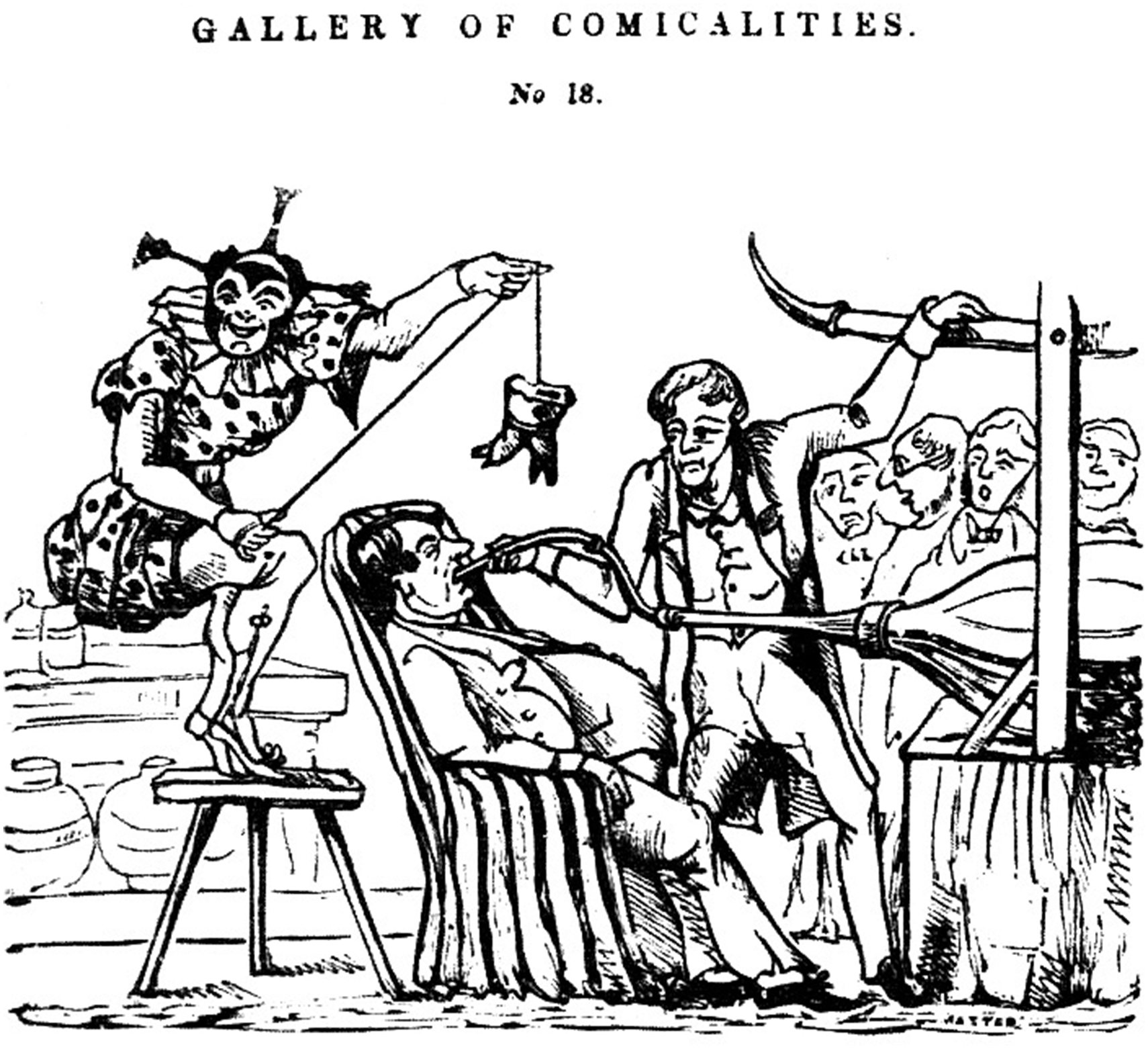
Gallery of Comicalities, No. 18. From Bell’s Life in Sydney and Sporting Reviewer (Sydney, NSW), 26 June 1847, p. 3. 11
Little is known of Belisario’s inhaling apparatus. No details were provided in the first newspaper report of the etherisations in Belisario’s rooms. 12 In a subsequent report, it was noted that the ether vapour was inhaled from a ‘tube communicating with a vessel containing the ether’ 14 – the vessel presumably made of glass. We know more about the apparatus used by Dr William Russ Pugh (1806–1897) in Launceston. Pugh’s apparatus consisted of two glass vessels, one placed on the other, ‘similar to that figured in the Illustrated London News’. 15 Both vessels contained pieces of sponge saturated with ether. A pipe for insertion in the patient’s mouth was connected by a flexible tube to the lower vessel. 15
In contrast, a bladder was used by Dr Colin Buchanan (1810–1891) to administer ether on an unknown date at the hospital of the Australian Agricultural Company in Stroud, NSW: ‘not being aware of the kind of apparatus used for the inhalation of ether, I tried the simple bladder with mouth-piece, similar to what is used in the inhalation of the nitrous oxide, or laughing gas’.16,17 The account of Buchanan’s undated case appeared in The Sydney Morning Herald on 6 July 1847, a month after the earliest reports of etherisation in Sydney and Launceston, and nearly 2 weeks after the publication of the cartoon and poem (‘Song’) in Bell’s Life in Sydney. We should note that in the cartoon and poem, the ether was administered by means of bellows.
AIR. – ‘The Minstrel Boy’. The Ether-boy has just ta’en his stand, Where every fool can find him, With bellows handle in his hand, And his swallow-tails behind him. ‘Patient soft’, quoth the Ether-boy, ‘Embrace the nozzle – quick, Sir, Inhale my golden, sovereign joy, The Patent Quack Elixir’. Sappy sleeps, while a sounding snore Proclaims that the fumes have acted; The clownish servant holds his jaw Till the ivory’s extracted. ‘Tis done! Arise with the chinking dumps’, Sings the Ether-boy, so wary, oh – ‘Fork out the stumpy for the stumps: *Da obolum Belisario!’
*Which being freely translated means ‘Drop a trifle to Belisarius’. The unhappy petition of the Ancient Roman General clearly proves that he was not so good a General-, or so old a soldier as the Sydney-un.
Chloroform anaesthesia, April 1848
In the evening of 4 November 1847, Professor James Young Simpson (1811–1870) and two associates, Drs George Skene Keith and James Matthews Duncan, experimented with chloroform in the dining room of Simpson’s home at 52 Queen Street, in the New Town area of Edinburgh, Scotland. The ‘dense, limpid, colourless liquid, readily evaporating, and possessing an agreeable, fragrant, fruit-like odour’, 18 as chloroform was described by Simpson, was found to have potent intoxicating effects when inhaled, rendering Simpson and his fellow experimenters unconscious for a few minutes. In December 1847, Simpson wrote to his father: ‘Before sitting down to supper, we all inhaled the fluid, and were all “under the mahogany” [table] in a trice, to my wife’s consternation and alarm.’ 19 Within days of the experiment, Simpson administered chloroform for midwifery and surgery.
In the Australian colonies, chloroform was administered at the Sydney Infirmary on 11 April 1848 by Dr Charles Nathan; a brief record of the use of this ‘new agent’ appeared the next day in The Sydney Morning Herald. 20 Accounts of this new anaesthetic agent had reached Australia around the end of March 1848 in correspondence, medical journals and newspapers.
In addition, numerous hints of the discovery of anaesthesia had appeared in 1847 in the British satirical magazine Punch, or the London Charivari (first issued on 17 July 1841), whose punsters were quick to find novel applications for ether and chloroform; for example, to relieve suffering in many social situations. A month after Simpson’s announcement of a ‘new anaesthetic agent’, an anonymous poem ‘The Blessings of Chloroform’ was published in the issue of Punch for 18 December 1847. 21 The poem has been attributed to Percival Leigh, MRCS (1813–1889). 22 Leigh had abandoned medicine to become a comic author. He became a contributor to Punch soon after it was founded in 1841, and remained a contributor to the magazine until late in his life.
‘The Blessings of Chloroform’ has been wrongly proclaimed as ‘the first poem or song relating to anaesthesia’. 23 Chloroform was introduced more than a year after ether was first administered as an anaesthetic. Thus, it is likely that poems on etherisation would have been penned in America and Europe prior to November 1847 when the anaesthetic effects of chloroform were reported by Simpson. One example is ‘The Blessings of Ether’ – a short poem of eight lines, published anonymously in Punch magazine on 3 April 1847. 24 With regard to Australia, the two poems about ether in Bell’s Life in Sydney were published 5 months before Simpson used chloroform as an anaesthetic.10,11
The allusion to a scolding wife in the fourth verse of ‘The Blessings of Chloroform’ may well have been suggested by a cartoon in Punch in February 1847: ‘Wonderful effects of ether in a case of scolding wife’ (Figure 2). 25 The quarter-page cartoon was the work of Leigh’s friend John Leech (1817–1864), who is best known as an illustrator for Punch for more than two decades, and for his illustrations for the first edition of Charles Dickens’ A Christmas Carol. The term ‘cartoon’, from the Italian cartone (strong paper, card, pasteboard), which in earlier times referred to a preliminary sketch made by an artist on sturdy paper or cardboard, acquired a new meaning in 1843 when it was used in Punch to describe a satirical drawing, and subsequently, to any humorous drawing.
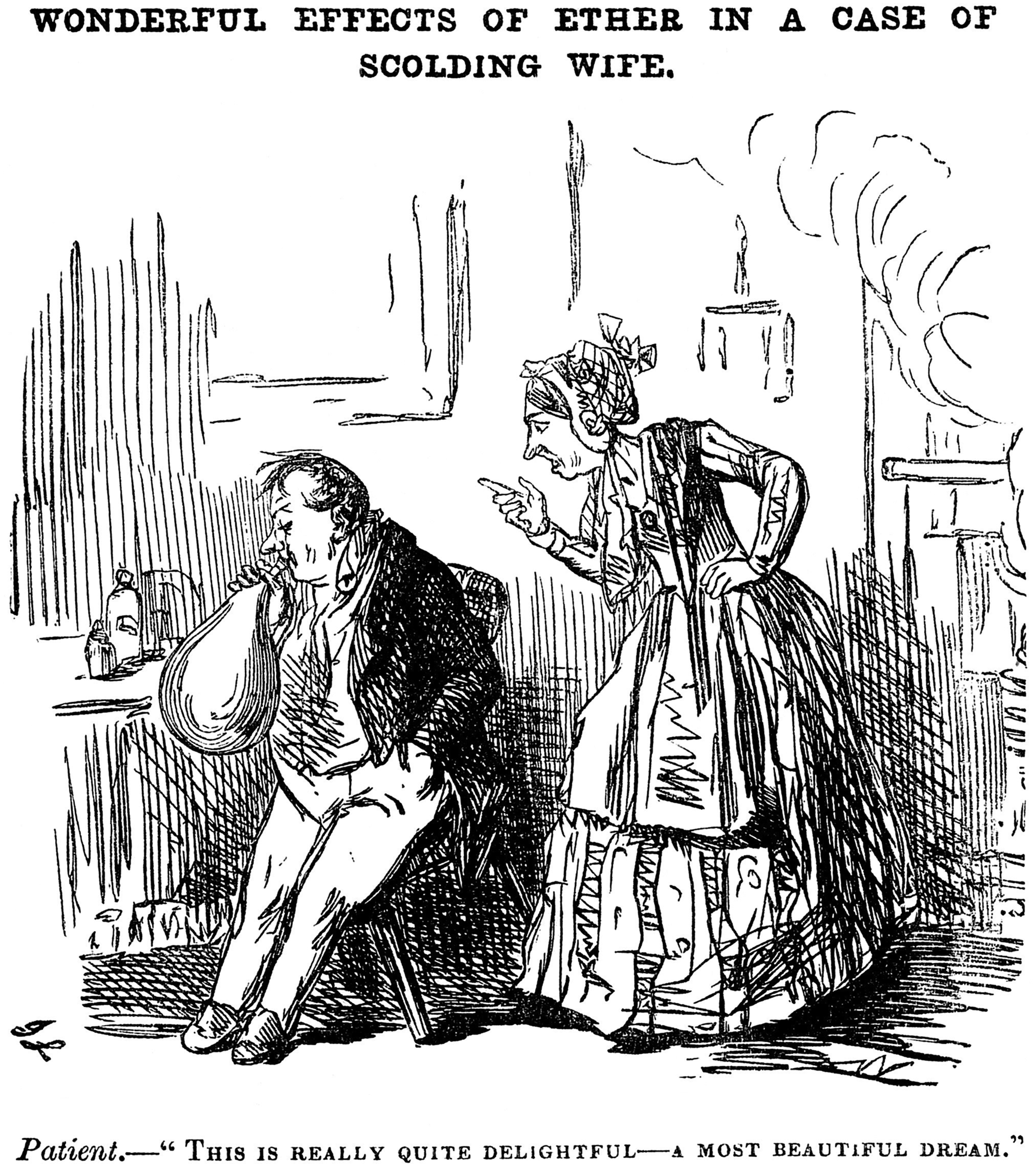
‘Wonderful effects of ether in a case of scolding wife’. Artist: John Leech (1817–1864). Punch, or the London Charivari, 6 February 1847, p. 60. 25
AIR – ‘Run Neighbours, Run’, &c.
OH! what a host, what an infinite variety,
Rapt Imagination, in her transports warm,
Pictures of blessings conferr’d upon society
By the new discovery of Chloroform!
Applications, amputations, denudations, perforations,
Utterly divested of all disagreeable sensations;
Like your coat-tail in a crowd – some clever cut-purse stealing it –
Arms and legs are now whipp’d off without our ever feeling it.
Take but a sniff at this essence anaesthetical,
Dropp’d upon a handkerchief, or bit of sponge,
And on your eyelids ’twill clap a seal hermetical,
And your senses in a trance that instant plunge.
Then you may be pinch’d and punctured, bump’d and thump’d, and whack’d about,
Scotch’d, and scored, and lacerated, cauterised, and hack’d about:
And though tender as a chick – a Sybarite for queasiness –
Flay’d alive, unconscious of a feeling of uneasiness.
CELSUS will witness our deft chirurgeons presently,
Manage operations as he said they should;
Doing them ‘safely, and speedily, and pleasantly’,
Just as if the body were a log of wood.
Teeth, instead of being drawn with agonies immeasurable,
Now will be extracted with sensations rather pleasurable;
Chloroform will render quite agreeable the parting with
Any useless member that a patient has been smarting with.
Then of what vast, of what wonderful utility,
View’d in its relation to domestic bliss,
Since, in a trice, it can calm irritability,
Surely such a substance will be found as this!
Scolding wife and squalling infant – petulance and fretfulness,
Lulling, with its magic power, instantèr, in forgetfulness:
Peace in private families securing, and in populous
Nurseries, whene’er their little inmates prove ‘obstropolous’.
When some vile dun with his little bill is vexing you;
When the Tax Collector’s knock assails your door;
When aught is troubling, annoying, or perplexing you;
When, in short, you’re plagued with any kind of bore,
Do not rage and fume and fret, behaving with stupidity,
Take the matter quietly with coolness and placidity;
Don’t indulge in conduct and in language reprehensible –
Snuff a little Chloroform, be prudent, and insensible.
Note: The word ‘chirurgeons’ (in the third stanza) was misspelled as ‘chirurgeous’ in the version of the poem that appeared in Punch on 18 December 1847. 21
‘The Blessings of Chloroform’ was reproduced in The South Australian Register on 26 April 1848.
26
Below the poem was a brief editorial note, followed by several case reports extracted from British newspapers. The editorial note reads: It appears that the use of ether is being superseded by a more effective agent. To Dr Simpson, an eminent professor of Edinburgh, the public, as well as Medical practitioners, are indebted for the discovery of this new remedy or anasthenic [sic]. The advantages over ether are numerous. First, its more speedy action, and only requiring the most simple explanation. Thus thirty or forty drops placed on a hankerchief [sic], as you would scent, or a cup shaped portion of fine sponge held over the mouth or nostrils, and from ten to twenty inspirations will produce a soporific state, so that without any pain, the most severe operation can be performed. Secondly, its action is more certain. Thirdly, no ill effects have followed its inhalation, &c. This new remedy has been most sucessfully [sic] tried at the Edinburgh and London Hospitals, in nearly six hundred cases, without being followed by any injurious results, and to the astonishment and satisfaction of all who have witnessed it. We subjoin a few successful experiments:–
Conclusion
On 26 June 1847, less than 3 weeks after ether was first administered in Sydney, NSW, an original poem and a cartoon on etherisation were published in Bell’s Life in Sydney. 11 Almost a year later, an Adelaide newspaper, The South Australian Register, reproduced a poem about chloroform from the British satirical magazine Punch.21,26
Footnotes
Author Contribution(s)
Acknowledgements
The author is grateful to Emeritus Professor Laurie Mather and Dr Michael Cooper for their comments and suggestions, and to Peter Stanbury OAM for copies of Punch.
Declaration of conflicting interests
The author(s) have no conflicts of interest to declare.
Funding
The author(s) received no financial support for the research, authorship, and/or publication of this article.
