




Abstract
Asking questions – questioning – is a medium through which we clarify our thinking as well as others’. Questioning is also a medium through which we begin to oppose the current system. An important space for questioning is academia. When students ask critical questions to their educators, this practice becomes a form of students’ active participation in their learning process. Besides, the vast majority of students are future workers (and many of them are indeed already workers), so developing a critical perspective on society is crucial to their lives as workers. To the extent that some of them might wish to become what Gramsci would call the organic intellectuals of the masses, then what kind of questions might they ask their educations that might expose the biases of their educators, that might aid their own learning process, and that might indeed make learning a collaborative process between students and teachers? The article suggests that these questions centre on the class character of the society in which we live.
Keywords
Humanity’s major problems, intellectuals and culture of questioning
Humanity experiences enormous problems such as worsening wealth and income inequality, unmitigable climate change and global pandemics, un-employment/under-employment, and grinding poverty. Resolving these problems requires us to understand them correctly. This means that one has to understand the problems at multiple levels: in the language of critical realism (Collier, 1994), one has to understand the mechanisms behind these problems and the social relations behind the mechanisms. The present is internally related to the past and to the future, so one needs to understand the problems of the current society from the standpoint of a future society, one where it will be possible to live without these problems. To understand the current society and to imagine a future society, one needs good ideas, both in science (of society) and in philosophy. One needs intellectual thinking, in other words.
Gramsci (1971: 9) famously said that all men and women are intellectuals, even if they do not earn their living by being an intellectual. In Gramsci’s own words, all men and women can produce ideas just as ‘everyone at some time can fry a few eggs or sews up a tear in the jacket’ (Gramsci, 1971). Or, as Althusser (1970: 8) said, ‘Everyone is not a philosopher spontaneously, but everyone may become one’.
In a recent book called the Revolutionary Marxism of Antonio Gramsci, the author, Rosengarten (2014), building on an idea from William Wordsworth and William Hazlitt, says, intellectuals are individuals who employ their intelligence to perform five activities, that is, they ‘examine, clarify, argue, advocate, and theorise points of view related to areas of broad general interest’ (p. 135). This is an excellent list. But it is inadequate in that it skips the work of asking questions, or critique, more broadly, which is indeed central to each of these activities. We should ask questions about current and future society to our parents, partners, friends, neighbours, co-commuters, newspaper editors, TV anchors, government and trade union officers, politicians, and community activists.
Questioning is a medium through which we clarify our own thinking as well as others’. And, questioning is a medium through which we begin to oppose the current system. After all, social conflicts do happen in the realm of ideas. When fascistic tendencies are showing their ugly head everywhere, with the curtailment of academic and other forms of freedom, including in the United Kingdom, the United States and India (see Figure 1), it is very important that we practice the culture of questioning. 1
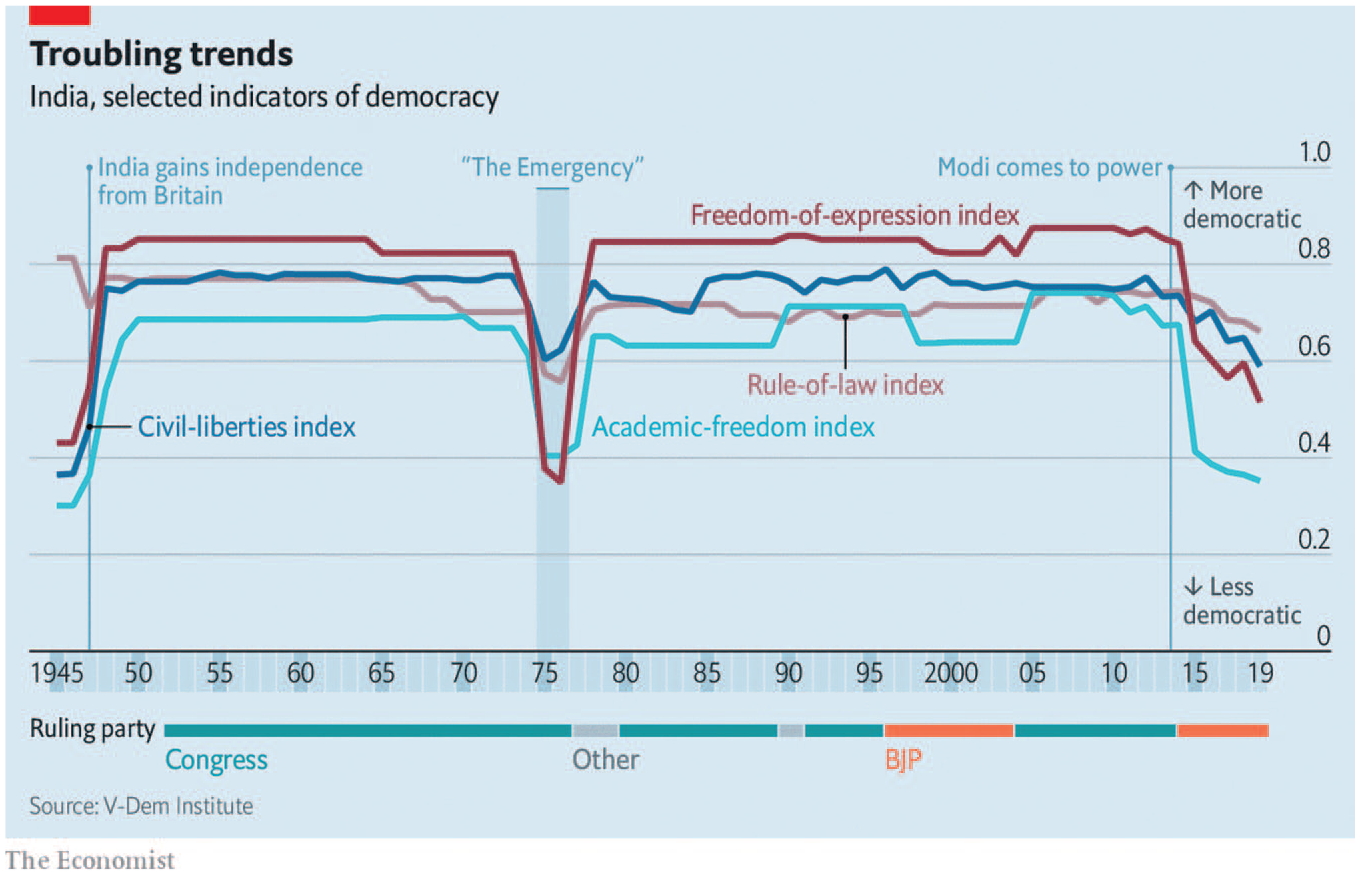
Curtailment of democratic rights in India.
An important space for questioning is academia. Academia is an important part of the intellectual arena which, as Gramsci (1971: 15) would say, is like a machine-producing machine. After all, university teachers, that is, the people who think, produce thinking-people, as they train their students.
Students asking questions is a form of their active participation in their learning process. Asking questions to their educators is a necessary part of their education. Besides, the vast majority of students are also future workers (many of them are already workers as they need to earn money to fund their education), so developing a critical perspective on society is crucial to their lives as workers (to be). To the extent that some of them might wish to become what Gramsci would call the organic intellectuals of the masses, then what kind of questions might they ask their educations that might expose the biases of their educators, aid their own learning process, and make learning a collaborative process between students and teachers?
What kind of questions for what kind of society and education?
Let me provide some examples of questions that students might consider asking:
What is the major social division – cleavage – in the current society? Do you think that the major contradiction in our society is between the two major classes – that is, a vast majority of people with little or no control over the means of production (land, mines, factories, research labs, etc.), and a small minority, which do? Or, do you think that the major division in society is between men and women, or between non-Whites and Whites, and so on?
Is it, or is it not, the case that the wealth of those who control society’s resources – say, top 1% to 10% – comes basically from the fact that those who do the work receive in the form of wages/salary only a part of the value they produce?
Has the increasing geographical flow of commodities and capital made imperialism an outdated concept, or is there still something called imperialism?
Is the state’s fundamental role to preserve the existing property relations by the actual use of force and/or the threat of force and by the use of material and ideological interventions that make people actively or passively accept the current social arrangements? Or is the state neutral in relation to the basic classes?
Do you believe that society is a harmonious place, that all will be well if people work harder and have better moral values, and that whether someone has adequate food, housing, access to education and health care, including, say, protective equipment during a pandemic, and so on should be left to the hidden hand of the market? Or, do you believe that the conditions under which people live should be more or less left to the market, but when market failures occur, governments should intervene, and that governments should also, to some extent, look after the poor and the marginalized?
More specifically, can the state as well as workers’ unions, NGOs and local community organizations durably and significantly resolve society’s major problems?
Do you imagine a future society that is a slightly better form of capitalism, that is, a capitalism, where there is slightly more economic and geographical equality, and where there is less oppression of women and racialized and other minorities, and where there is a little less ecological damage?
Or, do you imagine a future society where there is economic and political democracy; where productive resources are democratically and collectively controlled by men and women of different races and nationalities not to produce profit for a few but to meet human needs in an egalitarian, peaceful and ecologically sustainable and geographically equitable manner; and where there is little distinction between manual and mental labour and between rural and urban areas?
If society has to change in fundamental ways, which group of men and women is the most important agent in such a project, and how can they replace the current social arrangement with another one? Or, do you think that capitalism is simply too big to fail, and that if we seek to replace it with a new society, there will be so much chaos that we might even starve?
Given that our philosophical views shape our thinking, what sorts of philosophical views do you hold? For example, (a) Do you think that there are things in the social world (e.g. stock market, built environment, forests, factories, need to go to work for a wage) that are more or less independent of how we think about them right now, or do they exist more or less as social-mental constructions? (b) Do you believe that men and women must eat, drink, and have shelter and clothing, before they can engage in politics, science, art and religion and watch movies on Netflix and give Zoom lectures? In other words, are material conditions in life the primary explanation of things happening in our lives, even while material conditions are affected by non-material conditions? (c) How correct is it to assume that social processes happen on the head of a pin? Why indeed is university instruction often so geographically parochial? (d) Why is it that social processes in Western societies (e.g. Western Europe and North America) are often taken as the norm and that ideas that explain conditions in these regions at a rather concrete level remain the main academic focus? Why is it not adequately recognized that what happens in these societies is deeply connected to what happens in the Global periphery (where most people of the world live) and vice versa. (e) Conversely, why is it that an idea developed in Western Europe or North America must necessarily be seen as having limited relevance to the Global periphery? Isn’t there a distinction between relatively abstract ideas that have wider social-geographical applicability and relatively concrete concepts that do not? (f) What does being critical mean to you, and what are the philosophical and social-theoretical reasons for critique?
2
Why is critique often confined to critique of, for example, special oppression rather than critique of the total society or social totality – capitalism, a society that thrives on special oppression of certain groups and areas? And when there is any critique of capitalism, why is it that that critique is often confined to the (rather mild) critique of a specific form of capitalism (e.g. neoliberalism) or of specific excesses of capitalism (e.g. very low wages here, extreme forms of ecological degradation there), rather than of capitalism as such? Is the scope of your critique confined to the critique of those aspects of society which can be regulated and changed a little?
Importance of questioning in academia
Questioning philosophical inadequacies
To explain any concrete problem, one has to examine the issues surrounding the control over property as well as the nature of state power and so on. And to examine these issues, one needs certain philosophical principles – for example, the idea that there are objectively existing structures of relations and processes forming a totality, whose contingent reproduction is influenced by people’s thinking and action, and that things in our life are not creations of thought, although ideas can play an important role in social change. The ideas of objectivity, social totality and so on are often ignored in academia.
Questioning ‘fragmented’ or sectoral mentality
Often society is divided by professors into numerous groups (e.g. women, refugees, indigenous peoples, people in jail, heterosexual people), without the recognition that these groups are connected to the overall social-material (class) character of social totality of which they are a part.
Consider the following example. In Canada, professors often begin an academic event with an Indigenous land acknowledgement, the recognition that an academic institution is situated on the land taken away from Indigenous peoples by European settlers. Such a routine practice isolated as it is from actual political action to improve the material lives of Indigenous men, women and children, means relatively little. It indeed conflates political action with discursive/linguistic utterances.
It also valorizes and encourages the abstraction from the world of production and the lives of workers. If educational buildings have been established on the land taken away from the original occupiers (primitive accumulation is indeed rampant), all this has also happened on the back of men and women and children as workers who produce such buildings. If we need to start an academic event with gratitude, then we need to show our gratitude not only towards the people who were dispossessed but also towards the people whose labour was exploited. But we do not do so. Why? The answer is the propensity of educators towards identity politics, which must be challenged by students.
Questioning inadequate view of theory and action
To understand anything properly, one has to have a theory: it is theory that helps one connect the different parts of society one to another and to produce a coherent picture of society. But many educators are just keen on their students to see the world for themselves. Alas, without a theory, one will see many things without really seeing anything (much).
Theory is linked to action. So, it is important that educators be explicit about their stance theoretically (in relation to the fundamental mechanisms behind humanity’s problems) and politically (in terms of what needs to be done about the problems we study). 3 Professors should make explicit not only their theoretical stance that can provide an idea about why/how they wish to see society changed, but also their political stance that can indicate, howsoever imperfectly, how they explain the current society.
Conclusion
The foregoing discussion implies that students should consider making a series of demands on academia and on society as such, in order to improve their education and their lives.
Students should demand that they be taught rigorous theory of society as a whole and the theory of specific parts of society (e.g. child poverty or women’s oppression), as well as the theory of theorizing society and its relation with nature (i.e. philosophy, including ontology and epistemology), so that they can ask interesting questions.
Students should demand diversity: the professoriate should be drawn from different social backgrounds in terms of race, gender, geography, and so on. The curriculum must provide an opportunity to understand the enormous suffering caused by special oppression and imperialism and struggles against these. Students should have an opportunity to read the material produced by scholars from around the world. In this sense, the de-colonization movement may have a progressive element. But students should demand that the scope of pedagogical diversity be expanded beyond identity politics, including curricular de-colonization.
I cannot at all support the idea that students should not read the work of White professors about, say, the Global periphery or about racism. I will never endorse the idea that just because a professor is White and from the West, they necessarily fail to understand the fundamental nature of the South or racism and imperialism. It is also important to keep in mind that to the extent that a non-White or a female professor emphasizes racial or gender inequality as the dominant form of inequality, their crucial ideological contribution, objectively speaking, is towards the continued existence of class relations which are the main cause of racial and gender inequality (Das, 2020a).
The existing curriculum treats divisions based on capitalism/class as eternal, so a structural space is created for the middle-class educators to eternally emphasize to their students the identity-based cleavages and thus appear progressive/critical. Ideas and interests are closely related. Curriculum (a set of ideas) must reflect the objective and political interests of the majority or the working men and women of different races and nationalities and who are often brutalized by police and subjected to all kinds of discrimination. Students’ most important demand should therefore be to de-bourgeoisfy and de-class the curriculum.
Students must demand an immediate stop to the commodification and creeping corporate control over education, austerity and its bureaucratization as well as mixing of education with religion and religion-based politics (the latter process is happening on a massive scale in countries such as India). Obstacles that they face when they make this demand will be an enormous source of their education.
After years of education, students accumulate a huge amount of debt (it is $1.6 trillion in the United States). As well, the majority of students will remain un- or under-employed. These material facts cannot but adversely impact their education. Students, in an alliance with workers, must therefore demand that all able-bodied men and woman be guaranteed decent and secure employment with an adequate and inflation-adjusted compensation for their work and without any discrimination. The demand for a satisfactory education and the demand for improved material conditions are internally related. And students must also demand that their teachers have secure job and adequate compensation, and thus they may act as political allies of their educators.
Let me conclude with two caveats. First, while I have emphasized the importance of theory in education, and have said that to develop a theoretical understanding, one needs to develop a culture of questioning, it is important to bear in mind the following: ‘It is essential to learn with theory – but at the same time and crucially, it is essential to learn with the masses’ (Althusser, 1970: 9). Students (as future workers) have much in common with working people outside of the university. These people – their suffering and their struggles – are an immense source of learning.
Second, just as theory is not enough to change society, so questioning is also not enough. Only making criticisms cannot radically change society. But without change-enabling ideas, that is, the ideas that go to the root of the problems of the masses, change is not possible either. So let me end with Marx (1844) on this:
The weapon of criticism cannot . . . replace criticism by weapons, material force must be overthrown by material force; but theory also becomes a material force as soon as it has [gripped] the masses. Theory is capable of gripping the masses as soon as it . . . grasp[s] the root of the matter.
Footnotes
Author’s note
This paper is the modified version of a talk delivered by the author at Nottingham University on Zoom on 30 November 2020. It draws on Das (2020b), which, in turn, builds on  . The author is grateful to the participants in the event for asking stimulating questions and to Professor Andreas Bieler for his kind invitation to deliver the talk.