




Abstract
The purpose of this paper is to examine the behaviours and perceptions of university students who do not work part-time while studying. A structured, online questionnaire was issued to Business Management students at a UK university. A total of 123 responses were received, of which 64 indicated that they were not working while studying. While non-working students were mindful of the importance of work to developing employability skills, greater importance was attached to their degree studies. Most work to date has focused on the motivations and behaviours of university students who undertake work while studying. Little work has been carried out on university students who do not work during their degree studies. Not working part-time will have employability implications for graduates, employers and universities, all of which are discussed in this paper.
Introduction - The importance of work experience
Some form of work experience is now deemed vital by employers, who feel that a university education alone does not sufficiently prepare graduates for employment (Highfliers, 2019; Prikshat et al., 2019). While universities have increased the availability of placements and encourage taking up internships (Kapareliotis et al., 2019), at the same time, increasing numbers of university students are working part-time, predominantly for financial reasons (Adams, 2024; Neves and Stephenson, 2023). Although financial necessity is the key driver for students working while studying (Crockford et al., 2015), part-time work experience can also enhance employability credentials by supporting the development of transferable skills which are demanded by employers, particularly softer skills such as team-working and communication (Garner et al., 2019; Russell, 2024). Moreover, projecting into the future, those soft skills will become increasingly important to employers, to support technology-driven operations (Dickerson et al., 2023). Part-time working, therefore, not only brings students financial benefits, but the experience increases graduate work readiness (Young, 2023) something that Harsha (2023) notes is increasingly demanded by employers.
Non-working students
Nonetheless, approximately a third of UK university students do not work part-time while studying (Brown, 2022; NUS, 2023), meaning that they potentially miss out on the development of valuable transferable skills and thereby, make themselves less attractive to graduate employers in an increasingly competitive graduate jobs market (HE Professional, 2023). Hodgson and Spours (2001) identified three types of deliberate non-part-time-working student: those who are financially supported by affluent families (those who receive adequate government funding could be included in this category); those whose time is absorbed with extra-curricular activities such as sport or societies; and those who are dedicated to study, perhaps fearing that any external activity will be detrimental to their academic performance. This last classification of student resonates with the work of Burke et al. (2019), who found that students from lower social classes were inclined to be naive about the employment market and its employability nuances, and as a consequence, are focused primarily on their degree studies.
Meeting students’ needs
At the basic level of Maslow’s hierarchy of human needs (1943) is a requirement to satisfy physiological needs. In times of financial hardship, students could be compelled to seek part-time work in order to survive, especially as NUS UK (2022) indicates that 90% of UK university students are affected by the cost-of-living crisis with 42% living off £100 or less, per month. Nonetheless, Broadbridge and Swanson (2005) note that working can reduce an individual’s integration into university socialisation, negatively affecting their sense of belonging, a need further up Maslow’s hierarchy.
For university students, the decision to work part-time will be largely dependent upon the expected rewards, such as income, development of transferable skills, or the contextualisation of study material. The expected returns of working will need to be deemed sufficiently high to lead to a corresponding effort of working, outweighing for example, a reduction in study time and reduced social contact with university peers. If students do not expect that part-time working will bring desired rewards, then the motivational drive to work is correspondingly reduced. This, however, is based on an assumption that suitable part-time work is available, and that the student has the confidence to successfully apply for the work. Indeed, Hodgson and Spours (2001) identified an additional category of student, one who lacked confidence in obtaining work.
Eccles and Wigfield (2020) also differentiate between short-term and long-term goals of obtaining part-time work. As a consequence, there must also be a recognition of the difference between the more short-term extrinsic benefits of wages against the longer-term reward of developing transferable skills and providing impetus towards a graduate career. There are, however, a number of factors that will affect an individual’s expectation of outcomes, such as an awareness of the related benefits. In particular, if an individual is unaware of the transferable skills to be derived from work activity, then its attractiveness is reduced. Similarly, an individual might not be able to make a connection between skills being developed through part-time work and subsequent graduate employment.
The influence of external factors
Whilst there may be various drivers towards finding part-time work, it is important to note that the decision not to work might be influenced by external factors and therefore, ultimately, may not be the students to make. The recent economic scenario facing UK university students has been complex, with businesses still recovering from the legacy of COVID-19 (Joyce et al., 2023) and Brexit (Von Sternberg, 2019), combined with an emerging high cost of living, high interest rates, shortages of goods in the supply chain and the economy facing low growth. These factors may create further barriers to students’ engaging in part-time employment, particularly in hard hit sectors like hospitality and may also have reduced opportunities to find other routes to develop essential employability skills, such as via placements and internships. At the same time, weaker economic conditions and a high cost of living may have increased the financial need for university students to seek work.
The recent significance of external influences on employers and employees raises questions as to whether the classification by Hodgson and Spours (2001) regarding university students who do not work during their studies, takes sufficient account of the wider economic context, particularly in periods of economic uncertainty and upheaval. Moreover, important questions regarding the implications of not working for students’ employability, particularly how they will develop essential work-based skills, and how universities and employers might address any associated ‘skills gaps’, must also be considered.
Aims of this paper
This paper aims to examine the behaviours and perceptions of university students not working part-time, with the objectives: • To examine the behaviours and perceptions of university students not working while studying. • To explore the implications of the study findings for universities, graduates and employers, particularly for supporting the employability of students who do not work part-time.
The majority of studies in this area have been focused on university students’ work activity (see e.g., Evans et al., 2014, 2024). This study therefore, addresses a gap in current understanding by building on prior studies, especially Hodgson and Spours (2001), to explore the behaviours of university students who are not working while studying.
The study concludes by exploring the implications of the study findings for universities, graduates and employers, particularly regarding the employability of students who do not work part-time. Students who choose not to work during their studies or are unable to do so, may face potential barriers within the graduate jobs market, given the missed opportunity to develop transferable skills. Future employers may, therefore, need to address skill shortfalls arising from graduates’ lack of work experience. Moreover, the findings of this study may help to inform and shape efforts by universities to address what might be considered an ‘employability gap’ amongst this category of student.
Research approach
The study adopted a cross-sectional, online survey data collection approach. The same survey instrument was also used in the related study by Evans et al. (2024) which explored the perceptions of students who do work part-time during their studies. The survey instrument comprised a mix of nominal and rating-scale (Rattray and Jones, 2007) questions in addition to open questions to elicit qualitative insights relating to student perceptions and behaviours. The sample comprised Business students enrolled on an undergraduate degree at a case HEI in the United Kingdom. Participation was voluntary and anonymous. Although the study is limited in scope to students studying the discipline of business, it should be noted that this was the largest subject area for university entrants in the academic year 2020-21 (OfS, 2023). Therefore, the results may be considered representative of a large sub-section of UK students.
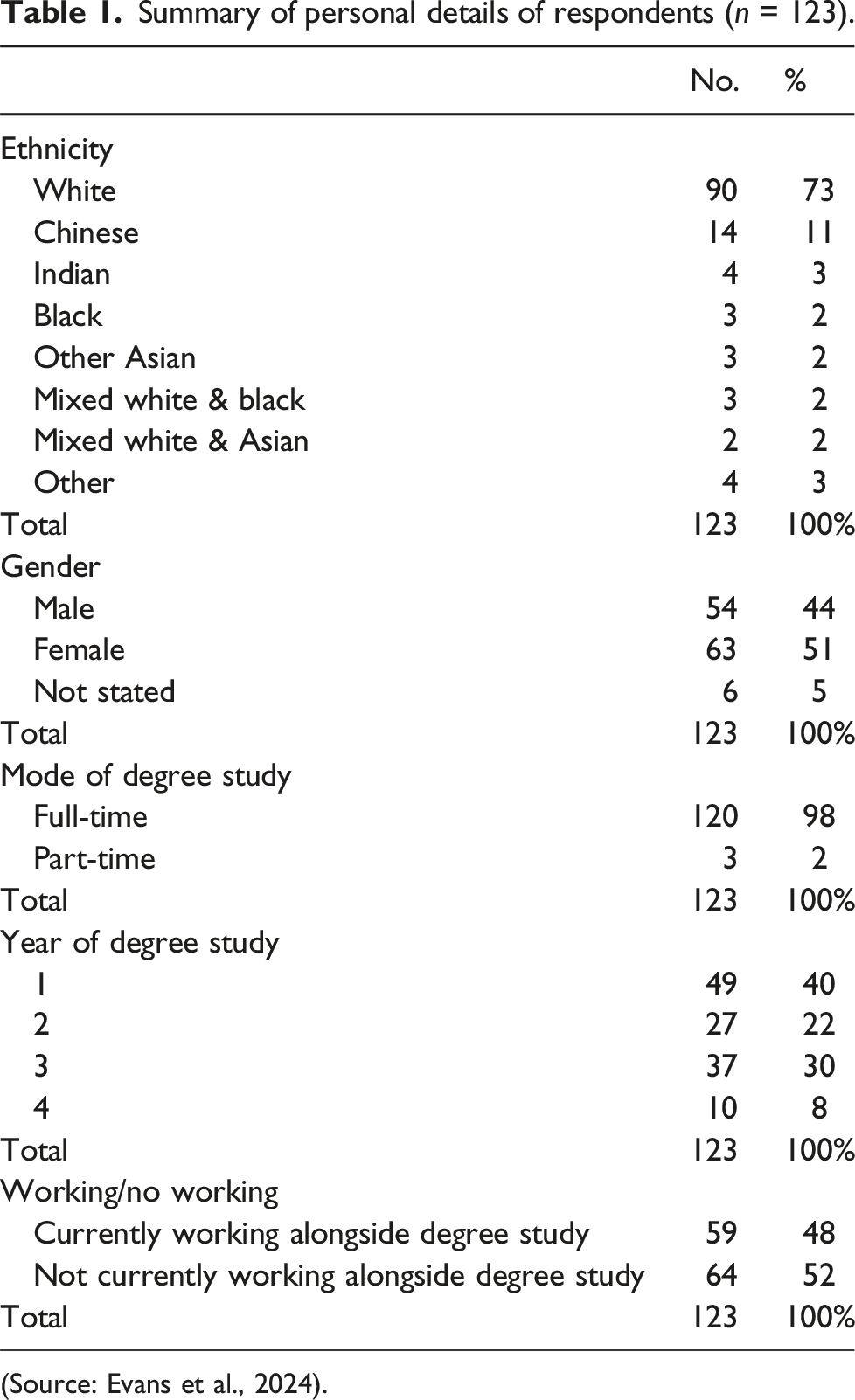
Summary of personal details of respondents (n = 123).
(Source: Evans et al., 2024).
Results
The majority of respondents (52%) were not working at the time of the survey (see Table 1). This is higher than the national figures in the survey undertaken by HEPI, which indicated 45% of students not working (Neves and Stephenson, 2023). This variation may be explained by the fact that the HEPI survey will have been undertaken at a time when students were feeling the impact of the cost-of-living crisis, which is likely to have resulted in more working part-time in order for students to survive financially (Standley and Fermer, 2023).
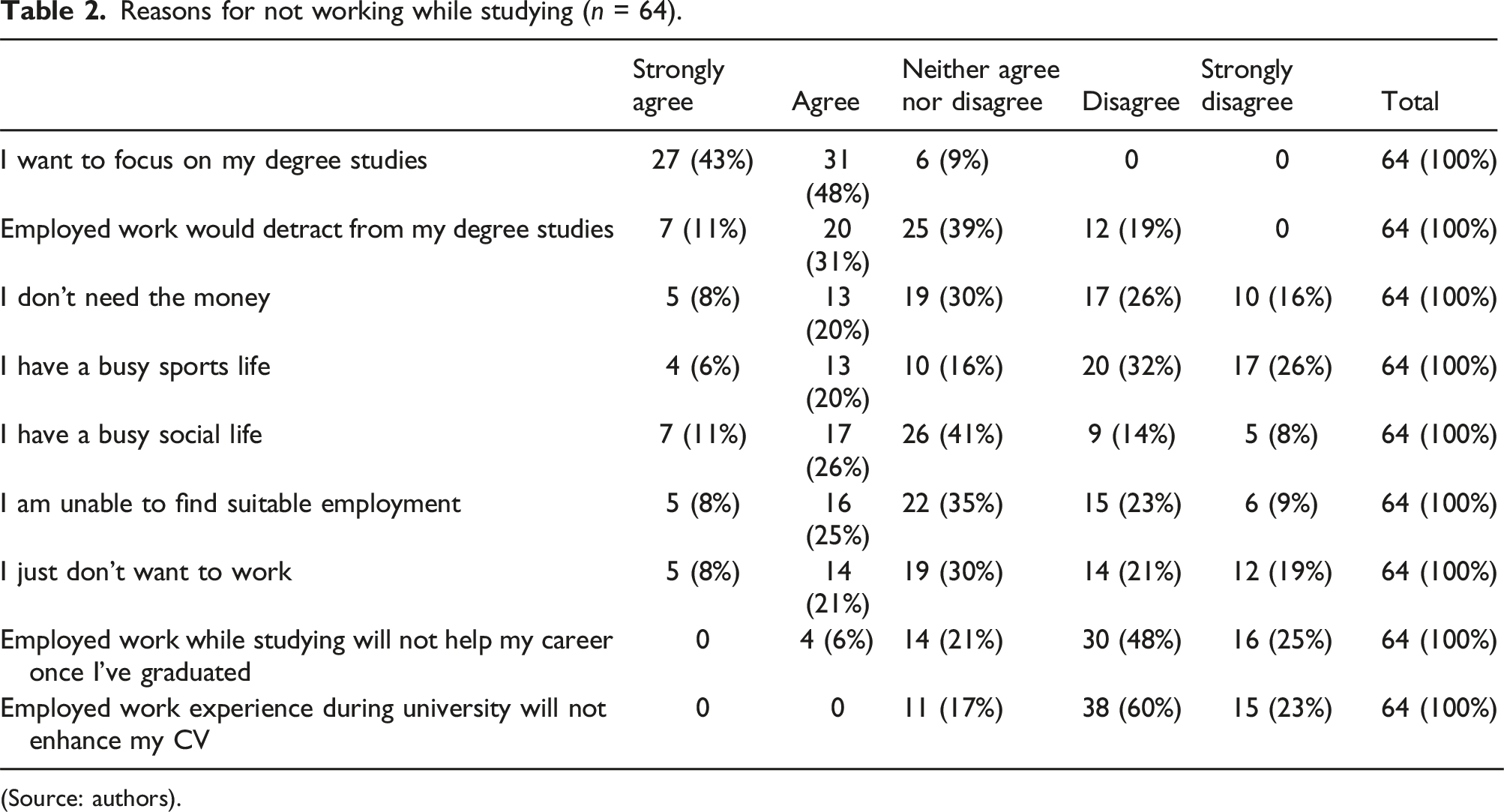
Reasons for not working while studying (n = 64).
(Source: authors).
Respondents made further comments: I just want to learn well in my undergraduate study at first and focus on self-development, and then consider a career job. I love working, but not while at university in my final year of studies. It would distract me from my studies.
For some students, such reactions could reflect perceptions of the level of uncertainty in the jobs market causing students to want to focus solely on studying. With the ongoing difficult economic scenario faced by students, it was surprising to see that 28% of respondents indicated that they did not require the money derived from part-time working. However, 33% of respondents indicated they were unable to find suitable employment. This could reflect an inability to find a position with sufficient flexibility to accommodate study and outside interests, since open comments included: I can’t work because the timetable is so random my only options are weekends, and I already attend social events on those days. I had a job for the first year and had one for the first two months of the second year, but the shifts were 6 am starts and I had to commute for studies on top of this, so it became too much once assignment deadlines came around.
It could also indicate that non-working students are less aware of or ‘networked’ into the job market and career support services and, therefore, less able to identify appropriate job opportunities. Yet, despite not working, there was a clear indication from respondents that working was a useful activity in supporting future career aspirations, since 73% of respondents indicated that it would be helpful to them post-graduation. In addition, 83% indicated that working would enhance their CV. These figures point to a clear picture of positive perceptions of work (i.e., enhancement to career/CV); what is seemingly lacking is the opportunity or even the motivation to actually work. Regarding the latter, 29% indicated that they just did not want to work, with a further 30% unsure whether they wanted to.
Perspectives of the future for non-workers (n = 64).

(Source: Authors).
Working outside of semester time might seem attractive for those who did not want part-time work to interfere with their study commitment, but only 44% indicated they would consider such work activity. Whilst placements are becoming increasingly available at universities and are deemed to be valuable in supporting career aspirations (Brooks and Youngson, 2016), again only 44% of non-workers indicated an active interest in undertaking a placement.
Discussion
The importance of work
Even for those students who do not currently work, there is recognition that work experience is important. Graduates improve their interview chances with work experience (Owen, 2001) since it supports employability skill development (Rhew et al., 2019). Part-time work experience provides students with opportunities to learn key skills and reflect more fully on those skills in relation to the needs of employers (Ferguson, 2022). This is supported by Bennett et al. (2023) who found that students with work experience were more aware of employability demands.
Despite the positivity among non-working students concerning the importance of work experience alongside studies, actual engagement is lacking. There were a significant number of participants who did not want to work or were unsure they wanted to.
It is noteworthy that for 28% of participants, financial necessity did not provide impetus to seek employment. This provides some support for the findings of Hillman (2024) who identifies a bifurcation of university students into two groups: those poorer students who have to work long hours to survive financially; and those who have sufficient money to not need to work.
Non-working behaviours
The study results indicate that an inability to find an appropriate job that gives the required flexibility to work alongside studies is an important factor in non-working behaviour. As identified by Hodgson and Spours (2001), this could result from a lack of self-confidence, for instance in terms of accessing career support services. Other barriers relating to social and family networks and knowledge of the local jobs market may also be important. The fact that this study was undertaken during a period of economic challenge points to the significance of the prevailing economic conditions as a factor affecting the uptake of part-time work. For some, the impact may be negative due to reduced availability of jobs. For others, economic conditions may further drive the financial necessity to work.
This study finds that students who do not work are predominantly focused on their degree studies. Any external activity such as part-time working is seen as a distraction. Yet, prior studies show that a degree in itself is insufficient to effectively drive employability (McMurray et al., 2016; Tomlinson, 2008). Also, such students miss out on opportunities for networking and developing relationships that could be beneficial in the future (English et al., 2021). It seems that some students are taking an immediate-term perspective, rather than a strategic outlook by aiming to finish their degree, achieving a good grade and then seeking employment. Chadi et al. (2019) found that high performing students put less effort in to other activities because they believe that their academic performance will help them secure a high-earning position post-studying. Similarly, Bennett et al. (2023) note that students who have not worked, may have a greater confidence in their abilities, hence negating the need to work. So interestingly, a student not working may result from a conscious decision based on high confidence about their future career stemming from high academic performance; or conversely it may result from low confidence in seeking out work or support from careers services. Clearly the reasons for not working are both diverse and complex and it is not possible to generalise about student behaviour.
The needs of employers
Whatever the reasons for students not working, it remains the case that employers demand graduates who possess some form of work experience (CMI, 2018) with part-time work deemed invaluable in developing skills, especially the softer, interpersonal ones (CIPD, 2024; McMurray et al., 2016). For those graduates without work experience, the onus will fall upon employers to upskill those individuals, and accordingly incur the economic cost (Chavan and Carter, 2018). While Ferns and Lily (2015) and CIPD (2024) acknowledge that employers need to keep employees’ skills up to date, a lack of prior work experience does mean that some new graduates will not be fully work-ready (Mari et al., 2019). Yet, employers desire graduates who are ready for work, possessing in particular, effective soft skills (Winterton and Turner, 2019), so they can contribute effectively from the outset of employment. Nonetheless, it should be recognised that work-readiness is not a binary state, but more of a continuum (O’Brien et al., 2013) with lifelong learning a requirement for all employees. Hence employers should have realistic expectations and presume that ongoing skills development will be needed.
Notwithstanding the need for employers to play their role in developing new graduate employees, a lack of work experience might still signal that a graduate is not work-ready, which could hinder their entry into competitive job markets or mean they have to take lower-status jobs in order to gain some initial work experience. Therefore, universities will also have some responsibility to ensure that gaps in experience and skills development are addressed in ways including part-time employment, but also through alternative means such as placements or micro-internships, which may better accommodate those students not wishing to be diverted from their studies. Placements are particularly attractive, deemed as contributing to developing transferable skills (Juznic and Pymm, 2011) and also having a positive impact upon career aspirations (Brooks and Youngson, 2016).
The role of universities
Employers look to universities to ensure that graduates are work-ready. Minocha et al. (2017) and QAA (2019) emphasise that universities should ensure all graduates have an opportunity to acquire work experience. Meanwhile, Hall (2010) calls for universities to accommodate working students more effectively and this could entail greater flexibility in subject timetabling, build around students work schedule.
Despite the best efforts of higher education institutions, there is no guarantee that students will voluntarily undertake part-time work or other forms of employment experience, even if it is facilitated by universities. Some form of credit-bearing work experience or work-based learning may therefore be deemed appropriate as a mandatory element of degree programmes. Additionally, a greater awareness of the importance of work experience in developing transferable skills and driving graduate employment needs to be raised by universities. Here, Ishengoma and Vaaland (2016) find linkages between universities and industry are key drivers of improved graduate employability. Similarly, Mgaiwa (2021) advocates university-industry linkages to ensure university practices and curriculum contribute to employer needs.
Recommendations
At the moment, there seems to be a disconnect between the benefits of part-time working and graduate careers. Universities, therefore, need to not only promote to students the importance of part-time working but emphasise skills that can be derived from undertaking it, and how these can meet the needs of employers and help fulfil individuals’ career aspirations.
In addition, greater consultation is needed between universities and employers, to create a more symbiotic relationship. As a result, university administrative functions may need to develop more flexible timetabling schedules to accommodate students part-time working more comfortably. This could, e.g., result in the blocking of course modules over two or 3 days, freeing up the remainder of the week for work. Alternatively, greater use of online, hybrid and flexible learning would help students to achieve an appropriate balance between study and work.
For teaching staff, embedding students’ part-time work activity into learning, teaching and assessment could result in deeper experiential learning by bringing the curriculum ‘alive’ and enabling students to develop their own understanding of how academic theory connects to practice through work participation. This approach could be further extended by accrediting students’ part-time work. This could convince students of the value of part-time work by making it part of their degree, rather than viewing work and study as two distinct activities. Moreover, it would also highlight to employers the work-readiness credentials of university students, giving students a head start in an ever more competitive graduate jobs market.
Developing the findings
While the findings in this paper provide insights into the behaviours and perceptions of students who do not work while studying, its limitations are related to its limited generalisability. Future research may extend the scope of this study by assessing the differing work behaviour and perceptions of students across subject domains, especially as some subject disciplines (e.g. medicine, science) may have higher contact hours and, therefore, less likelihood of supporting students’ part-time working. There is also scope to develop this work further by evaluating the strategies used by universities to embrace and integrate part-time working within their institutions, including the use of work-based learning to support the development of work-readiness amongst graduates.
Footnotes
Declaration of conflicting interests
The author(s) declared no potential conflicts of interest with respect to the research, authorship, and/or publication of this article.
Funding
The author(s) received no financial support for the research, authorship, and/or publication of this article.
