




Abstract
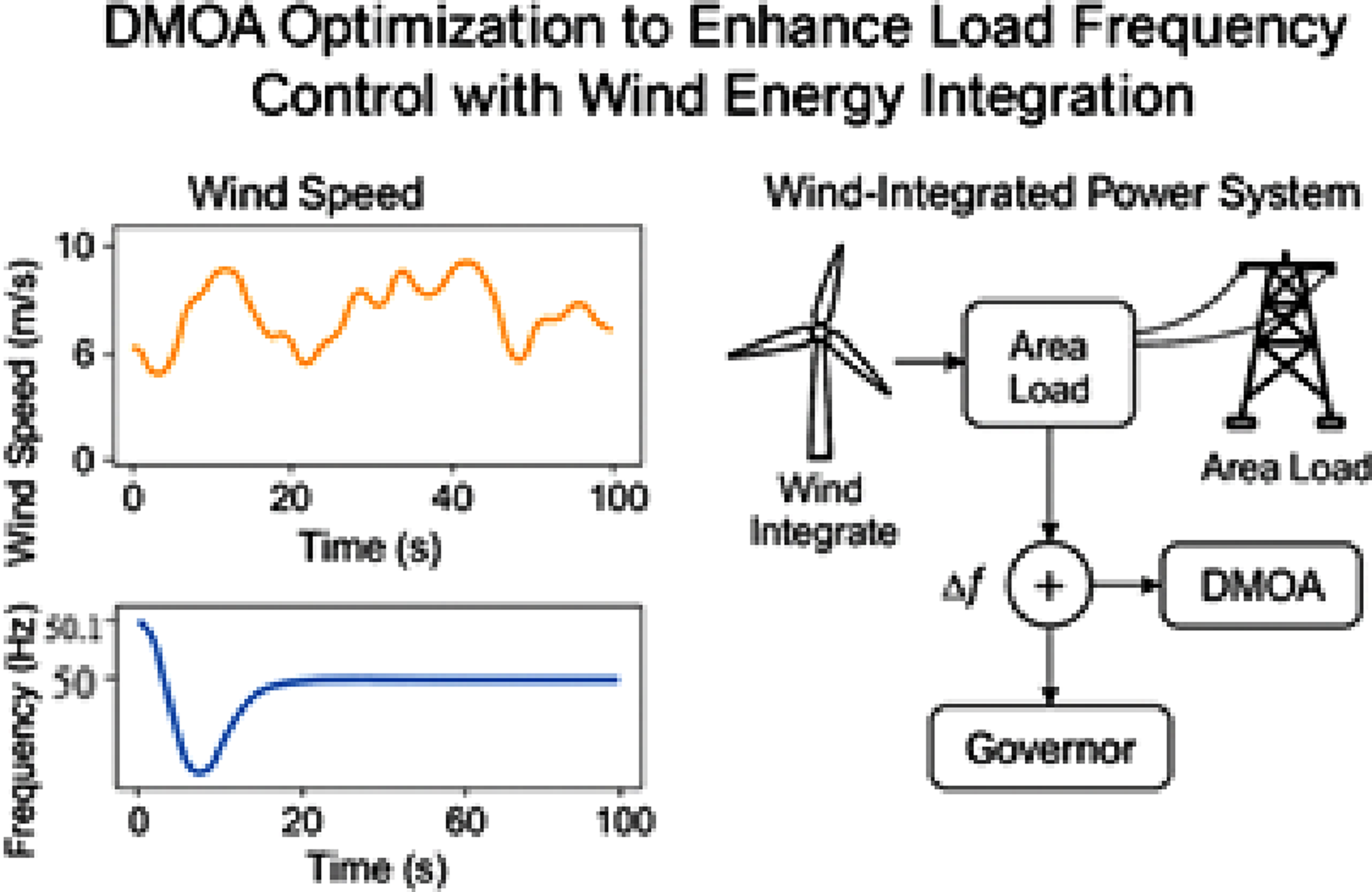
As wind energy becomes more common in modern power networks, it becomes harder to keep the frequency stable since wind power output is random and not inertial. This work suggests a better Load Frequency Control (LFC) method for a wind-integrated single-area power system. It uses a Proportional–Integral–Derivative–Acceleration (PIDA) controller that has been improved by the Dwarf Mongoose Optimization Algorithm (DMOA) to reduce frequency deviations. The dynamic model uses real wind speed data and shows how power changes in three situations: step change, dynamic variation, and actual wind power changes. When compared to benchmark PI controllers that have been optimized by Genetic Algorithm (GA), Gravitational Search Algorithm (GSA), Crow Search, and Harmony Search (HS), the DMOA-PIDA controller does a better job of keeping the frequency stable, especially when the wind changes it. The suggested controller has better damping, a lower maximum overshoot, and almost no steady-state error. It also has synthetic inertia and frequency nadir protection. These results show that DMOA-PIDA could be a strong and flexible way to manage frequency in future grids that have a lot of wind energy. In addition, the proposed controller surpasses Firefly- and Genetic Algorithm–based PI controllers in a two-area system with PV integration, while also exhibiting high robustness under sudden load disturbances.
Keywords
Get full access to this article
View all access options for this article.