




Abstract
Case description:
Conventional methods for producing custom prosthetic fingers are time-consuming, can be uncomfortable for the patient, and require a skilled prosthetist. The subject was a 40-year-old male with congenital absence of the thumb and related metacarpal bone on the right non-dominant hand, anomaly of the lengths of individual upper limb segments, and contracture of the elbow joint. This hand presentation made it impossible for him to perform thumb opposition, which is a very important function for common daily activities.
Objective:
The goal was to design an individual passive thumb prosthesis using free open-source software, 3D scanning technology, and additive manufacturing methods (i.e., fused filament fabrication).
Study design:
Case report.
Treatment:
Artificial thumb prostheses with two types of bases and fastening interfaces were designed and manufactured. One combination was chosen as the best alternative.
Outcomes:
The shape, positioning, firmness, and fastening of the prosthesis were compliant enough for the patient to be able to hold objects with his healthy fingers and artificial thumb. This innovative approach to fabrication of a custom thumb prosthesis provided considerable advantages in terms of custom sizing, manufacturing time, rapid production, iteration, comfort, and costs when compared to conventional methods of manufacturing a hand prosthesis.
Conclusion:
The methodology of designing and manufacturing a prosthetic thumb using 3D scanning and additive manufacturing technologies have been demonstrated to be adequate from a practical point of view. These technologies show potential for use in the practice of prosthetics.
Case description
Hands and fingers are important for communication and social contact, in addition to their fundamental functions of grasping, feeling, and manipulating objects. Absence of the thumb considerably impairs the ability to grasp objects and causes physical, psychosocial, and economic damage to an individual. 1 The restriction of normal activities as the result of amputation or congenital anomalies is also linked to the occurrence of depression. 2 The psychological impact of a visible disfigurement or difference may depend on self-perceived appearance rather than on the objectively-assessed extent of disfigurement. Adjusting to amputation or limb difference is a complex process involving individual variations. 3 Innovative methods like 3D scanning and printing allow the realization of products with custom sizing, reduced cost, improved comfort of use, and rapid production and iteration of prosthetic devices.4–6 There is great potential in 3D printing to transform the fabrication process of medical devices.7,8
The subject was a 40-year-old male with congenital absence of the thumb and related metacarpal bone on the right non-dominant hand, anomaly of the lengths of individual upper limb segments, and contracture of the elbow (Figure 1). This hand anomaly made it impossible for him to perform thumb opposition. The subject stated that he was not satisfied with the shape and stabilization of the prosthesis he was using and wanted a new, low-cost, passive prosthesis. This was the main reason to design an individual thumb prosthesis using free open-source software, 3D scanning technology and manufacturing using additive methods. The subject gave written permission to publish his photographs and case information.
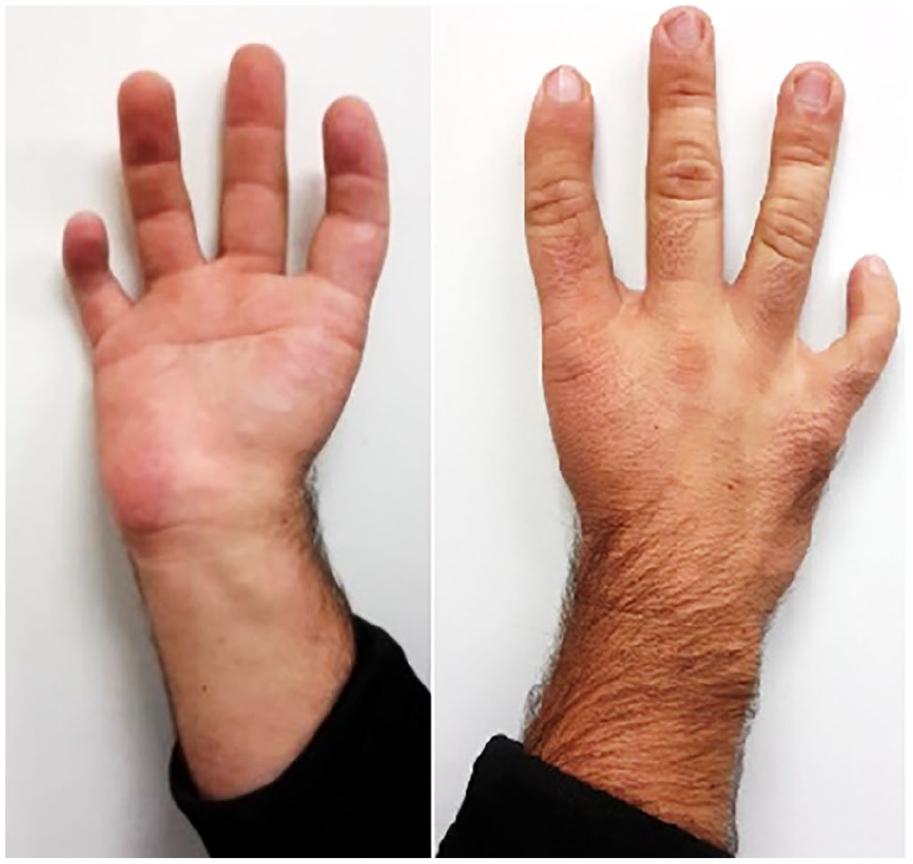
Palmar (left) and dorsal (right) views of the subject’s right hand.
Treatment
Design and manufacturing approach
A primary task in designing a prosthesis is to obtain a positive model, which can be further used in the fabrication process. Casting is the traditional method but uncomfortable for the subject, therefore we used contactless methods. 9 3D models of the healthy and impaired hand of the subject were generated using the Artec Eva scanner (Artec 3D, Luxembourg City, Luxembourg). One of the aims was to use free, open-source 3D modelling software into which we could import stereolithography (STL) data of the subject’s 3D scan and use it in prosthesis development. We chose Autodesk Meshmixer (Autodesk, Inc., San Rafael, CA, USA), as it has functions suited to prosthesis and orthosis design. The prosthesis was designed according to the subject’s requirements regarding its shape and functionality. It was intended to support the anatomical fingers when grasping objects. No extra movement of the thumb was necessary. The focus was on creating a sufficiently stable base and a properly positioned prosthetic thumb.
Interface
Designing an interface requires solving the issues of fastening the prosthesis onto the subject’s hand. As this was a special case of deformation of the lateral side of the palm, it was necessary to design a custom base that would exactly match the dimensions of the subject’s hand. Two bases were designed—a rigid one and a flexible one.
Fused filament fabrication (FFF) 3D printers were chosen for the manufacturing process, as they are the most affordable and they do not require much skill to operate. Default printer settings and nozzle size were applied during manufacturing of the prosthetic parts. The surface of the rigid and flexible bases, which were in contact with the skin, were smooth enough that there was no need to change the printer parameters or the nozzle diameter. Two types of materials were chosen for the printing of the prototypes.
Rigid base
The goal of the rigid base was to copy the surface of the hand and stabilize the metacarpal structures. The base was designed by modifying the scan of the right hand in Meshmixer 3D modelling software. The thickness of the base shell wall was 1.5 mm. The modified model was printed using the MakerBot Replicator+ (MakerBot Industries, Brooklyn, NY, USA) FFF printer with polylactic acid (PLA) material, which was sufficient for testing of the prototype on the subject. Printing was carried out with the following parameters: nozzle diameter of 0.4 mm; layer height of 0.2 mm; layer thickness of 0.4 mm; filling density of 10%; and printer head temperature of 215°C.
Flexible base
The goal underlying the design and manufacture of the flexible base was to both copy the hand surface and increase comfort of wearing the prosthesis. Designing the flexible base was similar to the process used for the rigid base; however, in this case, the palmar part of the hand and the place where the little finger contacted the ring finger were maintained. The modified model was printed using the Bq Witbox (BQ, Las Rozas de Madrid, Spain) FFF printer with Arnitel Eco (DSM, Heerlen, Limburg, The Netherlands) material. Printing was carried out with the following parameters: nozzle diameter of 0.4 mm; layer height of 0.2 mm; layer thickness of 0.4 mm; wall thickness of 0.8 mm; filling density of 60%; and printer head temperature of 230°C.
Thumb prosthesis
When designing fingers, it is necessary to make their shape look as natural as possible. 10 The missing segment of the right thumb was supplemented using the modified model of the left-hand thumb in the final version of the custom base. The metacarpal region was mirrored so that it corresponded to the position of the right-hand thumb. The obtained model was attached to the scan of the right hand and transformed to make it fit onto the subject’s hand. The focus was on creating a fillet between the palmar part of the hand and the thumb, a fillet between the thumb and the index finger, and on the alignment and optimal proportion of the given segment relative to the remaining part of the hand. Printing was carried out using the Arnitel Eco material and the Bq Witbox FFF printer, with print parameters identical to the ones used for the flexible base. During the prosthesis design no anthropometric measurements were required. 11
Outcomes
The material of the rigid base limited the range of motion of the fingers, while the shape of the flexible base covered an unnecessarily large area (Figure 2). Even after various modifications (opening on the ulnar side of the arm, redundant material elimination), it was functionally unacceptable. Testing of both flexible and rigid interfaces showed that the best alternative was combining the shape of the rigid base with the material of the flexible base. Arnitel Eco material was chosen for manufacturing of the thumb prosthesis because it is flexible, highly breathable, ultraviolet (UV), and heat resistant up to 200°C, polyvinyl chloride (PVC) free, and 100% recyclable. Flexibility can be altered by changing the density of the model. This enabled the construction of a thin, flexible base and a firm thumb for stable grasping. As for the fastening of the prosthesis, an elastic band was applied.
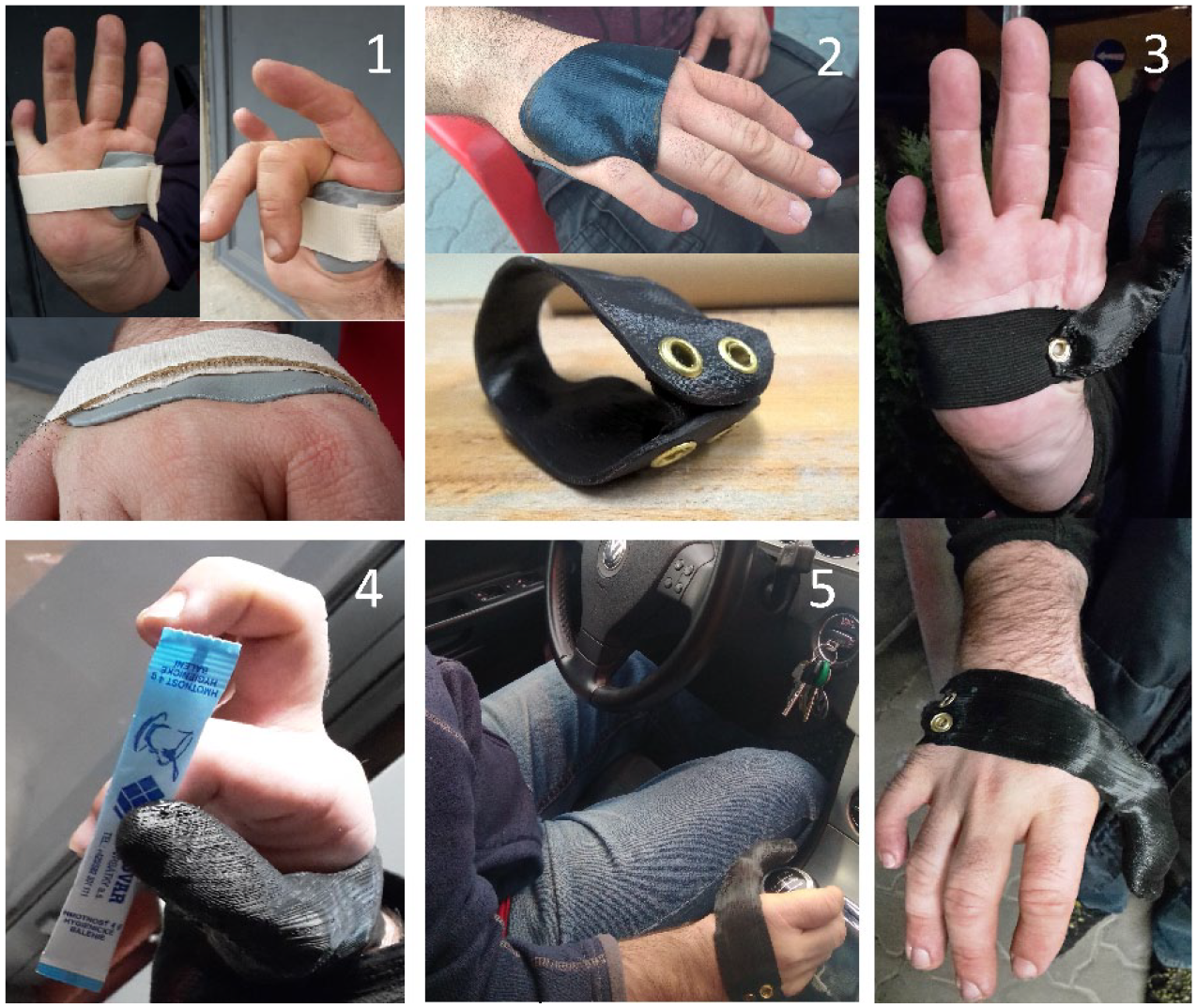
Rigid base (1), flexible base (2), thumb prosthesis (3) and object grasping with the prosthesis (4, 5).
Following application of the final version of the prosthetic thumb (Figure 2) onto the subject’s hand, it was acceptable in terms of its position as well as its dimensions. The subject was able to position the prosthesis on his hand easily without any help. The edges of the prosthesis were smooth and precisely aligned to the hand shape, and this is likely why the base was sufficiently comfortable. The shape, position, firmness, and fastening of the prosthesis were sufficient for the subject to be able to hold objects with his healthy fingers and the artificial thumb. With the use of this aid, the subject managed to perform a tip pinch, lateral pinch, and cylindrical grip (Figure 2). The subject did not mind the black color of the thumb and did not express any interest in a prosthesis matched to the color of his skin.
Discussion
With this type of individually-designed passive prosthesis, a compromise between hand grasp variations and stable, firm fitting must always be considered. The artificial thumb should be formed in mild flexion, placed opposite to the healthy fingers to allow various hand grasps. The base of the prosthesis must be flexible, but also firmly positioned on the hand so it cannot dislocate during object gripping and it must not cover the metacarpophalangeal joints in order to allow full movement of the healthy fingers. Future recommendations include developing new designs, especially focused on thumb shapes and different types of grasping area surfaces (e.g. antiskid surface and application of a conductive layer) for better handling functions, as well as assessing various 3D printers and materials for results comparison. It would be useful to survey other patients with partial hand amputation regarding their preferences for a discreet appearance or distinctive designs of prostheses.
Conclusion
The methodology of designing and manufacturing a prosthetic thumb using innovative technologies is adequate from a practical point of view. The use of 3D scanning and additive manufacturing in prosthetics has potential and should be considered in practice.
Footnotes
Author Contributions
B.S., M.M., L.B., M.T., J.Z. designed the study, J.Z. managed the research and acquired financial support, B.S. created the models, B.S., M.M., L.B., M.T. wrote the manuscript and M.M., L.B., M.T., J.Z. approved the final version.
Ethics Review and Approval
The research was approved by the ethics committee of Technical University of Košice.
Declaration of Conflicting Interests
The author(s) declared no potential conflicts of interest with respect to the research, authorship, and/or publication of this article.
Funding
The author(s) disclosed receipt of the following financial support for the research, authorship, and/or publication of this article: This work was conducted with support from the project KEGA 023TUKE-4/2020, KEGA041TUKE-4/2019, VEGA1/0316/18, and APVV-15-0356 (PEEK).
