




Abstract
Background:
Foot pain and paresthesia are common in cycling, due to plantar pressure and repetitive loading.
Objectives:
The aim was to investigate the effect of foot insoles on plantar pressure of the foot in motorcycling, as well as self-reported comfort.
Study design:
A randomized crossover clinical trial.
Methods:
A flexible foot pressure mat (GP MobilData WiFi® Gebiomized®) with different sizes was utilized.
Results:
Maximum pressure values occurred predominantly in the hallux with 4.90 ± 1.19 N/cm2, followed by second and third metatarsal areas with 4.57 ± 0.73 N/cm2, followed by the first metatarsal area with 4.30 ± 0.96 N/cm2, and followed by the fourth and fifth metatarsal areas with 3.22 ± 0.89 N/cm2 when using the control foot insole and using aluminum foot insole, which reduces maximum pressure to 1.55 ± 0.34, 1.56 ± 0.75, 1.09 ± 0.43, and 1.07 ± 0.59 N/cm2, respectively (p < 0.001), with an effect size of 3.828, 4.067, 4.315, and 2.847, respectively.
Conclusion:
The use of an aluminum foot insole significantly reduced maximum pressure during motorcycling.
Clinical relevance
In this study, an aluminum insole in a motorcycling boot was shown to decrease maximum pressure on the foot. Comfort was significantly higher than that from ethylene vinyl acetate or commercial boot inserts. This increased comfort and decreased pressure should result in increased safety and control for motorcyclists.
Background
Riding comfort is considered to constitute a top priority for motorcyclists. Fatigue is associated with the comfort level provided by the motorcycle and associated equipment. Fatigue can result either from the rider being too comfortable or too uncomfortable due to the physical aspects of riding, such as handle bar design, seat, footpegs, and vibration. 1 The Royal Society for the Prevention of Accidents 2 recommended that motorcycle riders can reduce fatigue by adopting a comfortable position on the motorcycle while riding and positioning their forefeet on the footrests.
In general, numerous musculoskeletal disorders begin with discomfort. Motorcyclists often complain about foot and ankle discomfort when riding3–5 and attribute the source of their discomfort to the vibration of the footpegs/footrests.6,7 The ankle and foot are also the most common sites for severe injuries in enduro motorcycle riders, with 16% of injuries occurring at phalanges and metatarsals. 8 The motorcyclist’s riding posture is also not static and changes during the riding process. Simple motorcycling activities, such as changing the gearshift, have been reported to cause severe pain, tingling, and numbness at the medial and plantar aspects of the first metatarsophalangeal joint and hallux due to a compressive neuropathy, called Joplin’s neuroma. 9
Neither round/oval-shaped footpegs nor elongated flat floorboards provide secure foot placement for motorcycle riders. In fact, these types of foot supports efficiently transmit mechanical vibrations and road surface shocks, displacing the feet from the supports and causing the rider to reposition his or her feet constantly and/or maintain muscular pressure to hold the feet in position. These adjustments increase discomfort substantially. 10 To overcome this problem, some footrests have been designed with shock absorbers 11 or pads. 12 It is also possible that other ergonomic interventions might provide comfort to the feet and reduce the plantar foot pressure that riders experience from acceleration, deceleration, and changing the gearshift.
While some extant literature has focused on the distribution of plantar pressure using insoles in cycling, 13 this issue has not yet been addressed in motorcycling. To the best of our knowledge, no research has been performed to elucidate the relationship between foot insoles and in-shoe pressure distribution in motorcycling. Our hypothesis is that the use of aluminum insoles during the sport of motorcycling will decrease plantar foot pressure and increase comfort while riding motorcycles. The aim of this study was to investigate the effect of foot insoles on pressure at the hallux and metatarsal plantar aspect of the foot in motorcycling, as well as perceived comfort.
Methods
Design and sample
Between January 2015 and February 2016, we performed a crossover randomized clinical trial and evaluated the effects of foot insoles fabricated with different hardness on plantar pressure on the metatarsal area and perception of foot comfort in motorcyclists. The commercial insert of boot condition was used as a control, and the use of insoles was random.
The sample was calculated with software from Unidad de Epidemiología Clínica y Bioestadística, Complexo Hospitalario Universitario de A Coruña, Universidade A Coruña (www.fisterra.com). We aimed to test for differences in maximum pressure similar to those observed on the feet of cyclists using insoles fabricated with ethylene vinyl acetate (EVA) material. The medial forefoot pressure using flat and contoured insoles was 148.4 ± 35.2 and 147.2 ± 29.8 kPa, respectively. 8 To achieve this with statistical confidence, a 80% statistical power analysis (β = 20%, α = 0.05, two-tailed test) was required.
Eight participants (16 feet; two feet per participant), all of whom were male, participated in the study. All participants were competitive road motorcyclists. The mean age of the participants was 25.50 ± 8.50 (18.39–32.61) years, mean height was 170 ± 6.50 (164.56–175.43) cm, mean weight was 63 ± 8.94 (55.52–70.48) kg, body mass index (BMI) was 21.69 ± 1.72 (20.25–23.13), and European foot size was 40.13 ± 2.03 (38.43–41.82). Participants were initially screened by a clinician and were required to be free of musculoskeletal or neurological disorders affecting the spine or lower extremities at the time of testing. Participants were also required to have been using their own motorcycling competition clothes and motorcycling boots. This study was approved by the ethics committee at the University Rey Juan Carlos of Madrid (consent no. #050520165316). Informed consent was obtained from all subjects prior to their participation.
Procedure
In the study, three models of insoles were used, and the insole of their own boot was used as a control. Three flat noncontoured insoles were made using three materials: one from EVA with a hardness of 52° Durometer Shore A, 3 mm thick; one made of polypropylene (Poly) insole 2 mm thick + 1 mm EVA lining 52° Shore A, with a total thickness of 3 mm; and one made of a 2 mm Poly insole with fenestration in the area of the metatarsal heads where an aluminum plate of 2 mm thickness + 1 mm of EVA lining of 52° Shore A was placed, with a total thickness of 3 mm (aluminum; Figure 1). Hardness was measured with a durometer (durometer model Vickers PCE-1000, PCE Ibérica S.L. Tobarra, Albacete, Spain), and insoles were made in different sizes to fit the boot of each participant by Podoactiva® (Podoactiva, Huesca, Spain). Each participant wore his or her own cycling-specific road motorcycling boots with its own commercial insole boot as a control. The order of testing of the two insert conditions was randomized.
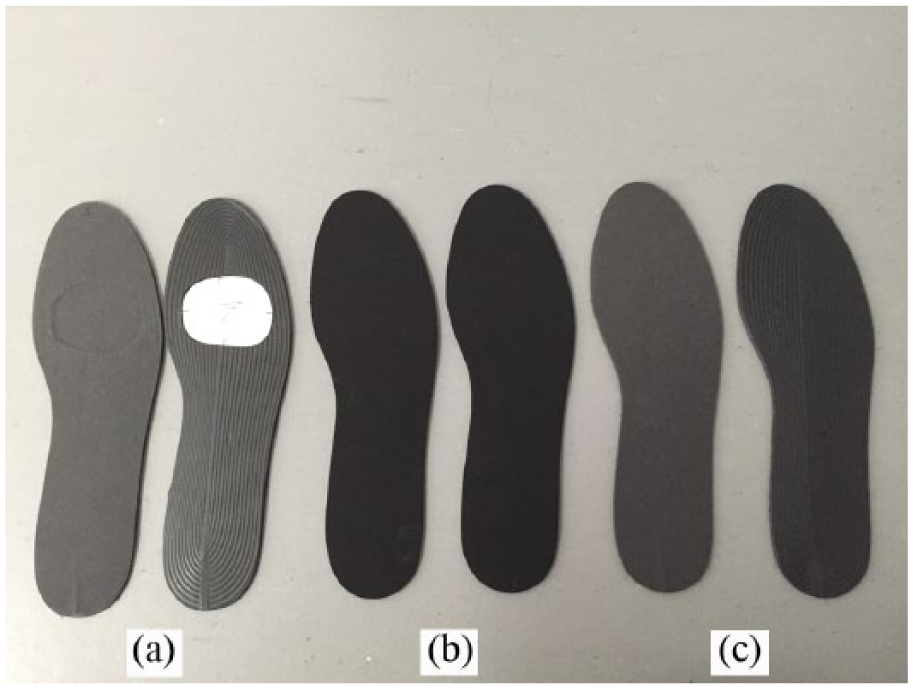
Dorsal and plantar view of insoles used in the study: (a) foot insoles of polypropylene (Poly) with an aluminum plate at the metatarsal area, (b) foot insoles made of polypropylene (Poly), and (c) foot insoles made of ethylene vinyl acetate (EVA).
A flexible foot pressure mat, the GP MobilData WiFi® Gebiomized®, was used, with different sizes to adjust to the size of each participant’s boot (Go-Tec, GebioMmbHMünster, Johann-Krane-Weg, Münster, Germany; http://www.go-tec.de/druckmessung/). It was equipped with 64 resistive-pressure sensors and inserted into the boots. The measured data are transmitted at 200 Hz to a laptop via a WiFi-transmitter to record maximum foot pressure within the boots for each insole condition. The validity of the capacitance sensor used has been previously demonstrated. 14 All pairs of sensor insoles used in the study were calibrated prior to the start of data collection. Insoles were placed in the shoe directly beneath the sock-covered foot.
The software used was the GP Manager SQL 6.5® (Go-Tec). The software divides the plantar surface into size plantar regions: heel zone, midfoot area, medial zone of the forefoot at the head of the first metatarsal area (Met 1), central zone of the forefoot at the head of the second and third metatarsal areas (Met 2 and 3), lateral zone of the forefoot at the head of the fourth and fifth metatarsal areas (Met 4 and 5), and hallux (H). In our study, the midfoot and heel regions were not included in any further analysis because pressures in the heel region either commonly do not exist or are too low due to the way in which motorcyclists support the foot in the stirrup of the motorcycle (Figure 2). We also used only the hallux and metatarsal plantar pressure of the metatarsal bones because the pilots do not support the midfoot and heel. As force is applied to the stirrup primarily by the forefoot region, these constituted the primary regions of interest, and maximum pressure (N/cm2) was taken for each zone, as well as type of insole insert used (Figure 3). Participants were asked to rate the comfort provided by each specific insole insert condition using a visual analogue scale (VAS), as previously described by Mündermann et al. 15 The VAS has been demonstrated to provide a reliable measure of assessing footwear comfort. 15 At the end of the study, each participant rated comfort on a Likert-type scale from 0 to 10, with 0 being “not comfortable” and 10 being “the most comfortable imaginable.”
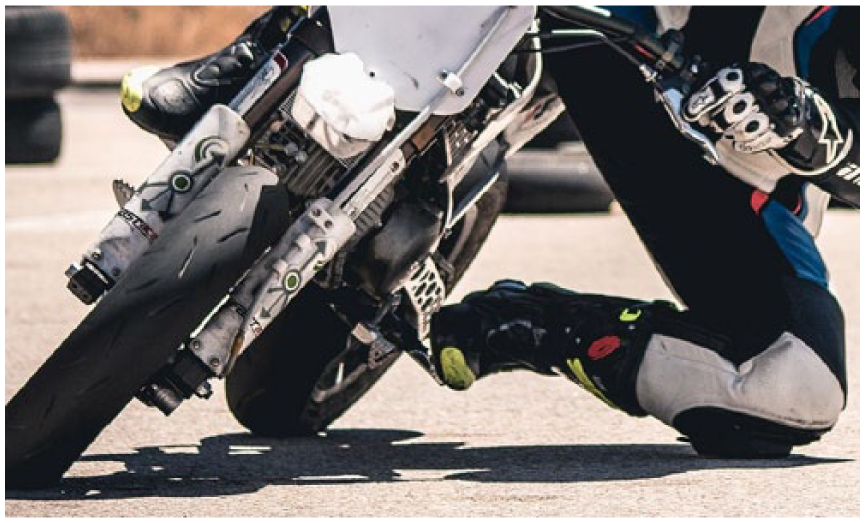
Details of how force is applied to the stirrup primarily by the forefoot region in a curve.
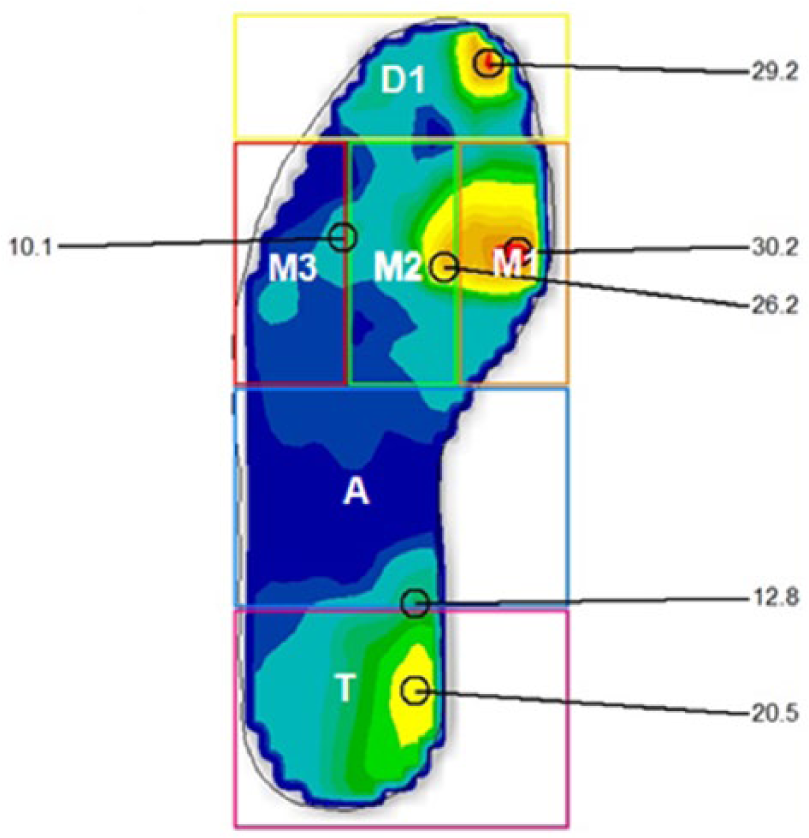
Maximum pressure profile of a single participant demonstrating that software divides the plantar surface into six plantar regions: heel zone (T), midfoot area (A), medial zone of the forefoot at the head of the first metatarsal bone (Met 1), central zone of the forefoot at the second and third metatarsal bones (Met 2 and 3), lateral zone of the forefoot at the fourth and fifth metatarsal bones (Met 4 and 5), and hallux (D). Unit N/cm2.
Motorcycling trials were conducted with the participants using a motorcycle training simulator for professional motorcycles. A plasma television screen was attached to the simulator, on which a video of a racing circuit in Austin, Texas, USA was projected to simulate real time racing. The simulator used was the CKU28® (Mecanitzats Muntada SL, Barcelona, Spain). Each participant was required to ride at a minimum velocity of 250 km/h (155.34 miles/h) on a straight line. They also needed to reduce speed to take curves and self-select a gear in which they could comfortably maintain the simulator for a total of 30 min of motorcycling. This gear setting in the simulator was maintained for the duration of testing.
For each test condition, the participant wore boots, and foot mat pressure was used. The first 25 min of the testing period allowed the participant to achieve the self-selected gear, and data were collected in the curves for each foot at the final 5 min of the 30-min period. Thus, three measurements for each foot condition were obtained, and average recordings were analyzed. Immediately after each test condition was completed, the participants were asked to rate their perceptions of comfort provided by that specific condition. All measurements were recorded by the same researcher.
Statistical analysis
All data were examined for normality using the Shapiro–Wilk test, and data were considered normally distributed if p > 0.05. Descriptive statistical analysis was performed using mean ± standard deviation (SD) and a 95% confidence interval. Significant differences in maximum pressures between zone and each type of foot insole were measured using two-factor repeated-measures analysis of variance (ANOVA) with Greenhouse Geisser correction. Post hoc comparisons were followed by Bonferroni adjustment of all probability values on the basis of the number of comparisons made in each period. One-factor repeated-measures ANOVA was utilized to compare differences between comfort and foot insole type. Post hoc comparisons were determined using Bonferroni’s post hoc analysis. For demonstrating the effect size of the comparisons, the Cohen d coefficient was calculated. The standard interpretation offered by Cohen and expanded by Sawilowsky 16 is as follows: 0.01 = very small, 0.20 = small, 0.50 = medium, 0.80 = large, 1.20 = very large, and 2.0 or higher = huge. A p value < 0.01 with a confidence interval of 99% was considered statistically significant for all tests (SPSS for Windows, version 20.0; SPSS Inc., Chicago, Illinois).
Results
All of the variables studied exhibited a normal distribution (p > 0.05). Maximum pressure at the forefoot and for all participants is shown in Table 1. The maximum pressure values occurred predominantly at the H area, followed by Met 2 and 3 areas, followed by Met 1, and followed by Met 4 and 5 areas for each insole condition.
Forefoot maximum pressure at each region for the different foot insole conditions used in each test, and the effect size of the comparisons.
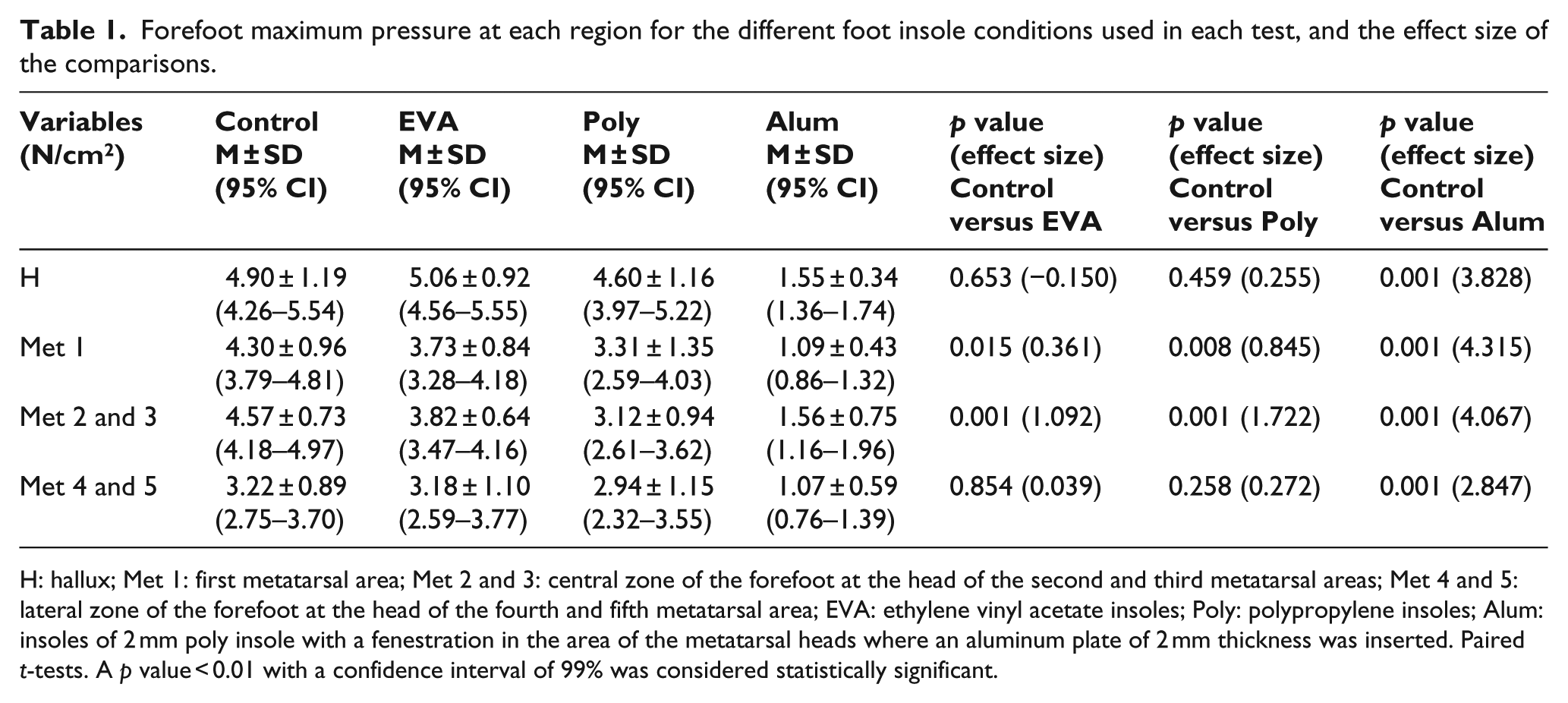
H: hallux; Met 1: first metatarsal area; Met 2 and 3: central zone of the forefoot at the head of the second and third metatarsal areas; Met 4 and 5: lateral zone of the forefoot at the head of the fourth and fifth metatarsal area; EVA: ethylene vinyl acetate insoles; Poly: polypropylene insoles; Alum: insoles of 2 mm poly insole with a fenestration in the area of the metatarsal heads where an aluminum plate of 2 mm thickness was inserted. Paired t-tests. A p value < 0.01 with a confidence interval of 99% was considered statistically significant.
For the maximum pressure data, a statistically significant interaction effect existed between maximum pressure and insole condition. As shown in Table 1, follow-up tests of simple effects of insole condition at each specific plantar region demonstrated that, as the insoles became harder, a decrease in maximum pressure at all forefoot areas occurred (p < 0.05).
The effect sizes for maximum pressures using different types of insoles are presented in Table 1. A reduction of maximum pressure constituted a huge effect size when the aluminum insert was worn compared with control at the Met 1 area (4.315), followed by Met 2 and 3 areas (4.067), followed by H area (3.828), and Met 4 and 5 areas (2.847). Lower effect sizes were obtained wearing EVA or polypropylene (Poly) insoles.
Follow-up tests of simple effects of insole condition for each perception of comfort demonstrated that there was a significant increase in perceived/reported comfort when the insoles were harder (p < 0.001; Table 2).
Mean and standard deviation (SD) of overall comfort perception measures at the foot for each foot insole condition.
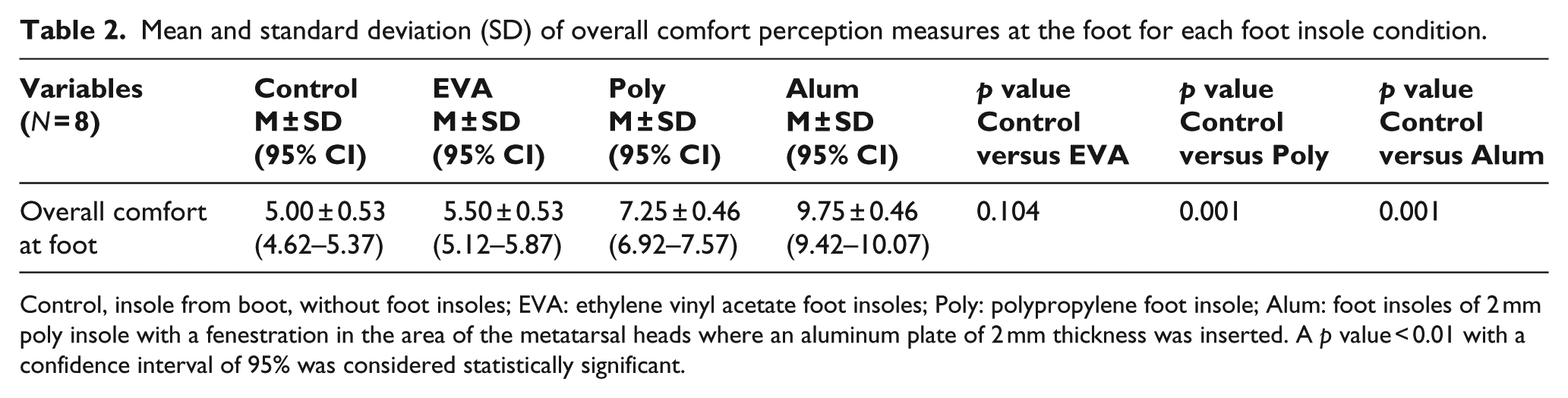
Control, insole from boot, without foot insoles; EVA: ethylene vinyl acetate foot insoles; Poly: polypropylene foot insole; Alum: foot insoles of 2 mm poly insole with a fenestration in the area of the metatarsal heads where an aluminum plate of 2 mm thickness was inserted. A p value < 0.01 with a confidence interval of 95% was considered statistically significant.
Discussion
The aim of this study was to investigate the effect of foot insoles on pressure at the hallux and metatarsal plantar aspect of feet in motorcycling, as well as perceived comfort. To the best of our knowledge, this is the first study to investigate maximum plantar foot pressure in motorcycling. When comparing foot insole inserts, an influence was found at maximum pressure of the foot during motorcycling. Regarding pressure distribution, surprisingly, the EVA did not reduce maximum pressure at the hallux, Met 4 or 5, but did reduce maximum pressure at Met 1–3, compared to the control (p > 0.01). Moreover, the Poly reduced maximum pressure significantly at the Met 1–3 regions, but not at the hallux, Met 4, or Met 5 (p < 0.001). However, with the aluminum insert, maximum pressure reduced significantly at all regions analyzed (p < 0.001). Importantly, the effect size for the reduction of plantar pressure between insoles was huge when wearing aluminum insoles compared with the control at all areas studied. Since this is the first extant description of maximum forefoot pressure distribution in motorcycles, it is not currently possible to compare this pattern of maximum pressure distribution with or without insoles.
It is unknown if this maximum pressure in the hallux and metatarsal areas is detrimental or beneficial in contributing to performance gains. Regarding the foot, however, it might be reasonable to speculate that the increased contact area through the midfoot, particularly at medial forefoot with the largest effect size, would override any potential increase in risk of injury due to pressure at these foot areas. Although we think that any insole that reduces maximum forefoot pressures should be beneficial during motorcycling competitions, additional research is required to confirm this assertion. Concerning perception of comfort, all of the participants reported significantly more comfort when using the aluminum insert (p < 0.001). We find this to constitute another interesting aspect from the rider’s perspective, since he or she needs to remain comfortable riding for long periods of time in racing circuits.
The main limitation of this study is that the testing period examined was relatively short compared with the length of time spent riding in a typical competition. The results of this study certainly imply that using harder or aluminum inserts would also reduce pressure and increase comfort for longer periods of riding. However, it would be worth examining longer periods of motorcycling time with increased training intensity in future studies. Another limitation of the study is that the number of curves was standardized across all participants and velocity was kept constant across all participants, but braking varied. Additional studies could include variations of curves, speeds, and control of braking to potentially extend the generalizability of the current findings. Finally, the insoles were not individually molded to each participant’s foot. It would be interesting for future work to determine whether molding would add to, or detract from, the effect of hard or aluminum insoles, or if interaction effects would be revealed.
Conclusion
The use of hard insoles, such as aluminum insoles, versus a flat insert from a commercial boot, significantly reduced maximum forefoot pressure during motorcycling beneath the hallux and along the first, second, third, fourth, and fifth metatarsal bone areas. Moreover, the perception of comfort reported by participants while motorcycling greatly increased when using the hardest insoles. The findings of this study offer valuable insight for motorcyclists in the areas of overall safety, increased control, injury reduction, and comfort. The increased comfort and decreased pressure identified in this study by wearing a hard insole should result in increased safety and control for motorcyclists. In addition, the decreased maximum forefoot pressure and increase in foot comfort may help to reduce any pressure-related issues that affect the joints, bones, or soft tissues of motorcyclists.
Footnotes
Author contribution
All authors contributed equally in the preparation of this manuscript.
Declaration of conflicting interests
The author(s) declared no potential conflicts of interest with respect to the research, authorship, and/or publication of this article.
Funding
The author(s) received no financial support for the research, authorship, and/or publication of this article.
